Better choice needed

Yad Vashem holds an almost sacred place in the Jewish world. The foremost repository of materials relating to the Holocaust, and Israel’s official memorial to the victims of Nazism, the centre is practically an obligatory destination for visiting diplomats and foreign dignitaries. It is a solemn place dedicated to the terrible past, but with an explicit vision for a future without hatred and genocide.

Yad Vashem is rightly focused on the Jewish particularity of the Shoah. We take for granted the logic of Yad Vashem being located in Jerusalem. The capital of Israel and, spiritually, of the Jewish people seems a logical place to remember this massive cataclysm in Jewish history. But it commemorates a history that took place thousands of kilometres away, in Europe. Its presence in the Jewish state is itself a statement about Jewish particularism. But this does not erase the universal lessons Yad Vashem advances.

Since its founding in 1953, it has been a model for the world in commemorating and educating about the worst chapters in human history. The events of the 20th century that necessitated the invention of the word “genocide” did not end with the Holocaust. Genocides have occurred since 1945 – and before. Educators and others who strive to preserve and transmit these histories and their lessons struggle over the balance between respecting the very specific characteristics of the Holocaust, for example, with the broader messages for all humanity. At a time when antisemitism is experiencing a resurgence, it is essential that the role of Jew-hatred be addressed and confronted, at least in part with the recent past as a warning for the dangers of complacency.

While the struggle between universality and particularism is challenging, all can probably agree that Yad Vashem stands as a monument to human rights and the dignity of all people – and as a lesson to those in societies where those values are compromised. At the same time, the existence and focus of Yad Vashem safeguards the particular and monumental horrors of the genocide against the Jews.

This is why there is rightful concern over the proposed appointment of former brigadier general Effi Eitam as head of Yad Vashem. His proponents – including Prime Minister Binyamin Netanyahu, who nominated him for the position – contend that Eitam’s career has been spent defending the Jewish state. And among the lessons many people take from the exhibits of Yad Vashem is the necessity of a Jewish state as a bulwark against a world that has yet to cure itself of antisemitism.

But Eitam’s military record is more than troubling, and this is the main reason for concerns about his appointment. During the First Intifada, he brutally instructed his troops to break the bones of a 21-year-old Palestinian prisoner, Ayyad Aqel. The soldiers beat the young man to death. Four of Eitam’s soldiers were court-martialed and the Military Advocate General reprimanded Eitam and recommended he never be promoted. (He was.) In addition to his military career, he served two terms in the Knesset representing various religious parties, and held several cabinet portfolios.

Beyond Eitam’s record of heinous action is a record of deeply concerning and racist ideas. He has referred to Arab Israelis as a “cancer” and promoted ethnic cleansing of West Bank Palestinians: “We’ll have to expel the overwhelming majority of West Bank Arabs from here and remove Israeli Arabs from political system,” he said in 2006.

Referring to human beings with terms like “cancer” is precisely the sort of dehumanization that can be a precondition to genocide. In any society – including one as open as Israel, where diverse views and expressions are the norm – these statements must preclude someone from a role like head of the world’s foremost research centre about, and memorial to, the Shoah. Eitam’s military service – he was part of the raid on Entebbe, among other things – can be seen as evidence that a strong Israel is the best defence for the Jewish people in a world capable of genocide. But Eitam’s statements cannot be justified from the mouth of one who seeks to advance the lessons, particular or universal, that Yad Vashem is expected to convey.

The nomination is threatening to create yet another schism in the government, as Netanyahu’s coalition partner Benny Gantz opposes Eitam’s appointment. Ideally, a more suitable leader will be found for this important role, one who stands as a defender of the sanctity of the Shoah and its lessons for humanity.

Life with inherited trauma

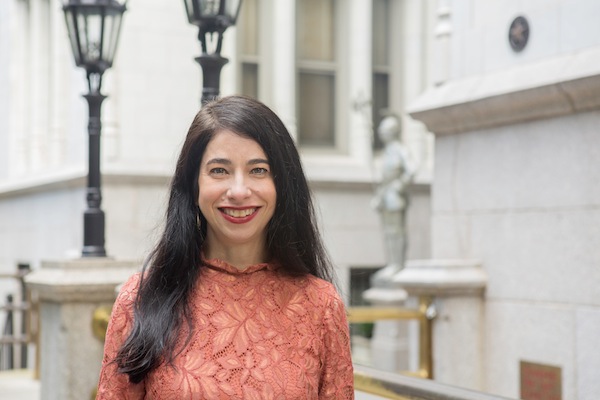
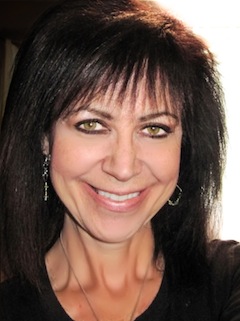
Dr. Gita Arian Baack, author of The Inheritors: Moving Forward from Generational Trauma. (photo from Gita Arian Baack)

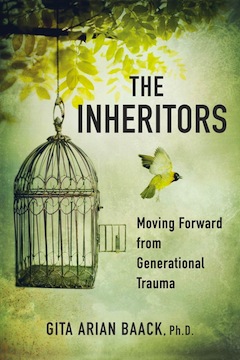
Dr. Gita Arian Baack, author of The Inheritors: Moving Forward from Generational Trauma, was in town earlier this month to speak at the Cherie Smith JCC Jewish Book Festival and hold a three-day experiential workshop with the Second Generation Group in Vancouver.

The Ottawa-based counselor began her festival presentation with a quote from the late Israeli novelist Amos Oz, who wrote, “Our past belongs to us, but we do not belong to it.” For Baack, the quote underscores her message to inheritors of the Shoah – that “we were given life and an obligation to bear witness and honour the martyrs and heroes of the Holocaust. And that we also have the right to live full and joyful lives.”

“Generational trauma stems from devastating events which transpired before we were born,” Baack told the Independent. “In the case of the Holocaust, we have experienced it from birth; it is as if we were there. We carry an unrelenting sadness, sense of absence and betrayal.”

The ultimate question her book explores is: “How can we live a full life despite the difficult trauma we inherited?”

Prior to writing The Inheritors, Baack conducted doctoral research into the subject of intergenerational trauma and resilience, yet what she uncovered did not fit or go deeply enough into either. Often, resilience is described as bouncing back with support from others. But, she said, “You don’t bounce back from the Holocaust!”

She was resolved to unravel answers to these and other questions, such as why are so many of us resilient and compassionate despite our inherited trauma? Do we carry memory from one generation to another? How do we move forward, when the usual therapies for trauma have proven not to work for us?

“We are also faced with the difficulty of piecing together our family stories,” said Baack. “Much of our family stories are full of holes, unknowns and even secrets, our roots destroyed. Understandably, we have strong emotions but don’t know how to deal with them; for example, excessive sadness, fear of authority, worry, lack of trust, lack of safety, etc.”

Further, inherited trauma is often frozen, embedded in the brain stem, also known as the primitive brain – accessing it is difficult, but it can be done, she said.

Baack noted that ancient wisdom, the Bible and new epigenetic scientific research explain that trauma is passed onto generations in the DNA, and even the cells, for as many as seven generations. She strongly believes that this is the case if it is acknowledged and processed; if it is not, then it can take longer than seven generations.

image - The Inheritors book coverThough Baack’s own experience is being a child of Holocaust survivors, The Inheritors encompasses others who have been victimized: Canada’s indigenous population, survivors of the Rwandan genocide and of several other horrible episodes of recent history. The book also looks at trauma on a personal level, from those who have suffered as a result of natural disaster, an accident, economic hardship, the justice or education system, illness or loss of a loved one.

The intent of The Inheritors is to serve as a tool for moving forward, said Baack. The book is filled with dialogues, poetry and stories from people of different backgrounds. Readers are invited to explore their story, and there are questions at the end of each chapter to help them process that story and, in so doing, transform their pain. At the least, in the end, they will have a written story as a legacy to their descendants.

The Inheritors has had other, unexpected, impacts. For example, the conductor of the North Carolina State University orchestra commissioned composer and flutist Allison Loggins-Hull to write a piece for an upcoming performance and she has chosen to write a work inspired by the book – Inheritors Overture will première on April 5 in Raleigh, N.C.

The group dialogues that Baack conducts offer a means of validation through other people with similar experiences and various experiential tools that can help further a deeper exploration of their trauma stories, the “undiscussables” and the unknowns. Group participants, she said, are often surprised by the creativity, laughter and camaraderie that arise.

The Inheritors is dedicated to (and inspired by) Baack’s two half-siblings. “From my earliest beginnings, I remember carrying a great sadness for my siblings, Henush and Halina Arian, who were only 4 and 3 years old, respectively, when they were killed,” she writes. There was no information about the circumstances of their death or burials, “But their existence was real and has mattered to me in an extraordinary way. And so I don’t fight the sadness; I embrace it. It has a special place. I am the carrier of their memory. This burden is the most cherished of all my burdens.”

At the age of 4 or 5, Baack had what she describes as a “knowing” or “inherited memory.” A “felt sense” told her, even at that young age, that her siblings, two of 1.5 million children killed by the Nazis, had both been shot in the back. When she asked her father how her half-siblings died, he said he didn’t know. Nonetheless, the memory (and feeling) she had inherited persisted, and could be placed on a spot in the middle of her back, with a knowing that her half siblings had been shot in that place.

Her research revealed that the timing of their deaths was before gas chambers had been built, and children under 5 were regularly shot. In 2019, a tour guide in Krakow pointed to the very street where the children and their mother were shot. To Baack, it was a stunning confirmation of her lifelong memory.

Baack has been consulting and coaching individuals and organizations for more than 30 years. She recently founded the Centre for Transformational Dialogue to help individuals and communities that have inherited devastating legacies. She also has written a book of verse, Poems of Angst and Awe, published in 2017.

For more information, visit gitabaack.com. Baack continues to research inherited memory and wishes to hear from others on the subject. She can be reached at gbaack@rogers.com.

Sam Margolis has written for the Globe and Mail, the National Post, UPI and MSNBC.

Many ideas at Limmud

At LimmudVan’20, Anna-Mae Wiesenthal will present on The “Othering” of Germany’s Jews and Canada’s First Nations. (photo from Anna-Mae Wiesenthal)

The latest local incarnation of the global Jewish learning festival Limmud takes place Feb. 29 and March 1. LimmudVan’20, which is being held at Congregation Beth Israel, begins with Havdalah and a few musical and intellectual appetizers on the Saturday night, followed by a day of presentations on a diverse array of topics on Sunday.

Anna-Mae Wiesenthal, a teacher at King David High School and a PhD candidate in Holocaust and genocide studies, will present on The “Othering” of Germany’s Jews and Canada’s First Nations.

Originating from Winnipeg, Wiesenthal has long had an interest in First Nations issues and has been involved in community programs there. She is aware of the sensitivities around paralleling these histories.

“There is a lot of controversy surrounding the use of the word genocide and First Nations, but I approach it from an examination of looking at different viewpoints and different research that argue both sides,” she told the Independent. “What do these two experiences of these two people have in common?” The point, she said, is not to come to any firm conclusions.

“I want to leave it open to the audience to process the information and to assess the commonalities and the differences,” Wiesenthal said. “I’m certainly there to point some of them out, but I think it’s to provide a different perspective that will engage and inspire discussion and curiosity among the participants to go further with it.”

Also not promising any proscribed conclusions is Rabbi Philip Gibbs, who will ask: Would the rabbis approve of Uber? Gibbs, who is spiritual leader of Congregation Har El, in West Vancouver, said that even issues as seemingly modern as an app that permits ride-sharing can be addressed through ancient wisdom.

Traditional arguments around fair and unfair competition have remained with him since rabbinical school and came to the fore in recent weeks as British Columbia argued over, and then slowly and somewhat clunkily implemented, ride-hailing services like Uber and Lyft. Some of the issues that could arise include whether a company keeps money in the community it serves or extracts it to some distant parent company. But don’t expect him to come down clearly on one side.

“If you’ve ever looked into a question of Jewish ethics, you know that you can make the joke of saying two Jews will have three opinions,” said Gibbs. “Maybe, through the discussion, someone else will tell me what it seems like I’m thinking, but really I think the goal is just to be more attuned to what some of the issues are so that, as we begin to make choices of who do we call up for a ride to the airport, that we’re taking into account a wider range of values than simply how little we want to pay for it.”

Other presenters will talk about crafting Jewish children’s books (see jewishindependent.ca/new-publisher-set-to-launch); how Leonard Bernstein used the music of Selichot to create West Side Story; the rich and poor among Portuguese Jews in Amsterdam’s Golden Age; building Jewish micro-communities through co-housing; healing Christian antisemitism; analyzing the Israeli smash TV show Shtisel; and many other topics.

Tickets and more information can be found at limmudvancouver.com.

A book about Operation Ezra

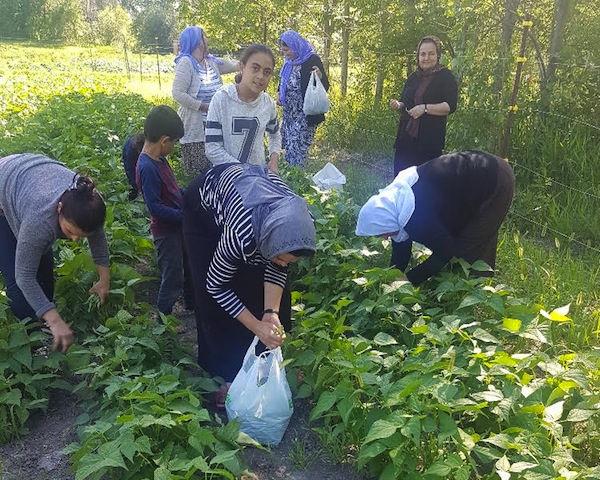
Operation Ezra in Winnipeg has expanded to include farming and selling local produce. (photo from Operation Ezra)

When the Operation Ezra committee in Winnipeg decided to produce a book about the efforts of Yazidi-Winnipegger Nafiya Naso and Operation Ezra, the local Yazidi community was very excited about the idea, about passing down their story in writing to future generations, as their tradition is largely oral.

Operation Ezra: Winnipeg’s Jewish Community-Led Interfaith Response to Survivors of the Yazidi Genocide was launched on Sept. 24 at the JCC Berney Theatre. The event included a few words from the author, Chana Thau, as well as from Operation Ezra (OE) leaders, and a panel discussion. The 71-page paperback includes photographs, interviews and various facts about the Yazidis and how OE came to be, among other things.

“When I first held the book in my hands,” said Naso, “it felt really special and I felt really proud of everything we had accomplished. Having it all in one text to give to people in the community and outside the community, to show what a small group of individuals was able to accomplish in the span of four-odd years, I’m very proud of it.”

Belle Jarniewski, director of the Jewish Heritage Centre of Western Canada (JHCWC), who has been involved in OE since its inception, said it was a grant from the Jewish Foundation of Manitoba that allowed the book to be published.

“By the time the book was written, there was so much more that we had done, but we thought it would be a nice way to let more people know about this wonderful multifaith initiative,” said Jarniewski.

Each of the families that OE brought to Winnipeg was given a book, including the most recent new-to-Canada family of 10, who had arrived just before the book launch.

Apart from OE’s ongoing efforts to bring more refugees to safety in Winnipeg, the endeavour has been helpful in settling the families already there. Both Nafiya and her sister, Jamileh, were invited to separate events in Europe over the summer to share the story of OE and some insight as to why it is so successful.

“We don’t really know if Operation Ezra can really be done anywhere else,” said Nafiya Naso. “Just because the community here is so welcoming and open, and it would be ideal if every city and every country in the world was like this … realistically, it’s not. Within the larger spectrum of the refugee crisis, a lot of people have very negative perceptions of refugees, without knowing the different types and layers of what refugees are, who they are, and things like that. So, even for us, education was a huge piece – letting people know who the Yazidis are and what’s happening.”

A group of individuals in Germany has been eager to incorporate some of the OE approaches. Naso said one of the main things that has made a huge difference is that OE is multifaith. She suggested that people wanting to undertake similar initiatives start by reaching out to faith-based communities and local businesses to find out who might want to become involved.

One of the more recent aspects of OE that has caught the attention of other communities around the world has been the farming project that started up two summers ago on a small plot of land.

“We had one of our volunteers whose father was a farmer with a lot of land, a potato farm, so some of the community went and helped out and got huge bags of potatoes after, and we had media coverage of it,” said Naso.

“The pastor from Charleswood United Church connected us to the owner of Shelmerdine Garden Centre,” she added. “He donated about five acres of land this summer and the community was harvesting it and they were able to sell some of the leftover produce and make money, and that money then came back into the community.

“This is not only a way for them to work and be involved in the community, but it’s also very therapeutic, especially for the women who have gone through the brunt of what ISIS committed and is continuing to commit.”

The land is located just outside of Winnipeg’s city limits. The families worked together and carpooled there to grow and harvest the produce and sell the excess at Shelmerdine, the Rady Jewish Community Centre and Charleswood United.

“Almost all of our families have vehicles, so everyone will go pick up a couple people, and that’s how we transport everyone,” said Naso. “A couple of times, too, we’ve used a bus, bringing the whole community out there – the kids and everyone – renting a bus or two to get everyone out there.”

“This has been just such a wonderful experience for them,” Jarniewski said, “because this is what most of them already knew, what most of them did in Iraq. Not only have they grown food for themselves, but they have been selling the produce. So, this has been a very positive project and we hope to expand it more next year. They will be able to feed the Yazidi community all winter with the kinds of vegetables you can put into cold storage, like beets and potatoes.

“Now, it’s an exponential growth. They really grew all kinds of things. I would see them here, at the Rady, when they were selling celery, beets, onions, zucchini, you name it … even mint and basil.”

Operation Ezra: Winnipeg’s Jewish Community-Led Interfaith Response to Survivors of the Yazidi Genocide explains the background of the Yazidis, a monotheistic religious minority in northern Iraq that was displaced and persecuted by the Islamic State group in 2014. It also goes into the efforts of the Jewish community to lobby the federal government to bring Yazidis to Canada and to resettle families in Winnipeg via private sponsorship. Sales of the book ($10 each) support the ongoing Operation Ezra efforts – it can be ordered from Jewish Child and Family Service Winnipeg by calling 204-477-7430.

Rebeca Kuropatwa is a Winnipeg freelance writer.

A word chosen with care

Words matter. In a period when traditional media compete with social media, where everyone on the planet can pretty much find a place to say whatever they want, the weight of words can seem lost in the deluge of opinions, aspersions and insults. So, it is encouraging, in some ways, to see a pitched battle over the use of a single word. It assures us that many people still understand the power that language can have.

After the Truth and Reconciliation Commission’s 2015 final report, the federal government set up the National Inquiry into Murdered and Missing Indigenous Women and Girls. The MMIWG report, released last week, concluded that there are “serious reasons to believe that Canada’s past and current policies, omissions and actions towards first Nations peoples, Inuit and Métis amount to genocide….”

The use of the term genocide has sparked a debate. Top federal officials at first avoided using the word. At the ceremony marking the release of the report, Prime Minister Justin Trudeau was interrupted by an audience member who yelled, “Genocide! Say it!” Trudeau opted against it on that day, but he would use the term later in the week. Justice Minister David Lametti deflected discussion, saying he would leave the determination around the use of the term genocide “to academics and experts.”

The 1948 Genocide Convention defines it as “intent to destroy, in whole or in part, a national, ethnical, racial or religious group.” Raphael Lemkin, the Polish Jew who coined the term, described genocide as an effort to destroy the foundations of a national group with the objective of annihilation. While genocide certainly includes state-led mass murder, the term can also incorporate a range of less aggressively lethal acts, such as Canada’s residential schools system, the core goal of which was to eradicate indigenous cultures and languages among native peoples in the country.

The report identifies “colonial structures,” including the Indian Act, the Sixties Scoop, residential schools and offences against human rights, as antecedents to current rates of traumatic violence, suicide and deaths among indigenous populations.

The MMIWG report makes a series of recommendations, including, for example, that police services investigate officers for discrimination and mistreatment against indigenous peoples and failures to investigate crimes, government funding to improve recruitment of indigenous peoples into policing, a national task force to review and potentially reinvestigate every unresolved case and a standardizing of protocols around treatment of the thousands of missing and murdered women.

The chief commissioner, Marion Buller, chose the term genocide determinedly and used it throughout the report.

“This report is about deliberate race, identity and gender-based genocide,” she wrote in the opening paragraph of the final report.

However, the report also acknowledged that there are “outstanding disagreements” over the definition of the term. Alongside the final report came a 43-page legal analysis of the term genocide and how it applies to the Canadian situation.

The lead author of the legal assessment, Fanny Lafontaine, a specialist on international criminal justice and human rights at Université Laval, said, “I think it has to be understood as a very distinct type of genocide from the Holocaust…. Genocide is composed of lethal and nonlethal acts. All of that together leads to the physical destruction of indigenous people, but also as a social unit. It’s the genocide taken as numerous acts spanning decades, basically, that is the root cause of the violence against [indigenous] women,” she told the National Post.

RCMP statistics indicate that 16% of female homicides in Canada between 1980 and 2012 were perpetrated against indigenous women, who make up just 4% of the population. This is triple the rate of nonindigenous women and double those of indigenous men. Testimony from individuals and families that were incorporated into the final report tell a harrowing story of violence and dehumanization.

Some might say that the debate over the term genocide detracts from the urgent, less theoretical components of the report and its recommendations. Maybe. But the considered choice by those who best understand the social impacts of systemic discrimination against indigenous Canadians, especially indigenous women, to use the term genocide should give us pause. Among Jewish observers, there may be an understandable sensitivity to anything that seems to shift the weight of the word, which was created specifically to articulate the Jewish experience in the Shoah. Yet, we should also take this opportunity to learn and understand why and how a community in our midst would articulate their own experiences as amounting to genocide.

Knee-jerk responses are not helpful on this front (or any, probably) and, while the arguments over the meaning and intent of the term reassure us that people still appreciate the power of words, we might also caution not to get stalled over this debate. What non-indigenous Canadians should do at this point – especially if we have an issue with the use of the term genocide – is to dive deeply into the tragic legacies of colonialism that have led to this moment and try to understand why this term was carefully chosen. Perhaps, we can each start with a commitment to read the report.

Interacting with genocide

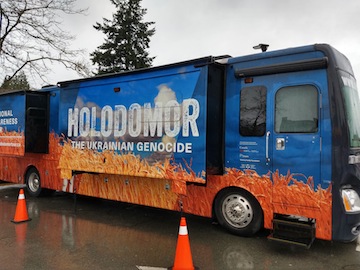
A project of the Canada-Ukraine Foundation, the national educational tour about the Holodomor began in 2015 and has reached about 30,000 Canadian high school students so far. (photo by Pat Johnson)

What constitutes a genocide? How many Ukrainians were murdered by Josef Stalin’s human-created famine in the 1930s? Would you stand up in a situation where lives were at risk – even if it meant you might become targeted?

These were some of the questions confronted by Grade 12 students of King David High School last week. A national educational tour about the Holodomor – the mass murder of Ukrainians by the Soviet regime – pulled into Vancouver, opening the eyes of young people to this chapter of history.

Beginning in 1932, the Soviet government under Stalin began a calculated, systematic famine in Ukraine, seizing all food sources, cutting off escapes for people fleeing starvation and implementing summary execution for the crime of stealing the smallest piece of sustenance. Farming was collectivized, creating catastrophic conditions. Political and intellectual elites were murdered.

Some details, including the number of Ukrainians killed, remain cloaked in uncertainty because, from the start, the Holodomor was deliberately hidden from the outside world through a comprehensive system of censorship and misinformation, as well as the complicity of media and other countries. Estimates of the number of dead range from seven million to 14 million.

Holodomor is a portmanteau made up of holod, starvation, and mor, death, meaning “death by starvation.”

photo - Last week, King David High School Grade 12 students and others participated in the educational tour
Last week, King David High School Grade 12 students and others participated in the educational tour. (photo by Pat Johnson)

The Holodomor National Awareness Tour consists of a bus-sized repurposed former recreational vehicle. Rather than a static exhibition through which participants walk, the vehicle has been retrofitted with a 30-foot screen down one interior wall and 30 theatre-style seats down the other, with interactive tablets that invite students to study and discuss in small groups before reconvening to share what they’ve learned with the larger group. A project of the Canada-Ukraine Foundation, the tour began in 2015 and has reached about 30,000 Canadian high school students so far.

The Holodomor was not an endeavour to kill an enemy, but an effort to restructure society, a form of social engineering at its most extreme. In September 1932, Stalin wrote to one of his lieutenants that Ukraine was restive. The Soviets perceived Ukrainians as being profoundly religious, individualistic, believers in private property and attached to their plots of land, making them unsuitable for building communism. Addressing these perceived flaws would require, according to Soviet leaders, an action so extreme that a word had not yet been invented to describe the intent.

The entire agricultural sector was upended by collectivization and resisters were murdered or sent to gulags, Soviet concentration camps. At first, remaining supplies of food sustained the Ukrainian people, but those reserves were soon depleted, while the Soviets extracted ever-increasing quotas of grain and Soviet wheat exports to the West grew. As the Holodomor proceeded, NKVD secret police were sent to search for and confiscate any remaining food sources. While those caught stealing or concealing food were executed, for millions more, fate was less sudden.

“Most of the victims died slowly, at home,” according to the narrator of one of the interactive films viewed by students. “Special NKVD units raided people’s homes to collect the dead bodies. They received 200 grams of bread for every dead body they delivered.”

Students examined the forces that allowed the Soviet Union to hide the reality from the world. For the Soviets’ part, there was censorship and the threat of retaliation for those who shared the truth. But their crimes were abetted by Western figures, including New York Times correspondent Walter Durante, who won a Pulitzer Prize for his reporting from the USSR, even as he misrepresented the Holodomor. In one article, titled “Hungry, not starving,” Durante wrote that there is no actual starvation or death from starvation, though he acknowledged there was widespread mortality from diseases due to malnutrition.

Leading journalism figures from the time are brought to life through reenactments. British journalist Malcolm Muggeridge, reporting for the Manchester Guardian, reflected on being raised in a socialist household and how he was enthusiastic about traveling to the Soviet Union to report on the utopia being created there. When he saw the reality, he evaded Soviet censors by sending his dispatches home via the British embassy’s consular pouch.

One of the heroic figures of the story is Gareth Jones, a Welsh journalist who risked his life to bring the truth from Ukraine. He convened a press conference in Berlin, on March 29, 1933. But the timing was terrible. The Soviets were about to launch a show trial against six U.K. citizens, accusing them of espionage in what would become known as the Metro-Vickers Affair.

In order to remain in the USSR and report on what promised to be a trial of global importance, journalists had to stay on good terms with the authorities.

“It would have been professional suicide to make an issue of the famine then,” one reenactor remarked. “So, none of us supported Jones.”

Lauren Shore is a student in King David’s Holocaust and Genocide Studies 12 course. The class, created by teacher Anna-Mae Wiesenthal, is delivered during lunch hour and, while students receive credit, they take the course in addition to their full complement of other classes. A province-wide genocide studies elective course is part of the new B.C. curriculum and will be offered next year at schools that opt-in.

Shore, with a partner, did a project on the Holodomor.

“Since there is a lot of debate on whether it’s a genocide or not, and how it was planned, we decided to focus on that,” she said. “We were focusing on the different steps of genocide [and] people were debating whether it was a genocide or not, since it wasn’t necessarily planned as exactly as other genocides were. As we looked into it, we found that it was planned just as much as the other genocides, just in other, more subtle ways.”

Solly Khalifa, also in Grade 12, was impressed with the interactivity of the Holodomor tour.

“I was astonished at how innovative it is,” he said. “They really get everybody participating and it’s very interesting and an easy way to participate also.”

Classmate Noah McNamara saw parallels between the Holodomor and the Holocaust.

“All genocides are kind of similar, in that it’s a governing body that takes advantage of their power to push a goal,” he said. “In the Holocaust, [it was] the Aryan race that they wanted to push. In this case, it was communism that they wanted to push. I think it’s important for us now to be aware of aggressive governments and governments that are trying to radically push things, because that’s definitely a precursor to genocide.”

Ava Katz, who worked with Shore on their Holodomor project this year, noted that studies of the Holocaust enforce the dictum “never again.”

“But I feel like sometimes that’s overlooked with other genocides,” she said. “Not a lot of people will say that. But when you really study other genocides in-depth and see how severe they are, it’s important that we never let any of them happen again.”

The cross-country tour operates with a shoestring staff. Alexi Marchel leads students though the experience. Kevin Viaene drives the bus and supports the program.

Memory still debated

Dr. Laura Beth Cohen (photo from Dr. Laura Beth Cohen)

Although the Srebrenica genocide – the killing of more than 8,000 Bosnian Muslims by Bosnian Serb forces in July 1995 – occurred more than 20 years ago, it still affects the people of Bosnia and Herzegovina every day, according to Dr. Laura Beth Cohen, director, Kupferberg Holocaust Centre, Queensborough Community College, City University of New York.

Cohen was in Winnipeg on March 8 to speak as part of the Mauro Centre for Peace and Justice: Brown Bag Lecture series. She spoke on the topic Conflicted Walls: Untangling Transitional Justice and Traumatic Memories at Bosnia’s Memorial.

“There was an opportunity to participate in the first fellowship called Summer University Srebrenica and so I decided to go,” Cohen told the Independent. “I learned very quickly – that was in the summer of 2010 – that, to really understand Bosnia, it was not enough to take a course and learn about it from books. It’s very important to understand what’s actually happening there, and the best way to do that is to actually go there. It’s a place with intense beauty, legacy and a wonderful history of different ethnic groups coming together, living in harmony.”

But, the legacy of the last war, which lasted from 1992 to 1995, is still very much present. In fact, she said, the current government is debating about it.

“Here, in America, we talk about the Second World War as if it’s confined to the past,” said Cohen. “But, in many places in Europe, the Second World War, that memory, is very much alive. And, once you’re in an environment like that, it really starts to help you, not only sort out what has taken place, but you can see … because you’re not part of that country, or you don’t belong to that population … you can start to see different ways that those memories of the past are interacting in contemporary life, and are incredibly problematic.”

When Cohen was in Srebrenica, she was taken by how much the memory of the genocide affects the surviving population, how much it is fought over. The country and government are split into two ethnic entities that are a result of the Dayton Accord, which was signed after the massacre in Srebrenica. One side was deemed the perpetrator; the other, the victim.

“It is not a big surprise there are very different perspectives between the sides over what happened in Srebrenica,” said Cohen. “The RS [Republika Srpska] government in the last month has created a new commission on Srebrenica to, once again, reexamine the facts and evidence to determine whether or not genocide took place … even though genocide took place and was proven multiple times, and especially in the international criminal tribunal. So, this debate over what happened and denial over what happened is still occurring within Bosnian society, as well as, particularly, in Srebrenica.”

This, of course, makes it very difficult for the residents of Srebrenica and the region to move forward, she said.

“It’s a place that would really benefit from having a lot of people just step away … and allowing the population to just live, move forward, and gain attention for things that they really need support with – economic relevance, additional support for education, and rebuilding parts of the community,” said Cohen. “But, with the memory so volatile and kept alive, it really overshadows what’s taking place there. You can imagine trying to raise your family, regardless of your ethnicity, in a place where the past is constantly looming, and it’s a grotesque past. How do you bring your children up in that world?”

According to Cohen, the constant and continued fight over the politics and memory of what happened at Srebrenica does not allow people to learn about what happened or why, and that this is preventing coping mechanisms from being put into place; mechanisms that could help stop other massacres from happening.

“We only focus internationally once a year – on July 11, during the annual commemoration of the Srebrenica genocide that takes place at the memorial – so we often don’t understand what’s taking place there the other 364 days of the year,” said Cohen.

“People visit the 9/11 memorial in downtown Manhattan. They visit Auschwitz-Birkenau in Poland. They visit Kigali Genocide Memorial [in Rwanda]. These memorials serve as an educational component. For local residents and national citizens of these countries, they also serve as places of memory making,” she said.

In Srebrenica, Cohen hopes to eventually see ways of involving the local community in dialogue initiatives that facilitate the creation of memorials, ones that speak to the locals, helping them repair their communities.

“While we, as Jews, have a view of what Auschwitz-Birkenau is, to the people of Poland, it’s a German extermination camp on Polish soil,” said Cohen. “And, to the local people in Oswiecem, which is the Polish name of the town that the camp was built by, they struggle with having that kind of site in their community.”

When it comes to Srebrenica, she said, “We get stuck in the conversation of the politics over the genocide and what happened. What then happens is, a lot of these issues play out at the memorial. Part of this conversation is theoretical, but part of it is to help us understand that these are not static locations. They are very much interactive places, where memories are not only being promoted, but shaped by the larger discourse where they are situated.”

Cohen said the part of Bosnia, Herzegovina and Srebrenica that has always drawn her is “not only the friends I’ve made, but a vibrancy of life in Bosnia that gets lost in the discussion. The culture is beautiful, the people are beautiful, the relationships that people have with each other are beautiful. And, despite all of the horror of the last war, and despite all the history, and the Second World War and before that, it’s a place where there’s a lot of love and a lot of hope. That’s something that keeps, especially, international activist scholars engaged in what’s taking place there … and that, we can’t lose sight of when we talk about all the politics and things that aren’t going well.”

Rebeca Kuropatwa is a Winnipeg freelance writer.

Emerging from terrible abyss

Robbie Waisman and Dr. Uma Kumar spoke Jan. 24 at UBC’s Hillel House. (photo from Hillel BC)

History’s resonance in the present was a recurring theme at a commemoration of International Holocaust Remembrance Day last week.

The event at Hillel House on the University of British Columbia campus, featured Holocaust survivor Robbie Waisman speaking about his experiences in Buchenwald concentration camp and his life before and after the Shoah.

Thirteen survivors of the Holocaust lit yahrzeit candles, after which Hillel’s Rabbi Philip Bregman chanted the Mourners’ Kaddish.

Before Waisman’s presentation, the audience watched a 1985 video from CBC television’s national program The Journal, which followed Waisman as he traveled to Philadelphia to meet Leon Bass, the American soldier who had liberated him from the camp 40 years earlier.

Bass, an African-American, was the first black person Waisman had ever seen. At the age of 13, Waisman thought Bass and his fellow American soldiers must be angels.

“Indeed, they were,” he said.

At the event Jan. 24, which was co-sponsored by the Vancouver Holocaust Education Centre, Hillel BC, the Centre for Israel and Jewish Affairs and UBC’s department of Central, Eastern and Northern European Studies (CENES), Waisman said the thing that kept him and his fellow survivors alive was the hope of being reunited with family.

“The enormity of the Holocaust was not yet known to us,” said Waisman. When it did become known, he said, “we had to find a way to deal and cope with the huge loss of all our loved ones.… How are we going to live with all these horrors?… Has anyone survived? If not, what is the point of my own survival?”

He and his father had seen one of Waisman’s brothers murdered, and his father died later in the same camp. He would learn that his mother and his other three brothers were also murdered, as were his uncles, aunts, cousins and friends. Of the family, only Waisman and his sister survived.

“I search for answers,” he said. “I only find more questions. How could anyone remain sane and functioning as a human being when humanity was destroyed in front of our eyes? Worst of all, how do you come to terms with the tragic loss of all our loved ones, fathers, mothers, brothers, sisters, friends that we grew up with, all innocent – everything gone – how is it possible? We started questioning the existence of God. How could this happen to us?… Before the war, we all came from Orthodox homes, rich in heritage and traditions. After coming out of the terrible abyss, the darkness, we questioned angrily. But what we learned in the home, from our parents, was not lost. The sense of humanity slowly returned to us. Our faith was shaken yet, in spite of it all, we remained true to it.”

Waisman said his experience in the Holocaust, and the experience of other survivors, has taught that “evil must be recognized and that we all have a responsibility to make sure that it never happens again to anyone. And yet … what is the world doing about it now?”

He reflected on the concept of “Never again.”

“Noble, thought-provoking words, but only if we act upon them,” he said. “Today, over 70 years after my liberation, the promise of never again has become again and again. There have been a number of situations that have tested the world’s resolve, in Cambodia, the former Yugoslavia, in Darfur and in Syria – I could go on and on.

“When I speak at high schools, I try to convey to students the pain of my experience in order to inspire them to prevent such events from occurring again,” he said. “The world must learn from the past in order to make this a better place for now and the future. We must teach compassion, we must eradicate racism and religious persecution. We must teach ourselves, teach our children, each generation must learn.”

photo - IHRD at Hillel, right to left, Michael Lee, Rabbi Philip Bregman, Robbie Waisman, Sam Heller (Hillel BC), Joyce Murray
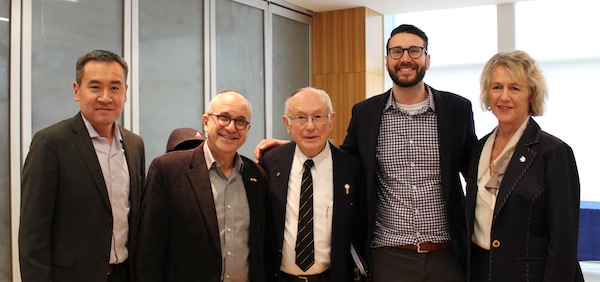
IHRD at Hillel, right to left, Michael Lee, Rabbi Philip Bregman, Robbie Waisman, Sam Heller (Hillel BC), Joyce Murray. (photo from Hillel BC)

Also at the Jan. 24 event, Dr. Uma Kumar, a lecturer with CENES, noted recent reports that indicate many Canadians and others are ignorant of the most basic facts of the Holocaust.

“Nearly half of Canadians cannot name a single concentration camp or ghetto that existed in Europe during the Shoah,” she said. “However, there is a positive point: 85% of the respondents of the study said that it was important to keep teaching about the Holocaust so that it does not happen again. Hence, there is a pressing need for more and better Holocaust education at schools and universities in Canada. We, as Holocaust educators, still have a lot of work to do.”

Joyce Murray, member of Parliament for Vancouver Quadra, brought greetings on behalf of the federal government and also reflected on her visit last year to Auschwitz.

“The Holocaust reality, for me, shifted from being a part of history that I thought I understood and regretted to a reality that I feel in my body and in my heart,” she said. “Commemorating mass atrocity and genocide in the continued sharing of the story of survivors is a vital part of prevention. These stories serve as a reminder of the dangers of hate, prejudice and discrimination, the dangers of seeing human beings as ‘us’ and ‘them,’ the dangers of excessive nationalism to the detriment of others that is stalking so many nations today.”

Murray also mentioned the Canadian government’s recent apology for refusing admission to passengers on the MS St. Louis in 1939 and reminded the audience that Canada is not immune to bigotry.

Michael Lee, member of the B.C. legislature for Vancouver-Langara, was also present.

International Holocaust Remembrance Day was officially marked worldwide on Jan. 27, the date when Allied forces liberated the Auschwitz-Birkenau concentration camps in 1945. Another ceremony and a film screening took place Sunday at the Peretz Centre.

For more about Waisman’s Holocaust experience, see the Independent story Feb. 28, 2014, at jewishindependent.ca/holocaust-survivor-robbie-waisman-receives-national-honor.

Much work left to do

One of the displays in the exhibit Canada Responds to the Holocaust, 1944-1945, which was at the Vancouver Holocaust Education Centre in 2016. (photo by Cynthia Ramsay)

Nearly half of Canadians are not able to name a single Holocaust concentration camp. A large number of Canadians do not know that six million Jews died in the Shoah, offering up numbers like two million, with nearly one in four admitting outright that they just don’t know. Among millennials, those aged 18 to 34, the numbers are particularly disturbing: 22% have not heard of the Holocaust or are not sure whether they have (which seems like much the same thing). One in three Canadians thinks that this country had an open immigration policy for Jewish refugees in the 1930s, unaware that very few Jews were permitted into Canada in the lead up to genocide.

These are some of the details found in a survey conducted on behalf of the Azrieli Foundation and the Claims Conference. The study was based on 1,100 interviews of Canadians to coincide with International Holocaust Remembrance Day Sunday. (See story, “Emerging from terrible abyss. ”)

On the positive side, 85% of respondents said it’s important to keep teaching about the Holocaust in order to prevent such a thing from happening again, while 82% said that all students should learn about this part of history.

In reality, it is unlikely that all Canadian students will learn about the Holocaust. In British Columbia, for example, the Holocaust only became part of the core curriculum with the overhaul of the entire provincial curriculum three years ago – and only if the teacher chooses to include it. The history of genocide is one module that teachers are able to select from a range of subject components at particular grade levels. Therefore, it is still a crapshoot whether a student graduating from the British Columbia education system will have much or any knowledge on the subject.

It is extraordinarily unlikely that the curriculum will be revised again any time soon to make Holocaust education mandatory across the system. Educators complain, with good reason, that they are expected to teach more content than there are hours in a day. Competing needs, including career preparation and life skills, contend with subjects like history for class time.

In Canada, where the educational curriculum is determined by every province, similar discussions take place across the country and a patchwork of curricula exist.

At the same time, a massive shift in the larger culture has taken place, eliminating what had been, until the last few decades, a largely shared body of knowledge. In the days when there were only a couple of television networks, and hard copy newspapers were most people’s sources of information, everyone would generally be aware of similar issues and events. Half of all televisions in the United States in 1978, for example, were tuned in to the nine-and-a-half-hour miniseries Holocaust (a program that was admittedly not without its critics among Jews, historians and others).

The internet and the proliferation of cable TV channels has refracted our attention in unlimited directions. People now largely self-select the information they receive and that can blind us to matters outside of our spheres.

In a better world, knowledge of the Holocaust would be universal. In the world we live in, it remains vital to continue to focus attention on the subject whenever possible – and to use this history to educate about other genocides and violations of humanity while not diminishing the uniqueness of the Shoah itself.

Organizations devoted to the critical work of Holocaust education, including the Vancouver Holocaust Education Centre, are carrying a heavy burden for the larger society and depend on public support to meet their mandate. The Azrieli Foundation, which undertook this study, publishes survivor memoirs and funds a variety of Holocaust-related projects across Canada. Other groups, to varying degrees, share the burden of teaching this history, including universities, synagogues, Hillels, book publishers and authors, and so forth.

Unquestionably, the most powerful form of Holocaust education is firsthand testimony from survivors and witnesses. British Columbians who are survivors of the Holocaust have spoken to tens of thousands of students but, in a handful of years, this method of transmitting history will no longer be possible. Innovative strategies are being developed, such as the New Dimensions in Testimony oral history project, a collaboration involving Steven Spielberg’s USC Shoah Foundation, which includes holographic representations of survivors with whom students and others can interact virtually. This project recognizes that the issue is not only to continue educating, but to find ever-advancing means of doing so effectively.

The breadth of the challenge was underscored by Prof. Jan Grabowski, who delivered the Rudolf Vrba Memorial Lecture at the University of British Columbia last November. He and a team of scholars and researchers are visiting town and city archives across Poland, doing primary research on the events that led to the murder of three million Jews in that country. In other words, we’re still compiling the most basic facts of that history and, it may be safe to say, we are just as far away as ever as to understanding the larger moral questions – How? Why? – the Holocaust raises. Much work remains to be done.

A first of its kind in Canada

The University of Manitoba is now accepting applications for its interdisciplinary master’s degree in human rights. (screenshot)

The first interdisciplinary human rights graduate degree program in Canada will be starting soon, spearheaded by the director of peace and conflict studies at the University of Manitoba, Dr. Adam Muller, who helped design it.

The new degree will be the first of its kind in the country. Offered by the faculty of law at the U of M, it will train students for careers in human rights work in collaboration with the university’s faculties of arts, education and social work, as well as the Centre for Human Rights Research. Up until now, students wanting an interdisciplinary education in human rights law, theory and qualitative research methods had to go to the United States or Europe.

“We’re going to be training generations of students to serve domestically and abroad in a way that’s deeply inflected by rights, culture and ideas of dignity and social justice that, I think, in some ways, is uniquely Canadian and importantly Canadian,” Muller told the Independent.

“It’s worth noting that, when South Africa transitioned from an apartheid to a post-apartheid state, and they needed to rewrite their constitution, and particularly their charter of rights and freedoms, they drew upon the Canadian model and used Canadian jurists to assist in that drafting process.”

photo - Dr. Adam Muller spearheaded the new human rights program
Dr. Adam Muller spearheaded the new human rights program. (photo from Adam Muller)

Muller spent the first nine years of his life in South Africa. His family emigrated from there in the late 1970s in the wake of the Soweto Uprising, for political and other reasons. In addition to his position at the U of M, he is also the first vice-president of the International Association of Genocide Scholars.

Most of his work is about representations by artists of mass violence and atrocity, said Mueller. “So, I’m particularly interested in photographers, but also painters, musicians … people who try to give shape to unimaginable violence with the view of educating people about it.”

While there are other master’s of human rights programs in Canada, this is the first interdisciplinary master of human rights program in the country, said Muller.

The program will be housed in the faculty of law for a number of reasons, he said, the main one being that the language of human rights is first and foremost a legal language.

While other aspects of the program will look at the philosophical, sociological and anthropological discourses, Muller said, “There are different cultural inflections on the idea of human rights, partly because of the [perspective] that human rights practitioners have – an idea of a universal moral subject, which is complicated when you look at it anthropologically. Not all communities around the world share the same moral presuppositions, so those differences matter in terms of the understanding of global rights culture.”

While students will be encouraged to be human rights champions and advocates, the aim is that they not be so in a naïve way. “We want them to actually understand that human rights can be seen by other people as potentially unwelcome, super-impositions of a Western frame of reference over indigenous ways of thinking about the relationship with a person to the group,” said Muller.

In learning about what happened in genocides such as the Holocaust, students in the program will also be taught the continuing implications. For example, Muller wants the master’s students to go into the German studies class and learn, not just about the Holocaust, but about why it still matters in the German context today.

One of the unique aspects of this interdisciplinary program is that the courses available to students will vary from year to year, depending on what is being offered by the different faculties that have agreed to open up their classes to MHR students.

“We expect there to be, for example, considerable coverage of indigenous issues, just because there is a lot of that kind of work going on at the U of M,” said Muller. “We fully expect the MHR students to be both interested in and to become cognizant of the kind of debates surrounding human rights and indigenous people in the Americas.

“What we have is, I think, a healthy elasticity, in terms of the actual curriculum of the program,” he said. “So, there are three required courses, and then three courses students will be able to select from a vast range of options made available.”

Applications are now being accepted through the Centre for Human Rights Research at the U of M for admission in September 2019. It is not a prerequisite to have a degree in human rights.

Since the goal is to train students to become human rights professionals, the program will offer a practicum component for those students who prefer a hands-on approach.

Belle Jarniewski, who recently took on the role of executive director of the Jewish Heritage Centre of Western Canada and is probably most known for her work at the Holocaust Education Centre, which is an integral element of the JHCWC, is one of the scholars who was asked to review the MHR program proposal.

photo - Belle Jarniewski of the Jewish Heritage Centre of Western Canada was one of the scholars who reviewed the master’s in human rights program proposal
Belle Jarniewski of the Jewish Heritage Centre of Western Canada was one of the scholars who reviewed the master’s in human rights program proposal. (photo from Belle Jarniewski)

“I was quite honoured that Adam asked me to be one of the people across the country to review the proposal for the program and to submit a recommendation,” said Jarniewski. “I think that it’s very exciting to have a post-graduate human rights program offered. One of the things that I really like about it is that it really allows people to work in or concentrate on different areas of human rights.

“Certainly, I think human rights have always been important. But, in this particular time, where human rights are being abused in so many different countries, and where the mere understanding of what human rights are is being clouded, I think that a program such as this, that will produce scholars in this area, is of extreme importance.”

Jarniewski said Winnipeg is the perfect place to host such a program, with the Canadian Museum for Human Rights being in the city.

“Winnipeggers don’t fully appreciate the importance of it,” said Jarniewski. “When I go overseas, this museum has put us on the map. I think it’s just a logical city to host such a program, given that we have this wonderful museum, and our ability to access it for research purposes, as well as the ongoing work that they do in hosting lectures.

“I’m thrilled that this is happening, that it’s happening in Winnipeg, and that Winnipeg is taking on an important role in the area of human rights.”

For more information about the program, visit law.robsonhall.com/future-students/master-of-human-rights-mhr.

Rebeca Kuropatwa is a Winnipeg freelance writer.