Skip to content
  • Home
  • Subscribe / donate
  • Events calendar
  • News
    • Local
    • National
    • Israel
    • World
    • עניין בחדשות
      A roundup of news in Canada and further afield, in Hebrew.
  • Opinion
    • From the JI
    • Op-Ed
  • Arts & Culture
    • Performing Arts
    • Music
    • Books
    • Visual Arts
    • TV & Film
  • Life
    • Celebrating the Holidays
    • Travel
    • The Daily Snooze
      Cartoons by Jacob Samuel
    • Mystery Photo
      Help the JI and JMABC fill in the gaps in our archives.
  • Community Links
    • Organizations, Etc.
    • Other News Sources & Blogs
    • Business Directory
  • FAQ
  • JI Chai Celebration
  • JI@88! video

Recent Posts

  • Eby touts government record
  • Keep lighting candles
  • Facing a complex situation
  • Unique interview show a hit
  • See Annie at Gateway
  • Explorations of light
  • Help with the legal aspects
  • Stories create impact
  • Different faiths gather
  • Advocating for girls’ rights
  • An oral song tradition
  • Genealogy tools and tips
  • Jew-hatred is centuries old
  • Aiding medical research
  • Connecting Jews to Judaism
  • Beacon of light in heart of city
  • Drag & Dreidel: A Queer Jewish Hanukkah Celebration
  • An emotional reunion
  • Post-tumble, lights still shine
  • Visit to cradle of Ashkenaz
  • Unique, memorable travels
  • Family memoir a work of art
  • A little holiday romance
  • The Maccabees, old and new
  • My Hanukkah miracle
  • After the rededication … a Hanukkah cartoon
  • Improving the holiday table
  • Vive la différence!
  • Fresh, healthy comfort foods
  • From the archives … Hanukkah
  • תגובתי לכתבה על ישראלים שרצו להגר לקנדה ולא קיבלו אותם עם שטיח אדום
  • Lessons in Mamdani’s win
  • West Van Story at the York
  • Words hold much power
  • Plenty of hopefulness
  • Lessons from past for today

Archives

Follow @JewishIndie
image - The CJN - Visit Us Banner - 300x600 - 101625

Tag: memorials

Vrba monument is unveiled

Vrba monument is unveiled

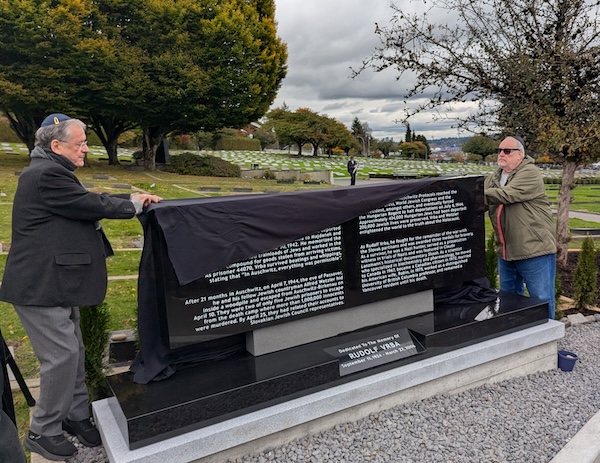
Robert Krell, left, founding president of the Vancouver Holocaust Education Centre, and Al Szajman, the current president, unveil the monument to Rudolf Vrba at Schara Tzedeck Cemetery. (photo by Pat Johnson)

Rudolf Vrba, a scientist who had a significant but comparatively quiet career in the laboratories and lecture halls of the University of British Columbia, enjoyed a comfortable life with his wife Robin in Vancouver before his death in 2006. Unbeknownst to thousands of his students over the years, Vrba may have saved more Jews during the Holocaust than any other individual. Despite this astonishing fact, his name has remained almost unknown not only among scholars of that history but even in his own adopted community of Vancouver.

At Schara Tzedeck Cemetery in New Westminster on Oct. 26, a monument was unveiled that seeks to remedy Vrba’s relative anonymity. 

“Why do so few know his name?” asked Dr. Robert Krell, founding president of the Vancouver Holocaust Education Centre and a member of an ad hoc group that came together to recognize Vrba’s life and bravery. “Sir Martin Gilbert, the British historian, wrote that Vrba was directly responsible for saving at least 100,000 Jewish lives. Others now credit him with the preservation of as many as 200,000 Hungarian Jews.”

Before about 200 people gathered in the cemetery’s chapel prior to the monument’s unveiling, Krell recounted the exploits of Vrba and his co-conspirator, fellow Slovakian Jew Alfréd Wetzler, who were incarcerated in Auschwitz. 

In April 1944, Vrba, just 19 at the time, and Wetzler, 25, contrived to conceal themselves within the Auschwitz compound, while, outside the camp, a massive search was undertaken by dogs and armed guards. After hiding silently in a woodpile for three days, the two men escaped and traveled for days by foot to Slovakia, where they shared all the information they had amassed about operations at the death camp. Vrba has been credited with having had an almost photographic memory and, over 22 months in Auschwitz, with Wetzler and he both having risen to positions of comparative privilege and trust in the camp, they were uniquely equipped to tell the world what was happening. 

Vrba had worked on the arrival platforms at the camp, observing the incoming Jews and, later, in the “Kanada” compound, where the stolen valuables of arriving prisoners were stored. Wetzler was a registrar and clerk in the camp. The pair chose their moment to act because their vantage points alerted them to the imminent deportation of the last remaining large group of surviving Jews in Europe, those of Budapest. 

Their account, which became known as the Auschwitz Protocols, or sometimes the Vrba-Wetzler Report, was the most credible and detailed information received to that moment about the extent of mass murder taking place in Auschwitz. More than 400,000 Hungarian Jews had already been murdered. 

“The Jews of Budapest were next,” said Krell. 

After dictating the report, Vrba joined the Slovakian army as a machine gunner and, later, joined the Slovak partisans, participating in 10 major battles and being awarded multiple medals for bravery. 

After the war, Vrba completed a PhD in biochemistry at Charles University in Prague, then lived in Israel and England before serving as a research fellow at Harvard Medical School. He married Robin, an American, in 1975 and they made a home in Vancouver. Vrba was an associate professor in the department of pharmaceutical sciences at UBC for 30 years and Robin was a realtor.

The explanation for Vrba’s relative anonymity has been explored in books, including a recently released first volume of a two-part biography by Vancouver writer Alan Twigg. (Holocaust Hero: The Life and Times of Rudolf Vrba was reviewed in the Oct. 10 issue of the Independent.)

The unfamiliarity with Vrba’s story in Israel, in particular, has been explored by Ruth Linn, a University of Haifa academic who first heard of Vrba when she was on sabbatical in Vancouver in the late 1990s. She returned to Israel and began asking if others with expertise in the field knew of Vrba, Wetzler and their escape. Her explorations led to her 2004 book Escaping Auschwitz: A Culture of Forgetting, which made the case that there was a deliberate effort in Israel to silence Vrba’s voice and obscure his history.

Vrba bore particular animus toward Rezső Kasztner, a leader of the Budapest Jewish community who went on to become a mid-level bureaucrat affiliated with the Israeli establishment and the Mapai party that led the country. Vrba – and others – viewed Kasztner’s actions as having saved the lives of Kasztner, his family and several hundred of his friends and associates at the possible expense of thousands of other Hungarian Jews. Vrba believed that, had ordinary Hungarian Jews been privy to the Auschwitz Protocols, as Kasztner was, they could have made their own decisions about whether to board the deportation trains.

The new monument and the unveiling ceremony were the culmination of several years of work by a group including Krell, Yosef Wosk, Geoffrey Druker, Joseph Ragaz, Arthur Dodek and Bernie Simpson, who formed a core committee advancing the project. Dodek, who emceed the Oct. 26 event, acknowledged additional contributions from the Kahn family, Ryan Davis, Marie Doduck and Jack Micner. Mayor Patrick Johnstone of New Westminster attended.

Organizers thanked the Schara Tzedeck Cemetery Board, including chairs Arnold Silber and Jack Kowarsky, and executive director Howard Jampolsky, as well as Schara Tzedeck’s Rabbi Andrew Rosenblatt.

Rosenblatt spoke of biblical and modern concepts of righteousness, citing Vrba as the definition of a hero. 

“He did not escape from Auschwitz simply to save his own skin,” said the rabbi. “He escaped from Auschwitz to save Hungarian Jewry. He escaped from Auschwitz to warn the world.”

The monument, located adjacent to an area of the cemetery not yet open to burials, means that future generations who pass through mourning loved ones will have an opportunity to reflect on true heroism.

“I am struck anew by how singular his legacy was, how young he was, how hard he fought to bring the truth to the world,” said Hannah Marazzi, executive director of the Vancouver Holocaust Education Centre, which sponsored the ceremony. “It is a legacy of courage, brilliance, sorrow, resilience and endurance. But perhaps what I have treasured most is learning about his life and legacy from those here who have had the privilege of knowing him.”

Druker noted that the monument reflects an increased awareness of Vrba locally and hoped that the knowledge would expand beyond his hometown.

Druker read aloud the inscription, which recounts the details of Vrba’s life: his origins, his deportation to Majdanek and Auschwitz, his escape, his war heroism and his life as an academic. 

“We hope that, in Israel, he will finally be recognized for what he is: a central hero that changed the course of the Holocaust for Hungarian Jews,” Druker said. “We want the world to recognize that too.”
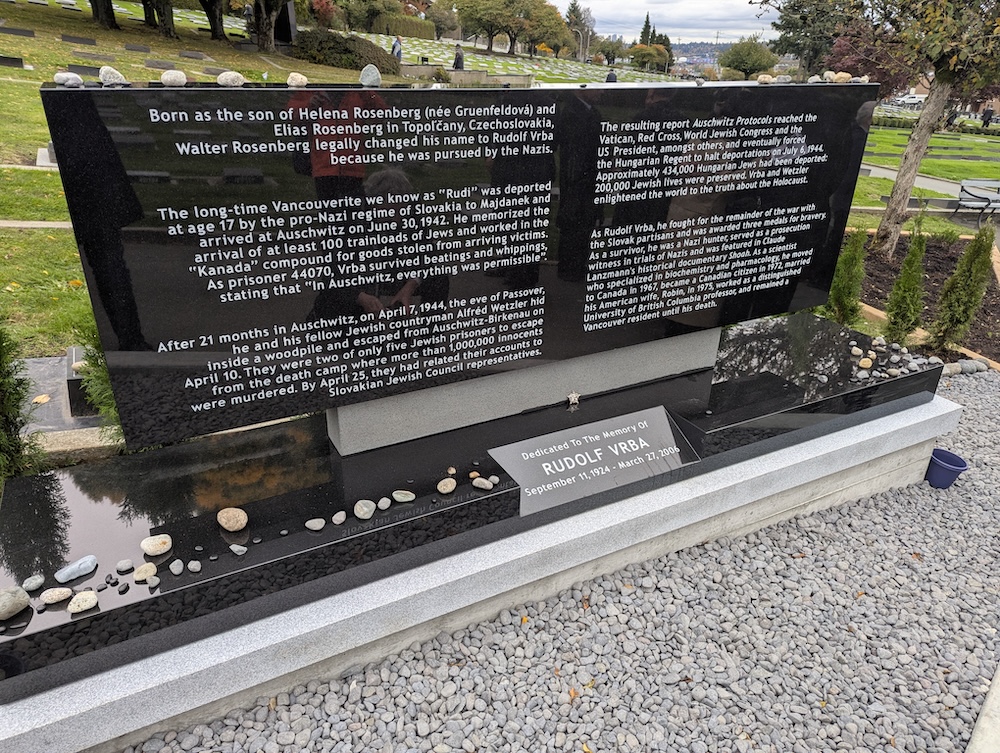
photo - The new monument to Rudolf Vrba at Schara Tzedeck Cemetery
The new monument to Rudolf Vrba at Schara Tzedeck Cemetery. (photo by Pat Johnson)

Chris Friedrichs, professor emeritus of history at UBC, put Vrba in the context of his times.

“The existence of Auschwitz was no secret to those leaders,” he said. “They knew that Auschwitz was the site of a vast industrial complex where German war production was being performed by forced labour. But, as we know, this report for the first time described the actual operations of the camp in terrifying detail, making clear that Auschwitz was not only a location of industrial activity, but also the site of mass extermination of human lives on a scale that nobody had previously fully grasped.

“A huge number of Hungarian Jews had already been sent to Auschwitz, but the approximately 200,000 Jews of Budapest had not yet been deported, and it was largely thanks to this warning that the deportations were halted and the lives of most of those 200,000 Jews were saved.”

The experiences Vbra underwent at a young age, as well as his anger that his escape and the report he helped draft did not save even more lives, affected him through his life. Friedrichs, who knew Rudi and Robin Vrba, said they enjoyed a happy life in Vancouver, but the past haunted Vrba.

“For, although he could escape from Auschwitz, Rudolf Vrba could never really escape from the Shoah,” said Friedrichs. “He knew too much and he cared too much to put what he had seen behind him.… Rudolf Vrba was dedicated to relating the facts, but there was also anger, and that anger was directed not just against the Nazis, but also against Jewish leaders during the war who could not bring themselves to inform their fellow Jews about what was happening in Auschwitz. He was like a biblical prophet who had inveigled against the wilful ignorance or stubborn disbelief of those who should have known better.”

Friedrichs credits Robin, who now lives in the United States and was not able to attend the unveiling, as “not only his cherished companion for over three decades,” but with ensuring that his legacy not be forgotten. 

“In fact,” said Friedrichs, “that task is a challenge for all of us. Even the Jewish community of Vancouver never fully recognized the greatness of this man and the role he had played both in saving Jewish lives and in contributing to knowledge of the Shoah.” 

The monument is a belated recognition, said Friedrichs.

“What we do today is overdue, but it is not too late,” he said. “Future generations will pass by this monument and realize how proud our community should have been that this man lived and worked for 30 years in our midst. As we watch the monument being unveiled, and if we gently lay some stones upon it, we will be paying a debt of gratitude to someone who is not only a hero of the 20th century, but should continue to be an inspiration for the 21st.” 

Format ImagePosted on November 7, 2025November 6, 2025Author Pat JohnsonCategories LocalTags Andrew Rosenblatt, Chris Friedrichs, history, Holocast, memorials, Robert Krell, Rudolf Vrba, Schara Tzedeck Cemetery, Vancouver Holocaust Education Centre
Flowers for those murdered

Flowers for those murdered

A new daffodil garden at Beth Israel commemorates the 1,200 people murdered by Hamas on Oct. 7, 2023. (photo by Cynthia Ramsay)

“It’s not much, but I wanted those in the Jewish community to know that they are not forgotten, and they are not alone,” Lora Anjos told the Independent.

On the morning of April 27, at Congregation Beth Israel, there will be a dedication ceremony in memory of the 1,200 people murdered in the Hamas terror attack on Israel on Oct. 7, 2023. To be dedicated is a new daffodil garden at the synagogue’s southwest corner, at 28th Avenue and Oak Street. The garden was inspired by Anjos.

Just over a year ago, Beth Israel member Alan Farber paid a visit to Anjos. Farber, a retired lawyer, and Anjos, also a lawyer, shared office space for many years. During that time, they became close friends. When Farber saw Anjos in February 2024, he said, “Lora expressed to me how upset she was over the horrific events of Oct. 7 and how sorry she felt for her Jewish friends over the rise of antisemitism. Lora said she would like to do something as a memorial to the innocent victims of the slaughter, and suggested planting 1,200 daffodil bulbs that would bloom annually in memory of the fallen. She wanted to place it at a Jewish location but truly didn’t know how to go about it. I was inspired by her idea and told her to leave the organization to me.”

Farber approached Beth Israel’s Rabbi Jonathan Infeld with the idea of a garden and Infeld “simply said do it,” Farber shared.

“Everyone I dealt with in organizing the planting was fully on board and inspired by the commitment made to our community by a non-Jewish person,” said Farber. “Grade 11 students came in October and helped plant 1,200 bulbs.”

Anjos came to that October event, spoke to the King David High School students and helped plant bulbs with them and members of the congregation, said Farber.

“There are a few stories I could tell that would explain it. But this one stands out,” Anjos told the Independent of her reason for wanting to do something for the Jewish community. She was influenced, in part, by a conversation she had with a former Dalhousie University classmate, Robert Astroff, who was part of the small Jewish community in Halifax. Some of his family members had been killed in the Holocaust and, she said, “If I recall correctly, he started keeping kosher after visiting the camps, in honour of those who lost their lives. He was gracious in all respects, including the sharing of his faith, through stories and food, hospitality and kindness, as an act of community.

“Sometime after graduation, he came to Vancouver,” she said. “We met and had lunch at the Vancouver Art Gallery. We sat outside on the terrace. It was a hot and sunny day. We talked about many things. But, at some point, the discussion turned to traveling. I mentioned the unexpected feeling I had experienced years earlier when I flew into Amsterdam after a four-month backpacking trip to Europe. As the plane descended over the flat green fields and dykes of Holland, I was reminded of Richmond, where I grew up, and immediately felt a sense of peace, as if I was landing at home. What happened next has never left me. Robert said he felt the same thing when he flew to Israel for the first time. I asked him why – because my sense of home and peace had stemmed from the similarity of the terrain between the Netherlands and Richmond, while Israel and Nova Scotia looked nothing alike. He said: Because, Lora, when they come for us again, Israel will be the only country that will protect us.

“Those words shook me,” said Anjos. “I had no doubt as to the heartfulness of Robert’s feelings. But I did not believe that that would happen. I did not believe I would live to see a pogrom. And I did not believe that, if such hatred took place, Israel alone would stand against it. I was left incredibly sad that Robert thought his fellow citizens, his friends, his colleagues and his country would not protect him. I could not fathom that. Then, Oct. 7, 2023, happened.”

Anjos spoke fondly of Farber and his late wife, Felicia Folk, who died in August 2023, as well as other Jewish friends and colleagues who have shown her kindness over the years, including Janet Stern.

“She had worked at Mills Brothers in Halifax, which I frequented often,” said Anjos. “When I was set to leave Halifax for the last time, she took a tired and broke student out to the most glorious lunch. It was so unexpected and so appreciated, I remember it still. Kindness from people who knew me well, and not so well.”

To attend the dedication, register at bethisrael.ca. 

Format ImagePosted on April 11, 2025April 10, 2025Author Cynthia RamsayCategories LocalTags Alan Farber, Beth Israel, Israel, Lora Anjos, memorials, Oct. 7
A Learning Stones memorial

A Learning Stones memorial

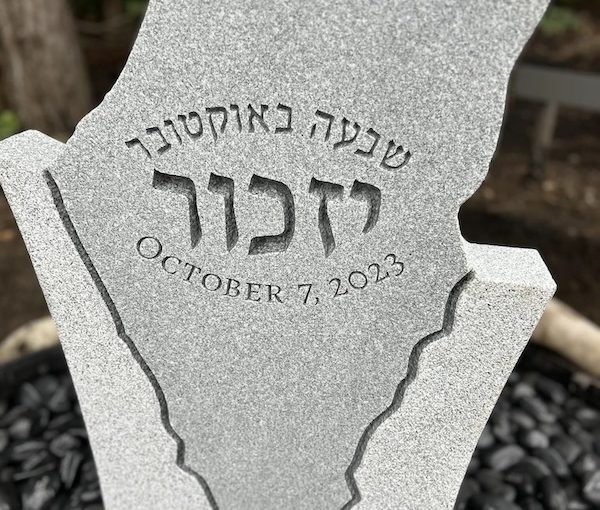
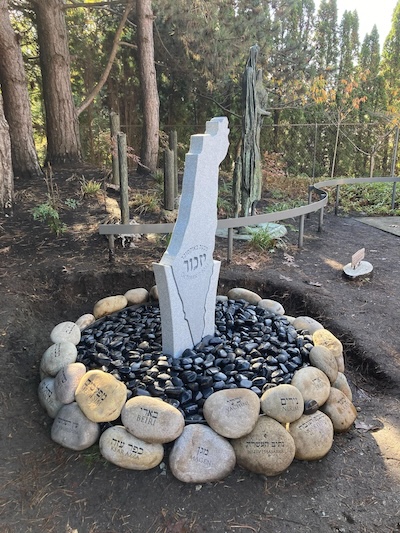
A newly created monument in the garden of Temple Sholom Synagogue commemorates the victims of Oct. 7, 2023, and the Israeli civilians, soldiers and foreign nationals who have lost their lives since that day. (photo from Temple Sholom)

There’s a newly created monument in the garden of Temple Sholom Synagogue – a serene and contemplative space. It’s not a cemetery, as you might expect, but a place to remember the horrific events of Oct. 7, 2023, and the tremendous loss of Israeli civilians, soldiers and foreign nationals who have lost their lives since that day. The project, envisioned by Temple Sholom Senior Rabbi Dan Moskovitz, draws on the Jewish tradition of placing stones when visiting the graves of the deceased and the “stumbling stones” of Berlin. The monument stands adjacent to the Temple’s Holocaust memorial. The proximity of the two is its own heartbreaking reminder of Jewish loss and tragedy

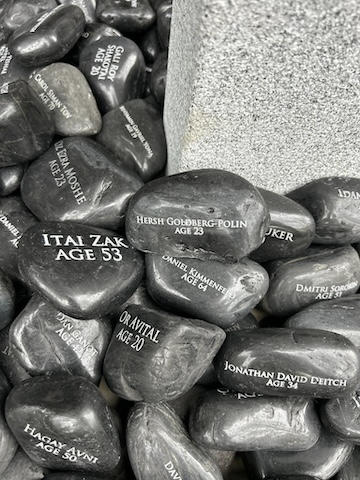
The new monument is surrounded by 33 large boulders, each inscribed with the name of a town or kibbutz attacked on Oct. 7; there is also one for the Nova Music Festival. Encircling the monument’s base lie some 1,658 small black stones, each one bearing the name and age of a victim.

The act of placing stones on a grave signifies that the person’s soul is remembered and honoured. It reflects the belief that the soul continues to exist in the afterlife and that the memory of the deceased remains alive in the hearts of the living. In this case, Rabbi Moskovitz’s intention was to make sure his community remembers those killed not as one massive number but as individual Jews. Every individual had a unique life story, just as each stone is unique. 

It was this topic that the rabbi talked about in his Kol Nidre sermon only days after the one-year anniversary of the Oct. 7 attacks. A reminder that we must keep the memory of every person who died on that horrible day alive. All members of the congregation were asked to take home a small black polished stone inscribed with the name and age of a victim of the Hamas attacks and the Israelis killed in the war since then.

photo - The Oct. 7 memorial draws on the Jewish tradition of placing stones when visiting the graves of the deceased and the “stumbling stones” of Berlin
The Oct. 7 memorial draws on the Jewish tradition of placing stones when visiting the graves of the deceased and the “stumbling stones” of Berlin. (photo from Temple Sholom)

Congregants were asked to research the name engraved on their stone(s); learn their story, their plans, and to even write a message on the stone if they so wished. They were then requested to bring their stone(s) back to the synagogue by Simchat Torah, when the monument would be dedicated. Moskovitz anticipated that the one-year anniversary that falls on the Jewish holiday, marred by the attacks, would be a time of sorrow, reflection and memory as the community gathered for what is otherwise a joyous holiday.

The sermon had a profound impact both in person and online. People wrote back from as far away as Thailand and the majority of synagogue members picked up a rock on their way home.

Inspiration for the monument came from when Moskovitz was a teenager. He recalls wearing a metal bracelet with the name of a Soviet refusenik, a Jew who was denied permission to emigrate to Israel. When the names of the hostages were gradually released, the rabbi said: “The idea struck me that we must hold on to the names of the hostages, share them and never let the world forget their torment and danger. I also wanted to do something to help raise money for the families and all of those in Israel forever changed and impacted by Oct 7. And so began the production and distribution of 10,000 bracelets engraved with the name of each hostage, their age and where they were taken from in a project called Till They All Come Home.”

As the anniversary approached, Moskovitz used the basis of the bracelet project to inspire the memorial stones. Temple Sholom Sisterhood provided the funding for the rabbi to purchase 1,000 pounds of stones and commission a five-foot-tall monument for the synagogue garden. Each stone was personally engraved by the rabbi and his family and the project took more than a month. Every victim was researched on the internet and often the entire family grieved as they reflected upon the age of the victim and the personal stories.

“Chana Kritzman’s was the first stone I picked up,” said Barb Halparin, a Temple Sholom congregant. “Its shape, a glistening black tear drop, attracted my attention. Chana’s age, 88, was etched below her name and I felt the immediate kinship of senior womanhood. Googling Chana’s name only intensified my sense of identification with her. I learned that, as a founding member of Kibbutz Be’eri, Chana had established the kibbutz library, where she ‘raised her children and grandchildren on a love of books, reading, and the art of storytelling.’

“I’ve been an avid reader all my life, and I earned my BA in English literature. I value my membership in the Isaac Waldman Library, and my favourite gift to my grandchildren is a book.”

Kritzman was shot by Hamas invaders while being evacuated from her home. She fought for her life in hospital for two weeks before succumbing to her wounds.

Halparin expressed how reading about Kritzman, her life, her love of words, her senseless, suffering death was a deeply emotional experience for her, as was placing her stone beside the memorial’s larger rock dedicated to Kibbutz Be’eri.

“It felt like I was in some small way bringing her home,” she said. “When Rabbi Moskovitz introduced the stumbling stone concept, I was deeply touched and eager to participate in such a meaningful project of remembrance.”

Another Temple Sholom member, Reisa Schneider, said: “One of the stones I took home was of Tair David, who was 23 years old when she and her sister Hodaya, age 26, were murdered by Hamas terrorists at the Nova music festival on Oct. 7, 2023. They were from the town of Beit Dagan. Their father, Uri, spent 30 minutes on the phone with them. He could hear blasts of gunfire nearby; he instructed them to lie on the ground, hold hands and breathe. Their connection was cut; he never heard from them again.”

On Instagram, their sister Liza wrote that Tair was “just like her name, a child of light, with a smile that could be seen for miles and a presence that is hard to hide.” 

“I found it interesting, maybe even coincidental, that the name of the person who I was expected to remember meant light,” said Schneider. “We gave our middle daughter the Hebrew name Orah, which also means light. Additionally, my maiden name is Smiley. I have tried to keep the name alive by smiling authentically and frequently. I have happily and intentionally passed that quality on to my daughters and grandchildren. I plan to honour Tair’s memory by bringing light into this broken world and by continuing to smile, despite these challenging times.”

photo - The Oct. 7 monument in the garden of Temple Sholom
The Oct. 7 monument in the garden of Temple Sholom. (photo from Temple Sholom)

Synagogue member Louise Krivel wrote: “After hearing Rabbi Moskovitz’s amazing sermon on Yom Kippur and learning about the over 1,600 rocks that his family had engraved in memory of the victims of Oct. 7 and beyond, I felt a tremendous sense of responsibility to honour the memory of the individuals whose rocks our family had been given.

“I researched each one and reached out to a couple of Israeli families via Facebook to advise them of our synagogue’s memorial and to let them know what Rabbi Moskovitz had been responsible for creating.” 

Yoni Znati, the father of Matan Znati, a 23-year-old Nova festival-goer, who died protecting his girlfriend, was one of those grieving family members Krivel contacted. He responded that he was very excited to hear about the memorial. He appreciated it very much, requested photos and hopes that, one day, he can meet Krivel so that he can tell her more about Matan.

“I can’t think of a more meaningful way that we as a congregation could honour the victims of Oct. 7,” Krivel shared. “I am so proud of Rabbi Moskovitz and his family and our congregation for creating this meaningful and beautiful memorial. Am Yisrael Chai.”

These are just three brief stories that Temple Sholom congregants researched from the horrific attack of Oct. 7 and those killed during the year since.

It’s after Simchat Torah. I am standing in the memorial garden. It’s now flooded with the rocks. Inside the synagogue, there’s a bat mitzvah. I can faintly hear the lively sounds of playfulness and laughter.

There will always be moments of celebration and sadness. As Kohelet (Ecclesiastes) reminds us, “To everything there is a season, and a time for every purpose under heaven.” 

Jenny Wright is a writer, music therapist, children’s musician and recording artist.

Format ImagePosted on November 29, 2024November 28, 2024Author Jenny WrightCategories LocalTags Barb Halparin, Dan Moskovitz, learning stones, Louise Krivel, memorials, monuments, Oct. 7, Reisa Schneider, stumbling stones, Temple Sholom
Memory still debated

Memory still debated

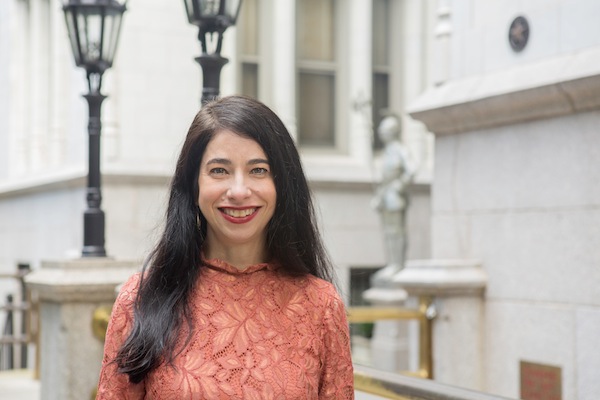
Dr. Laura Beth Cohen (photo from Dr. Laura Beth Cohen)

Although the Srebrenica genocide – the killing of more than 8,000 Bosnian Muslims by Bosnian Serb forces in July 1995 – occurred more than 20 years ago, it still affects the people of Bosnia and Herzegovina every day, according to Dr. Laura Beth Cohen, director, Kupferberg Holocaust Centre, Queensborough Community College, City University of New York.

Cohen was in Winnipeg on March 8 to speak as part of the Mauro Centre for Peace and Justice: Brown Bag Lecture series. She spoke on the topic Conflicted Walls: Untangling Transitional Justice and Traumatic Memories at Bosnia’s Memorial.

“There was an opportunity to participate in the first fellowship called Summer University Srebrenica and so I decided to go,” Cohen told the Independent. “I learned very quickly – that was in the summer of 2010 – that, to really understand Bosnia, it was not enough to take a course and learn about it from books. It’s very important to understand what’s actually happening there, and the best way to do that is to actually go there. It’s a place with intense beauty, legacy and a wonderful history of different ethnic groups coming together, living in harmony.”

But, the legacy of the last war, which lasted from 1992 to 1995, is still very much present. In fact, she said, the current government is debating about it.

“Here, in America, we talk about the Second World War as if it’s confined to the past,” said Cohen. “But, in many places in Europe, the Second World War, that memory, is very much alive. And, once you’re in an environment like that, it really starts to help you, not only sort out what has taken place, but you can see … because you’re not part of that country, or you don’t belong to that population … you can start to see different ways that those memories of the past are interacting in contemporary life, and are incredibly problematic.”

When Cohen was in Srebrenica, she was taken by how much the memory of the genocide affects the surviving population, how much it is fought over. The country and government are split into two ethnic entities that are a result of the Dayton Accord, which was signed after the massacre in Srebrenica. One side was deemed the perpetrator; the other, the victim.

“It is not a big surprise there are very different perspectives between the sides over what happened in Srebrenica,” said Cohen. “The RS [Republika Srpska] government in the last month has created a new commission on Srebrenica to, once again, reexamine the facts and evidence to determine whether or not genocide took place … even though genocide took place and was proven multiple times, and especially in the international criminal tribunal. So, this debate over what happened and denial over what happened is still occurring within Bosnian society, as well as, particularly, in Srebrenica.”

This, of course, makes it very difficult for the residents of Srebrenica and the region to move forward, she said.

“It’s a place that would really benefit from having a lot of people just step away … and allowing the population to just live, move forward, and gain attention for things that they really need support with – economic relevance, additional support for education, and rebuilding parts of the community,” said Cohen. “But, with the memory so volatile and kept alive, it really overshadows what’s taking place there. You can imagine trying to raise your family, regardless of your ethnicity, in a place where the past is constantly looming, and it’s a grotesque past. How do you bring your children up in that world?”

According to Cohen, the constant and continued fight over the politics and memory of what happened at Srebrenica does not allow people to learn about what happened or why, and that this is preventing coping mechanisms from being put into place; mechanisms that could help stop other massacres from happening.

“We only focus internationally once a year – on July 11, during the annual commemoration of the Srebrenica genocide that takes place at the memorial – so we often don’t understand what’s taking place there the other 364 days of the year,” said Cohen.

“People visit the 9/11 memorial in downtown Manhattan. They visit Auschwitz-Birkenau in Poland. They visit Kigali Genocide Memorial [in Rwanda]. These memorials serve as an educational component. For local residents and national citizens of these countries, they also serve as places of memory making,” she said.

In Srebrenica, Cohen hopes to eventually see ways of involving the local community in dialogue initiatives that facilitate the creation of memorials, ones that speak to the locals, helping them repair their communities.

“While we, as Jews, have a view of what Auschwitz-Birkenau is, to the people of Poland, it’s a German extermination camp on Polish soil,” said Cohen. “And, to the local people in Oswiecem, which is the Polish name of the town that the camp was built by, they struggle with having that kind of site in their community.”

When it comes to Srebrenica, she said, “We get stuck in the conversation of the politics over the genocide and what happened. What then happens is, a lot of these issues play out at the memorial. Part of this conversation is theoretical, but part of it is to help us understand that these are not static locations. They are very much interactive places, where memories are not only being promoted, but shaped by the larger discourse where they are situated.”

Cohen said the part of Bosnia, Herzegovina and Srebrenica that has always drawn her is “not only the friends I’ve made, but a vibrancy of life in Bosnia that gets lost in the discussion. The culture is beautiful, the people are beautiful, the relationships that people have with each other are beautiful. And, despite all of the horror of the last war, and despite all the history, and the Second World War and before that, it’s a place where there’s a lot of love and a lot of hope. That’s something that keeps, especially, international activist scholars engaged in what’s taking place there … and that, we can’t lose sight of when we talk about all the politics and things that aren’t going well.”

Rebeca Kuropatwa is a Winnipeg freelance writer.

Format ImagePosted on April 12, 2019April 10, 2019Author Rebeca KuropatwaCategories WorldTags Bosnia, genocide, Herzegovina, Laura Beth Cohen, memorials, Srebrenica, tikkun olam
Proudly powered by WordPress