Last week, thousands were on the streets of Tehran for Al-Quds Day events, which consist of calling for the annihilation of Israel. Parallel events were held in other cities, including London, England, where Hezbollah flags flew amid posters bearing modern blood libels, and in Toronto, where a speaker called for the “eradication” of Israelis and Zionists.
Also difficult to ignore are the realities of the incendiary kites being sent over the border from Gaza affixed with flaming tails or petrol bombs. Some international observers have dismissed the incidents, contrasting the Gazans’ unsophisticated arsenal with Israel’s contingent of fighter jets and advanced weaponry. But Israeli firefighters report that 741 acres of forest and 4,500 acres of agricultural land have burned in the past two months thanks to at least 285 individual kite and helium balloon attacks. An estimated 500 kites have been intercepted before they could do damage. Experts say return of flora and fauna in affected areas will take years.
The ongoing hostilities at and near the Gaza border are the latest in the ongoing conflict that keeps the world’s attention focused on the region.
That attention turned to the world of soccer recently. A planned game between the Israeli and Argentine national teams was cancelled after pressure from the movement to boycott, divest from and sanction Israel (BDS).
On social media, the BDS movement profusely thanked the Argentine team for cancelling the match. But the president of the team acknowledged it was not political considerations, but safety concerns, that led to the cancellation. The team – and specifically its megastar Lionel Messi – received threats of violence. As well, at the team’s practice facility in Barcelona, protesters waved Argentine soccer jerseys daubed with fake blood, and it wasn’t clear whether the blood was meant to symbolize Palestinians who have died or Argentine soccer players who might have been harmed if the game had been held as planned and the threats been realized.
There has been a shift from peaceful protest – that was the phrase repeatedly invoked about the conflagrations at the Gaza border – toward overtly violent rhetoric, threats and actions by Israel’s adversaries, who are both literally and figuratively “playing with fire.”
Nonviolent pressure, which is what BDS has claimed to advocate, is a tactic that could, one never knows, lead to some peaceful resolutions. But destroying farmland, endangering children, threatening people with harm and inciting genocide will only lead to more violence.
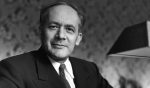
Polish-Jewish lawyer Raphael Lemkin was the first to use the term “genocide.” (photo by Moidov)
The word “genocide” was conceived by Polish-Jewish lawyer Raphael Lemkin to describe the attempt of the Ottoman Empire to efface Armenians from Turkish society. He articulated the empire’s actions as a specific category of crime – one that could be named, analyzed, resisted and penalized by the global community.
Lemkin was born in 1900 on a small farm near the Polish town of Wolkowysk. As a young man, he heard that as many as 1.2 million Christian Armenians were killed by the Ottoman Empire, the population of which was mainly Muslim. He also knew of the pogroms and violence against his own people, of course, but it was the situation of the Armenians that led him to the idea of a change in international law that could address such violence.
When the German army invaded Poland, Lemkin fled Europe for safety in the United States. He began teaching at Duke University and, in 1942, he joined the war department, where he documented Nazi atrocities. This led to the 1944 book Axis Rule in Occupied Europe: Laws of Occupation, Analysis of Government, Proposals for Redress, wherein Lemkin first introduced the word “genocide.”
“By ‘genocide,’ we mean the destruction of a nation or of an ethnic group,” Lemkin wrote. “Generally speaking, genocide does not necessarily mean the immediate destruction of a nation, except when accomplished by mass killings of all members of a nation. It is intended rather to signify a coordinated plan of different actions aiming at the destruction of essential foundations of the life of national groups, with the aim of annihilating the groups themselves. Genocide is directed against the national group as an entity, and the actions involved are directed against individuals, not in their individual capacity, but as members of the national group.”
Lemkin later worked on the Nuremberg trials, where he succeeded in getting the word genocide included in the indictment. Genocide was not yet a legal term, however, and the verdict at Nuremberg set a precedent only for war crimes. While in Nuremberg, Lemkin learned of the death of his parents, who, along with 49 other family members, were killed by the Nazis.
Lemkin was determined to see genocide added to international law and, after his return to Europe, he began agitating for this at the meetings of the then newly established United Nations. His efforts to enlist the support of national delegations and influential leaders eventually bore fruit. On Dec. 9, 1948, the United Nations approved the Convention on the Prevention and Punishment of the Crime of Genocide. As of December 2017, 149 states, including Canada, had ratified or acceded to the treaty.
Lemkin committed the rest of his life to convincing nations to pass legislation supporting the convention. He died in 1959, “impoverished and exhausted by his efforts,” according to Lemkin House, an American sanctuary for asylum seekers named in his honour.
At the 2005 World Summit, all member states of the United Nations endorsed the Responsibility to Protect (R2P) doctrine, which Canada was instrumental in promoting – on paper, at least, it carries Lemkin’s vision forward.
“The international community,” states the doctrine, “through the United Nations, also has the responsibility to use appropriate diplomatic, humanitarian and other peaceful means … to help protect populations from genocide, war crimes, ethnic cleansing and crimes against humanity … we are prepared to take collective action, in a timely and decisive manner … on a case-by-case basis and in cooperation with relevant regional organizations as appropriate, should peaceful means be inadequate and national authorities manifestly fail to protect their populations from genocide, war crimes, ethnic cleansing and crimes against humanity.”
This article was being written as almost one million Rohingya refugees were preparing to celebrate Ramadan in the camps of Cox’s Bazar, in Bangladesh – 700,000 of them have fled Myanmar since August 2017, running from what several international observers have called genocide. Yet Canada, and many others, including the UN, have shied away from using Lemkin’s term to describe the situation.
Modern Turkey still denies the Armenian genocide that was instrumental in inspiring Lemkin’s efforts. And, although some countries, notably Germany and Rwanda, have made attempts to deal with their past, with the crimes committed by their governments and civilians, the fight to prevent, identify, resist and respond effectively to genocide remains relevant.
Matthew Gindinis a freelance journalist, writer and lecturer. He is Pacific correspondent for the CJN, writes regularly for the Forward, Tricycle and the Wisdom Daily, and has been published in Sojourners, Religion Dispatches and elsewhere. He can be found on Medium and Twitter.
Arthur Miller’s Incident at Vichy is set in a Nazi detention centre in Vichy France, where a group of prisoners are being held. (photo from Theatre in the Raw)
Theatre in the Raw is bringing Arthur Miller’s Incident at Vichy to the Studio 16 stage April 11-22.
The play was chosen and recommended to the theatre’s board of directors in 2017, said Jay Hamburger, artistic director of Theatre in the Raw and director of the theatre’s production of Incident at Vichy. “It had been a piece that had been suggested previously as well,” he said. “But, with the recent political developments in the U.S. as well as worldwide, I felt that, as a theatrical piece, it spoke closely to issues today perhaps even more so than when it was written in the 1960s, and these events were behind the popular consciousness in some way.”
In Incident at Vichy, Miller – whose most popular plays include Death of a Salesman, The Crucible and A View from the Bridge – explores our moral responsibility to act in the face of intolerance and hate. The one-act play, which was first performed in 1964, is set in a Nazi detention centre in Vichy France, where a group of prisoners are being held. “Their unease, fear and confusion is stirred up as they contemplate what may divide or unite them. And what fate awaits them,” reads the press material.
Panel discussions will follow each performance and explore the question, Can it happen here?
“That is the overall and main question placed before the audience as well as to ourselves,” said Hamburger. “Can fascism, or a wave of totalitarian, racially dividing politics take place in Canada? We see fragments of such distressing political and socially oriented movements happening worldwide. Even in the U.S., so close to Canada, there are semblances of divide and conquer. Sadly, it seems to come from the current administration in Washington, D.C. This is cause for real concern.
“Now more than ever this may be the time to warn people that eternal vigilance is key to the well-being of our daily lives, especially given the rise of violent hate crimes against Jews, Muslims, South Asian and First Nations communities, even in Canada…. The play finds a way to touch on economic and class concerns related to the increasing gap between the rich and the poor. It notes that certain people are at an insurmountable disadvantage in seeking ways to survive. Certain characters in the play point out the way prejudices are manufactured and fomented, often condemning people because of misconceived notions concerning races of people, ethnicities or religions.”
Incident at Vichy doesn’t only examine how genocide can happen, however, but what people could do to prevent it.
“Each character in the play has their own experience and background in relation to being interrogated for being Jewish or perhaps seen as an ‘undesirable’ in some way,” explained Hamburger. “The play is basically a dramatized account of events that took place in 1942 in the unoccupied ‘free zone’ of Vichy France,” he said, and it presents many of the attitudes that “people had who weren’t quite ready to accept the extent of what was happening around them until it is completely undeniable – and too late.
“It also includes as an important aspect the perspectives of characters who are non-Jewish Germans, and Austrians as well,” he added. “It implores members of the society to not be complacent in the face of governments and demagogues that wish to grab power by lying and oppressing the large swaths of society.
“A question and statement is placed forward within the play: who is responsible for such horrendous acts of cruelty leading to genocide? At what point must one consider themselves also responsible? The play suggests it is for all in society to give a damn or have a sense of responsibility to such terrible events. There is an important act of human kindness in the play, but I won’t give away the ending here. But, obviously, Miller is writing about shattering events, with shreds of hope that a holocaustal deluge will not repeat itself, that such human massacres will not happen again.”
Audiences should come away from Incident at Vichy with some answers, but perhaps as many questions about the nature of evil, how we perceive it and deal with it.
“I think the play is trying to answer the question, How did things get so far out of hand without people rising up and stopping the madness?” said Hamburger. “The play tries to answer that question, even though you get the impression of how relentless the evil and suffering was once certain powers were in control and the momentum of a horrific madness got going…. I think the play insists that ordinary people are instrumental in realizing evil actions, without necessarily wanting to see the bigger picture themselves. Thus, a vigilant eye is necessary on governments and draconian racial laws implemented upon a citizenry. Such policies must be watched, debated and fought against in a fair and free manner without fear of punishment or reprisal.”
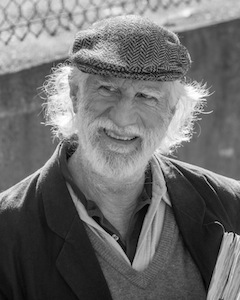
Theatre in the Raw artistic director Jay Hamburger directs the theatre’s production of Incident at Vichy. (photo from Theatre in the Raw)
Theatre in the Raw’s mission statement is on their website. Part of it is to be “risk-takers, willing to give exposure to voices seldom heard, striving for artistic excellence, in the presentation of unusual, awakening and exchanging theatre.”
“We are an independent grassroots theatre that has been in production and functioning for 24 years, residing on the Eastside of Vancouver,” said Hamburger. “We have produced comedies, tragedies, radio play works, original one-acts and full-length mainstage plays, as well as original and revived musicals of quality and enjoyment. Our process is to take the art of theatre and performance seriously and to present it first on a local level to Vancouver audiences and then beyond.”
The audition process for Incident at Vichy started seriously in early January and continued to the end of February.
“We saw dozens of actors (actually over 50 for weeks on end) that also included an extensive call-back set of days,” said Hamburger. “A few actors were called in to audition because I attended the unified general auditions that the Greater Vancouver Professional Theatre Alliance provides for theatre company members in the province. That proves an invaluable resource for those involved in the theatre arts.”
Rehearsals started at the end of February and will continue until the opening of the play on April 11 at Studio 16, which is housed in La Maison de la francophonie de Vancouver. “We are meeting three to four times a week, as well as individual meetings and sessions with each of the 15 actors cast in the show,” said Hamburger.
Incident at Vichy features some longtime Theatre in the Raw company members, he said, naming Roger Howie, Jacques Lalonde, David Stephens, zi paris, Brian Leslie, Stanley Fraser, Michael Kruse-Dahl and Ralston Harris. Hamburger is also part of the cast, as are Rob Monk, Julie Merrick, Daniela Herrera Ruiz, Laen Avraham Hershler, Giuseppe Bevilacqua and Simon Challenger, with Amanda Parafina as stage manager.
“We are fortunate to have such a dedicated and hardworking group of able thespians on the boards for the April run of the show Incident at Vichy,” said Hamburger, adding that fellow Jewish community member Cassandra Freeman also has been helpful.
“Cassandra has been an invaluable advisor and advocate for a number of years with Theatre in the Raw,” he said. “She has been a coordinator with the Tuesday night Vancouver Actor’s Drop-In sessions. We have cast at times from those evening sessions for some of our shows. She is a creative writer and has made the effort to report about Theatre in the Raw in a column or two she does for the press.”
Tickets for Incident at Vichy are $25/$22 and can be purchased from theatreintheraw.ca or 604-708-5448.
* * *
In his interview with the Jewish Independent, Jay Hamburger, artistic director of Theatre in the Raw and director of the theatre’s production of Arthur Miller’s Incident at Vichy, said, “A question and statement is placed forward within the play: who is responsible for such horrendous acts of cruelty leading to genocide? At what point must one consider themselves also responsible? … There is an important act of human kindness in the play, but … Miller is writing about shattering events, with shreds of hope that a holocaustal deluge will not repeat itself, that such human massacres will not happen again.”
Hamburger added, “The sentiment reminds and brings forth four related historical quotes that speak directly to significant parts of the play”:
“How can we expect righteousness to prevail when there is hardly anyone willing to give himself up individually to a righteous cause. Such a fine, sunny day, and I have to go, but what does my death matter, if, through us, thousands of people are awakened and stirred to action?” – Sophie Scholl, a member of the anti-Nazi White Rose group, who was executed for treason by the Nazis
“Of course, the terrible things I heard from the Nuremberg Trials, about the six million Jews and the people from other races who were killed, were facts that shocked me deeply. I was satisfied that I wasn’t personally to blame and that I hadn’t known about those things. I wasn’t aware of the extent. But, one day, I went past the memorial plaque which had been put up for Sophie Scholl in Franz Josef Strasse, and I saw that she was born the same year as me, and she was executed the same year I started working for Hitler. And at that moment I actually sensed that it was no excuse to be young, and that it would have been possible to find things out.” – Traudl Junge, one of Adolf Hitler’s secretaries
“I don’t believe that the big men, the politicians and the capitalists alone are guilty of the war. Oh, no, the little man is just as keen, otherwise the people of the world would have risen in revolt long ago!” – Anne Frank
“I’ve found that there is always some beauty left – in nature, sunshine, freedom, in yourself; these can all help you. Look at these things, then you find yourself again, and God, and then you regain your balance. A person who’s happy will make others happy; a person who has courage and faith will never die in misery!” – Anne Frank
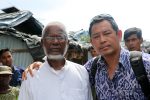
Maung Zarni, right, with a 67-year-old Rohingya man from Maungdaw, who had been a leader at a township level in former prime minister Ne Win’s early days, when Rohingyas were recognized as an ethnic community with full citizenship rights. (photo from Maung Zarni)
Calls are mounting to recognize Myanmar’s violent campaign against the Rohingya as genocide. At the United Nations’ Human Rights Council in Geneva on March 12, Yanghee Lee, special rapporteur on the human rights situation in Myanmar, said she is “becoming more and more convinced that the crimes committed … bear the hallmarks of genocide and call[s] in the strongest terms for accountability.”
Nearly 800,000 Rohingya have fled state-sanctioned and -organized violence in Myanmar (Burma) since August 2017, after the government – blaming an alleged attack on Myanmar’s security forces by Rohingya militants – initiated a brutal campaign of arson, murder and systematic rape and torture against the civilian Rohingya population in Rakhine state. The violence follows decades of oppressive measures against the Rohingya, which, in recent years, have included restrictions on education and medical care, deliberate starvation, state-imposed birth control, property seizure, and removal of citizenship and civil rights.
“These human rights violations constitute nothing less than a slow-burning genocide,” human rights activist Maung Zarni, founder of the Free Burma Coalition, told the Jewish Independent.
With respect to the situation in Myanmar, for months terms like “atrocities,” “military crackdown” or “state-sanctioned violence” have been used to describe it, instead of using the word “genocide.” The UN has previously called what is happening in Myanmar, a majority Buddhist country, whose dominant ethnic group is Bamar, “ethnic cleansing.”
There have been some exceptions to the hesitancy to call the government’s actions genocide. For example, French President Emmanuel Macron called it that last September. And independent tribunals and experts like the International State Crime Initiative and the Permanent Peoples’ Tribunal have also called it genocide. But the media and other international organizations have generally not been using the word.
A young girl in a displaced person’s camp shows how her hands were tied behind her while she was raped; one of her finger tips was cut off for resisting. (photo from Maung Zarni)
“There is a high barrier for the use of the term genocide, and I think this is correct,” said Rainer Schulze, professor of modern European history at the University of Essex and founder of The Holocaust in History and Memory journal, speaking at the Berlin Conference on Myanmar Genocide Feb. 26, which the Jewish Independent attended. “We should not use the term genocide lightly. Not every human rights violation, ethnic cleansing or forced resettlement is a genocide. The Genocide Convention gives us a very clear definition, but, with regards to the Rohingya, it is appropriate and must be used.”
Gianni Tognoni, general secretary of the Permanent Peoples’ Tribunal in Rome, agreed. “The UN has been playing with names,” he said at the conference. “To declare something as genocide is to declare it as something intolerable for the international community. Instead, this is delayed.”
“Governments, in general, are very reluctant to use the term genocide for fear that it could damage diplomatic initiatives to secure peace or damage bilateral relationships,” Kyle Matthews, executive director of the Montreal Institute for Genocide and Human Rights Studies at Concordia University, said in conversation with the Independent. “In some cases, governments have refused to label atrocity crimes as a genocide for fear it would force them to take a stronger response, such as intervening militarily.”
The Convention on the Prevention and Punishment of the Crime of Genocide adopted by the UN in 1948 obliges signatories to take concrete steps to respond to genocide. As of December 2017, 149 states had ratified or acceded to the treaty, including Canada. In 2005, all member states of the UN endorsed the Responsibility to Protect (R2P) doctrine, a doctrine Canada was instrumental in promoting. The Canadian government continues to avoid the term genocide, however – although it has taken some steps towards addressing the situation.
“I would say the Canadian government has been one of the most responsible and thoughtful governments in trying to find a solution to protect the Rohingya minority in Myanmar and in neighbouring countries,” said Matthews. “Ottawa has appointed Bob Rae as special envoy to the prime minister to help identify different policy options and strategies for engaging the government of Myanmar. Ottawa also recently imposed economic sanctions on leading figures in Myanmar’s military.”
On Feb. 16, the federal government imposed sanctions, under Canada’s new foreign human rights legislation, against Maung Maung Soe, a high-ranking member of the Myanmar military. “What has been done to the Rohingya is ethnic cleansing,” Foreign Affairs Minister Chrystia Freeland told CBC in a statement that did not use the word genocide. “This is a crime against humanity.”
The sanctions impose a “dealings prohibition,” which freezes an individual’s assets in Canada and renders them inadmissible to enter Canada under the Immigration and Refugee Protection Act.
Matthews said there is much more that we could be doing. Speaking at the Berlin conference, he said, “Broader economic sanctions have to be done immediately. We should look at travel restrictions. We need to demand humanitarian access to Rakhine state [where the remaining Rohingya live, access that is currently denied by Myanmar]. We need to do more economic naming and shaming of who is associating with the regime. Myanmar embassies around the world should be protested.” The government should issue a travel advisory, he said, warning “you are going to a state that is now committing genocide.”
Matthew Gindinis a freelance journalist, writer and lecturer. He writes regularly for the Forward and All That Is Interesting, and has been published in Religion Dispatches, Situate Magazine, Tikkun and elsewhere. He can be found on Medium and Twitter.
As Rabbi Dr. Donniel Hartman writes (in this week’s issue), the Exodus story is not one in which humankind is the protagonist. It is the hand of God that creates the circumstances that permit the Hebrew people to escape bondage and, after a time, find freedom.
Still, this did not abrogate the need for human action. The people needed to recognize the successive messages being sent to them and, then, take the opportunity to escape – take that first step into the roiling Red Sea, for example, even before God parted it. A jailer may leave the key within reach of the unjustly imprisoned, but the inmate still needs to reach out and unlock the cell door.
Central to Judaism is the concept that God left the world unfinished and imperfect. It is the work of humankind to complete the work. Bringing about that ideal is the purpose of our existence.
Often, lately, it seems that the global trajectory is moving in the wrong direction. The reelection of Vladimir Putin – by an entirely anticipated landslide, assisted by his control of media and the murder of his opponents – moves Russia further away from the nascent democracy that emerged in the late 20th century. Across the former Eastern Bloc, tyrants and hyper-nationalists are rising. Even in Slovakia, one of the finest examples of democracy emerging from the communist past, people are rising up – this is an encouraging reality – as their government appears to be moving away from its promise.
The fate of the Rohingya people (addressed by Independent writer Matthew Gindin in this issue) is a flashpoint of inhumanity and yet we continue to argue over nomenclature. Is it genocide? Words matter. But, for heaven’s sake, let us take action.
Sadly, almost anywhere one looks in the world, including, of course, in Canada and in Israel, there are injustices, inhumanities and tragedies. The uncertainty facing African refugees in Israel, and still-unaddressed issues of the most basic human rights for First Nations communities – like the right to clean water, education and opportunity – remain scars on Canada’s conscience. To our south, angry rhetoric and divisive leadership sow discontent, distrust and falsehoods in pursuit of political and social advantage. There are literal or figurative slaves needing redemption on every continent.
Jewish tradition emphatically calls us to pursue justice, but perhaps never so ardently as at Pesach. Through our enjoyment of the holiday and the reminders of our bitter history and the components of the seder, the order of our remembrance, may our resolve be strengthened to pursue justice in this year and in the decades to come.
May we strive to not be disheartened by the magnitude and breadth of the work to be done, but inspired by the inestimable number of examples we have before us, locally and elsewhere.
So many in our own community are pursuing justice in their unique ways, from the day school kids who assembled and delivered hundreds of mishloach manot recently to those in need, or Rose’s Angels, who made Valentine’s Day special for hundreds more, or for the hundreds of individuals in our community whose every day is devoted to making the world better for seniors, students, people with special needs or those who just need a comforting companion.
We can be overwhelmed by the ferocity with which news comes at us, and it can seem that whatever we do could provide only a tiny drop in the required ocean of goodness to make this world a better place. But what is an ocean but billions and billions of tiny drops?
This is our mission. We do not repair the world by despairing. We redeem it by our actions. It is, perhaps, up to Canadians who are, by any measure, among the most fortunate people in the world, to rededicate ourselves during this season of remembering and reliving our time in bondage, release and redemption, to finding ways to play our small but irreplaceable part in the enormous work to be done.
For years, Poles have bristled at terms like “Polish death camps” or “Polish concentration camps.” Rightly so. Places like Auschwitz-Birkenau were Nazi German camps on Polish soil. Calling them Polish camps was misleading and imputed the murder of millions of Polish Jews (and many other Poles) to Poles themselves. This is a linguistic formulation that should be avoided.
But it should not be illegal. There are few, if any, words that should be illegal, in our judgment. But the Polish government thinks otherwise and has passed a law that penalizes any suggestion that Poland was complicit in the Holocaust. So, anyone who uses such terminology as “Polish death camps” could face fines or up to three years’ jail time.
However, while the camps were German, there has never been any question about the willing complicity of plenty of Poles in the extermination of most of their Jewish compatriots. Many Poles were conscripted into the Nazi killing program, but others willingly advanced the mission. Notably, the murder of Jews in Poland did not end with the Nazis’ defeat. There were many instances of Holocaust survivors returning to their homes after the war only to be murdered by their former neighbours, the most notorious example being the Kielce pogrom of July 1946, in which about 40 Jews were killed and as many injured. To utter these facts in Poland now is presumably illegal. On the other hand, it is presumably not illegal to state the fact that many Poles risked their lives to save the lives of Jewish Poles.
The dreadful and confusing new law has been condemned by the American and Israeli governments, among others. Israel’s criticism hit a particular nerve with Andrzej Zybertowicz, an advisor to the Polish president and a sociology professor at Nicolaus Copernicus University. He suggested that Israel’s response to the law resulted from a “feeling of shame at the passivity of the Jews during the Holocaust” and he accused Israel of “clearly fighting to keep the monopoly on the Holocaust.” He went on to say: “Many Jews engaged in denunciation, collaboration during the war. I think Israel has still not worked it through.”
The irony is as stark as it is distressing, that Zybertowicz could accuse Israel of failing to work through its Holocaust history when his own country has just codified its own refusal to do just that.
Conversely, Germany has just announced that it will acknowledge as Holocaust survivors Jews who lived in Algeria under the Nazi-collaborationist Vichy French regime. This means about 25,000 people will be eligible for some compensation under the Conference on Jewish Material Claims Against Germany. This is a positive development, no matter how late it has come.
These two very different present-day actions, 73 years after the liberation of the camps, are but two examples of how we are still navigating the facts of the Holocaust. We are still determining, among much else, who are to be included among the perpetrators and who among the victims. And these are not even the much more difficult, perhaps impenetrable, moral questions and issues raised by the Holocaust. We have not come close to understanding the patterns of antecedents, the human and historical prerequisites that allowed the Holocaust to happen – and which permit genocides to continue happening.
Interior perspective of The Evidence Room, with models of an Auschwitz gas column and gas-tight hatch, plaster casts and a model of a gas-tight door. (photo by Fred Hunsberger, University of Waterloo School of Architecture)
Visitors to the Royal Ontario Museum (ROM) will see an obscene display among the collections of dinosaur fossils, Egyptian mummies and suits of armour – a scale model of a gas chamber of the kind used at Auschwitz, where more than one million Jews were murdered between 1942 and 1945.
The Evidence Room exhibit, as it is named, consists of white plaster replicas of elements of the Nazi death camp murder machine, including the steel mesh columns through which pellets of Zyklon B insecticide were lowered to asphyxiate the prisoners locked inside the gas chambers. Similarly, it depicts the heavy door, which was bolted from the outside.
The exhibit features a reproduction of the original architectural drawings prepared by German architect, engineer and SS-Sturmbannführer Karl Bischoff, who served at Auschwitz as chief of the Central Construction Office of the Waffen-SS.
Visitors to ROM will note the meticulously planned airtight seal around the gas chamber’s door to prevent toxic leaks, and the grill-covered peephole that allowed dignitaries to watch the prisoners die.
“To understand this room … we first have to acknowledge that it’s related to the most murderous place,” said the exhibit’s creator, Robert Jan van Pelt, at a ROM Speaks lecture on June 27.
Van Pelt’s grisly display is the first in a ROM series intended to engender discussion of contemporary issues. And the issue here is forensic architecture, a relatively new field that uses planning and design tools to understand human rights abuses, in this case genocide.
For van Pelt, a Dutch-born architect who teaches at the University of Waterloo, The Evidence Room represents the culmination of two decades of work.
Van Pelt served as an expert witness during a trial, in London in 2000, in which Holocaust-denier David Irving unsuccessfully sued Emory University professor Deborah Lipstadt for libel after Lipstadt, in a book, called out the pseudo-historian’s falsehoods. Irving famously quipped “No holes, no Holocaust.”
Van Pelt testified that indeed there were apertures in the gas chambers’ ceilings through which poison pellets were dropped. His testimony led to his 2002 book The Case for Auschwitz: Evidence from the Irving Trial.
The 592-page volume greatly impressed Alejandro Aravena, curator of the 2016 Venice Architecture Biennale. The Chilean, who was awarded architecture’s Pritzker Prize for his work transforming slums and making architecture a tool of justice and social change, commissioned van Pelt to create an exhibit explaining the workings of an Auschwitz gas chamber. A model was on display at last year’s Venice Biennale.
In preparing for the current exhibit at ROM, van Pelt – together with colleagues Donald McKay, Anne Bordeleau and Sascha Hastings – wrote a supplementary book, The Evidence Room, published by the New Jewish Press in association with the University of Toronto’s Anne Tanenbaum Centre for Jewish Studies.
“It is difficult to imagine the details of a gas chamber, where humans were locked in to die,” says one Holocaust survivor quoted in van Pelt’s new book. “One has to feel the double grates that protected the bucket filled with poison pellets from the desperate hands of the condemned, peer into the bucket, imagine the pellets melting away, the poison oozing out of them.
“I knew a good deal about the Auschwitz-Birkenau murder factory,” says the survivor, “but the gas column really shocked me. Because of what I had read about people thinking they were going into a shower room, I had always imagined the gas being dispersed by sprinklers. Touching that construction had a profound effect on me – a new visceral recognition all these years later.”
And what of the pristine white plaster van Pelt and his architecture students used to build the reproduction?
For me, it jarringly evoked a sense of peace and innocence. But, as well, it called to mind that those murdered in the gas chambers defecated and urinated as they died and that Sonderkommandos (a special unit of slave labourers who removed gassed corpses and hauled them to the crematoria) had to whitewash the gas chambers after each usage.
Outright denial of the Holocaust is a phenomenon almost exclusively in the realm of utterly discredited figures who deserve condemnation. One of those figures is David Irving, who lost his libel suit against Deborah Lipstadt, an American professor and author, who correctly characterized him as a Holocaust denier in her book Denying the Holocaust. A new film, called Denial, about the trial, opens today in Vancouver and the Independent interviewed Lipstadt earlier this week.
It only takes a quick Google search to find that there are certainly people in the world today who, for various reasons, make it their business to allege that the Holocaust did not happen or, in an insidious manner presumably intended to lend a hint of credibility to their position, acknowledge that it happened but quibble about details – as if the number of millions murdered can be considered “details.”
There is, however, a different kind of Holocaust denial that also deserves attention and is potentially more dangerous. This form of denial does not rest on the supposition that the Holocaust did not happen. Rather, it is more often an expressed view that it doesn’t matter. Of course, these ideas are rarely expressed so crudely. Yet, this is the subtext of a commonly expressed position, even in so-called polite company, that the Holocaust has had its run, that we have spoken enough about it, that it happened 70 years ago, that it is time for people other than the Jews to have their historical grievances addressed.
The idea that we talk about the Holocaust too much has both particular and universal consequences. The Holocaust was particular in its intention to eradicate the Jewish people from the earth. However, as most individuals and organizations devoted to Holocaust education, commemoration and awareness understand, work about the particular experience of Jewish genocide is foundational to the prevention of future genocides affecting other groups, as well as violence and discrimination that does not meet the level of genocide.
This should not diminish the Jewish particularity of the Holocaust, and it need not. However, while the Holocaust was a particular product of Nazism and of Germany, we will fail the future if we do not recognize the Holocaust as a keystone to understanding the human capacity for genocide, as well as less cataclysmic group targeting, isolation and discrimination. Ultimately, the Holocaust was perpetrated on human beings by other human beings.
The word genocide was invented to find language for the Shoah. Tragically, we have been able to apply it to many terrible incidents since – and before, such as the Armenian genocide. To create a better future, we need to devote more resources to understanding these events and their antecedents. These are not pleasant topics to discuss, to put it mildly. There can be nothing in human experience more distressing to confront than genocide. Yet we must.
There are many truths around the Holocaust that cannot be denied. One of them is that, because human motivations are not an exact science, particularly when extrapolated into the madness of crowds, we really do not understand why the Holocaust or other genocides have happened. The proof of this statement is that, we hope, if we did understand genocide in a complete way, we would have eradicated it from the world.
In the context of how much it matters and how much we have left to learn, we are certainly not talking too much about the Holocaust, devoting too many resources to it or moving far enough away from it in time to start deemphasizing it. No. We have barely begun to discuss and understand it.
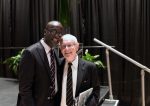
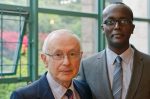
Éloge Butera, a survivor of the genocide against the Tutsis of Rwanda, and Robbie Waisman, a survivor of the Holocaust, at Vancouver Holocaust Education Centre’s gala event on May 26. (photo from VHEC)
For the Vancouver Holocaust Education Centre, the first half of 2016 has been a time of intense activity, though the pace of contemporary events has been accompanied by a very conscious reflection on both the past and the future of the organization.
The VHEC held its first gala-style event in more than a decade on May 26, a dinner and program titled “Looking Back, Moving Forward.”
“The event was very deliberately intended to recognize that the organization is at a moment of profound significance,” said Nina Krieger, VHEC executive director. “We took the opportunity to reflect on the past, show our gratitude to those who founded and led the organization, and to take pride in the achievements we have had. But the program was also quite emphatically focused on the future. The VHEC began as a small organization and we have grown dramatically in size and impact, in the depth and breadth of the programs we deliver, and it was our intention to illustrate both of these profiles to the nearly 500 people who attended.”
Co-chaired by Marie Doduck, Helen Heacock-Rivers and Shoshana Lewis, “Looking Back, Moving Forward” intended to give guests a taste of what more than 25,000 British Columbia students experience every year through VHEC programs. Annually, a symposium on the Holocaust takes place at the University of British Columbia. An additional 12 symposia take place in school districts throughout Metro Vancouver. Each of these is an opportunity for students to learn about the Holocaust from an historical perspective, view a film on the subject and then meet and hear the testimony of a survivor.
“The symposia are undoubtedly the most impactful thing we do,” Krieger said.
“We have thousands of letters from students telling us about the life-changing impact meeting a survivor has had on them,” she explained. “We have classes brought to our symposia by teachers who chose their profession because of the impact of a symposium they attended years earlier.”
In a moving moment at the gala event, Caden Dorey, a Grade 11 student from Surrey, read aloud a letter he had sent to survivor speaker Lillian Boraks-Nemetz after he met her at a symposium.
“I have never been so moved in my life,” he wrote. “You have changed my perspective on the Holocaust, and life itself.… I will never forget you, and thank you for letting me share this moment with you. I’m forever impacted by this day.”
The centrepoint of the evening was a joint presentation by Robbie Waisman, a survivor of the Holocaust, and Éloge Butera, a survivor of the genocide against the Tutsis of Rwanda. Both spoke of the importance of sharing their survival stories and the influence it has had on students and others.
Waisman explained that it is difficult to help young people comprehend the idea that 1.5 million Jewish children were murdered in the Holocaust, so he tells the story of his nephew, Nathan. Waisman was only 8 years old when his older brother Haim and his wife Golda had Nathan. Waisman spoke of his pride on being an uncle, but the Holocaust destroyed their family.
“Nathan was not yet 3 years old the last time I saw him,” Waisman said. “His mother Golda could have easily gone to work in the ammunition factory after the Nazis established the ghetto, but she would have had to give up her little Nathan. She refused to be separated from her little boy and so was sent to the Treblinka gas chambers with him.”
Butera credited Waisman for inspiring him to speak up about his experiences and devote himself to confronting racism and the potential for genocide.
The evening, which was emceed by Dr. Art Hister, also represented the increasing engagement of younger members of the community in VHEC’s work. Children and grandchildren of survivors, as well as others of their generations, were involved in the planning committee and Katia Hessel, a granddaughter of four survivors, spoke about the obligation she feels for carrying on the memory of her family’s history.
While not lining up exactly with the calendar, the VHEC gala event marked three significant milestones. It is more than 40 years since the first symposium on the Holocaust for high school students took place. It is about 30 years since the society that created the centre was founded. And it is more than 20 years since the centre first opened its doors as a teaching and research museum. Honorary chairs of the event were the four past-presidents of the organization: Robert Krell, Waisman, Rita Akselrod and Jody Dales.
Passing the torch of Holocaust memory from one generation to the next has been central to the Holocaust centre’s work recently.
“The greatest single challenge we face is continuing to maintain the relevance of our mission and mandate in a post-eyewitness survivor era and I think we are well-positioned to do that,” said Ed Lewin, who retired after six years as president of the VHEC board at the annual general meeting a week after the gala.
The centre is undertaking a major project of digitizing the archival collections, which will make them accessible worldwide. The process of digitization will also allow the centre to integrate historical materials seamlessly into pedagogical materials for use by teachers locally and wherever educators are seeking supplementary classroom resources.
“We are finding a way to keep the students, who are our audience, enthused and energetic and interested in hearing about stories without actual eyewitness survivors to tell it to them,” Lewin said.
For visitors to the centre, planned upgrades will make artifacts and some of the archival materials more accessible, including through interactive electronic kiosks and visible display units.
Lewin was honored at the AGM with a life fellowship in the VHEC, as was Jack Micner.
Phil Levinson, who succeeded Lewin as president, said he intends to continue to ensure that the VHEC’s mission is met as the number of eyewitnesses to the Shoah declines.
“We have to plan for the time when we don’t have someone standing on the stage who was there,” he said. “It’s going to be easier to deny [the Holocaust] and it’s going to be harder to have an impact live. I would see that, for me and the president after me, as the biggest challenge and the most important challenge.”
While there may be a perception that working in the field of Holocaust remembrance and education is a sad or depressing vocation, people associated with the Holocaust centre say it is quite the opposite. Levinson said watching the reaction of students, who frequently mob survivor speakers and hug them at the end of a symposium, is uplifting. Such reactions demonstrate the power of the program, Levinson said.
“You see what’s happening in that room over the few hours of the symposium, and you look at all the different types of people that are in there that leave unified,” he said. “There are 1,000 people who have a better chance of going out in society now and not being racist and not tolerating it and not turning the other way. That is super-rewarding. That is why I do it.”
Pat Johnsonis a communications and development consultant for the Vancouver Holocaust Education Centre.
Robbie Waisman, left, and Éloge Butera will be the keynote speakers on May 26. (photo from Vancouver Holocaust Education Centre)
At a first-in-a-decade gala dinner this month, the Vancouver Holocaust Education Centre will mark three significant anniversaries.
“It’s more than 40 years since the first Holocaust symposium for high school students at the University of B.C.,” said Nina Krieger, VHEC’s executive director. “It is more than 30 years since survivors of the Holocaust formed the Vancouver Holocaust Centre Society for Remembrance and Education with the vision of creating a permanent legacy in the form of a teaching museum. And it is now just over 20 years since the doors to the Vancouver Holocaust Education Centre opened.”
Krieger said it seemed like an appropriate time to invite the community to celebrate the achievements of the past, learn about the diverse programs in which the centre is currently engaged and also the ambitious plans for the future. The event, titled Looking Back … Moving Forward, takes place May 26, 5:30 p.m., at Congregation Beth Israel.
“As an organization, we are at a turning point,” she said. “What started as a small Holocaust museum on the edge of the continent has grown into an institution that is renowned in its field for innovative, impactful pedagogy, exhibits, programs and collections.”
Thanks to a grant from Citizenship and Immigration Canada and a legacy gift from the estate of Edwina and Paul Heller, she said, the centre is digitizing its artifacts and archival collections, including one of the earliest extensive collections of audiovisual survivor testimonies.
“When Dr. Rob Krell began interviewing survivors on videotape in the 1970s, he was among the first to do so in North America,” Krieger said. “The collection now includes more than 200 testimonies, which have been shared with other archives, including Yale University’s Fortunoff Video Archive for Holocaust Testimonies, and are currently catalogued into a new VHEC system that will support access to these first-person accounts of the Holocaust.
“With these digitization projects, we are going to be able to reach exponentially more scholars, students and members of the general public in Vancouver, in Canada and around the world,” she continued. “The impact we can have on Holocaust studies will be enormously increased. More importantly, thousands more people will be able to access our impressive collections. Furthermore, thanks to a related project in which we are developing complementary pedagogical materials, educators worldwide will be able to access multimedia teaching resources at age-appropriate levels to share this history in impactful ways.”
Krieger said Looking Back … Moving Forward will introduce attendees to the power of firsthand eyewitness testimony. The keynote speakers will be Robbie Waisman, a survivor of the Holocaust, and Éloge Butera, a survivor of the Rwandan genocide. Their stories of survival are examples of the kinds of VHEC programs that reach more than 25,000 B.C. students annually.
The event is also intended as an opportunity for attendees to learn about the breadth of VHEC programming.
“People are often surprised at the diversity of the programs and services we deliver,” Krieger said.
Earlier this month, the 41st annual Symposium on the Holocaust at UBC brought about 1,000 students from across Metro Vancouver to the university for two days of meetings with Holocaust survivors and historians. In addition to this annual event, VHEC now delivers similar “satellite” programs in 10 school districts and sends outreach speakers to schools all year round. Teachers’ conferences, learning resources and hands-on Discovery Kits help teachers educate about the Holocaust at age-appropriate levels. School groups and the general public visit VHEC to experience locally and internationally developed exhibits. Survivors access services including financial, medical and social supports. Scholars and other researchers use Western Canada’s largest collections of Holocaust-related materials. Four annual commemorative events – International Holocaust Remembrance Day, Yom Hashoah, the High Holidays cemetery service and the Kristallnacht Commemorative Lecture – provide opportunities for both mourning and learning.
“We hope that attendees of Looking Back … Moving Forward will come away with a deeper appreciation of the work we are doing,” Krieger said. “And with our deep appreciation that everything we accomplish is due to the support of people who understand the value of what we are doing.”
The event is co-chaired by Mariette Doduck, Shoshana Lewis and Helen Heacock Rivers. Honorary chairs are the four past presidents of the organization: Waisman, Krell, Rita Akselrod and Jody Dales. For tickets, visit vhec.org.
Pat Johnson is communications and development consultant at Vancouver Holocaust Education Centre, as well as a member of the Independent’s editorial board.