
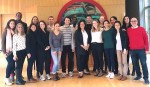
The Hon. Jody Wilson-Raybould, minister of justice and attorney general of Canada, centre, addressed Project Tikkun participants at Hillel BC on March 13. (photo from Hillel BC)
As the academic year winds down on university campuses across the province and students gear up for exams and summer jobs, 15 student leaders from the University of British Columbia and Simon Fraser University are also preparing for a totally different experience: a 16-day experiential learning and service trip to Rwanda and Israel.
Project Tikkun was developed by Hillel BC to challenge students to “understand the essence of hate by breaking down stereotypical thinking.” It is a yearlong program of learning that allows participants to explore the root causes of racism and antisemitism, culminating in a service trip to Rwanda and Israel between May 3 and 18.
The overseas component will enable participants to bear witness to how the diverse citizenry of two relatively young nation-states have grappled with a legacy of genocide. It will provide a firsthand examination of conflict resolution and reconciliation through the humanitarian work and activism pursued in each country to build durable and bonded communities.
According to its website, Project Tikkun brings together “undergraduate students of different ethnic backgrounds, religious practices, sexual orientation and personal beliefs to establish a caring and committed community of change-makers.”
Rebecca Recant, program director at Hillel BC, noted that the intent of the project is also to “build a local community of allies that can support each other when a [hateful] incident comes up, no matter which community.”
Student interest in the program exceeded the limited number of spaces and, last fall, a diverse group of 15 participants was selected. The group includes students of Chinese, Taiwanese, Indian, Korean, Persian and Rwandan backgrounds and a mix of the Jewish, Sikh, Baha’i and Christian faiths. The religious affiliation of the Jewish students varies – some come from secular homes whereas others were raised Orthodox; some have visited Israel and, for others, this will be their first trip to Eretz Yisrael.
Over the course of the year, the participants have been getting to know each other and examining their biases through intensive group learning sessions in which they have explored the history of Canada, Rwanda and Israel. A number of guest speakers, ranging from academics to community activists, have facilitated discussions. Of note, Dr. Andrew Baron, an assistant professor of psychology at UBC whose research examines the cultural and cognitive origins of unconscious bias, structured tests for Project Tikkun participants based on the Harvard Implicit Bias Test that he helped create. Jordana Shani, managing director of Hillel BC, explained that the testing of participants’ level of bias takes place at three different intervals: at the outset of the program, prior to departure and one to two months after return to Canada. The testing provides a way “to measure what we’ve done and how effective the program has been,” she said.
Certainly, much time, effort and money has been channeled into the program, especially the service trip. The journey begins in the capital city of Rwanda, Kigali, where local guides will accompany the students on a tour that will highlight the many landmarks and memorials of the 1994 genocide. The students will then travel to the Agahozo-Shalom Youth Village (ASYV), where they will spend the bulk of their time. Established in 2008 as a residential community-home to protect and nurture Rwandan children who were orphaned during and after the genocide, ASYV now cares for approximately 500 of Rwanda’s most vulnerable high school-aged students. It is modeled after Yemin Orde, an Israeli youth village founded in 1953 to care for orphans of the Holocaust, and it provides a family-like environment for at-risk youth.
The Rwandan students “grow up in this youth village hearing about the youth aliyah village in Israel that [ASYV] was based on,” said Recant. “It’s an Israeli model that is part of the connection between the two countries. They even know Hebrew words, like tikkun olam.”
At the youth village, Project Tikkun participants will learn and live side by side with the ASYV students and volunteer in the classrooms, on the farm and in the kitchen. They will accompany the ASYV students during their foray into town to fulfil a weekly community service commitment.
Libia Niyodusenga, a second-year UBC economics and geography student who was raised at the Agahozo-Shalom Youth Village, is looking forward to returning to Rwanda as part of Project Tikkun. “I think the country itself has the best ways and methods of teaching people through so many organizations that are based in Rwanda and so many history-based sites that you can learn from,” he said.
From Rwanda, Project Tikkun participants will travel to Israel, arriving on Yom Ha’atzmaut, where they will celebrate Israel’s independence in Jerusalem. Later, they will commemorate the victims of the Holocaust at Yad Vashem, tour the Old City and observe Shabbat before moving on to explore other parts of the country, including the Yemin Orde Youth Village. All the while, participants will learn from and volunteer with Israelis who are committed to combating intolerance and inequality – political, religious, ethno-cultural and socio-economic – to effect positive change within Israeli society.
The Israel portion of the trip will demonstrate that complex issues – both regional and domestic – defy the simplistic characterizations often portrayed by the media and that “you can love the country and be critical of it at the same time,” said Shani. The participants, she added, “will meet with people who believe in the right of Israel to exist and who are engaged to make it a better place.”
Jasmeet Khosa, a fourth-year student of international relations at UBC whose Sikh parents immigrated to Canada from Punjab, India, said: “I know that this project focuses on Rwanda and Israel as case studies [for conflict resolution and activism], but what I’ve learned so far is that this extends far beyond – [the message] is universal.”
By all accounts, Hillel BC is pleased with the results of the project thus far. Participants are inspired to help create positive change both at home and abroad and have developed a profound sense of strength through their diversity. As Khosa observed, “… the great thing is that we come from such different backgrounds – academically, culturally, religiously – that everyone brings their own perspective and we get a really great mix in that everyone has something unique to contribute to discussion and friendships, in general.” Niyodusenga added that the connections between program participants are already “deep and intimate.”
In reflecting on the many experiential learning and service trips that she participated in during university and how integral they were to forming her identity, Recant said, “Trips like this are life-changing.”
Shani and Recant are grateful for a grant from the Diamond Foundation that made Project Tikkun possible. While participants will pay a fee, the cost of the program is heavily subsidized to ensure that finances do not pose any obstacles. However, because of the decrease in the value of the Canadian dollar, Hillel BC is continuing to seek financial support for the program. For more information about Project Tikkun, visit projecttikkun.hillelbc.com; to make a donation, call 604-224-4748.
Alexis Pavlich is a Vancouver-based freelance reporter.