

Tasha Faye Evans shares a work in progress at Dance in Vancouver. (photo courtesy Scotiabank Dance Centre)
“With everything I do, I always ask myself, what is the medicine of this work? How is this dance, this play, this project, contributing to the greater health and well-being of my community? Who is this character speaking for? Who am I dedicating this work to? Then, when it comes time to perform,” said Tasha Faye Evans, “I am rarely nervous, because it’s not about me and my skills, its more about the work I am doing and who I am doing it for.”
Evans was speaking to the Independent in advance of Dance in Vancouver, which runs Nov. 20-24 at the Scotiabank Dance Centre. The dance and theatre artist, who has Coast Salish, Welsh and European-Jewish grandparents, is presenting t’emək’ʷqən-seed, a work in progress, in a free-to-attend double bill with Starr Muranko/Raven Spirit Dance on Nov. 22, 2 p.m. A moderated conversation with the artists will follow the performances.
“There is not a word in Coast Salish culture for art,” writes Evans on her website. “Our art is functional. Our dances, prayers. Our songs, blessings. I am an artist because I love fiercely and creating work is my way of having hope, preserving the sacred and imagining a better future for all our relations.”
“My own body of work has always been because I am not a blockader, I don’t write the letters to the people in charge, I am weary of shaking my fist in the air,” she told the Independent. “My dance, theatre and community work are my way of addressing a helplessness I feel in the face of the misused powers in the world. My community work is mostly about redress and recalibrating values to align with the original caregivers of these Coast Salish lands and waters. We all share in a sacred responsibility to ensure a future of health and well-being for all our relations, and my work is in service of this sacred responsibility.”
Evans’s choreography has been presented by various companies and she has participated in performances and festivals around the world. She has many projects on the go, in dance and more broadly. One initiative is In the Presence of Ancestors, an exhibition of five Coast Salish House posts being carved and raised in Port Moody along its Shoreline Trail. She was recognized for the
exhibit with a 2023 Edge Prize, which is given to leaders, or “Edgewalkers,” in the Salmon Nation, described on the prize’s website as “a bioregion defined by the historic range of wild Pacific salmon, from the Salinas River in California, north to the Yukon River in Alaska.”
seed was inspired by a sculpture created by Coast Salish artist James Harry.
“The sculpture was part of KWÍKWI – The Seventh, an exhibit James Harry and his partner Lauren Brevner dedicated to their daughter, the seventh generation born in James’s family since colonization,” said Evans. “seed draws upon what master carver Xwalacktun [James Harry] refers to as the Ancestor’s Eye or the Salish Eye, and the fundamental shapes and teachings of Coast Salish art and design, the sphere, crescent and trigon. The Salish Eye can be found carved into the oldest Coast Salish tools and, for that matter, I refer to these shapes as sxwōxwiyám, part of our original stories, written into the land and shared generation to generation, teaching us how to be human.”
Having collaborated with master carvers for more than a decade now, Evans said her “choreography experiments with how Coast Salish art and design can be expressed in movement, gesture and architecture of the space. I am developing a methodology that is based in the shapes and cultural teachings of the Ancestor’s Eye, the sphere, trigon, crescents, and the space in between. I am passionate about showcasing Coast Salish art form and culture and I am driven to share sxwōxwiyám and invoke a sacred responsibility in my audiences for all our relations.”
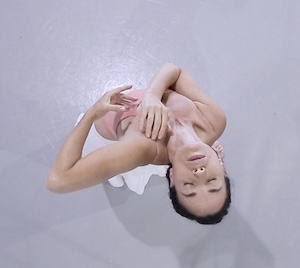
What people will see at Dance in Vancouver is “the tap root of t’emək’ʷqən-seed,” said Evans, “the first part of the work to grow, unfolding itself first towards the earth. I’ll be sharing that vulnerable moment of the creative process where the story is newly manifesting, taking root in the body and just beginning to grow.”
seed was commissioned by Odd Meridian Arts, whose artistic director is Ziyian Kwan. While in residence there, Evans created another work, Song.
“My connection with Odd Meridian Arts began decades ago when I was a shaved-head theatre kid and Ziyian was one of those dancers I’d see on posters and just stare at in awe,” shared Evans. “She’s always represented ambition for me and what a successful career as an artist looks like. (I don’t think I’ve told her this.) Ziyian has always been one of those artists whom I could only aspire to be.”
It was during COVID that Evans said she “got over” herself and responded to a message Kwan had posted on Facebook.
“Song was also a seed,” said Evans. “It was a section of a larger piece I am still creating called Cedar Woman. It was a landing piece in my creative process, when I was exploring how to re-member myself to a legacy of Coast Salish women. I follow the song I hear calling me in my heart. The dance is a journey through the song, all the way back in time to my first grandmother, singing the song as prayer for her grandchildren during the great flood. I don’t dance Song the same in Cedar Woman any longer, but the core of Song, is finding itself in seed.”
For Evans, being part of such diverse ancestry, holding space for her Coast Salish, Welsh and Jewish heritage, is challenging.
“For much of my adult life, it has been learning how to sit in the circle within my Indigenous community,” she said.
“I didn’t grow up in Jewish culture more than our comfort foods like chicken soup, matzah, and lox and cream cheese. We did not practise being Jewish and I learned very little about this part of me other than the trauma we all carry. For years, I wore a Star of David, mostly because it was a gift from my Nana. Sometimes, I feel my Jewish great-grandmother Faye nudging me disgruntledly until I mention her name, too, when I introduce myself. I’m not sure how to hold being Jewish in this body while living here in these Coast Salish lands and waters.
“There is a piece I’d like to create for my GG Faye, actually. I have a long mink coat that reminds me of one of the photos I have of her, taken just before World War II. I know she’d really appreciate that and I welcome the parts of me I would discover dancing for her.”
Her Welsh heritage has also been less explored, but, said Evans, “I have always longed to go to Wales. To dance on those lands and waters and listen to the language calls me for sure.
“While it’s these Coast Salish lands and stories that dance in me the loudest, I do honour that I am the dream of all my ancestors.”
Dance in Vancouver also features a work by Action at a Distance/Vanessa Goodman on Nov. 23 and DIV Unstructured on Nov. 24 includes Idan Cohen/Ne.Sans Opera & Dance. For more information and tickets, visit thedancecentre.ca.