
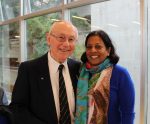
Robbie Waisman and Dr. Uma Kumar
spoke Jan. 24 at UBC’s Hillel House. (photo from Hillel BC)
History’s resonance in the present was a recurring theme at a commemoration of International Holocaust Remembrance Day last week.
The event at Hillel House on the University of British Columbia campus, featured Holocaust survivor Robbie Waisman speaking about his experiences in Buchenwald concentration camp and his life before and after the Shoah.
Thirteen survivors of the Holocaust lit yahrzeit candles, after which Hillel’s Rabbi Philip Bregman chanted the Mourners’ Kaddish.
Before Waisman’s presentation, the audience watched a 1985 video from CBC television’s national program The Journal, which followed Waisman as he traveled to Philadelphia to meet Leon Bass, the American soldier who had liberated him from the camp 40 years earlier.
Bass, an African-American, was the first black person Waisman had ever seen. At the age of 13, Waisman thought Bass and his fellow American soldiers must be angels.
“Indeed, they were,” he said.
At the event Jan. 24, which was co-sponsored by the Vancouver Holocaust Education Centre, Hillel BC, the Centre for Israel and Jewish Affairs and UBC’s department of Central, Eastern and Northern European Studies (CENES), Waisman said the thing that kept him and his fellow survivors alive was the hope of being reunited with family.
“The enormity of the Holocaust was not yet known to us,” said Waisman. When it did become known, he said, “we had to find a way to deal and cope with the huge loss of all our loved ones.… How are we going to live with all these horrors?… Has anyone survived? If not, what is the point of my own survival?”
He and his father had seen one of Waisman’s brothers murdered, and his father died later in the same camp. He would learn that his mother and his other three brothers were also murdered, as were his uncles, aunts, cousins and friends. Of the family, only Waisman and his sister survived.
“I search for answers,” he said. “I only find more questions. How could anyone remain sane and functioning as a human being when humanity was destroyed in front of our eyes? Worst of all, how do you come to terms with the tragic loss of all our loved ones, fathers, mothers, brothers, sisters, friends that we grew up with, all innocent – everything gone – how is it possible? We started questioning the existence of God. How could this happen to us?… Before the war, we all came from Orthodox homes, rich in heritage and traditions. After coming out of the terrible abyss, the darkness, we questioned angrily. But what we learned in the home, from our parents, was not lost. The sense of humanity slowly returned to us. Our faith was shaken yet, in spite of it all, we remained true to it.”
Waisman said his experience in the Holocaust, and the experience of other survivors, has taught that “evil must be recognized and that we all have a responsibility to make sure that it never happens again to anyone. And yet … what is the world doing about it now?”
He reflected on the concept of “Never again.”
“Noble, thought-provoking words, but only if we act upon them,” he said. “Today, over 70 years after my liberation, the promise of never again has become again and again. There have been a number of situations that have tested the world’s resolve, in Cambodia, the former Yugoslavia, in Darfur and in Syria – I could go on and on.
“When I speak at high schools, I try to convey to students the pain of my experience in order to inspire them to prevent such events from occurring again,” he said. “The world must learn from the past in order to make this a better place for now and the future. We must teach compassion, we must eradicate racism and religious persecution. We must teach ourselves, teach our children, each generation must learn.”
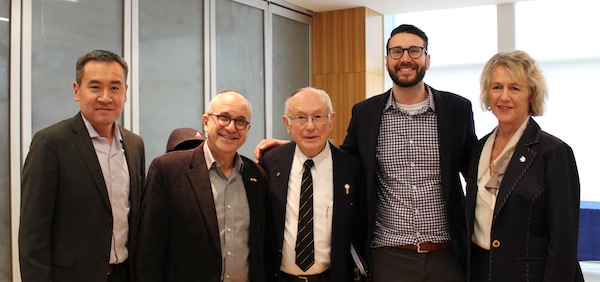
Also at the Jan. 24 event, Dr. Uma Kumar, a lecturer with CENES, noted recent reports that indicate many Canadians and others are ignorant of the most basic facts of the Holocaust.
“Nearly half of Canadians cannot name a single concentration camp or ghetto that existed in Europe during the Shoah,” she said. “However, there is a positive point: 85% of the respondents of the study said that it was important to keep teaching about the Holocaust so that it does not happen again. Hence, there is a pressing need for more and better Holocaust education at schools and universities in Canada. We, as Holocaust educators, still have a lot of work to do.”
Joyce Murray, member of Parliament for Vancouver Quadra, brought greetings on behalf of the federal government and also reflected on her visit last year to Auschwitz.
“The Holocaust reality, for me, shifted from being a part of history that I thought I understood and regretted to a reality that I feel in my body and in my heart,” she said. “Commemorating mass atrocity and genocide in the continued sharing of the story of survivors is a vital part of prevention. These stories serve as a reminder of the dangers of hate, prejudice and discrimination, the dangers of seeing human beings as ‘us’ and ‘them,’ the dangers of excessive nationalism to the detriment of others that is stalking so many nations today.”
Murray also mentioned the Canadian government’s recent apology for refusing admission to passengers on the MS St. Louis in 1939 and reminded the audience that Canada is not immune to bigotry.
Michael Lee, member of the B.C. legislature for Vancouver-Langara, was also present.
International Holocaust Remembrance Day was officially marked worldwide on Jan. 27, the date when Allied forces liberated the Auschwitz-Birkenau concentration camps in 1945. Another ceremony and a film screening took place Sunday at the Peretz Centre.
For more about Waisman’s Holocaust experience, see the Independent story Feb. 28, 2014, at jewishindependent.ca/holocaust-survivor-robbie-waisman-receives-national-honor.