Immersive art experience

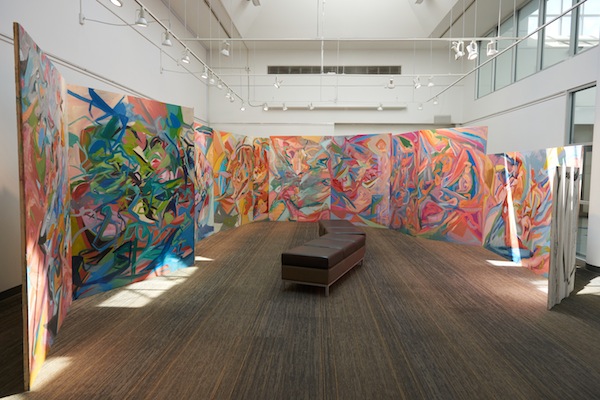
Marty Katzoff’s The Light Within the Shell was created specifically for the Zack Gallery. (photo by Lauren Zbarsky)

The Light Within the Shell exhibit opened at the Zack Gallery on July 4. There is a sign beside the door: “This space is meant to be explored. Wander, sit, experience, enjoy.” The show was created specifically for the gallery.

Created by artist Marty Katzoff, it doesn’t involve traditional paintings hanging on the walls. Instead, it looks like a huge folding screen comprised of a dozen panels. They encircle the room, leaving only a narrow passageway along the walls. Each panel has a colourful abstract painting on its inside surface and a black and white image on its outside. A few small copper sculptures scattered outside the enclosed space complete the installation. Viewers are invited to sit down and meditate on the benches inside the vibrant shell of the exhibit or wander along the outer passageway.

Born in Rhode Island, Katzoff grew up playing sports. “I didn’t do much art until my teenage years,” he told the Independent. “I was going through difficult times in high school. My friend was an artist. She introduced me to the arts. I started making collages and found it therapeutic.”

He never completed high school and worked a variety of jobs. “For the next 10 years, I worked in construction, in restaurants,” he recalled. “And, all that time, I made art. I taught myself to paint. Then I went back to school and completed my BA at Bard College in New York.”

For years, Katzoff worked as an artist in New York, created large murals in indoor and outdoor spaces. He graduated from the University of British Columbia’s master of fine arts program in 2021.
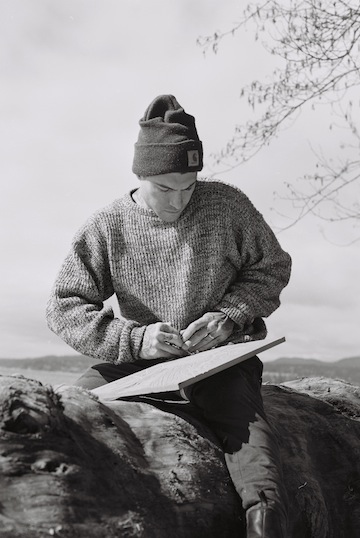
photo - Artist Marty Katzoff at work
Artist Marty Katzoff at work. (photo by Lauren Zbarsky)

His artistic education vaguely coincided with his newly found fascination with kabbalah, specifically the Tanya, which he has been studying for the past few years. “Before, I had separate ideas about art and spirituality. Now, I’m exploring how Jewish learning is connected to my art, how mythology and tradition transform my spiritual life into my paintings,” he said.

As a child, Katzoff went to a Jewish day school, but kabbalah offered him a different perspective. “I started with a book by Gershom Sholem. Before, I always painted with music in the background. This project is the first I’ve ever done without listening to music. I listened to kabbalah lectures online while I painted. I wanted to discover what I could create while listening to something complex and different … [by the late] Rabbi Yehoshua B. Gordon.”

The idea for the current installation came to him when he was finishing his graduate program at UBC. “One of our family friends lives in Vancouver,” Katzoff explained. “She is Jewish and she told me about the Zack Gallery. I submitted the proposal, and it was accepted. I wanted to create an installation specifically for the gallery, an interactive space, a visualization of light. This show took me 11 months to complete.”

Katzoff sees this exhibit as an amalgam of dreams, painting, architecture, Jewish learning and personal symbolism. Vancouver artist Rosamunde Bordos’s essay about the show, which is available in the gallery, expresses her visual composition in words.

Katzoff’s media, the plywood panels, are all recycled materials. “I have a friend who works in art shipping,” he said. “They ship large pieces in plywood crates. That was where the panels came from. Some of them have holes, so customs could look inside the crates to see the art. I painted around the holes. It was like a collaboration with someone else.”

The size of the panels, some of them taller than a person, left him undaunted. “I always liked to work on a large scale,” he said. “That’s why I did murals in New York.”

His oil paints are also recycled. “I use lots of recycled materials in my art,” he said. “My grandmother was an artist. She gave me her entire collection of pigments for the oil paints I use. I’ll probably work with her paints for the next decade.”

In addition to painting, Katzoff also works as a printmaker. Currently, he teaches printmaking at UBC as a sessional instructor. “For me, printmaking provides the connection with literature, with storytelling and history,” he said. “My brain seems to process that connection better while I’m drawing and etching. My drawings are illustrations, while my painting remains more like a therapeutic activity.”

His abstract copper sculptures, several of which are included in the exhibit, grew organically out of his printmaking. “I make my sculptures reusing the copperplates from my prints,” he said. “I have lots of copper plates. Copper was an important part of Judaism and, after I use the plates for prints, I want to share the metal, recycle it. I make sculptures from it. I also make bracelets and amulets. You can see the remains of the etching if you look closely.”

To learn more, check out martinkatzoff.com. The Light Within the Shell is on display until Aug. 22.

Olga Livshin is a Vancouver freelance writer. She can be reached at olgagodim@gmail.com.
Picturing connections

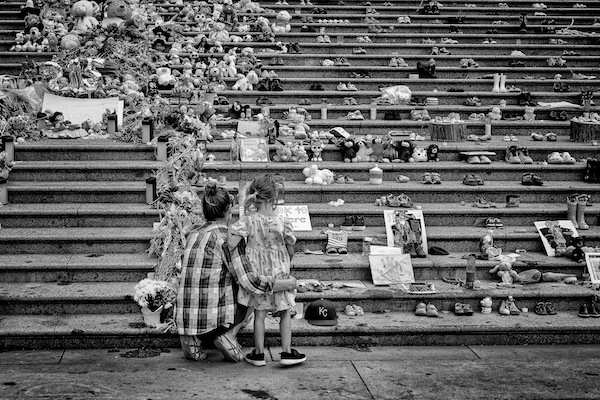
“Remembrance” by Michael Shevloff. Part of PhotoClub Vancouver’s Connections exhibit at Zack Gallery until June 27.

Whenever a photographer – amateur or experienced – snaps a picture, they establish a connection between themself and their subject. They shout to the world that this image at this time and in this place is an important occurrence and should be preserved and treasured.

The PhotoClub Vancouver group show, Connections, opened June 2 at the Zack Gallery. People and birds, industrial cityscapes and soothing nature shots, close-ups and panoramas – every image in the exhibit tells a story about the world and the photographer’s place in it.

The club was officially established in 1998. Its friendly, non-competitive environment for photographers of all skill levels encourages members to develop their technical and artistic abilities through various activities, including peer critique, field trips, workshops and seminars. And, of course, exhibitions like Connections, which allow members to share their art beyond the group.

Some of the photographers took the Connections theme literally, like Ivor Levin’s “Roped In.” The orange ropes in the image are taut and sure, but the objects they hold together are left outside the frame. Only the connection itself is important to the artist.

A similar approach characterizes Lynn Copeland’s “Cranes and Planes.” The image’s graphic simplicity is almost abstract, as the harsh lines of the industrial cityscape, viewed on the background of the distant sky, induces the sense of a steel labyrinth where any uninitiated human would be lost.

Barb Kaiser’s “Hanging Around” also includes ropes as the connecting medium, but the feeling it inspires is vastly different. A window washer hangs in his harness in the foreground, doing his job. Behind him, a skyscraper-studded panorama of North Vancouver is visible in all its urban majesty. We are all connected, the image seems to say, in every window of every building.

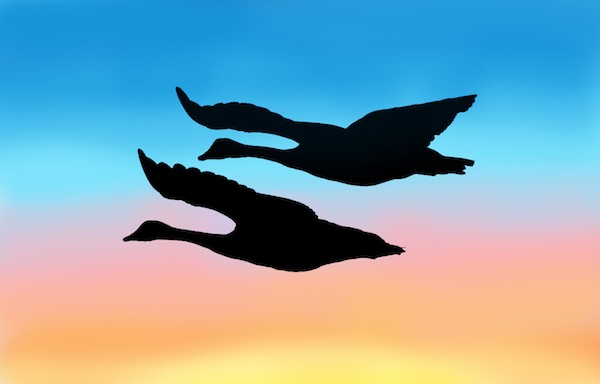
Unlike the stark, sharp-angled industrial imagery, logical and attractive on a cerebral level, the pictures reflecting nature flaunt softer lines. They appeal to our emotions. For example, Terry Beaupre’s “Canada Geese Flying Off Together” depicts two geese. Their dark silhouettes soaring together on the background of a pink sunset evoke ideas of love and companionship. “I couldn’t have asked them to pose more perfectly for me,” Beaupre says in her artist’s statement, although she admits that she painted the dramatic colours of the sunset later on, to enhance the picture.

photo - Terry Beaupre’s “Canada Geese Flying Off Together”
Terry Beaupre’s “Canada Geese Flying Off Together.”

The grace of a couple in love is also implied in another bird picture – Levin’s “Peck.” The two doves in the image are sharing a kiss. Or maybe they are sharing a bug to eat. Whatever they are sharing, their affection for each other is unmistakable and heartwarming.

The charm of the loving doves is absent in Drago Tutnjevic’s “Bus Stop.” The four people standing in line to board a bus are strangers. Their estrangement is made even more obvious by the fact that three of them are absorbed in their phones. The one not on the phone looks straight ahead, thinking her own thoughts. No doubt, each of the passengers has multiple connections – their friends, family and others – but here, at this bus stop, nothing connects them except the expectation of the bus itself. The photo reflects the complex networks that link us all, as well as the separateness of every person in our huge technology-permeated world.

In contrast, a simple path in the park, portrayed in John Konovsky’s “Onward No Matter What,” reminds us of the mysteries of childhood adventures and the romantic wandering of our youth.

Another image reminiscent of the joy of childhood is David Beaver’s “Balloon Man.” Even in black and white, the man holding bunches of balloons in both hands brings to mind birthday parties and vacation frolicking. The photo is part of the club’s Henry Ballon B&W Challenge.

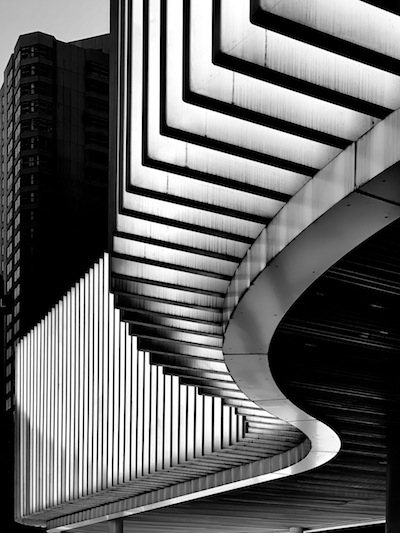
photo - "Line S" by Ivor Levin
“Line S” by Ivor Levin.

An entire wall of the gallery is reserved for the black and white photographs, by different photographers, all parts of the challenge, which was started in 2015 in memory of the late Henry Ballon. Ballon was an avid monochrome photographer and advocated photography with minimum retouching by any software. Club members honour Ballon by creating their own art using his principles. The photos demonstrate how deep the artists can reach, even if their expression palette is limited to the gradations of black and white.

But the most visceral and poignant image in this exhibition is “Remembrance” by Michael Shevloff. A mother crouches beside her young daughter in front of a staircase. Their backs are to the viewer. They face the stairs together, just like everyone who looks at this photograph. And on the stairs reside memories. Toys. Shoes. Hats. Books. No people. What does this young mother tell her child? Who were the owners of the objects on this staircase? What happened to them? Where? When? The photograph raises many questions, and all of them remain unanswered – unless the artist decides to answer them, which Shevloff did.

“The photo was taken at the Vancouver Art Gallery, where there was an outdoor installation commemorating the discovery of the unmarked graves found at a residential school recently. It affected many people and brought a dark period of history to light. Flags were lowered across Canada for many months.

“I took the photo on July 1st of 2021. Normally on Canada Day, there are parades and many people celebrating our history. However, last year, with the pandemic and the dark events I mentioned above, it seemed like no one was celebrating our national day.

“In the photo a woman is talking to her child. In my mind, I tried to imagine how she would be explaining the memorial and the events surrounding it to her daughter. Just as the memory of the dead children is elicited by the installation, the mother and child are also photographed from behind and also remain nameless in time.”

Connections is on display until June 27. For more information, check out photoclubvancouver.com.

Olga Livshin is a Vancouver freelance writer. She can be reached at olgagodim@gmail.com.
Sculpting emotion with glass

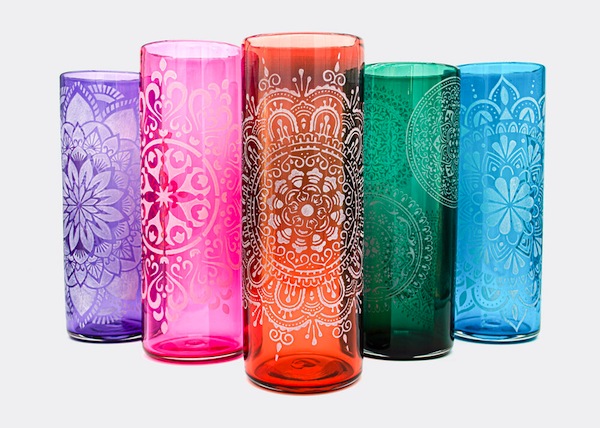
Some of Tara Pawson’s Human Beams. (photo from Tara Pawson)

Tara Pawson’s fascination with glass began when she was in high school.

“My dad was a welder,” she said. “He would bring home some metal pieces, and I would fabricate some garden art in our garage. Then, I got a birthday present – a weeklong class of glass-blowing – and I knew that was what I wanted to do with my life. Before that class, I was planning to go to a culinary school after graduation. After it, nothing else but glass.”

Pawson’s solo show, Human Beams, opened on March 22 at the Zack Gallery.

“Glass is a fascinating medium,” Pawson told the Independent. “It combines all the elements: air, fire, wood, metal, water. It is labour-intensive and demanding, and the results are beautiful and fragile. There is a contradiction there.”

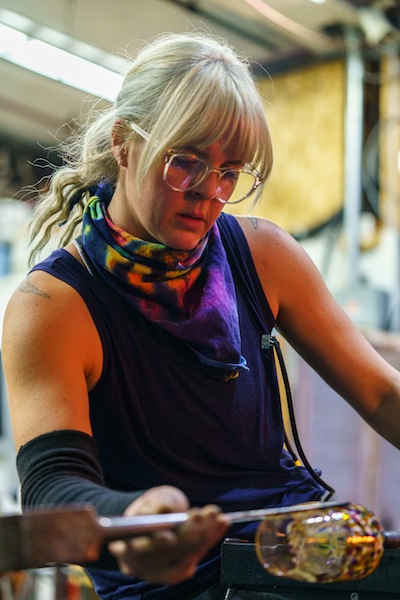
photo - Glass artist Tara Pawson at work
Glass artist Tara Pawson at work. (photo from Tara Pawson)

Pawson enjoys the process of glass-blowing – despite its inherent danger. “It’s like a game to me,” she said. “I’m not afraid of getting hurt. I have been once or twice, but I love doing it all the same…. When a piece is finished, I always want to do it again, in a different way.”

She loves the functionality of glass, its accessibility to everyone in the forms of glassware or candelabras. “I’m not drawn to huge installations. I want to make art for the people,” she said, “for their homes and their hearts.”

Pawson doesn’t have a classical art education, but she has taken many workshops in a wide variety of glass-blowing techniques over the years. “I apprenticed and I learned,” she said.

At 21, she found a job with Robert Held Art Glass.

“The company created giftware and home decor,” she said. “I learned a great deal there. It was a full-time job, and I did everything: glass-blowing, sales, cleaning. I stayed with them for about eight years. During the week, I worked for the company, but on the weekends, they allowed me to use their glass-blowing equipment, and I started making things for myself.”

Then she moved to a company that created glass light fixtures. “There, I learned to work with a different type of glass, different styles, different process,” she said.

About six years ago, Pawson decided to become an independent glass artist. “After my youngest son was born, it was time,” she said. “I wanted to make my own hours and [have] no commute to work, so I could spend more time with my family.”

For the equipment, she joined Terminal City Glass Coop and rents time when it suits her schedule. She makes some unique artworks.

“I make glass gifts and I make memorial pieces that are very popular,” she said. “Those memorial keepsakes are small glass baubles – hearts or orbs or coins – which incorporate tiny amounts of cremains within the glass matrix. The result is a treasured heirloom. I can make them for several family members, so they will always have a keepsake to remember their loved ones. People love them. One client of mine said she always wanted to travel with her father. After he died, she took the glass marble with his ashes on her travels, so he was with her everywhere. This way, she had no problems with customs – an urn with his ashes might be much harder to pass through customs.”

Pawson’s giftware includes vases and glasses, paperweights and funky little “monsters,” candleholders and Christmas ornaments. She sells her glass in several stores in British Columbia, Alberta and Ontario, as well as online, through her website and her Etsy shop. She is also an active participant in many seasonal markets. Recently, she created a new collection of glass beams, which are included in her current show at the Zack.

“My mother passed away shortly before the COVID lockdown started,” Pawson explained. “I was dealing with my grief and I felt alone in the pandemic. Everything was closed. So I started working on these glass pieces. They helped me process my grief. I thought, maybe I could share it, help others. I never had an art show before. I started asking around how to go about it, whom to approach. I know Hope [Forstenzer] through the Terminal City Glass Coop. I asked for her advice, and she said: ‘Why don’t you apply at the JCC? We have a gallery there.’ I did. This is my first show.”

The show at the Zack, where Forstenzer is director, displays three distinct lines: Human Beams glassware, Thought Towers sculptures and Pearls of Light wall decorations. The Human Beams series works are tall cylindrical glasses of different colours, decorated with mandalas.

“The cylinders start as dark shadowy forms and flow into the bright beams of light,” Pawson said. “They reflect the timeline of the dark days, when the trauma begins, and grow organically towards the light days, when you find peace.”

She explained the symbolism of a mandala, which “represents the universe in Hinduism and Buddhism,” she said. “Their circular design without beginnings or ends is a symbol of a spiritual journey. They illustrate the events, memories and thoughts we have when the emotion of grief consumes us. Some days are darker than others, but, with time, work and support, we learn to ride those waves…. I hand-carved every mandala on every glass. It took me about four hours for each mandala. I think I’m done with them for awhile.”

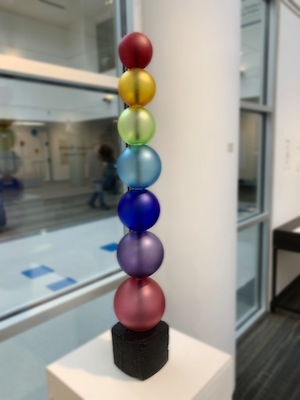
photo - One of Tara Pawson’s Thought Towers
One of Tara Pawson’s Thought Towers. (photo from Tara Pawson)

The Thought Towers are sculptural compositions, orbs of various sizes and colours growing like a tree out of each other. The lighter, bigger orbs echo lighter emotions, like hope or joy, but they are always interspaced with small dark orbs of desperation, guilt or anger. “The Thought Towers convey a spectrum of emotions,” said Pawson. “As we deal with grief, we have good days and bad days. Anything could trigger a crippling emotional response – a song, an image, a TV episode. But we have to remember that good days always follow the bad ones.”

And then, there are the Pearls, each one hand-formed, each a complex and beautiful glass tablet. “Each one is a person or an event we encounter in our daily lives,” Pawson said. “Pearls of Light, or Baily’s Beads, are a phenomenon seen during a sun eclipse. These spots of light encircle the moon. They resemble a string of luminous beads, visible immediately before and after a total eclipse. They are the people around us, our family and friends.”

Pawson’s exhibit is on display until April 28. For more information about her and her work, visit her website, tarapawson.com.

Olga Livshin is a Vancouver freelance writer. She can be reached at olgagodim@gmail.com.
Gallery’s new guides

New docent program at the Zack gets underway. (photo from Zack Gallery)

Sidney and Gertrude Zack Gallery director Hope Forstenzer recently instituted a new docent program, to train guides for the art gallery.

“I came up with the idea of creating a group of volunteer docents for the gallery right after I got here, which means right before the pandemic,” Forstenzer told the Independent.

Unfortunately, the pandemic made it impossible to implement the idea at that time, and the initiative only became reality in the past few months.

“My job as the gallery director is only half-time,” Forstenzer said. “Even when I’m working, I’m frequently in meetings or visiting studios or doing other work that takes me away from engaging the people in the gallery. I created the docent program to make sure the gallery was staffed with friendly and available faces, with people who knew about the shows, could make sales, and could answer questions.”

Initially, about a dozen people responded to her invitation to become volunteer docents at the Zack. “Some dropped out for various reasons as we were getting underway,” she said. “Others have come along since.

Currently, we have six docents on our active roster.”

Before the docents could perform their assigned duties, they needed a certain amount of training on the gallery rules and procedures.

“The docents each attended two training sessions, both lasting about an hour,” said Forstenzer. “Sometimes, we’d do the whole training in one session, but it varied. The second training shift was usually about our sales system, which isn’t difficult, but isn’t something most of the docents have seen or used before. In the first training session, I explained what their responsibilities were, we discussed scheduling, and I’d either show them how to use our sales system or invite them back to learn it on a different day…. Then they did a shift with me in the gallery as backup. Then they were ready to go.”

The first docent started at the Zack last October. “Some of them have taken breaks due to the Omicron,” said Forstenzer, “but others have stayed throughout.”

She has lots of plans for her volunteer docents. “The primary purpose of having the docents in the gallery right now is to have a knowledgeable and friendly presence that welcomes visitors,” she said. “They can also make sales. As the restrictions due to COVID lift (hopefully), the docents will also help me run events in the gallery, both for kids and for adult groups. Eventually, I hope they’ll be able to run some of these events themselves. We might even schedule some docent-led viewings of shows.”

At the moment, most docents do one shift a week, each shift three or four hours long, but Forstenzer is flexible about that. “Some do two shifts a week. Some split their shifts and go for a swim or a workout in the middle and then come back. It is up to them, and I create a schedule based on their availability and the gallery’s needs.”

She added that all the docents take their volunteering seriously. “If someone can’t make their shift, they let me know,” she said. “If I can cover it, I will. If not, the gallery won’t have a docent that day.”

The docents vary widely in age and experience. Some are students. Others are retirees or people participating in various community centre programs. Gail Bloom shared with the Independent a bit about herself and why she became a docent at the gallery.

Bloom worked as a city planner in San Francisco. “I studied city planning in college and then worked as a practising planner,” she said. “I love cities and was interested in public utilities. My chief role for over a dozen years was sorting out public financing of major infrastructure projects in San Francisco.  It was very satisfying to see the fruition of that work across the city.”

She retired about 20 years ago. “My home is still in the Bay Area. I live there with my husband, and my son’s family also live nearby, but, last fall, I came to Vancouver for an extended winter visit with my daughter – she lives here and teaches at Emily Carr.”

Bloom, who turns 70 this month, has been volunteering in many fields since her retirement. “I lead the Board of Children’s Book Project and presently serve on a regional public health agency at the Marin/Sonoma Mosquito and Vector Control District,” she said. “I have also enjoyed working on state, local and federal election campaigns, mentoring youths, and helping with the major fundraising event for the Oakland Museum of California.”

She has always been interested in art. “I love cities, as I said, and the museums are a big part of that – especially art museums. In the last couple months, I visited the Vancouver Art Gallery and a small community gallery at the Deep Cove Cultural Centre. There is a show at the VAG now that I’d recommend – Emily Carr and Edith Heath. Heath was a local San Francisco ceramic artist; she started her iconic tile and pottery company out of her little apartment in San Francisco in the ’40s.”

Of course, when she visited the Jewish Community Centre of Greater Vancouver for the first time, the Zack Gallery attracted her. “As I’m interested in the arts personally and enjoy art museums, their new docent program seemed like a good fit,” she said. “And my family were thrilled that I found the gallery and something meaningful to do with my time. Now, I’m at the gallery every week. My docent days are Mondays.”

Besides volunteering, Bloom takes advantage of several other programs the JCC offers. “The aquatics program is pretty great,” she said. “I also attended several sessions of the book fair last month, and I just started watching VJFF [Vancouver Jewish Film Festival]. I’m fortunate to have time to participate in them all.”

Olga Livshin is a Vancouver freelance writer. She can be reached at olgagodim@gmail.com.
Artwork of belonging

Mike Levin’s “Waiting for the Train.”

Community Longing and Belonging is a community art show in celebration of Jewish Disability Awareness and Inclusion Month. It opened at the Zack Gallery on Feb. 14.

Curated by Leamore Cohen, inclusion services coordinator at the Jewish Community Centre of Greater Vancouver, the fourth annual exhibit once again considers the questions, How do we make meaning of the concept of community, the real and the imagined spaces we inhabit? What does community longing look like and what are the possibilities for belonging in an ever-changing world?

Many of the pieces on display were made by artists from JCC Art Hive, a free and low-barrier program for artists with diverse needs. The collection comprises the work of diverse artists, with different levels of experience, perspective, faith and social location.

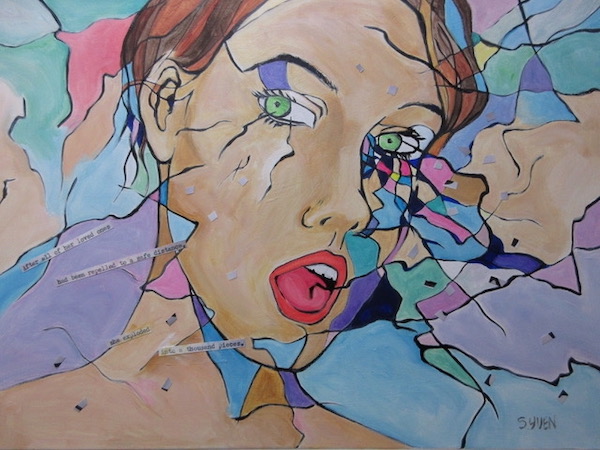
One of those featured is award-winning artist and writer Sandra Yuen, who is a member of Kickstart Disability Arts and Culture. Her piece, “Exploded,” is based on the prose of Derrick Bauman, an artist and writer, and influenced by pop art, Roy Lichtenstein, and graphic design. In her artist’s statement, Yuen writes, “As a person with schizophrenia, I wanted to express the fractured mind, the cut edges, the shattering of my life experience because of mental illness. However, this rendition is more a poetic image versus the cruel reality of living in madness, paranoia, hysteria and anger. The colours are sweet, the black lines clean and sharp, creating a mythological or romanticized view of insanity. I try to whitewash my life, sanitize the pain out of it, deny the diagnosis, but the illness remains, the weakness, the flaws, the humanity.”

photo - “Exploded” by Sandra Yuen
“Exploded” by Sandra Yuen

Mike Levin’s “Waiting for the Train” is about being shrouded in darkness, yet feeling the abundance of sunshine not far away. It is a metaphor for the continued longing for COVID to end so that we can get back to normal living.

Levin’s paintings are often abstractions of nature or city life that conform to structure of composition. They are amalgamations conjured from his imagination, photos he has taken and memories of his experience of exploring.

Growing up in Calgary, Levin has practised art from a young age, and also plays clarinet and saxophone. He attended the University of Calgary’s fine arts and urban studies programs and, after moving to Vancouver, completed his bachelor’s degree in fine arts at Emily Carr University of Art + Design in 2020.

For the past 20 years, Levin has lived with schizo-affective disorder, which he controls through medication and being active in the arts and mental health communities. He has taught drawing and painting at Vancouver General Hospital, the Art Studios, Gallery Gachet and privately within the community; he also works part-time in carpentry. His art has been sold in Canada and the United States to more than 70 private collectors.

Mark Li is a Vancouver-based visual artist whose narrative-focused work creates a whimsical world filled with colour and imagination, as his untitled work in this exhibit shows. Every painting is a tale of friendship and acts of kindness: a bear might be best friends with a cat; a T-Rex smiles with shy humour and sweetness at the viewer; a lady bug and a cat might go dancing in the sunlight; a simple walk in the park with a friend and his dog is a delightful adventure – anything could happen and they could meet anyone.

photo - “Untitled” by Mark Li
“Untitled” by Mark Li

Rickie Sugars’ “Like Minded” is an example of his unique style of painting in abstract cubism expressionism, using bold colours and black outlines.

A seasoned professional artist, Sugars had his first gallery showing, and sold his first painting, at the age of 17. Since then, he has displayed and sold his art in several galleries and art shows throughout British Columbia.

Sugars is a classical animation graduate from Vancouver Film School. He started creating animated characters well before graduation, resulting in a partnership in an animation company that went on for many years. Continuing his artistic path, he began tattooing in 2004 and has his own tattoo shop. He also designs sculptures created from broken toys.

A few years ago, during an attempt to assist a woman who was being attacked, Sugars received a traumatic brain injury. He had to re-learn everything, including how to talk – however, it did not stop his artistic endeavours. Today, you will find Sugars painting on canvass (or any surface, really), crafting stickers, postcards, wall murals, sand and wood sculptures, and interior/exterior commissioned graffiti.

“My artwork is influenced by media, fads, plus social, political and cultural issues,” he writes in his artist statement. He wants viewers “to look past the obvious, to treasure and celebrate the unique, the unconventional, the familiar: and to be nonjudgmental. Respect others and support them for who they are. Find the beauty in broken toys, an old door, a broken guitar – take time to look more carefully at things around you and you’ll discover beauty in unusual places.”

Another of the artists contributing to the Community Longing and Belonging exhibit is Adrianne Fitch.

Born in Kew Gardens, Queens, N.Y., Fitch studied English and writing at Pennsylvania State University and has traveled all over the world, including living and studying in Israel. She has lived in Vancouver since 2008 and pursues a number of other art forms. She is also a writer and desktop publisher.

“Having lived with a hearing disability and also struggled with depression all my life,” she writes, “I definitely know what it means to feel isolated. As hearing loss is invisible, people frequently make assumptions about me (e.g. they think I’m stupid, stoned or purposely ignoring them). As I did not begin learning ASL until adulthood, I occupy that grey area between the hearing and deaf worlds. I miss a great deal of communication, both spoken and signed, and have often felt as though I don’t belong anywhere.

“That’s why this art show’s theme, Community Longing and Belonging, is so significant and meaningful to me. Indeed, I have always longed for community and belonging. The Jewish community, with its wonderful heritage and incredible diversity, is very precious to me. In creating these three ceramic menorahs, I have tried to express this diversity, as well as my love for the Jewish people.”

Community Longing and Belonging is at the Zack Gallery until March 17. There is a virtual meet-and-greet with the artists on March 2. Visit jccgv.com/art-and-culture/gallery or email Cohen, leamore@jccgv.bc.ca, for more information.

– Courtesy Jewish Community Centre of Greater Vancouver

A chance to journal, create

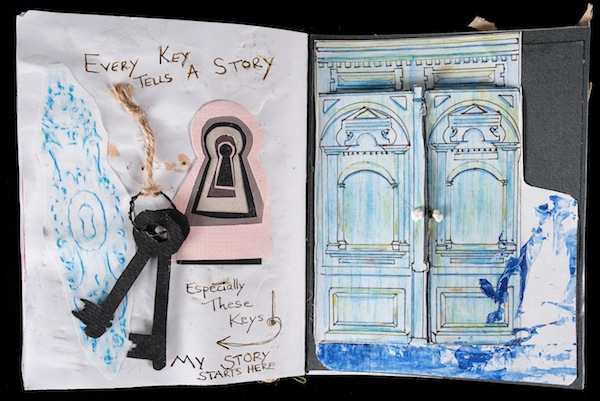
Kathy Bilinsky’s two-page collage makes us wonder what story – or two or three or more – we could find behind the mysterious ornate blue door. (photo by Byron Dauncey)

The Sketchbook Show officially opened at the Zack Gallery on Jan. 12. The brainchild of Hope Forstenzer, gallery director, and Lisa Cohen Quay, coordinator of the Jewish Community Centre of Greater Vancouver’s Adults 55+ program, the exhibit is the culmination of a journaling workshop.

“We wanted to give JCC members the opportunity to say what they felt about COVID and everything else in their lives,” Forstenzer told the Independent. She offered the gallery as a place for the in-person workshop and invited instructor Lex Ireton to lead it.

photo - Lex Ireton led the workshop that resulted to the Zack Gallery’s current exhibit, the Sketchbook Show
Lex Ireton led the workshop that resulted to the Zack Gallery’s current exhibit, the Sketchbook Show. (photo from Lex Ireton)

Ireton, a graduate of Alberta College of Art and Design, and Forstenzer know each other through their work as glass artists.

“I recently went back to school to get an art therapy diploma,” said Ireton. “When Hope contacted me about the workshop she had in mind, I was excited. I’ve taught art classes before, but this one was my first class for adults.”

Putting It All Down: A Creative Journaling Workshop started in the fall of 2021, well into the second year of the pandemic.

“The beauty of journaling is that you don’t have to be an artist,” said Ireton. “We provided all the participants with blank journals plus writing, drawing and crafting supplies. And they had the gallery space itself to work together and create.”

Although more people initially came to the workshop, only six participants stayed to the end. “We met once a week for eight weeks,” Ireton said. “Everyone wore masks, of course. I came up with an exercise, and we did it during the session, sometimes timed, sometimes not. Often, people were so involved, they continued the work at home.”

One of the exercises was called 30 Circles. Ireton explained: “I gave each participant a sheet with 30 empty circles and asked them to fill each circle in any way they chose: a line, a colour, words, images. The circles could be filled thematically or not. Nobody was forced to fill all the circles. Just a few could spark a direction the person wanted to go. It was a warm-up activity, a way to explore the materials and ideas without the pressures of a final completed project. Later, we used the circles as inspirations for journal pages or utilized them for collages.”

Another exercise was a thematic prompt to fire participants’ imaginations, so they could write or draw on a subject. Some wrote poetry or essays. Others did collages using materials they wanted: old magazines, coloured paper, their own paintings or drawings, dry leaves and flowers, fabric fragments.

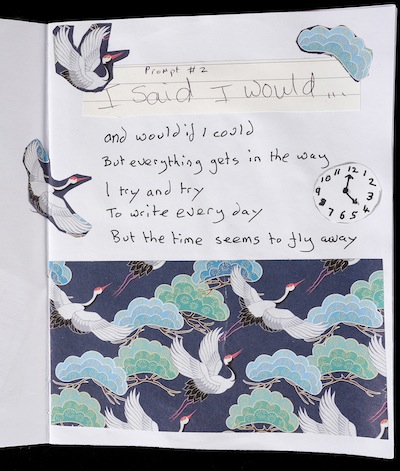
photo - A page of Judy Stern’s sketchbook expresses a lamentation familiar to any writer
A page of Judy Stern’s sketchbook expresses a lamentation familiar to any writer. (photo by Byron Dauncey)

“As the workshop progressed, participants wanted to know more about each other. We talked a lot. People shared ideas and finished pages. Everyone became more confident with the techniques and media,” Ireton said. “Each session was a joyful social event as much as a journaling workshop. We were all tired of the isolation restrictions caused by COVID.”

While the JCC supplied materials for the workshop, local artist Susan Lee created the empty journals everyone used. “Susan donated the journals for the workshop,” said Forstenzer.

This month, Forstenzer mounted the show, which comprises selected pages of participants’ journals.

“This show is a tangible result of the workshop,” she said. “It is imbued with the energy of the participants putting their imagination to work, creating something meaningful regardless of their personal history as art-makers. The show reflects the child-like pleasure everyone experiences while playing with glue and paper and colours. The weeks of working on their creative sketchbooks has yielded a look into the beauty of putting thoughts on paper in words and images.”

The show is anonymous – there are no names attached to any of the pages, but each image serves as a window into the author’s personality. Some are humorous, like a tongue-in-cheek collage of two pages from a magazine. The collage contains two contradictory lists: What Men Love in Women juxtaposed with What Women Love in Men.

Other images are colourful and lyrical drawings, like a leafy branch with no words. And others combine drawings with poetry and cuttings.

Several workshop participants agreed to talk to the Independent about themselves and their journals.

Judy Stern, a retiree, didn’t have any artistic experience prior to the workshop. “In high school,” she said, “art was the only subject I ever failed. This took away any confidence I might have had, so I have never taken an art class, although I often thought about doing so. Last fall, I received information from the JCC about the upcoming journaling class. I enjoy writing and do have an interest in art, so I asked whether I needed any art experience. I was told, absolutely not…. I was so excited about this, as it was my first group social activity since the beginning of COVID. I was eager to be out and about again, doing something different.”

At first, she was nervous, but the welcoming atmosphere of the workshop soon put her at ease. One image from her journal, cranes flying away among the clouds, integrate her poem – a lamentation familiar to any writer – into a beautiful metaphoric collage.

“I would’ve been happy for the class to go on indefinitely,” she said. “I hope that something similar will be offered again. I am already thinking about my next journal.”

Kathy Bilinsky, another retiree, admitted to having some previous artistic exposure. “I’ve always enjoyed the creative process,” she said. “I have taken various art classes over the years, including two certificate programs at Emily Carr.”

Bilinsky, joined the workshop at the recommendation of Stern, who is a friend. “Judy said I might like it, and she was right. Before, when we could still travel, I always worked in sketchbooks. I have many travel journals documenting our trips with sketches, watercolours, and a bit of cut and paste. As we’re not traveling these days, I looked at this workshop as the opportunity to create.”

Her adjoined journal pages, “Keys and Door,” feature a key ring and a keyhole, above which is written, “Every key tells a story.” We wonder what story – or two or three or more – we could find behind the mysterious ornate blue door depicted on the opposite page.

“I didn’t fill all the pages in my journal,” said Bilinsky, “but so many ideas have been circulating in my mind that I would like to fill in the remaining pages.”

The show can be viewed in person at the Zack Gallery or online at online.flippingbook.com/view/892314086. It runs until Feb. 11.

Olga Livshin is a Vancouver freelance writer. She can be reached at olgagodim@gmail.com.
Art show with a holiday feel

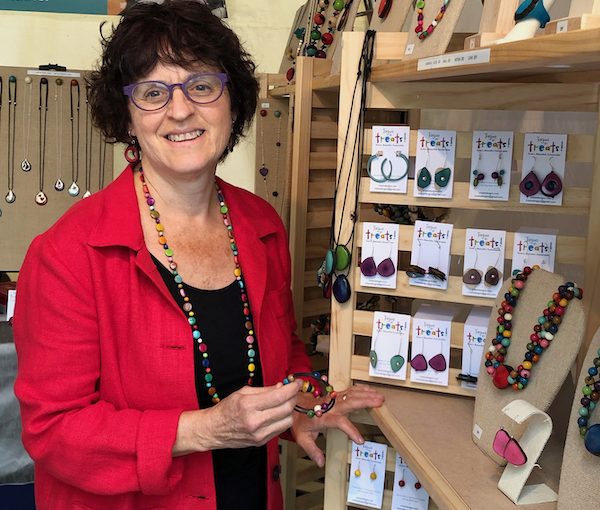
Ande Axelrod has developed a partnership with artisans in the village of Sosote, Ecuador, as her source for tagua beads. (photo from Zack Gallery)

The current show at the Zack Gallery, Affordable, opened on Nov. 17. It delivers on its name’s promise. Every item on display is less than $250 and thus in the realm of affordability for many people, not just art connoisseurs.

“That’s what I wanted for the Zack Gallery from the beginning,” said gallery director Hope Forstenzer. “I wanted to deepen the involvement of the JCC community in the gallery, wanted the art within people’s reach.”

Accordingly, this show looks more like a holiday craft fair than a high art exhibition.

“I don’t believe in the separation of art versus craft,” said Forstenzer. “For me, craft is another word for art, but art that is functional and affordable, designed for enhancing your life and your home rather than a wall of a museum. I hope we can make such a show an annual event.”

To achieve the artisan market feel, Forstenzer invited 10 artists in different media to participate. “They are all local B.C. artists,” she said. “Some Jewish, some not. I wanted to cater to different tastes, to represent different artistic fields. I wanted the show to be fun.”

photo - Ceramics by Hitomi McKenzie
Ceramics by Hitomi McKenzie.

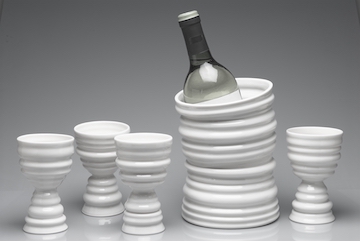
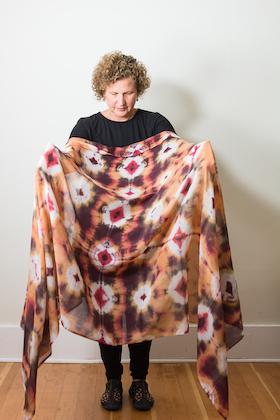
The atmosphere of the show is jazzy and welcoming. The giclée prints of well-known Vancouver artist Linda Frimer glow with greens and blues. The glass and jewelry twinkle. The ceramics by Hitomi McKenzie stand proud and bright. Mariana Frochtengarten’s colourful shawls in Shibori patterns add a touch of elegance.

Frochtengarten teaches textile art at the Jewish Community Centre of Greater Vancouver. “This is a great opportunity for me to show the community my personal work,” she said. “My work is based on the principles of Shibori – a Japanese manual tie-dye technique. I combine the ancient Japanese tradition with a contemporary approach.”

She works with natural fibres, mostly cotton and linen, and has been working as a textile artist for more than 25 years. “My way into textile art was a bit accidental,” she told the Independent. “I was born in Brazil. When I was in high school, I took a batik class for a hobby, but I fell in love with it.”

After graduating from high school, she studied at Fine Arts and Education University in Brazil and later completed her master’s in fine arts (textiles) at Nova Scotia College of Art and Design, in Halifax. “For 17 years, I worked with batik,” she said. “I had a business in Brazil and sold my works in stores, galleries, shows and fairs. I also experimented with some Shibori. I slowly moved on to my own form and interpretation of Japanese Shibori after moving to Canada in 2006. I love the elements of surprise involved in the process of Shibori and I am fascinated by the idea of creating different designs by blocking areas of the fabric before dyeing it.”

Another artist who works with an unusual material and technique is Ande Axelrod. Her company, Treats Designs, produces whimsical and sophisticated tagua jewelry: necklaces, earrings, pendants, and bracelets. Axelrod is very enthusiastic about her artistic creations. “Tagua is known as ‘vegetable ivory,’” she explained. “The tagua palms are native to the rainforests of Ecuador and other South American countries. The nuts grow and harden inside their seedpods. Some tagua nuts can grow up to six centimetres. Once the seedpods are ripe, they’re picked, and the seeds are dried in the sun, peeled and polished.”

The creamy white substance of the nuts is incredibly hard, similar to elephant ivory, hence the name. According to Wikipedia, a mature tagua palm can produce up to 20 pounds of vegetable ivory a year.

“Tagua nuts have been used as a substitute for ivory since the early 20th century,” Axelrod said. “The local masters carve the nuts into a variety of beads and buttons and dye them using bright natural colours.”

photo - Mariana Frochtengarten shows of one of her colourful Shibori shawls
Mariana Frochtengarten shows of one of her colourful Shibori shawls.

She is thrilled to use tagua nuts as the base for her jewelry. “I worked as a graphic designer for more than 25 years. In 2011, a friend and I took some jewelry making classes and I explored a variety of media and techniques. The next year, I discovered tagua while traveling in South America. I was dazzled by the colours, and I loved how light and comfortable the pieces were. You could wear a bigger statement necklace or a pair of earrings and not have a sore neck or headache at the end of the day.”

The sustainability and eco-friendliness of tagua sealed the deal for her. “I wanted to save elephants and I was truly inspired by the vast creative potential of this versatile natural material. It also provides an economic incentive for the local communities to protect the rainforests,” she said.

Since then, Axelrod has developed a partnership with artisans in the village of Sosote, Ecuador, as her source for tagua beads. “Before COVID, I’d made annual visits to Ecuador each February. It gave me the opportunity to work with tagua throughout the process, from seed to bead. Of course, like everyone else, I’ve had to improvise these past two years. Zoom, WhatsApp, FedEx and Western Union have enabled me to stay in touch with my South American partners and get tagua here for me to create my jewelry.”

While Shibori scarves and tagua jewelry may more easily be thought of as unique artwork in the Vancouver context than photography perhaps, Michael Shevloff proves that he is an unquestionable master of the camera, producing his own singular creations. His images, both in colour and in black and white, are statements of his love for British Columbia: its forests, its mountains, its waterways, its streets.

“I do predominantly nature photography,” he said. “However, I also shoot street photography, portraits, and many other genres, both digital and film.”

For this show, Shevloff offers framed and matted photos and photo coasters. “In the past, I also produced books of my photos, collages, cushions and more. I even put one of my images on my phone cover. The choices are many, and there are online firms, as well as local places, that specialize in putting images on almost any surface.”

He has been taking photographs since he was a teenager. “That was a long time ago,” he joked. “I have albums filled with photographs from places I have worked and traveled throughout the years.”

For Shevloff, photography has always been a hobby, while he worked in information technology. It remains a hobby in his retirement, although he obviously has more time now to immerse in his artistic endeavours.

photo - “Tropical Vancouver,” by Michael Shevloff
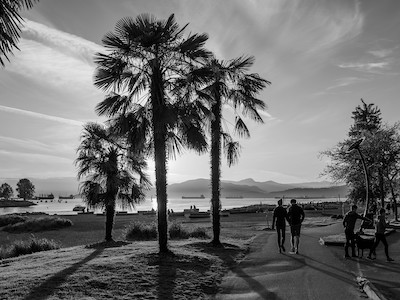
“Tropical Vancouver,” by Michael Shevloff.

“I have taken classes with professional photographers to hone my craft. And I belong to two photo clubs in Vancouver,” he said. “Vancouver PhotoClub is a well-organized group with monthly meetings and outings. I enjoy being a part of that club because they have assignments, which gives me a challenge and focus each month. They also organize exhibits, which gives me an opportunity to show my work.”

He belongs to the West End Photographic Society, as well. “That one is dedicated to film work and darkroom processing,” he explained. “They also organize exhibits. I enjoy the challenge of working with film and working with prints.”

The 10 artists of this show incorporate different art forms, different artistic philosophies, different ethnic roots and different price ranges. But one fact unites them all – every piece of art in the gallery for the next month is affordable.

The exhibit continues until Dec. 31.

Olga Livshin is a Vancouver freelance writer. She can be reached at olgagodim@gmail.com.
Capturing nature in photos

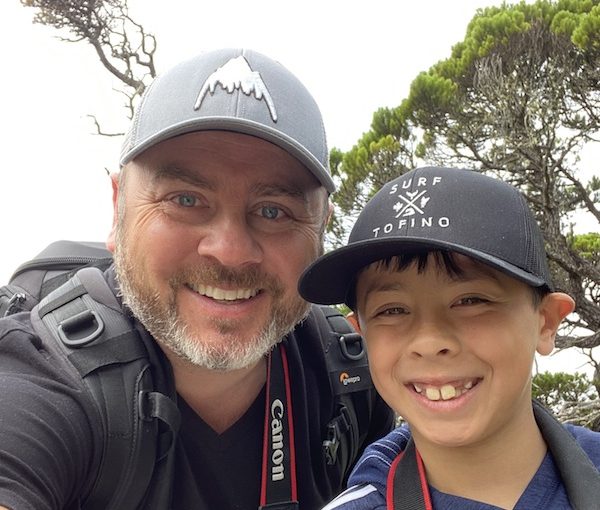
Micah Groberman with his son, Evan. (photo by Micah Groberman)

The current photography exhibit at the Zack Gallery, Discoveries: A New Way Forward, allows visitors a peek into the wilderness of British Columbia. A bird serenades the sunset. A bear crosses a road. A coyote glares into the camera. Even a Whistler bridge seems to lead to an adventure in the forests and mountains of our province. The photographer, Micah Groberman, talked to the Independent about his art and how the pandemic set him on his new creative course.

“Before the pandemic, I had a business with a partner, Ivan Solomon. We did many different things, but mostly we designed wall murals for children’s stores, hospitals and private clinics,” said Groberman. “After the pandemic hit, we couldn’t do it anymore, couldn’t stay inside the enclosed spaces for the long time it takes to create a large mural. Many places closed. School was canceled. I had to stay at home and take care of my sons.”

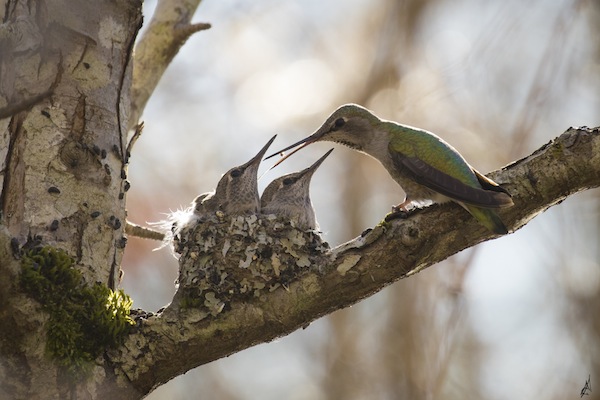
photo - Micah Groberman’s photo of a hummingbird feeding her babies was featured on CBC
Micah Groberman’s photo of a hummingbird feeding her babies was featured on CBC.

For Groberman, instructing his elementary school sons from a set curriculum was frustrating. “I’m not good at math,” he joked. So he found something else to do with his boys. He shared his passion for nature with them. They went for walks in local parks. And they took photographs.

“I started taking photos when I was about 9,” Groberman recalled. “It was with a simple camera, the point-and-shoot kind. I enjoyed it and did it for a long time, simply for myself and my family. During COVID, my photography took a more serious turn. I wanted to do it well. I wanted to learn. I watched videos on YouTube. You can find all sorts of useful tips online. I got myself some professional gear, a large camera. And I took photos. Many, many photos. I learned by doing.”

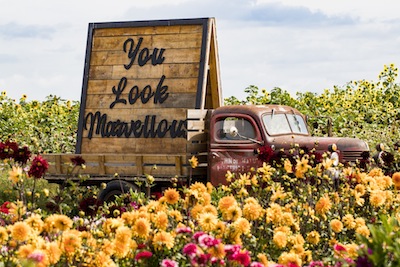
Groberman classifies his images into three categories: landscape, wildlife (which includes all his animal and bird shots) and fine art. The last category is the most inclusive. It overlaps with landscape and boasts some unusual shots, like a PNE ride from a rare angle or an old pickup surrounded by flowers that displays an uplifting message in its cargo bed.

photo - Micah Groberman took this photograph last year at the Richmond Sunflower Festival
Micah Groberman took this photograph last year at the Richmond Sunflower Festival.

“I took it last year at the Richmond Sunflower Festival,” Groberman explained. “The organizers put the old truck among the flowers, and I thought it looked interesting.”

Many of his images, especially of wildlife, are fascinating because he has sought them out. In addition to artistic skill and adequate hardware, nature photography requires a great deal of perseverance and patience. Groberman has both.

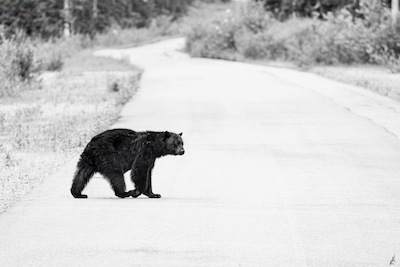
“The bear that crosses the road – I took this picture from my car,” he said. “We were in Whistler, driving around, looking for bears. It took us three hours, until one walked out of the woods.”

Another of his amazing wildlife shots is a coyote on a piece of driftwood. “I noticed him hiding in the bushes on the other side of a stream in Richmond. I followed him for about five minutes, with only glimpses, until he came out and stared at me. I took the shot, but I was glad there was water between us.”

While taking his own photos, Groberman tried to share his knowledge with his sons. “My younger son wasn’t that interested,” he said, “but my older son, Evan, took to photography. I taught him, and he inspired me. Many of my photos in this show I took when I was with him. I think teaching him made me a better photographer.”

Groberman hadn’t ever exhibited his photos prior to the pandemic. He had never even thought about doing so. “It was just a hobby,” he said. “But, in 2020, I participated in a group show at the Zack. A couple of my son Evan’s photos were also on display. That’s how I first met Hope [Forstenzer], the gallery director.”

photo - It took a few hours of searching before Micah Groberman came across this bear and took its picture
It took a few hours of searching before Micah Groberman came across this bear and took its picture.

According to Groberman, the current show was supposed to be a double feature, including a sculptor as well. “But the sculptor didn’t happen,” he said, “so it became my solo photography show. There are 37 images in the show: 30 are mine, seven are Evan’s. We have a show together.”

The name of the show – Discovery – came from the experiences shared between father and son. “Our walks together were bonding,” said Groberman. “We discovered things together. Evan discovered new skills. I discovered a new way to move forward and I discovered teaching. That’s where the name of the show came from.”

Groberman hopes that his wall mural business will recover once the pandemic ends, but he also sees several new avenues for his creativity.

“I want to do more with my photography,” he said. “I’m exploring different options, trying to establish myself locally. I went to stores to offer them prints of my photos and postcards. I rented a bunch of my prints to a movie set. I entered local contests. One of my photos – a mama hummingbird feeding her babies – was featured on CBC. Another – a photo of a heron – won the Richmond banner contest last year in the nature category. You will see my heron on the streetlights in Richmond. I have an Instagram account. I’m just starting with photography, but I want to see where I can end up.”

Discover opened on Oct 4 and runs until Nov. 7. Learn more about Groberman’s work at micahgphotography.com.

Olga Livshin is a Vancouver freelance writer. She can be reached at olgagodim@gmail.com.
Chosen Family now at Zack

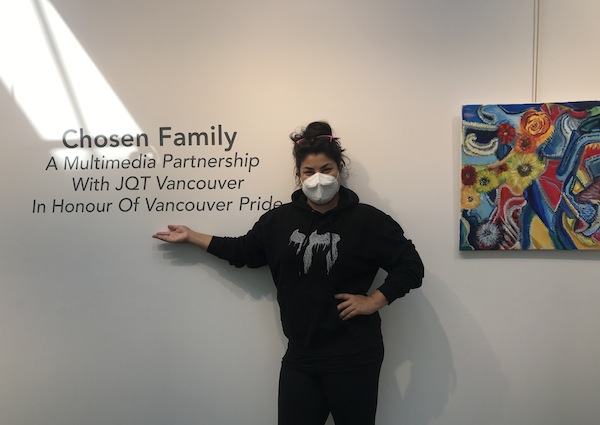
JQT Vancouver executive director Carmel Tanaka at the Zack Gallery, where the Chosen Family exhibit is on display until Sept. 30. (photo from Carmel Tanaka)

In a Simon Fraser University survey of more than 4,000 elderly Canadians (55+), conducted from August to October 2020, to see how people were coping with the pandemic, about 10% of respondents identified themselves as part of the LGBTQ+ community. These respondents were more likely to follow COVID protocols and to have said they “feel they have been here before” – they were 10 times more likely to report experience with HIV/AIDS than heterosexual persons. Among the many other findings, LGBTQ+ respondents were less likely to ask relatives for help, but more likely to call upon close friends.

In the context of the pandemic, then, the focus of the new exhibit at the Zack Gallery has added significance. The show, called Chosen Family, is a multimedia partnership between the gallery and JQT Vancouver in honour of Vancouver Pride. It opened officially on Aug. 26, with the artists in attendance.

JQT (Jewish, Queer and Trans) is an arts, culture and education nonprofit organization. It is dedicated to creating connections and seeking space to celebrate the intersectional identities of Jews of diverse sexual orientations and genders. The organization’s executive director, Carmel Tanaka, said JQT’s members are accomplishing their goals “by queering Jewish space and ‘Jewifying’ queer space in Vancouver.”

“We started JQT in Vancouver four years ago, as a grassroots movement, everyone was a volunteer,” Tanaka told the Independent. “We incorporated as a nonprofit in 2020. This show feels like a milestone. It is probably the first exhibition here, at the Zack Gallery, that features exclusively queer Jewish artists.”

The theme of the show, Chosen Family, reflects that some LGBTQ+ individuals face rejection by their immediate family and must look elsewhere for understanding and acceptance. “I’m lucky,” said Tanaka. “I didn’t have to look for another family; my family was supportive. Unfortunately, that’s not true for everyone.”

image - One of the images in a series of six by Ari Fremder
One of the images in a series of six by Ari Fremder.

Only a few artists are featured in the exhibit. “We invited more artists from the JQT community, plus their families, to submit art for the show, but not everyone was easy with the invitation,” Tanaka said. “Some didn’t feel ‘artistic’ enough. Others didn’t feel Jewish enough. Still others – the older people mostly – didn’t feel entirely safe to identify themselves as queer to the wider community. It is an ongoing vulnerability issue with many of us.”

Another reason might lie in the location of the gallery. “The Zack Gallery is inside the Jewish Community Centre, so the art must be family friendly. That might be a limiting factor for some artists,” Tanaka mused. “We might look at another venue next time.”

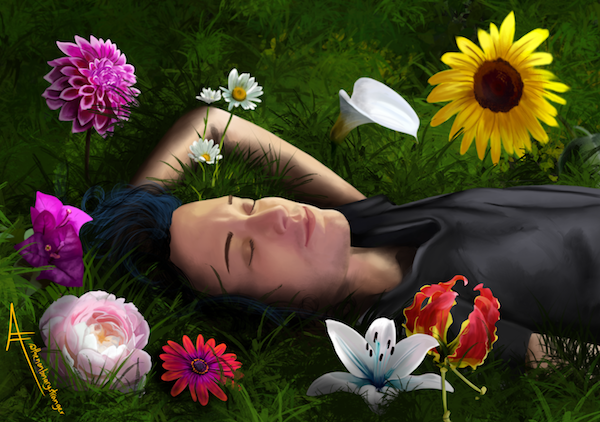
The show includes art in a variety of media: paintings, prints, textiles, cinematography, sculpture. A series of six pictures by Ari Fremder all have the same size and structure – a human face surrounded by flowers – but they centre on different faces, representing different friends or family members, and have varied arrangements of flowers. Nonetheless, they all have one thing in common – they are all beautiful and upbeat.

Two of Fremder’s paintings are self-portraits. One looks like a face in repose; the other an angel with black wings. The angel soars in the dark sky and, unlike the six-photo series, this image is moody and contemplative.

image - A collage by artist Holly Steele
A collage by artist Holly Steele.

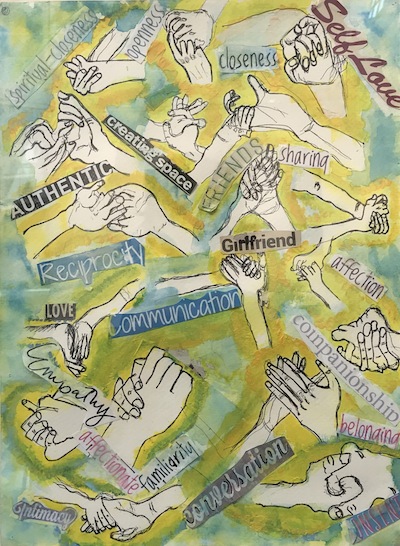
On another wall, there are several paintings by Holly Steele. In one, a multimedia print, hands clasp together in various combinations: hands of friends and hands of family, interspaced with positive, trust-affirming words. The image, done in a muted greenish-yellow palette, screams of the yearning for acceptance.

In the centre of the gallery resides a sculptural composition by Morgan Strug. A dinner table with chairs around it shows us what a family meal means to the artist. There is understanding and affection there, benign teasing and fierce joy in the others’ fulfilments. Is it wishful thinking? Is it the artist’s reality? Everyone can decide for themselves.

Strug is the director of the short movie Enby, which screened at the Vancouver Queer Film Festival earlier this month, and the film is part of the Zack exhibit. The gallery planned three screening dates, the first being for the exhibit opening Aug. 26, as well as Sept. 9 and Sept. 30. Those who want to see it should contact the gallery first.

“This is a very eclectic show,” Tanaka said. “It is the first art show for several of the participating artists. Some of them celebrate both their identities: as a queer and as a Jew. We would love this show to become an annual tradition.”

Chosen Family continues until Sept. 30. To learn more, visit jqtvancouver.ca.

Olga Livshin is a Vancouver freelance writer. She can be reached at olgagodim@gmail.com.
Communicating with visuals

“Hanging Out” by Derry Lubell.

Derry Lubell’s photography captures the motion of dance, the ephemeral magic of the art form that generally only exists at the moment of performance. Unless, of course, it is recorded by a talented photographer.

Lubell’s solo exhibition The Body Speaks: Dance • Movement • Emotion opened on July 2 at the Zack Gallery. The official opening on July 8 was in person, as the long months of COVID restrictions started to ease. The gallery’s latest email to its patrons joyously states: “Appointments are no longer needed to see the show in person. Come on in!”

photo - “The Dichotomy” by Derry Lubell
“The Dichotomy” by Derry Lubell.

When you do go in, you’re surrounded by dance and dancers, their beautiful faces, and their astounding bodies. The gallery is a quiet place, but you can almost hear the music floating in the air, while the graceful ballerinas leap and pirouette around you. Most images are black and white or rendered in muted colours. “I think you can see the lines better in black and white,” said Lubell in an interview with the Independent. “The colour is often distracting, and I don’t want that. I don’t like fussy. I want clean shots.”

Lubell has been an artistic photographer for about five years. “Before that, I had a career as a psychotherapist. I had a family to raise,” she mused. “I always had a small camera with me, since I was young, to photograph my family or places I visited, but it was casual, like memory shots. After I retired, I started thinking: what else do I want to do? I always enjoyed talking to people, understanding their emotions. I wanted to do something similar but without the responsibility. Photography allows that. Using photography, I can still communicate with people, discern their emotions, reach their hearts, but on a visual level, without words.”

photo - Derry Lubell
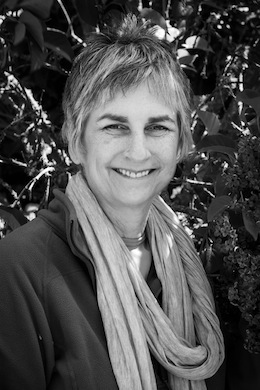
Derry Lubell (photo from Derry Lubell)

The former psychotherapist reinvented herself as a photographer, and it led her on a long road of self-exploration, especially because the technology had progressed so much. “I had to learn computers,” she said. “I work harder now than before I retired. Shooting. Editing my pictures. Studying. Taking classes. Looking at other photographers’ images to see what works and what doesn’t. I put up my pictures on my website and Instagram, so others can see me, too.”

The dancing series is her latest, and it came about almost by accident. “I always enjoyed working with people who are comfortable with their bodies,” she said. “Even as a psychotherapist, I paid attention not only to words but to body language. Many people speak with their bodies. Dancers are the best at that.”

Her admiration of dancers prompted her a few years ago to enrol in dance lessons. “It was incredible,” she remembered. “The instructor was wonderful. I asked her: could I take your photograph? She agreed. After that, I photographed her and some of her students, and some other dancers.”

Lubell prefers taking pictures in people’s natural milieu. Some of the photos in the exhibit she took during rehearsals in the dancers’ studio spaces around the city. For others, she arranged meetings with the dancers outside, in urban surroundings, parks or the beach.

“Each session is an hour or two hours long. Each one is a collaboration between a photographer and a dancer,” she explained. “Together, we choose a location. I would ask her to bring half of her dancing wardrobe, and we try different costumes to see what works for the camera. I often select the background, and then the dancer would start dancing, and I would walk around and take shots. I might suggest a position or a prop, like ‘play against that log’ or ‘turn this way,’ but they are the performers. They like to perform. It is up to me to capture the perfect moment.”

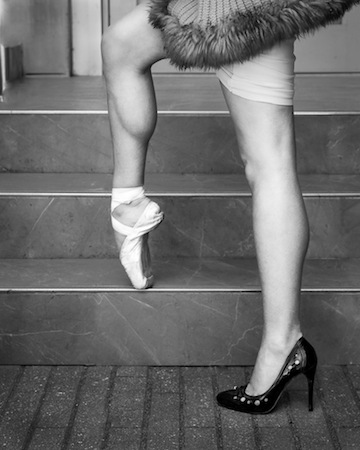
One of those moments resulted in a unique picture. Only the legs of the dancer are showing. One wears a point shoe, posing like a coquette on a staircase. The other is still wearing a stiletto. The photo, titled “The Dichotomy,” emphasizes the dual nature of the subject: a woman and a dancer.

“It was sold before the show started,” Lubell said. “I brought pictures to the gallery to hang on the walls. Everything was still on the floor, in boxes. I left the gallery for a few minutes. When I came back, Hope [Forstenzer, the gallery director] said: ‘You know, this one just sold.’ Before it was even displayed.”

photo - “Form in Flight” by Derry Lubell
“Form in Flight” by Derry Lubell.

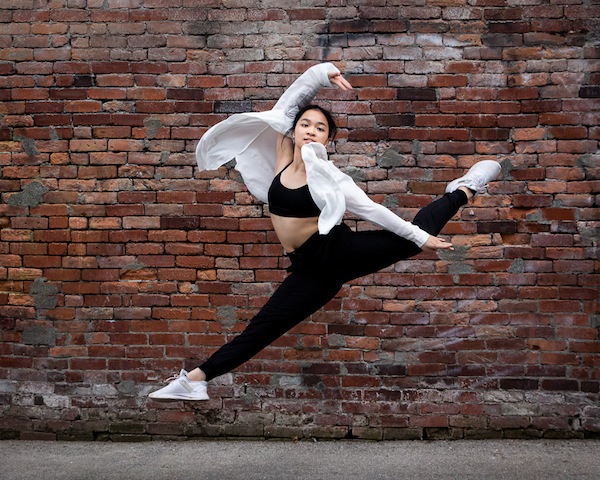
Another interesting image, “Form in Flight,” is of a young dancer in street clothing jumping in front of a brick wall. Lubell took the photo in Chinatown. “It is one of the oldest walls in the city,” she said. “I walked around Chinatown with that dancer. She is a student, but she loves dancing. When I saw that wall bordering a parking lot, I asked her to dance against it.” The dancer’s flight in the image is airy and joyful.

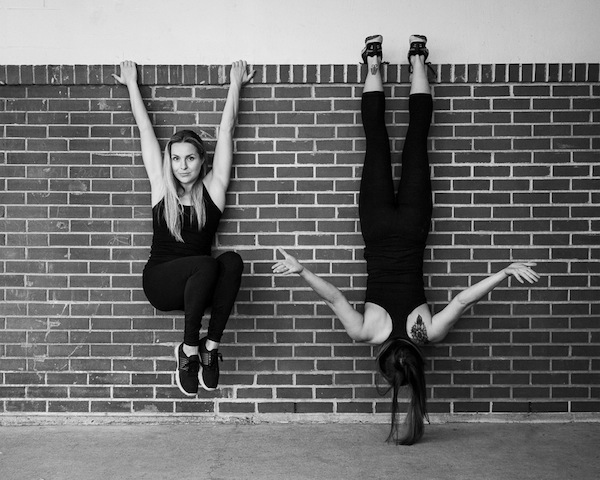
Several pictures display more than one dancer. One of those photos, called “Hanging Out,” is imbued with humour: one dancer is hanging from a wall with her hands, while the other is hanging upside down by her feet. “They are best friends,” Lubell said. “They met years ago as gymnasts. One does stunts for the movies now – she is the one who is upside down. I asked them to dance against the wall, and they started playing together, having fun. That mutual pose was a surprise to me.”

Lubell considers her dancers as partners in her art. “They have the right of veto. It doesn’t happen often, but sometimes they would say: ‘Don’t use this picture, my leg is in the wrong position.’ And I won’t. I honour their requests. After all, they honour me by allowing me to shoot their photos.”

The Body Speaks is on display until Aug. 16. For more information, visit the photographer’s website, derrylubell.com.

Olga Livshin is a Vancouver freelance writer. She can be reached at olgagodim@gmail.com.