Skip to content
  • Home
  • Subscribe / donate
  • Events calendar
  • Business Directory
  • FAQ
  • News
    • Local
    • National
    • Israel
    • World
    • עניין בחדשות
      A roundup of news in Canada and further afield, in Hebrew.
  • Opinion
    • From the JI
    • Op-Ed
  • Arts & Culture
    • Performing Arts
    • Music
    • Books
    • Visual Arts
    • TV & Film
  • Life
    • Celebrating the Holidays
    • Travel
    • The Daily Snooze
      Cartoons by Jacob Samuel
    • Mystery Photo
      Help the JI and JMABC fill in the gaps in our archives.
  • Community Links
    • Organizations, Etc.
    • Other News Sources & Blogs
  • JI Chai Celebration
  • JI@88! video

Recent Posts

  • SFU honours Gloria Gutman
  • Lifting people’s spirits
  • Wedding a ray of light
  • Indigeneity and Zionism
  • Rule of law broken: councilor
  • Football and its roles
  • The burden of defence
  • Fish Café returns after fire
  • All right in what goes wrong
  • Nuns & mermaids at TUTS
  • Camp offers holiday retreat
  • Students and mentors inspire
  • Once-in-a-lifetime trip
  • 100 dancers, one heart
  • Money for the sciences
  • What “Jewish food” means
  • Have a cookie, schnitzel too
  • Federation now across BC
  • Israel fighting for its existence
  • Deal strengthens Iran
  • Patriotic belonging diminishes
  • A campaign to engage
  • Upstanders’ first live event
  • Responding to Carney
  • Having your own home
  • Music a family tradition
  • Musical to warm heart
  • Community milestones … June 2026
  • Sharing her passion for Israel
  • Or Shalom reopens its doors
  • JFS from past to future
  • Need holistic approach
  • Sharing stories, advice
  • Journalist shares fears
  • Skills to live together
  • Road to independence

Archives

Follow @JewishIndie
image - CJN box ad Rockowers 2026

Tag: Zack Gallery

Chai Quilt grows and changes

Chai Quilt grows and changes

When I first entered the Zack Gallery to view its new show, the Chai Quilt, my first impression was that it was an amateur show. Only one wall of the gallery featured art, and it looked like the work of a kindergarten class, with several exceptions. I soon found out that that is indeed what it is!

In talking to gallery director Hope Forstenzer, I learned that this exhibit is different from most of the shows the gallery has produced. Many of the amateur artists are actually 3 to 5 years old and attend the JCC’s preschool.

“We sent out a call for participation in this show to everyone on the mailing lists of the JCC and the gallery,” said Forstenzer. “I wanted this show to connect the gallery to the community, to make it a mixed show. Whenever someone expressed an interest, we gave them the fabric squares and the craft kits. Some families received four or five squares for every family member. Our preschool at the centre had several, too. A few professional artists also responded to the call, as did some of the JCC staff.”
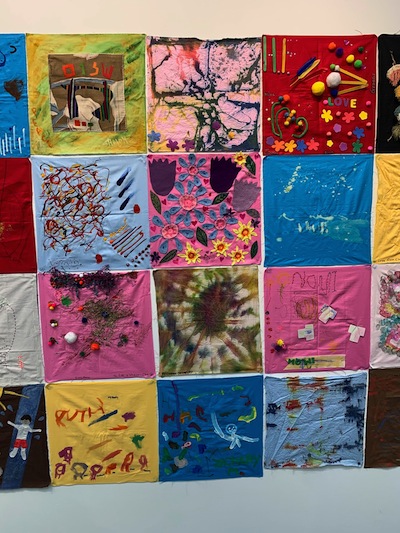
photo - A portion of the Chai Quilt at Zack Gallery
A portion of the Chai Quilt at Zack Gallery (photo by Hope Forstenzer)

The show takes place in conjunction with the JCC’s Festival of Israeli Culture and, therefore, shares the festival’s theme, which is celebrating life – chai, in Hebrew.

“We asked everyone to create their own celebration of life and spring,” explained Forstenzer. “No matter how hard the pandemic hit us all, there is still life worth celebrating.”

When the squares came back from the artists, Forstenzer created a quilt of them on one long wall of the gallery, a continuous artistic surface reflecting community members’ united vision of life. “The squares touch sides,” she said. “Even if we can’t meet because of the pandemic, we’re still in this together. Our art brings us together.”

The show’s unique blend of professional and amateur artists means there are several profound differences from previous Zack shows. One of those differences is that there are no name cards. If a participant signed their square, everyone can see their name; if not, the square’s creator is anonymous.

Another difference is that the show started a week later than planned.

“Many of the participants are families with children,” said Forstenzer. “They kept calling me and asking for more time. Even now, when the show is open, the squares are still trickling in. There are already over 70 on the wall. I had three new ones today, waiting on my desk, and more are coming, I’m sure. I’m going to add them on to the end of the quilt as they come.”
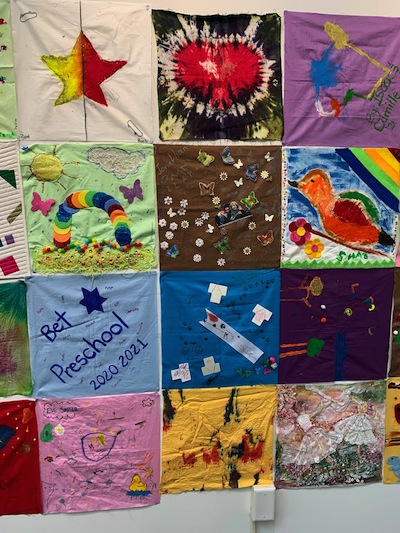
photo - Another part of the Chai Quilt at Zack Gallery
Another part of the Chai Quilt at Zack Gallery (photo by Hope Forstenzer)

The show, or rather the quilt, grows daily; resembling a living organism. And, it also changes. As I was speaking to Forstenzer, one of the participants, Jessica Gutteridge, artistic director of the Rothstein Theatre, came into the gallery. She wanted to rotate her square, which was already on the gallery wall. “It would look better the other way,” she offered, and Forstenzer agreed.

“I was excited to have an opportunity to participate in this community art project,” Gutteridge said. “Although my professional artistic practice is in the theatre, I have been involved as a hobbyist and student in visual arts and crafts, particularly needlework, for most of my life. During the early part of the pandemic, Hope and I created a virtual drop-in community art program called the Creative Kibbitz. It was based on a project I had started – to invite people to my home to socialize and make creative work. This show was a nice way to extend that work, and a theme based on celebrating life and renewal seemed very appropriate and inspiring in this moment.”

Although Gutteridge has never participated in a Zack show before, her pink square with its jolly cherry blossoms looks like it belongs on the gallery’s wall. “Cherry blossom time is one of my favourite moments of the year,” she said. “It is so ethereally beautiful for the short time it lasts. To me, it captures the rebirth of spring perfectly and the stirring of new life. I decided to make a spray of cherry blossoms using two of my favourite media, yarn and rhinestones, in an effort to make something that captures the shimmer and sparkle of spring.”

In addition to needlework, the quilt pieces have been made using an astounding variety of media. Photo collages and paintings. Feathers and beads and felt flowers. Dried leaves and confetti paper ribbons. Letters and abstract glitter splashes. Buttons and lace.

The creator of one square, which has dancers in lacy costumes, is Beryl Israel, a retired teacher. “I am a member of the fantastic JCC Circle of Friends program,” she said in an email interview. “Up to the start of COVID, I taught tap dancing at one of the local community centres.” Her love of dancing poured into her contribution to this show.

“My motivation for this work was to concentrate on the happiness and positivity around us in a gentle, hopeful way, with the inspiration from the dancing figures of Matisse,” she explained. “I wanted to record some of my old dress fabrics, laces from my mother, favourite photos, handmade paper, flowers, etc., plus the use of acrylic paints and stitching, which resulted in my composition.”

The imagination all the artists infused into their squares seems to know no bounds, as if they wanted to say, the ways in which we each see life is different, but, together, we can create a life as diverse and colourful as the Chai Quilt on the wall of the Zack Gallery.

The quilt is on exhibit until May 14.

Olga Livshin is a Vancouver freelance writer. She can be reached at [email protected].

Format ImagePosted on April 23, 2021April 22, 2021Author Olga LivshinCategories Visual ArtsTags art, Beryl Israel, chai, Chai Quilt, Hope Forstenzer, Jessica Gutteridge, life, multimedia, Renewal, spring, textiles, Zack Gallery
Artists rise to challenge

Artists rise to challenge

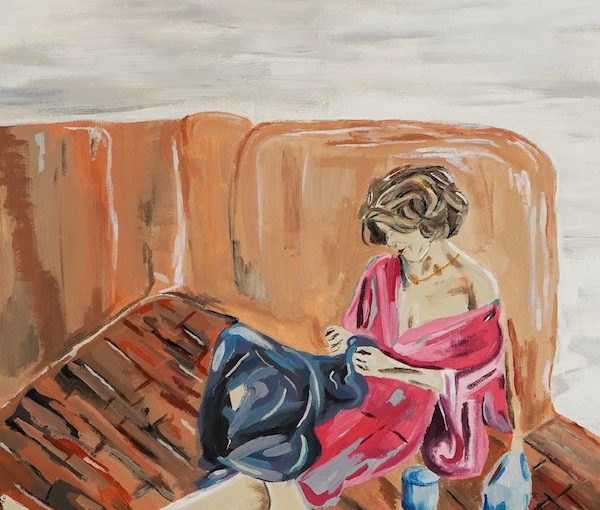
“Sometimes Being Human … Can Be Hard” by August Bramhoff.

The Jewish Community Centre of Greater Vancouver’s inclusion services’ third annual art exhibit at the Zack Gallery is on display this month. And people can meet the artists at a March 23 virtual reception.

“For the last two years, the JCC has celebrated Jewish Disability Awareness and Inclusion Month through an art exhibit that interrogated and explored themes of community longing and belonging,” Leamore Cohen, inclusion services coordinator, told the Independent. “We asked artists of mixed ability: How do we make meaning of the concept of community, the real and the imagined spaces we inhabit? What does community longing look like and what are the possibilities for belonging in an ever-changing world?”

This past year, the world has changed almost beyond recognition. “In Vancouver, we are nearing a year since the COVID pandemic shut down our city and transformed all aspects of our social world,” acknowledged Cohen. “However, while we were isolated, we also saw our creativity flourish.”

In the two previous exhibits, artists responded enthusiastically to inclusion services’ challenge, unfolding a fascinating slice of society through their art, and both shows were successful, well-attended cultural events. Unfortunately, the pandemic has moved most of our interactions online, and so it is with this new show, though it is also available to view in-person by appointment.

The participating artists are of differing abilities and artistic levels, so the artforms vary. There are paintings and multimedia collages, figurative and abstract imagery, landscapes and still life. Some pictures are disturbing in their naked emotional pain. Others are quietly sad, or funny, or absurd. One thing is universal: the artists’ willingness to express their feelings, both in their art and in words, as each piece is accompanied by its creator’s short writeup.

It is impossible to mention all 57 pieces on display, but here are a select few to represent this multifaceted show.

August Bramhoff’s painting “Sometimes Being Human … Can Be Hard” depicts a woman sitting, alone. She is sewing or knitting. The painting’s muted colours permit no joy. There is obviously no one there with her, even beyond the edges of the painting. The woman’s isolation and loneliness are palpable despite the spare simplicity of the image.

The artist wrote about his painting: “My main practice is analogue photography, with a focus on street photography…. This is the first painting I’ve created in over 10 years. The inspiration for this work is from a feature film. It captures the sense of longing and displacement we all seem to be juggling during the COVID shutdown.”

In contrast, Tracy-Lynn Chernaske’s “Whispers” is a dreamy landscape. The moon shines over the night forest and a trail of shiny fog weaves its way between earth and sky. Maybe it is just the weather. Or maybe the fog illustrates our mutual desire to connect with one another. Maybe it is a whisper of our souls.

The artist explained: “Community is … a place and a way to tell stories and journeys so they can be witnessed, heard and held. They are a way of bonding together … and the need to push away and seek out new and more fitting spaces.” According to Chernaske, we all nourish “the invisible threads of relationships that cross borders, land, sea and time.”

In Evelyn Finchman’s “Roots” – an abstract composition in the earthy colours of brown and beige – interconnected spirals, lines and shapes allow the viewer’s imagination to stir. Is it food? Is it a surreal terrain? A carpenter’s schematics?

“Belonging to a community is much more than interacting with our societies and being accepted by our peers,” mused Finchman. “This year, I realized how important it is to coexist within the nature that surrounds us…. There is no human life if we don’t respect all living beings on our planet and understand that we are part of the whole environment.”

image - “Roots” by Evelyn Finchmann
“Roots” by Evelyn Finchmann.

Another artist who touched on the theme of nature and its connection with humanity is Peggy Logan. Her painting “Flowers Adrift” shows single blooms, all different – a tulip, an orchid, a daffodil, a daisy – but all similarly pale and faded, bobbing on the blue background. The image seems dejected and symbolic.

“The piece of work I have created,” said Logan, “is about that sense of disconnection that exists now with friends and family with restrictions on travel, social distancing, and isolating inside. This image is about the lack of roots the flowers have as they float over the water via the internet.”

Symbolism is also the main approach of Theresa Moleski in her painting “Life In and Beyond our Bubble.” The painting is dark, almost black and white. A tree is imprisoned inside a sharply delineated bubble, striving to get free. But there is something vaguely optimistic outside the bubble, too. And the artist expressed herself in no uncertain terms in her writeup: “COVID or not, I will continue my journey as an artist!”

While most of the images in this show are serious in tone, a few offer a humorous slant on our very human follies. Danielle Haslip’s painting “First Date Red Flags” is a tongue-in-cheek exploration of dating. Its style – childlike and undeniably funny – includes a figure with lots of teeth. You see it and you know: something is gonna bite.

“Reflecting on my own personal growth, as I wait for conditions to be safer for meeting people, I thought I’d be cheeky and depict an exaggerated vision of dating, in which we can either fall prey to manipulative people, who mean us harm, or attempt to force a connection with someone who is not a good fit for us,” wrote Haslip.

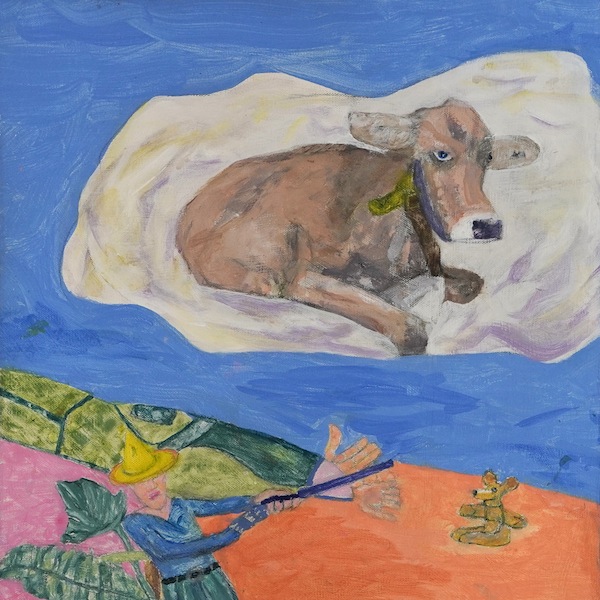
Another smile-inspiring work is Paul Leighton’s “Not Over the Moon Yet.” On the painting, a sad cow is floating on a cloud. Or is it an island? The style is two-dimensional, but the meaning is much deeper. Is the poor cow attempting to fly away from stupid humans? The artist thinks so: “My approach to the theme of longing and belonging is to use oblique humour to ponder unfathomable human global problems through the lens of the preposterous…. An individual, no matter how earnest, can’t solve all the interrelated problems of the Anthropocene or rescue a cow fleeing into the clouds,” said Leighton. “However, social pressure and citizens’ assembly can help.”

image - “Not Over the Moon Yet” by Paul Leighton
“Not Over the Moon Yet” by Paul Leighton.

And then there are paintings like Gail Rudin’s “Home is Where the Heart Is.” Folk art in style, it is heart-warming in its essence. It reminds all of us of the importance of home.

The show is on display at the gallery until April 2. To view the exhibit anytime or attend the March 23, 5 p.m., reception, visit jccgv.com/community-longing-and-belonging.

Olga Livshin is a Vancouver freelance writer. She can be reached at [email protected].

Format ImagePosted on March 19, 2021March 18, 2021Author Olga LivshinCategories Visual ArtsTags art, disability awareness, inclusion, JCC, JDAIM, Jewish Community Centre, Leamore Cohen, painting, Zack Gallery
Jewish Poland in 1932

Jewish Poland in 1932

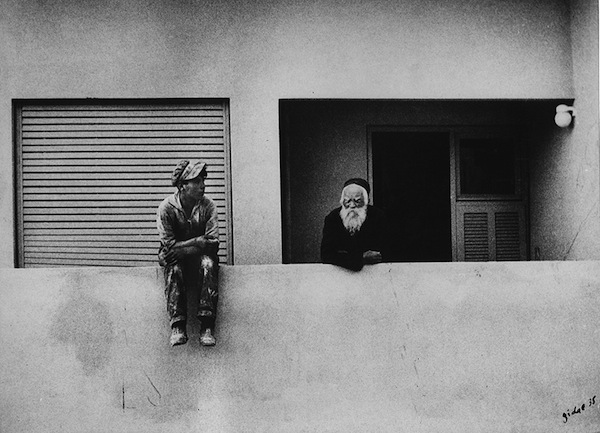
This photo, called “Generations,” was taken by Tim Gidal in Tel Aviv in 1935. (courtesy Zack Gallery)

The current show at the Sidney and Gertrude Zack Gallery, Invisible Curtain: The 1932 Polish Photographs of Nachum Tim Gidal, was organized in partnership with the Cherie Smith JCC Jewish Book Festival, which runs Feb. 20-25. Gidal (better known as Tim Gidal or Tim N. Gidal) was a renown photojournalist of the last century and the exhibit’s images come from the new book Memories of Jewish Poland: The 1932 Photographs of Nachum Tim Gidal. (For a review, click here.)

The driving force behind the book’s publication was Yosef Wosk, who wrote its preface. Wosk approached Zack Gallery director Hope Forstenzer and Jewish Book Festival director Dana Camil Hewitt about a year ago, Forstenzer told the Independent. “He suggested we have a Tim Gidal show at the gallery to coincide with the festival and his newly published book,” she said.

Both Wosk and Forstenzer curated the exhibit. “Together, we chose about 50 images for the show, as many as the gallery could fit. It couldn’t include all the images in the book, of course,” said Forstenzer.

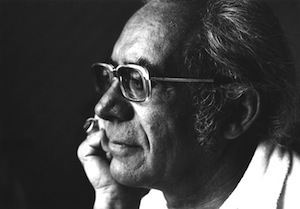
photo - A self-portrait by photographer Tim Gidal, taken in 1974
A self-portrait by photographer Tim Gidal, taken in 1974. (courtesy Zack Gallery)

The history of the photographs is best described by the photographer himself in the book’s introduction. In 1932, Gidal, then 23, traveled with two friends to Poland from his hometown of Munich, Germany. It was his first trip abroad. “My knowledge of the political, economic and social conditions of the Jews in Poland didn’t seem to square with my feelings about their spiritual life,” he wrote. “So I decided to go and see for myself.”

Gidal, who passed away in 1996, took numerous photographs of people and places, as he went from shtetl to shtetl on his three-week “little odyssey.” He wrote: “I encountered spiritual and material heights and depths: material well-being and abject poverty, rejuvenation and dissolution. Some were rich, but many more were very poor. It was a hopeless poverty, endured with an incredible humility. I met men of faith and hypocrites … atheists, socialists and communists, Zionists and Bundists, Orthodox and assimilationists. We also experienced the all-pervading Jewish humor.”

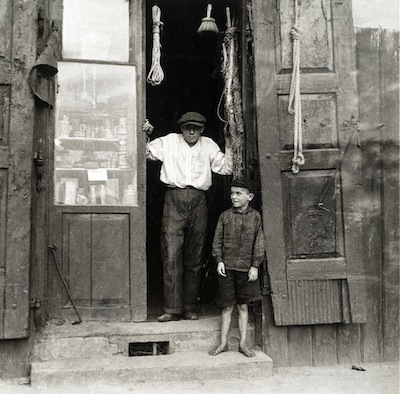
photo - Tim Gidal’s cousin Gershon in the doorway of the family’s rope shop, in Lowicz, Poland. The photo was taken by Gidal in 1932
Tim Gidal’s cousin Gershon in the doorway of the family’s rope shop, in Lowicz, Poland. The photo was taken by Gidal in 1932. (courtesy Zack Gallery)

Everything the young photographer experienced was reflected in his images, including those now on display at the Zack. We see children laughing and women looking far older than their real years. We see ancient eyes and tired, worn hands. We see educated men reading in front of a synagogue, and broken windows and peeling walls the next street over. And we know something Gidal didn’t know at the time, which makes this book and the show all the more poignant: not many years later, most of these people would be murdered in the Holocaust, and they and their entire way of life would be lost. But, in Gidal’s photos, his subjects remain alive. According to Wosk, “Each photograph is a monument, a letter in light.”

Gidal’s 1932 Polish photo essay comprises only a small portion of the master’s body of work. His photography journey spanned almost seven decades and encompassed most major players and momentous events of the 20th century.

One of the pioneers in the field of modern photography, Gidal made his debut in 1929 with his first published photo report. He was a proponent of the style of the “picture story” and he captured most of his subjects unaware, instead of staging elaborate scenes. Very few of his subjects posed for his photos, and every image tells a story.

Four years after his trip to Poland, Gidal moved to Palestine. During the Second World War, he served as a staff reporter for a British army magazine. A wanderer and a chronicler of life, he traveled a lot and lived in the United States for awhile. He taught and illustrated books. He exhibited widely.

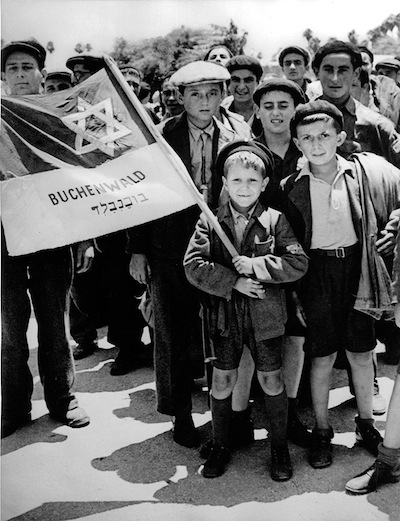
photo - Tim Gidal took this photograph of Buchenwald survivors arriving in Palestine in 1945. It is one of the images featured in the exhibit Invisible Curtain, on display until Feb. 25
Tim Gidal took this photograph of Buchenwald survivors arriving in Palestine in 1945. It is one of the images featured in the exhibit Invisible Curtain, on display until Feb. 25. (courtesy Zack Gallery)

A portion of the Zack exhibition is dedicated to Gidal’s artistic photography after 1932. The pictures demonstrate his technical progress, as well as his breadth of interests and subjects. There is a lyrical photo, “Generations,” taken in Tel Aviv in 1935 and another – a dramatic portrait of the youngest survivors of Buchenwald, taken in 1945 upon their arrival in Palestine. There is a photo of Mahatma Gandhi at the All-India Congress in Bombay in 1940 and the fascinating picture called “Handshake,” taken in Florence in 1934, which shows two men shaking hands in front of a wall covered with multiple posters of Mussolini.

Half a century before Photoshop was invented, Gidal experimented with his images, compiling them in different combinations and creating something unique, like his triptych of Winston Churchill of 1948 or the Rhomboid photomontage of 1975.

As a photo reporter, Gidal used his camera to record the 20th century in all its glorious and painful contradictions, and his early 1932 Polish photographs serve as a symbol of his multifaceted canon.

Invisible Curtain opened on Jan. 5 and the exhibit will continue until Feb. 25. To see the show’s digital equivalent, visit online.flippingbook.com/view/891736. To book an appointment to see it at the gallery, email Forstenzer at [email protected]. To attend the virtual book launch on Feb. 11, 7 p.m., and to see the full book festival lineup, visit jccgv.com/jewish-book-festival.

Olga Livshin is a Vancouver freelance writer. She can be reached at [email protected].

Format ImagePosted on January 29, 2021January 29, 2021Author Olga LivshinCategories Books, Visual ArtsTags books, Cherie Smith JCC Jewish Book Festival, history, Holocaust, Hope Forstenzer, Invisible Curtain, Israel Museum, photography, Poland, Tim Gidal, Yosef Wosk, Zack Gallery
Painting survivors, life

Painting survivors, life

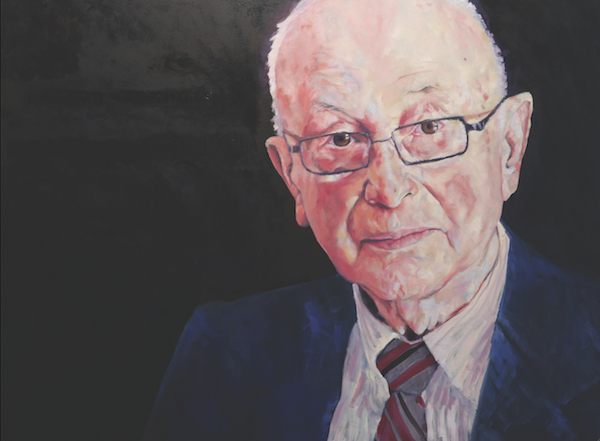
A portrait of Robbie Waisman, by artist Carol Wylie. Part of the exhibit They Didn’t Know We Were Seeds, at the Zack Gallery to Jan. 4.

Even via a wobbly Zoom-led tour, the impact of Saskatoon artist Carol Wylie’s portraits – nine of Holocaust suvivors and nine of residential school survivors – can be felt.

The title of the solo exhibit at the Zack Gallery until Jan. 4 is They Didn’t Know We Were Seeds. It is taken from the proverb: “They buried us … they didn’t know we were seeds.” And the choice of 18 portraits was deliberate.

“It was quite quick and early in the process I decided that 18 had to be the number,” said Wylie at the exhibit’s virtual opening Nov. 19, “because there’s so much darkness in the stories but there’s so much light and life in the survival… [T]here’s three of the Holocaust survivors who are involved with the March of the Living and to actually go back to the camps, to Auschwitz, and to make that walk when you were there; I can’t imagine the courage it takes. And they do it so that others are educated. That’s the rising above it and making something really powerful out of a black, dark experience.

“And I see the same thing with residential school survivors, like Gilbert [Kewistep] and like Eugene [Arcand], who spend so much of their time going around to schools and speaking in public about their experiences to make sure people are educated about that. And, again, reliving what they went through every time they tell it, I’m sure.

“So, the 18 and the connection to chai, to life, came really early in the process. It had to be 18, because that validation of life that these people represent … had to be present.”

The scale of the paintings was also chosen purposefully. “I want these portraits to take up space and to be very present and, for when you’re standing in front of them, to have them fill up your field of vision, so that you can’t wander past, uninterested and unengaged,” said Wylie.

The project started several years ago, she explained. “I saw Nate Leipciger speak at the Holocaust memorial service in Saskatoon and, it’s ridiculous, I’ve been [attending] for lots of years but, for some reason, that year, it hit me for the first time how elderly all these people are getting.”

The firsthand experience that is so powerful is soon to be lost, she said, and “I felt there was something that I had to do to help to preserve that.” And she would do it with the best tool she had, her passion and ability to create portraits.

“What I have learned over the years,” she said, “is that, when you capture the nuances of a person’s face, you really reflect who they are and much of their history and how they’re made up of that history. Even though it’s not like hearing a verbal story, it’s seeing a story in a different form.

“I started this idea to do a series of portraits of Holocaust survivors. And then, as I entered into it, little things started to pop up that were connecting the Jewish survival to the residential school experience. It started with a community seder at our local synagogue, where our rabbi, who is very forward-thinking, always has elements on the tables that recognize other groups … and, that particular year, he had made special mention of making sure that we understand – especially in Saskatchewan, where we have a really dark history of residential schools – the experience of the Indigenous people that we live with.

“And I started thinking, it’s not a parallel experience, but it’s an experience that is shared in terms of pain and suffering and then survival and rising above it…. And, because I live in Saskatchewan, this is part of the history of the land that I call home, that I’m a settler in, that this is a time of truth and reconciliation, it’s a time of trying to address these issues, so, as a personal step towards reconciliation, I can sit down, listen to the stories of some of these residential school survivors and bear witness to them and bring them in to be part of this project, so that they can converse through their portraits, as a group of survivors.”

It was only after making this decision that Wylie discovered that people like Vancouver’s Robbie Waisman – who is among those featured in the exhibit – were already meeting with residential school survivors to share ideas and experiences.

The project took about three-and-a-half years to complete. Waisman is the only Vancouver-based subject. “All the other Holocaust survivors were from Toronto, Edmonton and Saskatoon, and all the residential school survivors are from Saskatchewan,” said Wylie in an email interview with the Independent.

“I had to be really careful,” she noted at the exhibit opening. “There’s a very, very fraught history of non-Indigenous artists and non-Indigenous photographers representing Indigenous peoples and I knew I was stepping into this murky ground. All the way along, I had to keep asking myself questions about my own integrity around this, what are the reasons for why you’re doing this and does every single survivor that you talk to understand fully what this project is about and [are they] fully on board with it. At the end, I thought, if there are people who are criticizing it, that’s fine, but, I feel, after conversations I’ve had with many residential school survivors, that it’s more important that we raise this issue and more important that I make this step towards reconciliation than be fearful of doing something that maybe I shouldn’t be doing or that the art world might perceive that I shouldn’t be doing.”

When the work was completed, Arcand and Kewistep “smudged the work before it went off on its first exhibition. Then they gave me a smudge kit that I could use myself, if I wanted to, in the future. It was extremely meaningful to me; it was almost like they’d given it their stamp of approval, as well as imbuing it with these good graces and these good thoughts and this positive energy before the work went anywhere and anyone had a chance to see it.”

The exhibit has been shown in various places and will travel elsewhere after its time at the Zack.

Wylie’s general process in doing portraits is to speak with her subjects first.

“I think that, in order for the mask that we all wear in the world to protect ourselves, in order for that to drop, there needs to be time spent talking,” she said. “There’s this very strange artificial intimacy that happens when you’re sitting two feet – before COVID times – away from somebody that you’re drawing, and you’re talking and you’re looking intently at them…. So, I always wait until that couple of hours of conversation and visiting is over and then I pull out my camera.

“I need to work from photographs because I like to get a strong resemblance and I can’t have people coming back endlessly to sit for me…. But that’s when I take them, is after that time has been spent, that conversation has happened, and their mask has come down and they are open.”

The openness that is seen in the subject’s faces, stressed Wylie, “is not something that I put there, it’s something that they had. Seriously, I paint what I see… And that captures what they have, what they are, because it’s all within there, it’s all in their face.”

Given the caveat that there is something intangible about what makes a good portrait, Wylie said in an email, “I believe a portrait should bear resemblance to the subject. But, in addition, it should feel like the portrait is inhabited; like it contains the spirit of an individual. You often hear people comment about the eyes in a portrait following them. I think that’s the sensation of some element of the person, and not just their resemblance, being present. I also like to see evidence of the artist in the work in the form of brushstroke, colour choices, etc. This trace of the artist distinguishes a painted portrait from a photo.”

She described her need to create portraits as “a compulsion I’ve had since I was a child. Even then,” she said, “I drew people, made my own paper dolls. In my grad school investigations I discovered, I believe, that it’s because of a fascination I have with the mystery of consciousness, and the fact that we can never share another’s consciousness. We learn about ourselves through our interactions with others and these connections enrich our being.

“The face is a major part of how we communicate and is strongly connected to our identity,” she said. “Yet, we cannot see ourselves the way others see us, so there’s this mystery around faces. What do they hide? What do they reveal? How do you feel as ‘you’ wearing your face? How do I communicate as ‘me’ wearing my face? I am just never tired of painting a portrait, but am always excited when I begin a new one.”

The exhibit opening was hosted by gallery director Hope Forstenzer, who credited her predecessor, Linda Lando, for bringing this show in. The exhibit is open by appointment and via onlyatthej.com. A commemorative book, being prepared with Wylie’s help, is in the works, as well, said Forstenzer.

On Dec. 9, 6-8 p.m., the gallery is having a Zoom event with Waisman and Wylie, as well as Lise Kirchner from the Vancouver Holocaust Education Centre and Shelley Joseph from Reconciliation Canada. Readers interested in attending should email Forstenzer at [email protected].

Format ImagePosted on December 4, 2020December 2, 2020Author Cynthia RamsayCategories Visual ArtsTags art, Carol Wylie, Holocaust, Hope Forstenzer, JCC, portraiture, residential schools, Robbie Waisman, survivors, Zack Gallery
COVID stories and moments

COVID stories and moments

(“Skewed Priorities,” photo by Bob Prosser)

COVID-19 has upended all of our lives in multiple ways. More people work from home. Self-isolation has become customary. Masks are everywhere. The anxiety and fear of infection have spread as widely as the virus itself. To reflect these and other changes, the Sidney and Gertrude Zack Gallery invited Jewish community members – not professional artists but lay people – to share their experiences, thoughts and emotions in both visual and oral formats. The results can be found in the gallery’s current show, What We See: Stories & Moments from the COVID-19 Pandemic.

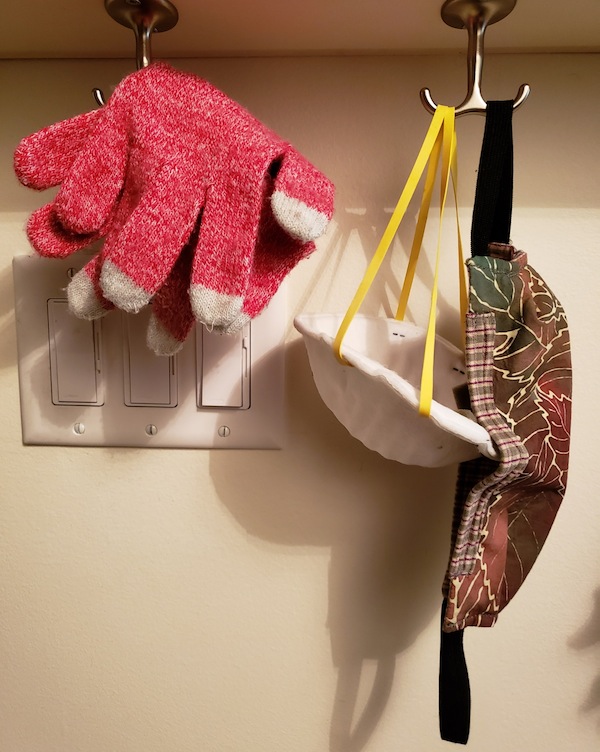
photo - “Gloves and Masks” by Doris Fiedrich
“Gloves and Masks,” photo by Doris Fiedrich.

The exhibit, which opened Sept. 10, consists of 15 entries. Each entry, submitted by one person, includes a few photos depicting that person’s new reality and a short essay, in which the participant wrote what has touched them most profoundly. As the deadline for the submissions was early July, everything in the show is about the first few months of the pandemic, before we all got more used to it and the new rules of social interaction became the norm.

Participant Sandra Collet presents her impressions through a poem on the meaning of the current crisis: “… A time of loneliness / A time of LIFE … A time of sadness / A time of hope.” Its last line, “Together apart,” encapsulates one of the most significant changes wrought by the pandemic.

Bob Prosser has written about his “ordinary experiences” and contemplates the days ahead: “… my wife sewed masks, we’re growing herbs and vegetables, we have learned to bake bread.… I’m hopeful but pessimistic about the post-COVID future.” One of the most memorable photographs of the whole show is his: the stockpile of toilet paper in his house.

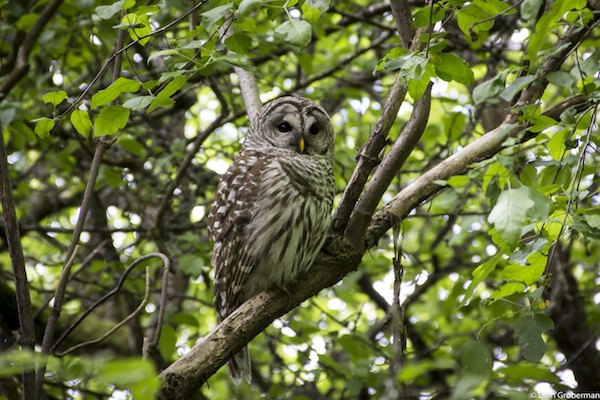
photo - “Owl” by Evan Groberman
“Owl,” photo by Evan Groberman.

For Derry Lubell, the hardest aspect of social distancing is her inability to be with her family, to interact with her grandchildren. Her short essay is almost a lament. She writes, “… one afternoon, I went to their house and stood on the sidewalk. They all came out onto their front porch.… I took these shots of our separation.”

Micah Groberman encountered a different challenge. Before the pandemic, his business was focused on tourism and, like most every other business connected to tourism, it fizzled out due to the global travel and gathering bans. He writes, “… before COVID, I would walk my sons – Evan, 8, and Jonas, 5 – to school and then begin my workday, but suddenly, I became my boys’ teacher.” He admits that he is not too good at math, so he decided to teach his sons about what he knew, instead: photography and nature. His older son’s photographs of wild birds, taken under Groberman’s tutelage and included in the show, prove the father’s talent for teaching. The images are outstanding.

Paul Steinbok’s photos capture simple, everyday images. In his essay, he expresses sympathy and compassion for those who have suffered from COVID. His own feelings have become more acute, more attuned to the life surrounding him. “This year,” he writes, “I have observed more closely and photographed the ever-changing colours and textures of spring. In addition, I have photographed some situations that have resulted from the COVID restrictions, such as messages of hope, COVID-style birthday parties and exercise classes.”

Tybie Lipetz, the mother of a 4-year-old daughter, writes about the disappointments young children have faced, the school closures and birthday party cancellations. “Life was turned upside down for the kids,” she notes.

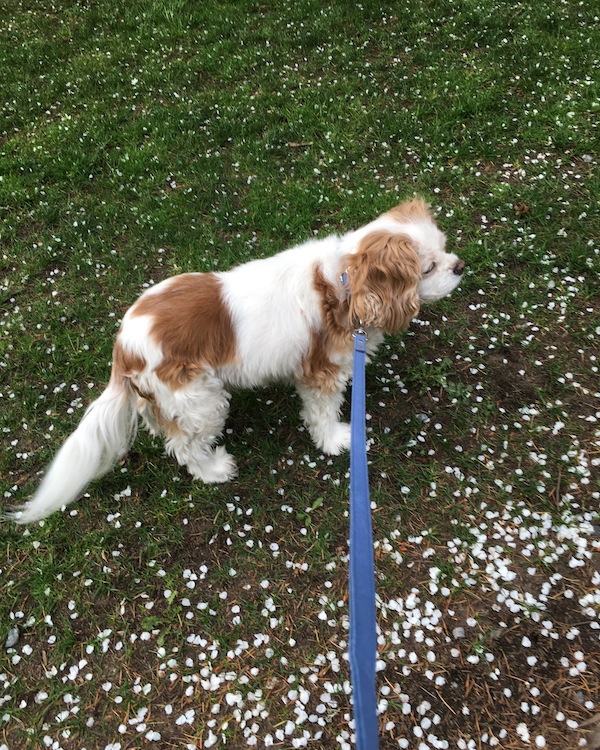
photo - “Dog Scarlett” by Fran Goldberg
“Dog Scarlett,” photo by Fran Goldberg.

Despite the drawbacks and dangers of COVID, many entries emphasize the authors’ hope and joy. For example, Fran Goldberg, who belongs to the especially vulnerable age group of 70-plus, has found positivity from her family and her dog. She and her children stay in touch by phone daily. “Instead of talking about what I couldn’t do, we started to focus on what I could,” she writes. “For one thing, I could Zoom with my family.… I have a dog.… She is 13 years old and, on our walks, she still takes the time to ‘smell the roses.’ She and my family have taught me to slow down and appreciate the beauty I see around me.”

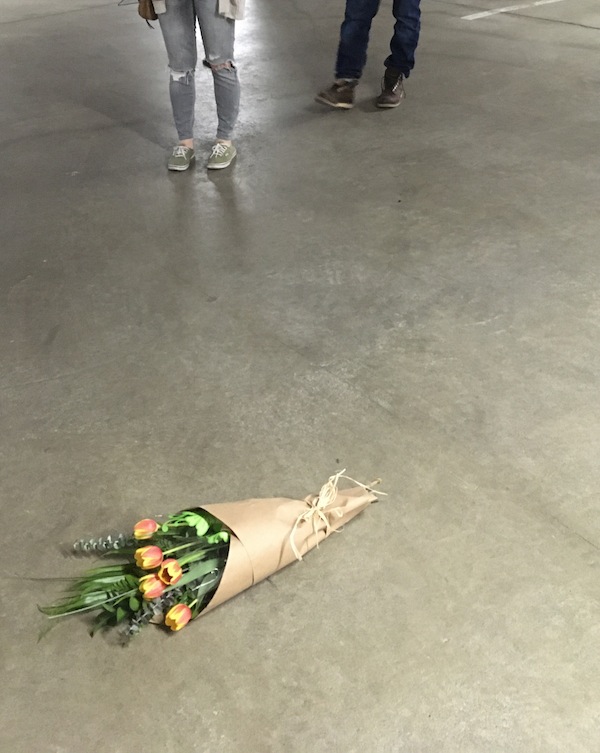
photo - “Bouquet” by Kathy Bilinsky
“Bouquet,” photo by Kathy Bilinsky.

Kathy Bilinsky also recognizes the beauty around her, however unexpected, and has captured it with her camera. In her essay, she mentions walking around Granville Island, which she did countless times before the pandemic, and notes how, at the pandemic’s onset, everything looked different, abandoned: “… no vendors, no shoppers, no tourists. It felt surreal…. So many doors that we can’t enter, nor do we want to.”

In her photos of the closed doors of Granville Island, the familiar noisy streets are almost unrecognizable. Who had ever seen those doors in broad daylight without a crowd in front of them?

Another of Bilinsky’s photographs is a bouquet on the asphalt, a gift from her children on Mother’s Day: “… flowers received ‘socially distanced,’ awkwardly tossed on the parking lot floor.… We all just stood and stared at them.”

The 15 participants in this unique show offer stories and moments ranging from eerie to prosaic, from heartwarming to poignant, all contributing to this combined slice of memory of the first few months of the pandemic in Vancouver.

What We See: Stories & Moments from the COVID-19 Pandemic runs until Nov. 10. You can visit the Zack Gallery by appointment or view the show’s digital book at jccgv.com/art-and-culture/gallery.

Olga Livshin is a Vancouver freelance writer. She can be reached at [email protected].

Format ImagePosted on October 30, 2020November 1, 2020Author Olga LivshinCategories Visual ArtsTags art, Bob Prosser, coronavirus, COVID-19, Derry Lubell, Fran Goldberg, Kathy Bilinsky, Micah Groberman, Paul Steinbok, photography, Sandra Collet, storytelling, Tybie Lipetz, Zack Gallery
Zack Gallery reopens

Zack Gallery reopens

“Resistance” by Dorothy Doherty. Part of the Beyond the Surface exhibition now on at the Zack Gallery until Sept. 8. (photo from gallery)

The Jewish Community Centre of Greater Vancouver has opened its doors again, at least partially, and the Sidney and Gertrude Zack Gallery is presenting a new exhibition, Beyond the Surface. Art lovers can make appointments to tour the show in person. It features five local artists – Janice Beaudoin, Olga Campbell, Dorothy Doherty, Jane McDougall and Ellen Pelto – and the Jewish Independent interviewed them recently by email about their art, and how the pandemic has affected them.

photo - Olga Campbell
Olga Campbell (photo from the artist)

“This exhibit was originally scheduled for June 4,” said Campbell. “Because of COVID, it was a bit late. It was hung on June 18, and the virtual opening through Zoom was on July 8.”

Last year, the five artists attended a five-day workshop in Victoria led by California artist Michael Shemchuk, though some of them had met before then.

“Dorothy and I have been friends for 45 years,” said Pelto. “I met her in a clay class she was instructing. I’ve also known Olga for eight years.”

“I met Olga Campbell in various art workshops in Vancouver and then spent five years on campus with her at Capilano College between 2008 and 2014,” said Doherty. “We took some classes together and worked independently in others, all the while growing in friendship.”

Doherty, who has taken Shemchuk’s workshops several times over the years, met McDougall and Beaudoin at one or another of those sessions. And Shemchuk’s teaching, especially on the paper layering technique, has been instrumental in the birth of this Zack show.

“A couple of us thought that it would be interesting to show some of the work that we had created in his workshop,” Campbell recalled. “We thought that five [artists] would be a good number to demonstrate the cohesiveness of the art, as a result of us all using the same techniques, but also showcase each of our individual styles.”

photo - Dorothy Doherty
Dorothy Doherty (photo from the artist)

Doherty came up with the title, Beyond the Surface. She said the rest of the group quickly agreed. “I think the word surface resonated with us because we all do unique surface treatments,” she said. “Surface is really important in art and in life, but we always want people to look beyond appearances – learn about people and artwork in greater depth.”

To produce the works, the artists manipulated a surface in many ways. They layered, sanded, abraded and painted it; even cut into it to reveal what lay beneath.

Beaudoin elaborated: “Beyond the Surface is the ideal name for this show, as the technique we all used is based on the process of layering paper and paint. As we add and subtract paint and materials by sanding or scraping, each artist makes decisions about what elements to reveal and what to hide. The final surface is one that often appears aged and somewhat mysterious, providing the viewer with enticing glimpses of things that are hidden beneath the surface and leaving them to wonder what has been covered.”

In a way, this show’s unusual story echoes its title as well. While a traditional vernissage is an event where art connoisseurs mingle inside a gallery, the pandemic forced Zack Gallery director Hope Forstenzer to show and promote the art digitally.

“She did a virtual tour of our show at the JCC,” said Campbell, “and she is also interviewing each of us in our studios live via Zoom, so that people can see our art and have a virtual tour of our studios.”

photo - Janice Beaudoin
Janice Beaudoin (photo from the artist)

The artists mused about the changes in their field and in gallery procedures wrought by COVID-19.

“My sense is that pandemic or no pandemic, artists will always make art. The biggest challenge is going to be getting the art out to the world to enjoy,” said Beaudoin. “There is always a basic human desire to stand before a work of art in person. That is definitely the best way to engage with a painting. However, there is a generation of media savvy younger art buyers who are used to purchasing things by seeing them on a computer screen. I think that galleries that are working to provide virtual viewing options are the ones that will survive. The art world, like all industries, really has no choice but to adapt.

“I also feel that it must be acknowledged that many people still find comfort in seeing art in person. The art world is known for its fun social events – and we know now that the comfort of human contact cannot be fully recreated online. My sense is the future of art shows and museums will be a carefully managed balance of socially distanced in-person viewing and virtual showings.”

“I have been fortunate,” said Campbell. “I continue to meet regularly with three other artists. We create our art at home and then share it with each other on Zoom. With another artist friend, I have been playing Photoshop tennis online. One person sends the other an image, the other person adds another image through Photoshop, and this continues until the piece is finished.… I think that we are in this for the long haul; two years, maybe more. I think that, in the future, art shows will continue in real life – in fact, it is already happening – but I do think that some of the virtual things will remain.”

“It’s hard to say how the pandemic will change exhibition practices in the future,” said Doherty. “I do appreciate all the online exhibits, as there would be no other way to see many of these exhibitions. But I really believe there is no substitute for the gallery system as we know it, with wonderful opening nights and the ability to see the artwork in person. We need that direct exchange of human energy, and the feedback we get from visitors and friends. We need access to art in galleries and to artifacts in museums – it’s how we learn. I have always said, despite my gratitude for online Zoom meetings, that the human experience is not the same. It’s flat instead of three-dimensional. We are looking at screens. We are not looking at the real person. There is no exchange of human energy online. We need direct human contact. That’s what we need to live happy, successful lives.”

photo - Jane McDougall
Jane McDougall (photo from the artist)

For McDougall, the pandemic hasn’t changed much for her. “I think most visual artists are used to working in isolation. My art practice has remained the same,” she said. “Listening to CBC in my studio keeps me up to date on the world and, of course, most of the talk is about COVID. I feel grateful to live in B.C.

“I am generally a positive person and my thoughts reflect that. I think there will be more of an online presence for art,” McDougall continued. “And, like Hope Forstenzer’s example throughout this show, there will be interactive web calls and taped studio visits. Because of that, artists will become more involved in the galleries. Long term, I think the pandemic will pass. Art galleries and museums will always be an important element in education and sharing the past. Nothing will replace the up close and personal view of art.”

photo - Ellen Pelto
Ellen Pelto (photo from the artist)

Pelto agreed. COVID has changed exhibition practices, she said, and “will inevitably change the future practice of making, exhibiting, buying and selling art. However, people will always need to see art. That will not change. People need to see it to appreciate the scale, proportions, richness of colours and textures, and to feel their evocative response. Some of the positive outcomes include the creation of more and stronger online artistic communities. The online presence increases exposure for artists, and interesting themes will emerge in art that will define the human condition of COVID.”

Beyond the Surface runs until Sept. 8.

Olga Livshin is a Vancouver freelance writer. She can be reached at [email protected].

Format ImagePosted on August 28, 2020August 27, 2020Author Olga LivshinCategories Visual ArtsTags art, coronavirus, COVID-19, culture, Dorothy Doherty, Ellen Pelto, Hope Forstenzer, Jane McDougall, Janice Beaudoin, Olga Campbell, Zack Gallery
Zack Gallery’s new director

Zack Gallery’s new director

Former Zack Gallery director Linda Lando, left, with new director Hope Forstenzer. (photo by Daniel Wajsman)

The Sidney and Gertrude Zack Gallery at the Jewish Community Centre of Greater Vancouver has a new director, Hope Forstenzer – one of the few directors in the gallery’s history to be a professional artist.

Forstenzer is a graphic designer and a glass artist; she is a member of the Terminal City Glass Co-op. She takes over the reins of the Zack Gallery from Linda Lando, who retired at the end of last year.

“I have a background in visual art and performing art,” Forstenzer told the Independent. “For years, I was the artistic director of a multimedia company in New York. We worked on short plays: judged them and then produced them around New York. It was an amazing job, very interesting, but it didn’t pay my bills. For that, I worked as a graphic designer.”

She also taught graphic design, first in the United States – New York, Seattle and Baltimore – and, later, in Vancouver, after her wife accepted a job at B.C. Children’s Hospital in 2012 and the family moved here. Forstenzer has been teaching graphic design at Emily Carr University of Art + Design and at Simon Fraser University.

The artist began working with glass in 2001, while still in New York. She liked it so much that she made it her principal medium. A number of glass shows in Seattle and Vancouver have included her pieces.

“I had two solo shows for my glass, both here in B.C.,” she added. “I also participated in a group show at the Zack in 2015.”

The life of a freelance artist is a hectic one. Forstenzer has had to juggle her teaching schedule and studio time, plus a family with young children. She longed for more professional stability.

“I started looking for a steady part-time job,” she said, “then I heard Linda Lando was retiring from the Zack. I always loved this gallery and its artists, loved the JCC. I decided to apply for the job. I’ve worked in leadership positions in the art field all my life, so this job seemed perfect, both in its essence and its timing.”

Her plans for the gallery are extensive. “I want to do at least as well as Linda did. She was a marvelous director, so I have big shoes to fill.”

Forstenzer is already working on future shows, both solo and group exhibitions, in various artistic formats. “I love diversity,” she said. “But a group show might be harder in some ways to jury and organize. Art is always subjective and, in a group show, some people will always like certain artists more than others. The trick is to make it work for the majority…. When a curator assembles a group show, it is a collaboration, like putting together a puzzle, making as little dissonance as possible from the disparate pieces. On the other hand, in a solo show, you create a flow of energy.”

With regard to the gallery and its place in the community, Forstenzer said, “I want to make sure the gallery is connected to the JCC. We are part of it, and that should be emphasized. It doesn’t mean only Jewish artists – the JCC has a diverse membership, it draws in people of all ages, skills and cultural influences. I want to reflect that in our future shows and programs. Linda started that with her amazing poetry series. I want to do more. Children’s programs. Sessions for older citizens. Workshops for families. I want interactions with the gallery. I want our visitors to be part of the shows.”

As for the artists, she said, “I want to create a nurturing environment for them in the gallery, want to encourage younger artists, not just in age but in experience. Some people only start in the arts after they retire, and their mastery in other areas makes them unique in artistic venues. I want to establish a relationship with our artists, so they will trust me.”

Forstenzer is sure that her being an artist herself is an asset for her work as gallery director. “I’m not only an artist, I’m a fan of the arts, of beautiful things of any kind. It’s not really that common. Many artists are not fans, they prefer their own art to anyone else’s, but I love art. When I visit a museum or a gallery, I want to absorb as much as I can of the other artists’ imaginations.”

Her years as an artist and as an art administrator give her a unique perspective – to see the gallery from both sides. “I can advocate for the artists,” she said, “but I also can and will represent the gallery and its patrons.”

While acting as the gallery director, Forstenzer said she will not exhibit her own work at the Zack. “It would be a conflict of interest,” she said. “I’ll never exhibit here. I will participate in the Terminal City Glass Co-op’s group shows as a glass artist, but, at the Zack, I’m the director, not an artist. I will keep a hard line between my glass-blowing and my gallery.”

To learn more about Forstenzer’s glassworks, visit her website, hopeforstenzer.com.

Olga Livshin is a Vancouver freelance writer. She can be reached at [email protected].

***

Editor’s Note: This article has been corrected to reflect the fact that Hope Forstenzer was not the first Zack Gallery director to be a professional artist, but rather is one of the few directors in the gallery’s history to be a professional artist.

Format ImagePosted on February 21, 2020February 24, 2020Author Olga LivshinCategories Visual ArtsTags art, glass-making, Hope Forstenzer, Linda Lando, Terminal City Glass Co-op, Zack Gallery
Inspiring optimism with art

Inspiring optimism with art

Linda Frimer’s exhibit, Beckoned by the Light, runs until Feb. 23 at the Zack Gallery. (photo from Linda Frimer)

“Since I was a child, I’ve always looked for the light – in the forest near my home and in the stories of my family. All the paintings in my show were inspired by light, the light of creation,” said Linda Frimer.

The exhibit, Beckoned by the Light, opened at the Zack Gallery on Jan 30. Originally, Frimer thought that her show would open simultaneously with the launch of her upcoming book, Connecting the Dots, and this is why the gallery exhibit opened in conjunction with the Cherie Smith JCC Jewish Book Festival. But life interfered, and the book is still a work-in-progress. Nevertheless, Frimer told the Independent, “I decided to go ahead with the show.”

Frimer’s paintings are beautiful, suffused with light. They are closer to impressionism than to realism, but every piece is unmistakably and uniquely hers. Light bathes the trees and the streams. It filters among the branches. It soars on dove’s wings over brilliant abstractions and illuminates mysterious paths winding through the woods. Light bursts into explosions of gladness and swirls like dancing fairies, inviting gallery visitors to share the luminous joy, to rejoice in the rainbow of colours.

“When I paint, I want to be positive,” the artist said. “Life is hard. That’s why I want joy in my paintings.”

To express her joy, Frimer uses bright colours, including gold and silver. “Gold and silver are great for all the recurring symbols in my paintings,” she explained. “One of my favourite symbols is wings – wings of the birds, like a dove, which is a metaphor for light.”

Another symbol that appears frequently is a tree. “Trees have wings, too. Sure, they are rooted in earth, but they reach for the sky, for the light,” Frimer said.

One more symbol populates many of her paintings – a flower, specifically a sunflower, which always strives to stretch higher, to touch the sun.

And then there are paths, roads to the light. Or to a better place. Or to someone you love. “I love people,” she said. “Love being a member of a group. I’m a member of several different groups.”

One of her groups – with five artist friends – attended her opening night and brought a gift: a wooden staff adorned with symbols of her art. Each object that was attached to the staff was created by a member of the group.

“We met through a project of the Hebrew University about 15 years ago,” Frimer said. “Now, we meet regularly, support each other in life and art. Whenever one of us has a show, the rest of us always make something symbolic for her.”

The group comprises Frimer, Nomi Kaplan, Lilian Broca, Barbara Heller, Sid Akselrod and Melenie Fleischer. “We call our group Five Hens and a Rooster,” Fleischer said with a laugh, as she presented the group’s gift to Frimer.

Music also plays a big part in Frimer’s artistic life. One could almost hear notes thrumming in her imagery. “I often listen to music when I paint,” she said. “I even dance sometimes. I love classical music, pop, all kinds, really.”

Frimer always starts a painting with an idea, but then her imagination takes over. “I follow my intuition,” she said. “Painting is a spiritual act for me. It’s like meditation. I love the process, the magic of creating. It’s wonderful to be able to express all that positive energy.”

In her opinion, everyone is an artist. Not necessarily a visual artist, but we all create in our own way. “It’s about how you feel, how you express yourself,” she said. “The process is much more important than the end result. I taught art a lot and I facilitated several healing artistic projects. It is great when I can help people tell their stories through creativity.”

Her new book is about that, too. “It’s my life story through art,” she said. “There are also creative exercises there, and some essays about different aspects of creativity. It’s about the healing power of the arts.”

Many of Frimer’s canvasses are large, expensive, fit for corporate headquarters or ballrooms, but the artist wants more than to sell her paintings for profit. “I believe in art reaching the public, being accessible. That’s why I make reproductions of my own work,” she said. “I make posters and giclée prints in different sizes. While my original paintings might not be affordable to many, anyone can afford a small print or appreciate a poster.”

In the same spirit, she often makes donations of her art to hospitals and synagogues. “When a painting hangs in a hospital,” she said, “I hope it might make someone feel better, help with their healing. In a synagogue, I hope my paintings might inspire and support. I studied colours and how they could aid in healing a body or a spirit. I even wrote about it in my book.”

Frimer’s bright paintings are permeated with hope and energy. They are celebrations of possibilities, as if the artist sees everything through the lens of optimism. And she shares that optimism freely with all of us.

Beckoned by the Light runs until Feb 23. For more information on Frimer and her work, visit lindafrimer.ca.

Olga Livshin is a Vancouver freelance writer. She can be reached at [email protected].

Format ImagePosted on February 7, 2020February 6, 2020Author Olga LivshinCategories Visual ArtsTags art, Beckoned by the Light, Linda Frimer, painting, tikkun olam, Zack Gallery
Cohen’s clay defies gravity

Cohen’s clay defies gravity

Larry Cohen’s new ceramic exhibition at the Zack Gallery runs until Jan. 25. (photo by Olga Livshin)

Larry Cohen’s new ceramic exhibition at the Zack Gallery is called This and That. The name is symbolic for the artist. His show consists of two entirely different types of pottery: whimsical woven sculptures and functional crockery. “I wanted to explore the relationship between pure art, like my sculptures, and functional things, like my bowls, vases and cups,” said Cohen in an interview with the Independent.

“There is a continuum that stretches from pure functional to pure art, and every object fits somewhere along that continuum,” he explained. “The closer to the artistic end, the less functionality the object has, except for people to look at it and think about it. On the other end, there is pure functionality: you can use a bowl for fruits or a mug for your coffee, but it also has a shape and a colour; something to look at, too.”

In his long artistic life, Cohen has worked in many different mediums, creating sculptures from metal and wood, but clay is his material of choice. “Clay is a wonderful thing to work with. It feels good in my hands,” he said. “And it could be found anywhere in the world. Here, in British Columbia, in Europe, in China, in Japan, in Latin America.”

In the past decade, Cohen has won a couple of month-long residencies as a clay master, one in China, another in Japan. “The clay is different everywhere. Its chemically different compositions provide different visual and textile effects in the objects made of it,” he said. “It could be the same colour when unfired and painted with the same glaze, but, if made from different types of clay, after firing, the resulting pottery would look and feel different.”

Cohen travels a lot and, everywhere he goes, he searches for the local potters and their art, trying to absorb as much as he can from the various traditions. “As clay is different everywhere, so the traditions are different, but, in most of the places I have visited, the history of pottery goes back thousands of years,” he said. “People made things of clay in ancient China and ancient Mexico. Not so much in Europe – it had to import the technique from China, but it is still very old. The only place in the world I know that didn’t have pottery is here, in British Columbia. The local clay is wonderful, but the indigenous people here didn’t use it. They made everything out of wood. Only in the past 200 years, since the Europeans settled in B.C., pottery has been on the rise.”

To a degree, Cohen is a local clay pioneer, like other local potters. It is important to him that everything he creates is unique, that no object repeats another. He is as much a craftsman as an artist, which makes even his utilitarian bowls and vases works of art. His woven sculptures are really one of a kind; they are akin to wicker baskets, but made of clay.

“Some of them look like vases, but there are holes,” he said with a smile. “You can’t pour water inside. No functionality except to look at and admire. It is a new technique for me. I always try something new, always think: what is another way to use clay?”

This particular technique looks like ceramic ribbons lying on top of one another, or interwoven. “Clay is forgiving,” Cohen said. “You can make all kinds of different shapes from it, but, even so, it took me awhile to develop this technique. I had to figure out how to overcome the softness of clay and how to combat gravity, so the upper layers wouldn’t squish the lower ones.”

photo - On display are works he has made using a technique that creates dynamic, ribbon-like clay structures
On display are works he has made using a technique that creates dynamic, ribbon-like clay structures. (photo by Olga Livshin)

He cuts clay in strips and then twists them in various ways to create the dynamic shapes. “Sometimes, I repeat the same shape multiple times, sometimes make them different,” he said. “I dry them before firing, so the whole sculpture doesn’t collapse under its own weight. Sometimes, I make two or three layers together. Other times, every layer is dried separately, and then they come together in the kiln, held to each other by the glaze. Once or twice, I made the full sculpture before firing, and you could see the lower layers sort of melting together.”

Unlike a painter, who sees the immediate result of his labours, a potter doesn’t see what he creates until it’s fired in the kiln. Cohen fires every piece twice, first without glaze, the second time with glaze.

“Once a piece goes into the kiln, you never know what will come out,” he said.

Cohen makes his pieces in bunches before firing them all together. “I have three large kilns in my studio on Cortes Island,” he said. “I fire them four or five times a year. One is electric, for lower temperatures. It is the first one I use. Whatever I’ve made by the time I fire the kilns goes in. Then everything has to cool down before I paint on the glaze and use the other two kilns – one for regular glaze, for the smooth surfaces, and another with salt for the special textures.”

This and That opened on Jan. 9 and continues until Jan 25.

Olga Livshin is a Vancouver freelance writer. She can be reached at [email protected].

Format ImagePosted on January 17, 2020January 15, 2020Author Olga LivshinCategories Visual ArtsTags art, clay, Larry Cohen, pottery, Zack Gallery
Letting imagination fly

Letting imagination fly

Janet Strayer at the opening of her solo exhibit, Wings of Imagination, on Nov. 28 at the Zack Gallery. (photo by Olga Livshin)

Janet Strayer first conceived the idea for her new show at the Zack Gallery, Wings of Imagination, about a year ago. “I was talking with Linda, and the bird theme came about,” she said in an interview with the Independent, referring to Linda Lando, director of the gallery.

“Birds appeared in my paintings before,” said Strayer. “They take us into the air, into a different place. Birds symbolize freedom – freedom of movement, freedom of imagination. The flight of imagination allows us to envision different possibilities, different solutions, even different ways to see familiar things. When I considered the name for this show, I thought about [Albert] Einstein and his words that knowledge is always limited, but imagination is limitless. Imagination is the most important thing for any artist.”

Wings of Imagination is all about flight and wings. Birds populate the paintings. Bright and whimsical, they flitter around birdhouses, soar towards a distant sky or interact with other creatures, real or imaginary. Some images are bright, almost cartoonish, inviting a smile, while others seem more serious, characterized by quiet intensity and misty, pastel colours. And then there are funky collages, with real 3-D birdhouses attached to the two-dimensional pictures.

“There are three distinct styles of paintings in this show,” said Strayer. “The three styles are consistent with the theme of the show. I started it conceptually, as I always do, but I couldn’t explore it in any one direction. Wings of imagination is a huge theme, and there is no one way to approach it – all the possible ways should be expressed. Freedom of expression is what it is all about; it is like several different directions of flight.”

image - “Papageno” by Janet Strayer, whose exhibit at the Zack Gallery runs until Jan. 5
“Papageno” by Janet Strayer, whose exhibit at the Zack Gallery runs until Jan. 5.

One of the styles is almost impressionism. The paintings’ blurry lines are reminiscent of Claude Monet’s foggy nights. The dream-like imagery catapults the viewers into some eldritch realms of sublime illusions with their wings and birds, sky and air.

“Another style is magic realism,” the artist explained. “I wanted to go magical. Imagination is magic. The Canada goose is flying, but his wings are magical – you can’t see such pattern on a real goose, except in your imagination. Beside the goose hangs my homage to Leonard Cohen, as he walks across the sky.”

The two paintings of “Birdwoman” seem similar in composition but entirely different in their palettes and in their emotional subtext. “The colours in ‘Birdwoman on the Roof’ are muted compared to the other one,” said Strayer. “On the roof, she is open to the sky, not as loud as the other, more of a mystery. It has space for you to come in and indulge in your own perception, while the other one is more enclosed inside its room and its brilliant colours.”

Strayer’s magic realism paintings are eccentric and capricious, with clear lines between the colours and frolicking creatures from fantasy novels, while her third style, the collages, appear at first glance as a jumble of small images punctuated by birdhouses.

“Birds need places to live in,” said the artist. “I took a risk with the collages, didn’t know what would happen, but it was such fun working with them. It took me three months to finish those two collages. They started with fragments, and then they led to other fragments. And feathers. And birdhouses. Things tell you what to do, until the entire image comes alive. It was like an adventure in my studio every day. Where would it go?”

Strayer’s playful adventure resulted in two unique art installations. “I wanted people to be surprised by these collages,” she said. “I wanted them to stop and look at all the tiny details. We don’t always stop and look. Even with art, so often, we come to a gallery, but we just glance. We don’t stop and really look.”

Strayer’s is a familiar name to Zack Gallery patrons. She had a solo show at the gallery in 2010, but the difference between the two shows is not only temporal but esthetic. While the previous show was black-and-white digital art and a poetic look at childhood, this one is bursting with colour and exuberance, and features mostly acrylic paintings.

“I enjoy creating digital art,” she said, “but I wouldn’t want it as a steady diet. I’m an explorer. I always want to try something different. I love to work on real paintings. And I’ve always loved colour.”

For Strayer, a predominantly abstract artist, the esthetics of her creations are more important than the telling of a story or the conveying of a message.

“A message should come through the esthetics,” she said. “And, if someone has a different interpretation than me, it’s fine, too. As soon as the paintings are on the gallery wall, they are not mine anymore, even though I created them. Everyone could see something different, compatible with their own memories and experience.”

Wings of Imagination opened on Nov. 28 and runs until Jan. 5. To learn more about Strayer, visit janetstrayerart.com.

Olga Livshin is a Vancouver freelance writer. She can be reached at [email protected].

Format ImagePosted on December 13, 2019December 12, 2019Author Olga LivshinCategories Visual ArtsTags art, collage, Janet Strayer, nature, painting, Zack Gallery

Posts pagination

Previous page Page 1 … Page 4 Page 5 Page 6 … Page 12 Next page
Proudly powered by WordPress