Skip to content
  • Home
  • Subscribe / donate
  • Events calendar
  • Business Directory
  • FAQ
  • News
    • Local
    • National
    • Israel
    • World
    • עניין בחדשות
      A roundup of news in Canada and further afield, in Hebrew.
  • Opinion
    • From the JI
    • Op-Ed
  • Arts & Culture
    • Performing Arts
    • Music
    • Books
    • Visual Arts
    • TV & Film
  • Life
    • Celebrating the Holidays
    • Travel
    • The Daily Snooze
      Cartoons by Jacob Samuel
    • Mystery Photo
      Help the JI and JMABC fill in the gaps in our archives.
  • Community Links
    • Organizations, Etc.
    • Other News Sources & Blogs
  • JI Chai Celebration
  • JI@88! video

Recent Posts

  • SFU honours Gloria Gutman
  • Lifting people’s spirits
  • Wedding a ray of light
  • Indigeneity and Zionism
  • Rule of law broken: councilor
  • Football and its roles
  • The burden of defence
  • Fish Café returns after fire
  • All right in what goes wrong
  • Nuns & mermaids at TUTS
  • Camp offers holiday retreat
  • Students and mentors inspire
  • Once-in-a-lifetime trip
  • 100 dancers, one heart
  • Money for the sciences
  • What “Jewish food” means
  • Have a cookie, schnitzel too
  • Federation now across BC
  • Israel fighting for its existence
  • Deal strengthens Iran
  • Patriotic belonging diminishes
  • A campaign to engage
  • Upstanders’ first live event
  • Responding to Carney
  • Having your own home
  • Music a family tradition
  • Musical to warm heart
  • Community milestones … June 2026
  • Sharing her passion for Israel
  • Or Shalom reopens its doors
  • JFS from past to future
  • Need holistic approach
  • Sharing stories, advice
  • Journalist shares fears
  • Skills to live together
  • Road to independence

Archives

Follow @JewishIndie
image - CJN box ad Rockowers 2026

Tag: Zack Gallery

People and places of Cuba

People and places of Cuba

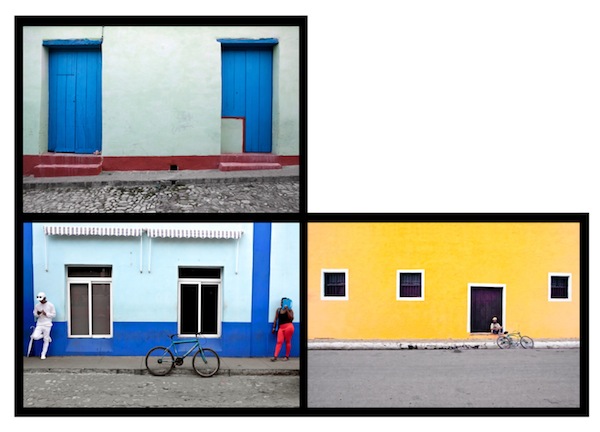
Lorne Greenberg’s solo show, Cuba, comprises photographic compositions, such as this one. (photos by Lorne Greenberg)

The origins of Lorne Greenberg’s solo photography exhibition Cuba can be traced back more than 35 years. “I had my MFA in photography from the University of Arizona in 1983,” he told the Independent. “In 1984, I began photographing Mexican street art.”

At first, he photographed on the American side of the border, but later visited Mexico several times, taking pictures of streets and buildings in many Mexican border towns. “I have an affinity for Latin American art,” he said. “I also read many Latin American writers.”

After a few years, though, Greenberg turned his artistic eye to other interests and new subjects. He only started refocusing on Mexico five years ago.

“In 2014, I began to photograph in Mexico again,” he said. “This time, I was interested in streets, buildings and yards, objects as artifacts of culture. I see it as the archeology of Man, a study of Man in his environment through the observance of objects and artifacts. There is no sky in my Mexican photos, but walls and doors and windows. Colours, shapes and lines, and where things are in relation to each other.”

He wanted to dig deeper in that direction, but, having been in Mexico multiple times, he turned to Cuba. “I had never been to Cuba before. I wanted to see it,” he said. “I heard that [Barack] Obama was going there, and I decided that I’d better go before Americanization.”

In spring 2016, Greenberg flew to Cuba for the first time. “Just me, my camera and my backpack. I came a few days after Obama left. I was there for about 10 days and visited three cities: Havana, Santa Clara and Trinidad.”

He wandered the streets and photographed doors and walls and windows, but with a new mode of expression. “I started seeing people,” he said. “Before, there were hardly any people in my photos. Now, I wanted to photograph them as part of the streetscape.”

He continued his Cuban exploration in 2018, on his second trip to the country. This time, he stayed exclusively in Havana. “When I was there, I ate, slept, photographed and listened to jazz,” he recalled. “It’s a vibrant place, with music a prevalent part of life.”

Again, he roamed the streets, without a plan, photographing houses and people. “Nothing is staged in my photos; nobody posed,” he said. “I just waited until I had a perfect image, and then I took it. I wasn’t trying to make a statement, didn’t have any preconceived idea. I just wanted to find what is there, discover the relationship between people and places, the coherence of individuals and their building backdrops. If some people didn’t want to be photographed, they would say it, and I didn’t take their pictures, but that happened only three times.”
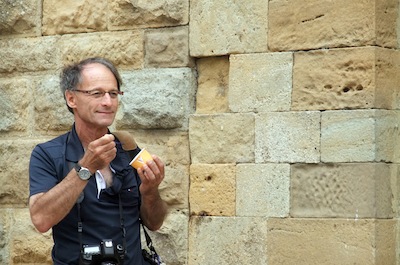
photo - Lorne Greenberg in Italy
Lorne Greenberg in Italy. (photo by Lorne Greenberg)

In selecting the images to include in his solo show, from the hundreds he took in Cuba, he said, “I didn’t want to show just 10 or 15 large pictures. A single large image has a privileged status, and I wanted to create an experience of Cuba, to show people what I saw.”

Therefore, he compiled his photographs into compositions, which made it possible to increase the number of different images on display. Each composition is more than a collection of individual photos – it is a work of art on its own.

“There are 102 different pictures in the show, combined into eight compositions,” Greenberg said. “At first, I considered each composition as a tic-tac-toe grid, but it didn’t work. It was too orderly, too tight, didn’t give the sense of Cuba. Then I thought about the sculptures of Alexander Calder. I changed the layout of my compositions, opened them up, created a flow. They are not individual photographs anymore. They are installations, and they incorporate the gallery space as part of the experience. Each composition has a certain colour scheme, and its lines and shapes create a whole, simultaneously dynamic and static, random and structured.”

The arrangement of the compositions was as creative an endeavour as was taking photographs. “It was fun moving pictures around, seeing different possibilities. I could have done it for much longer, if I didn’t have a deadline for the show,” he joked.

Greenberg’s Cuban compositions reflect the political reality of the country. The lively colours of the buildings preen under the heat and light of the sun, while simultaneously exposing the peeling paint, dirty or moldy walls, and the rusty metal of fences and shutters, which hint at the poverty that exists in the country.

“I see beauty, aesthetics and humanity,” said Greenberg. “Poverty is more in the ethical dimension, and everything for me is in the aesthetic world.”

The show Cuba opened on Oct. 24 at the Zack Gallery and continues until Nov. 24. The opening reception was held on Oct 30. For more information on Greenberg’s work, visit lornegreenbergphotography.ca.

Olga Livshin is a Vancouver freelance writer. She can be reached at [email protected].

Format ImagePosted on November 8, 2019November 6, 2019Author Olga LivshinCategories Visual ArtsTags Cuba, Lorne Greenberg, photography, Zack Gallery
Trees bring Zack to life

Trees bring Zack to life

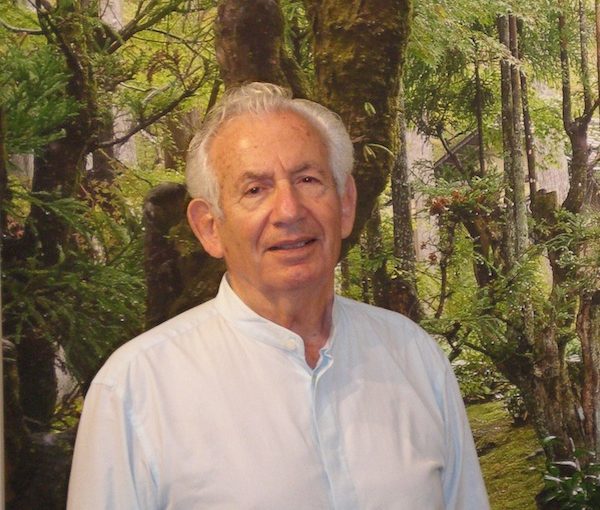
Michael Seelig is donating the proceeds from his exhibit Trees to the Zack Gallery. (photo by Olga Livshin)

Trees, Michael Seelig’s new solo photography exhibit at the Zack Gallery, opened last week. It is a fundraiser for the gallery, which is located in the Jewish Community Centre of Greater Vancouver.

Such philanthropic initiatives “are of ultimate importance to the gallery and the community, as everybody wins when the gallery is well-supported,” said Zack director Linda Lando. “We have approximately three benefits a year, and they come in different ways. Sometimes, they’re initiated by the artist, sometimes by myself or another staff member of the JCC.”

Seelig’s decision to donate all the proceeds came from the heart, and it’s not the first time. His previous show at the Zack, which was held five years ago, was also a benefit. “This is my way of contributing to the JCC,” he said in an interview with the Independent. “We have a longstanding connection to the centre. My wife was president of the JCC some time ago, and we’ve given several donations to the community over the years.”

Unlike his previous show, which focused on architectural images – Seelig was an architect before he retired – this show is all about trees. A cornucopia of greens dominates the gallery walls.

“When Linda asked me to do a show this year, I didn’t have much in mind,” he said. “I started going through my photographs, selected the best 20, and then realized that eight of them were photos of trees. Looking back, I’ve always photographed trees. Maybe I have an affinity for trees. So, I thought I’d make it the theme of this entire show.”

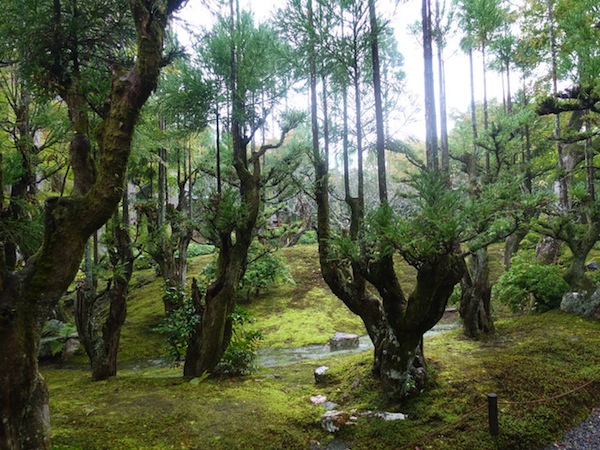
photo - “Garden Kyoto” by Michael Seelig
“Garden Kyoto” by Michael Seelig.

Seelig has been drawn to trees and their unique charm for a long time. “I think my love of trees comes from my childhood, when I was growing up in Israel,” he said. “Jewish people are the only ones I know who have a holiday dedicated to trees: Tu b’Shevat. During that holiday, we cherish trees, plant them, take care of them, so they can take care of us. That tradition probably influenced me from a young age to love trees and photograph them. I take photos of trees wherever I travel.”

In the Zack exhibition, there are pictures of trees from Israel and Scotland, Canada and Japan.

“There is a book I read recently,” Seelig said, “called The Hidden Life of Trees, by Peter Wohlleben. He is a German forester and writer and he knows trees. He says trees form communities. They communicate with each other and with us. It was a fascinating book, and I agree with the author; his book inspired me. Have you noticed that old stumps sprout new growth sometimes? That is because there are other trees around. Trees are life-givers; they create the air we breathe. Without trees, there would be no life on earth.… In Canada, and particularly in British Columbia, we often take trees for granted. Most of us do not pause to look at them and admire their beauty, solidity and permanence. We forget that, without trees, our planet cannot survive. This show pays homage to trees in many parts of the world.”

Seelig’s trees are all different; each one has its own shape and personality. Some are gnarled and twisted, while others stretch up in straight lines.

“I like it that they don’t talk to me,” he joked. “Trees are my models, but they’re more obedient than people when it comes to posing for a photo. I can take my time snapping pictures of trees. They are perfect photography objects. A tree just stands there. You can walk around it, see it from 360 degrees or from underneath. And every view is different. You can’t do this with a person.”

In addition to Seelig’s photographs of trees, the show includes several watercolours, most of which he painted specifically for this exhibit. Only two small works are exceptions. “When I was looking through my archives in preparation for this show, I found a small painting, created by my father in 1940. He painted a street in Haifa, and there is a tree in the image. The second painting is mine; I painted it in 2010, also in Haifa. Seventy years passed between these two paintings, but their colour schemes are surprisingly similar. And there are trees in both paintings.”

The sizes of the images on display vary greatly. While Seelig’s father’s painting would fit in a school notebook, and most of the photographs are the perfect size for a family home, a huge triptych on canvas of one of his Kyoto garden photos would enliven a hotel foyer or a corporate conference room. “I invited some designers to the show,” Seelig said. “Maybe one of them would like it.”

Seelig’s approach to photography is consistently organic. He doesn’t edit his photos with Photoshop, doesn’t even crop them.

“My pictures are exactly what I see,” he said. “And now you see them, too. There are other photographers who manipulate their photos with editing software, many of them wonderful artists, but I don’t do that. I don’t call myself an artist either, even though I use my creativity for many things in my life. I used artistic judgment for my work as an architect, before I retired. Now, I make greeting cards and wedding invitations with my photographs and my paintings. I illustrated a couple of children’s books, written by my daughter and her husband. Even making dinner for our friends is a form of art for me.”

The Trees exhibit runs until Oct. 20.

Olga Livshin is a Vancouver freelance writer. She can be reached at [email protected].

Format ImagePosted on October 4, 2019October 2, 2019Author Olga LivshinCategories Visual ArtsTags environment, Michael Seelig, painting, philanthropy, photography, trees, Zack Gallery
Photos inspire a dream

Photos inspire a dream

“Curiosity,” photo by Liron Gertsman.

One of the most important issues we should be grappling with nowadays is the preservation of our habitat. At the forefront of the nature preservation movement are photographers and one of them is Liron Gertsman, a young, award-winning local nature photographer whose solo show, Essence of Earth, is at the Zack Gallery until Sept. 22.

The show is sponsored by Esther Chetner.

“Eldad Goldfarb, executive director of the Jewish Community Centre of Greater Vancouver, approached me about this upcoming sponsorship opportunity, aware of my own concern about climate change and my passion for photography,” Chetner told the Independent. “Though I’ve traipsed parts of the globe enjoying the wonders that photo details can deliver, I’m not at all technically trained nor technologically nimble…. I recognize the remarkable quality of Liron’s images, and see value in making his work accessible to others.”

Calling Gertsman a “rising star,” Chetner said, “Encouraging this type of exquisite work is another way to help people appreciate our natural world more deeply and then, hopefully, to work toward preserving such essential global health and diversity. The more we see and appreciate about our natural environment, the more we will all be inclined to proactively protect it.

“Jewish values are quite aligned with environmental stewardship, and so having Liron’s work displayed at the JCC seems like an appropriate fit.”

Part of the proceeds of the exhibit will benefit the gallery, and another part will go to the Nature Trust of British Columbia.

“There are several charities concerned with nature preservation in B.C.,” Gertsman said, “but I like the Nature Trust because they purchase land specifically to build and maintain a treasury of wild areas.”

The 19-year-old photographer is passionate about preservation. (See jewishindependent.ca/tikkun-olam-through-photos.)

photo - Liron Gertsman has loved nature and photography all his life
Liron Gertsman has loved nature and photography all his life. (photo by Ian Harland)

“I’ve loved nature and taking photographs all my life,” he told the Independent. “Recently, I started moving toward doing it professionally, like giving photography workshops or guiding people on their bird-watching expeditions.”

His photographs are like a guided tour. “I want people to witness nature,” he said. “I want to share with them what I see, even if they can’t travel themselves.”

To cover some of his costs, he has, at times, formed partnerships with companies and organizations.

“I choose companies focused on nature conservation,” he explained. “They would subsidize some aspects of my trip, or sometimes an entire trip, in exchange for photo use and social media marketing, usually through my Instagram account, which has close to 50,000 followers.”

For instance, in May and August of this year, Gertsman partnered with Ocean Outfitters, an ecotourism company based in Tofino.

“They are Tofino’s first carbon-neutral ecotourism company, and they have committed to donating $200,000 a year for multiple years towards restoration of the Tranquil Watershed,” he said.

Gertsman’s photos at the Zack Gallery are full of life and colour. His birds seem to soar through the gallery space. His landscapes are like windows, looking out into the British Columbia wilderness. Stars twinkle in the night sky. Pink crags reflect in the still surface of the lake. Waterfall gurgles across the boulders. Owls hide in the grass, and gulls skim over the rippling wavelets. But the beauty and serenity of his images filled me with apprehension. Could we lose all of this gorgeousness? The night after I visited his show, I had a dream, and Gertsman’s imagery figured heavily in my dreamscape.

* * *

“What is it, Grandpa?” a girl asked.

“A picture archive,” the old man replied.

“But it’s not a memory crystal.”

“No, it’s from the 21st century, an antique. Two hundred years old,” he said, inserting an outmoded device into a slot of his com-link and opening the files. Hundreds of pictures appeared on his screen. Nature, when it flourished.

“Oh,” his granddaughter said with interest. “What are those?”

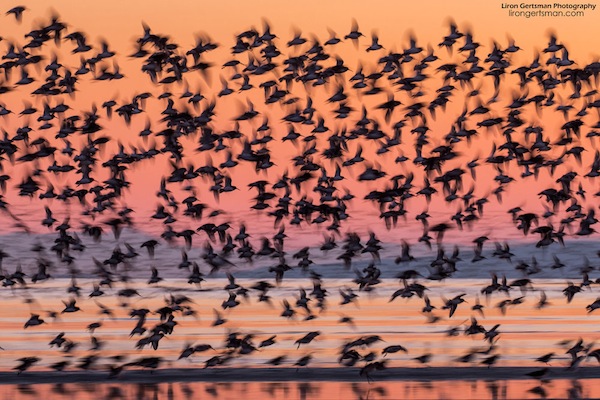
“Birds,” he whispered reverently. In the image, hundreds of small dark bodies hurtle across the peachy sky, their wings pumping so rapidly, the image blurred.

“Like a hologram in a museum?”

“Yes. Only they were alive. Flying.”

“But why is the wall pink? Why would they paint it pink?”

photo - “Sandpiper Sunset,” by Liron Gertsman
“Sandpiper Sunset,” photo by Liron Gertsman.

The old man glanced at the wall of the cave that housed the archives. Nobody lived on the surface of the earth anymore. Nobody could survive the toxic environment. People inhabited underground caverns such as this one and, mostly, they didn’t bother painting the walls. There were few resources anymore.

“It’s not a wall, it’s the sky,” he said. He had been very young when the last of humanity had moved underground, but he still remembered the sky. Scientists said that, in a few more generations, they could live outside again, but he wasn’t sure his granddaughter would last that long. He certainly wouldn’t.

“Our teacher said the sky should be blue,” the girl insisted.

“The sky could be any colour. This is probably sunset.”

“What is sunset?” She had never seen the sun.

He sighed, but, before he could explain, her gaze had skipped to another image.

“It looks like a fountain,” she marveled, “but what are these green blobs?”

The old man winced. “Trees. Bushes. It’s not a fountain. It’s a waterfall.”

Her finger zeroed in on another image. “I know,” she said triumphantly. “These are dogs. Strange dogs, though.”

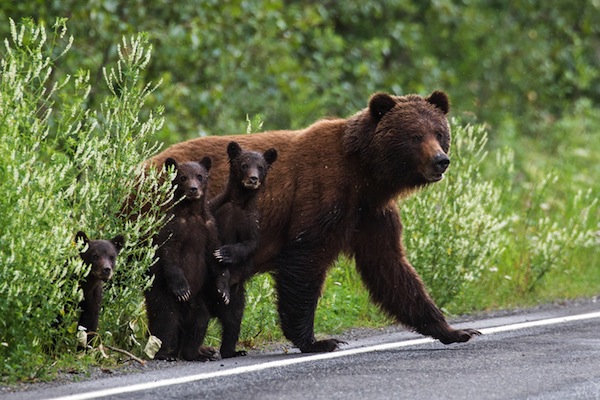
“These are not dogs. These are bears. The mother bear is….” He contemplated the animals on the screen, trying to remember his own textbooks. He had never seen a living bear either. “I think she is as big as I am,” he said at last. “Maybe bigger. And the little bears are probably your size.”

“So huge?” She eyed him with doubt. “They lived outside, too?”

He nodded.

“I don’t think I’d like it outside,” she said. “Everything is different. I like it better here.” She climbed off her chair and started to leave. “We have everything here.” She went out into the corridor. “I think it’s all fairy tales anyway,” she called back.

The old man remained still, staring at the closed door with sadness.

* * *

Essence of Earth opened at the Zack Gallery. To see more of Gertsman’s work, visit lirongertsman.com or instagram.com/liron_gertsman_photography.


Olga Livshin is a Vancouver freelance writer. She can be reached at [email protected].

Format ImagePosted on September 6, 2019September 4, 2019Author Olga LivshinCategories Visual ArtsTags environment, Esther Chetner, Liron Gertsman, photography, Zack Gallery
Exhibit of inscriptional art

Exhibit of inscriptional art

Ken Hughes infuses his paintings with messages. (photo by Olga Livshin)

Ken Hughes has always been fascinated with typography. “Since childhood, letters of the alphabet have intrigued me,” he said in an interview with the Independent.

“Public lettering is a centuries-old method of civic communication, both official and informal,” he said. “It goes back to Mesopotamia. By Greek and Roman times, public writing – inscriptions on buildings, commercial graphics, signs, epitaphs on tombs, graffiti – was common. The messages could be political or commercial, funerial or commemorative, religious or frivolous. In more contemporary times, particularly in Europe, public inscriptions have undergone a revival.”

The artist draws from this rich tradition for his paintings and his new show at the Zack Gallery, Ancient Writings in Contemporary Contexts, opens next week. A collection of inscriptional paintings, beautiful and evocative, colours and shapes of the images enhance and deepen the meanings of the lettering, and every piece tells a story.

Before retiring, Hughes was a professional graphic designer. He taught graphic design for years at Emily Carr and Kwantlen universities. He turned to art five years ago.

“Inscriptions – texts expressed formally or otherwise in different alphabets or languages – are a major source of inspiration for my paintings,” he said. “This particular exhibition’s goal is to visually express texts related to Jewish beliefs and culture. Some of the paintings have writings in the Hebrew alphabet. Others have transliterated Hebrew using the Roman alphabet.”

He explained that the messages in his paintings come from various sources: the Hebrew Bible, fiction and nonfiction by Jewish writers, as well as quotes by famous people, all related in one way or another to Jewish culture.

“I don’t speak Hebrew,” he said, “but I have friends who do. I always ask them to check the writing before I incorporate it into my paintings.”

In his work, the esthetics of the letters are intertwined with the message of the citation used. He has been collecting quotes, personal mottos, sayings and other forms of public texts for a long time. “I sing in a choir, and much of choral music is liturgical,” he said. “It has incredible messages, many of them in Latin. I also read a lot and get my messages from books, from newspapers, from common idioms.”

In 2002, Hughes took a yearlong sabbatical from teaching to prepare for what he does now.

“I traveled through Europe – Poland, France, Turkey, Belgium, Greece and Israel,” he said. “I took photos of the public inscriptions on civic buildings, in churches, at cemeteries. I wrote down quotes from illuminated manuscripts in national libraries. There are incredible inscriptions on the tombstones in Budapest, where many famous Hungarians are buried. Jewish cemeteries have beautiful inscriptions in Hebrew.”

Sometimes, a line of text or a quote stays in his memory or in his notebooks for decades before appearing in one of his paintings. Many of his pieces are sad, executed in a darkish palette, underscoring words of deep emotion: grief, fear, despair, memories of hard times and bleak thoughts. But there is hope and joy, too, and Hughes uses bright and colourful compositions to accentuate those messages.

One of his uplifting works, a multi-paneled cycle based on the story of Genesis, with Hebrew lettering dancing across the panels, is decorative as well as informative. The series will be in the exhibit at the Zack.

“Alphabets are amazing inventions, incredible almost,” Hughes said. “They allow people to communicate ideas with just a few symbols. And they are all different – the Roman alphabet, the Cyrillic letters, the Hebrew. In all cases, letters by themselves mean nothing; they’re just symbols. But a combination of letters, a phrase, could have profound meaning.”

When Hughes starts working on a piece, he approaches it as a designer, with a typographer’s attention to detail. He makes many sketches while investigating each idea. What colours should be employed and in what combinations? What is the best number of panels for this message and the most expressive configuration to highlight the meaning of the words? Even the font used can make a difference.

“Some letters look better in a rounded font; others need a blockier typeface,” he said. “The positioning of the letters and the words could be of paramount importance in my paintings. They constitute the composition. And, of course, the message itself often dictates the font type.”

There are not many artists in Canada who dedicate their art to this kind of painting.

“I wanted my paintings at the Zack,” Hughes said. “I don’t want to display at commercial galleries. I think my works are much more suited to schools, churches or community centres.”

Ancient Writings in Contemporary Contexts runs from July 25 to Aug. 25. To learn more, visit kenhughes-art.com.

Olga Livshin is a Vancouver freelance writer. She can be reached at [email protected].

Format ImagePosted on July 19, 2019July 18, 2019Author Olga LivshinCategories Visual ArtsTags inscriptional art, Ken Hughes, painting, writing, Zack Gallery
Colour bursts forth in Conjunction

Colour bursts forth in Conjunction

Ira Hoffecker’s current solo exhibit at the Zack Gallery, Conjunction, runs until July 21. (photo by Olga Livshin)

Conjunction, Ira Hoffecker’s current solo exhibit at the Zack Gallery, opened on June 13 and runs until July 21.

German-born Hoffecker and her family moved to Canada in 2004. “I always liked art, but when I lived in Germany, my husband and I worked in marketing for the movie industry,” she explained in an interview with the Independent.

Once, when her children were still young, they came here for a family vacation and traveled Vancouver Island. “We loved it,” she said. So much that, when they moved here permanently, they settled in Victoria. As if that wasn’t change enough, Hoffecker also decided to switch careers and follow her lifelong love of art. She enrolled in the Vancouver Island School of Art and has been studying and creating ever since.

Hoffecker’s previous show at the Zack Gallery, in 2016, was dedicated to maps. Since then, her art has undergone a couple of transformations. Conjunction is much brighter and more expressive set of works, although the abstract component remains.

On the journey to her new colourful mode, Hoffecker went through a black-and-white stage, which was the focus of her master’s in fine arts’ thesis, which she completed last year. The works she created for her master’s degree include a number of huge paintings – abstracts made with tar on canvas – plus three documentary videos. The theme – “History as Personal Memory” – was a painful one for the artist. She recalled, “One of my professors said that my works are the interconnected layers of urban setting and history. ‘Where is your personal layer?’ he asked me.”

Taking this advice, she has been trying to delve into her personal recollections, to uncover her place in history, her “personal layer” among the historical layers dominating her art. “In ‘History as Personal Memory,’ I tore pages from a history book about the Third Reich, an era in history that many Germans would prefer to forget. Yet I think it is important to face and discuss this past. Such dialogue might prevent the horrors from happening again,” she said.

In Hoffecker’s art, the artist’s memories are intertwined with the history of her nation. “Correlations between my childhood abuse, which I tried to forget, and the history of Germany, which the Germans tried to eradicate from their memories, exist in my paintings and films,” she said.

In her art and her videos, she opens up about the abuse she suffered as a child at the hands of her grandfather, who was also a Nazi. She is convinced that such openness has helped her heal, whereas suppressing the memories led only to the festering of her inner wounds.

The same is true for historical memories, Hoffecker insisted. “Germany needs to remember, to confront and challenge complacency to prevent a repetition of historical atrocities,” she said.

Her master’s thesis was a deep and painful discovery, a journey in black-and-white to underscore the grimness and tragedy of the topic. Once it was completed, she was ready for a change of direction.

“I spent the summer last year in Berlin,” she said. “When I came back home to Victoria, I wanted to paint some colours again.”

Hoffecker’s current exhibit bursts with vibrant colours and optimism. The series Berlin Spaces, like most of her paintings, has several layers. “There are outlines of many famous Berlin buildings there,” she said, tracing the architectural lines embedded in the abstract patterns with her finger. “The Jewish Museum, the Philharmonie, the library, the Reichstag. It is like a reconstruction, when I think about the past. I overlay history and architecture.”

One of the paintings, a bright yellow-and-pink abstract, has writing among its patterns. “It means ‘forgetting’ in German,” Hoffecker explained. “A few years ago, I was invited to have a solo show in Hof, a city in Germany. I worked there in the archives, found many old maps and records. One of their buildings is a factory now. After the war, it was a refugee camp, and there is a plaque to commemorate the fact. But, during the war, it was a labour camp, a place from where Jewish prisoners were transported to concentration camps and death, but nothing is there to remind [people] of that past. The painting reflects the current happy state of the building, but it also reflects the tragic past, the past we shouldn’t forget.”

While not many art lovers will see the horrors of the labour camp in the airy and cheerful palette of the painting, Hoffecker doesn’t mind. Like other abstract artists, she infuses her images with hidden messages, but doesn’t insist on her personal intentions.

“I own the making,” she said. “I bring in my memories and my heart, but I have to leave the interpretation to the viewers. One man in Victoria loves my art. He bought two of my paintings. He said he sees animal in them. I don’t paint animals, but I’m glad people’s own experience resonates with my paintings.”

Hoffecker is very serious about her art, but bemoans the need for promotion. “I did marketing for movies professionally, but I never really cared [about the reaction]. If someone didn’t like the movie we were pushing, it was his business,” she said. “But to promote my own paintings is scary. When someone doesn’t like what I do, I care. It hurts. I don’t want to do it. An artist wants to be in her studio and paint. It is all I want: to paint and to exhibit. I want people to see my work. Besides, a show is the only time when I see many of my paintings together. I never can do that in my studio. I only see one or two at a time.”

To learn more about Hoffecker’s work, visit irahoffecker.com.

Olga Livshin is a Vancouver freelance writer. She can be reached at [email protected].

Format ImagePosted on July 5, 2019July 10, 2019Author Olga LivshinCategories Visual ArtsTags abuse, art, Germany, history, Holocaust, Ira Hoffecker, maps, memory, painting, Zack Gallery
A mind-blowing exhibit

A mind-blowing exhibit

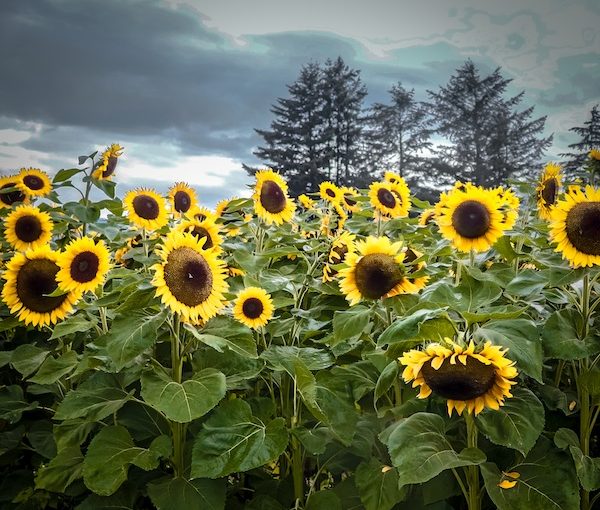
“Sunflowers” by Jocelyne Hallé.

The new show at Zack Gallery, #SeasonsAtZack features Instagram artists. A fundraiser for the gallery, the exhibit is extremely eclectic.

“The theme of the show is based on the theme of Festival Ha’Rikud, ‘Seasons of Israel,’” said Daniel Wajsman, marketing coordinator at the Jewish Community Centre of Greater Vancouver. “Every year, the gallery has a group show to coincide with the festival and the artists submit their paintings to the gallery. This year, we thought: why don’t we do social media instead? These days, everyone has a camera…. We all take pictures with our phones and share them with friends and family. This is one step further. Why can’t we share our photos with everyone? That’s what Instagram does – it is a site where we share our images with the world. That’s what we aimed for in this show at the Zack. We wanted to change the concept of what art is.”

The gallery started with the idea that only artists who have an Instagram account would be featured in the exhibit, but later opened the submission process to everyone, said Wajsman. All of the images from the show will be on the JCC’s Instagram page and prints will be available for purchase in different sizes and formats.

About a third of the photos in the exhibit come from a select group of people: staff members of several Jewish organizations, who went to Israel in April for a professional seminar. The organizations participating in the seminar were the JCC, Jewish Federation of Greater Vancouver, Jewish Family Services, Louis Brier Home and Hospital, Vancouver Holocaust Education Centre and Nava Creative Kosher Cuisine.

“We work closely together, but we don’t all know each other,” said Wajsman. “Some of us are Jewish, and some are not. The seminar had a double goal: to teach us about Israel and Jewish history and to connect us with each other.”

Regular visitors to the Zack Gallery will be familiar with many of the photographers in the exhibit. Some of the photos are by artists who have exhibited previously at the gallery – like Lauren Morris, Michael Abelman and others – and submitted photographs of their paintings for the show.

Another set of participants includes local masters of photography, such as Jocelyne Hallé, Judy Angel and Ivor Levin. Each one has more than one of their images on display.

Halle’s “Sunflowers” photo was taken recently. The bright sunny heads of the large flowers contrast sharply with the heavy stormy clouds overhead, and the juxtaposition evokes strong emotions. “It wasn’t Photoshopped at all,” said Hallé. “It’s just the way I took it.”

In contrast, Angel’s airy images glow and shimmer with transparent sunlight. They are so light, they seem translucent, able to fly off the wall like magical butterflies.

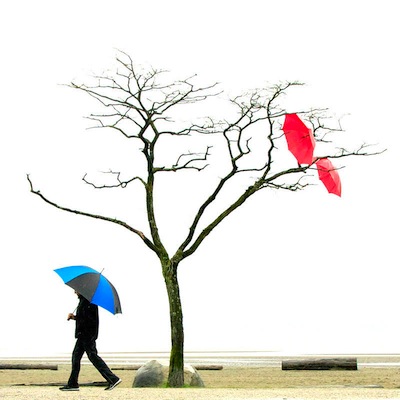
photo - “Umbrellas” by Ivor Levin
“Umbrellas” by Ivor Levin.

Beside them, Levin’s photos look like drawings, their colour schemes and compositions inspired by the rains and umbrellas of the autumn season in Vancouver.

New artists also have a strong presence in this show. For them, having their names under their art on the gallery walls is a fascinating experience. One of this crowd is Linda Lando, the Zack Gallery director. “I’m not an artist,” she said. “I’ve never displayed anything before.”

One of her photos, the colourful “Ein Gedi Night,” was taken on her trip to Israel, as a member of the seminar. “We visited Kibbutz Ein Gedi late at night,” she said. “It is a beautiful floral oasis in the desert. They have amazing flowers, and this blooming tree was near the entrance.”

Robert Johnson, also part of the seminar and a longtime JCC employee, has a couple of his photos in the show. One of them is particularly memorable: a photo of a camel with a sad expression, lying under a tree. The title of the photograph is “This is Not a Camel.”

“He talked to me,” Johnson said with a smile. “People were riding him all day, and he didn’t want to be a riding camel anymore.”

The variety of the images in the show is mind-blowing: from Israeli landscapes to mud bathers on the shore of the Dead Sea to abstract composition. #SeasonsAtZack continues until June 9.

Olga Livshin is a Vancouver freelance writer. She can be reached at [email protected].

Format ImagePosted on May 17, 2019May 16, 2019Author Olga LivshinCategories Visual ArtsTags #SeasonsAtZack, art, Festival Ha’Rikud, Instagram, Israel, photography, Zack Gallery
Exhibit starts with friendship

Exhibit starts with friendship

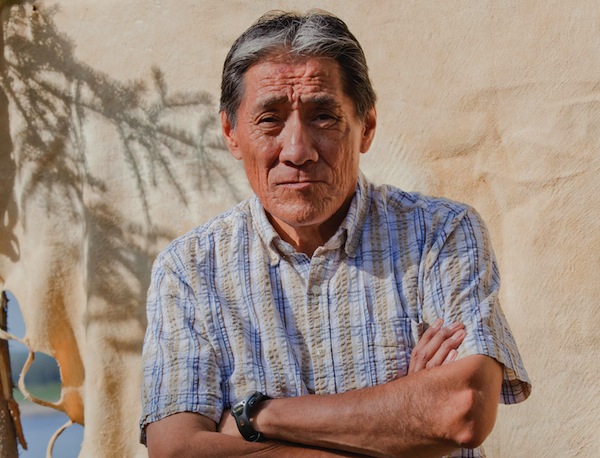
Linda MacCannell’s photograph of John T’Seleie. (photo from Drew Ann Wake)

The new show at the Zack Gallery, Crossed Paths – which explores the connection between the Jewish and the Dene peoples – has its roots in the federal Mackenzie Valley Pipeline Inquiry.

“In the 1970s, I was a CBC reporter in the Northwest Territories,” show curator Drew Ann Wake told the Independent. “When the government proposed a pipeline through the area, they sent Justice Thomas Berger to investigate the impact of the proposed pipeline [in 1974]. He talked to over 30 native communities to get their input. When he was finished, he issued a report recommending the government settle all the claims on land that the pipeline would pass through before construction started…. They are still settling those claims. The pipeline hasn’t been built yet.”

As a journalist, Wake accompanied Berger and his team on that historic trip. She taped numerous interviews with the local people participating in the inquiry.

“Ten years ago, I found those old tapes,” she recalled. “Only audio tapes; it was so long ago. I thought it would be interesting to go back and talk to all of them again. And let their children and grandchildren listen to their elders’ voices.”

photo - Linda MacCannell’s photograph of Michael Jackson
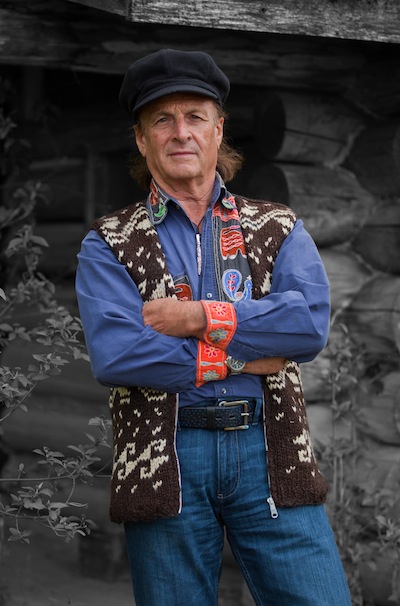
Linda MacCannell’s photograph of Michael Jackson. (photo from Drew Ann Wake)

She invited a friend, photographer Linda MacCannell, to create portraits of some of the participants of the Mackenzie Valley negotiations. Over several years, they traveled to the villages Wake had visited with Berger. MacCannell took photos and Wake filmed her interviews. “We created a show of Linda’s portraits and the stories I collected and went on the road. By now, we’ve exhibited this show in 50 galleries across North America,” said Wake.

MacCannell’s large-scale portraits of various members of the Dene First Nations, who live along the Mackenzie River, constitute the heart of the exhibit at the Zack.

“Two years ago, we gave a presentation at the grunt gallery, an artist-run centre in Vancouver,” Wake explained. “We showed the films. After the presentation, a man approached me. He introduced himself as Michael Shumiatcher, a local artist and educator. He said he knew Justice Berger at the time of the inquiry. Michael was a high school student then, and Berger was his best friend’s father.”

Shumiatcher suggested they work together and present the exhibit to schools around the province. Wake liked the idea, and invited him to join her on her next trip north. Also joining the summer 2018 trip were artist Melenie Fleischer and her husband, cellist Eric Wilson, as well as composer Daniel Séguin.

“Daniel saw the video I made of the drummers the previous year,” Wake explained. “He wanted to write new music to incorporate the traditional drums.”

The group traveled to Fort Simpson, N.W.T., to study the drumming culture of the Dene in more depth.

“Séguin wrote a piece of music, called Dehcho, for cello and the drums,” Wake said. “That is how the local nations call the Mackenzie River – Dehcho. Wilson performed it at the local gallery presentation of our show. The gallery was packed. People sat in the hall and stood on the stairs. He had to repeat his performance for all who wanted to hear it.”

As well, Fleischer and Shumiatcher produced several paintings.

One of Fleischer’s, a herd of bison, is suffused with wild, tumultuous energy. “They were huge,” she said of the animals. “They looked up casually and continued grazing and drinking water in the shallow puddles. We were cautious and maybe even scared as we huddled close in the van to take our photographs. Thrilled at our first encounter with the ancestors of the ancient bison depicted on the cave walls of Altamira, Lascaux and others, I knew then that I was going to paint bison.”

A painting by Shumiatcher depicts Wilson blowing a shofar on the shore of the Mackenzie River. Fleischer and Wilson brought the shofar on the trip as a gift.

“Once we got our invitation from Chief Gerry Antoine to come to Fort Simpson and collaborate with Liidlii Kue First Nation on our cultural exploration of music – cello and drums – we were very excited. We were in New York at the time, and I wanted to bring Chief Antoine something special,” said Fleischer. “All I could think of was that our nation was thousands of years old, as were the indigenous people. With that in mind, we went looking for a ram’s horn from Israel, a shofar.”

They visited several Judaica stores in New York. “It was funny,” said Fleischer, “my husband Eric blowing shofars outside the stores, on the sidewalk. He is a cellist and very particular about sound.”

The next step for the group was to approach the Zack Gallery for a joint show. The Jewish artists’ paintings complement MacCannell’s photography, showing another facet of the northern experience. Just as power and serenity dominate the portraits and the photographer’s triptych of the river landscape, the paintings add a touch of awe at nature and its symbiotic relationship with humankind.

The Zack exhibit also includes traditional clothing made by several Dene artists. “Last year, we won a grant from the Canada Council [for the Arts] to commission northern artists,” Wake said. Of the pieces on display, each has a story. In some cases, the stories are real; they happened to the artists’ family members. For others, the stories are purely imaginary or are based on local folklore. Regardless, every story has a link to the tapes Wake collected in the 1970s and the people she interviewed.

Linda Wolki, known for her needlework, created a traditional yellow coat after she listened to the recording of her mother telling Wake how she hunted seals when she was young. “The woman’s story was amazing,” Wake said. “She was out hunting in the snow and cold, and four polar bears decided to chase her. She laughed.”

A pair of embroidered moccasins, made by Agnes Mitchell, is displayed in a plexiglass case next to the pair her father wore for years. The embroidery on the old moccasins – made by Mitchell’s mother – and the new ones is equally elaborate.

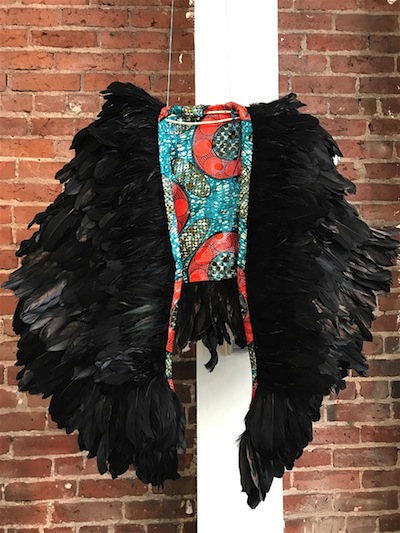
“One story I asked an artist to illustrate was an ancient northern legend about an abandoned woman,” Wake said. “The tribe abandoned that woman in the forest because of her sharp tongue. She only had a few coals for her fire, but she survived. She made herself two cloaks – one of raven feathers and another of rabbit fur – and many more objects.”

Artist Jeneen Frei Njootli has brought the cloaks to life. Her creations, a black cloak of raven feathers and another of white rabbit fur, hang in a corner of the Zack, one above another, as a tribute to her people’s tenacity and their drive to survive in the harshest conditions.

photo - Raven cloak made by Jeneen Frei Njootli
Raven cloak made by Jeneen Frei Njootli. (photo from Drew Ann Wake)

“We were very proud to learn that recently Jeneen Frei Njootli was chosen as one of the five finalists for the Sobey Art Award, an annual prize given to the most promising Canadian artist under 40,” said Wake, who then pointed to a blue coat on display. Smiling, she said, “And that coat belongs to Michael Jackson. But not the Michael Jackson of pop music. Our own Michael Jackson, a Vancouver lawyer who, in the 1970s, was part of Justice Berger’s team.”

When Wake started working on this show, one of the new interviews she conducted was with Jackson. “He worked with many First Nation people,” she said, “and I asked him how come he was so empathetic to their plight. He said it was because he was Jewish. When he grew up in London, England, he experienced antisemitism. He knew hunger as a child in post-World War Two Britain. It made him sensitive to others suffering from discrimination. Made him want to help.”

During the Berger inquiry, Jackson befriended one of the local men, John T’Seleie, who organized his community to meet with the inquiry’s lawyers.

“Their friendship has lasted for decades. They’re still friends,” Wake said. “As a child, T’Seleie was a student at a residential school. Like many others at residential schools, he suffered. As an adult, he became an advocate for his people.”

The portraits of these two friends hang side by side on the gallery walls, and the film Wake made of her interviews with them is also part of the exhibit.

“That’s how our entire show started, so many years ago,” she said, “with those two and their friendship: a Jew and a Dene.”

Crossed Paths is at the Zack until April 7.

Olga Livshin is a Vancouver freelance writer. She can be reached at [email protected].

Format ImagePosted on March 22, 2019March 25, 2019Author Olga LivshinCategories Visual ArtsTags Drew Ann Wake, First Nations, Mackenzie Valley, paintings, photography, Zack Gallery
Mixing abstract, nature

Mixing abstract, nature

Sidi Schaffer’s current exhibit, In Partnership with Nature, is at the Zack Gallery until March 3. (photo by Olga Livshin)

Sidi Schaffer’s art has gone through several different incarnations. At the beginning of her career, in postwar Romania, she adhered to a realistic approach. “For several years, the central images of my work were people,” she said in an interview with the Independent.

After her family immigrated to Israel, she continued her studies and received her art education degree. “At that time, I fell in love with the Impressionists, especially Cezanne, and started painting more landscape and still life,” she said. “I tried to catch the essence, the light and beauty of my surroundings. Even my palette changed.”

The next stage in her artistic development came after she immigrated to Canada in 1975. It was as if every country triggered a twist in her artistic road. “I needed to establish new roots and master new challenges,” she recalled. “In 1980, I went back to school to study printmaking at the University of Alberta. They told me: ‘Paint abstract, throw away realism.’ I followed my teachers’ good advice … and totally immersed myself in abstraction. I simplified my work; my focus became my inner world, my feelings and my emotions. The art-making process became a sacred ritual.”

But pure abstraction didn’t hold her interest for long. Her abstract compositions acquired random elements of realism. “I tried to make my works integrated, bring together abstract and figurative,” she said. “I tried to express the concept of unity between the internal and the external, between the spiritual and the physical.”

Her current show, In Partnership with Nature, which opened at the Zack Gallery on Jan. 31, combines her inclination towards abstraction, her love of nature and her ability to bridge the realistic and the spiritual in her paintings. It also highlights her innate optimism. The show is airy, uplifting and charming, the works prompting a quiet gladness in viewers.

It’s about flowers, but in an oblique, complex way. “I love flowers,” said Schaffer. “Nature is my biggest inspiration. When it surrounds me, I feel alive, free, and in awe of all its beauty and miracles.”

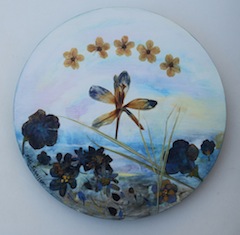
For years, she has been drying flowers between pages of books. “I have piles of those books in my house,” she said. “I always wanted to preserve the flowers’ beauty, even after the original bloom. I have been doing it since I was a young girl…. In autumn, I also dry leaves with their amazing colours and abstract designs. Nothing is more beautiful. Sometimes, I pick a flower just to remind me of a place and time.”

A few years ago, Schaffer decided to try and incorporate those dried flowers and leaves into her art. “I wanted to make them the subject matter,” she said. “Every picture in this show, except one, has one or more dry flowers or leaves in them.”

photo - “Grace into Focus 1” by Sidi Schaffer is part 1 of a triptych
“Grace into Focus 1” by Sidi Schaffer is part 1 of a triptych. (photo from Sidi Schaffer)

All of the images in the exhibit are mixed media. She experimented with acrylic and oil paint, with old prints and new drawings, with collage. The dried leaves or flowers form the heart of the compositions.

“I wanted to give them importance,” she explained. “Some of the landscapes in this show look fantastic, because dry leaves play the part of trees. Some abstract collages were like memory boxes for me, with layers. There are dry petals there, and lettering and musical notes.”

Schaffer’s collaboration with the elements of nature tends towards whimsical. Flower petals float on the visual breeze. Mundane dandelions turn into exotic palm trees. Waves of musical notation sparkle with rainbow colours.

“I played with the images,” said the artist. “I didn’t take myself seriously when I prepared this show.”

Schaffer said every image in the exhibit started with an idea. “But I never knew how it would come out,” she said. “It’s a process, a discussion between me and the flowers. Sometimes, it is a struggle. I look at the flowers and they supply more ideas. This one flower I had, I put it on the painting and the petals came off. I left them off, incorporated into the image.… From a flash of excitement to the end result, each image reflects my emotional journey. By the time I finish a painting, it seldom resembles my original starting point. What is important for me is the visual poetry, the relationship of form, space, colour and light.”

Schaffer’s exploration into creative possibilities is nourished by her rich inner life. Before her retirement, she taught art and painted commissions, but never, for example, something made specifically to harmonize with anyone’s living room décor.

“I paint what is inside of me,” she said. “I don’t paint for anyone’s sofa. I enjoy the hours I spend in front of my canvas. It is an intense emotional outlet and, when I’m finished, I feel happy, but, at the same time, drained and vulnerable.”

In Partnership with Nature is at the Zack until March 3.

Olga Livshin is a Vancouver freelance writer. She can be reached at [email protected].

Format ImagePosted on February 15, 2019February 13, 2019Author Olga LivshinCategories Visual ArtsTags art, environment, multimedia, nature, Sidi Schaffer, Zack Gallery
Events around town this month – Sisterhood Choir, community artists & Netta

Events around town this month – Sisterhood Choir, community artists & Netta

photo - Temple Sholom Sisterhood Choir under the direction of Joyce Cherry with pianist Kathy Bjorseth
(photo from Gordon Cherry)

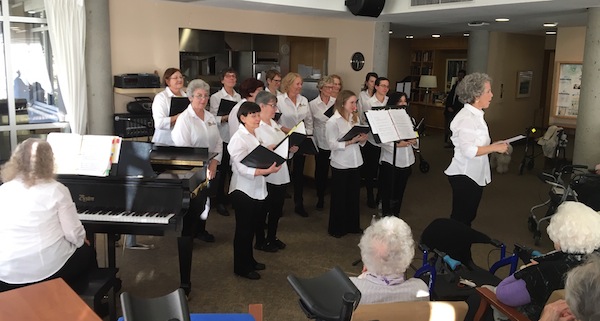
Temple Sholom Sisterhood Choir under the direction of Joyce Cherry with pianist Kathy Bjorseth performed an afternoon concert of Jewish music at the Weinberg Residence on Jan. 13. Featured were three works by Joan Beckow, a resident of the Louis Brier Hospital and a Temple Sholom member. Beckow was an active composer and music director in Los Angeles and, for a time, was Carol Burnett’s music director. The 23-voice Sisterhood Choir has sung for the annual Sisterhood Service for a number of years, but the recent concert at the Weinberg was a first for them outside of Temple Sholom.

photo - Some of the artists on opening night of the group show Community Longing and Belonging, Jan. 15 at the Zack Gallery
(photo by Jocelyne Hallé)

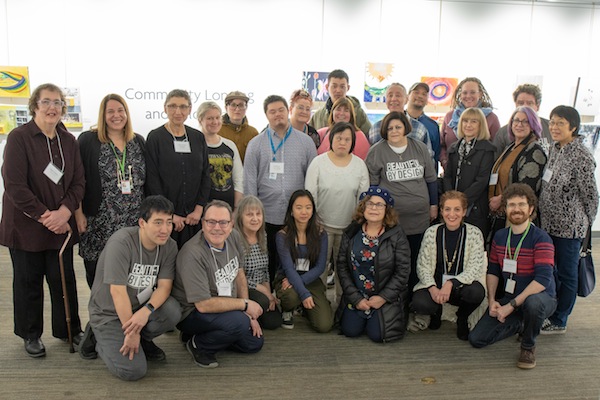
Some of the artists on opening night of the group show Community Longing and Belonging, Jan. 15 at the Zack Gallery. The exhibit marked Jewish Disability Awareness and Inclusion Month and ran until Jan. 27.

photo - Eurovision 2018 winner Netta Barzilai, right, with Carmel Tanaka, emcee of the night with IQ 2000 Trivia
(photo by Corin Neuman)

Eurovision 2018 winner Netta Barzilai, right, performed at the Jewish Community Centre of Greater Vancouver on Jan. 26 to help celebrate the 18th anniversary of Birthright Israel. Here, she is pictured with Carmel Tanaka, emcee of the night with IQ 2000 Trivia. The dance party was presented by the Jewish Federation of Greater Vancouver in partnership with Axis Vancouver, Hillel BC and the JCCGV.

Format ImagePosted on February 1, 2019January 29, 2019Author Community members/organizationsCategories LocalTags art, Carmel Tanaka, disabilities, JDAIM, Joyce Cherry, Netta, Sisterhood Choir, Taglit Birthright, Temple Sholom, Weinberg Residence, Zack Gallery
Community show at Zack

Community show at Zack

“Open Doors” by Marcie Levitt-Cooper. (photo by Daniel Wajsman)

The group show Community Longing and Belonging, which opened Jan. 15 at the Zack Gallery, marks Jewish Disability Awareness and Inclusion Month (JDAIM).

“I heard about community art shows in celebration of JDAIM in other communities,” said Leamore Cohen, inclusion services coordinator at the Jewish Community Centre of Greater Vancouver, who was the driving force behind the local exhibit.

“I thought an unjuried exhibit would be a fabulous way to honour our community-wide commitment to remove barriers, to celebrate our community members’ creative capacities,” she said.

The main idea was to open up participation to everyone – professional artists and amateurs, people of different skill levels, abilities, perspectives, faiths and socioeconomic status.

“To make participation truly inclusive,” said Cohen, “we provided each artist with a 12-by-16 wood panel. We have also been taking direction from Kickstart Disability Arts and Culture and its artistic director, Yuri Arajs, as we wanted to ensure that this event is fully accessible.”

The JDAIM inclusion initiative and month of advocacy began throughout North America in 2009, explained Cohen. The idea for the art exhibit started to take form last spring, when Cohen approached Zack Gallery director Linda Lando.

“Linda was really receptive to the idea of the show.… Once I had the green light from her, the support and use of the gallery,” said Cohen, “I began to focus more on the theme.”

The theme of community and inclusion prompted her next steps. She reached out to many different organizations and communities and invited artists from all over the Lower Mainland to participate. The call for submissions went out in late September, and the response was remarkable. Fifty-two artists are included in the show.

“We have artists from Vancouver, Burnaby, Richmond, North Vancouver, and even as far out as Cloverdale,” said Cohen. “I’ve had the good fortune to meet all these new and amazingly creative people, welcome them to our community centre, and make new friends along the way. It’s been a joy. It broke my heart that I had to turn many away because of the limited space in the gallery. I have artists who want to sign up for the next year. There is so much excitement and so much more to say on this issue.”

photo - “Embrace” by Evelyn Fichmann
“Embrace” by Evelyn Fichmann. (photo by Daniel Wajsman)

To frame this exhibit, Cohen posed two questions, which are being used in its promotional materials: “How do we make meaning of the concept of community, the real and the imagined spaces we inhabit? What does community longing look like and what are the possibilities for belonging in an ever-changing world?”

“This show was a challenge and an invitation to look at social problems creatively and critically,” Cohen told the Independent. “It was also an opportunity for artists living with diverse needs to exhibit their work in a professional venue and to receive exposure.

“I don’t think we are going to resolve the problems of longing and belonging, or longing for belonging, any time soon. I think we’ll always have people who are better situated and people whose social networks are more tenuous. We should just keep having the conversations and build up those connections. We create new platforms and new access points, new opportunities for people to engage and tell their stories, whatever they look like and from whatever lens, whether it be through mental health, sexual identity, ability or socioeconomic status. We all have a story to tell.”

Cohen shared one example of how the show’s theme relates to her own life.

“The ‘longing’ part of the theme resonates with a lot of people,” she said. “It resonates with me as well. It emerges from my own story of disconnection from the Jewish community during my youth and young adulthood. Fortunately, so, too, does the ‘belonging’ part of this show. The JCC is a wonderful place, a place for belonging.”

photo - “Veselye u Selu” by Daniel Malenica
“Veselye u Selu” by Daniel Malenica. (photo by Daniel Wajsman)

The theme allowed for a number of different approaches, and the skill of the various participating artists varies widely, but the utter diversity becomes its main attraction. Although the size and shape of the canvases – the wooden boards provided by the organizers – are universal, the content is anything but, and so is the media. Some pieces are oils, others acrylic; still others, mixed media. There are abstracts and figurative compositions. Some have narratives. Others evoke emotions. Some have Jewish connotations. Others don’t. Some artists participated solo, while others enrolled as a family group.

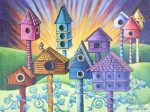
Marcie Levitt-Cooper represents one such family. Her painting “Open Doors” depicts a colony of colourful birdhouses. Every door of every birdhouse is open, creating a welcoming avian village, a festive metaphor that makes you smile. No birds appear in the image, but you can almost hear them sing. The artist’s three daughters – Rebecca Wosk, Teddie Wosk and Margaux Wosk – also exhibit in the show.

Another family of artists is mother Elizabeth Snigurowicz and son Matthew Tom Wing. “They regularly come to the Jewish Community Centre inclusion services Art Hive drop-in program, a low-barrier, free art program,” said Cohen.

Daniel Malenica doesn’t have a family in the show, but her charming, pastel-toned piece is a jubilation of the artist’s Croatian roots and her LGBTQ+ community. Two girls embrace each other in the painting, both wear Slavic costumes. The title, “Veselye u Selu,” is the English phonetic spelling of a phrase in the artist’s mother tongue, meaning “Celebration at the Village.”

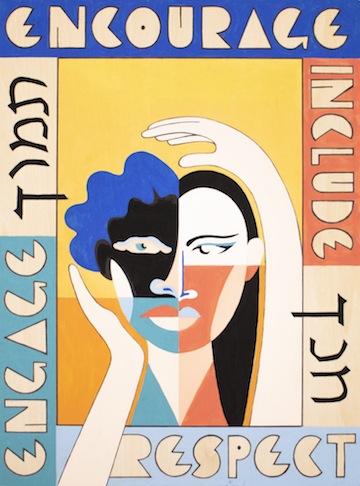
In Evelyn Fichmann’s painting “Embrace,” the artist, a recent immigrant from Brazil, has incorporated words in English and Hebrew. “Encourage,” “include,” “educate,” “respect,” “engage” and “support” surround the image, all fitting descriptors of what we should strive to do in our communities.

Community Longing and Belonging runs until Jan 27.

Olga Livshin is a Vancouver freelance writer. She can be reached at [email protected].

Format ImagePosted on January 18, 2019January 16, 2019Author Olga LivshinCategories Visual ArtsTags art, disabilities, inclusion, JDAIM, Leamore Cohen, painting, Zack Gallery

Posts pagination

Previous page Page 1 … Page 5 Page 6 Page 7 … Page 12 Next page
Proudly powered by WordPress