Victoria deli’s new chef

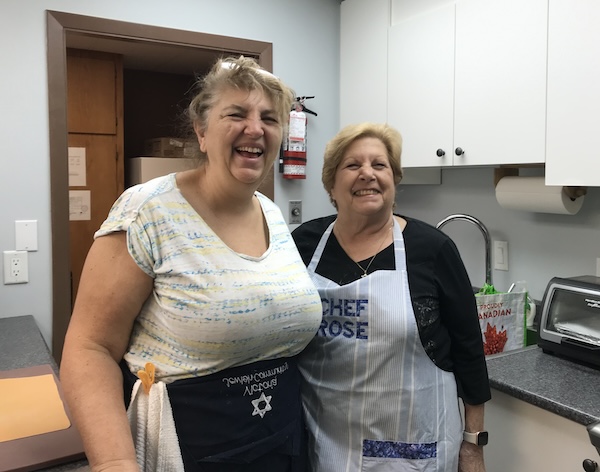
Lox Stock and Bagel’s new chef Lina Fainblum, left, and recently retired chef of 33 years Rose Carr, who will still be involved with the deli’s operations. (photo by Sam Margolis)

In June, Lox, Stock and Bagel deli at the Jewish Community Centre of Victoria was in something of a … well … pickle. A replacement needed to be found for Rose Carr, who had been overseeing the kitchen for 33 years, nearly the entirety of the deli’s existence, and about whom there are not enough superlatives to express her significance to both the local community and the customers the eatery serves.

Confronted with having to search for another chef, the JCCV advertised the vacancy. Many people applied but there was not a good fit, that is, a person who could fully appreciate the haimish (homelike) atmosphere of the deli and commit to staying in the position long term. The deli was forced to close.

Fortunately, the despair loyal patrons had to endure was short-lived, as Lina Fainblum, a member of the community and someone who loves cooking, came along.

“Everyone was thrilled,” said Larry Gontovnick, president of the JCCV. Lox, Stock and Bagel reopened in October, with a Wednesday to Friday schedule. Within three weeks, the deli resumed its original Tuesday to Friday hours.

“From looking pretty bad, it is going to what we wanted,” said Carr, who remains a beloved fixture at Lox, Stock and Bagel. “Lina is a mini miracle. Our prayers were answered.”

Although she has cut down her work in the kitchen, Carr is still on the board of the JCCV and runs the deli. The social aspect of the deli is very important, Gontovnick noted and, in this regard, Carr, who is also known as “Grandma Rose,” is in a class of her own.

“I’m in my third generation at the deli,” she said. “When I started here, people were bringing their little ones. Grandma Rose goes crazy when infants come in. And these kids grow up and come back and then bring in their little ones.

“We also have a lot of seniors who come in and they are treated with respect because we are all seniors,” she added.

When Carr arrived from Los Angeles in 1990, the JCCV at 3636 Shelbourne St. in Victoria’s Cedar Hill neighbourhood was in its fledgling stages, having just opened in June 1988. She introduced herself and has continued in her efforts to bring New York and Los Angeles deli food to Vancouver Islanders ever since.

At that time, the deli was located in a space at the centre that could only accommodate 15 people. Since then, it has expanded to seating 60 and, as Carr says, “many a day, we are full.”

Word of the wonderful dishes – such as knishes and kugel – spread shortly after the deli originally opened more than three decades ago. On one occasion, a group of firefighters came to test the exits of the JCCV. They wound up staying for lunch and told their friends and family, who were also eager to have a delicious and nearby nosh.

“It was recognized fairly early on that the customer base was non-Jews who lived in the area, enjoyed Jewish food and saw this as an affordable offering,” said Gontovnick. “It continues to this day. Most of our clients are non-Jewish. They love the place, the volunteers, the affordability and the quality of the food. It’s second to none. We have had a steady clientele. People come three or four times a week to eat.”

“People love us. They feel at home, they start clearing tables and they have been very generous with donations. They have been incredible accepting us as being Jewish.” added Carr. “After the Hamas attack, people whom we didn’t know would come into the JCC. They didn’t know anyone Jewish but would come to say they were praying for us. We are very well known and well liked in the community.”

As did many other establishments, Lox, Stock and Bagel faced challenges when COVID-19 struck in March 2020. The JCCV, at the time, decided to switch to takeout via the side door of the building. When the weather was balmy, they would set up tables outside.

One lasting result of the pandemic at the deli was the removal of a partition at the JCCV to open up more space and allow people to dine at tables further apart from one another.

Lox, Stock and Bagel, which received its name following a contest in the mid-1990s, serves all the standards one might expect at delis in much larger metropolitan areas: blintzes, matzah ball soup, pastrami on rye, jumbo hot dogs, pickled herring and gefilte fish. For dessert, there is the “Better Than Sex Chocolate Cake,” a favourite at the deli and at local fairs and, according to numerous sources, an item that lives up to its billing.

Lox, Stock and Bagel is open Tuesday to Friday from 11:30 a.m. to 1:30 p.m. From Dec. 5 to 15, it will be the site of Latke Mania. Hundreds of latkes will be prepared on several fryers for all those in the community to have a chance to mark Hanukkah with the traditional savoury treat.

“Our motto is: everyone’s welcome,” said Gontovnick. “This is nice place to come and just have a Jewish experience.”

Sam Margolis has written for the Globe and Mail, the National Post, UPI and MSNBC.

Help fund Gary documentary

The costs of completing the documentary A 20th Century Passion include editing time, colour correction and sound mix. (screenshot)

A GoFundMe campaign has been launched to bring to the big screen a documentary about the late Peter Gary, a Hungarian-born composer, Holocaust survivor and resident of Victoria.

The online fundraising effort to complete A 20th Century Passion was started by filmmaker David Malysheff and Gary’s widow, Judith Estrin. Their goal is $35,000.

Gary passed away in 2016, the same year his oratorio A 20th Century Passion premièred in Jerusalem. The work spans the period from the First World War to the Nuremberg trials, including his experiences living in and surviving three years in three different concentration camps.

Gary had a message, the campaign organizers say, which was to stamp out hate. Over the years, he delivered this message to tens of thousands of students throughout Canada.

“The message of the oratorio is to remember history, that hate is ugly and brutal and should be stopped. It is a love piece in honour of Peter’s mother, who was brutally murdered by the Nazis while Peter spent three years in death camps,” Estrin said.

“Like all classical oratorios, it is tragic – this one deals not with the life of Jesus but with the six million murdered Jews. Because Peter had to deal with the murdered bodies of children, he dedicated the piece to the murdered 1.5 million Jewish children,” she said.

While Gary wrote the oratorio over a period of many years, revising it right up to time of his death, it was mostly written during 1970s and 1980s. Barak Tal, the conductor who led the work in Jerusalem, spent time with Gary at his home, going over every note.

The documentary explains how the oratorio came to fruition, using the Jerusalem performance as the score beneath the narrative. The film also shows Gary speaking to high school students about his experiences.

Malysheff, who has been a cinematographer for The Nature of Things, Us and Them and The Fifth Estate, described the film as a passion project – one for which he has not received any payment in the seven years since he began working on it. The costs of completing the film, including editing time, colour correction, sound mix and more, have led Estrin and him to appeal to the public for support.

The importance of A 20th Century Passion at this time cannot be overstated, Estrin said. “With antisemitic hate crimes and acts up just since Oct. 7, the message to stamp out hate, to go in peace, is more critical than ever,” she said. “The world has lost its moral compass, and this piece is about the hope that [people] will remember what horror the 20th century held for the world. We are facing an enemy who wants to annihilate all Jews. Once they are done with us, they will come for everyone else.”

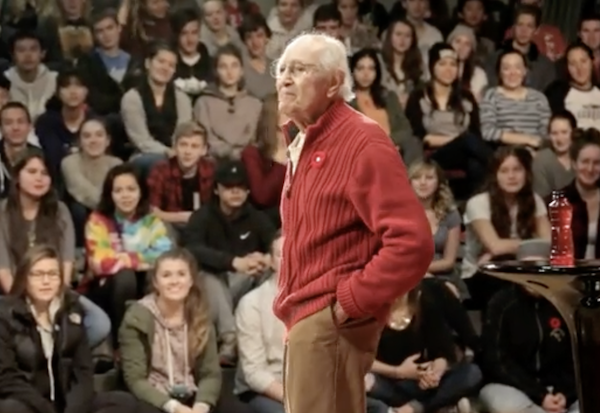
screenshot - The documentary shows Peter Gary, a Holocaust survivor, speaking to high school students about his experiences
The documentary shows Peter Gary, a Holocaust survivor, speaking to high school students about his experiences. (screenshot)

The filmmakers also point out that a significant number of North Americans born after 1981 cannot name a single concentration camp or ghetto and think that fewer than six million Jews were killed during the Holocaust. An alarming percentage of young people, they added, hold the opinion that the Jews caused the Holocaust.

Gary was born in 1924 into an artistic family that included famed Hungarian musicians, such as conductor Eugene Ormandy and pianist Lili Kraus. Through his mother’s encouragement, he began his musical training on the piano before the age of 5.

Deemed a musical “wunderkind,” Gary was admitted at the age of 9 to Budapest’s Franz Liszt Academy of Music, where he studied advanced choral and orchestral composition, as well as conducting, under the tutelage of Bela Bartok, Zoltan Kodaly and Leo Weiner.

In 1940, Gary’s education stopped when both he and his mother were arrested by the Nazis. His father was away on a business trip, which allowed him to escape into hiding. Gary spent the next years in concentration camps before he was liberated from Bergen-Belsen by the British on his 21st birthday.

Following the war, Gary moved to Paris to resume his musical studies at Sorbonne University. He received a doctorate in musicology there in 1949.

Gary then immigrated to the United States and, for a brief time, worked in the music department at MGM. In 1963, he took a year off to compose a ballet suite that was performed in France. During his life, he composed more than 20 orchestral pieces, which have been performed in the United States, Canada, Germany, Holland, France and Scotland.

The film runs approximately 90 minutes. Malysheff and Estrin would like it shown at Jewish film festivals and in schools. They have a curriculum for secondary schools that uses the libretto as text. To date, the oratorio has been translated into Hebrew, French and German.

The Jerusalem performance of A 20th Century Passion is available on YouTube. More on Gary can be found at jewishindependent.ca/help-passion-to-israel and jewishindependent.ca/holocaust-survivor-peter-garys-oratorio.

To donate to the documentary’s fundraising campaign, visit gofund.me/d335a5f8. All who send in a contribution will receive a screen credit for being part of the message of the film.

Sam Margolis has written for the Globe and Mail, the National Post, UPI and MSNBC.

Survivors a cautionary tale

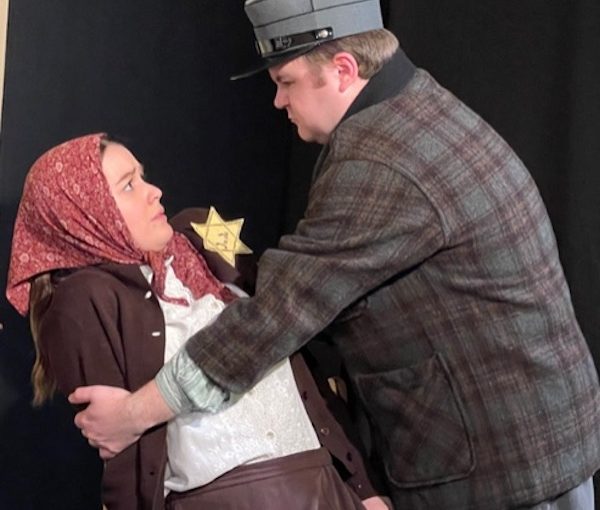
On Oct. 29 at the Phoenix Theatre in Victoria, there will be a one-night-only performance of Wendy Kout’s play Survivors, which is touring schools this month. (photo by Peter Nadler)

In light of the success of last year’s pilot tour, the educational play Survivors is touring middle and secondary schools throughout Vancouver Island this month. And, with the support of the University of Victoria, there will be one public performance of the play this month: at the Phoenix Theatre, Oct. 29, 2 p.m. Last year’s public shows sold out.

Following the mistaken honouring in Parliament recently of Ukrainian-Canadian Yaroslav Hunka, who fought in a Nazi unit during the Holocaust, there should no longer be any doubt about the ignorance of the history of the Holocaust. This conclusion is further supported by the existence of monuments in Canada that honour Nazi veterans who were members of the Galicia division of the SS in Ukraine. Furthermore, Canada’s Governor General Mary Simon has apologized for the Order of Canada given to Peter Savaryn in 1987. Savaryn was chancellor of the University of Alberta and president of the Progressive Conservative Party of Alberta in the 1980s – he also served with the Waffen-SS, a voluntary Nazi unit in Ukraine during the Second World War.

A 2019 study done by the Azrieli Foundation, Yad Vashem, the United States Holocaust Memorial Museum and the Claims Conference revealed Canadians’ lack of knowledge of this period in history. For example: 62% of millennials did not know that six million Jews were killed in the Holocaust and 22% of millennials hadn’t heard or were not sure if they had heard of the Holocaust. Nearly one-quarter of all Canadians believe that substantially fewer than six million Jews were killed (two million or fewer) during the Holocaust.

History shows that when it comes to racist attacks and xenophobia, Jews are often the “canary in the coal mine.” Holocaust awareness and education could not be more timely or important. “We’re not just telling history,” said Survivors playwright Wendy Kout. “We’re telling history as a cautionary tale for the present and the future.”

Survivors explores hatred, the capacity to survive and thrive, and serves as a call to consciousness of the present challenges. Combining history with life lessons, the audience is guided through a time when hatred was normalized. The audience is both uplifted by the survivors’ triumphs and inspired to take action against present and future racism.

The play tells a chronological history of the Holocaust through the personal prism of experience, interweaving the stories of 10 Holocaust survivors, four of whom were still alive when the play premièred in New York in 2018. Though each has a unique story, all the survivors “went through this horror and came through the other side to build meaningful, contributing, beautiful lives,” said playwright Wendy Kout.

The Victoria production of Survivors will be touring throughout the four Western provinces for the next few years. For more about those tours and the organizations collaborating on them, visit jewishindependent.ca/theatre-that-educates and holocausttheatre.com. For tickets to the Oct. 29 matinée at Phoenix Theatre, go to eventbrite.ca.

– Courtesy Victoria Theatre Productions

My Way Bikery expands

My Way Bikery owners Moshe and Leah Appel. (photo from My Way Bikery)

Vancouver Island’s only kosher bakery started the new secular year with new owners, Moshe and Leah Appel, and a slightly new name. What was formerly known as the Bikery is now My Way Bikery. The Victoria location, at 8-1701 Douglas, inside the Public Market at the Hudson, remains the same, though the selection has expanded to include more than baked goods.

Certified pareve kosher by Kosher Check and supervised by Rabbi Meir Kaplan from Chabad of Vancouver Island, My Way Bikery encourages customers to “challah” at them anytime. The bakery also delivers to customers and businesses all around Victoria, and people throughout Greater Victoria can place orders using SkipTheDishes, DoorDash and Uber Eats. Beyond Victoria, the bakery delivers as far up Island as Parksville and Qualicum Beach every Friday, with a minimum order of $25 placed by 5 p.m. on Wednesday.

“I’m the baker,” Leah Appel told the Independent.

“I’m everything else,” followed Moshe Appel.

photo - My Way Bikery lemon poppyseed muffins
My Way Bikery lemon poppyseed muffins (photo from My Way Bikery)

Originally from Montreal, the couple have known each other since they were 7 years old, but only got together after being in and out of each other’s lives for decades.

“My background is essentially in call centre work – inbound sales, inbound customer service and inbound security, things like that. But I’m extremely active in the Jewish community here in B.C., especially since first moving to Nanaimo,” said Moshe Appel.

“The idea for the business really didn’t come to fruition until I reunited with my childhood friend (and now wife), who is a classically trained baker and someone who has been in market research and management. Coming from Montreal as we both have, we were shocked at the lack of good Jewish food in B.C., and on the Island in particular.”

The Appels, who have always enjoyed cooking traditional Jewish recipes for their friends and family, started selling their goods at local markets a couple of years ago. The realization soon struck that they would need a larger space for their production. Serendipitously, they came across an opportunity last year when their friend Markus Spodzieja, founder of the Bikery, announced his intention to sell the business. The Appels purchased it, merging their original bakery name (My Way Bakery) with the Bikery to, as they say, “keep the nostalgia of Markus’s brand alive while adding our own recipes to the mix.”

According to the Appels, Spodzieja will be moving home to Nova Scotia to care for his grandmother.

The business obtained its first name, the Bikery, in 2017, when Spodzieja sold baked goods out of a 250-pound mobile vending bicycle as part of a pilot project for the City of Victoria’s Mobile Bike Vending Permit. It moved to its present location in 2021.

photo - My Way Bikery challah
My Way Bikery challah (photo from My Way Bikery)

“I met Markus when he first opened the Bikery and I was one of his first customers, but it was purely luck that I asked his advice for starting a business in Nanaimo and he handed us the business in Victoria. Unwilling to miss this G-d-given opportunity, we jumped on the chance,” Moshe Appel recalled.

“We are keeping much of the same menu as Markus did, but expanding it to include soups, salads, more breads and Jewish dishes and, in a few months, plan to expand it to include cholov Yisroel dairy products as well.”

The menu lists dozens of items. There are savoury pastries and shakshuka, halva and combos (including pita and Leah Appel’s hummus). Some of the popular items are the My Way Sandwich, potato salad, kimmel rye, peanut butter cookies and Israeli salad. A current hit is Those Darn Cookies, a sweet made with chocolate chips and almonds.

photo - My Way Bikery tahini cookies
My Way Bikery tahini cookies (photo from My Way Bikery)

Among the new touches are jelly chal-nuts, Leah Appel’s take on a jelly donut; challah dough stuffed with sweet jelly and topped with raw cane sugar; and Oyvegg, a roll with Daiya “cheese,” an egg, garlic aioli, lettuce and tomato.

The Appels are even offering goodies for canines – Dunstan Donuts. “Named after Dunstan, who was a very good boy,” the menu reads, “these certified-kosher pareve dog treats are made with oats and bananas and taste amazing! Dunstan’s Donuts are delicious enough for you, but made just for your four-legged friend!”

Favourites from the Bikery, including numerous varieties of pretzels and bagels, lemon-poppyseed muffins and challah in all shapes, sizes and flavours, are still available.

The Appels say they are in preliminary talks to open a storefront location in Nanaimo.

My Way Bikery is located toward the back of Victoria’s Public Market, which is situated close to City Hall and Centennial Square – a few blocks away from the Empress Hotel and Parliament – in a building that operated for several decades as a Hudson Bay department store. It is open Monday to Thursday, 7 a.m.-11 p.m., Friday, 7 a.m.-3 p.m.; and Sunday, 11 a.m.-6 p.m. Friday hours will be extended in the spring, as the days grow longer.

For more information or to place an order, visit mywaybikery.ca, call 778-430-2453 or email contact@mywaybikery.ca.

Sam Margolis has written for the Globe and Mail, the National Post, UPI and MSNBC.

Opening gates of kabbalah

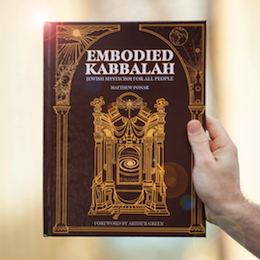
Rabbi Matthew Ponak recently released his latest book, Embodied Kabbalah: Jewish Mysticism for All People. (photo by Marilyn Wolovick)

Rabbi Matthew Ponak introduced his new book, Embodied Kabbalah: Jewish Mysticism for All People, this month both in a Zoom event and in-person at the Victoria Jewish Community Centre.

According to the book’s description, the objective of Jewish mysticism is to “touch infinity with your feet planted in everyday, ordinary reality.” The book contains universal teachings that Ponak believes are necessary to the world at this time.

Delving into a millennium of Jewish writings, Ponak hopes his approach will serve as a counterweight to the focus in modern spirituality on bliss and transcendence. Throughout the centuries, Ponak argues, Judaism – including Jewish mysticism – has held “being a good person” as the ideal.

image - Embodied Kabbalah book coverEmbodied Kabbalah, written in the talmudic style, in which commentary surrounds the original texts, looks to the mystic teachings for finding a healthy balance between one’s spiritual life and external commitments to family, work and community. Many of the book’s sources have been translated into English for the first time.

During the launch at the Victoria JCC, Ponak spoke of the personal journey that led to the creation of the book. In his initial studies, he observed two different paths. “One was a path of transcendence,” he said, “a path of bliss, that all is well in the world and we should be celebrating all day. On one level that appealed to me, but I felt there was something missing in it.”

The other path, he said, is one of transformation. “This is one of deep self-knowledge: that I could get to know who I was inside, and new parts of me would start to come forward. There is a deep, radical honesty that can liberate parts of who we are. Those parts can enter into our outer lives as we become more whole.”

Upon further exploration, he discovered there was a way to incorporate both paths into one’s life.

“I found a particular teaching that says there is a time to transform – the work week – and a time to rejoice – Shabbat. One day a week, it is time to celebrate all that we have and focus on the positive, to not get weighed down by the negativity,” Ponak said. “There is a time for the deep personal transformation of working on ourselves, the spiritual work week. On Shabbat, however, everything is whole and we are, too. We feed ourselves delicious food and take an extra nap to help our bodies know the world is complete.”

Ponak emphasized that it is not necessary to choose between the paths of rejoicing and of transformation. There is a time for working and a time for celebrating. If all one has is work, then there is the risk of missing out on the beauty of life, he said. Alternatively, if one is in a prolonged state of transcendent joy, then a spiritual leader, for example, might become unable to help others grow because they have “left the world, so to speak, unable to relate to people.”

He said, “It is good to come off the mountain. It took me a long time to understand the value of that. If I had a trauma or a difficulty in my earlier years as a seeker, it was with the bliss. The transformation stuff was hard, but I was able to get it once it was taught to me in an accessible way.”

Ponak retraced various aspects of his spiritual journey. He studied transpersonal psychology (or spiritual psychology) and other religions. Through this, he found he could be both a spiritual person and grounded.  “But there was a deeper part of me that knew there was something else,” he said. “There must be something in Judaism.”

After several years of study at the Rabbinical School of Hebrew College, he was able to decode the texts on his own. He discovered the hidden treasure of grounded Jewish spirituality that had been there all along in lesser-known mystical writings.

“If I had access to Embodied Kabbalah as a teenager, it could have saved me a lot of headaches and heartaches, to say nothing of my family’s stress,” he said. “This is why this book is so close to my heart.”

Among those who would benefit from the book, Ponak pointed to those interested in Jewish mysticism, those who have Jewish ancestry but feel alienated from Judaism, and those who want to learn about universal Jewish teachings as part of the global spiritual landscape.

Yet, for him, “the call to action that feels most urgent is to help people who are ‘ungrounded,’ who are finding mystical writings or going to spiritual retreats but are not connected to the earth: to the body or to their emotions. It’s time to open up the gates of Jewish wisdom to all who can benefit from it,” he said. “I hope this effort will help spiritual seekers to be responsible, relatable, whole and healthy – along with spiritually connected – so that we can be of our greatest service to humanity.”

For more information or to order the book, visit matthewponak.com.

Sam Margolis has written for the Globe and Mail, the National Post, UPI and MSNBC.

Candidates in Victoria

Tony Yacowar (PR photo)

Tony Yacowar will be vying for a seat on the Victoria city council this Oct. 15. Among his stated priorities, if elected, are affordable housing, addressing climate change and amalgamation within the Greater Victoria region.

Housing in Victoria, as in Metro Vancouver, is a primary concern among residents. Yacowar hopes to help pass the “Missing Middle Initiative,” a long-debated but deferred policy that he says would make it easier to add more housing units to areas of the city that have been traditionally residential.

“Victoria has an urgent housing crisis and we need leadership that will articulate a cohesive vision for the city in order to build the housing we need. We have an immediate deficit of between 4,500 and 6,300 homes. People need places to live. This impacts absolutely every aspect of city life. The healthcare crisis in this province is exacerbated by the fact that doctors and nurses can’t find places to live. We all want safe communities to live in and, if we aren’t able to provide housing to folks experiencing homelessness, we aren’t able to have safe communities for the long term,” Yacowar said.

“Gentle densification of our residential neighbourhoods is an important aspect of how we are going to accommodate the next generation of doctors and nurses, small business owners, artists and young professionals. Folks at all income levels need places to live. Missing Middle is not the solution to the affordability crisis, but it is the solution to the question of ‘where are these folks going to live?’”

Further, Yacowar would like to build density around the Douglas Street Corridor, the main thoroughfare linking the Victoria’s downtown and uptown, to support light rail transit. According to Yacowar, there is a strong connection between more homes and better transit in terms of reducing a city’s carbon footprint overall.

Yacowar is also pressing for amalgamation. “We need a cohesive vision for our city and we can’t have each municipality doing its own thing,” he said. “A city of 245,000 would be better able to advocate for more support from senior levels of government when it comes to housing and transit than a city of 91,000.”

A certified public accountant who is currently the chief financial officer at Royal Mountain Records, Yacowar regards having no prior involvement in politics as an advantage.

“I think it’s important to have a diverse set of views and backgrounds on council,” he said. “We don’t often get accountants in politics and I think there is a real benefit to having someone at the table with the kind of organizational and financial background that a CPA would bring, as well as someone representing the Jewish and LGBTQ communities. Quite often we have career politicians and bureaucrats running for office, but our democracy is at its best when we have folks of diverse backgrounds bringing different points of view to the table.”

photo - Ben Isitt
Ben Isitt (PR photo)

Of the eight present councilors in Victoria, only one, Ben Isitt, is seeking reelection. Five councilors elected in 2018 are stepping down and two are running for mayor. Isitt, too, identifies as a member of the Jewish community.

Isitt has served as a city councillor and regional director since 2011. His short bio on the City of Victoria website notes that he is an author, historian and legal scholar, who has taught at the University of Victoria and other institutions. It notes: “Ben’s involvement in civic politics builds from grassroots volunteer work for social and ecological justice, in support of worker rights, climate action, Indigenous rights, non-violence, the abolition of poverty and racism, and protection of forests and farmland. Ben’s research on housing, land use, forestry and public education reflect this community-based approach, as does his hands-on experience as a former housing support worker with Victoria’s street community.”

 Sam Margolis has written for the Globe and Mail, the National Post, UPI and MSNBC.

Speaker series returns

Kolot Mayim Reform Temple in Victoria is presenting a new season of its Building Bridges speakers series. The 2022/23 lineup will highlight the theme of Hineini: Answering the Call to Heal the World.

The Hebrew word Hineini can be translated as “Here I Am.” The series of six talks includes local, national and international speakers who have each in their own way stood up to create positive change in the world from a uniquely Jewish perspective. The monthly talks are offered free of charge and held on select Sundays from November to April on Zoom.

Beginning Nov. 6, 11 a.m. PST, the first speaker will be Rabbi Allan Finkel. Finkel is a Reform rabbi at Temple Shalom in Winnipeg. He will address the topic of Addiction in the Jewish Community and Jewish-based Recovery.

On Dec. 4, Elissa Bemporad, a widely published historian and professor at Queens College and the Graduate Centre – City University of New York, will speak on History is Not Destiny: Thoughts about the Russian War Against Ukraine and the Jewish Past in the Region.

Starting off the 2023 portion of the season will be Sari Shernofsky, a retired community chaplain from the Calgary Jewish community. On Jan. 6, Shernofsky will speak about Stories from the Narrow Bridge: Meeting People in their Time of Need. She will discuss her journey to chaplaincy, the patients she traveled with, spirituality and aging, and medical assistance in dying (MAiD).

Morton Weinfeld, professor of sociology and chair of Canadian ethnic studies at McGill University, recently published an updated edition of his book Like Everyone Else But Different. His Feb. 5 talk is titled Like Everyone Else But Different: The Jewish Glass is Half Full.

Pat Johnson, writer, organizer, entrepreneur and Jewish Independent editorial board member, will highlight his work with Upstanders Canada, an organization he founded to mobilize non-Jewish Canadians to stand up against antisemitism and anti-Zionism. His March 5 talk, Standing Up to Antisemitism, will explain coordinated steps anyone can follow to create a positive difference.

Rabbi Suzanne Singer, a former journalist and a Reform rabbi from Temple Beth El in California, will wrap up the series on April 6. With a history of leadership at Kolot Mayim, Singer will talk about Hope: How Do We Find Hope in a World with Unending Problems?

The word Hineini occurs 17 times in Hebrew scripture and is said at pivotal moments when profound change is about to take place. Kolot Mayim Reform Temple is an inclusive, welcoming congregation led by Rabbi Lynn Greenhough, who reminds us that, “Our world today cries out for responsive and responsible change; each of us can do our part in helping with that healing and transformative change.”

To register for any or all of the six talks that comprise the 2022/23 Building Bridges series, visit kolotmayimreformtemple.com.

Living their values daily

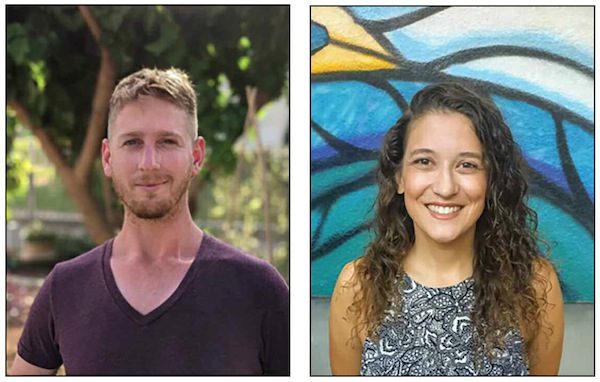
Dror Israel representatives Noam Schlanger and Joanna Zeiger-Guerra visited Seattle, Victoria and Vancouver last month. (photos from Dror Israel)

Last month, two representatives of Dror Israel, Noam Schlanger and Joanna Zeiger-Guerra, paid a visit to the region – Seattle, Victoria and Vancouver.

“We are educators at Dror Israel, a grassroots educational organization which works all through Israel,” Schlanger told the Independent. “Our 16 intentional communities of young, trained educators operate a variety of programs, including a network of innovative schools for at-risk youth and Jewish-Arab encounters, which all aim to bring together Israel’s different populations and create a more just and equal society. Our pedagogy focuses on empowerment and community building.”

Comprised of 1,300 people, Dror Israel works in a multitude of fields in Israel and has an impact on the lives of more than 150,000 people each year.

As for their specific involvement in Dror Israel, Schlanger has led a youth centre in Kafr Manda, an Arab town in Lower Galilee, and now works at the community garden in Acre (in northern Israel). Zeiger-Guerra is an educator who is familiar to many young people in southern British Columbia, having worked at Camp Miriam, the Jewish summer camp on Gabriola Island, for several summers. She is also a Habonim Dror alumna.

“I founded and operate a community garden where I work with mainly elderly Russian speakers, and Joanna mentors a cohort of our young educators taking their first steps in a variety of formal and informal educational settings,” explained Schlanger.

During their local visits, Schlanger and Zeiger-Guerra met with a variety of individuals, groups and communities to inform them of their work, specifically Dror Israel’s coexistence programs and ongoing relief efforts with Ukrainian refugee children. These gatherings included talks at Congregation Emanu-El in Victoria and with the Victoria Multifaith Society.

The pair also met with representatives from the Jewish Federation of Victoria and Vancouver Island and the Jewish Federation of Greater Vancouver. Those encounters involved “thinking about creative opportunities for programming collaboration,” said Schlanger.

For Schlanger, the message Dror brings – an inclusive vision of Zionism that strives to create a place for everyone, and the dream of a just and equal Israel – is a breath of fresh air amid the polarized discourse about the country.

Dror Israel was started in 2006 by graduates of the Israeli youth movement Hanoar Haoved Vehalomed, who served together in the Israel Defence Forces and shared a belief in the founding principles of Zionism. “Through truly innovative education based on dialogue and understanding, we teach leadership and responsibility for self and community. We promote social activism to drive positive change,” the organization states on its website.

Both Schlanger and Zeiger-Guerra live on urban kibbutzim established by Dror, a recent adaptation of the rural kibbutz. Between 30 to 100 young adults, aged 20 to 40, live on each of Dror’s 16 kibbutzim in Israel and work on the organization’s educational, cultural and social projects. With an emphasis on social justice, members of Dror Israel reside in the neighbuorhoods they serve, seeking to bridge gaps and solve local problems.

Throughout the pandemic, Dror Israel has been engaged in opening daycare centres for the children of doctors, nurses and healthcare workers; delivering groceries and medicines to home-bound seniors and those in need; volunteering on farms; and providing online programming for thousands of teens.

“Our message and the story of our work really resonated with everyone we met and sparked a variety of thoughts about future cooperation between Dror Israel and local organizations,” said Schlanger of his time here. “Our hearts were warmed by people’s decision to support our programs. It really attests to the strong, living connection between the Jewish communities here and Israel.”

After more than two years of being unable to visit or host trips to Israel due to COVID, Schlanger said Dror Israel hopes to reinvigorate connections that began many years ago in the region. Aside from delegations of educators to British Columbia, it looks forward to hosting visits in Israel.

“Joanna and Noam were very well-received,” said Sid Tafler, one of organizers of the emissaries’ stay in Victoria. “Many people were inspired by their message of peace and coexistence in Israel, principles they don’t just espouse but practise and live every day.

“We learned about their compassionate and community-building work with youth-at-risk, isolated older people, members of minority communities – including Druze and Arabs – and integrating new olim recently arrived from war-ravaged Ukraine. We have received guests from Dror before and expect we will welcome them again.”

For more information, visit drorisrael.org.

Sam Margolis has written for the Globe and Mail, the National Post, UPI and MSNBC.

“Never again” still resonates?

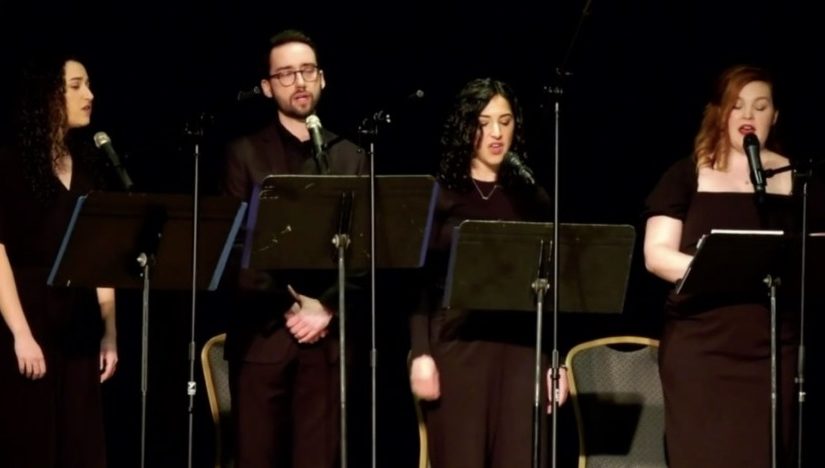
Left to right: Mia Givon, Lorenzo Tesler-Mabe, Kat Palmer and Erin Aberle-Palm. (screenshot from Kat Palmer)

Holocaust survivors and their descendants were joined by top elected officials and Jewish community leaders in a series of commemorations marking Yom Hashoah, Holocaust Remembrance Day, across Canada last week.

In Vancouver, community members gathered together at the Jewish Community Centre of Greater Vancouver April 27, while scores more watched remotely as the traditional in-person ceremony returned for the first time since the beginning of the pandemic.

Marcus Brandt, vice-president of the presenting organization, the Vancouver Holocaust Education Centre, welcomed guests and invited Holocaust survivors to light Yahrzeit candles.

“On Yom Hashoah, we join as a community to remember the six million Jews who perished in the Holocaust at the hands of Nazi Germany and its co-conspirators between 1933 and 1945,” he said. “It is also a day to pay tribute to the Jewish resistance that took place during the Holocaust.”

This year marks the 79th anniversary of the Warsaw Ghetto Uprising, which is the most notable of many acts of Jewish resistance to Nazism.

Marsha Lederman, a journalist who is the daughter of two Holocaust survivors, spoke of the importance of telling our stories.

“When I was growing up,” she said, “the Holocaust was everywhere and nowhere. As far back as I can remember, there were hints and references. My parents talked about things happening in camp. What was this camp? I knew it wasn’t like the summer camp that I went to. I knew a lot of their friends were also at these camps, but I didn’t know the details.”

At the age of 5, Marsha met a new friend whose home was filled with laughter and extended family.

“One day, when I came home from a visit at my friend’s house, I asked my mother what was really a simple, innocent question,” said Lederman. “She has grandparents, why don’t I? My poor mother. She was caught off guard and her answer was truly horrifying – at least as I remember it, because I know memory is very faulty. But, as I recall, she said I didn’t have grandparents because the Germans hated Jews and they killed them by making them take gas showers.”

This response raised more questions than answers for the young girl, not least of which was: “What did we do to make the Germans hate us so much and do they still hate us? It was a horrible introduction to the details of the tragedy of my family and it taught me another terrible lesson: be careful about asking questions because the answers could be murder.”

As a result, much of Lederman’s Holocaust education was gained “through osmosis, rather than sitting down and asking questions,” she said.

Her father died when Lederman was a young woman and, in a tragic turn of events, her mother died just as Lederman had bought a ticket to visit her in Florida, armed with a recorder to finally ask the questions she had hesitated to broach in earlier years.

“It’s taken me years to try to figure out what I could have learned in an afternoon at my mother’s kitchen table,” she said. “I have no way of knowing these things because I didn’t ask. We need to ask and we need to tell.”

Lederman explores these questions in a book being released this month, titled Kiss the Red Stairs: The Holocaust, Once Removed.

Amalia Boe-Fishman (née van Kreveld) was the featured survivor speaker at the Vancouver event. Born in the Netherlands, she was less than a year old when the Germans invaded her country. Her grandparents were soon transported to Auschwitz and murdered.

In what is an extremely rare phenomenon, Amalia, her parents and her brother all survived the war years because a Dutch Christian resistance fighter, Jan Spiekhout, and his family hid members of the de Leeuw family in a variety of hiding places over the course of years. Amalia’s mother even gave birth to another child in 1944. (That child, as well as Boe-Fishman’s oldest son, are both named Jan in honour of their rescuer.) Their survival was a statistical miracle. The Netherlands had among the lowest Jewish survival rate of any country during the Holocaust. Of 140,000 Dutch Jews in 1939, only 38,000 were alive in 1945.

Boe-Fishman recalled the day Canadian forces liberated the Netherlands – it was one of the only times in three years that she had set foot outdoors.

“It was strange and frightening outside and close to so many strangers,” she said. “The Canadian soldiers came rolling in on their tanks, handing out chocolates, everyone smiling, dancing, waving Dutch flags. Then I was told I could go home to my real family. But who were these strangers? I did not want to leave the family Spiekhout. They were my family. After all, I had not seen my real family for three years.”

In 1961, she traveled to Israel to meet members of her family who had made aliyah before the war and to reconnect with her Jewish identity. There, on the kibbutz she was staying, she met a Canadian, whom she married and they subsequently moved to Vancouver and had three children.

In 2009, Boe-Fishman and her three sons traveled to The Hague for the investiture of Jan Spiekhout and his late parents, Durk and Froukje Spiekhout, as Righteous Among the Nations by Yad Vashem.

“To be together with my children, my brother, and the grown children of the Spiekhout family, this was such a moving event in our lives,” she said.

As part of the Vancouver ceremony, Councilor Sarah Kirby-Yung read a proclamation from the City of Vancouver. Cantor Yaakov Orzech chanted El Moleh Rachamim. Lorenzo Tesler-Mabe, Mia Givon and Kat Palmer, members of the third generation, as well as Erin Aberle-Palm, sang and read poetry, accompanied by Vancouver Symphony Orchestra violinist Andrew James Brown and pianist Wendy Bross Stuart, who was also music director of the program.

The following day, a hybrid in-person and virtual event was held at the British Columbia legislature, featuring Premier John Horgan.

“On Yom Hashoah, we are challenged to ensure the words ‘never again’ are supported by action,” he said. “Over the past few years, there has been an increase in antisemitism in B.C., and the Jewish community is one of the most frequently targeted groups in police-reported hate crimes. That’s why our government will continue working to address racism and discrimination in all its forms.… Today, as we remember and honour those who were lost and those who survived, we must recommit to building a more just and inclusive province, where everyone is safe and the horrors of the past are never repeated.”

Michael Lee, member of the legislature for Vancouver-Langara, spoke on behalf of the B.C. Liberal caucus.

“Every year, we commemorate this day and remember the heroes and the Righteous Among Nations who stood up to oppose the most vile, hateful oppression,” Lee said. “We recognize the victims and survivors of the Holocaust, we make a solemn promise to never forget and never again allow such horrific actions to take place. This is a responsibility that we all must carry with us not only today but every day. It is a responsibility we must be better at upholding, as soldiers at this very moment commit war crimes once again in Europe. We have not done enough. Right here in Canada, we see another year of record rises in antisemitism. We have to do better.”

Lee called on the province to adopt the International Holocaust Remembrance Alliance Working Definition of Antisemitism.

MLA Adam Olsen represented the Green party.

“While time distances us from the horrific events, the memories and the stories remain steadfast in our mind and are carried and passed from one generation to the next,” said Olsen. “The Holocaust was an ultimate form of evil, persecution, oppression, genocide, complete disregard for human life, pushed to the most appalling degree…. The Holocaust is a stark reminder of the darkness, the wickedness, that can exist among us. However, it is also important to acknowledge that this is a story of strength, resilience and humanity and, to that, I raise my hands to all of the survivors, the Jewish community, that have ensured that the world knows and hears the stories. As difficult as it is to continue sharing them, we cannot stop hearing them or else we will fall victim to thinking that we have passed that now.”

Rabbi Harry Brechner of Congregation Emanu-El lamented the deaths of Holocaust survivors in the current war in Ukraine, “who died when they were cold, again, and hungry, again, and who died in the face of violence.”

“That never should happen and we all know that,” the rabbi said. “I don’t know how to make those big changes. I’m not a world leader. I’m the leader of a small congregation. But I think we are all leaders of our hearts and if each of us can make that difference, it’s got to have a huge ripple effect.”

Holocaust survivor Leo Vogel said that history records the end of the Holocaust in 1945. “But, for the people who lived through it and survived that horrible blight of human history, for them, 1945 is not when the Holocaust ended,” he said. “It continues to this very day to live in memories and nightmares and ongoing health problems.… The fascist attempt to eradicate the Jewish people must never be forgotten. The memory of the tortured and murdered cannot be shoveled underground as the Nazis did with the ashes. As children in the Holocaust, we were the youngest and, now, in our older years, we are at the tail end of those who can still bear witness.”

Vogel spoke of the unfathomable choice his parents made to hand him over, as a child, to a Christian family for hiding.

“Not long after that deeply painful decision to separate me from them, they were deported to Auschwitz and there they were murdered without ever knowing whether their desperate act to allow me to go into hiding saved my life,” he said. “I get cold chills when I think of the intense agony they went through in making their decision. It would have been their hope, I’m sure, that one day we would once again get together. That day never happened. Their pain must have been overwhelming. Many times, I have wondered what they said to each other and to me the night before they gave me away and, countless times, I have asked myself whether I would have had the strength to do an equal act when my children were young.”

In Ottawa, earlier on April 27, Prime Minister Justin Trudeau touted his government’s steps in fighting antisemitism, including the creation of a special envoy on preserving Holocaust remembrance and combating antisemitism, currently held by Irwin Cotler, and proposed legislation to make denying or diminishing the Holocaust a criminal offence.

“Earlier this year, our country and people around the world were shocked and dismayed to see Nazi imagery displayed in our nation’s capital,” the prime minister said, referring to trucker protests in Ottawa. “For the Jewish community, and for all communities, those images were deeply disturbing. Sadly, this wasn’t a standalone instance. Jewish people are encountering threats and violence more and more both online and in person. This troubling resurgence of antisemitism cannot and will not be ignored. The atrocities of the Holocaust cannot be buried in history.… We must make sure that ‘never again’ truly means never again.”

Shimon Koffler Fogel, chief executive officer of the Centre for Israel and Jewish Affairs, picked up on that theme, noting that the term “never again” was “born out of the Jewish experience but was always intended to be universal in its application.”

“How can we witness the atrocities visited on the Rohingya, the Uighurs or the Yazidi and claim the cry of ‘never again’ has meaning?” he asked. “How can we observe the unvarnished aggression against Ukraine and assert we have taken the lessons of the Holocaust to heart?”

He said he derives hope from the fact that Canada seems to have learned the lesson of the MS St. Louis, the ship filled with Jewish refugees that was turned away from Canada and other safe havens in 1939. Now, Canada is a place, he said, “where fleeing Syrian and Iraqi refugees can rebuild their lives, where Afghani women and girls can fulfil their dreams, where displaced, wartorn Ukrainians can find safe harbour.”

“I take great pride that Canada is so committed to Holocaust remembrance and education,” said Michael Levitt, president and chief executive officer of the Friends of the Simon Wiesenthal Centre, “A major reason is because of the survivors who, after suffering unthinkable adversity in Europe, rebuilt their shattered lives here, in our great country. Their strength, resilience and willingness to share their deeply personal and harrowing stories have been a gift and a source of inspiration to all Canadians.”

Dr. Agnes Klein, a Holocaust survivor, spoke of her family’s wartime experiences. Israel’s ambassador to Canada, Ronen Hoffman, commended Canada on adopting the International Holocaust Remembrance Alliance’s Working Definition of Antisemitism.

A day earlier, at another virtual commemoration from the Montreal Holocaust Museum, Holocaust survivor Max Smart told of his family’s harrowing Holocaust experiences.

Paul Hirschson, consul general of Israel in Montreal, compared the loss of Jewish life, with its incalculable loss of talent, in the Holocaust with the explosion of Jewish talent taking place in this century.

“Jewish talent lost was one of history’s greatest tragedies,” said the diplomat. “The talent emerging is perhaps the most exciting story of the 21st century…. Antisemitism is still widespread, also here in Canada. Montreal, where many survivors found a home, is no exception. We will defeat hate every time. Hatred will never again rob the world of Jewish talent.”

Bar mitzvah reveals tensions

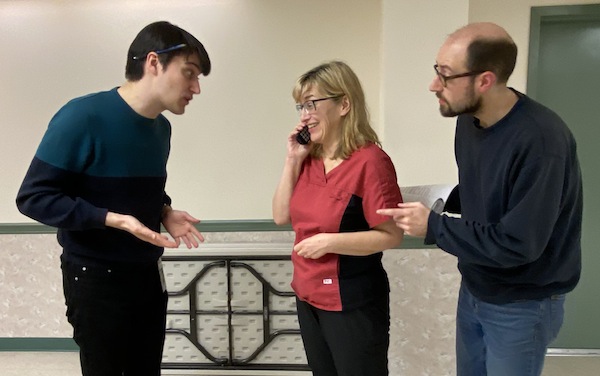
Nicholas Guerriero, left, Lorene Cammiade and Rudy Smith rehearse a scene from Bema Productions’ staging of Men Overboard, which will be at Emanu-El Synagogue’s Black Box Theatre May 5-15. Guerriero plays Jay Silver, a Buddhist monk and the youngest son of Zaida Ernie, Cammiade portrays Eva Fuzesi, the bar mitzvah tutor from Hungary, and Smith plays Doug Silver, Ernie’s middle son and a psychotherapist. (photo from Bema Productions)

Next month, Victoria’s Bema Productions mounts the first full production of Men Overboard.

Winner of the Long Beach Playhouse New Play Contest and a finalist for the Woodward-Newman New Play Award, Men Overboard was written by Rich Orloff. After well-received readings and workshops in New York, Philadelphia, Long Beach and Dayton, the play comes to Victoria, where the première will be directed by Kevin McKendrick.

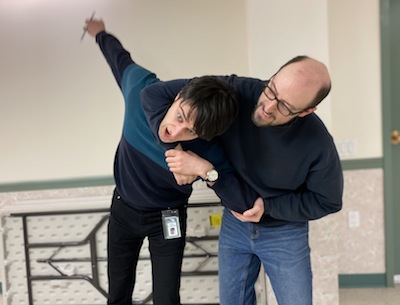
photo - Things get rough in Men Overboard: Rudy Smith puts a (fake) stranglehold on Nicholas Guerriero
Things get rough in Men Overboard: Rudy Smith puts a (fake) stranglehold on Nicholas Guerriero. (photo from Bema Productions)

The play focuses on a bar mitzvah for a boy, Abraham, who doubts he’s ready to become a man. The event brings together Abraham’s politician father and the father’s two brothers, a therapist and a Buddhist monk. Add their fading but forceful father and Abraham’s bar mitzvah tutor, a woman who loves Abraham and possibly one of his uncles, and it’s easy to see that Abraham is torn between obedience and defiance of his father. Tensions grow, affecting everyone in the family, until anger becomes abuse and it becomes clear that the family’s status quo is no longer an option. Men Overboard asks “What makes a man?” as it explores the responsibility each of us has to protect the souls of those we love.

The Bema production stars Lorene Cammiade, Nicholas Guerriero, Asa O’Connor-Jaeckel, Evan Roberts, Alf Small and Rudy Smith. It is produced by Alan Segal and takes place May 5-15 at Congregation Emanu-El Synagogue’s Black Box Theatre, 1461 Blanshard St. For tickets ($25) and showtimes, visit eventbrite.ca/e/295008758137. 

– Courtesy Bema Productions