Israel and UAE accord

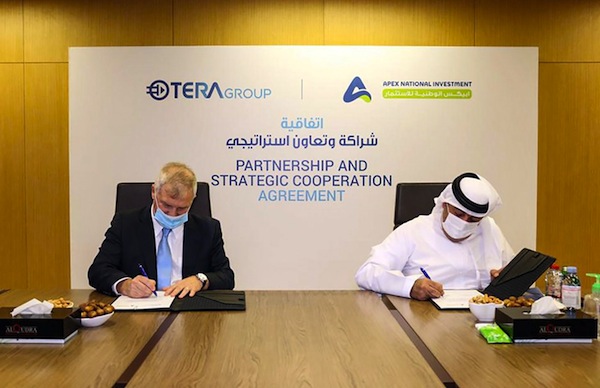
TeraGroup chair and chief executive officer Oren Sadiv, left, signs a research deal with Khalifa Yousef Khouri, chair of APEX National Investment, in Abu Dhabi. (photo from WAM Emirates News Agency via Israel21c)

Overcoming the COVID-19 pandemic could be just one of many positive results of Israel and the United Arab Emirates establishing full diplomatic relations on Aug. 13, 2020. The historic pact is expected to trigger numerous joint projects in health, economics, agriculture, water technology, telecommunications, security, culture, tourism and other fields.

“Today, we usher in a new era of peace between Israel and the Arab world,” said Israeli Prime Minister Binyamin Netanyahu in announcing the U.S.-brokered Abraham Accord with Abu Dhabi Crown Prince Mohammed bin Zayed al-Nahyan (“MBZ”).

Even before the accord, on July 3, Rafael Advanced Defence Systems and Israel Aerospace Industries of Israel signed agreements with Abu Dhabi’s Group 42 concerning research and development collaborations for solutions to SARS-CoV-2, the virus that causes COVID-19. On Aug. 15, UAE company APEX National Investment signed a strategic commercial agreement with Israel’s TeraGroup to develop SARS-CoV-2 research. And, on Aug. 16, in the culture arena, Israeli singer Omer Adam announced that the UAE royal family invited him to perform a private concert.

Netanyahu said the two technologically advanced countries will open mutual embassies and direct flights, among other bilateral agreements.

“This is the greatest advancement toward peace between Israel and the Arab world in the last 26 years, marking the third formal peace between Israel and an Arab nation, after Egypt (1979) and Jordan (1994),” he said.

One big difference is that Israel and the UAE – a federation of seven states including Dubai and Abu Dhabi – do not share a border and have never warred with one another. Under-the-radar business and security ties have been building over the past 20 years, and diplomatic ties more recently.

In 2015, Ministry of Foreign Affairs Director General Dore Gold opened a diplomatic mission in Abu Dhabi connected to the International Renewable Energy Agency. In 2018, Israel’s communications minister attended a telecommunications conference in Dubai; in 2019, Israel’s foreign minister spoke at a United Nations environmental conference in Abu Dhabi.

Israel’s culture and sports minister came to the Abu Dhabi Grand Slam judo competition in October 2018, where, for the first time, the UAE permitted Israeli competitors to wear their national flag on their uniforms, and played the Israeli national anthem on the winners’ podium.

The new agreement puts an official stamp of approval on this ongoing relationship and allows it to expand in full daylight.

* * *

The development of coronavirus vaccines, therapeutics and testing will “absolutely” figure prominently in Israeli-UAE deals following the Abraham Accord, said Jon Medved, chief executive officer of Jerusalem-based OurCrowd.

Medved has been traveling to the UAE for years, building contacts between Israeli and Gulf entrepreneurs, investors and experts.

“They’ve got world-class hospitals and there is huge interest in working with Israel on healthcare technology, telemedicine and digital health,” he told Israel21c.

Medved spoke in Abu Dhabi last December at the SkyBridge Alternatives (SALT) investment conference. He was the first Israeli investor to appear on a public stage in the UAE.

“I wasn’t sure they would let me speak openly about Israel, but, on the contrary, they wanted me to talk about Israel’s ecosystem,” said Medved. “You could tell we are in historic times. I was amazed how open they are to us and how aware they are of what is going on in our country.”

Medved reiterated that the UAE has long done business quietly with Israel but now will become a bigger trade partner and a bridge to other Gulf-region markets for Israel.

“For most of us, the Arab world has been more or less an afterthought and that’s about to change,” he said. “We will sell them enormous amounts of health gear and ag-tech, education-tech and cybersecurity,” he predicted. “For the startup community, the agreement will open up a source of tremendous new investment from the best investors in the world. [The Emiratis] are not only deep-pocketed but incredibly skilled, experienced and sharp.”

However, he added, “The real challenge for us is how we can really make this a win-win by trying to understand what they want. My sense is they don’t want to be passive investors. They want to build joint ventures, engage in technology transfer, build startups, do business and create jobs and long-term value and partnership.”

* * *

The Abraham Accord is “a huge diplomatic achievement for Netanyahu” and a “brave leadership act of Bin Zayed,” said Yoel Guzansky, senior research fellow at the Institute for National Security Studies and co-author of Fraternal Enemies: Israel and the Gulf Monarchies (Oxford University Press, 2020).

Guzansky, who coordinated Israeli policy on Iran and the Gulf states under four national security advisers and three prime ministers, said in a press call on Aug. 13 that “the announcement was historic and dramatic, but not 100% surprising for those who have been talking behind the scenes with Emiratis.”

“Relations between Israel and some of the Gulf States, especially the UAE, [are] the worst-kept secret in the Middle East,” Guzansky said. “It was almost ordinary for Israelis to visit the Gulf representing industries from diamonds to agriculture to desalination to security. Relations evolved, especially in the past five years, in several dimensions – security intelligence, economic/commercial, cultural and religious dialogue – pushed and led by Bin Zayed.”

Guzansky believes the deal could catalyze other Arab countries in the Gulf and North Africa. Indeed, Netanyahu said he expects to “soon see more Arab countries join our region’s expanding circle of peace.”

Bahrain released a statement lauding the landmark Abraham Accord, while an anonymous Saudi Arabian source told Israel’s Globes business newspaper that “the Arab world has a great deal to gain from Israel.”

The Israeli Ministry of Foreign Affairs has confirmed the start of phone service with the UAE and stated that the peace treaty “will benefit the entire region, helping secure a brighter and more prosperous future for all.”

Israel21c is a nonprofit educational foundation with a mission to focus media and public attention on the 21st-century Israel that exists beyond the conflict. For more, or to donate, visit israel21c.org.
Sisterhood building bridges

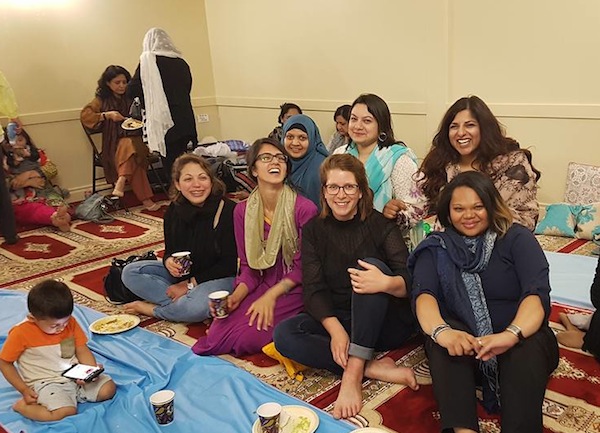
Members of Sisterhood of Salaam Shalom enjoy a Ramadan Iftar dinner together at a local mosque. Naz Qureshi is at top right and Rabbi Gila Caine is seated in the front row, second from the right. This photo was taken before the COVID-19 crisis. (photo from Naz Qureshi)

Sisterhood of Salaam Shalom, which works with Jewish and Muslim women to combat hate, stereotyping and prejudice, has chapters in the United States, England and Canada. After a trip to Israel in 2017, Naz Qureshi, who is Muslim and whose parents are from Pakistan, decided to start up a Salaam Shalom chapter in her own city, Edmonton.

“I’ve been to Israel/Palestine twice,” Qureshi told the Independent in a recent interview. “It’s one of my favourite places to go. I love to see the political dynamics, because … I can weave in and out of both sides. I’m Muslim, so the Palestinians get me. But yet, I’m very Western, so the Israelis get me, too. I don’t wear a hijab. I’m not seen as a threat. I can see it from both sides. I think that, because I’m also a South Asian Westerner, of course, the conflict is near and dear to my heart and I’m passionate about it, but I’m not as invested in it as a Middle Easterner would be.”

During Qureshi’s 2017 visit to Israel, she said, “Completely by chance, this Orthodox rabbi and I started talking about religion and we ended up becoming extremely good spiritual friends. We realized that our faiths have so much in common.”

On her way back to Edmonton, via Toronto, Qureshi happened upon an ad for Sisterhood of Salaam Shalom and reached out when she got home. She contacted Temple Beth Ora’s Rabbi Gila Caine.

“Gila was completely interested,” said Qureshi. “I said, ‘OK, this is perfect, because you’re a rabbi and you can bring the Jewish women, and I can bring the Muslim women.’”

Each leader managed to find a half dozen interested women from their communities, and they began meeting on a monthly basis in homes and places of worship.

“Initially, you don’t broach the Israel-Palestine topic, because you’re just going to have a breakdown of communication right there,” said Qureshi. “Instead, we started with similarities. And it’s not just like, ‘OK, let’s eat some baklava and hummus.’ No. You delve into really interesting topics, like our holidays, our festivals. Salaam Shalom provides you with a whole binder if you’re not able to work on your own topics. They’re really good at guiding you.”

By eliminating stereotypes and hate, and developing friendships, participants begin seeing the other’s points of view and standing up for one another.

To help create intimate friendships, chapters are kept small. “You can’t hate somebody who you end up liking,” said Qureshi. “And then you think, ‘Wow, this person is a lot like me.’

“I think that when that happens – I’ve seen it over and over again from both sides – it creates really interesting dynamics. When you see that wall fall, it’s like the Berlin Wall cracking and this realization that, ‘Oh, my God … this person is not evil, they’re really interesting and fun to be around.’”

At one of the meetings, members were asked to share a personally meaningful story from their faith tradition. “I remember one, I think it was my favourite,” said Qureshi. “We were at Gila’s house and Gila shared about the Kiddush cup. I’d brought zamzam water (Muslim blessed water) and explained its significance. We ended up toasting zamzam water in the Kiddush cup and it was amazing…. When we left, we all had that warm fuzzy feeling in our hearts.”

Just before the coronavirus outbreak, the group had planned to have an event to assess participants’ interest in continuing, but the gathering had to be postponed.

“What I really like about Salaam Shalom is the intimate, smaller group discussions,” said Qureshi. “You get past the formalities, past your name and what do you do, and you delve into real issues and gain an appreciation and learning from one another.

“There is so much Islamophobia and antisemitism on both sides and I really wish that people would just go out and make a Muslim or Jewish friend, and then you can see this closeness that exists.

“I think it’s maybe also so important for women especially to be doing this work because it’s easier for us … no matter where you fall on the spectrum, liberal, conservative … we tend to be more open.

“We can portray Muslims not in this negative stereotypical light, too,” she added. “We’re not all terrorists, we’re not all crazy…. It’s really important to sow those seeds wherever you can.

“Going back to my Israeli friend, the Orthodox rabbi, he feels so close to Palestinians he knows now … whereas before, he was a completely different person. Now, I think, from knowing me and when we talk about religion and the shared stories and our deep love of God and respect, he feels this closeness to Palestinians.”

After Qureshi’s phone interview with the Jewish Independent, she shared a message she received from her rabbi friend, which read: “The other day, when I came home after one of my rounds, I tried to park the minibus in the usual spot and there was this guy who told me that he cannot clean the area because I park there, so I parked somewhere else. Later, I go over to him and ask what days he comes to clean, so I know when not to park. He was a Muslim and he said, ‘I like you.’ He said he recognized me from before. Apparently, he used to sweep the area some time ago and remembers that I used to compliment him and say a good word. Anyway, he literally kissed me! It took me by complete surprise! Who would think of [a Muslim] kissing a Jew? Anyway, we exchanged numbers and now there’s another Muslim friend added to my list.”

Qureshi reflected, “Hearing this message made my Monday morning. I got off the train feeling elated and walked the remaining blocks to work. The sun shone a little brighter and the cooling breeze appeared to be sent directly from the heavens above! The scene was playing over and over in my mind. ‘Who would kiss a Jew?’ Why, a Muslim could and would kiss a Jew! And what had elicited such a strong emotional response? That a Jew could and did act kindly to a Muslim.”

Rebeca Kuropatwa is a Winnipeg freelance writer.

On brink of radical change

Prof. Shlomo Hasson was slated to bring a pessimistic forecast for the Middle East’s future to a Vancouver lecture March 31, but his visit was canceled due to the coronavirus crisis. (photo from CFHU Vancouver)

The Middle East is in a time of historical change and geopolitical shifts. The outcome is unknown and, for Israel, there may be good and bad consequences.

This is a core message from Prof. Shlomo Hasson, a professor at the department of geography, School of Public Policy, and Leon Safdie Chair at the Institute of Urban and Regional Studies at the Hebrew University of Jerusalem. Hasson was to speak in Vancouver March 31 at an event organized by the Vancouver chapter of Canadian Friends of the Hebrew University, but the lecture was canceled due to the coronavirus crisis. The Independent spoke with him by telephone about what he intended to discuss.

“We are in the midst of turmoil in the Middle East because we have this havoc with Iran and the intensifying tension between the United States and Iran,” he said. “We have the ongoing conflict within the Middle East, especially in Syria, the war now between Turkey and Syria. We have the recent events in Libya, we have a worsening situation in Yemen. I’m not optimistic about the Middle East and, when it comes to the Israeli-Palestinian case … the peace talks were stalled for a long time and now it seems that [U.S. President Donald] Trump’s initiative, in a way, helps to revive the issue but did it in such an awkward way that I’m not optimistic at all about the consequences of this initiative.”

The warming of relations between Israel and Saudi Arabia, as well as with some Gulf states, is cause for limited hope, he said.

“This is indeed a good reason to celebrate because there has been a change, even a significant change, between the Gulf states and even Saudi Arabia, and Israel because [they] are facing the same adversary, which is Iran,” Hasson said. “Israel supports Saudi Arabia because it supports them in containing Iran. In that sense, I think there is something to celebrate but this is very modest, because … the public in Saudi Arabia, for example, does not support Israel. It’s sort of an alliance between the rulers of the countries, but the public is not there yet.”

An additional crisis is climate change, which is hitting the region especially hard and will continue to do so, although this also presents opportunities for Israel to build bridges.

“We face the problem of water scarcity and droughts and flooding,” Hasson said. “I think that, especially in this crisis, Israel can help a lot because we have the technology, we’ve mastered the know-how and we can help the Middle East and Africa, while coping with this issue.”

Speaking before the most recent Israeli elections, Hasson predicted that, regardless of the outcome, they wouldn’t play a significant role in the bigger Middle East picture.

“Israel is not the central actor here,” he said. The central actors are Saudi Arabia and Iran, with China, Russia and the United States intervening from outside.

“Israel is in a position of reacting to these global, regional and intra-state developments,” he said. Even if Blue and White had won, said Hasson, it is still a right-wing party and the Israeli populace is developing a rightward consensus. “I don’t think that these elections are going to present a significant change in Israel’s political behaviour.”

He compares this moment in Middle East history to the pivotal epochs of the past.

“About 100 years ago, we still had the Ottoman Empire and, after that, we had the colonial regimes, the Sykes-Picot regimes, and then we have the nation-state regimes. The Middle East is at the brink of a change, a radical change, and nobody knows for sure what’s going to happen to the Middle East,” said Hasson. “But, in a way, it’s going to affect everything, it’s going to affect the global structure, it’s going to affect the relationships between the United States, China and Russia.”

A soap-opera comedy

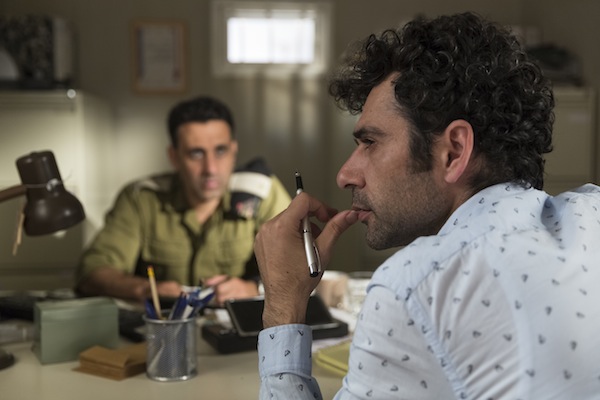
Yaniv Biton as Assi, left, and Kais Nashif as Salam in Tel Aviv on Fire, which screens Feb. 28 as part of the Vancouver Jewish Film Festival. (photo from Cohen Media Group)

Palestinian writer-director Sameh Zoabi achieves something altogether remarkable with his second feature film, particularly at this moment in time: he finds humour in the tattered relationship between Israelis and Palestinians.

“The whole idea of Tel Aviv on Fire is that we have more in common than we want to admit,” Zoabi said in an interview before his movie screened in the San Francisco Jewish Film Festival last year. It screens on Feb. 28, 1 p.m., at Fifth Avenue Cinemas, as part of the Vancouver Jewish Film Festival, which runs Feb. 7-March 8.

“We have to break these stereotypes and talk about what’s in common between us and not what divides us,” he said. “Let’s remind people how humanity can prevail in times where the politics of post-Oslo is, ‘Let’s dehumanize the other to be able to survive.’ I want to do the opposite.”

A sharp, insightful and winning comedy that juxtaposes the delicious absurdity of melodrama with the real-life absurdity of the occupation, Tel Aviv on Fire centres on an underachiever, Salam, who works as a gofer on his uncle’s hit Palestinian soap opera. Through a barely plausible combination of chance, chutzpah and desperation, the shlemiel is elevated to writer. Then he runs afoul of the Israeli commander of the checkpoint he crosses every day, whose wife is a loyal fan of the show.

Salam has to use every iota of guile and cleverness to navigate the opposing agendas that he’s caught between – and to win back the heart of a woman he had dumped. (Even while he’s landing political japes, Zoabi cheerfully seizes every opportunity to lampoon the conventions of both soap operas and movies.)

One of nine children, Zoabi grew up in a village outside of Nazareth, where people went to his grandfather’s barbershop for his humorous stories as much as for a haircut.

“In general, my village is very funny,” Zoabi related. “That’s maybe why comedy has become very easy for me, because I grew up in a place where they don’t take anything seriously.”

Zoabi studied at Tel Aviv University and then at Columbia University in New York, where he discovered the need for Palestinian stories. Returning to Israel, he made a short film, Be Quiet, in 2005 and his feature debut, Man Without a Cell Phone, in 2010. Zoabi’s experience of receiving government funding was the genesis of Tel Aviv on Fire (2018).

“You take money from the Israelis, so suddenly you are watched immediately,” he explained. “Israelis are making sure you are not becoming too Palestinian for them. And the Palestinians are watching, ‘He took money, maybe he’s a sellout, he’s doing a comedy.’”

After presenting Tel Aviv on Fire at several international festivals, Zoabi debuted the film in Haifa and in Nazareth. It was equally well received by both audiences, which didn’t surprise him. But he did have an epiphany.

“All the screenings led to this moment,” Zoabi declared. “Finally I understood – people are fed up. People are fed up of the reality that exists, which is managing the occupation.

“[The film] reminds people of the possibility that used to exist, the feeling that we can be normal people and just get along. I think that’s a fantasy that existed among the Israelis, that we can eat hummus together in Damascus one day. But they aren’t able to see the occupation as a major reason for that not to happen.”

It’s a measure of Zoabi’s skill that the current-events commentary in Tel Aviv on Fire goes down easily for viewers across the political spectrum. The means to that success, in large measure, is Salam’s evolution of necessity from hapless underdog to diplomatic savant.

“I’m attracted to people who don’t wake up knowing what they really want,” Zoabi said. “I think they’re more inspirational for me than black-and-white [characters]. Actually, people who know exactly what they want terrify me. You can’t be so certain all the time.”

For his part, Zoabi grew up in a milieu of group interaction and lots of soap operas, because those were the only two channels the family had. He wasn’t exposed to art, theatre and film until his late teens.

“I always say I’m not an artist, really,” he confessed. “I’m probably a barber of a new era in my family.”

Tel Aviv on Fire is in Hebrew and Arabic with English subtitles.

For the Vancouver Jewish Film Festival schedule, visit vjff.com.

Michael Fox is a writer and film critic living in San Francisco.

Loss-loss only solution

The parallels between the Trump impeachment trial in the U.S. Senate and the release of the Trump administration’s Israeli-Palestinian peace plan are striking. Donald Trump, a master of diversion, unveiled his incendiary proposal for the Mideast at the height of the Senate’s process. Just as the impeachment trial was, in some senses, a process whose outcome was predetermined by the Republican majority, so too is the Mideast proposal outcome predetermined in that it barrels over the Palestinian opposition and rubber-stamps almost everything the more extreme elements of the Israeli body politic have long demanded.

The approach is counterintuitive – like almost everything this U.S. president has done. Supporters might contend that, since all the rational thinking of the best diplomatic minds has not resolved this problem, a 180-degree turn that electroshocks the status quo might be better than nothing. The proposal is so one-sided that, out of sheer outrage, it has at least forced the Palestinian leadership to articulate what they will (or, rather, won’t) accept to a degree greater than they have expressed in recent years.

In the end, though, this emphasis on winning and losing – the Trump plan would be a clear win for Israel and a commensurate loss for Palestinians – is precisely the wrong approach. We may believe that the Palestinian leadership has betrayed their people by rejecting previous offers of coexistence, and conclude that what their people get is what their leaders deserve. But the Palestinian people deserve better than this.

Israel and the Zionist project have always had to contend with the realities and vagaries of coexistence – what other choice do Jews really have? Despite early warnings, coexistence with their neighbours was a widespread expectation among the early Zionists, some of whom thought (naïvely, in retrospect) that they would be welcomed with open arms by the other peoples in the region. But, even with the history of conflict and the absence of anything to give us a great deal of hope, some slow evolution that leads toward coexistence is the only realistic alternative to the status quo of suspended violence and intermittent war.

We need to recognize, above all, that a lasting resolution is not going to look like a win for one side and a loss for the other. Likewise, it is not going to resemble a win-win, as negotiators in various arenas, as well as salespeople, like to say. It will be a lose-lose proposition. An enduring peace and coexistence will almost certainly occur only when both sides are willing to accept a loss on many or most of their key demands – and accept that loss as a price for their children’s lives and well-being.

More immediately, we should be very wary of any master plan for peace that is scribbled out in the middle of an election campaign or another drama like an impeachment. The contents of such a plan are almost certainly more geared to the outcome it is trying to influence (votes for Likud or the Republican Party) or distract from (the U.S. president’s impeachment and trial or the Israeli prime minister’s loss of immunity from prosecution) than the problem it is ostensibly meant to address. Israelis and Palestinians, both, deserve self-determination and lasting peace.

An advocate for two states

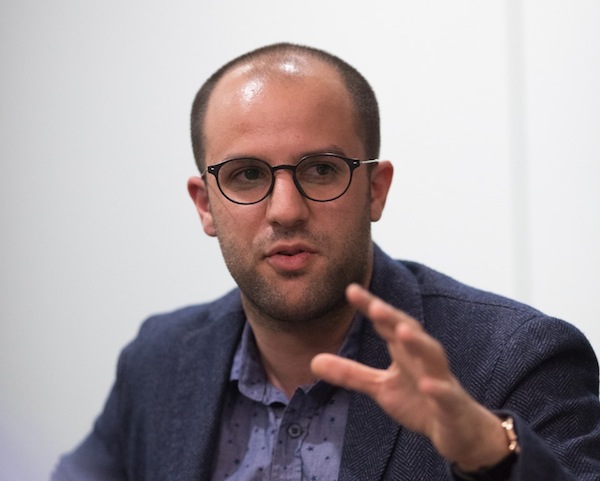
Eli Kowaz is communications director at the Israel Policy Forum. (photo from Eli Kowaz)

This article is one in an occasional series about people with British Columbian roots having positive impacts in Israel and elsewhere.

For Vancouver-born Israeli Eli Kowaz, there is only one path to ensuring Israel remains both a Jewish state and a democracy: a two-state solution. The road to that ideal may be long and the slogging hard, but this is the core mandate of the Israel Policy Forum, where he serves as communications director.

Though focused on Israel and its situation, IPF’s mission is to “shape the discourse and mobilize support among American Jewish leaders and U.S. policymakers for the realization of a viable two-state solution.”

Israel currently has military control over the entire land from the Mediterranean Sea to the Jordan River but, to continue being a Jewish state as well as a democracy, Kowaz said, Israel faces a decision.

“It can decide to annex the West Bank, keep the entire land and, if it wants to be a Jewish state, it will have to give up on the democracy aspect because, if it was to grant all the citizens living between the Jordan and the Mediterranean equal rights, then already today, Jews would be about 50-50, a small majority,” he said.

The answer is not cut and dry, he acknowledged. The Jordan Valley is a vital Israeli security interest and, come what may, Israel is likely to maintain military control there for the foreseeable medium-term. But both Israeli Prime Minister Binyamin Netanyahu and U.S. President Donald Trump have recently obfuscated their countries’ erstwhile support for a two-state solution. In Netanyahu’s case, it’s at least partly political, said Kowaz.

“He is dependent on his right-wing coalition partners, he’s willing to say things and even do things to secure his position as prime minister, even though he’s already surpassed [David] Ben-Gurion as Israel’s longest-serving one,” Kowaz said. “A lot of it is right-wing pandering to those people. Another part of it is a genuine security concern. The research done by the top security experts in Israel and others show that there is a way to keep that area secure while advancing a gradual separation of Palestinians and an eventual two states. Obviously, it’s not something that’s happening tomorrow.”

Kowaz, now 29, grew up in Vancouver’s Oakridge neighbourhood with an Israeli father, Joseph Kowaz, who moved to Vancouver in his 20s, and a mother, Andrea (Rogow) Kowaz, who moved here from New York at a young age. His late maternal grandparents were community leaders and academics Dr. Sally and Dr. Robert Rogow.

He attended Vancouver Talmud Torah and Hebrew Academy for elementary school and Magee and King David high schools, “so I kind of got a taste of Orthodox Jewish education, more of a secular traditional and also public school, so it was nice to have,” he said.

Kowaz did a gap year in Israel after high school, studying at Hebrew University and Ben-Gurion University. Returning to Canada, he graduated from McGill University in Montreal and then completed a graduate degree in digital media at Ryerson University in Toronto. His final project for his degree addressed ways to remember and educate about the Holocaust in the 21st century.

“From the beginning, I wanted to do something that was Israel-related,” said Kowaz. “So, it was either move straight to Israel or look for something Israel-connected that was outside of Israel.” He moved to New York City and soon got work at IPF. He moved to Tel Aviv last year and, in July 2018, married Tal Dor, a former graphic designer for the Israel Defence Forces newspaper BaMahane. She occasionally gives Kowaz advice and support from her experience.

Part of a generation that gained political awareness during the Second Intifada, Kowaz said he has been affected by the violent imagery of those days.

“I obviously want the best for everyone, but Israel is most important to me and I want Israel to be a Jewish state,” he said. “I want Israel to be a state that’s also accepted in the world to the best that it can be. Obviously, there will still be people that hate us but I don’t want Israel’s best allies to be Hungary, Poland, these right-wing [governments] with elements of fascism. We don’t want those to be our best friends, so, at the end of the day, I don’t think we have a perfect partner and the Palestinians, they’re never going to be a perfect partner, but we should do what’s best for Israel, which is at least preserve conditions for a two-state solution, a form of separation to secure Israel as a Jewish and democratic state as a goal for the next five, 10, 15 years. Keep that a possibility. And, right now … I think it’s definitely still an option. It’s still on the table. We haven’t killed it. But it’s treading in the wrong direction.”

The Israel Policy Forum began in 1993, said Kowaz, on the very day the day of the famous handshake on the White House lawn with Yitzhak Rabin, Bill Clinton and Yasser Arafat.

“At that time, Yitzhak Rabin was looking for American Jewish support for his vision of peace,” he said. “Even back then, AIPAC were already becoming close with Binyamin Netanyahu, who [had been] Israel’s ambassador to the UN and, at that time, he was already opposition leader.”

IPF does a lot of work in Washington, D.C., with policymakers, convening roundtable discussions and panels with congresspeople, congressional staffers and opinion leaders, as well as organizing events in synagogues around the United States, all focused on preserving conditions for two states.

Their positions are credibly backed up, said Kowaz, by security experts in Israel, called Commanders for Israel’s Security, which was begun by former major-general Amnon Reshef, a hero of the Yom Kippur War, and includes a cadre of 290 former IDF generals, Mossad and Shin Bet division heads and others.

“They work in Israel, so we work closely with them to relay their policy proposals and their messaging to an American audience,” he said. “It represents about 80% of the retired security establishment. It doesn’t get more legitimate than that. These are people that, I think, between all of them have 6,000 years of experience at the highest positions, making decisions constantly with people’s lives.”

While AIPAC has an upstart challenger on the left, J Street, Kowaz sees IPF as a more fact-based alternative to the politically oriented advocacy groups.

“People are looking for a voice that is different, that’s more policy-based, less trying to rally the troops and more looking at the facts,” he said. “I think we provide that kind of home and, in a way, everything’s very fact-based.”

Kowaz looks forward to continuing to work toward the perpetuation of Israel as a Jewish democratic state.

“It really doesn’t matter to me what the role is, I think that’s where I’d like to see myself,” he said, adding: “I’ve given up on the professional soccer career.”

Rockets raining down

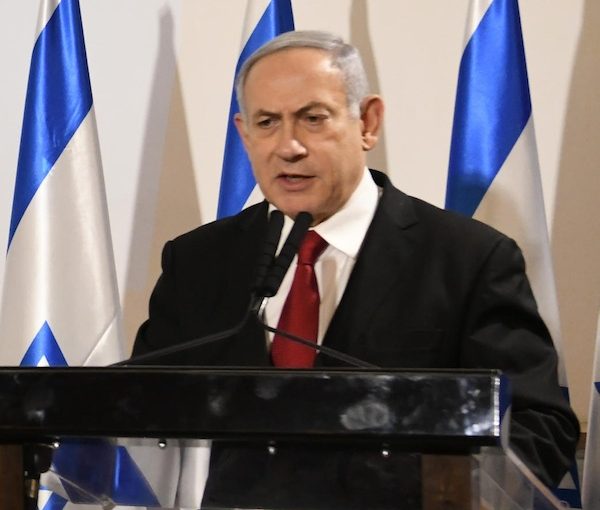
Israeli Prime Minister Binyamin Netanyahu talks about the rockets being fired from Gaza. (photo by IGPO via Ashernet)

Rockets were falling on southern and central Israel as the paper went to press this week. After the Israeli military killed Islamic Jihad commander Baha Abu al-Ata, Gaza once again erupted into full war footing.

The Iran-backed Palestinian Islamic Jihad called the assassination “a declaration of war against the Palestinian people” and declared, “Our response to this crime will have no limits.” Because they’re usually so restrained.

Schools were closed and Israelis, especially in the “envelope” area near the Gaza Strip but also in Tel Aviv, hunkered down in bomb shelters as Iron Dome deflected some but far from all of the rockets launched from the enclave.

The new, or renewed, conflict does not occur in a vacuum. Political leaders in Israel are in the midst of difficult negotiations to form a government after the second inconclusive election this year. Some critics claim the fighting is a scorched earth attempt by incumbent Prime Minister Binyamin Netanyahu to shake up the status quo and tip domestic politics in his favour. But, among those who reject this assessment is Netanyahu’s chief rival, Benny Gantz, who is now leading the efforts to cobble together a working alliance in the Knesset.

It all has a feel of déjà vu, of course, because this scenario, in different permutations, has played out repeatedly. As we posited in this space recently, some people say the status quo cannot hold. It can. It has for decades. But intermittent, terrible flare-ups like this are a part of and a price for that status quo, a high price paid by both Israelis and Palestinians. Until someone finds a path for both peoples to coexist more peacefully, this is life.

The broader impacts of war

Vancouver Peace Poppies co-founder Teresa Gagné at the White Poppy Memorial in 2018. (photo by Diane Donaldson)

A local group is hoping to broaden the scope of Remembrance Day as more than an occasion to honour the brave men and women who have died while serving for their country. Through the distribution of white poppies, the Vancouver Peace Poppies (VPP) movement strives to extend the focus on Nov. 11 to all those who have suffered as a result of military conflicts.

Teresa Gagné, who co-founded VPP with Denis Laplante in 2008, stresses that the group intends no disrespect towards soldiers. Instead, they wish to bring more awareness to the toll warfare has on the whole population, whether it be the loss of life or other trauma experienced. Beyond representing the victims of war, civilian and military, the white poppy, according to VPP, also challenges the beliefs, values and institutions that create the view that war is unavoidable.

“I have always had respect and sympathy for veterans, who put their life, health and family on the line to serve,” Gagné said. “I believe they deserve recognition and support, but, for years, I was uncomfortable wearing a red poppy, because of the undercurrent of promotion and recruitment for present and future wars that I detect in many public events around the topic of supporting veterans. The white poppy attracts questions, and gives me a chance to explain the nuances of my support.”

A 2016 study by Alexandre Marc, a specialist in conflict and violence for the World Bank, brought to light the overwhelmingly disproportionate number of casualties among non-combatants as opposed to combatants in recent decades. According to some reports, civilians constitute 90% of wartime fatalities, a ratio that has existed since the mid-1950s.

What’s more, Marc’s research points out that global poverty is increasingly concentrated in countries affected by violence and that prolonged conflict keeps countries poor.

Gagné and Laplante have been active in the peace movement since their teens. Their 2008 launch of VPP began by distributing handmade white poppies as a way to promote discussion and a broader focus for Remembrance Day. The following year, while still a “kitchen table” operation, they imported 500 cloth poppies from Britain. VPP now sends out more than 5,000 poppies across Canada annually.

Since 2016, VPP has partnered with the B.C. Humanist Association to host Let Peace Be Their Memorial, an annual Remembrance Day wreath-laying ceremony that includes peace songs, short presentations and poetry. This year, the Multifaith Action Society is also a co-host. The event poster highlights, “The time and location of the ceremony has been chosen to avoid any appearance of competition with, or disrespect for, veteran-focused events.”

Holocaust remembrance

As in previous years, this year’s ceremony at Seaforth Peace Park on Nov. 11, 2:30 p.m., will include a special wreath laid in memory of Holocaust victims.

Two members of the Vancouver Jewish community, Marcy Cohen and Gyda Chud, are engaged in the local movement. In 2017, Cohen attended her first Let Peace Be Their Memorial and then sought to get others in the community involved.

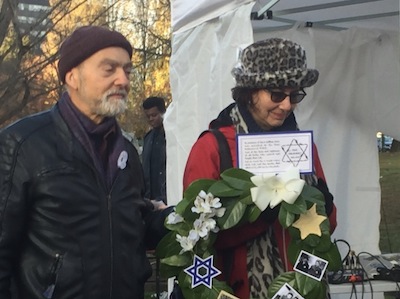
photo - Henry Grayman and Deborah Ross-Grayman with the Holocaust wreath at the memorial last year
Henry Grayman and Deborah Ross-Grayman with the Holocaust wreath at the memorial last year. (photo by Diane Donaldson)

“I was far more affected emotionally than I anticipated,” said Cohen of the occasion.

After learning of the history, values and focus of VPP, Chud recently joined the committee, and seeks to profile their work in the larger Jewish community. She represented Pacific Immigrant Resource Society (PIRS), a local refugee service group, in laying the refugee wreath in 2017 and 2018.

“The memorial serves as a powerful and compelling call to action for everything we can and must do to create a more peaceful world,” said Chud.

Last year’s Holocaust wreath was laid by Henry Grayman and Deborah Ross-Grayman, both children of Holocaust survivors. Having each experienced the intergenerational effects of trauma, the couple, both therapists, are facilitators for the Second Generation Group, an organization in Vancouver comprised of children of Holocaust survivors sharing their experiences among peers.

The people laying the Holocaust wreath at this year’s Let Peace Be Their Memorial have yet to be announced.

Poppies’ history

The red poppy widely worn today first appeared in 1921 on what was then called Armistice Day. In 1926, the No More War Movement, a British pacifist organization, came up with the idea for the white poppy and, in 1933, the Co-Operative Women’s Guild in the United Kingdom sold the first white poppies as a means of remembering that women had lost husbands, sons and fathers during wartime.

The wreaths that Vancouver Peace Poppies and other groups make, a mix of white and red poppies, highlight the amount of civilian suffering. VPP also distributes white poppies in schools in an effort to teach students that wars mostly kill non-military people, pollute the environment and send the message that violence as a means to settle disputes, even for adults, is acceptable.

VPP hands out its poppies by donation to increase awareness of its cause and not as a fundraiser. Poppies cost $1.25 each, of which 95 cents goes to the Peace Pledge Union, a pacifist organization based in London, England, which, since 1934, has advocated for nonviolent solutions to global problems. A $1 or $2 donation allows VPP to provide subsidized poppies for classroom use and free poppies to disadvantaged groups.

For poppies and more information, visit peacepoppies.ca or call 604-437-4453.

Sam Margolis has written for the Globe and Mail, the National Post, UPI and MSNBC.

Status quo OK?

Israeli Prime Minister Binyamin Netanyahu places his vote on election day. (photo by Haim Zach/IGPO from Ashernet)

Unless something dramatic happens between when we write this and when you read this, the future of Israel’s government remains uncertain. To avert a third election in a year, the most viable option for a stable government would appear to be a “national unity” or “centrist coalition” involving both major parties, Likud and Blue and White.

This was the subject of face-to-face discussions between leaders and President Reuven Rivlin, but no agreement was reached. So Binyamin Netanyahu, the incumbent prime minister, has a few weeks to try to cobble something together. If he fails, Rivlin will probably call on Blue and White leader Benny Gantz to give it a go. Some bets are that, if it comes to that, there will be enough Knesset members desperate enough to avoid a return to the polls that some accommodation will be made. Perhaps the likeliest possibility is a Likud-Blue and White unity government without Netanyahu. (This scenario would become likelier if Netanyahu officially faces criminal charges in the next few days.)

Any broad coalition of this sort would lead to a degree of progress on some fronts – if far-right and religious parties are excluded, some policies and legislation that appeal to the secular majority are likely to advance – while progress on some other fronts would likely stall.

One example is the peace process – although there is, basically, no progress to stall at this point. There is great divergence in Israel over what the next steps should be vis-à-vis the Palestinians. In a broad-based coalition government, that uncertainty would define government policy, probably leading to inaction.

During the recent election, Netanyahu went further than previous leaders, promising to annex chunks of the West Bank to Israel. Gantz and the centre-left in Israel have been confounded by the reality that, while they seek a two-state solution and recognize a one-state situation as demographically unsustainable, until Israel sees a benefit to ending the occupation and can be certain that an independent Palestine in the West Bank will not be a launch pad for terror, independence will not come and the occupation will not end. Without that, no peace, no Palestine.

As a result, we will likely see more of the status quo, until some force acts to alter it. While Netanyahu’s provocative promise to annex areas would have altered the status quo for the worse, a precipitous end to the occupation that left a vacuum to be filled by those wishing to do Israel harm would likewise be a change for the worse. The tense status quo Israelis and Palestinians have now is definitely not great, especially for Palestinians, but it is better than outright war.

An old tale has the rabbi of a medieval Jewish community visiting the duke who has threatened to throw the Jews from his realm. The rabbi returns to his community and tells his people, “I convinced the duke to let us stay – if I can teach his dog to talk within five years.” The Jewish community is dumbfounded. “What a promise? It’s impossible!” The rabbi says, “Relax. I’ve got five years. The dog could die. The duke could die. I could die. Meanwhile, I bought us five years.”

The occupation, the statelessness of the Palestinian people, the recurring missile attacks from Gaza and the violence against civilians are not things we should understate or dismiss. But neither should we believe that any change is necessarily an improvement. The status quo is better than war and it is better than the dissolution of the Jewish state. The status quo is not ideal, but it may be better than currently available alternatives.

In solidarity with neighbours

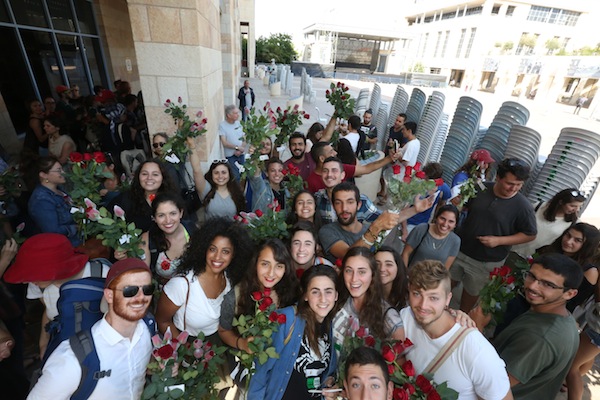
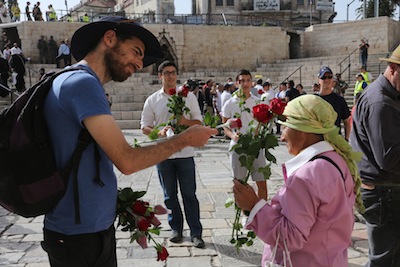
One of Tag Meir’s annual events is Flowers of Peace. Participants hand out roses on the streets of the Old City in Jerusalem on Jerusalem Day. This year, they gave out some 2,000 flowers as a message of peace to Muslims and Christians in the city. (photo from Tag Meir)

To counter what Tag Meir head Gadi Gvaryahu described as incitement by radical settlers through Tag Mechir (Price Tagging), Tag Meir (Light Tagging) was formed.

Tag Meir, which started in 2011, is operated by members of the same segment of religious Zionistic Judaism that started price tagging (attacking Palestinian property and people) in 2009. Members of Tag Meir started visiting victims on both sides of the conflict in an effort to show solidarity and repair physical and psychological damage.

Today, Tag Meir is supported by many organizations and institutions in Israel from all segments of Jewish society – secular, Reform, Conservative, Orthodox and ultra-Orthodox Jews – coming together to stand against hate and intolerance.

Though he now lives in Rehovot, Gvaryahu still considers Jerusalem home. He is the eighth generation of his family to live there.

Gvaryahu was deeply affected by the assassination of Yitzhak Rabin and the fact that the killer had come from his segment of religious Zionism, Kippot Srugot (Knitted Kippot). He decided he had to put his passion for helping animals aside – he is a farm animal behavioural researcher by training – to find ways to mend Israeli society.

“I decided it’s about time to be more involved in public business – not politics, but more education,” said Gvaryahu. “Me and a few other families initiated a synagogue, an Orthodox synagogue in Rehovot, named after Yitzhak Rabin.”

Gvaryahu realized there was something wrong with the education system when he received a call from the head of his son’s yeshivah, demanding his son apologize for an outburst.

“Six months after Yitzhak Rabin’s assassination, a famous rabbi came to my son’s school,” recalled Gvaryahu. “He said that now, with Rabin dead, all his bad things were forgiven. And he didn’t even mention that he was murdered. He just treated him like someone who’d sinned a lot, talking to the whole synagogue, like 400 students, including the head of the synagogue … and they were all silent, except one person – my son.

“My son said, ‘How dare you say that? He just passed away! And, how dare you say that he has sins? He was killed, murdered!’ Then, he left the room, crying.”

When the rosh yeshivah called, Gvaryahu commended his son’s actions and said, “This rabbi should apologize. I’m not going to ask my son to apologize.”

Eventually, they consulted a leading rabbi who declared that Gvaryahu’s son “did a wonderful job and there’s no reason for him to apologize.”

It was at that point that Gvaryahu decided they needed to start their own school.

The first time that Israelis heard the term “Price Tag” in the context of payback was in December 2009. It was dubbed so by a small group of extreme right-wing West Bank settlers who had begun indiscriminately attacking Palestinians.

Gvaryahu explained the psychology behind it: “Something happened to us by Palestinians, by the army, by politicians, whatever … someone will pay the price. The thinking is, we don’t care that you’re innocent, we don’t care that you are Christian, Muslim…. You’re not Jewish, you’ll pay the price. We’ll burn, damage your mosque, your house, your car, your olive trees, and that’s called, ‘Price Tag,’ happening almost daily in the West Bank. Most of them, we don’t hear about. But, after a terror attack by Muslims, unfortunately, we have a bunch of them in the last two months … there’s been attacks by extreme settlers.”

While Tag Mechir destroys, Tag Meir aims to rebuild and bring light. “So, we call the people, the victims, in hospitals, villages, wherever, mosques, monasteries or churches, and we create a solidarity visit,” said Gvaryahu.

photo - Flowers of Peace volunteers on Jerusalem Day
Flowers of Peace volunteers on Jerusalem Day. (photo from Tag Meir)

“Over the years, we’ve gained many, many Jewish, Christian and Muslim friends, and that’s very important. It’s important, because it’s a correct response to that crime, because they want to create terror or fear, especially among Muslims and Christians. So, those visits strengthen the relationship between Jews and Muslims and Christians. We have three Facebook pages – one in Hebrew, one in Arabic and one in English – with 35,000 followers.”

People in Israel not connected to Tag Meir have started solidarity visits by themselves, aiming to mend fences with Palestinian neighbours. “First, you know, I’m happy about Tag Meir,” Gvaryahu said about this development. “Second, that they get that this is the right way to respond to a hate crime or a price tag attack – it’s wonderful. It’s what we want to happen.

“This isn’t something that can be solved quickly. It’s education. We try to educate society, especially the Zionist society, we hope.”

This year, due to the rise in Tag Mechir attacks, Tag Meir held an education symposium on Sept. 10 at the Van Leer Jerusalem Institute, near the home of the president of Israel, Reuven Rivlin. Among the speakers were the former head of the Israeli security agency, Shin Bet, Yaakov Peri, senior rabbis from different segments of society, and the mother of one of the Jewish victims of terror, Sarah Rosenfeld.

“Her son [Malachi Moshe] was murdered and she will give her strong condemning opinion about ‘price tag,’” said Gvaryahu prior to the symposium. “When we came to visit the Rosenfeld family, she said that, if Malachi would be with us, he would join Tag Meir.

“This is very unique about Tag Meir, that we visit both settlers and victims of Tag Mechir on the Palestinian side. It’s not that pleasant an activity sometimes, but we feel it’s very important.”

One of the yearly events Tag Meir hosts is a flower giveaway called Flowers of Peace. They go out into the streets of the Old City in Jerusalem on Jerusalem Day and hand out roses. “This year, we spread 2,000 flowers all over the Old City,” said Gvaryahu. “It’s a symbolic act, sending a message of peace to Muslims and Christians in Jerusalem.”

While Gvaryahu said 40% of the people in Jerusalem are Muslim, Jerusalem Day is only celebrated by the Jewish population. He said some of the songs that are traditionally sung must irritate the Muslim population. “Unfortunately, we don’t celebrate it, in our opinion, in the right way,” he said. “We just march with Israeli flags from West Jerusalem to the Western Wall through the market. Not all the songs are horrible, but a few of them are. So, this is our response. We march with Flowers of Peace.”

For more information, visit tag-meir.org.il/en.

Rebeca Kuropatwa is a Winnipeg freelance writer.