Tolerance via playing soccer

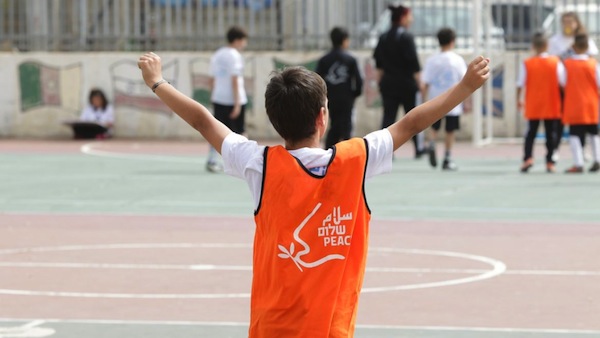
A participant in Playing Fair, Leading Peace in Jaffa. (photo from Peres Center)

“I did not know I could play with Jews or talk to them. Now I want to and I can,” wrote an Arab middle school student whose school was one of 10 – five Jewish, five Arab – to participate in Playing Fair, Leading Peace, created by the Jaffa-based Peres Center for Peace and Innovation to unite Jewish and Arab Israeli children through soccer.

In 2018-2019, Playing Fair, Leading Peace engaged 300 fifth- to seventh-graders in Arab and Jewish sectors of Jerusalem, Tel Aviv, Jaffa, Kalansua, Kfar Saba, Beersheva and Tel Sheva. In each participating school, one class is matched with one class from the corresponding nearby school. Kids and their teachers are guided by two specially trained university students (one Jewish, one Arab) in five tolerance education and prep sessions held at their own school, and in five joint soccer matches on one another’s turf.

In these games, Arabs don’t play against Jews; each team mixes children from the hosting and visiting schools. And there are no referees; the children are given the responsibility of determining rules and mediating disputes.

“They need to communicate to solve issues during the game by themselves. This is a smart component of the program,” said Tamar Hay-Sagiv, director of the education for peace and innovation department at the Peres Center.
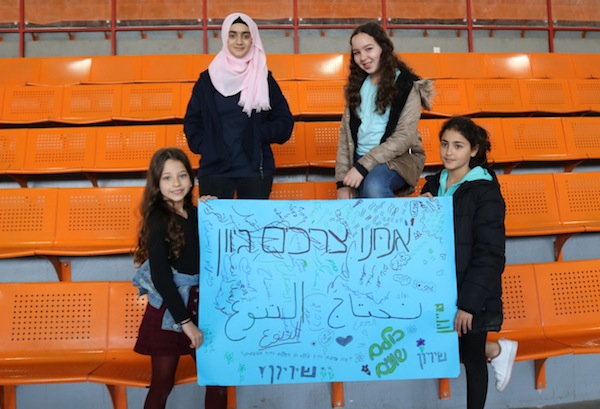
photo - Children in the Arab village of Kalansua with a poster stating, “We need diversity” and “We are all equal” in Hebrew and Arabic
Children in the Arab village of Kalansua with a poster stating, “We need diversity” and “We are all equal” in Hebrew and Arabic. (photo from Peres Center)

But it’s not an easy component, because one side speaks Hebrew and the other speaks Arabic. “We tackle the language issue by teaching through sports. They learn the language of ‘the other’ while they play,” said Hay-Sagiv.

Nor is it a simple matter to convince parents to allow cross-visits.

“There are fears and stereotypes to overcome,” acknowledged Hay-Sagiv. “We had one child in the south whose family was afraid for him to travel to a Bedouin school. It was a trust-building process between his parents and the head of the school, who gave us full support and made the family comfortable in allowing the visit. It’s always a challenge for Jewish schools to agree to travel to Arab communities, but the hospitality they receive is unbelievable.”

One child wrote on the evaluation form after the first visit: “Even after they prepared us, I was still afraid of them, but when I met them, they looked like us, only with different clothing.”

As for stereotypes, it’s not only about the Arab-Jewish divide but also about gender. “We’ve had girls thinking they are not allowed to play soccer,” said Hay-Sagiv. “We have to overcome that, too. We try to create a safe space for everyone that is fun and interactive.”

For the last 18 years, the Peres Center has used sports, specifically soccer, as a tool to break down barriers between youth, Hay-Sagiv told Israel21c.

The centre’s flagship project, Twinned Peace Sports Schools (TPSS), involves leadership training and mixed teams led by professional coaches. Britain’s Prince William kicked around a ball with the TPSS team in Jaffa during his visit to Israel last summer.
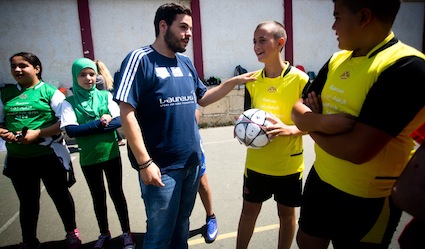
photo - Playing Fair, Leading Peace soccer match at a Jerusalem school
Playing Fair, Leading Peace soccer match at a Jerusalem school. (photo from Peres Center)

TPSS, started in 2002, is the first and longest-running initiative of its kind in the region. Hay-Sagiv said it “significantly influences Arab and Jewish, Israeli and Palestinian girls and boys to become agents of positive change in their community and around the world.”

The Peres Center sought a way to scale up this successful, but limited, peace-building-through-sports program in a more accessible and less expensive format that would also involve nonathletic children.

“Based on our experience, we thought it would be interesting to get into Jewish and Arab schools during school hours and engage full classrooms. This way, we can reach all the boys and girls, as well as their teachers,” said Hay-Sagiv. When the other children in the host school observe the mixed teams playing soccer together, “it’s unbelievable to see the reactions to this unusual sight. That also has an impact.”

Playing Fair, Leading Peace is supported by the Israel Football Association, which oversees Israel’s national football (soccer) team comprised of Jewish and Arab Israelis, and captained by Circassian-Israeli Muslim Bibras Natkho. The program also works with the National Union of Israeli Students (representing all Israeli universities) and the Laureus Sport for Good Foundation.

“Hopefully, next [school] year, we will double the number of participating schools,” said Hay-Sagiv.

She explained that fifth- to seventh-graders were chosen for the program “because we see this as a crucial age for exposing them to this type of experience. Verbally, they are well developed and they’re going into a tough age. You have enough time to work with them during school hours, and it’s still possible at this age to work with boys and girls together.”

Based on questionnaires distributed before and after the activity, Hay-Sagiv and her staff can see that the program effects changes in attitude.

“I want to feel with them exactly the way I feel with my friends,” wrote one child.

“I hope that we will become one family that does joint activities in togetherness and tolerance,” wrote another.

Hay-Sagiv isn’t surprised by this impact, having seen the inroads made over the years by Twinned Peace Sports Schools.

“We’re traveling to Poland to organize a sports tournament in Warsaw with Israelis, Poles, Germans, Hungarians and Russians to mark 80 years since World War II, hopefully in September,” she said. “We are thinking of bringing a mixed Jewish and Arab team from Israel.”

For more information, visit peres-center.org/en/the-organization/projects/sports/playing-fair.

Israel21c is a nonprofit educational foundation with a mission to focus media and public attention on the 21st-century Israel that exists beyond the conflict. For more, or to donate, visit israel21c.org.


Disagreeing respectfully

Left to right: Nico Slobinsky (CIJA Pacific Region), Rabbi Adam Stein (Beth Israel), Rabbi Andrew Rosenblatt (Schara Tzedeck), speakers J.J. Goldberg and Jonathan S. Tobin, Cynthia Ramsay (Jewish Independent), Rabbi Hannah Dresner (Or Shalom and RAV) and Rabbi Dan Moskovitz (Temple Sholom). (photo by Glen Bullard)

“We have lost the ability to listen to each other. We have lost the ability to credit each other with good intentions when we disagree…. What we must do is somehow regain a sense of community.”

In his response to the last audience question at Left vs. Right: The Battle for Israel’s Soul, Jonathan S. Tobin, editor-in-chief of JNS.org and a contributing writer for National Review, among other publications, went on to say what he hoped the audience would take away from his 90-minute debate with J.J. Goldberg, editor-at-large and senior commentator at the Jewish Daily Forward.

“You have to open yourself up to both sides,” said Tobin. “You have to relearn the ability to listen, to be open. If you agreed with J.J., maybe you should read some of the things that I write… If you agreed with me, read J.J. at the Forward and his column…. It’s not what we’re used to anymore because we live in these social media silos…. It’s what we have to model for our kids. It’s what we have to model for ourselves because, when we listen, when we open ourselves up to ideas that are different from our own, that don’t just confirm what we already thought, we are reminded of something that is always true but we often forget…. That which unites us is still stronger than that which divides us.”

Ten community organizations united to host the Oct. 23 event in the Wosk Auditorium at the Jewish Community Centre of Greater Vancouver: the Jewish Federation of Greater Vancouver, the Centre for Israel and Jewish Affairs, the JCCGV, the Jewish Independent, Ameinu, Or Shalom, Congregation Schara Tzedeck, Congregation Beth Israel, Temple Sholom and the Rabbinical Association of Vancouver (RAV).

In his response to the last question of the night – on how young people could have similar respectful dialogues on Israel, which the speakers broadened to include all community members – Goldberg stressed the importance of having self-doubt. “If you believe the other side is saying something that could bring about the end of the world, the death of the Jewish people, you’re not going to be tolerant. And, as Jonathan says, if you listen, look for the grain of truth, because then you can allow yourself not to shout and scream when you hear something you don’t like, because it’s not the end of the world.”

Rabbi Hannah Dresner, spiritual leader of Or Shalom and head of the RAV, welcomed the approximately 100 people who came to hear Goldberg and Tobin engage in a formal debate on four prepared questions, and then on a handful of questions from the audience. “Our guests hold differing points of view and speak to one another with respect and we would like all to follow their examples,” she said. While there was some audible discomfort from listeners in a couple of instances, it was a model event, made easier by the fact that it featured two journalists who may disagree on the details, but who both agree that Israel has a right to exist and that Israel has a right to defend itself. As well, neither speaker is an ardent supporter of U.S. President Donald Trump – although Tobin gave the president credit for moving the U.S. embassy to Jerusalem and reinstating sanctions against Iran to delay its attainment of nuclear weapons, he criticized Trump’s relationship with Russia. One has to separate Trump the man and his Twitter account from the policies the administration has implemented, said Tobin. “It’s clear,” he said, “that Israel can count on the United States, certainly it can count on this administration to have its back.”

Tobin made these comments in response to the first question of the night, which was about Trump and whether Israel could rely on an “unstable United States as a shield in an unstable Middle East.” Goldberg was more concerned than Tobin, saying that character counts. “Having a president who is lacking in elementary characteristics of personal ethics and grace is a problem,” he said. “It is a problem that this is a president who has no respect or loyalty for America’s allies; and says he’s in love with the dictator in North Korea, who, by the way, does have nuclear bombs; and who can’t say a bad word about the dictator of Russia…. If Canada can’t rely on the United States, and France and Germany and Sweden can’t rely on the United States, how long can Israel rely on the United States?”

Goldberg and Tobin also had opposing views as to the continued relevance of a two-state Israeli-Palestinian peace agreement and whether the construction of settlements is an obstacle to peace.

Goldberg pointed to the 2002 Arab League declaration, which outlined the terms under which they would recognize Israel and normalize relations with it; the declaration has been renewed since then and, last year, “Iran voted yes.” He said we believed the Arab countries when, in the 1970s, they were talking about “driving Israel into the sea,” and we should believe them now when they say they would accept Israel. He argued that peace negotiations have not failed but been continually interrupted, giving several examples, including the assassination of Yitzhak Rabin and Ehud Olmert’s having to step down as prime minister when he was indicted on corruption charges.

While a two-state solution is the most rational, said Tobin, he argued that Israelis have made several attempts at peace and have shown their willingness to trade land for peace, but they are rightfully not willing to trade land for terror, which is what Israel got after the withdrawal from Gaza.

On the question of how much world opinion should matter to Israel, both Tobin and Goldberg said it does. Tobin gave examples – such as diplomatic trips to Africa by Prime Minister Binyamin Netanyahu – of how Israel is not isolated, despite an increase in the world of antisemitism disguised as anti-Israel sentiment. The boycott, divestment and sanction (BDS) movement, he said, won’t hurt Israel, but us. “Their target is us – Jews, Jews here,” he said. “We are their target. That’s why resistance against BDS, fighting back against it is, I think, the issue that should unite us, if anything could. It’s not a liberal issue, it’s not a conservative issue, it’s a Jewish issue.”

Goldberg said Israel “pretty much controls events on the ground” – noting that cooperation between Israeli and Palestinian security forces has decreased the number of deaths caused by terrorism significantly – but that the Palestinians “have the advantage in international opinion: they’re the underdogs, they’re the Third World, they’re the people of colour” and they use this advantage “as a way of fighting back against Israel.”

That said, Goldberg contended that Islam aspires to rule the world and there are Muslims who believe that to the extent that they will use violence. However, he added, no matter how right Israel is to defend itself, the optics of a tank shooting at a kid throwing rocks can never “look good on television” and “antisemitism increases, in part, because people are mad at Israel.” Since Diaspora Jews are one with Israel, then they become a target: “An Arab who’s willing to blow up a bus full of children in Haifa, who had nothing to do with this, is certainly willing to blow up a Federation building in Seattle.” World opinion is a problem “because there’s a war going on and it hasn’t ended yet,” he said. “If and when Israel enters into negotiations with the Arab League … one of the things Israel can and must demand is that Saudi Arabia stop teaching the hatred of Jews that it teaches in schools and mosques around the world.”

In response to the question about how Jews should position themselves in “this polarized and hyper-partisan political culture,” Goldberg said, “If we are attached to Israel at a time when our traditional allies on the left, in the liberal world, are souring on Israel, we don’t have to accept that. If the right is becoming more extreme … there are reasons we have our social values and we don’t need to give them up to be friends with the pro-Israel forces on the right.”

Goldberg noted that we often consider antisemitism, but overlook the respect the world holds towards Jews – as evidenced by the number of Nobel Prize winners, and three Jews out of nine justices on the U.S. Supreme Court. He said we must use this respect “not only to advance our own particular interests in defending our brothers and sisters in Israel, but in also defending the things that we believe in and the things that we believe make a better world.”

Tobin, on the other hand, said, “As Jews, we have an issue that should unite us – the survival of the Jewish people, the survival of the Jewish state. That should be a priority. We are probably more divided on it than we are on abortion, as my friend [J.J.] likes to say, but that is still our first obligation. And when we put that aside and instead favour partisanship, our partisan loyalties over that, I think we’re doing a disservice to our community….”

By the end of the night, Goldberg and Tobin fielded nine questions, responding to audience members’ concerns about such issues as the health of Israel’s democracy – Tobin thinks it is not declining, while Goldberg observed that the way in which governments are elected means that a democratically elected government does not always reflect the will of the majority population. They also responded to questions about the lack of leadership on the Israeli left, the impact of the ultra-Orthodox on Israeli society in the long-term, Trump’s popularity in Israel and how we can enable young people to have such discussions as took place that night.

Experience range of emotion

Tzahi Grad, left, and Ala Dakka are great together in The Cousin. (photo from Shaxaf Haber/Venice Film Festival)

The 30th annual Vancouver Jewish Film Festival, which runs Nov. 7-Dec. 2, has an impressive lineup. Not only is there a wide range of quality films from which to choose, but the reach of the festival has widened, with screenings this year also taking place in West Vancouver and Port Moody. Here are just some of the great films you’ll be able to see.

Peace possible?

After Naftali, a successful Israeli actor-director, proudly shows his newly hired Palestinian worker, Fahed, the trailer for his latest creation – an internet series called One by One, which will bring Israelis and Palestinians together to talk and, eventually, Naftali believes, help bring about peace – Fahed’s response is, “Yes, it’s nice. It’s a little, um, a little naïve, isn’t it?” Begrudgingly, Naftali admits, “Totally, but not impossible.”

Maybe not impossible, but certainly beyond the scope of a web series, as Naftali soon finds out in The Cousin. When a ninth-grade girl is attacked in the neighbourhood, suspicion immediately falls on Fahed, who is arrested, then let out on bail – bail paid for by Naftali, who is pretty sure that Fahed is innocent. As the film progresses, Naftali’s beliefs are seriously challenged, both by his neighbours, who are champing at the bit to mete out their own justice on the not-proven-guilty Fahed, and by his wife, who wasn’t comfortable having a Palestinian worker in the first place. The pressure forces Naftali to confront his own latent racism, which arises rather quickly.

The acting in this film is excellent. Writer, director and star Tzahi Grad is convincing as the somewhat pompous but well-meaning Naftali and Ala Dakka is wonderful as Fahed, a compassionate, laidback, not-so-handy handyman who shows some promise as a rap musician. The supporting characters fulfil their roles believably. The oddball neighbours, who at first just seem to have been added for comic relief, become truly menacing, and Osnat Fishman as Naftali’s wife aptly portrays her transformation from merely nervous and annoyed to scared and angry.

The writing in the film is mainly good. The serious dialogue and action are compelling and there are humourous interjections that work to both lighten the material and shed light on it. However, there are other attempts at humour that are inconsistent with the overall mood and message. And the last three minutes of the film are completely bizarre, and really should have ended up on the cutting-room floor. But this should not stop you from seeing what otherwise is an entertaining, gripping and thought-provoking movie because, if nothing else, it’s such a bad ending that it’s almost good; at the least, it’s memorable, in a shake-your-head-in-wonder way.

The Cousin has three screenings: Nov. 10, 6:45 p.m., at Fifth Avenue Cinemas; Nov. 25, 2 p.m., at Kay Meek Studio Theatre (West Vancouver); and Nov. 26, 6:45 p.m., at Inlet Theatre (Port Moody).

– CR

A tragic thriller

photo - In Act of Defiance, Antoinette Louw, imbues Molly Fischer with backbone, wit and warmth to match her husband, Bram, played with verve and intelligence by Peter Paul Muller
In Act of Defiance, Antoinette Louw, imbues Molly Fischer with backbone, wit and warmth to match her husband, Bram, played with verve and intelligence by Peter Paul Muller. (still from Act of Defiance)

Bram Fischer is one of the great Jewish heroes of the 20th century, yet he is not widely remembered outside his native South Africa. The crackling moral thriller An Act of Defiance, which recreates the attorney’s gutsy exploits during the Rivonia Trial in the early 1960s, brilliantly revives his legacy.

From the outset, the film defines Fischer (played with verve and intelligence by Peter Paul Muller) less by his considerable legal skills and reputation than by the company he keeps: he is a strategist and ally of Nelson Mandela and the other leaders (several of them Jewish) covertly plotting against the apartheid regime. In fact, Fischer is supposed to be at the meeting where the police bust in and arrest the activists.

Free and available to represent the accused against charges of sabotage, Fischer is more than their defender and advocate: he’s an active member of the resistance whose actions – epitomized by a tense, protracted sequence in which he smuggles key documents out of a government building, inadvertently placing his family in danger – express his commitment and courage even more than his legal challenges and parries.

Fischer’s extracurricular activities have the effect of pushing An Act of Defiance out of the realm of courtroom drama and into a full-bore thriller. That said, the film never loses sight of the plight of the Rivonia defendants, who face death sentences if convicted.

Dutch director Jean van de Velde fills the cast with South African actors such as Antoinette Louw, who imbues Molly Fischer with backbone, wit and warmth to match her husband. Along with its other attributes, An Act of Defiance is a moving love story.

An Act of Defiance screens Nov. 11, 3:30 p.m., at Fifth Avenue.

– MF

Faith and family

photo - Emily Granin and Moshe Folkenflik share one of several touching moments in Redemption
Emily Granin and Moshe Folkenflik share one of several touching moments in Redemption. (still from Redemption)

Redemption, which is called Geula in Hebrew, after the main character’s daughter, is a powerful film, the emotional impact of which builds up imperceptibly, such that you may only find yourself teary-eyed awhile after it has ended, when all the feelings it evokes finally reach the surface.

Co-directors and co-writers Joseph Madmony and Boaz Yehonatan Yacov grab viewers’ attention right away, with a lyrically and musically edgy song accompanying us as we follow Menachem through the streets to the drugstore, where he gets his photo taken – even though his attempts at smiling fail – then pausing to have a smoke before returning to his apartment to relieve the babysitter. Within the first five minutes, we know he is an awkward, sad, kind and generous Orthodox Jew, as well as an attentive, caring and loving father.

Other aspects of his life come into focus as he reconnects with his former friends and band mates, including his reason for reuniting them. Menachem’s 6-year-old daughter, Geula, needs expensive cancer treatments if there’s a chance for her to survive the cancer that killed her mother. Menachem, who works at a supermarket, needs the money that the band could make from playing at weddings.

The renewal of the friendships involves the reopening of some old wounds, and the men’s paths to healing are stories well told, though the film is mainly about Menachem, who, we find out, broke with the group when he became religious 15 years earlier. Moshe Folkenflik plays the widower with nuance, humility and depth, and Emily Granin as his daughter, Geula, captures the strong will, intelligence, bravery and fear of this young girl, playing with subtlety what could have been a maudlin role.

Redemption will be screened twice: Nov. 12, 8:45 p.m., at Fifth Avenue and Nov. 29, 8:45 p.m., at Inlet Theatre. [It will also screen as part of the Victoria International Jewish Film Festival on nov. 4, 1:30 p.m., at the Vic Theatre. For tickets and information to the Victoria festival, visit vijff.ca.]

– CR

Smiles and belly laughs

photo - Nate Kroll, left, and Elliot Gould provide many laughs in Humor Me
Nate Kroll, left, and Elliot Gould provide many laughs in Humor Me. (still from Humor Me)

Sam Hoffman’s resoundingly funny debut feature, Humor Me, imagines a well-appointed New Jersey retirement community as the setting for mid-life rejuvenation and resurrection. Neatly avoiding or flipping every cliché about seniors (cute, crotchety or flirtatious), the adult son-aging father dynamic and the theatre, Humor Me is a warm-hearted, flawlessly executed fable.

When his wife takes their young son and leaves him for a billionaire, talented-but-blocked playwright Nate Kroll (New Zealand actor Jemaine Clement) has to move out of their Manhattan brownstone and into the guest bedroom at his dad’s town house at Cranberry Bog. Bob (a note-perfect turn by Elliot Gould) is an inveterate joke teller, but his repertoire doesn’t work on a 40-year-old failed artist.

“Life’s going to happen, son, whether you smile or not,” he declares, a philosophy that the audience can embrace more easily than Nate can. If it contains a bit of Jewish fatalism, well, that’s Gould’s voice. So Bob’s jokes, which are consistently risqué and constructed with an ironic twist, have a faint air of the Borscht Belt about them. (It’s not a coincidence that Hoffman produced and directed the web series Old Jews Telling Jokes.)

There’s not a single stupid character in Humor Me, including Nate’s bland, successful brother (Erich Bergen), and this generosity of spirit means we’re always laughing with Nate’s foils, not at them. It helps immeasurably that Hoffman (best known for producing the TV show Madame Secretary) assembled a veteran cast – Annie Potts as Bob’s girlfriend, Le Clanché du Rand as a flirtatious senior and Bebe Neuwirth as a theatre heavyweight – that nails every last punch line and reaction shot.

Humor Me plays out the way we hope and expect it will, which is to say it delivers on its implicit promises. En route, it provides lots of smiles and several belly laughs. Even Nate, who’s well aware that he’s earned every joke that he’s the butt of, gets his share of one-liners. There’s plenty to go around, you see.

Humor Me is at Fifth Avenue on Nov. 14, 1 p.m.

– MF

For the full Vancouver Jewish Film Festival schedule and tickets, visit vjff.org.

Michael Fox is a writer and film critic living in San Francisco.

Oslo Diaries: peace possible

Left to right: Yitzhak Rabin, Yasser Arafat and Shimon Peres after the three received the Nobel Peace Prize in Oslo in 1994. (photo by Saar Yaacov via VIFF)

It’s almost painful to be reminded of how close Israelis and Palestinians were to achieving peace 25 years ago with the Oslo Accords. Yet, Mor Loushy, co-director of The Oslo Diaries with partner Daniel Sivan, hopes that the documentary inspires audiences to believe that peace is possible. After all, the impossible almost happened in the 1990s, so why not in the future?

The Oslo Diaries screens as part of the Vancouver International Film Festival, which runs Sept. 27-Oct. 12. The film is based on the personal diaries of the Israeli and Palestinian negotiators in the initially secret peace talks that unofficially began in 1992 in Oslo, Norway, after the late-1991 Madrid Conference – at that time, it was illegal for the two sides to communicate. Those meetings, which eventually became public and official, led to the signing of the Oslo Accords in Washington, D.C., in 1993.

The narrative of The Oslo Diaries comprises archival footage, reenactments and interviews, including the last interview former prime minister and president of Israel, Shimon Peres – who was foreign minister during Oslo and a signatory of the accords – gave in his life. It takes viewers through an abridged version of the negotiations and offers insight into the leadership and compromise that was needed to reach an agreement.

That leadership and the prospects for peace took a literally fatal blow when Israeli prime minister Yitzhak Rabin was assassinated on Nov. 4, 1995. Binyamin Netanyahu, who, the documentary shows, was fierce in his opposition to the peace accords – passionately addressing rallies at which supporters held signs calling for Rabin’s death – was elected prime minister in 1996. The documentary ends with the start of his victory speech: “Dear supporters, friends, the state of Israel is embarking on a new path today.”

The Oslo Diaries is the third film Loushy and Sivan have worked on together; Censored Voices and Israel Ltd. being the other two. The couple is based in Santa Monica, Calif., for a year, after which they and their two children, ages 3 and 6, will return to Tel Aviv. Loushy was born and raised in Tel Aviv and Sivan, born in Haifa, moved to Tel Aviv when he was 18. The Jewish Independent spoke to Loushy by phone recently, in advance of her arrival in Vancouver to participate in VIFF.

While The Oslo Diaries does an admirable job of attempting to present the material without commentary, the filmmakers’ political perspective does come through, in particular with Netanyahu being depicted as the bad guy, so to speak.

“First of all, we never hide our opinion,” said Loushy. “We’re from the left-wing, or part of it. We stand behind our views and, if someone from the right-wing would have made that specific film, it would have been a completely different one. But, what ‘film’ is about, I don’t think that there is an objective film. Every cut that I make in the film, it’s a decision. But, I think that it’s really more important for us to keep it balanced, and we fought a lot about it, we had a lot of discussions about it.”

Given the reactions she has received, Loushy said, “I think that this film is completely not right- and left-wing – this is a film about peace. And I do feel, from the screenings around the world, that it’s past this boundary of camps, on the one hand. On the other hand, in Israel, the situation is difficult: we are divided, there are camps … and our government is the most right-wing government that we ever knew. Every day, there is a new anti-democratic law that passes, and it’s frightening.”

About making the documentary, she said, “We’ve hit such a rock bottom that someone needs to stop for a moment, and it’s part of my duty as a civilian and as a filmmaker to say, OK, let’s talk…. We’ve forgotten about Oslo, and most of the people don’t even know the story behind the code name ‘Oslo.’ Let’s talk for a moment, let’s really see what happened there and what really was there – not from the news or from secondary sources, but from the first sources, the people that were there. Listen for a moment. What exactly happened there? What went wrong?”

She said people have forgotten about the negotiations and that reminding people about them will help. “It gives hope for the future,” she said. “We were that close, we can do it again, it’s not impossible. You just have to stop for a moment and think, what kind of future do we want to leave our children? Do we want the same, as in the present, a future of wars … so many people that are being killed every day, that’s what we want for ourselves? Or do we need a reminder for a second of the place we could have gone to, for the places we can get to? We just need a strong leader that’s going to take us there. And I think that this film does an incredible job of putting this discourse again on the table because, in the past three or four rounds of elections, the word ‘peace’ … [and the prospect of] ‘negotiation’ is no longer on the table, and this is such a crazy thing.”

When asked how much blame she attributes to Netanyahu for the breakdown of the peace process, Loushy said, “It’s a very complex answer because it’s not one answer. I think that he had a lot to do with the peace breakdown but he was not the only one. The people voted for him and, when people voted for him, they knew what they were voting for – it was obvious he was not going to continue with the peace process. So, I think it was the people and I think that, yes, he had an essential part, saying, ‘I believe in the holy grail,’ [in Greater Israel]. This is his belief, and I think he succeeded in that,” she said, citing figures indicating that the number of settlers has quadrupled since 1993.

Loushy said Netanyahu has claimed that “the West Bank is just a part of Israel, and [he] wants more and more settlements, [so] that also the left-wing people right now are saying, OK, how can we resolve it? That there is an unresolved situation because of the settlers.”

Both fanaticism and fear are contributing to the situation, she said, “although I do believe that most of the people want peace, believe in peace, [and] are just too scared to give it a chance.

“And that’s where this film comes in, saying, listen: first of all, the whole Palestinian leadership was interviewed for this film. I was a guest in Ramallah in all of the high places in the Palestinian leadership – there is a partner. He [Palestinian Prime Minister Mahmoud Abbas (Abu Mazen), who was also one of the signatories of the Oslo Accords, for the Palestinian Liberation Organization] wants to talk to us. He wants a solution. I believe it in all of my heart that the Abu Mazen government wants peace.

“So, there is the Palestinian leadership that was interviewed for this film, and I do believe there is a chance, but that people are just too scared and [the film’s purpose is to help people] to remember exactly what happened.”

While the filmmakers interviewed several Israelis who were involved, they could not get access to Netanyahu. “We wanted to [interview him],” said Loushy, “but Netanyahu doesn’t give any interviews to the press…. You see Yitzhak Rabin – in all of the archives, Yitzhak Rabin is giving interviews every other day… [Netanyahu] is connecting through Twitter, and that’s it. He doesn’t give interviews to the press.”

The Oslo Diaries premièred at the Jerusalem Film Festival and there have been screenings all over Israel, said Loushy, who noted the diversity of audiences, which have included secular and observant Jews. “This is amazing,” she said, to have people from both sides sitting together in the theatre. “People want the discourse, want to talk about it again. Of course, every screening, [when there’s] someone shouting at me, I know I did my job…. I made somebody think about something he hasn’t thought [about] before.”

The Jewish Independent is VIFF’s media partner for the Vancouver screenings of The Oslo Diaries, which take place Sept. 28 and 29, and Oct. 12. The documentary is a Canadian co-production, co-produced by Ina Fichman (Intuitive Pictures); Radio-Canada is also listed as one of the film’s sponsors. All of the post-production was done in Montreal, said Loushy, “and we loved it.”

For the full VIFF schedule and tickets, visit viff.org.

Ayalon speaks at TWU

Danny Ayalon speaks at Trinity Western University on Aug. 30. (photo by Chloe Heuchert)

On Aug. 30, Danny Ayalon spoke at Trinity Western University. Ayalon, a former deputy foreign minister of Israel and former ambassador of Israel to the United States, is the founder of The Truth About Israel website. The event at Trinity was sponsored and co-organized by the TWU Alumni Association with Natalie Hilder, a former political aide at Parliament of Canada, who hosted and introduced the talk.

Ayalon’s presentation, Insights and Analysis of Israel and the Middle East, was thought-provoking. He described the outstanding issues and argued that peace could be attained if both sides would come together for a resolution. Throughout the interactive lecture, Ayalon mentioned Judaea and its importance in our modern day.

Ayalon has served as an advisor to three Israeli prime ministers: Binyamin Netanyahu, Ehud Barak and Ariel Sharon. In 2002, he was selected as Israel’s ambassador to the United States, a role he occupied until 2006, playing a significant part in the Road Map for Peace, a plan to resolve the Israeli-Palestinian conflict. He later became involved with Nefesh b’Nefesh, which facilitates aliyah by North American Jews, and then he joined the Yisrael Beiteinu political party, being elected as a member of the Knesset in 2009 and bein//g appointed as deputy foreign minister in Netanyahu’s government of the time; he wasn’t a candidate in the next election.

The lecture at TWU began with Ayalon explaining how Israel strives – and is obligated – to bring about peace. He spoke about the peace treaty with Egypt in 1979. President Anwar Sadat, he said, offered Israel an olive branch in 1977 by speaking at the Knesset to identify strategies for peace, which led to Israel’s decision to give up the Sinai Peninsula, an area almost three times the size of the state of Israel. Israel and Egypt have a mutual respect and fight together against Hamas and ISIS, said Ayalon.

Israel also made peace with Jordan, he said. The mid-1990s agreement gave Jordanians land and water and, today, the Israel-Jordan border is peaceful because the governments work together on certain matters, said Ayalon.

Not all peace discussions have gone according to plan, however, and Ayalon described the Oslo negotiations of the early 1990s and the 1993 agreement that was reached, but which was ultimately unsuccessful. The parties would meet again at Camp David in July 2000 and Ayalon was there. He shared some of his firsthand experiences from the discussions, recalling how Israeli prime minister Barak offered Palestinian Authority chairman Yasser Arafat Gaza and half of Jerusalem but to no avail. Ayalon also spoke about the unsuccessful attempt at peace that occurred in 2008 between prime minister Ehud Olmert and PA president Mahmoud Abbas. Again, he said, both sides could not come to an agreement even though Israel offered land.

Ayalon said the ways in which Israel strives for peace are not broadcast on the news, but are, instead, ignored in a way. The major headlines are about Israel’s alleged war crimes, he said, but this not the truth. Israelis fear for their lives every day, he said, because of the bomb attacks and other hostile actions of Hamas, who use their own people as human shields.

“There are 22 Arab countries and Israel is one state, and makes up only [a miniscule part] of the entire Middle East,” said Ayalon. “This is not a war about territory or natural resources but of elimination and extinction.”

When it comes to the United Nations, Israel is outnumbered. There are 193 member countries, with 120 voting against Israel, he said. While some of these countries are bowing to the pressure against Israel in order to keep themselves safe, Ayalon said the result is that many resolutions against Israel are made by the UN, so that Israel has little chance on the international front.

He went as far back as UN Resolution 181 in 1947, which called for the partition of Palestine into Jewish and Arabs states. The Arabs rejected the agreement and denied that Jews had any right to the land. To this day, Ayalon said, Palestinian schools use their curriculum to teach children that Israel is theirs. He said, in order for peace to become a real possibility, the truth must be established – curricula, media and the way in which children are brought up need to change before peace can be achieved.

Chloe Heuchert is a fifth-year history and political science student at Trinity Western University. She was involved in the early stages of the planning for the lecture.

Learning negotiation together

The Pathways program pairs Arab and Jewish high schools for two-day experiential workshops about interest-based negotiation skills. (photo by Emily Singer)

As politicians debate about how to bring peace to the Middle East, or if it’s even possible, a newly formed nonprofit organization is bringing together hundreds of Jewish and Arab children across Israel every year and teaching them how to get along.

The Pathways program, directed by Avi Goldstein and facilitated by Michael Schnall, pairs Arab and Jewish high schools for two-day experiential workshops about interest-based negotiation skills. The program, sponsored by the U.S. embassy and run in partnership with school networks and community organizations, is based in large part on concepts from the international bestselling book Getting to Yes: Negotiating Agreement Without Giving In by Roger Fisher, William Ury and Bruce Patton (Penguin Books, 2011) and on methodology developed at the Program on Negotiation at Harvard Law School. Thanks to the initiative of the Darca network, the school where I teach, Shaked Darca on Kibbutz Sde Eliyahu, has had the tremendous privilege of participating in Pathways for the past two years.

The Pathways program combines a few goals, the most important of which would be difficult to say. Last year, when we received the invitation to apply to participate, I saw it as an exciting opportunity to expose my students to two intensive days of study and conversation in English. The entire program is in English, and this is a natural common language for communication among the Jewish and Arab students. But the program exposes the students to so much more.

With rich and varied activities, the students learn English as the international language of negotiation, conflict resolution and peace. They develop many new skills with one central message – in order to “win,” you don’t need for someone else to “lose.” When you listen to others and you are curious about their needs, instead of reaching a compromise, you can often reach agreements in which both sides walk away with a feeling of success.

And all of this takes place in a setting in which students have the opportunity to meet kids from a very different population and culture. Or maybe not so different.

The program opens with an activity designed to foster cooperation among the students, while emphasizing what they share. They are divided into mixed groups and given the task to build a paper chain made up of things everyone in the group has in common. Sound simple? Now try it with one hand behind your back. Literally. The students need to talk and plan together, and also to write, cut and paste, all with lots of cooperation, creativity, and even laughter.

Throughout the program, the kids are given situations in which they have to negotiate with each other. For example, a kid lends his friend his iPod. The next day, after the iPod is returned, he discovers that it doesn’t work and he wants his friend to buy him a new one. This is his “position.” But, before he goes into negotiation with his friend, he has to weigh a number of important issues. What does he think his friend is going to claim? Might there be any truth to it? How valuable is his friendship with this person? What is most important to him, and on what is he prepared to compromise?

There is a lot of discussion over the two days about “positions” versus “interests.” If each side comes to the table after serious consideration of what is really important to him or her (their “interests”) and curiosity about what the other party wants and needs, this leaves open the possibility for empathy as well as creative, outside-the-box thinking, and then the sky’s the limit.

The students are exposed to a wide variety of situations that must be negotiated, but none of them addresses the political conflict in which they live. They are able to make connections and compare shared values with students whom they might never otherwise meet, in a setting where the “sides” are mixed up, so they are not negotiating as Jews and Arabs, but rather “Table 1” against “Table 6,” “parent” versus “child,” or friend and friend.

The first day concludes with two powerful exercises. In one, the students are asked to divide into pairs, lock arms and “try to bring their partner’s arm down to the table as many times as possible.” The students proceed to arm wrestle. Mike, the program facilitator, asks why the students felt a need to struggle with their partner. “Did anyone notice that with cooperation, both players could arrive at much higher results?”

The final activity of Day 1 is an improvisational role play of a negotiation between a father and child. The child wants to go to a party and to come home late. Mike is the stubborn father who says, “By 10:30.” The part of the kid is played by students, who take turns volunteering. It begins with a classic negotiation of compromises. Midnight? No, 10:40. How about 11:30? No, 10:45. Whatever the outcome, someone will walk away disappointed. Until one student finally goes up to the stage and asks the Pathways magic word, “Why?” After a real conversation about interests, the boy understands that his father is worried about safety on the roads at night, and he’s feeling too tired to stay awake until his son arrives home safely. So, the boy suggests he stay overnight at his friend’s house and return home in the morning. Dad agrees. Everyone “wins” and walks away happy.

The second day begins similar to the first. After another ice-breaker, volunteers are invited to participate in a game. The kids are divided into two teams. There is a long rope, and each side has to pull the middle of the rope over the red line on their side as many times as possible. Rida, my Arab partner teacher, and I stand there watching in disbelief as the two sides struggle with all their might to “win.” Do they not remember the arm wrestling from the day before? Why are they not working together? But we learned from this and from many other activities that these skills are like muscles. Our habits and assumptions need to be understood and new skills need to be developed and exercised often. The good news is that they are relevant in every aspect of our lives – whether with friends, colleagues, family or business partners – so there is no shortage of opportunities to practise.

By the end of the second day, the students leave with a new language of negotiation – positions versus interests, options versus alternatives, communication, legitimacy, obligation and, of course, everything in English. They also leave thinking a bit differently about “the other,” with some students exchanging emails and telephone numbers.

Unfortunately, after the two days, the program ends and the students remain 45 minutes away, but worlds apart. This year, Pathways has begun new initiatives to build on the program for the future. To this end, I participated in Pathways’ Negotiation Education Teachers Fellowship, funded by the U.S. embassy, designed to bring together a community of teachers to integrate the learning of problem-solving negotiation skills into the English-language curriculum. We are also looking for ways to continue bringing the students together.

I feel incredibly blessed to be a part of the Pathways program and the rich community of Arab and Jewish English teachers in Israel who devote their lives to making the world a better place through education. I’m deeply grateful to the Darca network and to my school, Shaked Darca, for their support and their ongoing desire for innovation and alternative education. I also appreciate the contribution of the U.S. embassy, and Mike and Avi, who created Pathways and continue to keep it going, always thinking how the program can be improved and expanded. Most importantly, I am thankful to our fabulous students, mine and my partner teacher Rida’s, without whose open minds, open hearts and willingness to try new things and to dare to speak in English for two straight days, none of this would be possible.

Our children are truly our future. The more they know the language – and tools – of communication, cooperation and peace, the better our world will be. For more information on Pathways Institute for Negotiation Education, see pathwaysnegotiation.org.

Emily Singer is an English teacher and coordinator at Shaked Darca School on Kibbutz Sde Eliyahu in Israel. Singer taught at Vancouver Talmud Torah and her husband, Ross, was rabbi of Vancouver’s Shaarey Tefilah congregation until 2004.

A once in 30-year occurrence

Take a seasoned children’s book author like New York-based Jane Breskin Zalben – who has created more than 50 children’s books and is an abstract painter – and pair her with Mehrdohkt Amini, an illustrator of children’s books who lives in the United Kingdom, and the result is a charming book about interfaith friendship for 3-to-7-year-olds – and older readers.

In A Moon for Moe and Mo (Charlesbridge Publishing, 2018), Moses Feldman and Mohammed Hassan meet in a Flatbush, Brooklyn, grocery store, where the storeowner mistakenly takes them for twins since they both have curly dark hair, brown eyes and olive skin. They are shopping with their mothers for their up-and-coming holidays, with Rosh Hashanah, the Jewish New Year, and Ramadan, the Muslim holy month of daylong fasts that marks the giving of the Qur’an to Muhammad, overlapping – something that happens only once every 30 years or so.

The two boys become friends, including going on a picnic, which brings their families together. That same evening in their homes, both boys see the first sliver of the new moon.

In an interview, Breskin Zalben said she was shopping with her granddaughter in a store in Brooklyn when she met an Arab mother with her child and the two children began to interact.

“After being invited to speak at many international schools, in counties where I visited mosques and old synagogues, doing this book was a natural outgrowth of those broadening journeys to other cultures,” she said.

Although Breskin Zalben was art director at Scriber Publishers and illustrated most of her other books, she knew that Amini was from Iran, saw her portfolio and wanted her to do the illustrations for this book. Amini has created beautiful acrylic, marker, ink and photo-collage artwork, which was then assembled digitally.

In the back of the book is information about Rosh Hashanah and Ramadan, notes from the author and illustrator and two recipes.

Said Breskin Zalben, “I am excited to share the diversity and the similarity of Moe and Mo…. I hope maybe this book, in any book’s small way, finds an audience. It was six years in the making and so much hard work and passion goes into every book.”

This is a very special book for children and their parents to read at Rosh Hashanah.

Sybil Kaplan is a journalist, lecturer, book reviewer and food writer in Jerusalem. She created and leads the weekly English-language Shuk Walks in Machane Yehuda, she has compiled and edited nine kosher cookbooks, and is the author of Witness to History: Ten Years as a Woman Journalist in Israel.

Violence not solution

Last week, thousands were on the streets of Tehran for Al-Quds Day events, which consist of calling for the annihilation of Israel. Parallel events were held in other cities, including London, England, where Hezbollah flags flew amid posters bearing modern blood libels, and in Toronto, where a speaker called for the “eradication” of Israelis and Zionists.

Also difficult to ignore are the realities of the incendiary kites being sent over the border from Gaza affixed with flaming tails or petrol bombs. Some international observers have dismissed the incidents, contrasting the Gazans’ unsophisticated arsenal with Israel’s contingent of fighter jets and advanced weaponry. But Israeli firefighters report that 741 acres of forest and 4,500 acres of agricultural land have burned in the past two months thanks to at least 285 individual kite and helium balloon attacks. An estimated 500 kites have been intercepted before they could do damage. Experts say return of flora and fauna in affected areas will take years.

The ongoing hostilities at and near the Gaza border are the latest in the ongoing conflict that keeps the world’s attention focused on the region.

That attention turned to the world of soccer recently. A planned game between the Israeli and Argentine national teams was cancelled after pressure from the movement to boycott, divest from and sanction Israel (BDS).

On social media, the BDS movement profusely thanked the Argentine team for cancelling the match. But the president of the team acknowledged it was not political considerations, but safety concerns, that led to the cancellation. The team – and specifically its megastar Lionel Messi – received threats of violence. As well, at the team’s practice facility in Barcelona, protesters waved Argentine soccer jerseys daubed with fake blood, and it wasn’t clear whether the blood was meant to symbolize Palestinians who have died or Argentine soccer players who might have been harmed if the game had been held as planned and the threats been realized.

There has been a shift from peaceful protest – that was the phrase repeatedly invoked about the conflagrations at the Gaza border – toward overtly violent rhetoric, threats and actions by Israel’s adversaries, who are both literally and figuratively “playing with fire.”

Nonviolent pressure, which is what BDS has claimed to advocate, is a tactic that could, one never knows, lead to some peaceful resolutions. But destroying farmland, endangering children, threatening people with harm and inciting genocide will only lead to more violence.

Business of building peace

Barbara Stegemann’s 7 Virtues perfumes help farmers in war- or weather-torn countries rebuild. (photo from Barbara Stegemann)

Barbara Stegemann (née Rabinovitch) was born and raised in an Anglophone neighbourhood in Montreal. While her Catholic mother disallowed any practise of Judaism, Stegemann recalled having begged her zaida to take her to synagogue to meet the rabbi.

“My soul felt very Jewish,” Stegemann told the Independent. “As Ben Stiller says, ‘When I look in the mirror, I see a Jew.’ That’s how I feel. My 23andME report came back and said I am 47.7% Ashkenazi Jew – so, science even accepts it.

“Interestingly, this genetic DNA test does not tell you if you’re Christian, Catholic or Muslim, but your DNA tells you that you are Jewish. For me, that is how powerful the connection is to being Jewish. It’s undeniably in our DNA.”

After earning a degree in journalism in 2006, Stegemann moved to British Columbia and settled in Port Moody, where she started a boutique PR firm, providing community economic development and strategy to clients from the City of Coquitlam to Mitacs, which designs and delivers research and training programs.

Then, something happened that shook Stegemann to the core. Her best friend from university and mentor, Capt. Trevor Greene, took off his helmet in a village in Afghanistan during a discussion about the need for clean drinking water and healthcare for the residents. A man attacked Greene, taking an axe to his head.

“We didn’t think he would make it through the night,” said Stegemann. “I prayed harder that night than I have ever prayed in my life. He made it through the night and, together with his fiancée, Debbie, and family, we all went on a healing journey. Since then, he married Debbie and they now have two children, Grace and Noah.

“I was blessed that I had my own company, so I could visit him in the Vancouver General three times a week. I lived in Port Moody, so it was not far. And, in the hospital, I promised him I would take on his mission of peace while he healed. Then, I realized, as a female in this patriarchy, I didn’t have a way to touch peace.”

Stegemann knew that, if women could find a way to harness their power – their buying and voting power – they had a chance to end war and corruption, two roots of poverty and suffering. With this in mind, she wrote the book The 7 Virtues of a Philosopher Queen: A Woman’s Guide to Living & Leading in an Illogical World, which was published on International Women’s Day (March 8) in 2008. A bestseller, it will see its seventh edition this year.

“I took all of the stoic wisdom of Socrates and Aurelius, the great leaders who guided [Winston] Churchill and the leaders who had to guide us out of hell,” said Stegemann. “I realized that our mothers didn’t talk to us about Adam Smith, capitalism, Plato and the polis … and that, if we, as women, were to take our rightful places changing policy and leading to an end of the cycles of war and poverty … we needed to have that same wisdom men have been given for 2,400 years.

“I used to walk around as a child with my Bible story records and play them for anyone who’d listen. My favourite story was The Wisdom of Solomon. I became entranced by the virtues and how they could change your life through their daily practice – wonder instead of judgment (which gives you all the resources you need on this earth), balance, truth, courage, justice, wisdom and beauty.”

One day, while Stegemann was studying about Afghanistan, she read about Abdullah Arsala in Afghanistan and about how Arsala was growing legal rose and orange blossom crops to liberate the farmers from growing illegal poppy crops.

She learned that the same people who had attacked her friend, Greene, were knocking over Arsala’s distillery, which made his flowers into essential oils for use in perfumes.

“I decided, that is it! I am going,” said Stegemann. “I flew to Ottawa and met with CIDA (Canadian International Development Agency) and told them to help me find Abdullah. I bought what little orange blossom oil he had on my Visa and launched The 7 Virtues [perfumes] in 2010, on International Women’s Day.

“Two weeks later, we were on the front page of the Globe and Mail. And, eight weeks later, I was on Dragons’ Den, pitching to venture capitalists. By then, I’d moved back home to my province of Nova Scotia and became the first woman from Atlantic Canada to land a venture capital deal on the popular CBC show.”

Stegemann helps farmers transition into growing legal crops, and make twice as much profit as they did growing poppies. According to Stegemann, when a farmer in Afghanistan grows legal crops for her perfumes, “His daughters are safe from being taken by the Taliban opium traders if the poppy crop fails. There is less heroin that ends up on the streets, destroying lives. And, when a farmer grows legal crops, he is honouring his faith. It goes against Islamic law to grow the illegal poppy crop.”

By helping the farmers, Stegemann believes she is helping bring peace. “It may not be my faith, but the truest way to peace is to honour one another and our beliefs,” said Stegemann. “The Taliban are completely going against their faith, forcing their neighbours to grow the illegal poppy crop. So, we must help one another.

“Our legal essential oil purchases in Afghanistan began this peace journey by liberating farmers from the illegal poppy trade and all of the abuses they and their families endure at the hands of the Taliban.

“Then, countries rebuilding after war or strife began coming to us, asking us to purchase from their distilleries to further build peace in nations rebuilding. The next country was Haiti. We began sourcing their vetiver oil.”

Stegemann travels often to Haiti to volunteer. On a trip after Hurricane Matthew hit, she was devastated to learn of a boatload of aid being turned away from the south, where not a mango stick stood and people had no shelter, as a result of the hurricane. The local official had asked for a bribe so large that the aid workers on the ship could not pay it.

“Haiti is the 10th most corrupt country in the world,” said Stegemann. “We have to engage our world leaders to end the culture of corruption in Haiti, in Afghanistan, and other nations that can’t take care of their people because their leaders are corrupt and don’t pay their police fair wages.

“There are many steps that have to be taken, but sourcing from a nation, spending time there and getting to know the issues, allows us to not only purchase fair trade products that give people dignity and jobs … but I can then write articles and be a voice as a trained journalist and activist to push our government to expect more from these countries.”

Stegemann believes social enterprise is a key way to build peace. She also believes that these cycles of war and poverty will remain if we expect our military and government to do the heavy lifting. According to Stegemann, we need a cavalry of businesses to come and buy saffron, pomegranates, essential oils or any other ethically sourced product, and this will help build peace.

It wasn’t until Stegemann moderated a panel discussion on the Middle East at a German Marshall Fund of the United States-hosted forum in Halifax that she realized the potential. On the panel were then-deputy minister of defence for Israel Matan Vilna’i and the minister of housing for the Palestinian Authority Dr. Mohammad Shtayyeh – and everyone got along.

“I feel strongly that destruction takes no imagination, no creativity, no intelligence, and it is actually boring,” said Stegemann. “I am not going to give my energy to it. Now, rebuilding, that is exciting! My real job is to make building more exciting than destruction.

“I do this through perfume. I decided to make a perfume of harmony from the Middle East. I sourced sweetie grapefruit from the Sharon region of Israel, with the help of ambassador [Miriam] Ziv. And we tried to get oils from the Palestinian region but could not.

“When I learned of Israeli Ronny Edry’s ‘We Love you Iran’ campaign, I decided to put Israel and Iran together with lime and basil essential oils from the Shiraz region of Iran. In our classic collection at the Hudson’s Bay stores, it is called Middle East Peace. It’s our bestselling fragrance and sells out quite often.”

In their new contemporary collection, launching at Sephora this month, they have a fragrance with the same oils, named after the oils – Grapefruit Lime – and the story is on the packaging, as is information about the oils’ healing properties.

On Stegemann’s most recent volunteering trip to Haiti (after Hurricane Matthew), she learned of the Sephora Accelerate program for female founders in the beauty business. As fewer than four percent of beauty company chief executive officers are women, Sephora decided to mentor, empower and create a network for these women.

“I felt so alone before,” said Stegemann. “I never had other female social entrepreneurs to share knowledge and suppliers with, and to bounce ideas off of. I wanted the program so badly that, when I first met with my Sephora buyers, I asked about this program. They immediately connected me with the women in San Francisco who run the program. They wanted the trailer to our doc film, Perfume War (perfumewar.com), and said they loved it. So, I got in. I was mentored by the director of Sephora Canada, Will Chung. They gave me the confidence to stretch out of my comfort zone and hire a branding agency.”

Going with Sephora was a hard decision for Stegemann, as that meant she had to leave the small boutiques she had built. But she was determined to stick with her mission of helping as many farmers as she could, and going big was the only way to do that.

The 7 Virtues perfumes can be found at Sephora online (sephora.com) and in stores, including the Robson, Park Royal and Richmond stores in Metro Vancouver.

Rebeca Kuropatwa is a Winnipeg freelance writer.

Volumes in the silence

Jewish Voice for Peace held a discussion on antisemitism recently at the New School in New York City and the panel included Linda Sarsour, whose associations and opinions, particularly about Israel and Jews, are controversial.

The school defended its choice by saying that there are “differing views on the issue of antisemitism,” a Trumpian formulation on par with the idea that there are good people on both sides of every issue.

Sarsour, a daughter of Palestinian-American immigrants, rose to national prominence as a co-chair of the Women’s March earlier this year and was dubbed by Politico as “the face of the resistance” to Donald Trump.

She is also highly controversial. When she got into a public spat with ex-Muslims Ayaan Hirsi Ali and Brigitte Gabriel, Sarsour tweeted, “I wish I could take their vaginas away – they don’t deserve to be women.” (Hirsi Ali was subjected to female genital mutilation at the age of 5 in her native Somalia.)

Sarsour is particularly opinionated about Israel. She claims that Israel has a right to exist, but does so in the context of a “one-state solution” that would eliminate Israel’s Jewish identity. She supports the boycott, divestment and sanction movement and has defended sharing a stage with Rasmea Odeh, a terrorist involved in murdering two Israelis and wounding nine others. She has tweeted that “nothing is creepier than Zionism” (nothing?!) and said it is not possible to be a Zionist and a feminist.

So it was a point of contention when Sarsour was invited to join a panel on the subject of antisemitism. Yet Sarsour has something to say that everyone should listen to closely.

She says that antisemitism is “different than anti-black racism or Islamophobia because it’s not systemic.” As one commentator noted, what was more “systemic” than the Holocaust? But Sarsour was making a legitimate case: Jews in 21st-century North America do not suffer systemic economic disadvantage due to their Jewishness. Jews are no longer precluded from housing, universities or any place in the public realm because of their identity. Jews are not randomly pulled over and shot by police. Jews do not experience lower wages or lesser positions of employment because of their identity.

Antisemitism isn’t routinely expressed in the same ways as most other common forms of prejudice and discrimination. However, this doesn’t mean it doesn’t exist or should be dismissed.

Whether left, right or centre, most of us now accept an economic definition of discrimination: lower standards of housing, employment, opportunity and outcome. But antisemitism doesn’t manifest in these ways. However, it can manifest in hate speech, attacks on synagogues and other Jewish institutions, and physical assault. It can lead to genocide, as it has within the memory of the living generation. It can result in the ethnic cleansing of Jews from almost every Muslim-majority country on earth over the course of a couple of decades.

So, antisemitism is not a benign force, even if it does not fit the parameters we now widely use to identify and measure discrimination. In fact, it is, in itself, a form of discrimination to ignore the uniqueness of antisemitism.

Antisemitism can also take the form of a movement to eradicate the national homeland of the Jewish people. There are reasons to criticize Israel, but to argue that Jewish people are the only people in the world not deserving of national self-determination is problematic.

At the heart of the anti-Zionist movement is an imagined firewall between antisemitism and even the most extreme condemnation of Israel, including calls for it to be eliminated. It is fair to make the case that criticism of Israel is not necessarily influenced by anti-Jewish animus. But this is not the case being made by people like Sarsour. Their position is that there is effectively no connection at all between anti-Zionism and antisemitism and that any suggestion of a connection is a strategy to “silence” or discredit criticism of Israel.

The idea that opinions, stereotypes or prejudices about Jews play no role in perceptions of the Jewish state is unreasonable. If there is anything that should cause skepticism toward Sarsour and those like her, it is the stalwart refusal to even consider the presence in their worldview of prejudice about Jews. If any other group of people in the world so much as suggested that they were affected by bigotry or discrimination, people like Sarsour would take these concerns seriously. When Jews make this suggestion, it is rejected outright and labeled a ploy to win a political argument. This, in itself, speaks volumes.