Skip to content
  • Home
  • Subscribe / donate
  • Events calendar
  • News
    • Local
    • National
    • Israel
    • World
    • עניין בחדשות
      A roundup of news in Canada and further afield, in Hebrew.
  • Opinion
    • From the JI
    • Op-Ed
  • Arts & Culture
    • Performing Arts
    • Music
    • Books
    • Visual Arts
    • TV & Film
  • Life
    • Celebrating the Holidays
    • Travel
    • The Daily Snooze
      Cartoons by Jacob Samuel
    • Mystery Photo
      Help the JI and JMABC fill in the gaps in our archives.
  • Community Links
    • Organizations, Etc.
    • Other News Sources & Blogs
    • Business Directory
  • FAQ
  • JI Chai Celebration
  • JI@88! video

Recent Posts

  • Sharing her testimony
  • Fall fight takes leap forward
  • The balancing of rights
  • Multiple Tony n’ Tina roles
  • Stories of trauma, resilience
  • Celebrate our culture
  • A responsibility to help
  • What wellness means at JCC
  • Together in mourning
  • Downhill after Trump?
  • Birth control even easier now
  • Eco-Sisters mentorship
  • Unexpected discoveries
  • Study’s results hopeful
  • Bad behaviour affects us all
  • Thankful for the police
  • UBC needs a wake-up call
  • Recalling a shining star
  • Sleep well …
  • BGU fosters startup culture
  • Photography and glass
  • Is it the end of an era?
  • Taking life a step at a time
  • Nakba exhibit biased
  • Film festival starts next week
  • Musical with heart and soul
  • Rabbi marks 13 years
  • Keeper of VTT’s history
  • Gala fêtes Infeld’s 20th
  • Building JWest together
  • Challah Mom comes to Vancouver
  • What to do about media bias
  • Education offers hope
  • Remembrance – a moral act
  • What makes us human
  • המלחמות של נתניהו וטראמפ

Archives

Follow @JewishIndie
image - The CJN - Visit Us Banner - 300x600 - 101625

Tag: Judaism

Beacon of light in heart of city

Beacon of light in heart of city

The lighting of the Silber Family Agam Menorah in the Vancouver Art Gallery Plaza is an annual tradition. This year, the first candle will be lit on Dec. 14. (photo from Lubavitch BC)

The lighting of the Silber Family Agam Menorah in the Vancouver Art Gallery Plaza is an annual tradition. This year, the first candle will be lit on Dec. 14.

As the first night of Hanukkah approaches, the Vancouver Art  Gallery Plaza will once again welcome the annual lighting of the Silber Family Agam Menorah. Rising at the corner of Georgia and Hornby streets, this work of public art has become an enduring symbol of Jewish pride, resilience and unity for more than three decades.

photo - Silber Family Agam Menorah
(photo from Lubavitch BC)

Designed and built in 1991 by internationally renowned Israeli artist and sculptor Yaacov Agam, the menorah was commissioned by Fred Silber and the Silber family for Chabad Lubavitch of British Columbia. More than a sculpture, it was envisioned as a joyful and unapologetic statement of Jewish presence in the centre of downtown Vancouver. Since its debut, the menorah has returned each year with ceremony and celebration, illuminating the city skyline with its vibrancy and timeless message: that even in the darkest seasons, the light of Jewish identity continues to shine.

What began as a family’s dedication has grown into one of the largest annual Jewish gatherings in the province. Each year, hundreds of community members, friends, supporters and neighbours bundle up and fill the plaza for the first lighting of Hanukkah. Children clutch chocolate gelt and jelly donuts, elders share stories of holidays past, and young families, students and professionals gather to feel connected and uplifted.

Distinguished guests from across the civic and political landscape will join the festivities Dec. 14, reflecting the wide recognition the Agam Menorah lighting has earned as a Vancouver tradition. Member of Parliament Wade Grant will attend on behalf of the Canadian government and MP Melissa Lantsman will represent the official opposition. Their presence underscores not only the event’s Jewish significance, but also its role as a valued civic moment celebrating inclusiveness and the strength of community bonds.

“Each candle we kindle is more than a flame – it’s a statement of Jewish pride and a reminder that light, unity and hope will always overcome darkness,” said Rabbi Dovid Rosenfeld, director of Chabad Lubavitch BC. “This menorah has become part of Vancouver’s identity, and this celebration brings our entire community together in a beautiful and powerful way.”

The evening will feature traditions that light up the plaza each year: chocolate gelt, donuts, music, dancing, and greetings exchanged among old friends and new faces. 

The message of the Silber Family Agam Menorah is as relevant today as it was 30 years ago. In a world often challenged by uncertainty, its light stands as a reminder of the enduring spirit of the Jewish people and the importance of gathering publicly, proudly and joyfully.

As the candles are kindled once more, the entire community is invited to join in this Vancouver tradition. The gathering on Dec. 14 starts at 3:30 p.m. For more about Chabad Lubavitch of British Columbia’s holiday events, lightings and activities, go to lubavitchbc.com.

– Courtesy Lubavitch BC

Format ImagePosted on December 5, 2025December 4, 2025Author Lubavitch BCCategories UncategorizedTags Chabad, Hanukkah, Judaism, Lubavitch, menorah lighting, Silber Family Agam Menorah, Vancouver Art Gallery
An emotional reunion

An emotional reunion

Randy Wolfe, left, with Aharon Botzer, co-founder of Livnot U’Lehibanot. (photo from Livnot U’Lehibanot)

Reuven (Randy) Wolfe of Winnipeg recently returned to Tzfat, Israel, to reconnect with the founders of Livnot U’Lehibanot and with the place where his Jewish journey began.

Wolfe first arrived in Tzfat in 1981, as a young participant in Livnot’s third-ever program. Now, 44 years later, he and his wife, Beverly Werbuk, walked once again through the same stone alleyways, into the same historic buildings and back into the same spirit that once transformed Wolfe’s life.

“I remember everything,” he shared. “The formula still works: no show, no pretending, just truth, action, open hearts and good people.”

Since that formative experience, Wolfe has built a full life in Canada – family, community and career – yet the spark that was lit in Tzfat has never faded.

“Coming back to Livnot,” he said, “felt like coming home.”

For more than four decades, Livnot U’Lehibanot, founded by Aharon and Miriam Botzer, has guided thousands of young Jews from around the world to connect with their roots through hands-on volunteering, learning and community, including the rebuilding of homes along Israel’s borders.

“The walls may have changed,” Reuven smiled, “but the spirit – that same spirit – is still alive. It continues to build the Jewish people, in Israel and throughout the diaspora.” 

– Courtesy Livnot U’Lehibanot

Format ImagePosted on December 5, 2025December 4, 2025Author Livnot U’LehibanotCategories Israel, NationalTags Israel, Judaism, Livnot U’Lehibanot, Randy Wolfe

Give yourself the gift of love

A friend shared her plans for a “great” day off. This included a deep dive into her refrigerator to clean things out. This household task is necessary. Food safety is important, but that doesn’t make it fun. When the kitchen is completely clean and there’s nothing growing where it shouldn’t, it’s a relief. I also feel much better after a big clean up, even when it’s an effort.

I’m studying the Babylonian Talmud Tractate Zevachim, which is about how sacrifices must be done in the Temple, including what is prohibited. It’s mostly an intellectual exercise. The rabbis discussing this all lived after the destruction of the Second Temple. They were ironing out the minutiae, even when the whole sacrifice infrastructure no longer existed. Some see this debate as a grand effort of the imagination. Others read it to witness ancient legal debate in action. Many ask what we draw from these rabbinic texts today.

Since I’m a mom with twin teenage boys who eat a lot, I think about it practically. The concept of piggul pops up often. This is a disqualified offering, a sacrifice that cannot be accepted because the priest’s plan is to eat the sacrifice after the correct time for doing so. In modern terms, imagine purchasing food for a family gathering with deep spiritual meaning, but intending to wait to cook and serve it after its “best before” date. “Here, beloved relatives, please have this expensive roast that I chose to spoil before cooking!” It feels like a rabbinic prohibition that says: “It’s disqualified and forbidden to make a holy sacrifice this way because it’s wrong to give people food poisoning.” It’s bad housekeeping.

This food poisoning reference is meant in jest! Yet, sometimes we forget to be grateful and celebrate the amazing foods and gatherings that our families and friends offer us. One of my teens is taking a food and nutrition elective at school. This wasn’t a class he rushed to sign up for but he’s learning a lot. When he missed classes due to a field trip, he cooked at home instead. This kid likes to be our salad chef, but now he’s learning to make muffins, cakes and pancakes. He’s suddenly aware of how much goes into making meals. He now feels bad when he sees that I’ve produced (yet another) dinner without help, or when his dad stays up late frying eggs or making pancakes for breakfast the next morning. We don’t want our kid to feel bad. It’s both our duty and gift to our kids to feed them well, but I’m thrilled that he’s learning what goes into this labour so he can contribute, too.

I’m a “maker.” I find meaning in making things by hand, whether it’s sewing clothing, spinning yarn and knitting sweaters, or baking bread. The calm and focus I feel while making things is one of my life pleasures. Still, the drudgery of producing endless meals or sewing 10 pairs of pyjama pants for fast-growing twins can seem less pleasurable. 

Since I have high standards for how things are made, my household often claims it is hard to buy gifts for me … so they don’t. (Note: I give them lists, I point out things I admire by other artisans and even voice when something is too expensive!) This past week, I gave myself a gift instead.

First, I came up with easy meals. I arranged grocery pick up so that the rest of the household could do it and then put the items away. Next, I lined up several necessary, but enjoyable, making activities that I wanted to do when I didn’t have work deadlines. As the week unfurled, I spent hours at the sewing machine and hand-sewing. I knitted and read. I took long dog walks. I relished wearing new flannel PJs that I’d just made myself and using new dishtowels I’d sewn. I even sewed a new, natural-fibre oven mitt rather than shop for a subpar one. 

On Friday, I scheduled a walk by myself to two well-regarded artisan markets. I didn’t buy much. I came home with a new pottery service piece (for family food production), an industrial sweater pin made by Cloverdale Forge, a blacksmith, and a lot of inspiration for future creativity.

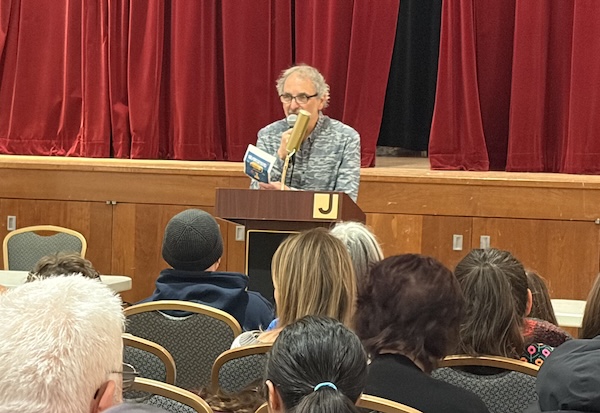
My weekend was also a big present. Our incredible cantor, Leslie Emery, was formally installed at Congregation Shaarey Zedek, though she has worked in our community for many years. My children and I chanted Torah at her installation Shabbat service. We heard amazing music at a Saturday night concert. We celebrated our cantor as a community. It was full of love.

The congregational installation guest was Elana Arian, an accomplished Jewish composer, performer and educator. It turned out I knew who she was. When I attended and worked at what used to be called UAHC Kutz Camp – the international leadership summer camp for Reform Jewish teenagers in Warwick, NY – Elana was one of the children running around. Her parents, Rabbi Ramie and Merri Arian, often came to teach at Kutz Camp. It was a full-circle moment to hear this Jewish musical talent at my congregation. I remembered the joyful little kid she’d been at summer camp, too.

Elana Arian taught us a song from her new album, If We Loved Like That, which is based on the talmudic teaching to “love your neighbour as yourself.” First, Elana pointed out – we need to love ourselves. Sometimes, making time to do this great service, to love ourselves, feels like too much. It’s too hard to offer ourselves a clean refrigerator or a staycation of rejuvenating creative work. It’s too much work to learn to chant a new Torah reading. Fact: we often don’t make time to go to bed early or sleep late, make and eat healthy food or take a long walk. Yet, these are the greatest gifts we can offer ourselves.

Don’t do “piggul” and eat spoiled meat. Carve out time, when you need it, to honour yourself and do things right. By extension, those chores for family, community and the world will feel easier. As one of Elana’s famous songs goes, “I have a voice. My voice is powerful. My voice can change the world …” – but to be the most powerful you? You need to fill your own cup up first.

Joanne Seiff has written regularly for the Winnipeg Free Press and various Jewish publications. She is the author of three books, including From the Outside In: Jewish Post Columns 2015-2016, a collection of essays available for digital download or as a paperback from Amazon. Check her out on Instagram @yrnspinner or at joanneseiff.blogspot.com.
Posted on November 21, 2025November 20, 2025Author Joanne SeiffCategories Op-EdTags Judaism, lifestyle, piggul, self-love, Talmud
JCC Maccabi in Toronto

JCC Maccabi in Toronto

The Team Vancouver delegation at the 2025 JCC Maccabi Games in Pittsburgh, Pa. (photo from  JCCGV)

When the Jewish community of Greater Toronto hosts the JCC Maccabi Games this summer, it will mark the first time that the Jewish teen athletics event has taken place north of the border since Vancouver hosted in 2006. And Team Vancouver, based out of the Jewish Community Centre of Greater Vancouver, will bring a delegation of at least 20 athletes to be a part of it.

The JCCs of Toronto will welcome approximately 1,600 Jewish teens from around the world Aug. 2-7, 2026, for this annual Olympic-style sporting event. The games will take over venues around Greater Toronto, offering a variety of team and individual sports.

“With the political climate being what it is these days, it’s really fantastic timing to finally have a set of games in Canada again,” said Kyle Berger, delegation head for Team Vancouver. “I can feel the excitement already building and we expect to be taking our largest delegation since before COVID.”

The JCC Maccabi Games, which engages 3,000-4,000 Jewish teens each summer, is focused on athletic competitions, but, Berger said, the true meaning of the games lies in the unique Jewish peoplehood experience it offers.

“From the powerful opening ceremonies, with the parade of athletes, and through the week of competition and special events, there is nothing that brings Jewish teens together like the JCC Maccabi experience,” he said. “This will be my 23rd set of games, but, when Team Israel enters the opening ceremony, with 10,000 people all waving their Israeli flags, cheering and singing together in a safe environment, it gives me goosebumps every time.”

Berger was involved with the games when Vancouver hosted in 2006 and said he appreciates how much hosting this event can bring a community together.

“Much like the way hosting the Olympics in 2010 brought the cities of Vancouver and Whistler together, hosting the JCC Maccabi Games really is a full-community experience,” he said. “And anytime it is in Canada, it’s special to be part of it and show off our amazing country. We will enter the opening ceremony with extra pride this year.”

The games in Toronto, which will take place at the same time as another set of games in Kansas City, will be one of the larger sets of games in recent years. Athletes aged 13-17 as of the date of the games will be able to compete in their choice of team or individual sports that include ice hockey – with a girls division for the first time – baseball, basketball, softball, volleyball, soccer, tennis, swimming, dance, track and golf.

Aside from the opening ceremony, the games will feature social events for the athletes and coaches, as well as Jewish and Israeli cultural programming, social action projects and an emphasis on the six middot (Jewish values) of tikkun olam (repairing the world), respect, joy, pride, big-heartedness, and Jewish peoplehood.

JCC Maccabi, a signature program of the Jewish Community Centre Association of North America, is part of the overall umbrella of the Maccabi World Union, which also includes the Maccabiah Games in Israel.

For more information about the JCC Maccabi Games or the opportunity to have your teen be part of Team Vancouver this summer, contact Berger at [email protected] or check out jccgv.com/program-category/maccabi-games. 

– Courtesy Jewish Community Centre of Greater Vancouver

Format ImagePosted on November 7, 2025November 6, 2025Author Jewish Community Centre of Greater VancouverCategories NationalTags JCC Maccabi Games, Judaism, Kyle Berger, sports, youth

Add Jewish joy to the mix

In Grade 9, the English teacher rotates table placements monthly because sitting with different students helps expose everyone to new worldviews. In general, this makes sense; discussions about literature require us to hear lots of opinions. This was also where, last week, my kid got exposed to a view that our household could have done without.

I didn’t know about the rotating seating until one night at dinner, when my kid asked if I knew of a short video that I could recommend. He needed to explain to a classmate that “all Jews are rich” was an antisemitic stereotype. Both parents stalled for a moment as we sought more information.

It turns out that other tablemates shut down this classmate immediately. They told her to be quiet and do her schoolwork. Let’s call the student Anna. These other female classmates’ backgrounds were Filipina and African Muslim. While grateful, my kid can’t wait until the seat assignments will be changed. He believed that Anna got her information about the Gaza war and Jews from TikTok and that maybe fighting this misinformation with facts, using shortform videos, would help.

When pressed, we learned my kid didn’t have a social media connection with Anna for forwarding information, nor did we think she would watch the video. After all, Anna’s grandmother was Palestinian and liked Jews, saying we were cousins. We parents concluded that someone in Anna’s life or online introduced hateful stereotypes to her. That’s what she believed – not her grandmother.

My husband retold the story of when his family was forced to couch surf. They were homeless for a year. My father-in-law, a young architect without financial backing, sold their family home to fund future work, including their new, half-built house. When the bank lost the deposited cheque from the house sale, they had nowhere to go. My husband, a kindergartener, his toddler brother and his mother spent the year at his grandparents’ New York Lower East Side apartment. My father-in-law had to stay with his parents in New Jersey. When the awful lost cheque episode resolved, they finally moved into their half-built house. They washed their dishes at the only faucet – in the bathtub. My husband could have gone on: his grandfather, raised in Mezrich, Poland, lived in a home that they shared with their cow for winter warmth and financial security. His great-grandmother had 13 children. This included three sets of twins, but none of the twins survived.

Our son said he didn’t want to share any family information. Our truths didn’t matter to Anna, he thought. He didn’t want this kid spouting hate to think he cared or even discussed this with his family. He wanted her to think her prejudice hadn’t affected him. He felt, aside from showing a video to counteract it, he’d get nowhere in explaining how she’d upset him.

This reaction correlates to a JTA article by Ilana Horwitz, a Tulane University professor. Noting that her Jewish studies students didn’t choose topics concerning antisemitism or Israel, she asked why. Her students are constantly facing antisemitism outside her classroom online and in person. Their anxiety about “saying the wrong thing” when it comes to Israel means that they don’t want any more discussions or pressure than they already face. Exhausted, they come to her class to find ways to deepen and strengthen their Jewish knowledge and history and find “Jewish joy.” They want “to remember what we’re fighting for.”

My child’s experiences echo some of the code-switching I did as a teenager in Virginia more than 35 years ago. As an adult, I realized that my Jewish identity, practice and ideals were carefully separated and toned down when we were a small minority amid Christian Southerners who were perhaps ignorant at best when it came to treating Jews as equals. Not much has changed, although, in Winnipeg, the majority culture is coded as secular Christian rather than religious, and there are many more Muslims, Hindus, Sikhs and other religious traditions around.

I recently attended a Jewish-Christian interfaith event on the 60th anniversary of Nostra Aetate, when the Pope decreed that the Catholic Church should guard against antisemitism and that Jews hadn’t killed Jesus. The event’s planners had great intentions. The speakers were good. Rabbi Lisa Grushcow (PhD) and Dr. Murray Watson, a Catholic theologian, brought thoughtful, intellectual views on the subject. They didn’t shy away from much-needed dialogue as a bulwark against rising hate. Unfortunately, the event moderation left something to be desired. The well-intentioned Catholic senior citizens, who rose during the Q&A to speak, didn’t have critical questions. Instead, they wanted to “testify” about the “great Jewish boss” they’d had or seek reassurance that it was OK to disagree with the nice “quite Orthodox Jewish couple” in their senior living facility when it came to the West Bank/Judea and Samaria. I couldn’t help myself. Leaning over to a Jewish friend, I whispered that it’s good there are these amazing Jewish examples mentioned, because of what it suggested about the rest of us “no-goodniks”!

After several awkward moments, I felt relieved when the event ended. As a small minority in Canada, we need allies and connections. We cannot afford to give up on building bridges with others. First, we might make deep friendships and gain positive community, but also, with rising hate, it’s important to have allies (like those school tablemates) who stand up and tell haters to stop when they spout prejudice.

That said, this work to counter antisemitism isn’t solely our problem. Perhaps my teen and those students at Tulane are right. We should devote more energy to our Jewish joy, culture and history. Let’s embrace all the good, rich parts of our identities and re-invest in our learning and celebration. My kid, and most of his tablemates, didn’t want to give hateful stereotypes any airtime. In this instance, he was probably right. Lots has changed since I dealt with this in high school. I was often forced to give all the explanations and information about Jews, since I was the only Jew there. Then, afterwards, there was Jew-hate spewed towards me anyway.

What’s changed is our understanding of what causes criminal behaviour. We now recognize that a short skirt doesn’t cause sexual assault. Nothing we do specifically, as Jewish individuals, brings on this hate. Nothing the modern state of Israel or individual Jews do created this ancient hatred. It’s not our behaviour or fault. We don’t have to own this or fight this alone. Antisemitism is an old symptom of a much more invasive disease of ignorance and hate.

The solutions are complicated. Meanwhile, let’s consider shutting down these biases when they pop up, just as they did in my kid’s Grade 9 class. Let’s offer some Jewish joy to the mix – and let’s also remind one another that it’s not all on us. What causes antisemitism? Antisemites. 

Joanne Seiff has written regularly for the Winnipeg Free Press and various Jewish publications. She is the author of three books, including From the Outside In: Jewish Post Columns 2015-2016, a collection of essays available for digital download or as a paperback from Amazon. Check her out on Instagram @yrnspinner or at joanneseiff.blogspot.com.  
Posted on November 7, 2025November 6, 2025Author Joanne SeiffCategories Op-EdTags antisemitism, family, Jewish joy, Judaism, school

MAID vs Jewish values

I am a Canadian Jew with deep roots in Canada. My grandfathers, one from Winnipeg and the other from Toronto, helped build two of Vancouver’s prominent synagogues in the postwar era. I married a Canadian, also the descendent of Canadian Jewish leaders. Now that my wife and I are raising children south of the border, we frequently hear from my relatives in British Columbia about how much more enlightened Canadian society is. We often agree.

However, my perspective on Canada has been shifting as I’ve learned more about Canada’s ever-expanding Medical Assistance in Dying (MAID) program. Recent international media attention has focused on the fact that Canadians are choosing MAID at rates far beyond expectations, particularly as Canada has expanded eligibility to include non-terminal cases (“Track 2”). I am deeply concerned about this direction.

My message to Canadians, especially Canadian Jews, is this: please be more critical of your government. (Notice I said “please” – can’t shake those Canadian manners.) Just because MAID is legal does not mean it’s ethical. We Jews know all too painfully that the actions of Western, enlightened governments can be immoral.

Since I’m a rabbi, I’ll start with the ways I believe that MAID violates the most basic Jewish tenets. The Talmud teaches that three partners are involved in the creation of every human being: the two parents, and the Holy One. (Kiddushin 30b, Niddah 31a) This ancient teaching captures something profound about the limits of human authority over life and death – we are partners in creation, not owners of life itself.

Our tradition also teaches that “One who saves one life, it is as if he saved a whole world.” (Sanhedrin 37a) One of the most important theologians of our time, Rabbi Irving “Yitz” Greenberg, recently published Triumph of Life: A Narrative Theology of Judaism. In this book, a culmination of lifelong philosophical inquiry, Greenberg presents a theologically grounded vision of a world moving toward deeper recognition of the infinite value, equality and uniqueness of every person. I recommend reading it.

Judaism values protecting and supporting the vulnerable, not offering them death as a solution. Even Track 1 MAID presents complex questions within Jewish tradition. While Judaism prohibits hastening death, there is also a tradition against unnecessarily prolonging the dying process. Some Jewish authorities might find space within this framework for passive euthanasia for Track 1 cases; others maintain that any hastening of death crosses a fundamental line. But Track 2 MAID represents something categorically different and far more troubling from any Jewish perspective on the sanctity of life.

The Toronto Board of Rabbis wrote to Canadian senators in 2021 about MAID, expressing concern about “pressure, both subtle and overt” on vulnerable people to choose death. While this letter represented important rabbinic concern, it wasn’t enough. Canadian Jewish leaders from every denomination should articulate clearly that MAID’s existence and expansion fundamentally contradict Jewish values about infinite human worth.

Dr. Arielle Berger, a Toronto geriatrician studying for the rabbinate, writes about “fundamental ideas necessary for aging such as the centrality of gratitude to living a meaningful life, and the truth of interdependence, which allows us to both give and receive with generosity.” She notes the “transformative impact these counter-cultural ideas can have” on understanding worth beyond productivity. Berger uses a Jewish lens and Jewish texts to express that human worth isn’t contingent on productivity, independence or the absence of suffering. Dependence, weakness and need of others are universal features of being human.

I want to amplify voices like Berger’s and Greenberg’s, and urge more Canadian rabbis and other Jewish leaders in Canada to take a clear stance: MAID needs to be questioned on both societal and individual levels. Individual citizens should reject MAID. Rabbis and religious leaders should call on the Canadian government to repeal MAID, while also guiding congregants to choose life. Choosing to live, even when life is diminished or difficult, even when we might feel like “a burden,” remains sacred and valid.

Even non-religious people have good reasons for concern. When the government anticipates almost $150 million in annual savings from MAID, we’ve created a system where death becomes financially advantageous. The possibility of coercion is impossible to avoid.

It’s also deeply troubling for a government to play a role in killing citizens. Decriminalizing suicide is one thing; making death easily accessible through state systems is categorically different. And, if you wouldn’t end your own life directly, asking someone else to do it for you isn’t ethical either. It’s also unethical to be a doctor providing MAID; perhaps the people who do so need a new professional title – “euthanists” – since they’re no longer practising medicine in any traditional sense.

Additionally, MAID represents ageism and ableism dressed up in the language of autonomy and choice.

When my great-aunt Mona Winberg was born with cerebral palsy in Toronto in the 1930s, doctors told her mother to institutionalize her and forget her. The medical consensus was that her life would have no value. Her mother refused. Mona became a pioneering journalist and disability rights activist, receiving the Order of Canada, among other honours. But, even if Mona had never won awards or achieved public recognition, her life would have been important and worthwhile, just like my own.

If any of these more secular arguments speak to you, or if MAID just makes you uneasy, or if recent headlines feel like a dystopian novel, rest assured that you have support from Jewish wisdom that has guided our people for thousands of years.

The Canada my grandparents helped build was founded on the principle that society is judged by how it treats its most vulnerable members. Today’s Canada seems to have forgotten that value, bent on helping vulnerable members access easy death rather than better care. I’m not saying we in the United States have society all figured out; far from it. But Canadian Jews have an obligation to think and act critically, and to engage in this public conversation before MAID unravels in even more alarming ways. 

Seth Winberg is executive director of Hillel at Brandeis and senior chaplain of Brandeis University. This article was originally published by the CJN. For more national Jewish news, go to thecjn.ca.

Posted on October 24, 2025October 23, 2025Author Seth WinbergCategories Op-EdTags Canadian Jewish News, Judaism, MAiD, Medical Assistance in Dying, The CJN

Cheshvan a great month, too

The Hebrew month of Cheshvan, or “Mar Cheshvan,” is the second month on the calendar after Tishrei. It comes right after all the fall holidays end. The rabbis called it “mar,” or bitter, because it doesn’t have any holidays or special mitzvot (commandments). This mom has an entirely different take. I’m very tired … and relieved. 

This doesn’t take away from any of the meaning, pomp or special parts of the fall Jewish holidays, which are all fantastic. I’m still holding one moment as dear: sitting in my sukkah, I could see the clear sky, with a few clouds floating past, see and hear the migrating birds, smell and see the fall leaves, and embrace the chill in the air. It was a fabulous family meal moment, only topped by the solitary lunch I ate on the back porch, in the sukkah sunshine. I had the newspaper, along with a big plate of food. I was warm. There were no wasps. A true triumph, considering it often rains or snows in Winnipeg during this harvest holiday.

Yet, I’m also worn out, and not just from two years of worry about the war. If you live outside big Jewish population centres and you want celebratory holiday meals, the options are limited. In Winnipeg, if you want kosher food, there’s only catering from two or three places. If you’re OK with kosher-style food, there are more options, but, for instance, a beautiful big challah is not always easy to procure at the last moment. Even if you’re not strictly traditional, purchasing and putting together a holiday meal can be expensive and time consuming, even if you don’t cook it.

Challah is a good example. If you want a buy a single challah, it costs somewhere between $6 and $12 in Winnipeg. I like to cook and bake. From what we’ve observed, my recipe is richer and has a higher food cost than these commercially produced challahs. In the past, I used to make one batch (about three pounds) using my bread machine and produce three loaves. One would go into the freezer for a future Shabbat or holiday. Two would go out on the table and last the weekend. I now have twin teenage boys. All three challahs might last through Sunday lunch. Doubling the recipe and doing it all by hand results in more loaves to freeze for another day, but I receive grumbling from the peanut gallery because it doesn’t taste the same.

The person in charge of food prep in your household is well-aware of the grocery planning and food preparation time needed. They’ll even know the time it takes to set a holiday table and get everything out onto it before a holiday starts. Yes, it’s sometimes easier if others help, but sometimes it results in bellyaching and goes slower than if the most efficient person does it all by themselves.

In recent years, this effort has been given a few names: mental load is one. I’ve carefully tried not to gender this task. However, just as women’s pay rates in Canada still don’t equal men’s, it’s also true that women tend to shoulder much of this unpaid burden. Yes, there are exceptions, absolutely. There are women who’ve never left the workforce to have children, haven’t married or compromised in any way for a man’s career, and never been a caretaker. These women might make an equal wage for their work, and that’s great. It’s also true that there are men who shoulder most household tasks. Just like the example of Golda Meir as Israel’s prime minister, simply because an exceptional woman has achieved equity or high office doesn’t mean we’re “there” yet in terms of equality and equity for everybody.

I recently pitched a class for Limmud (an international program offering Jewish learning, where everyone pays to attend and shares the cost) about positive tips for raising Jewish kids. Many of the tips I thought of relate to this situation: special foods or cooking together, holiday celebrations, Jewish stories, activities or events, and Jewish learning and home life. Again, many of these tasks often fall to women, even though there’s no essentialist reason why they should. If a mom wants to do some quiet quitting and pull back to regain some time for herself, her work life or other pursuits, it doesn’t always follow that the other partner will jump into action to fill the void.

While mainstream Jewish organizations bemoan the cost of Jewish life, it’s rare that the supports exist to make this kind of unpaid labour easier. One exceptional example is when Jewish preschools provide parents with a way to order challah for Shabbat. Every Friday or holiday when school was in session, we were able to bring home challah affordably. It made a huge difference.

This isn’t, of course, a new phenomenon. I recently read about the requirements of the priests’ clothing in the Babylonian talmudic tractate Zevachim. Essentially, in the days of the Temple in Jerusalem, if the priests’ clothing wasn’t appropriate, it could make a person’s animal sacrifice invalid. To do a sacrifice, a person incurred a lot of costs: raising or purchasing an animal, getting to Jerusalem, and more. An invalid sacrifice could result in a horrible outcome for the person and their family, the priest and the community. Yet, no one discussed in this section how the priests got the clothing in the first place. Other information indicates that predominantly women spun all this yarn (on spindles, by hand) and wove the fabric and likely sewed it all together for the priestly garb. This effort was thousands of hours of unpaid work behind the scenes.

I’m looking forward to a hopefully peaceful and easier Cheshvan ahead. It’s a time that some may find bitter, but, like a bitter coffee served with dessert, sometimes a little less hoopla might be a nice, restful contrast. It also might give families time to reflect on who provides all that planning and labour to make your home celebrations special and your holidays a reality – there are many ways to alleviate that burden. Further, we should stop using examples of truly exceptional cases – that woman with nine kids who works full time and makes all the meals – to shame everyone else. A better outcome would be more equitable distribution of these Jewish tasks – to increase holiday or Shabbat joy in every household. 

Joanne Seiff has written regularly for the Winnipeg Free Press and various Jewish publications. She is the author of three books, including From the Outside In: Jewish Post Columns 2015-2016, a collection of essays available for digital download or as a paperback from Amazon. Check her out on Instagram @yrnspinner or at joanneseiff.blogspot.com.
Posted on October 24, 2025October 23, 2025Author Joanne SeiffCategories Op-EdTags equity, High Holidays, Judaism, lifestyle, Talmud, unpaid labour

Grammar insight on holidays

This year, I volunteered to help during High Holidays at my congregation. As a result, I became one of the “ticket ladies” on Rosh Hashanah. I used a cellphone that scanned bar codes on service tickets. When I first saw this being done on a holiday, I was surprised because of the technology use at a Conservative congregation on a day when some might not carry a phone. My family chose to print out our tickets, but times change. Even though everyone in my family had a printed ticket, we carried our cellphones anyway as we volunteered. It seemed safer to have our phones while walking to synagogue and while we were there. After all, that’s what the tickets are for, too. They indicate that the person belongs or has a spot and that the person is “safe.” 

The police and private security guards asked where they should position themselves. More than once, they indicated that being indoors in the lobby might be a good spot. Instead, they were asked to stand outside, in autumn’s sunny weather, guarding the doors and/or directing traffic. I heard only one incident of loud, angry shouts on the street, near the police officer there. That was enough for me. I was relieved police were there, and that there were master lists of everyone who might be in the building that day, just in case. 

While outsiders might think that this security is new, this is just the usual necessity at Jewish gatherings, though admittedly now more than ever. At odd moments between ticket scans, I thought of a dear family friend named Marge, who passed away in her 90s. Marge was a venerable and respected volunteer at the temple where I grew up. She was famous for her High Holiday ticket lady efforts. Marge was all business at the front door, a big smile for those she knew as they flashed their tickets. Yet, even if Marge knew you for 50 years, if you forgot your ticket, that grin vanished. A stern reprimand ensued. Marge kept us safe, and she wasn’t playing. She took that job seriously. 

The congregation where I grew up, Temple Rodef Shalom in Falls Church, Va., is right near Washington, DC. Rodef Shalom started out small in the 1960s, when my paternal grandparents were founding members. It grew rapidly, along with the Washington area. My mom started its preschool, ran the entire education program, and ended her career there as the administrator/executive director. As a Jewish professional’s kid, I knew where the emergency alarm buttons were and that synagogues near DC were frequent targets of hate. Congregation members who worked for the FBI or CIA formed part of the volunteer security patrol for the High Holidays, too. Everyone smiled as they said that “no-nonsense” Marge ran a tight ship. She was their best line of defence. 

Nobody knew this history in Winnipeg when I was given the ticket lady designation. I’d emailed with Marge right up until her passing. I tried to see her at every family visit. She loved to tell me about her Canadian grandfather, a fur trader whose family came from Sault Ste. Marie. The whole holiday, in between wishing everyone gut yontif, shana tova or sweet new year, I longed to tell Marge all about how I was a ticket lady now. I knew she’d love it. When I mentioned this to my mother, we both smiled over the phone. I’d never be as good at it as Marge was, but my mom also said, “Don’t worry, I’m sure Marge knows. She’s proud of you.” 

Being a ticket lady was an education. I’ve been in Winnipeg 16 years, so I recognized many names on the tickets, but definitely not all the faces. As people rolled in, I also recognized how diverse we are as a people. Some of us are early, others right on time – and then, there are the rest. 

This experience let me greet new people and hold on to lifelong connections. It made me think about a grammar term that’s fallen out of use. I wondered at how, as individuals, we are also dependent clauses. For years, we have seen news, books and other sources where the editing allows a sentence to start with “and” or “but” in a way that’s clearly dependent on the prior sentence. When I see this, I want to chastise, just as Marge might have. To me, that editorial choice still grates, but the volunteer experience made me see how the Jewish community works together. At the best of times, we are an enormous team, dependent on one another to function at our best.

Volunteering is an important part of Canadian identity. It was a required topic to study for my Canadian citizenship test, and I wondered why more congregants hadn’t volunteered. It was a vital part of my holiday this year. It reminded me how reliant we are on one another, as well as on our allies, our laws and law enforcement. Dependent clauses aren’t full sentences on their own. We, too, must remain connected to maintain meaning as Jews in Canada. 

In the Babylonian Talmud’s tractate of Zevachim, which I’m now studying, there’s a lot of time spent on what happens when a Temple (animal) sacrifice goes wrong. If the priests in the Temple had the wrong intention or person in mind when performing a sacrifice, it could mean the person’s sacrifice wasn’t valid. We don’t sacrifice at the Temple in Jerusalem anymore, but our intentions, towards ourselves, the community and the world, still matter. Volunteering wasn’t a sacrifice for me. It felt like I was fulfilling my role with the best intentions while I depended on others to keep me safe at that open door. Instead of any kind of sacrifice, it was a High Holy Day bonus. 

Joanne Seiff has written regularly for the Winnipeg Free Press and various Jewish publications. She is the author of three books, including From the Outside In: Jewish Post Columns 2015-2016, a collection of essays available for digital download or as a paperback from Amazon. Check her out on Instagram @yrnspinner or at joanneseiff.blogspot.com.

Posted on October 10, 2025October 8, 2025Author Joanne SeiffCategories Op-EdTags High Holidays, Judaism, lifestyle, security, Talmud, technology, volunteering

Be more solution-oriented

Leaders are simply people, of course. And all people have strengths and weaknesses. Just like the traditional approach to weaving Persian rugs with an intentional mistake, we must remember that only the Almighty is perfect. 

But some leaders become lionized and celebrated, their human failings swept under the rug (sorry). However, we’re in a political moment where some leaders’ mistakes are all too obvious. No need to name anybody. Many fit this description. It’s upsetting and confusing to realize that even those chosen as “the best” or “brightest” fail sometimes. It’s a useful learning experience, too.

Awhile back, I was discussing politics online with other Canadians. I came upon something that stopped me cold. A poster criticized a political leader. I asked what she saw as solutions. The questions I asked were how, if she were in charge, she’d do things differently.

Her response surprised me. She said the only thing she could do was vote and complain. That, essentially, it was her right to find fault, but not her obligation to offer solutions. Her opinion was that she wasn’t passive because, well, she voted consistently and complained vociferously.

From a Jewish perspective, we have plenty of examples of whiners. Remember the Israelites, wandering in the desert, who wanted to go back to Egypt because they didn’t have meat, fish, onions, garlic, leeks or cantaloupes? (Numbers 11:4-5) It’s a normal response to crave foods when you’re unable to get them. As a high schooler studying abroad, I craved M&Ms so much that my mother brought them when she visited. They were superfluous, but I wanted them.

The opportunity to complain is always available, but it’s unattractive, especially if there’s something you can do to fix the problem yourself. Since that high school moment, I’ve lived many places where I’ve craved food but couldn’t buy it locally. As a result, I’ve become a more creative cook. When traveling, it’s good to “load up” on cravings if they’re available. Not to hoard, but just as an extra pleasure.

Worldwide political upheaval made me study the Babylonian Talmudic tractate of Horayot with more interest. It’s a small part of the Talmud but it’s about how people in charge (kings, high priests, judges, teachers, etc.) can make amends or do the right sacrifices or actions to atone for their mistakes. This text assumes that there will always be errors in judgment. People in certain important positions have societal roles to play, and that means their atonements to seek forgiveness for errors must be bigger sometimes than if they were private citizens. 

This may sound irrelevant but consider the role of a teacher. Teachers make mistakes. The best resolution to this would be a public acknowledgement of the error and a demonstration of how to fix it. We might shrug and get on with things after a private math mistake. Yet, if a math teacher makes this error in front of the class, the best lesson is having a student find and correct the error. Then, the teacher can perform the act of learning from their error, thank the student, and acknowledge that no one is perfect.

In our lives, even if we are not teachers, parents, supervisors, or in any authority roles, it’s a great idea to try to practise this approach: to remember that no one is perfect and that it’s all our jobs to find solutions. As Rabbi Tarfon teaches, “that it’s not upon us to complete the work, but neither are we free to stop doing it.” (Pirkei Avot 2:16) 

This sounds simple. But, in the tractate of Horayot, there’s a very powerful ending about how our pride and ego can get in the way. It’s about three rabbis and their leadership roles: Rabban Shimon ben Gamliel (Rashbag) was the leader of the Jewish community in the Galilee during the late second century, after the Bar Kochba Revolt; the head of the court was Rabbi Natan; and a great scholar at the time was Rabbi Meir. 

Rashbag is upset with a lack of protocol in the Torah academy. He wants everyone to stand when he comes in until they’re told to be seated. Rashbag suggests that, for Rabbi Natan and Rabbi Meir, who he perceives as less important, those studying should rise when they enter, but students can sit down again right afterwards. Rabbis Meir and Natan try to put Rashbag to an intellectual test to prove that he isn’t above them, but Rashbag finds out in advance and bests them. 

Rabbis Meir and Natan are expelled from the Torah academy and forced to study outside. However, the academy couldn’t continue without their expertise, so there was the ancient equivalent of paper airplane communication happening. The expelled rabbis would throw questions into the academy, students would try to answer. If the students couldn’t, they’d ask for more help. 

Obviously, this was a bad way to learn. Rashbag was forced to readmit the scholars, but only with the proviso that their rulings couldn’t be under their own names. Essentially, the glory of Torah was more important than the glory of Torah scholars. This remained true for all except for Rashbag and his descendants, who insisted on maintaining their grudge and hereditary leadership and denying these two learned men their due.

Where does that lead us? Leaders are fallible. Each of us has the potential to uplift, lead and find solutions. When necessary, we need to stop being passive and lead more. Sometimes, that means trying to avoid big egos or coming up with creative responses to difficult problems. It can feel uncomfortable to raise our voices and act, if we’re used to letting others do the hard work. Also, we need allies to help make change. This means building connections with others, particularly outside the Jewish community.

The pressing example for the Canadian Jewish community is our political leaders’ refrain after antisemitic incidents: “This isn’t who we are as Canadians.” Well, in fact, it is who we are, as evidenced by the dramatic rise in hate crimes. We have leaders who aren’t acting to solve this problem. It’s getting worse. In response, we must step up and ask our allies to do so, too. Nobody’s perfect. People make mistakes. That said, we must hold leaders – and all those passive followers – to account if we expect to remain safe in Canada. It’s time to find solutions. Complaints alone don’t cut it. 

Joanne Seiff has written regularly for the Winnipeg Free Press and various Jewish publications. She is the author of three books, including From the Outside In: Jewish Post Columns 2015-2016, a collection of essays available for digital download or as a paperback from Amazon. Check her out on Instagram @yrnspinner or at joanneseiff.blogspot.com.
Posted on September 26, 2025September 24, 2025Author Joanne SeiffCategories Op-EdTags democracy, Judaism, lifestyle, politics, responsibilities, Talmud

Hope for a good year

We begin the cycle of a new year in the coming days. We are all reflecting on our lives, our actions and our place in the world at this time of year. Perhaps, in the past two years, we are doing this more than ever before, even without the catalyst of the month of Elul or the impending holy days as motivation.

One of the things many of us are certainly pondering is how we move through life, and whether we approach the world with the balance tilted towards wonder and hope or towards cynicism and pessimism. These choices are challenging no matter where or under what conditions you live. For Jews in Israel and the diaspora right now, they are especially poignant.

A strength of Jewish life and practice is the capacity to hold sadness and joy in the same moments – life is rarely all one or the other. We mourn that there are still people being held hostage, the deaths in Israel and Gaza and in other conflicts, loved ones facing illness and confronting mortality, natural disasters, climate change, creeping 

authoritarianism in many countries, and all the big and small sadnesses of being human, but these are, above all, a part of being alive. In Judaism, it is a mitzvah to choose life through our actions and choices. This commandment appears in a Torah portion we read prior to Rosh Hashanah, reminding us that we can choose hope over despair, that we can choose a different reality.  

This duality will be on full display in the coming days as we move through the holy days, including navigating the joys and now sorrows of Simchat Torah, which will forever be equated in our memories with the atrocities of 10/7. 

Along with holding joy and sadness in the same moment is holding more than one truth, that being strong is being able to experience things that sadden or madden us and not permit their presence to destroy what happiness or equanimity we have.

Pirkei Avot asks and answers: “Who is mighty? One who conquers his impulse.” 

If our impulse is to be angry, vengeful, depressed or miserable, we might conclude that we have no control over these responses. We do. It’s not easy, but it is within our capability.

Without minimizing the challenges, neither should we dwell on them exclusively.

In the context of Jewish history, victory of a sort in our era comes from being physically safe, with the opportunity to live a contented, meaningful life.

As you hopefully gather as a community in prayer spaces and around holiday tables in the coming days, may you find a greater sense of ease in the balancing of the sweet and the sorrowful, and may you grant yourself and those you love the consent to live well, with hope for a truly good year. 

Posted on September 12, 2025September 11, 2025Author The Editorial BoardCategories From the JITags global politics, holidays, Judaism, lifestyle, Oct. 7, Rosh Hashanah, Simchat Torah

Posts pagination

Previous page Page 1 Page 2 Page 3 Page 4 … Page 67 Next page
Proudly powered by WordPress