
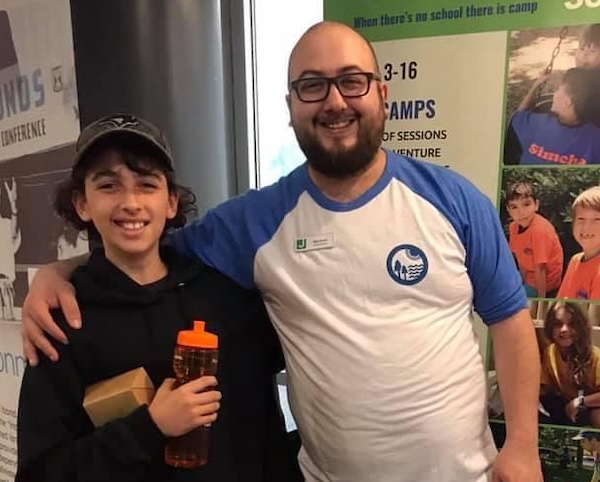

The writer as a kid at Camp Shalom with the camp’s director, Ben Horev. (photo from Uriel Presman Chikiar)
I was 9 years old when I first arrived at Camp Shalom. My family had recently immigrated from Argentina, and we were settling into Vancouver. I barely spoke English. When my parents told me they were sending me to summer camp, I panicked. I imagined feeling out of place and not understanding anyone around me. That fear did not last long.
From the minute I stepped onto the Jewish Community Centre of Greater Vancouver grounds, I was met with warmth. Counselors welcomed me by name and made it feel as though I already been to camp. Ben Horev, the camp director, greeted every camper as they arrived. The way he spoke to each person made it clear that everyone mattered.
What stayed with me most from that first day was not an activity or a game. It was the first friend I made. I remember standing off to the side, unsure of what to do, when another camper walked over and introduced himself. We decided to stick together for the rest of the day. We tossed a ball back and forth, spoke in short, hesitant sentences, and laughed when my vocabulary failed me. That small moment of inclusion changed everything. Camp suddenly felt manageable. I learned that camp was not defined by its schedule or programming, but by the people who made sure no one felt like a stranger.
Over the next few summers, Camp Shalom became an important part of my life. I formed friendships that lasted well beyond childhood and learned skills that still shape who I am today. I learned how to play Magic: The Gathering with friends I’ve kept in touch with. I discovered a love for camping through pitching tents, building fires and spending time outdoors. To this day, camping remains one of my favourite ways to spend time outside.
By the time I became old enough to be a counselor-in-training, returning to camp felt natural. The counselors I had looked up to as a camper led with care, energy and intention, and their impact stayed with me. I wanted to be that person for someone else. I wanted to help create the same sense of belonging that had meant so much to me.
My first summer as a counselor was unforgettable. Being part of a community that had played such a formative role in my childhood felt meaningful in new ways. I enjoyed leading programs, sharing activities I had grown up with, and helping campers feel comfortable in a new environment. One of the most meaningful experiences was working alongside my former counselors: being treated as a colleague marked a full-circle moment.
As a camper, my role was simple. As a counselor, I was responsible for the safety, well-being and emotional experience of those in my care. I had to learn how to manage different personalities, resolve conflicts and stay calm in unpredictable situations. It was a challenge, but it pushed me to grow.
One night, during an overnight camping trip, we heard a loud noise outside and feared it was a bear. The campers were scared and, honestly, so was I. We gathered together and began singing our Shira circle songs, the same ones we sing every morning. We sang our hearts out to make noise, to scare the bear, and to remind everyone that we were safe. That moment has stayed with me. I learned that leadership is not about pretending fear does not exist; it is about helping others feel steady in uncertain moments.
Over time, I noticed changes at Camp Shalom. New staff brought fresh ideas, and campers arrived with different needs, especially in the years following COVID-19. Still, the core of the camp never changed. Respect, responsibility and community showed up in small, everyday ways, like leaving a campsite cleaner than we found it or making sure no one was left sitting alone.
Those habits have shaped how I understand tikkun olam and chesed. Repairing the world doesn’t mean grand gestures; it means taking responsibility for the space and the people around you. Kindness is not abstract either; it is patience, inclusion and showing up for someone who needed it. These lessons were reinforced every Friday, when everyone came together for Shabbat. They continue to guide how I try to show up for others.
Looking back, Camp Shalom is not just a place I attended as a child. It is part of who I am. It was where I found belonging in a new country, built lasting friendships and learned the values that continue to guide me. Although I am no longer a counselor, I hope that, even in some small way, today’s campers feel what I felt when I first arrived: safe, supported and welcome.
Uriel Presman Chikiar is a student at Queen’s University and serves as executive vice-president of external relations at Hillel Queen’s.



