Skip to content
  • Home
  • Subscribe / donate
  • Events calendar
  • Business Directory
  • FAQ
  • News
    • Local
    • National
    • Israel
    • World
    • עניין בחדשות
      A roundup of news in Canada and further afield, in Hebrew.
  • Opinion
    • From the JI
    • Op-Ed
  • Arts & Culture
    • Performing Arts
    • Music
    • Books
    • Visual Arts
    • TV & Film
  • Life
    • Celebrating the Holidays
    • Travel
    • The Daily Snooze
      Cartoons by Jacob Samuel
    • Mystery Photo
      Help the JI and JMABC fill in the gaps in our archives.
  • Community Links
    • Organizations, Etc.
    • Other News Sources & Blogs
  • JI Chai Celebration
  • JI@88! video

Recent Posts

  • Or Shalom reopens its doors
  • JFS from past to future
  • Need holistic approach
  • Sharing stories, advice
  • Journalist shares fears
  • Skills to live together
  • Road to independence
  • Cutting grass with scissors
  • Zionism as a solution
  • Deceit, desire & the divine
  • Reclaiming sacredness
  • Creative project ideas
  • Summer squares and cobbler
  • Thou shalt … summer commandments
  • Legal help for students
  • Revisiting myth of Lilith
  • Wrong person rebuked
  • Canada’s mixed messages
  • Questions for museum
  • Symposium on antizionism
  • Making soccer political
  • CJPAC lauds Pulver’s impact
  • City recognizes Vrba’s legacy  
  • Organ donation saves lives
  • Theodore’s March premiere
  • A healing Shabbaton
  • Supplying healthy food
  • A chime of metal tags
  • Yellowknife seder a first
  • Ishai energizes, unifies
  • A Lag b’Omer to remember
  • Expanding the healing
  • Hannah Senesh – a unique hero
  • Community milestones … May 2026
  • Деньги до зарплаты на карту Займ до зп онлайн за 5 минут 2026
  • Микрокредит онлайн в Казахстане Микрозайм в Акшамат

Archives

Follow @JewishIndie
image - The CJN - Visit Us Banner - 300x600 - 101625

Tag: Chanukah

Community lights shine

Community lights shine

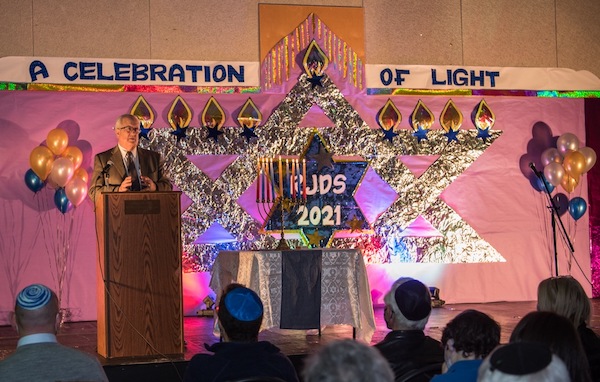
Richmond Mayor Malcolm Brodie speaks to those assembled at RJDS’s Celebration of Light event. (photo by Adele Lewin Photography)

Richmond Jewish Day School is on No. 5 Road, which has been named the “Highway to Heaven” because it is home to more than 30 places of worship, education and cultural practice. The temples, churches and religious schools all celebrate light during the winter season and RJDS’s Celebration of Light event celebrated the diversity within the school and throughout Richmond.

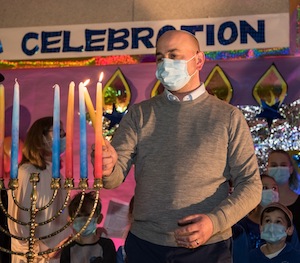
photo - Jewish Federation chief executive officer Ezra Shanken lights the chanukiyah
Jewish Federation chief executive officer Ezra Shanken lights the chanukiyah. (photo by Adele Lewin Photography)

On the last night of Chanukah, Dec. 5, RJDS hosted a night of coexistence, unity and light. After parking at the India Cultural Centre, folks aged 5 to 70 lined up at the entrance as the school gym filled with excitement. The night moved through hopeful speeches given by Ezra Shanken, chief executive officer of the Jewish Federation of Greater Vancouver; Rabbi Yechiel Baitelman of Chabad Richmond; Rabbi Susan Tendler from Beth Tikvah Congregation; Richmond Mayor Malcolm Brodie; and Richmond City Councilor Bill McNulty. The words “bridges,” “freedom,” “unity,” “light” and “together” echoed. Also in attendance were city councilors Andy Hobbs and Alexa Loo, showing their support.

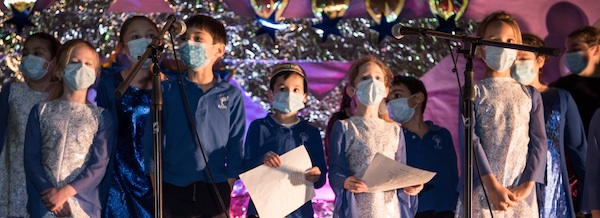
photo - RJDS Choir sings
RJDS Choir sings. (photo by Adele Lewin Photography)

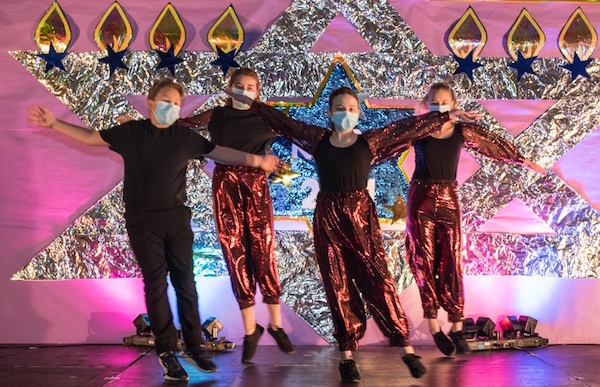
The RJDS Choir sang classic Chanukah songs, including a piece that called upon the audience to “celebrate our light,” and the school’s Israeli dancers showcased two Israeli dances.

photo - RJDS students perform an Israeli dance.
RJDS students perform an Israeli dance. (photo by Adele Lewin Photography)

The voices of RJDS’s neighbours were also heard. The school sent the question out to the community asking what “light” means to them during this holiday season. Each response had a different point of view, however, at the core, every answer reflected on hope, optimism, knowledge, community, compassion, joy, openness, anticipation and the goodness in humanity. Respondents included Navshina Savory from the Richmond School District, Umran Bhatti from the Ahmadiyya Muslim community, Balwant Sanghera from Gurdwara Nanak Niwas (and chair of the Highway to Heaven Association), Edward James Wong from St. Monica Parish Roman Catholic Church, Baha’i community representatives, and Russ Klein and Rabbi Stephen Berger from King David High School. They all had thoughtful insights and their participation was appreciated, as was that of everyone who spoke at, attended and otherwise contributed to this event.

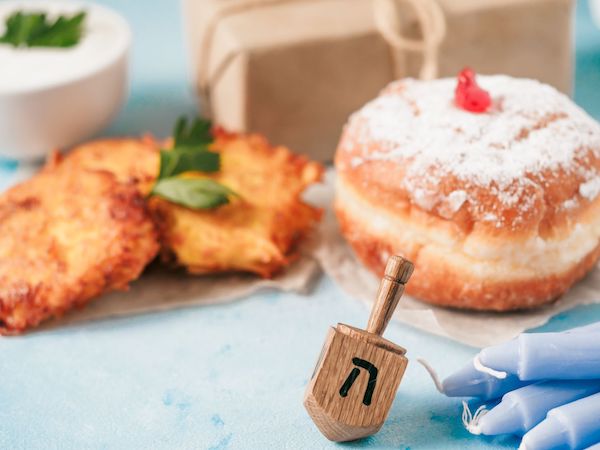
On their way out, guests could help themselves to coffee, water and Chanukah delights like latkes, sufganiyot and other fried goods. The night ended with hearts filled with the warmth that unity, a strong community and good food on a cold winter night can bring.

– Courtesy RJDS

Format ImagePosted on December 17, 2021December 16, 2021Author Richmond Jewish Day SchoolCategories Celebrating the HolidaysTags Chanukah, Highway to Heaven, interfaith, neighbours, politicians, RJDS

Two modern-day Maccabees

On Nov. 24, Chabad UBC invited two former Israel Defence Forces soldiers to the Nest on the University of British Columbia campus to speak about their personal stories and life lessons from serving in the army.

Amit Shmuel, a former soldier in the elite Palchan unit, and Matan Roettger, a former soldier in the Kfir Brigade, shared some of their experiences in service; stories of their courage and the sacrifice they made protecting and defending the state of Israel, and especially of their perseverance in the face of suffering and adversity. Both suffered career-ending injuries in the line of duty, and their strength and resilience to mentally and physically recover from their trauma were remarkable.

The two soldiers were at UBC as part of a larger tour of college campuses all across North America, along with Belev Echad, an organization dedicated to providing financial and moral support to IDF veterans wounded in action and to easing their transition back into civilian life.

The local event was sponsored by Hasbara Fellowships, which helps train young student leaders to become Israel ambassadors and activists on campus. As a Hasbara Fellow myself and having firsthand experience in Israel, I found the stories of Shmuel and Roettger to accurately represent the victory of hope over despair, the value of the sanctity of life, freedom and dignity that have been deeply encoded in the fabric of Israeli society and the Jewish community worldwide.

Just as the Maccabees 2,000 years ago rededicated the Second Temple from destruction to restoration, so too did these two modern-day Maccabees rededicate their lives from tragedy to triumph. They inspire us to not focus on what we cannot control, but rather on what we can: to elevate our attitude and response toward life’s misfortunes by sharing with others our light of faith and hope for a brighter future.

Eitan Feiger is a student at the University of British Columbia, class of 2024.

Posted on December 10, 2021May 2, 2025Author Eitan FeigerCategories LocalTags Belev Echad, Chabad, Chabad UBC, Chanukah, Hasbara Fellowships, IDF, Israel, Israel Defence Forces, Maccabees, UBC, University of British Columbia, veterans

Ideas worth the fight

During Chanukah, we celebrate the victory of light over darkness, of the triumph of our values over the hegemonizing ideals and practices of the oppressor.

A crucial part of Jewish tradition is applying the wisdom of the past to the challenges of today. And the world is full of challenges today. One of those closest to home for some of us is the culture and climate at universities. Over the past two decades, we have witnessed growing anti-Israel activity and antisemitism on campus.

Concurrently, a new orthodoxy has emerged, which is viewed by many as an overdue reckoning and by some as ideological overreach. This shift is typified by an intolerance or rejection of ideas that are deemed intolerant or worse. Racism, sexism, homophobia, transphobia and ideological extremism have been targeted by growing numbers of students and faculty, which, on its face, is progress. Even so, issues with this evolution include who is doing the judging, as well as where intolerance of intolerance intrudes on academic growth and ideological diversity, which is the lifeblood of the institutions.

A confounding aspect of campus culture today is that, in an ideal world, anti-Jewish sentiments would be included in the panoply of censured ideas. Instead, too often, the people who are denouncing racism are carving out exceptions in this one instance, as many voices have observed. (David Baddiel’s book Jews Don’t Count was reviewed in these pages recently.)

In a curious development, it has recently been announced that a group of academics, activists and entrepreneurs are set to open a whole new university. The University of Austin, to be soft-launched in Texas next year, intends to be a petri dish for unfettered “academic freedom.”

The historian Niall Ferguson, who is one of the proponents of the new school, has written of the problem they intend to address, using some of the reductive shorthand now deployed in this larger “culture war”: “Trigger warnings. Safe spaces. Preferred pronouns. Checked privileges. Microaggressions. Antiracism. All these terms are routinely deployed on campuses throughout the English-speaking world as part of a sustained campaign to impose ideological conformity in the name of diversity. As a result, it often feels as if there is less free speech and free thought in the American university today than in almost any other institution in the U.S.”

The University of Austin appears to be a product of frustration. The state of campus discourse today is problematic in many ways. But there is a larger principle at stake. If there is a problem in the academy at large, is the solution to pack up one’s books and ghettoize into a whole new school? Around the globe, liberal values are under threat by totalitarianism on both extremes of the political spectrum from left to right. The campus environment reflects and is a contributor to the trends in society, how we relate to one another and ourselves, as well as organize our politics and affiliations. We do not have the ability (yet) to decamp to another planet because of rampant illiberalism on this one. Similarly, while we do have the capacity to segregate ourselves into alternative institutions, is that in any way going to improve the broader issue?

Ironically, the purpose of the University of Austin appears to be to create a space for uncomfortable ideas. But isn’t that precisely what they are running away from? As in so many things in life, we have a choice: flee or stay and fight.

Academia is one of the places where we address, however awkwardly and inconclusively, concerns like power, class, race, gender, legacies of colonialism and many, many more. If the voices of intellectual homogeneity on campus are determined to shelter students from disturbing topics, or to instil in them a uniform, facile response, is it the proper reaction to give them what they want?

It is understandable and tempting to abandon the institutions that betray our values or challenge our identities. It is also understandable and tempting to want to have a whole institution that reflects back our values and reinforces our identities. Neither scenario sits well within Judaism’s long tradition of debate and critical thinking. And neither scenario makes for a healthy society.

Our only reasonable response in life – and especially at supposed institutions of higher learning – is to continue engaging in the battle of ideas, however daunting and hopeless the fight might appear.

Chanukah is but one of the Jewish holidays that teach us miracles can happen – but that they don’t happen on their own. We have an active role to play in this world, and should always be looking for ways to bring light into it.

Posted on November 19, 2021November 18, 2021Author The Editorial BoardCategories From the JITags academic freedom, antisemitism, Chanukah, culture, debate, education, Judaism, Niall Ferguson, politics, University of Austin

The small things matter most

With Chanukah coming early this year, more than one person has prompted me with, “Can you believe it? Are you ready for the holiday?” Meanwhile, on the news, we’re being bombarded with concerns about supply chain management. The message from stores is, “Shop early! We don’t have everything in stock and don’t know when we’re getting more!”

I might be the only person saying, in advance of what some people see as a huge gift-giving season: “No worries! It’s all fine.” Crazy, right? How could a person with kids think this?

Well, last year, when things seemed stressful, I was sewing endless numbers of flannel pajama bottoms for my twins for Chanukah. They got a lot of hand-sewn and hand-knitted gifts because I was so concerned that we might not have “enough.” Also, they were remote schooling, and I stayed up late working because I wanted them to know that they would lack nothing, we cared about them and wanted them to feel loved despite the major disruptions in their lives.

For years, I’ve advocated for buying local, making things from scratch or finding second-hand stuff close to home. If anything, I’ve appreciated that the pandemic made other people clean up and sell things they didn’t need. My kids don’t mind getting second-hand Playmobil. After all, someone else’s tidying campaign meant more toys for them!

For me, on a small scale, it means my kids get something they wanted and we don’t have to feel guilty about buying all this plastic. We’re just buying and reusing someone else’s plastic purchase. That’s better, right?

Some of our presents have always been socks or underwear, and this year will be no different. I foresee some intangible gifts, too, like my parents’ kind choice to buy us a family membership to the zoo. We’ll definitely have our night or two of tzedakah (charity) giving to the food bank or the Humane Society. We’ll have our doughnuts and latkes.

So, what’s Jewish about all this? Well, all of it. First, my family celebrates Chanukah, full stop. And, in a year with plenty of antisemitism, it seems great to proudly celebrate a holiday that commemorates Jewish victories and religious freedom.

Second, our traditions definitely suggest that the details matter – study any Torah portion and its commentaries, a page of Talmud, or just attend any Jewish organization’s board meeting. Getting the small choices around gift giving or festive oily foods right matters in our worldview. Hillel and Shammai debated which way to light the menorah or chanukiyah, but nobody said, “It doesn’t matter! Don’t bother! It’s all good!” What we do, how we act and how we choose to observe rituals with our families – it matters.

Third, in a time when so many of us have lost friends or family to COVID, or when some of us are struggling with our health, it’s so great to have a happy holiday ahead. I’ve always thought that the wish to gather with family and friends “only at simchas” (celebrations) seemed strange, because we need our loved ones when times are hard, too. Yet, we’ve all had plenty of hard times since March 2020. It’s OK to hope to be celebratory. I get the “only simchas” thing now.

The return to “normal” has been touted by some as very important. In my household, with kids who aren’t old enough to be vaccinated yet, we’re not back to normal. However, the whole supply chain breakdown is another reminder that normal wasn’t really that great. Our past acquisition system took advantage of many low-wage workers, wasted tons of energy moving goods across the world, and filled up our lives with more and more stuff. It might be a time to look closer to home for presents, make things for others, and stop expecting that buying this year’s “it” toy will make all the difference. We could all do with a little more handmade, local, small business support. Now’s the time for that.

It’s true that the supply chain disruption and the ongoing pandemic concerns make some things really difficult. If you’ve had an essential appliance break down, it might be months before you can get a replacement part. If you’re waiting for surgery and are in pain due to the current burdens on our healthcare system, you have all my sympathies. Worse still, if you’ve lost a family member, your job, business or your health, these are seriously hard things. These are the things that matter.

I don’t know if or when normal will return. If anything, studying more Jewish texts at this time has reminded me that we’re not alone in facing adversity. Throughout thousands of years, Jews have struggled with disease, forced immigration, difficulties in employment, poverty and death. It might be more useful to ask when we didn’t face big disruptions to “normal.” Our tradition has a lot to teach us about sticking to our ritual routines, observing holidays and caring for others in good and in hard times.

I can’t fix politics, or war or the supply chain anxieties. I miss my U.S. family and being able to travel to see them safely, without potential COVID exposure. However, my household has gotten much better at prioritizing small things that count. Now, we’re in a place where a long walk on Shabbat is a pleasure, playing outside is a gift, and new toys, tasty foods or fun surprises can be blessings for which we’re grateful. Chatting with a neighbour or seeing a woodpecker – these things can now make a day a special one. These daily details and rituals matter more than any single 2021 acquisition.

Wishing you a happy Chanukah, full of “only good” details that count: oily treats, enjoyable Jewish traditions, a meaningful donation or two and gifts that makes a difference close to home.

Joanne Seiff has written regularly for CBC Manitoba and various Jewish publications. She is the author of three books, including From the Outside In: Jewish Post Columns 2015-2016, a collection of essays available for digital download or as a paperback from Amazon. Check her out on Instagram @yrnspinner or at joanneseiff.blogspot.com.

Posted on November 19, 2021November 18, 2021Author Joanne SeiffCategories Op-EdTags Chanukah, COVID, gratitude, Judaism, lifestyle, supply chain, Talmud
Chanukah Market at JCC

Chanukah Market at JCC

Chanukah treats will be plentiful at the JCC Chanukah Market. (photo from JCCGV)

Come celebrate the Festival of Lights on Nov. 28 at the first-ever Chanukah Market. From 11 a.m. to 5 p.m. that day, the parking lot at the Jewish Community Centre of Greater Vancouver will be transformed into a marketplace for all to enjoy.

Under large heated tents, visitors will be able to shop at arts and crafts vendors, peruse affordable art, seek out that perfect gift, enjoy live, all-ages entertainment and participate in family activities – or just soak up the ambiance and enjoy a nosh from one of the food vendors on site. The day’s festivities will culminate in the lighting of the first candle on the chanukiyah at sundown.

Performances will include the music of Tzimmes, singer/guitarist Anders Nerman, children’s entertainer Monika Schwartzman, the Vancouver Jewish Folk Choir, singer-songwriter Auto Jansz, the klezmer sounds of the Klezbians plus other bands and singers, dancers and surprises. Kids and their families will find lots of things to do, from playing on bouncy inflatables to joining in some hands-on art-making specially designed and delivered by the JCC early childhood department.

More than 20 vendors will be on tap to offer jewelry and other creative, useful and decorative items and chachkas. In addition, an 11-member arts and crafts group is presenting an exhibition and sale, offering items such as giclée prints, ceramics, woodwork, glass design, photographs and textiles.

Food trucks and vendors will offer Mediterranean and Mexican cuisines – and Chanukah treats, including latkes and sufganiyot.

The market is presented with the assistance of Canadian Heritage and admission is free with a donation to the Jewish Food Bank. For the full vendor list and more information, visit jccgv.com/chanukah-at-the-j.

– Courtesy Jewish Community Centre of Greater Vancouver

Format ImagePosted on November 19, 2021November 18, 2021Author Jewish Community Centre of Greater VancouverCategories Celebrating the HolidaysTags art, Chanukah, food, gifts, JCC, marketplace, music
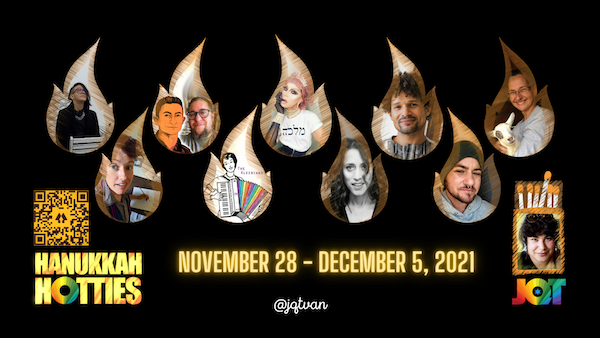
JQT’s 2021 Hanukkah Hotties

JQT’s 2021 Hanukkah Hotties

(image from JQT)

JQT Vancouver has a sizzling lineup of Hanukkah Hotties this year. Tune in to daily livestreams on Facebook with each Hanukkah Hottie, as they light their chanukiyah or share another tradition, and chitchat with JQT about their life, craft, activism and intersecting Jewish queer trans identities for the duration of the candles’ burning.

Hosted by Carmel Tanaka, founder and executive director of JQT Vancouver, who identifies as a queer, neurodivergent, Jewpanese woman of colour, the scheduled guests are:

Candle 1 (Nov. 28, 7 p.m.): Karen Newmoon, an Indigenous Jew-ish land dyke and subsistence farmer in Johnsons Landing, B.C.

Candle 2 (Nov. 29, 7 p.m.): Jersey Noah, a Jewish (Sephardi/Ashkenazi) transgender, autistic stoner in Oakland, Calif.

Candle 3 (Nov. 30, 7 p.m.): Adam W. McKinney / LaShawnah Tovah, a gay, Black, Native Jewish artist, and co-director of DNAWORKS in Fort Worth, Tex.

Candle 4 (Dec. 1, 1 p.m.****): Aviva Chernick, a queer, Jewish artist, and voice and meditation teacher in Toronto, Ont.

Candle 5 (Dec. 2, 7 p.m.): The Empress Mizrahi, a nonbinary/queer Persian Jewish Instagram content creator and activist in Los Angeles, Calif.

Candle 6 (Dec. 3, 7 p.m.): The Klezbians, a band of unruly, chutzpah-licious musicians from the Isle of Klezbos in Victoria.

Candle 7 (Dec. 4, 7 p.m.): Saul Freedman-Lawson and S. Bear Bergman. Freedman-Lawson is a student and illustrator in Toronto and Bergman is trans writer and educator from Toronto.

Shamash candle (Dec. 5, 9 a.m.): Tikva Wolf, a cartoonist in Asheville, N.C. (Cherokee territory).

Candle 8 (Dec. 5, 7 p.m.): Ari Fremder, a nonbinary, autistic, Latinx artist/animator and JQT Dream Team member in Vancouver.

During the livestream, closed captioning will be provided by Facebook’s AI bots, and JQT volunteers aim to post edited closed captioning videos on both Facebook and YouTube two to three days after each interview.

This series is supported by Creating Accessible Neighbourhoods (canbc.org), an organization that advocates for and educates about people with disabilities and/or chronic health conditions who have multiple intersecting identities.

For more on the participating artists and JQT, visit facebook.com/jqtvan.

**** NEW TIME!

– Courtesy  JQT Vancouver

Format ImagePosted on November 19, 2021November 21, 2021Author JQT VancouverCategories Celebrating the HolidaysTags Chanukah, diversity, Facebook, Hanukkah Hotties, inclusion, Jewish Queer Trans Vancouver

Brisket – a Jewish  tradition!

Brisket is the boneless meat on the lower chest of beef or veal. In traditional Jewish cooking, it is most often braised as a pot roast, especially as a holiday main course. For reasons of economics and kashrut, it was historically one of the more popular cuts of beef among Ashkenazi Jews.

Brisket is also the most popular cut for corned beef, which can be further spiced and smoked to make pastrami. In the 1900s, it appeared on Jewish deli menus, particularly in Texas, where the butchers, who emigrated from Germany and Czechoslovakia, had trouble selling the slow-cooking cut and created a way to dry smoke it and preserve it.

Brisket is one of the primal cuts of beef, though the precise definition of the cut differs internationally. The brisket muscles include the superficial and deep pectorals. As cattle do not have collarbones, these muscles support about 60% of the body weight of standing or moving cattle. This requires a significant amount of connective tissue, so the resulting meat must be cooked correctly to tenderize it.

The term brisket is derived from the Middle English brusket, which comes from the earlier Old Norse brjósk, meaning cartilage. The cut overlies the sternum, ribs and connecting cartilages.

Author and food writer Stephanie Pierson wrote an homage to this cut of beef: The Brisket Book:  Love Story with Recipes was published in 2011.

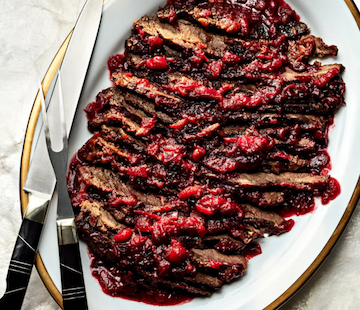
CRANBERRY-ONION CHANUKAH BRISKET
(This is Justin Chapple’s recipe from Food & Wine. It makes 8-10 servings.)

photo - Justin Chapple’s Cranberry-Onion Chanukah Brisket
Justin Chapple’s Cranberry-Onion Chanukah Brisket. (photo by Justin Walker)

8 cups fresh or thawed frozen cranberries
1 1/2 cups sugar
1 1/2-inch lemon peel strip
3 tbsp fresh lemon juice
salt and pepper to taste
2 1-ounce envelopes kosher pareve onion soup mix
1 7-pound trimmed beef brisket

The day before serving:

  1. Preheat oven to 325°F. Layer two sheets foil in a large roasting pan, letting foil hang over eight inches past each end. Repeat with two additional sheets of foil to form an X. Top with a sheet of parchment paper.
  2. In a saucepan, combine cranberries, sugar, lemon peel strip and lemon juice. Cook, crushing cranberries with a wooden spoon until mixture thickens, 10-14 minutes.
  3. Remove from heat and stir in onion soup mix. Let cool for 15 minutes.
  4. Spread a quarter of cranberry sauce on parchment. Place brisket fat side up. Spread remaining cranberry sauce over it, top with parchment and wrap foil around brisket. Place in oven for three to three-and-a-half hours. Uncover. Let cool one-and-a-half hours, then cover and refrigerate for at least eight hours.

The day of serving:

  1. Preheat oven to 325°F. Uncover brisket. Discard any fat. Scrape off cranberry sauce and place in a bowl.
  2. Slice brisket on carving board. Arrange in ovenproof dish. Spoon cranberry sauce over top, cover and bake 45 minutes to one hour.

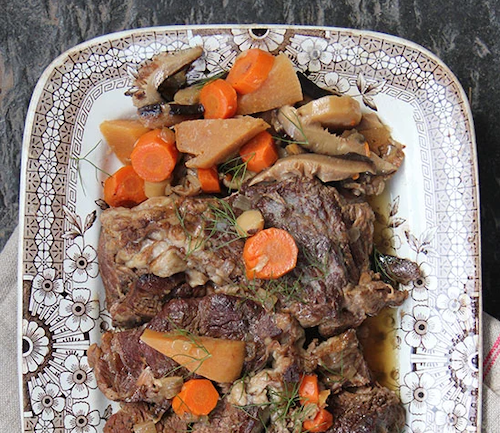
BEER-BRAISED BRISKET WITH ROOT VEGETABLES
(This recipe comes from Ian Knauer, former Gourmet Magazine editor, chef, food writer and owner of the Farm Cooking School. It makes 4-6 servings.)

photo - Ian Knauer’s Beer-Braised Brisket with Root Vegetables
Ian Knauer’s Beer-Braised Brisket with Root Vegetables. (photo by Ian Knauer)

1 2.5-to-3-pound brisket
2 tbsp olive oil
1 chopped medium onion
5 ounces sliced shiitake mushroom tops
3 finely chopped garlic cloves
3 large sliced carrots
3 sliced parsnips
1 rutabaga, peeled and cut into wedges
12 ounces beer of your choice
2 tbsp Worcestershire sauce
2 cups chicken stock
2 tbsp flour
1 tbsp dill

  1. Heat oil in a pot. Sear the brisket three to four minutes, turn, and continue searing another three to four minutes. Transfer to a plate.
  2. Stir onion, mushrooms and garlic into pot. Cook, stirring occasionally, for six minutes. Place brisket and juices back in pot.
  3. Stir in carrots, parsnips, rutabaga, beer, Worcestershire sauce and stock. Cover and simmer six hours, until meat is tender.
  4. In the meantime, stir flour and two tablespoons cold water in a bowl then whisk into the pot. Simmer until sauce thickens, about 10 minutes. Place on plate, sprinkle with dill and slice.

Sybil Kaplan is a journalist, editor of nine kosher cookbooks (working on a 10th) and a food writer living in Jerusalem. She leads English-language Shuk Walks in Machane Yehuda.

Format ImagePosted on November 19, 2021November 18, 2021Author Sybil KaplanCategories Celebrating the HolidaysTags brisket, Chanukah, cooking, Food & Wine
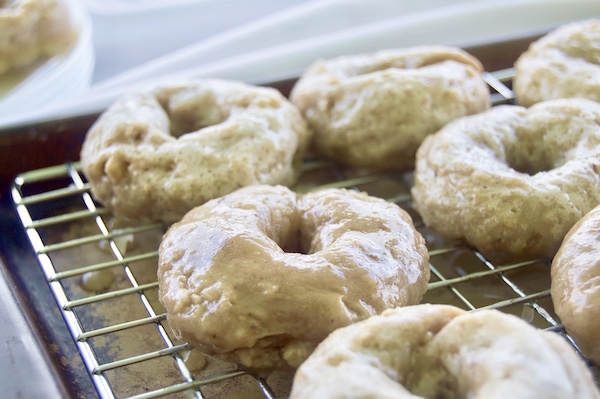
Making holiday doughnuts

Making holiday doughnuts

Syrian doughnuts can be made with a hole, or not. And they are topped with lemon or another type of glaze or syrup, rather than having a jelly filling. (photo from vegankinda.wordpress.com)

One of the things I have enjoyed the most as a food writer is learning the different customs of Jews from around the world. When it comes to doughnuts, all the communities make a dough dessert fried in oil, but there are differences.

Dov Noy, who was an Israeli folklorist and ethnologist, related a Bukhharian fable, which says that the first sufganiya was a sweet given to Adam and Eve as compensation after their expulsion from the Garden of Eden. He says the word sufganiya comes from the Hebrew word sof (meaning end), gan (meaning garden) and Ya (meaning G-d). Thus, the word means, the end of G-d’s garden. According to Noy, this fable was created at the beginning of the 20th century, since sufganiya was a new Hebrew word coined by pioneers.

Some consider sufganiyot, which means sponge-like, to be reminiscent of the sweet, spongy cookies that have been popular along the Mediterranean since the time of the Maccabees. Hebrew dictionaries say the word actually comes from the Greek word sufgan, meaning puffed and fried.

A few months ago, I happened to stop at a vendor in Machane Yehuda, the Jewish market where I shop and lead weekly walks, to ask about a pastry he was selling. He told me it was shvinze. Many years ago, a neighbour had given me her mother’s receipt for shvinze and I share it with you here.

I’ve also included a recipe from another neighbour, who made a similar type of dessert that she learned from her mother, who came from Syria. And the third recipe is for traditional Israeli doughnuts that can be filled or left plain. Talia was 5-and-a-half years old when she gave me this recipe – today, she is the mother of four, a tour guide married to a photographer, and living in the scene of the Chanukah story, Modi’in.

MOROCCAN SHVINZE

1 2/3 tbsp yeast
1/4 cup lukewarm water
a pinch salt
4 cups flour
oil
honey or confectioners’ sugar

  1. Place yeast in a small bowl with water. Place flour in another bowl. After the yeast swells, add to the flour. Add salt, then knead into an elastic dough.
  2. Place oil in a deep pot. Wet hands, take a piece of dough and shape it into a circle. Punch a hole in the centre, then drop the dough into oil. Brown it on both sides. Drain on paper towels.
  3. Serve with honey or confectioners’ sugar.

SYRIAN ZINGOLE

 2 tsp yeast
a few spoons warm water
2 cups flour
1 1/2 cups water
oil

icing:
1 cup sugar
1 cup water
1 1/2 tbsp lemon juice

  1. Place yeast in a small bowl. Add a few spoons of warm water to dissolve.
  2. Place flour in another bowl. Add yeast and then more water to make a liquidy batter.
  3. Heat oil in a deep pot. Spoon batter into pan like pancakes. Fry until brown on both sides. Drain on paper towels.
  4. Combine sugar, water and lemon juice in a saucepan. Cook until sugar dissolves.
  5. Dip each pancake in sauce, then place on a serving platter.

TALIA’S SUFGANIYOT FOR JUNIOR COOKS

3 1/2 cups flour
1 1/2 cups plain yogurt
2 eggs
2 tbsp sugar
a pinch salt
1/2 tsp vanilla
oil

  1. In a mixing bowl, supervised by an adult, combine flour, yogurt, sugar and salt. Add eggs and vanilla and blend.
  2. Heat oil in a deep pot (with an adult’s help). Drop dough by tablespoon into oil. Fry until brown on both sides. Drain on paper towels.
  3. When cool to the touch, fill, using a tube or a large syringe, with your favourite jelly. Roll in confectioners’ sugar.

Sybil Kaplan is a journalist, editor of nine kosher cookbooks (working on a 10th) and a food writer living in Jerusalem. She leads English-language Shuk Walks in Machane Yehuda.

Format ImagePosted on November 19, 2021November 18, 2021Author Sybil KaplanCategories Celebrating the HolidaysTags baking, Chanukah, doughnuts, sufganiyah
Heroes throughout the ages

Heroes throughout the ages

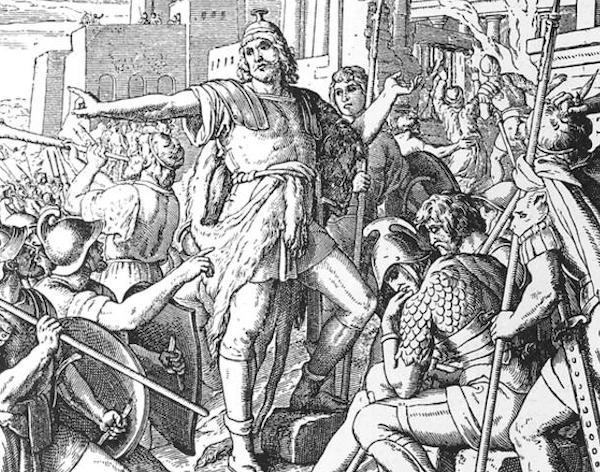
Judah Maccabee purifies the Temple, etching by Julius von Carolsfeld, 1860.

Every year, we look forward to Chanukah, even though it is not even mentioned in the Torah. Its name means “Dedication” and it starts on erev the 25th of Kislev, which, this year, falls on the night of Nov. 28.

The festival celebrates the triumph of the Maccabees, led by Mattityahu and, later, by his son Judah, over the Greek Syrians, led by Antiochus. As a result, Jewish sovereignty was reestablished in Judea for a time.

But we should not forget that this ancient conflict was also a civil war between the Jewish people themselves. The Hellenists admired Greek culture, which they began to emulate; whereas the Maccabees remained steadfast in their adherence to Judaism’s ideals and beliefs. The factions disagreed on various issues, including the rite of circumcision, a fundamental and crucial Jewish ritual that the Hellenists claimed violated the perfection of the body.

In 175 BCE, Antiochus tried to wipe out the Jewish religion entirely by substituting the Greek language, gods and customs. The final blow came when the Temple was defiled and a giant statue of the Greek god Zeus was erected there, with the Jews ordered to worship it.

Some, like Hannah and her seven sons, resisted passively, choosing death rather than idol worship. Hundreds hid in caves and some suffocated to death. But there was no active resistance until the Hasmonean family of Mattityahu and his sons at Modi’in raised a banner: “Whoever is for the Lord, follow me!”

A small army was formed, with Judah Maccabee as its leader. Antiochus sent three armies to suppress the revolt, but the Maccabees triumphed. Their first priority after victory was to purify the Temple.

As the story goes, all the cruses of oil had been defiled except one. Instead of burning for just one day, it miraculously lasted for eight days, until more holy oil could be acquired. Hence, the celebration of Chanukah for eight nights and days.

Today, Chanukah still has relevance. We remember not only the heroism of the Maccabeans, but other heroic acts. Many times in Israel we have seen the victory of a tiny nation against a larger and stronger one, the few against the many.

In 1948, the young Israel Defence Forces defeated much larger Arab armies to usher in the independent state of Israel. Earlier, in the Second World War, there was widespread Jewish resistance to Hitler’s brutal policies and Jews fought in the ghettos and joined partisan units in forests outside Polish and Russian cities conquered by the Nazis.

Israel’s operation into Entebbe to rescue hostages in Uganda is another instance of modern heroism and our history abounds with examples. The revolt of the Hasmoneans is the symbol of the spirit of Zionism. Today, in Western society, no tyrant is forcing us to abandon our faith, but many Jews are in great danger of losing their Jewish identity nonetheless. Hellenism, in a different form, is alive and well.

Chanukah has broad human significance as a festival of liberty and religious freedom, not just for us, but for all people. It is a humanistic festival. The symbol of Chanukah is light and the real miracle is that, despite millennia of persecution and dispersion, the light of our people has never been extinguished.

Dvora Waysman has written 14 books, and the film The Golden Pomegranate was based on her book The Pomegranate Pendant. Her latest novel is Searching for Sarah. She can be contacted at [email protected].

Format ImagePosted on November 19, 2021November 18, 2021Author Dvora WaysmanCategories Celebrating the HolidaysTags assimilation, Chanukah, Hellenism, heroism, Maccabees, progressive Zionism, Zionism
Dream warms frozen flames

Dream warms frozen flames

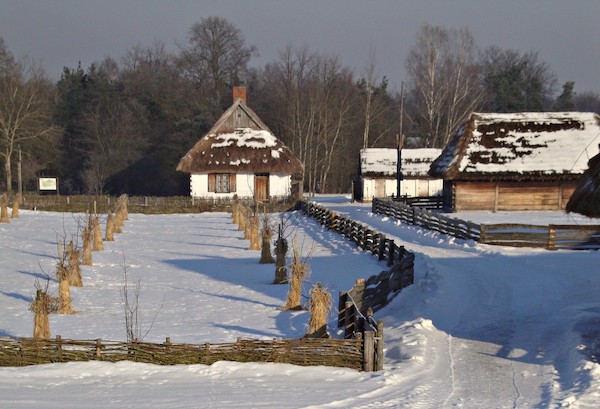
It was just before sunset on the last night of Chanukah, the coldest it had ever been in Chelm. (photo from pxhere.com)

It was a cold day in the village. It was so cold that when Reb Cantor, the merchant, sneezed without covering his mouth, his mucus solidified and blew a hole through the window of his shop, which his wife fixed by throwing a cup of tea at his head. He ducked, and the tea hit the windowpane and froze into place. It was that cold.

It was so cold that the flame of the eternal light in the synagogue froze solid. Instead of flickering brightly, it stood still, like red and yellow glass.

The villagers were frightened. It was just before sunset on the last night of Chanukah. Soup froze on its way from the pot to the table. Vodka oozed as it was poured into a glass. Chanukah candles snapped at the slightest touch. Reb Cantor’s matches broke into splinters. Stoves were almost useless. Warm challahs froze into rocks in seconds. Axes had to be warmed or else, when they struck the firewood, the blades shattered as if they were made of crystal. The Uherka River had frozen solid, trapping in its icy clutches a flock of geese late to leave the area.

It seemed as if the end was near. Everyone was hungry. They were afraid to go outside because the wind sucked the heat from their skin. The air itself left their lips numb. Kissing could be dangerous.

The day had been dark and cold, and the night would be darker and colder. Meals were uncooked and uneaten. Chanukah candles, set in their menorahs, were unblessed and unlit. Families stayed in their homes, huddled together in bed.

Even in the house of the wisest man in the village of fools, the menorah was dark.

Rabbi Kibbitz shivered in his bed with his wife, Channah Chaipul (she kept her maiden name, which, as you know, is another story). The two of them lay fully dressed beneath four sheets, three blankets, two quilts and seven coats – everything warm that they owned. Still, his teeth were chattering. For the first time in his life, he regretted not owning a dog or a cat.

“Channah,” the rabbi said. “We have to light the candles.”

“You do it,” she said. “I’ll watch from here.”

“My hand is too unsteady. The shammos will blow out. You are better at that sort of thing.”

“I’m almost warm,” she said. “You do it.”

“I’m nearly frozen,” he answered.

“So? You want me to get out of bed, light the candles, and come back in with icy cold feet?”

He shuddered. The last time she had put a cold foot on his ankle, his heart nearly stopped.

He sighed and closed his eyes. Maybe in a few minutes he would….

“Are you awake?” she said, elbowing him in the ribs.

“Channah!” he said, suddenly sitting up. “I had a dream!”

“Are you crazy? Lie down, you’re letting in a draft.”

“No, Channah, I’ve had a dream. Quickly! Get up! We need to gather everyone together in the synagogue.”

Mrs. Chaipul squinted at her husband. She hadn’t seen him this excited since he’d beaten Rabbi Abrahms, the schoolteacher, at canasta. “What did you dream?”

“I can’t tell you,” he answered. He slid out of bed and gasped as the frigid air slapped his neck like an icy wet towel. “Tell everyone to bring their menorahs and come to the synagogue. Quickly!”

Grumbling and shivering, Mrs. Chaipul stood, and nearly stopped right there. She wondered if it was possible for blood to freeze. Then, the rabbi went one way and his wife went the other, banging on doors and windows. They ran as fast as they could (which was remarkably briskly, considering their ages), waking villagers and telling them to gather in the synagogue.

“What? Why? Are you crazy?”

“Yes, I am,” said Mrs. Chaipul. “But the rabbi has had a dream. So you can freeze in your house or freeze in the shul. It’s up to you.”

Parents groaned. Children were wrapped in blankets. Doors were pried open. Menorahs were carried carefully, lest they crack into pieces on the short trip to the synagogue.

The small shul filled quickly.

Rabbi Kibbitz stood at the front, on the bimah, with five tallisim wrapped around his shivering old shoulders. He stood beneath the eternal light, staring at the still-frozen flame.

“Is everyone here?” he asked. Everyone looked around and nodded. No one was missing. “Then, please, somebody shut the door!”

“It’s shut,” came a shout from the back.

“Oy,” muttered the chilled rabbi.

“So, Rabbi, what is it?” said Reb Cantor. “What is so important that you asked us to risk life and limb to come to the synagogue on a night so cold my eyeballs almost froze?”

“I had a dream,” the rabbi said.

“So, I heard,” answered Reb Cantor. “You maybe want to tell us what the dream was?”

“I dreamed,” Rabbi Kibbitz sighed, “that all the villagers of Chelm gathered together in the synagogue.”

“Yes? Yes?”

“Well, in my dream, it was a cold, cold night, and the Chanukah candles weren’t yet lit.”

“Yes? Yes?” the villagers repeated.

“And everyone, all of you, came here to the synagogue.”

“Yes? Yes?”

“That’s it.” The wise rabbi shrugged. “We were all here. Then Channah nudged me, and I woke up.”

“That’s not much of a dream,” muttered Mrs. Chaipul.

The citizens of Chelm stared in disbelief at their beloved rabbi.

“You’re crazy!” shouted Reb Cantor. “You yanked us out of our moderately warm beds and dragged us here to tell us that you had a dream that we were all here? That’s it? Rabbi Kibbitz has finally lost his mind! Rabbi Abrahms, it is time for you to become the chief rabbi of Chelm.”

The villagers began to grumble and argue and stamp their feet. A wave of exasperated hot air lifted to the ceiling as their voices rose into shouts.

“Wait, wait!” Rabbi Kibbitz said. “Please, listen.”

Just then a child’s voice shouted, “Look! Look!”

It was young Doodle, the orphan, and one of the most foolish boys in the village of Chelm.

Doodle was pointing up at the eternal lamp. The pale light was thawing – flickering faintly, but growing brighter as it filled the synagogue with its glow of red, orange, yellow and gold.

Reb Cantor himself lifted Doodle up. “Careful, careful now,” he whispered, as the young boy touched his shammos to the light of the eternal flame.

That candle was passed back and forth throughout the shul, as every family lit their own shammos. Everyone held their breath, wondering whether the wind and the cold would extinguish the thin flames.

Then, at long last, the villagers of Chelm said the blessings all together. The shammosim touched the other candlewicks. Soon, for each family, one flame became eight (plus the shammosim).

Now the synagogue was full of light, and the villagers began to sing.

Reb Cantor swept the old rabbi up in a bear hug. “That was some dream!”

Everyone laughed and danced.

They stayed there all night, and the candles burned so slowly that it was well past dawn before the last one burned out.

That morning, when the doors to the synagogue were opened at last, a warm breeze left the shul and spread out over the village.

The ice on the Uherka River cracked, and the flock of trapped geese took flight. All the villagers watched and cheered as the birds sped south.

And, from the east, the sun rose higher, and its rays felt warm with promise.

Izzy Abrahmson is a pen name for author and storyteller Mark Binder, who  lives in Providence, R.I., and tours the world – virtually and in-person. Abrahmson’s Winter Blessings: Warm Stories from the Village was a National Jewish Book Awards finalist.

Format ImagePosted on November 19, 2021November 18, 2021Author Izzy AbrahmsonCategories Celebrating the HolidaysTags Chanukah, Chelm, fiction, storytelling

Posts pagination

Previous page Page 1 Page 2 Page 3 … Page 11 Next page
Proudly powered by WordPress