
Skip to content
  • Home
  • Subscribe / donate
  • Events calendar
  • News
    • Local
    • National
    • Israel
    • World
    • עניין בחדשות
      A roundup of news in Canada and further afield, in Hebrew.
  • Opinion
    • From the JI
    • Op-Ed
  • Arts & Culture
    • Performing Arts
    • Music
    • Books
    • Visual Arts
    • TV & Film
  • Life
    • Celebrating the Holidays
    • Travel
    • The Daily Snooze
      Cartoons by Jacob Samuel
    • Mystery Photo
      Help the JI and JMABC fill in the gaps in our archives.
  • Community Links
    • Organizations, Etc.
    • Other News Sources & Blogs
    • Business Directory
  • FAQ
  • JI Chai Celebration
  • JI@88! video

Recent Posts

  • Eby touts government record
  • Keep lighting candles
  • Facing a complex situation
  • Unique interview show a hit
  • See Annie at Gateway
  • Explorations of light
  • Help with the legal aspects
  • Stories create impact
  • Different faiths gather
  • Advocating for girls’ rights
  • An oral song tradition
  • Genealogy tools and tips
  • Jew-hatred is centuries old
  • Aiding medical research
  • Connecting Jews to Judaism
  • Beacon of light in heart of city
  • Drag & Dreidel: A Queer Jewish Hanukkah Celebration
  • An emotional reunion
  • Post-tumble, lights still shine
  • Visit to cradle of Ashkenaz
  • Unique, memorable travels
  • Family memoir a work of art
  • A little holiday romance
  • The Maccabees, old and new
  • My Hanukkah miracle
  • After the rededication … a Hanukkah cartoon
  • Improving the holiday table
  • Vive la différence!
  • Fresh, healthy comfort foods
  • From the archives … Hanukkah
  • תגובתי לכתבה על ישראלים שרצו להגר לקנדה ולא קיבלו אותם עם שטיח אדום
  • Lessons in Mamdani’s win
  • West Van Story at the York
  • Words hold much power
  • Plenty of hopefulness
  • Lessons from past for today

Archives

Follow @JewishIndie
image - The CJN - Visit Us Banner - 300x600 - 101625

Tag: Food & Wine

Brisket – a Jewish  tradition!

Brisket is the boneless meat on the lower chest of beef or veal. In traditional Jewish cooking, it is most often braised as a pot roast, especially as a holiday main course. For reasons of economics and kashrut, it was historically one of the more popular cuts of beef among Ashkenazi Jews.

Brisket is also the most popular cut for corned beef, which can be further spiced and smoked to make pastrami. In the 1900s, it appeared on Jewish deli menus, particularly in Texas, where the butchers, who emigrated from Germany and Czechoslovakia, had trouble selling the slow-cooking cut and created a way to dry smoke it and preserve it.

Brisket is one of the primal cuts of beef, though the precise definition of the cut differs internationally. The brisket muscles include the superficial and deep pectorals. As cattle do not have collarbones, these muscles support about 60% of the body weight of standing or moving cattle. This requires a significant amount of connective tissue, so the resulting meat must be cooked correctly to tenderize it.

The term brisket is derived from the Middle English brusket, which comes from the earlier Old Norse brjósk, meaning cartilage. The cut overlies the sternum, ribs and connecting cartilages.

Author and food writer Stephanie Pierson wrote an homage to this cut of beef: The Brisket Book:  Love Story with Recipes was published in 2011.

CRANBERRY-ONION CHANUKAH BRISKET
(This is Justin Chapple’s recipe from Food & Wine. It makes 8-10 servings.)
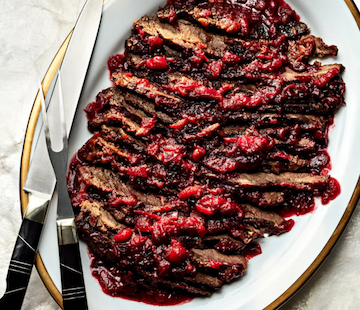
photo - Justin Chapple’s Cranberry-Onion Chanukah Brisket
Justin Chapple’s Cranberry-Onion Chanukah Brisket. (photo by Justin Walker)

8 cups fresh or thawed frozen cranberries
1 1/2 cups sugar
1 1/2-inch lemon peel strip
3 tbsp fresh lemon juice
salt and pepper to taste
2 1-ounce envelopes kosher pareve onion soup mix
1 7-pound trimmed beef brisket

The day before serving:

  1. Preheat oven to 325°F. Layer two sheets foil in a large roasting pan, letting foil hang over eight inches past each end. Repeat with two additional sheets of foil to form an X. Top with a sheet of parchment paper.
  2. In a saucepan, combine cranberries, sugar, lemon peel strip and lemon juice. Cook, crushing cranberries with a wooden spoon until mixture thickens, 10-14 minutes.
  3. Remove from heat and stir in onion soup mix. Let cool for 15 minutes.
  4. Spread a quarter of cranberry sauce on parchment. Place brisket fat side up. Spread remaining cranberry sauce over it, top with parchment and wrap foil around brisket. Place in oven for three to three-and-a-half hours. Uncover. Let cool one-and-a-half hours, then cover and refrigerate for at least eight hours.

The day of serving:

  1. Preheat oven to 325°F. Uncover brisket. Discard any fat. Scrape off cranberry sauce and place in a bowl.
  2. Slice brisket on carving board. Arrange in ovenproof dish. Spoon cranberry sauce over top, cover and bake 45 minutes to one hour.

BEER-BRAISED BRISKET WITH ROOT VEGETABLES
(This recipe comes from Ian Knauer, former Gourmet Magazine editor, chef, food writer and owner of the Farm Cooking School. It makes 4-6 servings.)
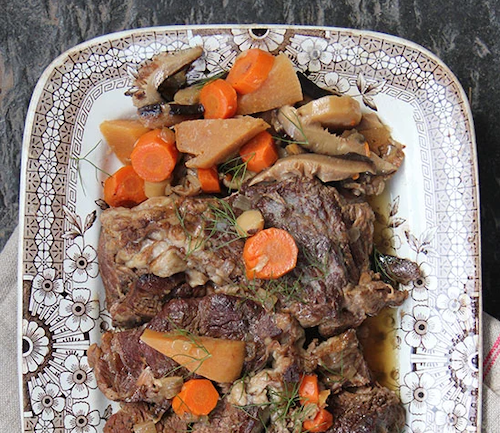
photo - Ian Knauer’s Beer-Braised Brisket with Root Vegetables
Ian Knauer’s Beer-Braised Brisket with Root Vegetables. (photo by Ian Knauer)

1 2.5-to-3-pound brisket
2 tbsp olive oil
1 chopped medium onion
5 ounces sliced shiitake mushroom tops
3 finely chopped garlic cloves
3 large sliced carrots
3 sliced parsnips
1 rutabaga, peeled and cut into wedges
12 ounces beer of your choice
2 tbsp Worcestershire sauce
2 cups chicken stock
2 tbsp flour
1 tbsp dill

  1. Heat oil in a pot. Sear the brisket three to four minutes, turn, and continue searing another three to four minutes. Transfer to a plate.
  2. Stir onion, mushrooms and garlic into pot. Cook, stirring occasionally, for six minutes. Place brisket and juices back in pot.
  3. Stir in carrots, parsnips, rutabaga, beer, Worcestershire sauce and stock. Cover and simmer six hours, until meat is tender.
  4. In the meantime, stir flour and two tablespoons cold water in a bowl then whisk into the pot. Simmer until sauce thickens, about 10 minutes. Place on plate, sprinkle with dill and slice.

Sybil Kaplan is a journalist, editor of nine kosher cookbooks (working on a 10th) and a food writer living in Jerusalem. She leads English-language Shuk Walks in Machane Yehuda.
Format ImagePosted on November 19, 2021November 18, 2021Author Sybil KaplanCategories Celebrating the HolidaysTags brisket, Chanukah, cooking, Food & Wine
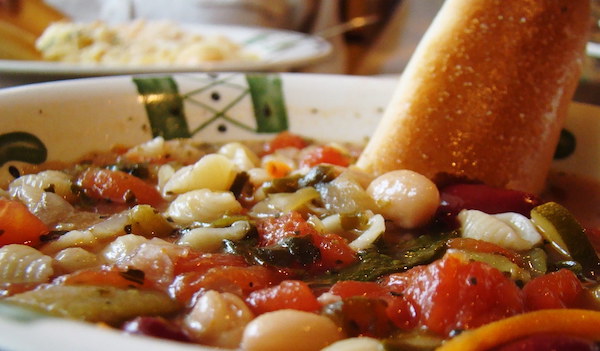
Minestrone warms the soul

Minestrone warms the soul

(photo from flickr.com/photos/veganfeast)

Minestrone came about as early as the second century BCE, when Rome conquered Italy and new vegetables flooded the market. It was known as an Italian peasant’s dish or poor man’s soup. Originally, it contained onion, garlic, celery, tomatoes and carrots – pasta seems to have been a later addition.

MY MINESTRONE
(6-8 servings)

2 tbsp margarine
3/4 cup chopped onions
2 minced garlic cloves
1 chopped leek
1/4 cup chopped celery
1/2 cup chopped carrots
2 chopped turnips
1 1/2 cups chopped zucchini
1 1/2 cups chopped cabbage
1 cup chopped potatoes
2 tbsp beef soup bouillon
1 cup chickpeas
1 cup chopped tomatoes
8 cups water
2 tbsp tomato paste
salt and pepper to taste
2 tbsp chopped parsley
1/2 tsp basil
1/2 tsp oregano
1 chopped bay leaf
1/4 tsp marjoram
1/2 cup small pasta
Parmesan cheese (optional)

  1. In a large soup pot, heat margarine. Sauté onions, garlic and leek.
  2. Add vegetables, water and spices but not pasta. Bring to a boil, reduce heat and simmer one hour.
  3. Add pasta and cook 15 minutes. Ladle into soup bowls and add the cheese.

ROOT VEGETABLE MINESTRONE
(Adapted from a Food & Wine recipe, it makes 6 servings.)

1/4 cup olive oil
1 finely chopped onion
1 minced garlic clove
1 sprig rosemary
2 sliced carrots
2 sliced parsnips
3 broccoli stems or chopped kohlrabi
3 cups cubed peeled, cut butternut squash
6 cups pareve chicken bouillon
salt and pepper to taste
1/2 cup angel hair pasta broken into 1-inch pieces
1/2 cup grated cheese

  1. In a soup pot, heat two tablespoons olive oil. Add onion, garlic and rosemary and cook until onion is soft.
  2. Add carrots, parsnips, broccoli or kohlrabi and squash and cook for one minute. Add bouillon, salt and pepper and cook about 15 minutes.
  3. In a frying pan, heat the remaining two tablespoons olive oil. Add pasta and cook, stirring frequently, about four minutes.
  4. Add pasta to soup. Cook until tender, five to six minutes. Discard rosemary. Stir cheese into soup and serve.

Sybil Kaplan is a journalist, editor of nine kosher cookbooks (working on a 10th) and a food writer living in Jerusalem. She leads English-language Shuk Walks in Machane Yehuda.

Format ImagePosted on November 19, 2021November 18, 2021Author Sybil KaplanCategories LifeTags cooking, Food & Wine, minestrone, soup
Pumpkin, but not pies

Pumpkin, but not pies

Pumpkin spice snickerdoodles (photo by Greg Dupree, food styling Torie Cox, prop styling Christine Keel / Food & Wine)

November arrives and I think pumpkin. Here in Israel, the d’la’at is amazing. Whole, they are huge in size and weight, cream in colour, with stripes all around.

Pumpkins are a variety of winter squash that belongs to the Cucurbitaceae (or cucurbits) family. Melon, watermelon and cucumber also fall into this category. Technically, pumpkins are fruit but, since they are often eaten in savoury dishes, many people refer to them as vegetables. Just about every part of the pumpkin is edible, including the seeds, their shell, leaves and flowers. Pumpkins are a superfood and are high in iron, packed with vitamins and minerals, and considered natural antioxidants.

But, enough about that and on to some recipes. Forget pie, though, and try these treats for your holiday guests.

The first dessert is pumpkin spice snickerdoodles. I was unfamiliar with snickerdoodles until coming across this recipe by Kelly Fields. Probably German in origin, the name of these sugar cookies could be a corruption of the German word schneckennudel, but notice the word schnecken, popular in Jewish cooking. American cookbook author Joan Nathan tells us: “Schnecken – the word means snail in German – are made of a rich and sweet yeast dough enriched with egg, sour cream and butter. The dough is pressed out in a large rectangle shape, sprinkled with sugar, cinnamon, raisins and ground nuts, and rolled up like a jelly roll. Cut on the cross section, the roll is sliced, baked and served open-side up in small coiled rounds.” Here is my version made pareve with slight changes.

PUMPKIN SPICE SNICKERDOODLES
(Adapted from Food & Wine. Makes 20 cookies.)

1 3/4 cups sugar
2 tbsp cinnamon
1 1/2 tsp cardamom
1/2 tsp nutmeg
1/2 tsp cloves
2 3/4 cups flour
2 tsp cream of tartar
1 tsp baking soda
1 cup unsalted butter or pareve margarine
2 large eggs
1 1/2 tsp orange blossom water or 3/4 tsp orange extract
1 tsp vanilla

  1. Preheat oven to 350°F and line three baking sheets with parchment paper.
  2. In a bowl, stir together 1/4 cup sugar, cinnamon, cardamom, nutmeg and cloves.
  3. In another bowl, stir together flour, cream of tartar and baking soda.
  4. Beat margarine and 1 1/2 cups sugar until light and fluffy (four minutes). Add eggs one at a time, then orange extract and vanilla. Add flour in two additions.
  5. Shape dough into 20 balls. Roll balls in spice mixture until coated. Arrange on baking sheets. Bake for six to seven minutes, then switch pans onto different racks, and continue baking 10 minutes. Let cool.

BAKED PUMPKIN WEDGES

image - Pumpkin Happy book cover
Published in 1976, Pumpkin Happy recipes are still happy-making.

(While I found this recipe in a newspaper some 40 years ago, it comes from the 1976 cookbook Pumpkin Happy, written by Erik Knud-Hansen and illustrated by Andrea Grumbine. It makes 6 servings.)

1 4-pound pumpkin, cut into wedges, strings and seeds scraped out
1/2 to 3/4 cup pareve margarine
1/4 cup brown sugar or honey
1 tsp cinnamon

  1. Preheat oven to 350°F. Oil a glass baking dish.
  2. Make shallow cuts in each wedge.
  3. Melt margarine in a saucepan. Add sugar and cinnamon. Brush over wedges.
  4. Bake for 35 to 45 minutes, until tender.

PUMPKIN BUTTER

(This butter is great on toast with cream cheese, according to Kelsey Youngman, writing on Food & Wine’s website. This recipe makes 2 1/2 cups.)

1 3-pound pumpkin, stemmed, halved lengthwise and seeded
1 tbsp vegetable oil
1/4 cup apple cider
1/2 cup brown sugar
3 tbsp honey
1 tsp apple cider vinegar
3/4 tsp cinnamon
1/2 tsp ginger
1/4 tsp nutmeg
a pinch of cloves

  1. Preheat oven to 350°F and line a baking sheet with parchment paper.
  2. Brush cut sides of pumpkin halves with oil. Arrange cut side down and bake 50 minutes, or until tender.
  3. Scoop flesh into food processor. Discard shell. Add apple cider, process one minute. Add brown sugar, honey, apple cider vinegar, cinnamon, ginger, nutmeg and cloves. Process 20 seconds. Transfer to a saucepan.
  4. Bring to a simmer, stirring occasionally. Reduce heat and cook until mixture is reduced by one-third and turns slightly darker in colour, about 25 minutes.
  5. Remove from heat, cool and spoon into jars with lids. Store in refrigerator.

Sybil Kaplan is a journalist, editor of nine kosher cookbooks (working on a 10th) and a food writer living in Jerusalem. She leads English-language Shuk Walks in Machane Yehuda.

Format ImagePosted on November 19, 2021November 18, 2021Author Sybil KaplanCategories Celebrating the HolidaysTags baking, cookies, Food & Wine, pumpkin
Proudly powered by WordPress