Skip to content
  • Home
  • Subscribe / donate
  • Events calendar
  • News
    • Local
    • National
    • Israel
    • World
    • עניין בחדשות
      A roundup of news in Canada and further afield, in Hebrew.
  • Opinion
    • From the JI
    • Op-Ed
  • Arts & Culture
    • Performing Arts
    • Music
    • Books
    • Visual Arts
    • TV & Film
  • Life
    • Celebrating the Holidays
    • Travel
    • The Daily Snooze
      Cartoons by Jacob Samuel
    • Mystery Photo
      Help the JI and JMABC fill in the gaps in our archives.
  • Community Links
    • Organizations, Etc.
    • Other News Sources & Blogs
    • Business Directory
  • FAQ
  • JI Chai Celebration
  • JI@88! video

Recent Posts

  • Eby touts government record
  • Keep lighting candles
  • Facing a complex situation
  • Unique interview show a hit
  • See Annie at Gateway
  • Explorations of light
  • Help with the legal aspects
  • Stories create impact
  • Different faiths gather
  • Advocating for girls’ rights
  • An oral song tradition
  • Genealogy tools and tips
  • Jew-hatred is centuries old
  • Aiding medical research
  • Connecting Jews to Judaism
  • Beacon of light in heart of city
  • Drag & Dreidel: A Queer Jewish Hanukkah Celebration
  • An emotional reunion
  • Post-tumble, lights still shine
  • Visit to cradle of Ashkenaz
  • Unique, memorable travels
  • Family memoir a work of art
  • A little holiday romance
  • The Maccabees, old and new
  • My Hanukkah miracle
  • After the rededication … a Hanukkah cartoon
  • Improving the holiday table
  • Vive la différence!
  • Fresh, healthy comfort foods
  • From the archives … Hanukkah
  • תגובתי לכתבה על ישראלים שרצו להגר לקנדה ולא קיבלו אותם עם שטיח אדום
  • Lessons in Mamdani’s win
  • West Van Story at the York
  • Words hold much power
  • Plenty of hopefulness
  • Lessons from past for today

Archives

Follow @JewishIndie
image - The CJN - Visit Us Banner - 300x600 - 101625

Tag: gifts

Gifts, property and curses

We recently had some work done on our garage. In 2021, when we purchased our new home, which was built in 1913, the inspector marveled at the garage, which was an early, purpose-built building meant for cars as compared to the converted carriage houses nearby.

There are still outbuildings in the neighbourhood, now used for cars or workshops, which contain horse stalls, but our garage, the inspector said, was special. That said, it’s narrow and the floor’s broken. It had the remains of both an old knob and tube electric panel and a chimney. Once, we imagined, a chauffeur warmed the space with the woodstove every winter to keep the car running.

When the contractors who fixed our house so we could live in it came back to work on the garage, things became complicated quickly. It turned out it was not just a couple rotten boards. Long ago, someone had cut important structural supports to put on larger heavier garage doors, likely when cars themselves became larger. A little stabilization project became a multi-week event, complete with new concrete footings all the way around the building and new structural supports. The garage no longer sits at a dangerous tilt. Our kids can go inside without danger.

This expensive project doesn’t mean that we’re suddenly using the garage in Winnipeg this winter. The concrete floor is still broken, the doors are narrow and the whole thing needs a coat of paint. All of those renovations will have to wait, because winter’s here. I’ve just cleaned snow off the car, parking on the street again this morning. This experience was one of those reminders that, in life, unexpected things happen, and that we make the best decisions we can in the moment, and roll with it. 

This brought me to what I’ve been studying in Bava Batra, the talmudic tractate I’ve been studying as part of Daf Yomi (a page of Talmud a day). Lately, what I’ve been learning has to do with death-bed gifts and inheritance. There’s an understanding that, if someone is on their death bed, they can give their property as a gift without the legal formalities that would normally be required. Also, the rabbis rule that, if a person miraculously does not die, their promises and gifts can be retracted. In other words, if you gift everything to your brother on your death bed, but then you don’t die, you can keep your home and fields.

On page 153, there’s a woman who gives away her property as a gift as she’s dying, but, by some miracle, she recovers. She goes to Rava, a wealthy rabbi who headed a school in Babylonia, and asks for her property to be returned. After all, she is still alive and needs her belongings back. But Rava says that the “gift” cannot be returned. His ruling doesn’t align with the rest of the rabbis or the law.

Obviously, this unnamed woman is upset and protests. Rava then has his scribe, Rav Pappa, create a ruling that, on the surface, looks like it’s in this woman’s favour, but references a text that indicates that this woman should just leave, without her property. Rava assumes this woman won’t notice his trickery, but this (unnamed) woman is smart, and angrier than ever.

Left with no other options, the woman in question resorts to a curse. Given the time, roughly 1,670 years ago, curses, amulets and magic were all used, and, in this case, the curse works. The woman curses Rava, says his ship will sink. Rava, somehow trying to trick the curse, soaks all his clothes in water to avoid it. Readers: the curse works, and not the tricks. Rava’s ship goes down. Rava drowns.

Later, medieval commentators wonder why the curse worked. The woman felt angry for good reasons. Rava had robbed her of her property. Rava’s ruling also had shamed her, and it was meant to trick her into leaving. This woman was clearly wronged. Sometimes, when a curse punishes the correct target – the later rabbis conclude a curse has strong power.

Long ago, someone really wronged our property, this garage, when they cut the structural supports. Given how unstable it was, it could have killed someone. Thankfully, no one was on their death bed here and apparently there were no curses. I did wonder whether we were expecting a miracle to fix this historical structure, or whether an expensive demolition was in order. It’s sometimes hard to undo a bad decision, but we were able to afford to repair a bad situation, which was created by someone else’s bad judgment.

People often seek the easiest way out – through tricks or pulling a fast one. Finding the best way forward sometimes means enduring jackhammering, structural work and funding a costly repair. Maybe if we hadn’t asked “our guys” to check out the garage, we wouldn’t have known the danger. Once we did, though, we couldn’t ignore it. Once the garage project started, even though this huge expense wasn’t in the budget, we had to deal with it.  

Hanukkah is coming up. Although our kids will still get treats and gifts, my husband and I will celebrate getting our garage back. Unlike this powerful, smart, unnamed woman who was wronged in Bava Batra, we didn’t lose all our property. We rolled with the unexpected, and now have a safe space, instead of a precarious risk. All this worked out better for us than for that unnamed woman long ago – and we didn’t even have to curse anybody. 

Joanne Seiff has written regularly for the Winnipeg Free Press and various Jewish publications. She is the author of three books, including From the Outside In: Jewish Post Columns 2015-2016, a collection of essays available for digital download or as a paperback from Amazon. Check her out on Instagram @yrnspinner or at joanneseiff.blogspot.com.

Posted on December 13, 2024December 11, 2024Author Joanne SeiffCategories Op-EdTags curses, education, gifts, Judaism, lifestyle, property, renovations, Talmud
Whimsical, huggable toys

Whimsical, huggable toys

Lea Bilot with some of her bearded gnomes. (photo from Lea Bilot)

Some artists find their niche, their preferred way of expression, early in life. For others, it takes longer, sometimes decades, to discover their creative outlet. Lea Bilot belongs to the second category. 

For the past few years, Bilot has been knitting and selling her whimsical stuffed toys at fairs and craft markets around Greater Vancouver.

“I was born in Vilnius, Lithuania. That was where I grew up and got married,” she told the Independent. Later, her family immigrated to Israel, where they lived for 26 years. They came to Canada in 2015, following their adult children.  

photo - Every one of Lea Bilot’s creations has its own expression
Every one of Lea Bilot’s creations has its own expression. (photo from Lea Bilot)

“I was never artistic before,” she said. Though perhaps she was, without realizing it. Creativity doesn’t usually spring out of nowhere. It surely shimmered inside her all along, finding unconventional channels among the demands of hard work and three growing children.  

“When we came to Vancouver, my husband and I started flipping houses,” she said. “We did it for a few years, but then COVID happened. Everything stopped. I didn’t know what to do. My husband found a job, but I was bored out of my mind.” 

She searched for an avenue to apply her fertile imagination.

“We went to our community centre once, and there was a craft fair there. I liked the knit toys someone was selling, but I thought: I could do better. And the idea stuck.”  

Never having made a knit toy before, Bilot did some research on the internet.

“I don’t speak good English,” she said. “So, I contacted a friend in Israel and asked if she could find me some books in Russian on the subject. She did and sent them.”

Bilot read all the books and then began to experiment.

“At first, I knitted some children’s clothing, but I don’t do that anymore,” she said. “Now, I concentrate on toys. I don’t copy what the books say either. I improve on them, make changes. I might use legs from one toy, hats from another, whatever fits my vision. Sometimes, I just follow my muse. Or I might find something new on the internet. There are several groups on Facebook, and we share information. We also help each other, when one of us hits a snag.”

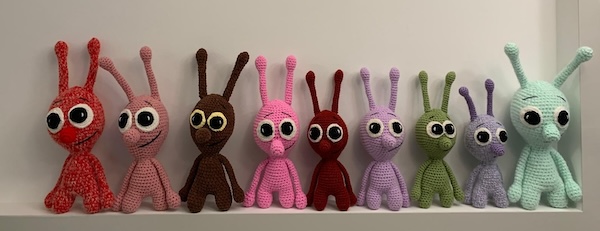
Lea Bilot also makes other creatures, such as aliens
Lea Bilot also makes other creatures, such as aliens. (photo from Lea Bilot)

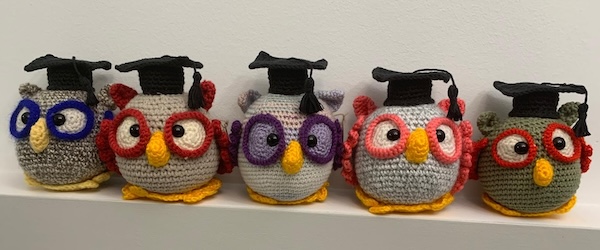
The variety of toys Bilot creates is astounding. Her output includes some common animals – dogs, cats, bears and rabbits – as well as owls in graduation hats, aliens with antennas and gnomes with beards. Each one has its own expression; no two are identical. For the winter holiday markets, she makes colourful Christmas trees with legs and hats, and snowmen decorated with buttons.

“I don’t knit snowmen – I make them from socks,” she said. “And, for my Christmas trees, I started to crochet. I’ve only been doing it for a few months.”  

She derives her ideas from everywhere.

“I once saw a man on the street with a big bushy beard. He was a short and fat older man, and his beard was white. I thought: that is my gnome.”       

Her home is half living space, half workshop.

“I have so much yarn now, I need to put it somewhere I can easily access,” she explained. “I put all my clothing in cardboard boxes, and my yarn into my dresser’s drawers.”

Most of her yarn is acrylic.

“Some children are allergic to wool. They like to hug their toys, kiss them, sleep with them. I have to use acrylic for the toys,” she said. “And I buy only expensive yarn: from Denmark, from Turkey, from Lithuania. I don’t use cheap local yarn – it doesn’t last long. Children put their toys to hard use. The toys need to be washable and durable.”   

photo - Lea Bilot’s handmade owls
Lea Bilot’s handmade owls. (photo from Lea Bilot)

From design to execution to sales, Bilot enjoys every step of the toy-making process.

“I love making them. Sometimes, when I want to finish one, I wouldn’t sleep for half the night. It is such a joy making all those details – skirts, boots, glasses – and coming up with new concepts, new patterns.”

She loves selling the toys as well.

“People don’t always buy them, but, whenever they pass my table, they smile. Women, children, even men – they all smile. Children are very well behaved, too. They would handle my toys, hug them – I make them soft and extremely huggable – but they don’t demand that parents buy them, don’t throw fits. It’s always a pleasure to be around them. That’s why I don’t offer my toys to any stores. I want to witness those smiles.”

Bilot sells her toys several times a year at craft fairs at community centres, schools and even universities.

“There are websites for artisans like me,” she said. “They list all the fairs. I would drive to those fairs first, see what they are selling, what the conditions are, before applying to them as a vendor for the next time. My husband helps, he drives me around. And my daughter helps with the application process.”

When asked if she gets any income out of her full-time toy-making hobby, Bilot laughed. “I cover the price of yarn,” she said, “and a bit above it, but not much. Mostly, I do it for the fun of it.” 

To see Bilot’s creations and be ready when she next tables at a market, visit instagram.com/leas_knittings. 

Olga Livshin is a Vancouver freelance writer. She can be reached at [email protected].

Format ImagePosted on November 29, 2024November 28, 2024Author Olga LivshinCategories LocalTags arts and crafts, gifts, knitting, Lea Bilot, toys
Chanukah Market at JCC

Chanukah Market at JCC

Chanukah treats will be plentiful at the JCC Chanukah Market. (photo from JCCGV)

Come celebrate the Festival of Lights on Nov. 28 at the first-ever Chanukah Market. From 11 a.m. to 5 p.m. that day, the parking lot at the Jewish Community Centre of Greater Vancouver will be transformed into a marketplace for all to enjoy.

Under large heated tents, visitors will be able to shop at arts and crafts vendors, peruse affordable art, seek out that perfect gift, enjoy live, all-ages entertainment and participate in family activities – or just soak up the ambiance and enjoy a nosh from one of the food vendors on site. The day’s festivities will culminate in the lighting of the first candle on the chanukiyah at sundown.

Performances will include the music of Tzimmes, singer/guitarist Anders Nerman, children’s entertainer Monika Schwartzman, the Vancouver Jewish Folk Choir, singer-songwriter Auto Jansz, the klezmer sounds of the Klezbians plus other bands and singers, dancers and surprises. Kids and their families will find lots of things to do, from playing on bouncy inflatables to joining in some hands-on art-making specially designed and delivered by the JCC early childhood department.

More than 20 vendors will be on tap to offer jewelry and other creative, useful and decorative items and chachkas. In addition, an 11-member arts and crafts group is presenting an exhibition and sale, offering items such as giclée prints, ceramics, woodwork, glass design, photographs and textiles.

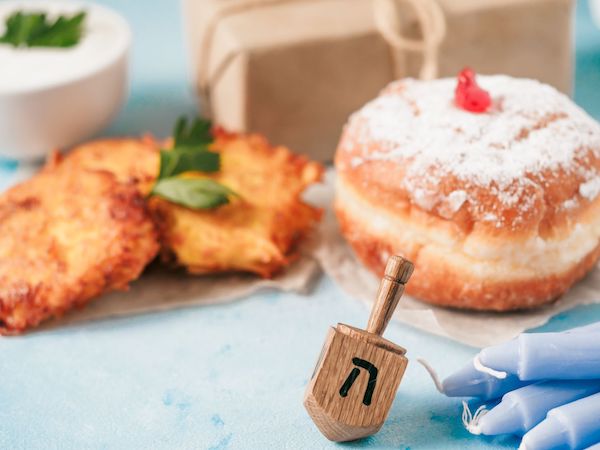
Food trucks and vendors will offer Mediterranean and Mexican cuisines – and Chanukah treats, including latkes and sufganiyot.

The market is presented with the assistance of Canadian Heritage and admission is free with a donation to the Jewish Food Bank. For the full vendor list and more information, visit jccgv.com/chanukah-at-the-j.

– Courtesy Jewish Community Centre of Greater Vancouver

Format ImagePosted on November 19, 2021November 18, 2021Author Jewish Community Centre of Greater VancouverCategories Celebrating the HolidaysTags art, Chanukah, food, gifts, JCC, marketplace, music
Matana expands its services

Matana expands its services

Each Matana gift box focuses on a different vendor. (photo from thematanashop.com)

Matana, a subscription box company from Israel, has a new mission-driven brand and vision. Formerly called Blue Box, Matana, the Hebrew word for gift, signifies the mutually beneficial exchange between the artisans, whose products are included in each box, and the recipients. Since its launch, the company has delivered more than 2,000 boxes with products from dozens of Israeli small businesses.

With a mission to highlight the unique flavours and textures of Israel while giving Israeli artisans a global platform to showcase their products, Matana features a selection of one Israeli vendor’s products in each box, along with a postcard that shares the vendor’s story. Israeli vendors include small enterprises, family-run farms, kibbutzim, social initiatives and young entrepreneurs. Boxes include products that range from Shalva Tea, locally foraged teas packaged by adults with special needs; to Kuchinate baskets, which are woven by African refugee women; to Sindyanna olive oil, which is created by Jewish and Arab women working side-by-side; to Rusty’s Nut Butters and Treats, a woman-led business.

photo - Israeli vendors include small enterprises, family-run farms, kibbutzim, social initiatives and young entrepreneurs
Israeli vendors include small enterprises, family-run farms, kibbutzim, social initiatives and young entrepreneurs. (photo from thematanashop.com)

“Every day, I am inspired by the ingenuity of Israel’s artisans working in nature and blending traditional with modern techniques on an ancient land,” said Matana chief executive officer Emily Berg. “Their products are handcrafted with purpose and passion, and tell the rich and multi-faceted story of Israel. We are thrilled to support Israeli artisans and, through them, to share Israel’s diverse fabric with the world.”

A Toronto native who moved to Israel in 2012, Berg developed the idea for Matana when her then-boyfriend, now husband, was called to serve in reserve duty in Gaza in Operation Protective Edge in 2014. During the tense time, Berg wanted to find a way to showcase Israel’s many sides to a global audience while supporting Israel’s artisans, whose businesses suffered during the conflict.

“My fiancé was called to reserve duty and was basically gone from the first until the 40th and final day,” Berg told the Independent in an interview in 2016. “It was a very quiet period. People were not going out much. And, it was the first time I was able to really reflect on my life, purpose and future here.”

The company was initially called Blue Box as a tribute to the Jewish National Fund’s blue-and-white tzedakah box that she’s known since childhood. (See jewishindependent.ca/jnf-inspires-entrepreneur.)

Due to the business’s success and the high demand for the boxes, the company has transformed from a one-woman show operated out of Berg’s own Tel Aviv-Jaffa living room to include new partners Elad and Maya Borkow, who run the logistics department from a warehouse in Ramat HaSharon.

Matana (thematanashop.com) offers several subscription options, including a new seasonal quarterly box that features products from several different vendors. The next shipment is scheduled for Dec. 12.

Format ImagePosted on November 30, 2018November 30, 2018Author MatanaCategories IsraelTags Chanukah, Emily Berg, gifts, Matana
Give a gift of language

Give a gift of language

Tina Turner, the late Leonard Cohen, TV presenter and comedian Bill Maher, the bands Madness and Led Zeppelin, actor Richard Gere and others have recently been added to the list of celebrities like actors Tom Selleck and Ben Stiller, musician Mick Jagger and former president Barack Obama who, perhaps unknown to them, have helped learners of Hebrew around the world acquire new vocabulary. Two years after the publication of the book Hilarious Hebrew: The Fun and Fast Way to Learn the Language, a fifth print run – which is also an extended edition – has recently been published.

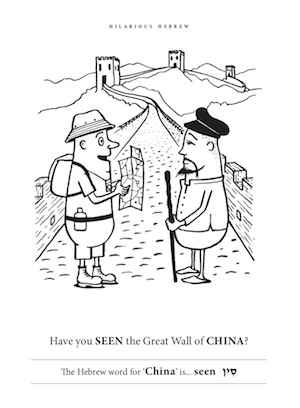
image - Hilarious Hebrew book coverCo-creator and Hebrew teacher Yael Breuer is convinced that, once readers find out that singer “Tina Turner does not hold a grudge,” for example, they are not likely to forget that the Hebrew word for grudge is tina.

“The method is a great way to memorize Hebrew vocabulary but, in fact, could be adapted as a teaching aid for any vocabulary in any language, and we have been asked about producing versions of the book for French, German and even Chinese speakers,” said Yael Breuer.

The book has been popular with Jews and Christians, tourists and students, and is sold in shops, Jewish museums and online. “The book was placed on the recommended book list by famous London-based Foyles bookstore and someone recently told me, half-jokingly, that our method could help lift the biblical curse of the Tower of Babel, which caused communication problems by separating people into speaking different languages,” she added.

image - Hilarious Hebrew page - ChinaHilarious Hebrew is divided into sections, which helps users identify words according to their need or interest, including vocabulary for vacationers, shoppers and restaurant-goers. It has been used as an aliyah gift to new immigrants to Israel by the Jewish Agency and has also been adopted as a language teaching tool by Edinburgh Hebrew congregation, who have started converting some of the book’s illustrations into animations. Hebrew tutorials, based on the method, are now available on the internet and co-writer Eyal Shavit, who is a musician, is in the process of composing a song using the Hilarious Hebrew method. “Just like the book, the song will teach Hebrew words in an entertaining way that will stick in the listeners’ minds,” he said.

For more information, see jewishindependent.ca/from-nonsense-knowledge. And event information about the book is available on hilarioushebrew.com; it is sold by Amazon.

Format ImagePosted on November 30, 2018November 30, 2018Author Pitango PublishingCategories BooksTags Chanukah, education, gifts, Hebrew, Hilarious Hebrew, language
Connect gifts to holiday

Connect gifts to holiday

Gifts can range from superhero socks to a journal to time with family and friends.

“When you consider the meaning of Chanukah, it’s about the Jewish struggle to maintain observance within a non-Jewish world,” writes Deena Yellin in the article “To gift or not to gift” on chabad.org. “The Maccabees’ victory was not just a military triumph but a win over assimilation as they succeeded in preserving the Jewish tradition. Chanukah presents a wonderful opportunity to convey the message of maintaining a strong identity despite outside pressures.”

In Yellin’s household, they “get out the Chanukah box filled with homemade decorations featuring menorahs and Maccabees that the children made in previous years…. We hang them up in our windows and around the candlelighting area. After all, publicizing the miracle is a big part of celebrating Chanukah.”

As well, every child lights their own chanukiyah, often one they’ve made themselves, and they invite people over. “One of the best ways to show children the beauty of the holiday is by sharing it with friends and relatives.”

Of course, food – latkes, sufganiyot and other deep-fried treats – is part of the celebration, as are games and crafts. Even gift-giving games. “One of my friends,” writes Yellin, “holds a ‘Mystery Maccabee’ project in which everyone picks the name of a family member from a hat so that they only need to buy a gift for that person. At their annual Chanukah party, everyone has fun guessing who got whose gift.”

Finally, many people use “Chanukah as an opportunity to teach their children to think of others who are less fortunate. One way to do this is by encouraging them to donate one of their gifts or some of their gelt to sick or needy children. Other philanthropic options are donating non-perishable items to a local food pantry or volunteering in a soup kitchen.”

***

Sarah Zadok, also in an article published on chabad.org (“Is giving Chanukah presents a non-Jewish custom?”), notes, “The word Chanukah shares a root with the word l’chanech or chinuch, which means ‘to mold’ or ‘to educate.’ Education, especially the education of children, is the foundation of what we celebrate on Chanukah.”

She allows that it is possible to educate and “to highlight the meaning of Chanukah through gift-giving. For example, giving your kids books or tapes or videos about the story of Chanukah…. Or, by drawing attention to the concept of the triumph of light over darkness – another powerful theme of the Chanukah story – you could invite your kids to bring ‘light’ where it is dark. You could, for example, make a project and bring it to a retirement home and brighten up someone’s day, or hand out cookies or latkes or winter coats to homeless people, or teach another Jew about our Chanukah traditions and invite them in to make a blessing over the candles with you.”

***

In the forward.com article “8 days of meaningful Hanukkah giving,” Shanee Markovitz writes, “it’s not about what we give as much as why we are giving it.” She offers night-by-night suggestions based on different themes.

Night 1 (Jewish values and roots): gifts like Chanukah Mad Libs for kids or a gift card to a Judaica store for adults.

image - Wonder Woman socksNight 2 (self-care): for kids, tablets that change the colour of bath water; for adults, essential oils for the bath or a massage.

Night 3 (dream big): for all ages, a journal or a pillow and/or pillowcase.

Night 4 (family and friends): again, for all ages, a picture frame for photos of/with family and friends.

Night 5 (hope): for kids, a night-night projector; for adults, scented candles.

Night 6 (gratitude): write someone “a letter of why you are grateful for them and leave them an empty card for them to write a letter and pass on the favour to someone else.”

Night 7 (surround yourself with warmth): for kids and adults, a sweater.

Night 8 (resilience): superhero socks for the kids and, for the adults, a goal planner or household tool kit (Maccabees means “Hammer,” after all).

***

Rabbi Rona Shapiro writes on ritualwell.org, in the article called “Chanukah gifts,” about using theme nights in an effort to practise moderation. Her family has had Big Gift Night (when each child gets one big gift from their parents); Grandparent Night (gifts from the grandparents); Book Night; Music Night (a night of songs); Cooking Night (make latkes and enjoy them with friends); Tzedakah Night (wrap presents to deliver to a children’s hospital or other charity); and Homemade Gift Night (such as a family photo album or scrapbook).

Shapiro suggests incorporating some new rituals into your celebration. For example, “Chag Habanot, the seventh night of Chanukah, is traditionally a women’s holiday (it falls out on Rosh Chodesh) when it was customary for women to give gifts and tell the stories of valiant Jewish women.”

For adults, she suggests presents ranging from personal blessings to wine, food and candles.

Format ImagePosted on November 23, 2018November 20, 2018Author The Editorial BoardCategories Celebrating the HolidaysTags Chanukah, children, gifts
Decembers of my childhood

Decembers of my childhood


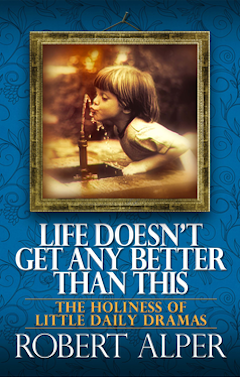
This story comes from the book Life Doesn’t Get Any Better Than This: The Holiness of Little Daily Dramas (Read the Spirit, 2015).

***

My father used to take showers with the lady next door.

It was all pretty kosher. We rented half of a “duplex” house at 89 University Avenue in Providence, and the Winn family occupied the other half. “Duplex” means different things in various places; in Providence, a “duplex” was a house with two separate entrances and two mirror-image units. Ours had three floors and a basement suitable for Cub Scout den meetings.

book cover - Life Doesn’t Get Any Better Than ThisThe way the house was designed, the bathrooms on the second floor shared a common wall, tub alongside tub and toilets back to back. The insulation was fairly thick, but subdued sounds could get through, and soon after the Winn family moved into 91 University Avenue, my father and Ruth Winn discovered that they observed similar morning shower routines. The muffled knocking back and forth on the tiles at 7:15 a.m., then a cute neighborhood joke, is now a piece of family folklore.


My mother and Ruth became friends immediately; 40 years later and 400 miles apart, they still dearly love each another. Laughter is what started it all off, but it was a hurricane called Carol that really brought us all together.

For eight days, Providence was without electricity, and neighbors drew closer to one another. Cold food went into the Keoughs’ old gas refrigerator at 85 University Avenue, while our battery-operated radio was the source for news and entertainment. The Winns’ vast quantities of sporting equipment helped everyone pass the time until that late afternoon when we were sitting on our porches and my mother suddenly yelled, “The lights are on!” Everyone rushed inside.

The bonding held.

The Winns’ oldest son Cooper David Winn IV and I were classmates, though never best friends. Still, we spent lots of time together, as neighboring kids do, and some of the most memorable moments occurred around the December holidays. Chanukah at my house. Christmas at his house.

Mutual envy.

For me, Chanukah generally meant one gift from my parents per night, but factoring in additions from grandparents, other relatives and friends, I averaged 16 to 20 each season. Not bad. I would even feel a bit on the smug side as I walked to school in the morning reporting to Cooper on the prior night’s take.

That is, I felt smug until early Christmas morning, when I would race over to the Winns’ side of the house to inspect the mountains of presents, the massive quantities strewn about the living room, such a volume of stuff that even the recognition in later years that the haul included a suspiciously large amount of underwear and socks could not make me rationalize away my jealousy.

The feeling of Chanukah has remained with me: our old tin menorah and the look, the smell, the soft, smooth texture of its candles, sometimes dripping their orange wax across my fingers. There were the traditional songs, the latkes and applesauce, and our one decoration, “Happy Chanukah,” printed on colorful paper dreidels and placed across the dining room entryway. The sign was worn, faded, but it was our tradition, and for eight days it transformed the room into a chamber of happy expectation.

Most of my presents were modest. I loved to make Revell models of antique cars, and so something like a Stanley Steamer one night might be followed by a Stutz Bearcat the next. Another year it was accessories for my small American Flyer train set: one night it might be a new caboose, and another night a little building to place near the tracks. I remember categories of gifts, but the particulars have long faded.

Except for two presents that I’ve never forgotten.

The first was a 26-inch English bicycle. It arrived on the year when I went for the gold in the “eight small presents or one big present” option game. Friday was the designated night and, as soon as the candles were lighted and the songs sung, I dutifully complied with the “Close your eyes tight” directive. The waiting seemed to go on forever as I listened to my father’s grunts and a bumping noise coming up the cellar steps. When he approached the dining room, I heard the rhythmic, metallic sound of a spinning tire, and knew that my yearlong series of unsubtle hints had been acknowledged.

Later we went to synagogue and, before the service began, I stood in the foyer for what seemed like hours, watching as every person entered, brushing the snow off their coats and stomping their boots. I scanned the arrivals, looking for Joey or Sammy or Ricky or anyone else I knew. “Guess what! I got an English bike!”

Other Chanukahs, though, were not as festive. My parents constantly struggled financially, one of the consequences of my father’s checkered career and made worse, later, by the albatross of medical bills from my sister’s long illness.

My father was always involved in the paper business. During the eight years when we lived on University Avenue, he worked for at least six different companies in waste paper, paper chemicals and wholesale tissue. Each position would begin with optimism and end with him returning home one night carrying his electric typewriter.

He always bounced back, always landed another job somewhere, somehow. Yet the process was draining, and the weeks or months between paychecks grim. One of those dark periods coincided with Chanukah.

I knew things were tough that season. We didn’t starve, but everything had to be cut back as we tried to make do on the salary my mother earned fitting women into corsets at the Peerless Department Store. “I know it’s hard,” she would say, “but some day our ship will come in.” I believed her. Sometimes I could even visualize “our ship,” a small speck on the horizon slowly, surely heading right for us.

“Our ship,” burdened with riches, was still far out to sea when Chanukah began. This year, I knew, would not be like other years. The grandparents and a few of my parents’ friends came through, but, my parents explained, I would need to understand that they just couldn’t afford presents this time. Just this year. Next year will be better.

Chanukah overlapped Christmas, fortuitously. The Winns were busy with their preparations, so I didn’t see much of Cooper. I was glad school was already on vacation; there was no need to report to friends on my Jewish version of an empty stocking.

That Christmas morning I didn’t rush next door.

On the final night of Chanukah, my parents surprised me with a gift. It was a small one, they warned. Nothing very special. But I’d been so understanding of what was happening that they wanted me to have it. I felt a slight twinge of guilt over their sacrifice as I accepted the little package.

Inside the box was a plastic model for my collection, a replica of a Chris Craft cabin cruiser. Probably cost about $2.95. I glued it together the next day and, for years, until I went off to college, the little boat sat on a shelf in my bedroom. It was far from being my fanciest model. Long discarded, the thought of it means more to me now than it ever did back then.

When I look back on all those Decembers of my childhood, those often wonderful days of mystery, anticipation, celebration, I know for a fact that I received many dozens of presents over the course of the years. They form an indistinct blur. After all, a long time has passed.

In truth, of all those gifts, I can actually remember only two. Only two. One was 26-inch English bicycle. Shiny black, three-speed, with a headlight powered by a generator that spun alongside the tire and its own silver air pump latched to the frame.

The other was a plastic model boat.

Rabbi Bob Alper (bobalper.com) is a full-time stand-up comic, performing internationally.

Posted on December 16, 2016December 15, 2016Author Rabbi Bob AlperCategories Celebrating the HolidaysTags books, Chanukah, gifts, memoir
Holiday treats for your pets

Holiday treats for your pets

Chanukah-themed pet gifts can be found aplenty on the internet. Some examples? A bowtie for your dog, cat or ferret from moderntribe.com.

image - Songs for your cat from amazon.ca
Songs for your cat from amazon.ca.

Pets are integral members of the family and there are many options to include your furry companion in Chanukah’s gift-giving celebration. Though most local pet stores will carry plush toys, chew bones and a variety of other treats for your pet, there are some truly cute and creative clothing and toys that are available via the internet – and which, if ordered soon, should make it in time for the holiday.

Moderntribe.com, a U.S. site, has a good selection of Chanukah-themed collars and leashes for your pet as well as plush toys including catnip-stuffed dreidels and gelt. For your cat and smaller dog, there are also Chanukah-themed bow ties and other clothing. Or perhaps a book titled How to Raise a Jewish Dog could be enjoyed by the whole family? The site has a section dedicated to such items.

image - A cat collar by ThePerkyPet from etsy.ca
A cat collar by ThePerkyPet from etsy.ca.

Etsy.ca has both a Canadian and U.S. site and, in a similar way to eBay, allows vendors to post a variety of products for sale. What makes this site different is that most of the products are globally sourced and handcrafted by individual vendors. There is a great selection of Chanukah toys and gifts for your pet, especially on the U.S. site, though some of the vendors may not ship to Canada, so check that out first. A search of “Chanukah pets” on the site should bring up something your pet will enjoy. Etsy has a good selection of pet toys, T-shirts, hats and bandanas – including a dreidel-patterned harness outfit and double-sided bandanas that are also appropriate for your ferret!

Amazon.ca and Petsmart.ca are also good sites to browse because they both have shipping from Canada; but when using their search program make sure that you try a variety of spellings for the word Chanukah.

While it is a lot of fun to include our pets in the gift-giving tradition during Chanukah, it is also important to remember that the most important gift you can give your pet during this busy holiday season is your time. Time to exercise him or her, time to just show you return the love they give you every day of their lives.

image - Gelt that won’t make your dog sick from petsmart.ca
Gelt that won’t make your dog sick from petsmart.ca.

It is also a time to be aware of the dangers that your pet may encounter at this time of year. Chocolate gelt can easily become accessible to dogs – and chocolate is very toxic for animals. Also, the temptation to treat your pet with the delicious food we humans indulge in at Chanukah can make them very sick. Latkes, with their onion component, can cause damage to red blood cells and the sugar and fat found in traditional doughnuts can cause digestive disorders in your pet. So, make sure your children know and show your love in other ways, perhaps with a stuffed singing dreidel, which can be found at multipet.com. It will be a hit with both dogs and kids, though after a few spins, you might be thankful that Chanukah, and the dreidel’s use, only comes once a year.

Leanne Jacobsen is a writer and longtime dog owner, as well as the director of sales at the Jewish Independent.

Format ImagePosted on November 20, 2015November 17, 2015Author Leanne JacobsenCategories Celebrating the HolidaysTags Chanukah, gifts, pets

Generosity gene

My wife is a lovely person. She reads every word I write. The last time I wrote a light, humorous commentary describing her few imperfections, she raided our mailbox and mugged the mailman (depriving a magazine of a great story). As I say, she’s almost perfect. But who’s perfect? They say that even Saint Francis of Assisi occasionally had fried pigeon as a lunchtime snack.

My wife’s fault is her generosity, especially at this time of year. We have a huge family: kids, grandkids, even great-grandkids – and the usual battalions of gift-hungry aunts, uncles, nephews, nieces, etc. And none of them entered the world through immaculate conception. In short, they all have birthdays. And graduations. And they celebrate every holiday known to man, including Abraham Lincoln’s cousin’s birthday. Then there’s Lag b’Omer, which only three rabbis in Sefad understand, handsomely celebrated with gifts from my wife.

In my wife’s lovely hazel eyes, if Sammy, the grandchild, gets a B in Sandpile 101 or an A in Arithmetic 101, guess what: Sammy gets a present from his grandparents, who must now dine on peanut butter and orange marmalade sandwiches.

So, now we get to the point. My wife’s constantly giving away the store. Even our Proverbs say that if you’re eating kosher peanut butter sandwiches for lunch, don’t buy your neighbor a rib steak. Or something like that.

Again, back to my wife. She was born without the basic selfishness gene for self-preservation. Worse, my fate is linked to hers. I once did an accounting: 40 gift-potential relatives plus friends, of which she has many due to her give-it-away gene. Now multiply by events – birthdays, anniversaries, holidays, illnesses. (“Uncle Henry has a cold, we’ll buy him a new bathrobe.” Me: “New robe? How ’bout a hanky?”)

I have a few weapons in my arsenal, too. A fleece-lined coat for Joey? It’s on sale, says the wife. Fifty bucks! “Guess what he did the other day,” I tell her. “Oh, I promised not to tell. Oops! Did I give it away? He said, ‘You seem to be putting on weight.’” Due to Joey’s misdemeanor, we compromise on a remote controlled toy car. Cost: $11.95. Joey will never know how close he came to a genuine fleece-lined coat. In like manner, we negotiate the entire list one by one. I’m very creative about the behavior, and sometimes the remarks of the subject.

The wife and I have this small economic disparity to negotiate. I love the clink of a quarter falling into our dresser change drawer; she loves the cha-ching of the cash register. The former, income; the latter, outgoing.

She’s particularly bad with kids’ gifts. I cite experts on adolescent psychology who warn us about the dangers of materialism. How ’bout when he grows up, makes $30,000 a year and because of your annual over-the-top gift giving, wants a $400,000 house – and Fannie May approves the loan, contributing to the U.S. default rate and my taxes?!

I do all I can to moderate her mania. I even lecture the kids on the popularity among their peers of Walmart shirts. And I tell the tale of the loner, the outcast who showed up at school in a pricey JoS. A. Bank shirt resulting in extreme loneliness. Result: “Grandma, would you give me one of those Walmart shirts next year?” A lesson for his adult life. I even quote Dickens, as well as the Bible. Mr. McCawber of David Copperfield – with the wisdom of Frederick Hayek – said, “income, 100 pounds; expenditure, 110 pounds. Result: misery. Income, 100 pounds; expenditure, 90 pounds. Result: joy.”

I’ve worked on this character flaw of hers for years. I guess I’ve been successful. For our 50th wedding anniversary, she gave me a pair of socks. Though I must admit, Jimmy, our first grandchild – upon graduating from high school, a feat shared by several hundred thousand kids – was gifted with a used (just a little) Honda Civic. I’m lucky it wasn’t a Lexus.

Ted Roberts is a freelance writer and humorist living in Huntsville, Ala.

Posted on December 12, 2014December 10, 2014Author Ted RobertsCategories LifeTags generosity, gifts
Unique, fun and giving gifts

Unique, fun and giving gifts

Lisa Pozin’s co-op features changing vendors, constant quality, available at the store and online. (image from givinggifts.ca)

Owning a small retail business may seem unconnected to making our planet a better place, but each purchase made in Lisa Pozin’s gift shop makes a positive difference in someone’s life.

Pozin started the company Giving Gifts about four years ago online. “I have been working at Temple Sholom as a program director since I was at university,” she said in an interview with the Jewish Independent. “I dreamt about having my own store before but I’m not a risk taker. I had a job, then I had three kids in three years. When I was on maternity leave with my youngest one, I decided it was time. Renting a retail space is expensive, and I wasn’t sure it would work, so I started online.”

photo - Lisa Pozin owns Giving Gifts & Co. at 4570 Main St
Lisa Pozin owns Giving Gifts & Co. at 4570 Main St. (photo by Olga Livshin)

Although her university degree in criminology and anthropology never prepared her for entrepreneurship, her job at Temple Sholom gave her practical business experience. “I got involved with the Temple’s gift shop. I liked it, liked finding artists and producers of interesting items. It appeared I have a good eye for what other people would want to buy.”

For Temple Sholom, of course, the items for sale have to have a Jewish connection (sholomjudaica.ca), but for her own shop, Pozin concentrated instead on selling only fair trade and eco-friendly gifts.

“I’ve always been a conscientious shopper myself. I think it’s part of being Jewish – trying to make a difference. I wanted to contribute to changing the world through shopping. There is this movement ‘Buy to Change’; I wanted to be part of it, wanted people to find special products in my shop, products which help the world. I sell things that help someone make a better life.”

Each product line has meaning. “We have necklaces called Giving Keys,” Pozin offered as an example. “They are keys with a word engraved on them, ‘strength’ or ‘courage.’ They’re meant to be passed on. When you get this key, you must give it away at some point to a person who needs the message on the key. The necklaces are made by formerly homeless people in L.A.”

Giving Gifts carries scarves made in Ethiopia by women transitioning out of the sex trade. It sells a series from Barefoot Books, a small children’s book company run by two mothers.

Each of Pozin’s vendors contributes to charities and, through them, so does Pozin. Ten percent of every sale made in the store is donated to various charities. “Mostly, they are children’s charities,” said Pozin. “A couple years ago, I started a donation campaign and we built a school in Kenya.”

When she finally opened a physical shop about a year and a half ago – Giving Gifts & Co. at 4570 Main St. – Pozin set it up as a co-op. “It’s a new concept in retail,” she said. “Giving Gifts is a permanent vendor at the store. The other vendors change. Each vendor rents a space from me for a certain amount of time – one day a week or some such – and sells his products and everything else in the store. This way, I don’t have to be in the store all the time and I help local artisans, jewelry and clothes makers, to sell their things. One of my vendors is a florist. Another is a perfumer. We have a wonderful community.”

Pozin offers shoppers both variety and convenience. She maintains an online presence (givinggifts.ca) and her services include shipping. “We ship almost every day. People shop online for gifts from small towns all over B.C. Even in Vancouver, they sometimes don’t have time to come to the store during working hours, so we ship to them.”

The shop manages to sustain itself. Pozin spends two days there and the rest of the week she still works at the synagogue.

“I love my work as a program director at Temple Sholom,” she said. “I work with families and teens. I run a seniors yoga class. It’s wonderful to work there, but I love my store, too. I’m excited when people buy from me. Together, we make a difference. We support good values and benefit the planet. There are more and more stores like that coming up everywhere. I hope the store will be successful at some point soon.”

In less than two years, Giving Gifts & Co. has acquired an excellent reputation. Earlier this year, it was a nominee in City of Vancouver’s first annual Awards of Excellence, which were presented in June, and it also made it into the latest edition of the Lonely Planet tourist guide.

“From Bakelite antiques to artisan chocolate bars and handmade kids wear, it’s well worth a browse if you’re in the neighborhood,” reads the guide entry. “The vendors are changed every few months to keep things lively, so there’s almost always something tempting to buy.”

Olga Livshin is a Vancouver freelance writer. She can be reached at [email protected].


Format ImagePosted on November 28, 2014November 27, 2014Author Olga LivshinCategories LocalTags gifts, Lisa Pozin, Temple Sholom

Posts pagination

Page 1 Page 2 Next page
Proudly powered by WordPress