Skip to content

  • Home
  • Subscribe / donate
  • Events calendar
  • News
    • Local
    • National
    • Israel
    • World
    • עניין בחדשות
      A roundup of news in Canada and further afield, in Hebrew.
  • Opinion
    • From the JI
    • Op-Ed
  • Arts & Culture
    • Performing Arts
    • Music
    • Books
    • Visual Arts
    • TV & Film
  • Life
    • Celebrating the Holidays
    • Travel
    • The Daily Snooze
      Cartoons by Jacob Samuel
    • Mystery Photo
      Help the JI and JMABC fill in the gaps in our archives.
  • Community Links
    • Organizations, Etc.
    • Other News Sources & Blogs
    • Business Directory
  • FAQ
  • JI Chai Celebration
  • JI@88! video
image - Weizmann Canada Physics Tournament 2025
image - The CJN - Visit Us Banner - 300x600 - 101625

Recent Posts

  • היהירות היא אחד האויבים הגדולים ביותר של ישראל
  • Vrba monument is unveiled
  • Music to build bridges
  • A better future possible
  • Anne Frank exhibit on now
  • Human rights in sport
  • Telling the story of an icon
  • Crawl bigger than ever
  • JCC Maccabi in Toronto
  • A way to meet fellow Jews
  • Time to include
  • Add Jewish joy to the mix
  • Reminder of humanity’s light
  • From the archives … editorials
  • Year-round holiday recipes
  • מדוע עזבתי את ישראל ואינני חושב לחזור ארצה
  • OJC hosts Oct. 7 memorial
  • A journey beyond self
  • Antisemitism a problem
  • Young man is missed
  • Orr action sparks complaint
  • Prison sentence for hate
  • Etgar Keret comes to Vancouver
  • New fall lecture series
  • Series explores music
  • Doc on Zapiro screens Nov. 6
  • Joy of shared existence
  • Community milestones … October 2025
  • MAID vs Jewish values
  • Cheshvan a great month, too
  • Bull, bear or bubble?
  • From the archives … a coin, etc.
  • מדוע האנטישמיות הולכת וגואה בעולם
  • New bio gives Vrba his due
  • Joy brighter than ever
  • When approaches differ

Archives

Follow @JewishIndie

Tag: arts and crafts

Whimsical, huggable toys

Whimsical, huggable toys

Lea Bilot with some of her bearded gnomes. (photo from Lea Bilot)

Some artists find their niche, their preferred way of expression, early in life. For others, it takes longer, sometimes decades, to discover their creative outlet. Lea Bilot belongs to the second category. 

For the past few years, Bilot has been knitting and selling her whimsical stuffed toys at fairs and craft markets around Greater Vancouver.

“I was born in Vilnius, Lithuania. That was where I grew up and got married,” she told the Independent. Later, her family immigrated to Israel, where they lived for 26 years. They came to Canada in 2015, following their adult children.  
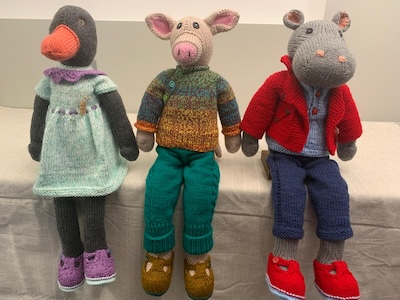
photo - Every one of Lea Bilot’s creations has its own expression
Every one of Lea Bilot’s creations has its own expression. (photo from Lea Bilot)

“I was never artistic before,” she said. Though perhaps she was, without realizing it. Creativity doesn’t usually spring out of nowhere. It surely shimmered inside her all along, finding unconventional channels among the demands of hard work and three growing children.  

“When we came to Vancouver, my husband and I started flipping houses,” she said. “We did it for a few years, but then COVID happened. Everything stopped. I didn’t know what to do. My husband found a job, but I was bored out of my mind.” 

She searched for an avenue to apply her fertile imagination.

“We went to our community centre once, and there was a craft fair there. I liked the knit toys someone was selling, but I thought: I could do better. And the idea stuck.”  

Never having made a knit toy before, Bilot did some research on the internet.

“I don’t speak good English,” she said. “So, I contacted a friend in Israel and asked if she could find me some books in Russian on the subject. She did and sent them.”

Bilot read all the books and then began to experiment.

“At first, I knitted some children’s clothing, but I don’t do that anymore,” she said. “Now, I concentrate on toys. I don’t copy what the books say either. I improve on them, make changes. I might use legs from one toy, hats from another, whatever fits my vision. Sometimes, I just follow my muse. Or I might find something new on the internet. There are several groups on Facebook, and we share information. We also help each other, when one of us hits a snag.”
Lea Bilot also makes other creatures, such as aliens
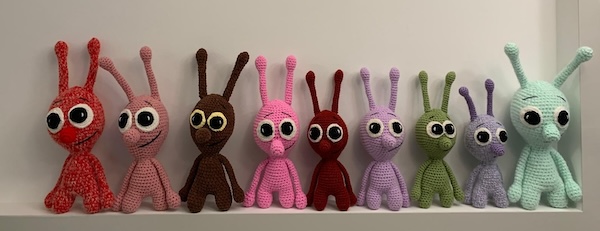
Lea Bilot also makes other creatures, such as aliens. (photo from Lea Bilot)

The variety of toys Bilot creates is astounding. Her output includes some common animals – dogs, cats, bears and rabbits – as well as owls in graduation hats, aliens with antennas and gnomes with beards. Each one has its own expression; no two are identical. For the winter holiday markets, she makes colourful Christmas trees with legs and hats, and snowmen decorated with buttons.

“I don’t knit snowmen – I make them from socks,” she said. “And, for my Christmas trees, I started to crochet. I’ve only been doing it for a few months.”  

She derives her ideas from everywhere.

“I once saw a man on the street with a big bushy beard. He was a short and fat older man, and his beard was white. I thought: that is my gnome.”       

Her home is half living space, half workshop.

“I have so much yarn now, I need to put it somewhere I can easily access,” she explained. “I put all my clothing in cardboard boxes, and my yarn into my dresser’s drawers.”

Most of her yarn is acrylic.

“Some children are allergic to wool. They like to hug their toys, kiss them, sleep with them. I have to use acrylic for the toys,” she said. “And I buy only expensive yarn: from Denmark, from Turkey, from Lithuania. I don’t use cheap local yarn – it doesn’t last long. Children put their toys to hard use. The toys need to be washable and durable.”   
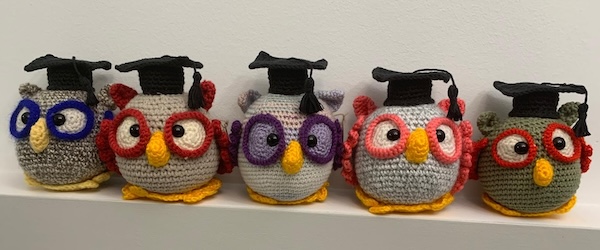
photo - Lea Bilot’s handmade owls
Lea Bilot’s handmade owls. (photo from Lea Bilot)

From design to execution to sales, Bilot enjoys every step of the toy-making process.

“I love making them. Sometimes, when I want to finish one, I wouldn’t sleep for half the night. It is such a joy making all those details – skirts, boots, glasses – and coming up with new concepts, new patterns.”

She loves selling the toys as well.

“People don’t always buy them, but, whenever they pass my table, they smile. Women, children, even men – they all smile. Children are very well behaved, too. They would handle my toys, hug them – I make them soft and extremely huggable – but they don’t demand that parents buy them, don’t throw fits. It’s always a pleasure to be around them. That’s why I don’t offer my toys to any stores. I want to witness those smiles.”

Bilot sells her toys several times a year at craft fairs at community centres, schools and even universities.

“There are websites for artisans like me,” she said. “They list all the fairs. I would drive to those fairs first, see what they are selling, what the conditions are, before applying to them as a vendor for the next time. My husband helps, he drives me around. And my daughter helps with the application process.”

When asked if she gets any income out of her full-time toy-making hobby, Bilot laughed. “I cover the price of yarn,” she said, “and a bit above it, but not much. Mostly, I do it for the fun of it.” 

To see Bilot’s creations and be ready when she next tables at a market, visit instagram.com/leas_knittings. 

Olga Livshin is a Vancouver freelance writer. She can be reached at [email protected].

Format ImagePosted on November 29, 2024November 28, 2024Author Olga LivshinCategories LocalTags arts and crafts, gifts, knitting, Lea Bilot, toys
Jewish papercutting art

Jewish papercutting art

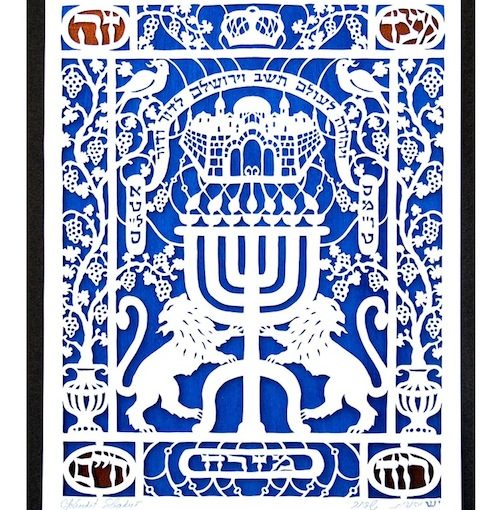
The paper cut “Jerusalem Mizrah” by Yehudit Shadur (1928-2011). (photo from shadurarts.com)

Papercuts are created by taking a folded sheet of paper and drawing a design on one side. The folded sheet is then fastened to a wooden board and the design is cut out with a sharp knife. When the paper is unfolded, a symmetrical work of art appears.

Papercutting dates back to the fourth-century CE in China. It appeared in Western Asia by about the eighth century; in Europe by the 13th century and in Turkey, Switzerland and Germany by the 16th century. Papercutting has been a common Jewish folk art since the Middle Ages and, by the 17th century, it was popular for Shavuot.

Shevuoslekh (little Shavuots) and roysele (rosettes or flowers) were used to decorate windows on Shavuot. They were made of white paper, usually, and frequently displayed the phrase, “Chag haShavuot hazeh” – “this holiday of Shavuot.”

According to an article by Sara Horowitz in the recently defunct Canadian Jewish News a couple of years ago, “for Ashkenazi Jews, there was a particular link between papercutting and Shavuot, which stems from an old practice of decorating homes and synagogues with flowers, branches, boughs and trees. In shtetl culture, cut flowers were a luxury – pricey and perishable. And Jewish culture was deeply literate, so paper, especially used paper – was always around and available for artistic repurposing. Some sources cite the objection of 18th-scholar Vilna Gaon to the Shavuot greening as another reason for the development of a Shavuot papercutting tradition. Because church décor involved cut flowers and pagan practices involved trees, the Vilna Gaon viewed such customs as inherently non-Jewish.”

An acquaintance of mine from many years ago, Yehudit Shadur (1928-2011), and her husband, Joseph, wrote a history of the last three centuries of Jewish papercutting, called Traditional Jewish Papercuts: An Inner World of Art and Symbol. The book won a 1994 National Jewish Book Council Award.

Yehudit Shadur was considered to be the one who pioneered the contemporary revival of the Jewish papercutting tradition. Her works are represented in major museum collections. She also had museum exhibits in Israel, England and the United States.

Shadur’s website offers many quotes from the artist, including one from a 1996 exhibit catalogue, in which she states, “What at first seemed a simple craft proved to be an artistic medium of endless possibilities and variations – not only in the arrangement of time-honoured Jewish symbols imbued with deep and often complex significance, but also in the challenges of colour, composition and texture. Eventually, the subject matter of my papercuts went beyond traditional forms and content to express my personal vision as a contemporary artist….”

Some typical symbols in Shadur’s Jewish papercuts – and in those of others – are menorot, crowns (keter Torah, the crown of Torah), columns representing the Temple in Jerusalem, plants or trees (the Tree of Life, the Torah), and grapevines, lions and gazelles (all representing the people of Israel).

For an in-depth article on the history of Jewish papercutting, visit myjewishlearning.com/article/jewish-papercutting.

If you’re looking for an activity to do with your children, PJ Library (pjlibrary.org) offers the book The Art Lesson: A Shavuot Story written by Allison and Wayne Marks and illustrated by Annie Wilkinson, in which “Grandma Jacobs teaches Shoshana how to make traditional papercuts,” and readers also learn to make a papercut. For anyone interested, there are various websites that have papercutting tutorials for kids and adults alike.

Chag sameach!

Sybil Kaplan is a journalist, lecturer, book reviewer and food writer in Jerusalem. She created and leads the weekly English-language Shuk Walks in Machane Yehuda, she has compiled and edited nine kosher cookbooks, and is the author of Witness to History: Ten Years as a Woman Journalist in Israel.

Format ImagePosted on May 15, 2020May 14, 2020Author Sybil KaplanCategories Celebrating the HolidaysTags arts and crafts, history, Judaism, kids, papercutting, parenting, Shavuot, Yehudit Shadur
Proudly powered by WordPress