
Skip to content
  • Home
  • Subscribe / donate
  • Events calendar
  • News
    • Local
    • National
    • Israel
    • World
    • עניין בחדשות
      A roundup of news in Canada and further afield, in Hebrew.
  • Opinion
    • From the JI
    • Op-Ed
  • Arts & Culture
    • Performing Arts
    • Music
    • Books
    • Visual Arts
    • TV & Film
  • Life
    • Celebrating the Holidays
    • Travel
    • The Daily Snooze
      Cartoons by Jacob Samuel
    • Mystery Photo
      Help the JI and JMABC fill in the gaps in our archives.
  • Community Links
    • Organizations, Etc.
    • Other News Sources & Blogs
    • Business Directory
  • FAQ
  • JI Chai Celebration
  • JI@88! video

Recent Posts

  • האלימות בישראל מורגשת בהרבה מגזרים
  • טראמפ עוזר דווקא לנושא הפלסטיני
  • New rabbi settles into post
  • A light for the nations
  • Killed for being Jewish 
  • The complexities of identity
  • Jews in time of trauma
  • What should governments do?
  • Annie will warm your heart
  • Best of the film fest online
  • Guitar Night at Massey
  • Partners in the telling of stories
  • Four Peretz pillars honoured
  • History as a foundation
  • Music can comfort us
  • New chapter for JFS
  • The value(s) of Jewish camp
  • Chance led to great decision
  • From the JI archives … camp
  • עשרים ואחת שנים להגעתי לונקובר
  • Eby touts government record
  • Keep lighting candles
  • Facing a complex situation
  • Unique interview show a hit
  • See Annie at Gateway
  • Explorations of light
  • Help with the legal aspects
  • Stories create impact
  • Different faiths gather
  • Advocating for girls’ rights
  • An oral song tradition
  • Genealogy tools and tips
  • Jew-hatred is centuries old
  • Aiding medical research
  • Connecting Jews to Judaism
  • Beacon of light in heart of city

Archives

Follow @JewishIndie
image - The CJN - Visit Us Banner - 300x600 - 101625

Tag: sufganiyah

Making holiday doughnuts

Making holiday doughnuts

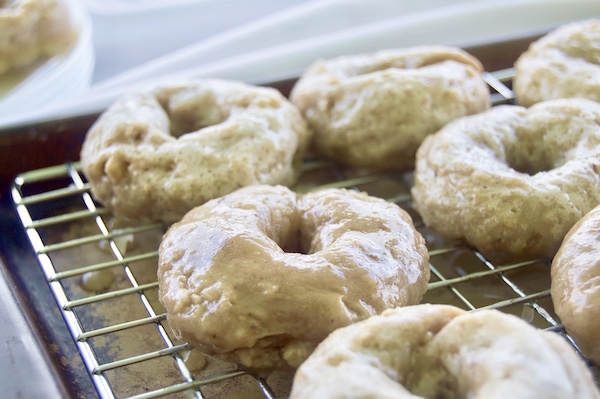
Syrian doughnuts can be made with a hole, or not. And they are topped with lemon or another type of glaze or syrup, rather than having a jelly filling. (photo from vegankinda.wordpress.com)

One of the things I have enjoyed the most as a food writer is learning the different customs of Jews from around the world. When it comes to doughnuts, all the communities make a dough dessert fried in oil, but there are differences.

Dov Noy, who was an Israeli folklorist and ethnologist, related a Bukhharian fable, which says that the first sufganiya was a sweet given to Adam and Eve as compensation after their expulsion from the Garden of Eden. He says the word sufganiya comes from the Hebrew word sof (meaning end), gan (meaning garden) and Ya (meaning G-d). Thus, the word means, the end of G-d’s garden. According to Noy, this fable was created at the beginning of the 20th century, since sufganiya was a new Hebrew word coined by pioneers.

Some consider sufganiyot, which means sponge-like, to be reminiscent of the sweet, spongy cookies that have been popular along the Mediterranean since the time of the Maccabees. Hebrew dictionaries say the word actually comes from the Greek word sufgan, meaning puffed and fried.

A few months ago, I happened to stop at a vendor in Machane Yehuda, the Jewish market where I shop and lead weekly walks, to ask about a pastry he was selling. He told me it was shvinze. Many years ago, a neighbour had given me her mother’s receipt for shvinze and I share it with you here.

I’ve also included a recipe from another neighbour, who made a similar type of dessert that she learned from her mother, who came from Syria. And the third recipe is for traditional Israeli doughnuts that can be filled or left plain. Talia was 5-and-a-half years old when she gave me this recipe – today, she is the mother of four, a tour guide married to a photographer, and living in the scene of the Chanukah story, Modi’in.

MOROCCAN SHVINZE

1 2/3 tbsp yeast
1/4 cup lukewarm water
a pinch salt
4 cups flour
oil
honey or confectioners’ sugar

  1. Place yeast in a small bowl with water. Place flour in another bowl. After the yeast swells, add to the flour. Add salt, then knead into an elastic dough.
  2. Place oil in a deep pot. Wet hands, take a piece of dough and shape it into a circle. Punch a hole in the centre, then drop the dough into oil. Brown it on both sides. Drain on paper towels.
  3. Serve with honey or confectioners’ sugar.

SYRIAN ZINGOLE

 2 tsp yeast
a few spoons warm water
2 cups flour
1 1/2 cups water
oil

icing:
1 cup sugar
1 cup water
1 1/2 tbsp lemon juice

  1. Place yeast in a small bowl. Add a few spoons of warm water to dissolve.
  2. Place flour in another bowl. Add yeast and then more water to make a liquidy batter.
  3. Heat oil in a deep pot. Spoon batter into pan like pancakes. Fry until brown on both sides. Drain on paper towels.
  4. Combine sugar, water and lemon juice in a saucepan. Cook until sugar dissolves.
  5. Dip each pancake in sauce, then place on a serving platter.

TALIA’S SUFGANIYOT FOR JUNIOR COOKS

3 1/2 cups flour
1 1/2 cups plain yogurt
2 eggs
2 tbsp sugar
a pinch salt
1/2 tsp vanilla
oil

  1. In a mixing bowl, supervised by an adult, combine flour, yogurt, sugar and salt. Add eggs and vanilla and blend.
  2. Heat oil in a deep pot (with an adult’s help). Drop dough by tablespoon into oil. Fry until brown on both sides. Drain on paper towels.
  3. When cool to the touch, fill, using a tube or a large syringe, with your favourite jelly. Roll in confectioners’ sugar.

Sybil Kaplan is a journalist, editor of nine kosher cookbooks (working on a 10th) and a food writer living in Jerusalem. She leads English-language Shuk Walks in Machane Yehuda.
Format ImagePosted on November 19, 2021November 18, 2021Author Sybil KaplanCategories Celebrating the HolidaysTags baking, Chanukah, doughnuts, sufganiyah
It’s time to make sufganiyot

It’s time to make sufganiyot

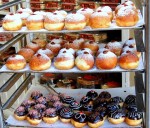
There are so many flavors of sufganiyot to be found in Jerusalem around this time of year. (photo by Barry A. Kaplan)

From Israel have come two popular foods for Chanukah: sufganiyot (doughnuts, often filled with jelly) and ponchikot, which are ball-shaped, resembling a doughnut hole.

Gil Marks, in The World of Jewish Desserts, writes that doughnuts fried in oil, ponchikot, were adopted by Polish Jews for Chanukah. The name is taken from the Polish paczki (pronounced poon-chkey), which led to the nickname ponchiks, the Polish name for jelly doughnuts. Paczki are similar to jelly doughnuts, only larger, more dense and more rich, and are traditionally served on Shrove Tuesday, the day before Ash Wednesday, which marks the beginning of Lent. Paczki were made to quickly use up stores of shortening and eggs, which were prohibited during Lent.

Sufganiyot also have interesting history. Some say sufganiyah, which in Hebrew means sponge-like, is reminiscent of the sweet, spongy cookie popular along the Mediterranean since the time of the Maccabees. Hebrew dictionaries say the word comes from the Greek sufgan, meaning puffed and fried.

In The Jewish Holiday Kitchen, Joan Nathan, an acquaintance of mine from our Jerusalem days and noted cookbook author and maven of American Jewish cooking, said she learned a fanciful fable about the origins of sufganiyot from Dov Noy, an Israeli folklorist. Noy relates a Bukhharan fable in which the first sufganiyah was given to Adam and Eve as compensation for their expulsion from the Garden of Eden. The word sufganiyah, he writes, comes from the word sof meaning end, while gan means garden and Y-ah is G-d. Thus, sufganiyah means the end of G-d’s garden. Noy clarifies that clearly this fable was created at the beginning of the 20th century, since sufganiyah is a spoken Hebrew word coined by pioneers.

CLASSIC SUFGANIYOT
makes 32-36

3 1/2 cups flour
2 eggs
4 3/8 tsp baking powder
3/8 tsp salt
2 cups vanilla yogurt
2 tsp sugar
1/2 tsp vanilla
oil
confectioner’s sugar or cinnamon sugar

  1. Mix flour, eggs, baking powder, salt, yogurt, sugar and vanilla in a mixing bowl until well blended.
  2. Heat oil in a soup pot. Drop tablespoon of batter around the pot, fry until brown on both sides, drain on paper towels.
  3. Roll in cinnamon sugar or confectioner’s sugar.

OVEN-BAKED SUFGANIYOT
makes 24

1 cup skim milk
2 tbsp unsalted butter
1/4 cup sugar
1 tsp salt
1 egg
3 1/2 cups flour
2 tbsp instant yeast

Syrup:
2 cups sugar
3/4 cup water

Sugar coating and filling:
1/4 cup sugar
jam 

  1. Preheat oven to 375°F. Grease mini muffin cups.
  2. Heat milk and butter in a saucepan. Stir in sugar and salt. Let cool.
  3. In one mixing bowl, combine egg and milk mixture. In a second bowl, combine three cups of flour with yeast, then add to egg-milk mixture and beat for two minutes with mixer or hand mixer.
  4. Stir in half-cup flour to make soft batter. Cover and let rise until double in volume.
  5. Turn dough onto a floured work space. Roll dough into a log. Cut off pieces and form into balls. Place each ball in a muffin cup. Cover pans and let rise for 30 minutes.
  6. Place in oven and bake 12-15 minutes until lightly browned.
  7. In the meantime, combine sugar and water in a saucepan. Heat, then boil until thick. Reduce heat and keep warm.
  8. Remove doughnuts to a cooling rack then toss in sugar syrup and remove with a slotted spoon. Roll in sugar. To inject, poke a hole in the side of each doughnut, inject jelly. If not serving immediately, wait to dip in sugar syrup and rolling in sugar.

These can be made three months ahead and frozen after cooled. To use, defrost, cover with foil, reheat in 350°F oven 15 minutes, dip in sugar syrup and either roll in sugar or inject with jelly.

PAREVE CHANUKAH PONCHIKOT
makes 36

2 cups flour
1/4 cup sugar
1 tbsp baking powder
1 tsp salt
1 tsp nutmeg
1/4 cup vegetable oil
3/4 cup non-dairy creamer
1 egg
oil
confectioner’s sugar or cinnamon sugar 

  1. In a mixing bowl, combine flour, sugar, baking powder, salt and nutmeg. Mix.
  2. Add oil, non-dairy creamer and egg and mix.
  3. Heat oil in a soup pot. Drop by teaspoon into oil and fry on all sides until brown. Drain on paper towels.
  4. Roll in confectioner’s sugar or cinnamon sugar.

Sybil Kaplan is a journalist, foreign correspondent, lecturer, food writer and book reviewer who lives in Jerusalem. She also does the restaurant features for janglo.net and leads weekly shuk walks in English in Jerusalem’s Jewish food market.

Format ImagePosted on December 12, 2014December 22, 2014Author Sybil KaplanCategories Celebrating the HolidaysTags Chanukah, ponchikot, sufganiyah, sufganiyot
Proudly powered by WordPress