Learn ABCs, Hanukkah-style

The Canadian Medical Association would probably not approve, but Rachel Teichman’s D is for Donut is a sweet way to teach kids their ABCs. (Pun intended … groan.)

image - D is for Donut by Rachel Teichman, with photos by Rebecca Wright, book cover

For this hardcover (or ebook), Teichman again pairs up with Rebecca Wright, Teichman composing the rhyming text and Wright taking the colourful large-as-life photographs. D is for Donut (2023) and their previous collaboration, B is for Bagel (2022), are both published by the Collective Book Studio, grouped as the ABCD-Eats series, implying, perhaps, that there are more books on the way.

The Collective Book Studio describes itself as “an independent publisher dedicated to creating high-quality, beautifully crafted books that celebrate diverse voices and empower storytelling.” On their website, under Collections, one can find Jewish Voices, which, in this time of increased antisemitism, is even more nice to see. The ABCD-Eats books are included here, as are two cookbooks that the Independent has reviewed and enjoyed: 52 Shabbats: Friday Night Dinners Inspired by a Global Jewish Kitchen by Faith Kramer, and NOSH: Plant-Forward Recipes Celebrating Modern Jewish Cuisine by Micah Siva. Collective also published Tali and the Toucan, which the JI reviewed (positively!) in its Nov. 29 issue.

D is for Donut is more proof that the Collective Book Studio really does produce beautiful, high-quality books. Whether or not one agrees with teaching kids their letters by also introducing them to the wide variety of sugary toppings that can be put onto fried dough, D is for Donut makes for a fun and eye-popping read. It begins with a brief summary, poetically written, of how donuts are made, from “First, flour, yeast and milk are mixed together and left to rise” through the frying then the frosting and sprinkles. “Did you know donut holes come from where the donut’s shape is cut?” asks Teichman. (I did not.)

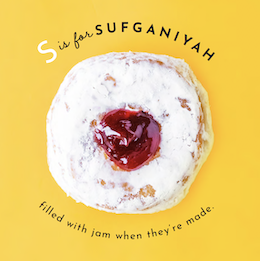
image - D is for Donut by Rachel Teichman, with photos by Rebecca Wright, includes the letter S, for sufganiyah
D is for Donut by Rachel Teichman, with photos by Rebecca Wright, includes the letter S, for sufganiyah.

The bulk of the book is the letters, and a global range of donut types. For example, “A is for apple fritter with fruit and cinnamon inside”; “L is for loukoumades dipped in honey and piled high”; “S is for sufganiyah filled with jam when they’re made” (happy Hanukkah!); and “Z is for zeppole, they’re a real work of art!” 

“Donuts are delish, frosted and fried! So tell me … which ones have you tried?” asks Teichman.

D is for Donut includes two recipes: one for Raised Donuts, which takes more time and requires some tools people may not own (to be exact, a two-quart pot, cooking thermometer and heat-resistant slotted spoon), and one for Quick Baked Donuts. 

Jewish Mexican food excites

Paletas can be made in many flavours. Sabor Judío includes a recipe that uses Manischewitz wine. (photo by Ilan Rabchinskey)

The minute I saw the cover, I wanted to try some of the recipes in Sabor Judío: The Jewish Mexican Cookbook by Ilan Stavans and Margaret E. Boyle. Not only did I learn how to make some very tasty food, but I learned a bit about the Jewish community in Mexico and its history.

image - Sabor Judío cookbook coverPublished by the University of North Carolina Press, with hunger-inducing colour photographs by Ilan Rabchinskey, and written by two Jewish Mexican scholars (now living in the United States), Sabor Judío was a cultural experience for me, never having been to Mexico before and only ever having made a basic burrito at home. Of course, I’ve eaten at many Mexican restaurants over the years, but Sabor Judío features recipes you won’t necessarily find in a restaurant here in Vancouver, or even in Canada, though local Jewish community members with Mexican roots might make some of these dishes at home.

There were two very important inspirations for Sabor Judío.

One was Stavans’ grandmother, Bobe Miriam, whose recipe book, written in a mix of Yiddish and Spanish, was started in the 1920s, after she immigrated to Mexico from Poland. It evolved over decades, as she figured out what worked and what didn’t, and as ingredients changed. The notebook “wasn’t just about cooking; it was also a time capsule that chronicled, through dishes, the Jewish family’s process of assimilation into Mexico and the way La Comunidad, as the Jewish Mexican community is known, showcases its personality to the world.”

The other was Boyle’s great-grandmother, Baba Malka, also a Polish immigrant to Mexico: “While Baba Malka was still actively cooking, her children, grandchildren and great-grandchildren took turns observing and documenting her work in the kitchen in Mexico City, filling the notebook’s pages with notes and adaptations in Spanish, Hebrew and English as the family generations expanded across Mexico and into the United States.”

The recipes in Sabor Judío are “dishes collected from grandmothers and other beloved home cooks, professional chefs and bakers, and a variety of historical sources,” writes cookbook author Leah Koenig in the preface. Even she came across ingredients she had never used before. “I learned the hard way that nopales (cactus paddles) should always be handled wearing gloves, lest the prickly spines leave your hands stinging for the rest of the day.”

The recipe for Cactus Tomato Salad does include a note about the proper handling of cactus leaves. But, not sure of where I could buy cactus here, I inadvertently saved myself the trouble of removing the spines, boiling the cactus and cutting it into 1/4-inch pieces by buying a jar of cactus that was already prepared in that way. This substantially eased the process of making this salad, which was very good, though I’m sure fresh cactus would have made it even better.

I chose what to make from Sabor Judío by looking at what the cookbook authors recommended as a festive Hanukkah meal, which includes the Cactus Tomato Salad. I had already singled out the Falafel Taquitos because I liked the idea of mixing Mexican and Middle Eastern flavours. In the end, there was a bit of a disconnect for me between the taste of the falafel centre and that of the corn tortilla shell. In eating leftovers the next day, I greatly enhanced the enjoyment of this dish by adding some fresh-cut tomatoes and cucumber.

I also had already eyed Agua de Horchata because of the first sentence in its description, which says that the rice-milk drink – which is believed to have 11th-century North African origins – “accompanies a good Mexican Jewish meal.” I was very pleased with how it turned out. I will definitely make it again.

The Latkes con Mole were as labour-intensive (grating potatoes and onion) and delicious as other latkes I’ve had, and I would happily swap out my usual apple sauce every so often for mole and crumbled queso fresco, even though it takes a lot of time to make mole.

I tried a second fried item, it being for Hanukkah and all, and the Sor Juana’s Ricotta Buñuelos were so good, if that’s a thing. The anise really made them pop, and I ate way too many.

Lastly, knowing how much I like paletas, I couldn’t resist making the frozen treats using Manischewitz. The wine most definitely tastes better frozen, after being steeped in cinnamon, cloves and orange.

There are other Hanukkah – Janucá – meals, as well as suggested menus for other Jewish holidays. In total, there are about 100 recipes in Sabor Judío, including desserts. One thing you’ll learn from this cookbook is that the Canadian and Mexican concepts of breakfast, lunch and dinner differ somewhat. You’ll learn some Spanish, some history and more. You’ll be introduced to some new-to-you ingredients and ways to combine those ingredients.

As Stavans and Boyle wish readers at the end of their book’s introduction, perfectly capturing the fusions taking place throughout it: “¡Buen provecho! Mit a gutn apetit! Kome kon gana!” Enjoy your meal(s).

FALAFEL TAQUITOS
(serves 6; prep takes 30 minutes plus overnight soaking and a 30-minute chilling time; 20 minutes to bake)

for the taquitos:
1/2 lb dried chickpeas, soaked overnight in water, then rinsed and drained
1/2 medium yellow onion, roughly chopped
2 tbsp fresh parsley, roughly chopped
2 tbsp cilantro, roughly chopped
2 medium garlic cloves, roughly chopped
1 tsp kosher salt, plus more as needed
1 tsp ground cumin
1/2 tsp ground coriander
1/8 tsp cayenne
vegetable oil, for brushing
12 (6-inch) corn tortillas

for the tahini sauce:
1/2 cup well-stirred tahini
1/4 cup fresh lemon juice
1/4 cup cold water

1. Add the chickpeas to a food processor bowl along with the onion, parsley, cilantro, garlic, salt, cumin, coriander and cayenne. Pulse, scraping down the sides of the bowl as needed until a textured paste forms. Taste and add more salt, if needed. Transfer to a bowl and refrigerate the mixture for 30 minutes.

2. Heat the oven to 400˚F and brush a 9-by-13-inch baking dish with about 1 tablespoon of oil. Lay one tortilla on a flat surface and place a scant 1/4 cup of the filling along one edge, nudging it into a line. Roll up the tortilla tightly and place it seam-side down in the prepared backing dish. Repeat the process with the remaining tortillas and filling.

3. Brush the tops of the tortillas with more oil and bake until crispy and golden, 15-20 minutes. Meanwhile, whisk together the tahini, lemon juice and water. Serve the taquitos hot, drizzled with tahini sauce.

AGUA DE HORCHATA
(serves 8-10; prep takes 10 minutes, plus overnight soaking and a 4-hour chilling time)

2 cups long-grain white rice, rinsed well and drained
1 cinnamon stick
6 cups room-temperature water, divided, plus more as needed
3/4 cup granulated sugar
2 cups whole milk
2 tsp vanilla extract
ice, for serving (optional)

1. Place the rice and cinnamon stick in a large glass bowl and add 4 cups of the water. Cover the bowl and let the mixture soak overnight at room temperature (at least 8 hours).

2. Pour the soaked rice mixture into a high-powered blender along with the sugar and blend until smooth. (You can tear the cinnamon stick into smaller pieces to facilitate its blending.) Pour the mixture through a fine mesh sieve into a large wide-mouth pitcher, stirring and pressing the mixture with a spoon, if needed, to help the liquid pass through the sieve. (Discard any remaining solids.)

3. Whisk in the milk, the remaining 2 cups of water, and vanilla. Cover the pitcher and chill the horchata in the refrigerator until cold, at least 4 hours. (The mixture will continue to thicken as it chills.)

4. Just before serving, stir the horchata well and pour into glasses (over ice, if desired). If the horchata gets too thick, you can thin it with a little more water.

SOR JUANA’S RICOTTA BUÑUELOS
(makes 10-15 fritters; prep takes 40 minutes, plus 1-hour resting time; 30 minutes to cook)

1 cup ricotta cheese
6 egg yolks
1/4 cup granulated sugar, plus more for serving
2 1/2 tsp ground anise
3 cups all-purpose flour, plus more for rolling
1 1/2 tsp baking powder
vegetable oil, for frying
jam, for serving

1. Combine the ricotta, egg yolks, sugar and ground anise in the bowl of a stand mixer and beat on low until combined. Whisk together the flour and baking powder in a medium-sized bowl.

2. Add the flour mixture to the ricotta mixture in stages, beating on low and scraping down the sides of the bowl as necessary, until a thick and sticky dough forms. Cover the mixing bowl and let rest at room temperature for 1 hour. 

3. On a large, floured work surface using a floured rolling pin, roll out the dough to a 1/8-inch thickness. Use a sharp knife and a plate or bowl with a 4-to-5-inch diameter to cut out circles. Gather the scraps and repeat the rolling and cutting process, if desired.

4. Heat 1/4 inch of oil in a medium frying pan set over medium heat until it reaches 350˚F on a digital thermometer, and line a large baking sheet with paper towels. Working with one circle of dough at a time, slip it into the hot oil and fry, turning once, until puffed and golden, 30 to 60 seconds per side.

5. Transfer the fritters to the paper towels to drain and cool slightly. Serve warm, sprinkled with more sugar or dolloped with jam.

PALETAS MANISCHEWITZ
(makes 6; prep takes 40 minutes; freeze 5 hours)

1 (750-ml) bottle Manischewitz sweet red wine
3 wide strips orange peel
4 whole cloves
1 cinnamon stick
2 cups water
thinly sliced limes and tangerines (optional)

1. Add the wine, orange peel, cloves and cinnamon stick to a medium saucepan set over medium-high heat. Bring the mixture to a boil, then lower the heat to medium and cook, stirring occasionally, until the liquid reduces to 1 cup, 30-35 minutes. Remove from the heat and let cool, then strain out and discard the spices and orange peel.

2. Stir the water into the strained wine syrup, then divide the mixture evenly among 6 paleta or flat popsicle molds. If desired, add a slice of lime or tangerine into each mold. Freeze until solid, at least 5 hours. 

Vibrant start to new year

Visiting Rabbi Cantor Russell Jayne (of Beth Tzedec Congregation, Calgary) was in Kelowna for a September Shabbaton. (photo from the OJC)

The Okanagan Jewish Community may be small, but it’s got a strong, involved congregation that makes an impact on the region.

On Sept. 14, the OJC hosted the first Okanagan multifaith community event, organized by the Kelowna General Hospital Spiritual Care Committee. Numerous faith-based organizations throughout the valley are part of this supportive, open-minded learning collective. The goal of the new group is to discover what unites us and what distinguishes us as citizens, and to promote peace and understanding across religious and cultural lines.

* * *

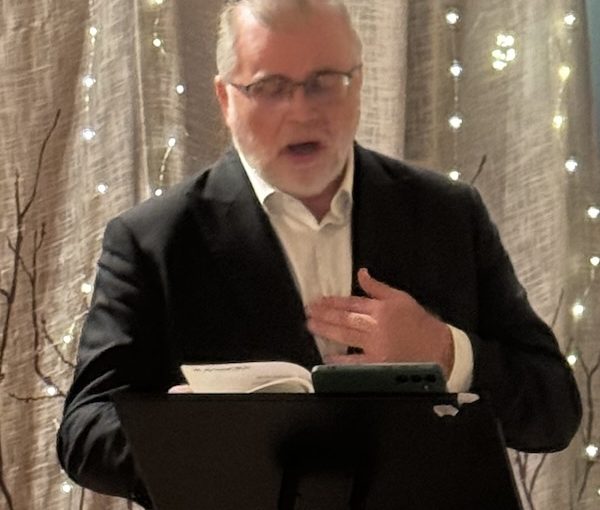
The OJC enjoyed another Shabbat with Rabbi Cantor Russell Jayne from Calgary, Sept. 20-21. This was the start of the community’s visiting rabbi series for the new year and Jayne shared his historical knowledge, philosophical insights and voice from the bimah, and delighted community members with beautiful melodies at the Kaffehaus event on the Saturday evening. 

* * * 

On Oct. 6, Harley Kushmier and Maureen Mansoor organized an Oct. 7 commemorative film and discussion evening, which was solemn, moving and enlightening.

* * * 

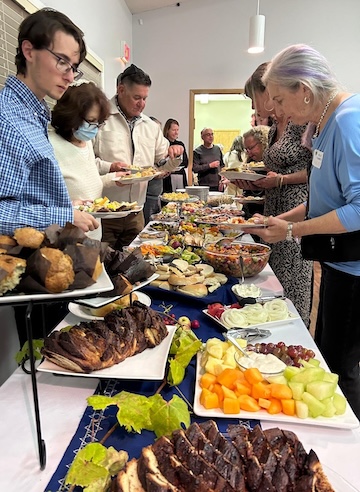
photo - The Okanagan Jewish Community’s break fast meal Oct. 12
The Okanagan Jewish Community’s break fast meal Oct. 12. (photo from the OJC)

The OJC’s High Holidays were very much community-driven again this year.

Evan Orloff led the services and the community is grateful that he has the heart and knowledge to serve as a lay leader. 

OJC president Laura McPheeters lent her musical talents to the services and Adam Tizel sounded the shofar. The Torah was read by Josh Golden and Steven Finkleman. The community break fast meal was organized by Josh Golden and Abbey Westbury.  

* * *  

The OJC Sisterhood hosted a luncheon on Oct. 23 with guest speaker Taylor Backman of the RCMP. His presentation about security during this period of heightened antisemitism was timely. Backman has offered to come speak to the community again in the spring.

The next Sisterhood luncheon is scheduled for Dec. 12, and there will be a reprise of last year’s popular Hanukkah gift exchange.

* * * 

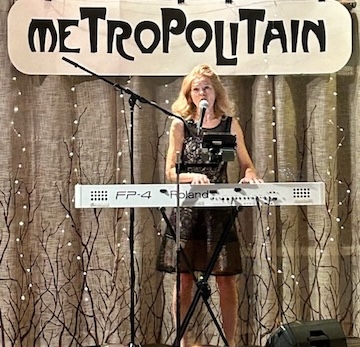
photo - Kelowna musician Patricia Dalgleish joined the OJC earlier this month for the Parisian-themed Café au J
Kelowna musician Patricia Dalgleish joined the OJC earlier this month for the Parisian-themed Café au J. (photo from the OJC)

The first weekend in November brought Rabbi Jeremy Parnes from Regina. As ever, he graced the bimah with thoughtfulness, charm, and a strong focus on community and healing. That Saturday evening, OJC members took a virtual field trip to the Seine with the Parisian-themed Café au J! Amid the croissants and crêpes, Kelowna songstress Patricia Dalgleish took to the stage with French ditties and crowd favourites that had everyone singing along.

* * *

Looking ahead, the OJC is excited to welcome Rabbi Matthew Leibl from Winnipeg for its December Shabbaton weekend. Social events will take place on those nights, as well. The community’s annual Hanukkah party, the Sisterhood’s Christmas Eve Chinese food dinner, themed Kaffehaus nights, and many other get-togethers are planned in the coming months. 

– Courtesy Okanagan Jewish Community

Two great books for giving – Tali and the Toucan & Oy, Santa!

Honestly, I think adults would benefit from reading children’s books, even if they don’t have kids. Generally, the books impart good messages, like how to overcome challenges or be proud of who you are, and their illustrations are works of art. The two I reviewed for this issue of the Jewish Independent are prime examples.

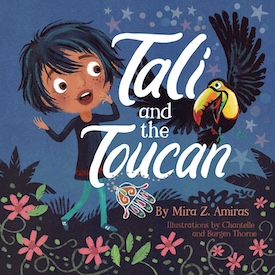
image - Tali and the Toucan book coverTali and the Toucan by writer Mira Z. Amiras and illustrators Chantelle and Burgen Thorne (Collective Book Studio) is set in San Francisco. The young protagonist, Tali, longs to tumble, swing and cartwheel like other kids, and she would love to take martial arts. But she is debilitated by fear – that the world will shatter, that she will break into a million pieces, that she will get hurt. Then, one night, she has a dream. At first, it’s kind of a scary dream, with a storm raging, chickens flapping about. One chicken makes it to the roof, pecks a hole in the window glass, and transforms into a toucan. The colourful-beaked bird teaches Tali how to tumble and soar in the sky. She awakes with new spirit and courage, no longer feeling like a chicken but like a toucan, ready to fly – and fall – with the other kids.

While not spelled out in the story, at the end of the book, there’s a note that explains that Tali’s fear of the world shattering “is taken from Jewish teachings that the world is indeed broken and that our job, called in Hebrew tikkun olam, is to put it back together again – starting with ourselves.” In addition to the “hamsa she wears – an amulet common to peoples of the  Middle East worn to protect children – her dreams lead her to conquer her fears, begin her tikkun and follow the path of Aikido, the Japanese martial art of nonviolence that teaches harmony, mutual assistance and peaceful resolutions to conflict.”

Other than the fact that Tali wants to do martial arts, the text of Tali and the Toucan doesn’t touch upon ideas like multiculturalism, cooperation or what a well-functioning society looks like, but rather expresses these concepts through the artwork. There’s a lot to look at in the illustrations and they beautifully capture Tali’s emotional journey.

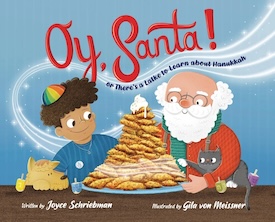
image - Oy, Santa! book coverOy, Santa!, or There’s a Latke to Learn about Hanukkah by writer Joyce Schriebman and illustrator Gil von Meissner (Intergalactic Afikoman) also expresses so much with its artwork. Whereas Tali’s hamsa makes an appearance on almost every page of her book, different kinds of light run through Oy, Santa! – white swirls full of stars, hanukkiyot with candles lit, strings of Christmas lights and exploding fireworks. While Tali and the Toucan only hints at multiculturalism and doesn’t explicitly talk about Judaism, Oy, Santa! puts both topics front and centre.

On Christmas Eve, young Oliver Overstreet writes an email to Santa: “I know you’re busy making toys, so I won’t write much. But I’m Jewish. And that means you don’t have to come down my chimney on Christmas Eve. I just wanna make sure you know.”

And so begins a delightful – and educational – email exchange between Oliver and Santa, who assures Oliver that he knows that both Oliver, and Oliver’s friend Ibrahim, do not celebrate Christmas. Oliver rails at Santa’s signoff, wishing Oliver a “Happy Chrismukkah!”

“Dear Santa,” he writes. “I know you’re still very busy. But please don’t write Chrismukkah. That’s not my holiday. I celebrate HANUKKAH. And Hanukkah and Christmas are different….” Oliver goes on to explain the story of Hanukkah and some of the fun ways the holiday is celebrated.

Santa and Oliver talk about many things in subsequent emails, from elves getting time off to celebrate whatever holidays are in their culture, to miracles and how reindeers fly, to whether it’s acceptable to put ketchup on latkes, and more. The conversation even gets a little heated, but – spoiler alert – Oliver and Santa work things out.

Oy, Santa! is a wonderful read, with lots of humour, fun illustrations, and great takeaways about identity, diversity, culture, civil discourse and friendship. 

Rabbis’ emotional journey

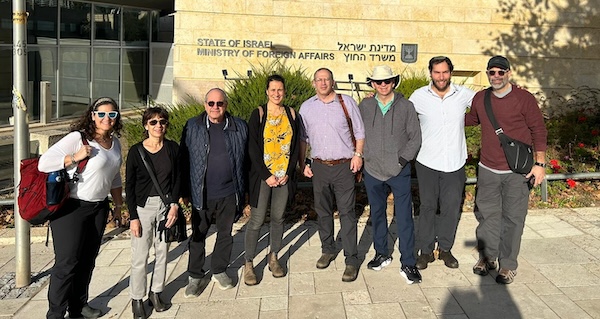
Left to right: Rabbis Susan Tendler, Hannah Dresner, Philip Bregman, Carey Brown, Andrew Rosenblatt, Jonathan Infeld, Philip Gibbs and Dan Moskovitz in Israel last month. (photo from facebook.com/jewishvancouver)

Eight Vancouver-area rabbis recently visited Israel where, among many other things, they handed out cards and letters prepared by Jewish day school students and members of Vancouver’s Jewish community to soldiers and other Israelis. The response, according to one of the rabbis, was overwhelming.

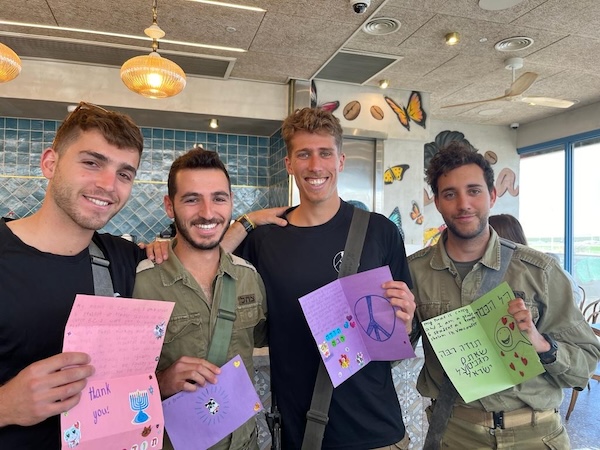
“I saw soldiers taking these cards and then dropping down to the sidewalk and crying,” said Rabbi Philip Bregman. “Holding them to their chest as if this was a sacred piece of text and just saying, ‘Thank you. To know that we are not forgotten….’”

photo - The rabbis’ mission included the delivery of thank you cards to Israeli soldiers
The rabbis’ mission included the delivery of thank you cards to Israeli soldiers. (photo from facebook.com/jewishvancouver)

Bregman, rabbi emeritus at the Reform Temple Sholom, was almost overcome with emotion while recounting the experience, which he shared in a community-wide online presentation Dec. 17. The event included seven of the eight rabbis who participated in the whirlwind mission, which saw them on the ground for a mere 60 hours. Rabbi Andrew Rosenblatt of the Orthodox Congregation Schara Tzedeck was part of the mission but did not participate in the panel because he extended his time in Israel.

According to Ezra Shanken, chief executive officer of the Jewish Federation of Greater Vancouver, who emceed the event, the Vancouver mission was unique in Canada and possibly in North America for bringing together rabbis from across the religious spectrum. The close connection of most local rabbis, facilitated by the longstanding Rabbinical Association of Vancouver (RAV), set a foundation for the mission, which took place in the second week of December.

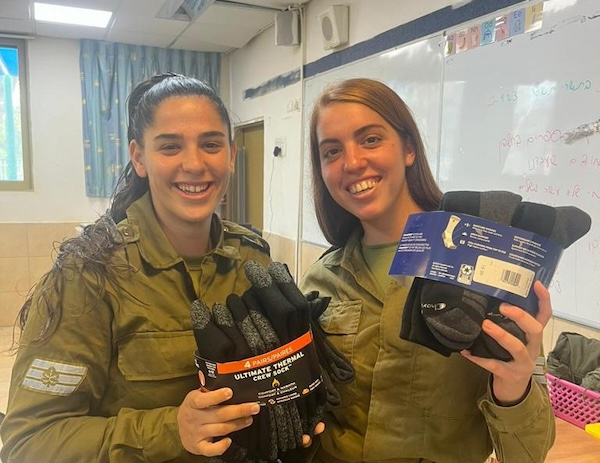
The eight rabbis transported 21 enormous duffel bags, filled with gear like socks, gloves, toques and underwear, mostly for military reservists.

photos - The rabbis delivered warm clothing, including socks, to Israeli soldiers
The rabbis delivered warm clothing, including socks, to Israeli soldiers. (photo from facebook.com/jewishvancouver)

Shanken, who visited Israel days earlier with Federation representatives and five Canadian members of Parliament, said nothing prepared him for what he encountered there. Bregman echoed Shanken’s perspective.

“It’s one thing to have that as an intellectual understanding,” said Bregman, “It’s another thing when you are actually there to witness the absolute pain and trauma. People have asked me how was the trip. I say it was brutal.”

The reception they received from Israelis was profound, several of the rabbis noted. 

“I’ve been to Israel dozens of times,” Bregman said. “People are [always] happy to see us. Nothing like this.”

Rabbi Dan Moskovitz, senior rabbi at Temple Sholom, said the mission was to bear witness and also was a response to what rabbis were hearing from congregants about the centrality of Israel in their lives. He told the Independent that he was able to connect with two philanthropists in Los Angeles who funded the mission. Rabbi Carey Brown, associate rabbi at Temple Sholom, and Rabbi Susan Tendler, rabbi at the Conservative Beth Tikvah Congregation, in Richmond, handled logistics, with input from the group.

The unity of Israelis was among the most striking impressions, said Brown.

“It’s so all-encompassing of the society right now … the sense that everyone’s in this together,” she said. The unity amid diversity was especially striking, she noted, when the rabbis visited the central location in Tel Aviv known as “Hostage Square.”

Brown said Israelis asked about antisemitism in Canada and seemed confounded by the fact that there is not more empathy worldwide for the trauma their country has experienced.

Tendler reflected on how Israelis were stunned and touched by the fact that a group of Canadians had come to show solidarity.

The rabbis were able to experience a microcosm of Israeli society without leaving their hotel. At the Dan Panorama Tel Aviv, where they stayed, they were among only a few paying guests. The hotel was filled with refugees from the south and north of the country who are being indefinitely put up in the city. 

Several rabbis spoke of incidental connections in which they discovered not six degrees of separation between themselves and people they ran into, but one or two.

Rabbi Jonathan Infeld of the Conservative Congregation Beth Israel, who is chair of RAV, told of being approached by members of a family staying at their hotel who heard they were from Vancouver. They asked if the rabbi knew a particular family and he replied that he not only knew them but that a member of that family had just married into his own.

Likewise, Tendler ran into people who went to the same summer camp she did and the rabbis found many other close connections.

“The idea [is] that we are spread out but, at the heart of it all, we honestly really are one very small, connected people,” said Tendler. “We are one family, one community and that was the most important, amazing thing of all.”

Close connections or not, the rabbis were welcomed with open arms. Rabbi Philip Gibbs of West Vancouver’s Conservative Congregation Har El told of how he was walking past a home and glanced up to see a family lighting Hanukkah candles. They insisted he come in and mark the occasion with them.

Gibbs also noted that the political divisions that had riven the society before Oct. 7 have not disappeared, but that the entire population appears to have dedicated themselves to what is most important now.

The rabbis met with scholars, including Israeli foreign ministry experts and many ordinary Israelis, including Arab Israelis, as well as the writer Yossi Klein Halevi, who told them that many Israelis feel let down by their government, intelligence officials and military leadership.

The rabbis traveled to the site of the music festival where 364 people were murdered, more than 40 hostages kidnapped and many more injured on Oct. 7. They saw scores of bullet-riddled and exploded vehicles. All of them will be drained of fuel and other fluids before being buried because they contain fragments of human remains that ZAKA, Israel’s volunteer rescue, extraction and identification agency, could not completely remove from the vehicles.

Rabbi Hannah Dresner of the Jewish Renewal-affiliated Or Shalom Synagogue was not the only rabbi to compare the mission with a shiva visit.

“I was just so amazed at the care that was being given, that each of these vehicles was now being siphoned of any remaining flammable materials so that each one of them could be buried according to our halachah,” Dresner said, “so that none of the human remains would be just discarded as junk. I found that overwhelmingly powerful.”

Relatedly, the group visited an exhibit at Expo Tel Aviv, which recreates the music festival site and features unclaimed property from the site, including the historically resonant sight of hundreds of pairs of shoes.

photo - The visiting rabbis went to an exhibit at Expo Tel Aviv, which featured unclaimed property from the music festival site where hundreds were murdered
The visiting rabbis went to an exhibit at Expo Tel Aviv, which featured unclaimed property from the music festival site where hundreds were murdered. (photo from facebook.com/jewishvancouver)

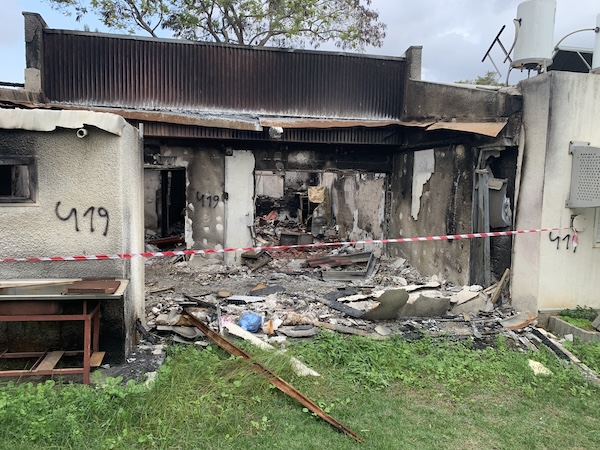
The rabbis visited Kibbutz Be’eri, where more than 100 people were murdered, and saw the devastation and destruction, some of it not from Oct. 7 but from days after, when explosives planted on that day detonated. It was also at this kibbutz that the Israel Defence Forces found a copy of the Hamas playbook for the atrocities. 

“It sounded as if it could have been written by Eichmann or Hitler,” said Bregman. “[The intent] was not only to destroy the body but to destroy the mind, the soul, the psychology, the emotional and spiritual aspect of every Jew.”

The plan included strategies for setting fire to homes in order to force residents out of safe rooms, then specified the order in which family members were to be murdered – parents in front of their children. 

photo - As part of their mission to Israel, Vancouver rabbis visited kibbutzim that were attacked by Hamas on Oct. 7
As part of their mission to Israel, Vancouver rabbis visited kibbutzim that were attacked by Hamas on Oct. 7. (photo from facebook.com/jewishvancouver)

While the trip may have had the spirit of a shiva visit, the mood of the Israelis, Dresner said, was “can-do resourcefulness.”

“It’s felt to me over the past couple of years that Israelis have been kind of depressed,” she said, referring to divisive political conflicts. “But they are full force embracing their ingenuity and turning the energy of the resistance movement into this amazing volunteer corps to supply really whatever is needed to whatever sector.”

Groups that had coalesced to protest proposed judicial reforms pivoted to emergency response, she said, ensuring that soldiers and displaced civilians have basic needs met and then creating customized pallets of everything from tricycles to board games, bedding and washing machines, for families who will be away from their homes for extended periods.

The rabbis also went to Kibbutz Yavneh and paid their respects at the grave of Ben Mizrachi, the 22-year-old Vancouver man and former army medic who died at the music festival while trying to save the lives of others. They had a private meeting with Yaron and Jackie Kaploun, parents of Canadian-Israeli Adi Vital-Kaploun, who was murdered in front of her sons, an infant and a 4-year-old.

On the final evening of their visit, the rabbis hosted a Hanukkah party for displaced residents of Kiryat Shmona, the northern Israeli town that is in the Vancouver Jewish community’s partnership region.

At the party, Temple Sholom’s Rabbi Brown spoke with a woman whose two sons are in Gaza fighting for the IDF.

“I told her that we do the prayer for tzahal, for the IDF, in our services in our shul,” Brown said, “and she was so surprised and touched, and she said, ‘Keep praying, keep praying.’” 

Creating light in dark times

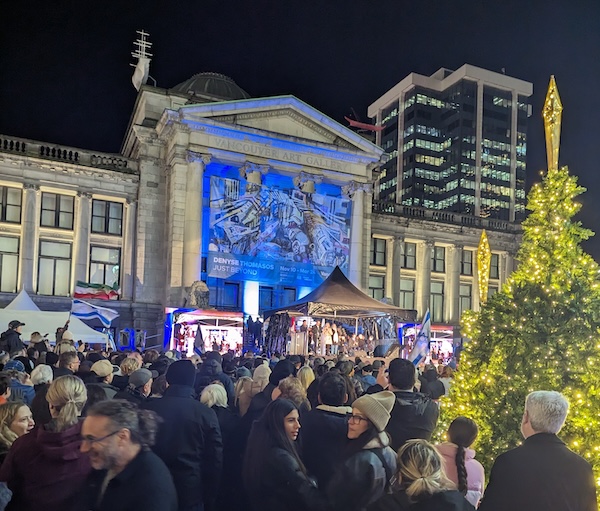
Hundreds attended the lighting of the Silber Family Agam Menorah on the first night of Hanukkah Dec. 7, where politicians from all levels of government offered holiday greetings and support. (photo by Pat Johnson)

Hundreds gathered outside the Vancouver Art Gallery on the first night of Hanukkah, Dec. 7, to kindle light in the darkness. The decades-old annual event led by Chabad Lubavitch BC had even more than the usual sense of familiarity, as the Jewish community has been gathering weekly on the same site since the Oct. 7 pogrom, and Hanukkah’s messages of hope amid tragedy reinforced the words that have been shared from the podium over recent weeks.

The art gallery event, as well as a community menorah lighting Sunday in Richmond, was attended by many elected officials – including the premier of British Columbia and the provincial opposition leader at both ceremonies. Ezra Shanken, chief executive officer of the Jewish Federation of Greater Vancouver, reiterated his gratitude for the support shown to the community in times of trouble. 

The first night event was co-hosted by Karen James and Howard Blank and was produced by Richard Lowy, who sang and played guitar. Children from Jewish schools and public schools sang Hanukkah songs. Spoken word artist Vanessa Hadari performed. 

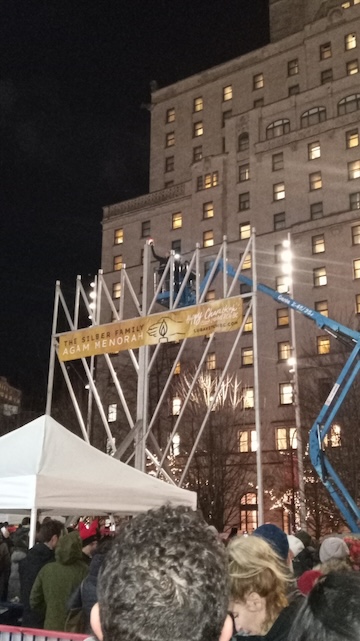
The first candle on the Silber Family Agam Menorah was lit by Etsik Mizrachi and Dan Mizrachi, father and brother, respectively, of Ben Mizrachi, the Vancouver man who was killed Oct. 7 while attempting to save others under attack at the music festival in Israel, where more than 360 people were murdered by Hamas terrorists.

photo - The first candle on the Silber Family Agam Menorah was lit by Etsik Mizrachi and Dan Mizrachi, father and brother, respectively, of Ben Mizrachi, z”l
The first candle on the Silber Family Agam Menorah was lit by Etsik Mizrachi and Dan Mizrachi, father and brother, respectively, of Ben Mizrachi, z”l. (photo by Cynthia Ramsay)

“This is a time of darkness in the world,” said B.C. Premier David Eby. “British Columbia is a place of tolerance and we need to be like the light on the menorah – we need to be a light against hatred.”

Speaking on behalf of the provincial government, Eby promised to do “all we can to push back against the tide of rising hate around the world.”

He spoke of meeting Dikla Mizrachi, mother of Ben, before addressing the assembly.

“It’s moving to meet the mother of a hero, a man from Vancouver who didn’t run away from danger. He ran back to help a friend,” said the premier, “and it cost him his life.”

In a message he repeated in Richmond a few days later, Eby said he prays for the release of the hostages and for peace.

Kevin Falcon, British Columbia’s leader of the opposition, also spoke both in Vancouver and in Richmond.

“I cannot think of a time in my lifetime that the message of Hanukkah, the triumph of good over evil, light over darkness, has resonated and been so meaningful to all of us,” he said on the first night of Hanukkah. “In the wake of that horrific tragedy, we’ve seen unfortunately some really vile antisemitism in the weeks that followed. Sadly, we’ve seen some of that even here in British Columbia and in Canada.”

Falcon received a resounding ovation on both occasions when he acknowledged Israel’s right to defend itself.

“Something must be made really crystal clear, and that is that Israel has a right to exist, Israel has a right to defend itself and the Jewish community here in British Columbia has the right to feel safe and secure,” said Falcon.

Vancouver Mayor Ken Sim, flanked by many Vancouver city councilors, said, “It’s a really tough time.”

“While we can’t unwind what’s going on, I can tell you that … we love you and we will always be here for you,” said the mayor. “You are our family, you are our friends, you are our neighbours. We have your back. We are not going to stand for any acts of hatred.”

Messages of support from Prime Minister Justin Trudeau and federal opposition leader Pierre Poilievre were read aloud.

“In a country built by immigrants, the contribution that Jewish Canadians have made and continue to make every day to our shared nation are indeed invaluable,” Trudeau wrote. 

“For generations,” Poilievre wrote, “the menorah has been a symbol of strength and comfort to the Jewish people. In times of darkness, it has carried a message of hope. In times of oppression, it has been an emblem of freedom. Today, it continues to bring encouragement to Jewish people in Israel, here in Canada and around the globe. Unfortunately, this message of hope is needed now more than ever.”

Jim DeHart, consul general of the United States to British Columbia and Yukon, also spoke, promising that the United States will not stand by in the aftermath of such attacks.

“We won’t be silent in the face of antisemitism and we will continue to work to defeat hate and prejudice in all of its forms,” he said.

Rabbi Dovid Rosenfeld compared current events with the Hanukkah story.

“In the glow of these menorah lights, we find inspiration and the triumph of light over darkness, hope over despair and freedom over oppression,” he said. “Even in the face of challenges that may seem insurmountable, the human spirit can prevail and miracles can unfold.… In the face of darkness, we choose to be the light.”

Herb Silber, son of the late Fred Silber, who donated the menorah that is lit annually at the Vancouver Art Gallery, spoke of the vision of his father and his father’s contemporaries, who built British Columbia’s Jewish community.

“It would be with a heavy heart if those pioneers like my father were here today to witness a rise in antisemitism that, while bubbling on the surface these last few years, has now burst into the open and become mainstream,” he said. “So, I come back to the holiday of Hanukkah because it reminds us that the story of antisemitism is not a new phenomenon. It is 3,500 years old, and the attempt to separate the Jewish people from their indigenous land of Israel is also not a new phenomenon. But what history has shown us is that Jews like my father and his contemporaries and those that came before him, and indeed the story of the Jewish people, is that we are a resilient people. 

“One disappointment that marks these historic outbreaks of antisemitism,” he continued, “has been the silence of the non-Jewish community and, regrettably, we have seen evidence of that in events of the past two months. But, gathering here tonight reminds us that we have friends on the stage and elsewhere. And we know that the silent majority of our Canadian neighbours and our friends cherishes each one of us as Canadians, as we do them.”

Lana Marks Pulver, chair of the board of the Jewish Federation of Greater Vancouver, thanked the Vancouver police for ensuring the safety of the community, and noted that antisemitic hate incidents reported in October were up 350% over the same month a year earlier.

Members of the Rabbinical Association of Vancouver stood on stage, days before most of them left Sunday for a three-day mission to Israel.

Rabbi Dan Moskovitz, flanked by seven other rabbis who are on the mission, said he will carry the light of the Vancouver community to the people of Israel.

“We are going because of your light, which shines so brightly in this dark time,” said Moskovitz, senior rabbi at Temple Sholom. “We are going to bring that light, the message of Hanukkah, of resilience, of dedication, of rededication, of religious freedom, of the few fighting to preserve freedom against the many who seek to destroy it, and us in its process. We are going to assure Israelis that they are not alone, that the people of Vancouver stand with them.”

The rabbis, according to Moskovitz, will meet with Israeli thought leaders, Oct. 7 survivors, the wounded, Jewish and Arab Israelis, and others, “to hear with our own ears what people experienced on Oct. 7 and what it has been like in the months since.”

They will also bring cold weather gear to soldiers, especially in the north, who have not been able to leave their posts to replenish supplies.

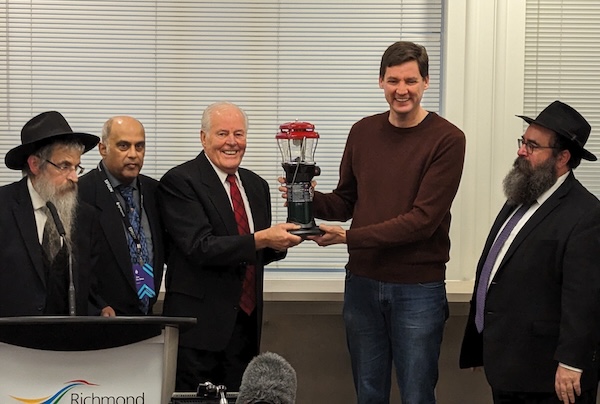
On Sunday, Dec. 10, almost every one of Richmond’s elected officials at the federal, provincial and municipal level was present to hear rabbis speak and to see the premier and Richmond Mayor Malcolm Brodie light the shamash and the first candle. Community leaders Jody and Harvey Dales lit the successive candles.

The Richmond event began 35 years ago and joining Eby on Sunday was Bill Vander Zalm, who was premier at the time and lit the menorah on the first year a public lighting was held.

photo - The Dec. 10 candlelighting was a chance to celebrate the 35th year that there has been a community menorah lighting in Richmond. Among those in attendance were, left to right, Rabbi Avraham Feigelstock, lighting organizer Joe Dasilva, former BC premier Bill Vander Zalm, BC Premier David Eby and Rabbi Yechiel Baitelman
The Dec. 10 candlelighting was a chance to celebrate the 35th year that there has been a community menorah lighting in Richmond. Among those in attendance were, left to right, Rabbi Avraham Feigelstock, lighting organizer Joe Dasilva, former BC premier Bill Vander Zalm, BC Premier David Eby and Rabbi Yechiel Baitelman. (photo by Pat Johnson)

Rabbi Levi Varnai of the Bayit emceed the Richmond event and said it was the Lubavitcher Rebbe who revived the ancient tradition of public menorah lightings, which, over the centuries, had fallen out of favour for fear of persecution. Richmond was among the first communities to institute the celebration, he said, thanks to Rabbi Avraham Feigelstock, who also spoke Sunday.

In addition to the rabbi and the former premier, numerous people who were at the first menorah lighting 35 years ago were also in attendance Dec. 10, including Joe Dasilva, who has organized every annual menorah lighting. He retired from the Ebco Group of Companies, whose founders, Helmut and Hugo Eppich, donated the Arthur Erickson-designed menorah. Richard Eppich, now president of the family business, attended Sunday. 

Inspiration is nearby

Light amid darkness is a common theme in the winter festivals of many wisdom traditions. As befitting a Jewish holiday, the meanings of Hanukkah are many and varied, among these the resilience of the Jewish people and the imminence of miracles. These are welcome themes this year.

At vigil after rally after menorah lighting after social media post after dinner table conversations during Hanukkah, the theme has been reprised endlessly over the past days: in a world of darkness, we are called upon to generate light, even to be the light. 

Finding the light – let alone being the light – is not easy. It is understandable to respond to events in the world today with hopelessness. A dramatic spike in antisemitic incidents locally and internationally is only an iceberg’s tip. It does not require a physical assault or desecrated property to be victimized by the tsunami of hatred sweeping over the world.

In the face of this conflict and the ensuing uptick in hatred, what have Canadian Jews done? In British Columbia and across the country, we have joined with Jews around the world to volunteer, donate and do whatever is necessary to repair, as much as it can be, the brokenness that happened on Oct. 7 and since. 

This is the light we are called upon to be. This is the resilience that is not just a word, but an actualized embodiment of Jewish values.

It is worth remembering that the greatest period of growth and expansion of our own local community occurred in the late 1940s and early 1950s. Even as the magnitude of the unprecedented historic trauma was just beginning to be understood, new synagogues were constructed, new day schools opened, social service agencies launched, refugee aid groups mobilized. Hillel welcomed students for the first time at the University of British Columbia mere months after the end of the Second World War.

In the shadow of unfathomable darkness, Jews in Vancouver redoubled their commitment to nationhood. Similar epochs of regeneration took place worldwide, not least being the fulfilment of the ancient dream of Jewish self-determination as a free people in our own land. 

This extraordinary burst of collective local regeneration was, of course, due in part to the influx of refugees, as well as the greatest period of sustained economic growth in human history. But, it was, first and foremost, an expression of the determination of the surviving remnant to plant for the future generations even while mourning those who had planted for them.

The chalutzim, the pioneers, who built the foundations of the community we live in today remain with us – some only in spirit, some very much still with us at advanced ages. Likewise, the founders who built the state of Israel are present, some in body but all in spirit, as we rededicate ourselves to girding the defence, strength and future of that country. Together, the examples of these forces of resilience are models for us to emulate as we struggle in these dark times.

We do not need to search hard for inspiration to get us through and embolden our commitment to carry on, to be the light. It is in the example of our families, our community and millennia of being a people that the poet Yehuda Amichai called “infected with hope.” May we merit to grow in hope, compassion, resilience and light in the coming days and weeks. 

Torts and the Jewish holidays

I’m that grown-up who jumps to catch a kid who is about to fall off a playground slide, even if the kid isn’t mine. I’m saying, “Hey, be careful!  You don’t want to hurt your bum,” or whatever concern is applicable. Some feel I’m overprotective. Rather than using unkind words like “hovering,” I prefer “proactive worrier.”

I felt isolated with this habit. Then I got to know the contractors for our home renovation better. The brothers who worked for us were also parents. They did everything possible to keep kids, dog and parents safe as they worked on the house with us living in it. The older brother, the electrician, would spell out exactly which hazards he was trying to avoid. He would close a door, put up a sign saying “Please stay out” or another proactive way to avoid problems. The day they installed a big new bathtub was a good example. After caulking it, the tub was filled with water to weigh it down and create a good seal. We knew the kids and dog would be very tempted to check it out – we imagined kids falling in in their clothing, playing with rubber duckies, a dog jumping in and flooding the room. We strategized how to keep everyone away from the tub until the caulk hardened.

I was surprised when I started studying Bava Kamma, a Babylonian talmudic tractate dedicated to civil law, particularly the law of damages and compensation owed. In “fancy” legal vocabulary, this is tort law, which “provides damages to victims in compensation for their losses.” The rabbis of the Talmud thought through these issues. They used examples from their day. They talked about oxen that gored, camels that fell (and caused a stumbling block) and other unpredictable situations. I’d heard sermons where people laughed about this level of detail, but my brain returned to those playground moments. Perhaps others don’t take these examples seriously because they’ve never interacted with large, stubborn livestock or a fussy, heavy toddler or two.

Here’s an example of a question posed in a baraita in Bava Kamma 29: “If one’s jug broke and he did not remove its shards, or if his camel fell and he did not stand it up, Rabbi Meir deems him liable to pay for any damage they cause. The rabbis say that he is exempt according to human laws, but liable according to the laws of Heaven.” So, the understanding is, if you create a dangerous situation, you’re obligated to clean it up. If you don’t clean it up, you’re still responsible for it. You’re guilty even if you don’t owe money as compensation.

Examples like these keep popping up. This tractate is a Jewish rabbinic lesson in taking responsibility for our actions. How might something we do harm someone? What if it’s an accident, like dropped pottery? What if you purposely left broken glass or pottery that could harm others?

This ancient rabbinic text can seem dry, as law texts might be, but also relevant. In the last few days, many communities have started to use law as an excuse to exclude public acknowledgement or celebration of Hanukkah. Moncton, N.B., made a name for itself in this way. A Hanukkah candlelighting has been customary there for 20 years. Suddenly, this year, the mayor and council felt it interfered with the separation of church and state. They canceled the event, although Moncton City Hall decorates with angels, a Christmas tree and wreaths. A last-minute petition with many opposing voices succeeded in forcing a new vote that overturned this decision, so the menorah and candlelighting were reinstated.

Other communities wrestling with this include Williamsburg, in my home state of Virginia. Organizers there suggested that a menorah lighting couldn’t be allowed unless it was under a “ceasefire now” banner. In Britain, a London town council reversed their decision to cancel a public menorah lighting after an outcry. Back in Canada, in Calgary, Alta., the mayor canceled her attendance at the city’s public menorah lighting. 

Suddenly, the rabbis’ detailed discussions in Bava Kamma make more sense. Their debates explore when someone is wronged by accident, and if they owed compensation. However, they also include the question of responsibility when someone is wronged “on purpose.” For example, when a government uses the law to suppress a minority religious observance, like Hanukkah. When this kind of action takes place, it does harm. It does harm beyond whether Jews are legally allowed to light a hanukkiyah in a public place. The message it sends causes bigger damage and fear. 

After all, if Jews in Canada or the United States aren’t allowed to publicly celebrate their religious rituals, it feels unsafe to be Jewish in these places. Where is it safe? Most Jews would then think about Israel as being the place where it’s truly safe to be Jewish. The people who want to withdraw public observance of Jewish traditions due to the Israel/Hamas war send a message to Jews living in North America – it’s not OK with them to have a Jewish homeland in Israel. It’s also not OK with them for Jews to observe their religion openly here. They probably missed the irony, as their message is that it’s especially not OK when the Jewish holiday is about religious freedom.

Laws about compensation for damages can sound uninteresting. It becomes more intriguing when imagining an unsafe play structure, a broken piece of pottery or a camel that won’t budge. It gets even more pertinent – and uncomfortable – when the law is used to keep us from celebrating our religious traditions freely, in public, without fear, in a democracy.

While Hanukkah is ending, it’s still the time of year when many indulge in more sweets and tortes than we’d planned. Sadly, it’s a different kind of tort this year, one where we consider how to compensate for the potential loss of religious freedom. 

Joanne Seiff has written regularly for CBC Manitoba and various Jewish publications. She is the author of three books, including From the Outside In: Jewish Post Columns 2015-2016, a collection of essays available for digital download or as a paperback from Amazon. Check her out on Instagram @yrnspinner or at joanneseiff.blogspot.com.

A time for miracles

Hanukkah is a reminder that darkness can be transformed into light, and that miracles are possible.

With so much conflict, misery, anxiety and hopelessness in the world, we need some miracles.

There have been a few rays of hope in Israel in recent days – the release of hostages from Gaza has brought a world of relief to the families and friends of those freed and to Jews and others abroad. As a people, we will not rest until all those who have been kidnapped are returned home safely.

Even then, the war will likely continue, with the stated goal of eradicating Hamas. As catastrophic and heartbreaking as the war and the atrocities that sparked it have been, this is a single battle in a longer conflict that seems destined to go on, at least for the time being.

When we look at today’s events in the context of a larger history, it is understandable to conclude that things are not getting better, but worse. Silver linings in such a situation seem few and far between. To be honest, in this space we try to find something constructive and hopeful in every topic we confront, and it has rarely been more difficult than in the past two months.

As students of history, we can only offer this piece of hope: many times, in our individual lives, in the story of the world and in the 3,500 years of history of the Jewish people, seemingly intractable problems have been resolved in stunning and unexpected ways.

Consider three massive geopolitical examples that have happened in the living memory of most of us.

Many of us grew up under the shadow of nuclear catastrophe. Some of us may recall practising hiding under our desks in preparation for a nuclear explosion. All of us who are middle-aged or older certainly remember a world viewed as a binary of “us” (the capitalist West) and “them” (the communist East).

From the perspective of the child cowering under the desk, the idea that the defining global status quo would end not in a bang – the ultimate bang – but with the relatively peaceful dismantling of the Soviet Union and its client regimes, would have seemed unimaginable. The Cold War, which defined our worldview and, at times, threatened our very existence, ended peacefully more than 30 years ago. Just a short time before it did, nobody could have foreseen the unfolding of events.

Likewise, the end of the racist regime in South Africa and its apartheid institutions. One of the most venal systems ever imagined was ended not by bloody revolution, but by a relatively peaceful, collaborative transition to democratic majority rule.

A third example, the Irish conflict, understatedly referred to as the “Troubles,” largely ended with the successes of the Good Friday accords of 1998.

In all three of these instances, the resolution of what seemed like intractable, even existential, challenges were overcome with remarkably sudden and unanticipated events.

It should be noted as well that, in all three cases, events played out very much because of specific leaders who were involved, who took immense risks, were willing to compromise, and placed an immense amount of hope in the goodwill of their people to make their societies and, by extension, the world a better place.

We might say that we don’t see great figures on the horizon on either side of the conflict that presently consumes us with such intensity. But this is precisely the point. Vast historic changes have happened when least expected because movements and visionary individuals emerged and ushered in changes, upending the seemingly rigid status quo.

The Israeli leadership has promised that the current war will eliminate the terrorist autocrats who have run Gaza. The leadership in the West Bank is inevitably going to change before long as well, if only because the current president is aged 88.

Not incidentally, when this horrible war finally ends, Israelis will be undertaking a very serious review of recent events. It is entirely reasonable to expect significant changes at the top of both Israeli and Palestinian power structures in the very near future.

The truth is, in change there is hope. And, indeed, change is the only thing that is inevitable.

It might be also time to dig up an old chestnut from David Ben-Gurion, who said something that is relevant here not only because of the time of year – Hanukkah – but because of the time of history.

“In Israel, in order to be a realist, you must believe in miracles.” 

Growing and sharing our inner light

If we fear “advertising” our identities, we should do everything we can to maintain our inner light and self-worth in trying times. (photo from PxHere)

Years ago, my husband lost both his grandmother and his great aunt. Several years apart, he traveled to the Lower East Side in New York to attend their funerals at the same funeral home. There was a rabbi there who officiated at both funerals. This rabbi told the same story twice. Perhaps he had only the one funeral teaching, but my husband remembered it. This rabbi suggested that a famous rabbi taught that the worst of the plagues against the Egyptians was darkness. Why was darkness the worst? It was all encompassing, overwhelming, and seemingly permanent. No one knew if the sun would ever return. This rabbi used this to talk about death, but the metaphor stayed with us.

Despite our efforts to find the source for this story, we couldn’t track down its origin. While looking for it, I thought about darkness and what we can learn from it as we celebrate Hanukkah this year.

There are parallels between the Hanukkah story and our current struggles. Before Oct. 7, Israelis were distracted by potential changes to their court system and very divided politically. While that political turmoil didn’t disappear in the face of the massacre and the war, Israelis have immediately united in the aftermath to work together. Israelis I know have said that it isn’t the government that is taking care of those who are displaced, but rather nongovernmental organizations and volunteers from every corner of Israeli society. Israelis are cooking meals for soldiers, for moms managing as single parents for long periods of time, and for those who have been evacuated or made homeless by the conflict. Israelis and the Jewish people worldwide have also worked together as a people to take care of one another.

The military conflict of Hanukkah is a story of division and unity. There were Jews at this time, around 200 BCE, who had become increasingly assimilated and Hellenized. They cooperated with the Seleucid Empire. There was societal upheaval. Others were more traditional in practice and offended by the changes made by more “liberal”-minded Jews and King Antiochus. The Maccabees represented the traditional or more orthodox Jewish tradition. They rose up against King Antiochus’s pagan practices and the more assimilated Jews who had adapted to Hellenistic practice.

We know now that the Maccabees won these battles. They rededicated the Temple in Jerusalem. This is a military victory and a story around religious or national liberation. The rabbis tried to focus the religious observance on the miracle of the light (the “ner tamid,” the holy flame in the Temple that should not go out) rather than on the military situation. However, we wouldn’t have Hanukkah without these historical cultural conflicts or the Maccabees’ wars.

The historical details of this struggle are in the books of the First and Second Maccabees, which describe the Hanukkah story. While there are many references to the holiday in the Mishnah, the detailed story has been maintained through the Catholic and Orthodox churches, which kept First and Second Maccabees as part of their Old Testament. Protestants don’t include these books in their bibles. We study these texts to understand Hanukkah, but they don’t hold any official status in Jewish tradition.

This, too, has a parallel to our modern experience. While we know our traditions around Hanukkah, some of the context comes from many historical texts preserved by others. During this war against Hamas, we are being forced to defend ourselves against antisemitism, and also to defend the existence of the state of Israel. The worldwide Jewish community doesn’t have to use our personal experiences to educate others about this. The historical contexts for understanding both antisemitism and the need for the existence of the state of Israel are embedded in world history. Learning about the historical roots of Christian antisemitism in Europe or in the dhimmi law of Islamic empires is part of the greater history. Information about when the Romans conquered Israel and destroyed the second Temple can be found in multiple sources, including on the Arch of Titus in Rome. The creation of the modern state of Israel in 1948 is also part of a much broader historical context.

The rabbis chose, in creating the rules around the holiday of Hanukkah, to focus on light and miracles rather than military victories. Rabbi Lord Jonathan Sacks (z”l) wrote in “8 Short Thoughts for 8 Hanukkah Nights” about the ways in which the light is emphasized. His fifth short thought focuses on Maimonides’ teaching about how to fulfil the mitzvah of Hanukkah. Maimonides teaches that lighting candles on Hanukkah is precious and that one must sell something or borrow to fulfil this commandment. Yet, if one finds Shabbat is coming and you have only one candle? Light it for Shabbat. In this case, Maimonides teaches: “The Shabbat light takes priority because it symbolizes shalom bayit, domestic peace. And great is peace because the entire Torah was given to make peace in the world.” Sacks suggests that, “in Judaism, the greatest military victory takes second place to peace in the home.” He points out the great victory is a spiritual and not military one.

For Israel today, too, the great victory must be the notion of continuing to pray and negotiate for peace while also navigating difficult military situations.

Sacks makes several points that could be articles on their own, but the ones I felt most drawn to remain relevant. The Hanukkah candles should be lit so that people can see them outside, but if one is afraid of inviting hate, it has long been taught that it is OK to light the candles indoors, out of public view. Still, we are meant to be public about our “light” more generally and fight for it, if necessary. If we fear “advertising” our identities, we should do everything we can to maintain our inner light and self-worth in trying times.

Finally, Sacks discusses a story in the Talmud in which Rav and Shmuel, third-century rabbis, disagree over whether you can use one Hanukkah candle to light another (if you lack an extra candle, a shamash, the helper candle, that is used to light the other eight candles). Rav suggests that you may not, as this might diminish the light of the first candle. Shmuel disagrees, and halachah (Jewish law) follows Shmuel, who teaches that you can use one Hanukkah candle to light another because it helps the light grow and brings us more light. Using your light to enlighten others is the best practice.

I bumped into a rabbi I admire who lives in Winnipeg, where I live. We were each dropping off kids at a Jewish youth group activity. He wore a ball cap, as he was “off duty.” I thanked him for his contribution to a news article about the war and local protests, and he responded, “These are dark times.”

Like the plague of darkness in Egypt, we don’t know exactly how or when things will lighten. We need Hanukkah’s message and rituals to offer that light. Maybe we won’t put our Hanukkah candles on public display this year, but we can draw wisdom and comfort from our long history and rabbinic teachings. These teach us to reach deep to find the messages of hope, faith and peace from a story about a war. This time around, we need to act individually like Hanukkah candles. We can lend our inner lights to volunteer, to speak out, to support others and to kindle others’ lights during a hard time. Even during times of war and hate, we can be the light. 

Joanne Seiff has written regularly for CBC Manitoba and various Jewish publications. She is the author of three books, including From the Outside In: Jewish Post Columns 2015-2016, a collection of essays available for digital download or as a paperback from Amazon. Check her out on Instagram @yrnspinner or at joanneseiff.blogspot.com.