As we light the hanukkiyah 

When we look at our calendars – especially that darkest of recent days, Saturday, Oct. 7, 2023 – it’s hard to imagine that that now-infamous date is part of a millennia-long continuum. 

About 2,200 years ago, the Maccabean revolt against the Greeks controlling Judea succeeded in the rededication of the Second Temple in Jerusalem. From this ancient victory, we celebrate Hanukkah, lighting candles over eight nights to honour our brave ancestors then and those who have followed. 

Now, more than two millennia later, we call on the Israeli Defence Forces to protect Israel from Hamas who, on Oct. 7, murdered more than 1,200 (mostly) civilians, injured more than 5,400 and abducted more than 240 elderly women, men, children and other civilians. Since that day, 200,000 Israelis have had to flee their homes and all in the entire country are living under constant threat of thousands of indiscriminately fired rockets launched by Hamas from Gaza. 

Operation Iron Swords is the Israeli response fighting for the safety of its people and, in fact, for its very existence. Is it Israel’s right to defend itself? Yes. But it’s much more than that. It is Israel’s obligation to its citizens, as it would be any country’s that wants to call itself a state. 

This operation, so necessary and yet so treacherous both on the ground and in the world of public opinion, has been used as an excuse for a disgusting surge in anti-Israel and – let’s be truthful – anti-Jewish rhetoric, threats, anarchy and vandalism. We’ve seen this before, in the May 2021 Gaza War and its aftermath, and we are seeing it again, only now the campaigns are emboldened and expanded by years of online Jew-hate that has made its way from the fringes to the centre.

photo - Judy Zelikovitz
Judy Zelikovitz (photo from CIJA)

What can we do? As descendants of the Maccabees – and generations more of intrepid survivors – we can rally, finding strength and comfort in our collective calls for civility, tolerance and bedrock Canadian values. 

We can stay informed and stay connected. 

We can, as thousands young and old across Canada have done already, donate to our local federation’s emergency campaigns supporting Israelis. How proud we can be that Canada’s diaspora has already raised more than $100 million in response to the emergency. Federations have already sent millions to support victims of terror, evacuees and those in need.

We can say something if we see something. The Centre for Israel and Jewish Affairs tracks hate-based incidents at cija.ca, under the Get Involved link. If you witness an antisemitic incident, report as many details as you can remember and, if it’s safe to do so, take pictures. If there is a threat or a crime, contact your local police. Many have officers specializing in this kind of report. 

Just as we honour our forebears who protected our lives, our culture and our values, we will honour those who were injured or died on Oct. 7. We will keep the Canadians who lost their lives in our hearts and remember their bravery in saving the lives of others.

At CIJA’s Antisemitism: Face It, Fight It conference in mid-October, most among the 1,000+ attendees were Jewish. But hundreds were not. We are not alone in fighting antisemitism.

As we light our hanukkiyah candles this year, let us celebrate the courage of those who went before us, of those who served us in sacrifice over thousands of years, and let’s ensure that those protecting Israel now feel our support and our gratitude. Let us be the light!

Wishing you and yours a joyful, meaningful Hanukkah. 

Judy Zelikovitz is vice-president, university and local partner services, at the Centre for Israel and Jewish Affairs.
Art sale for Israel

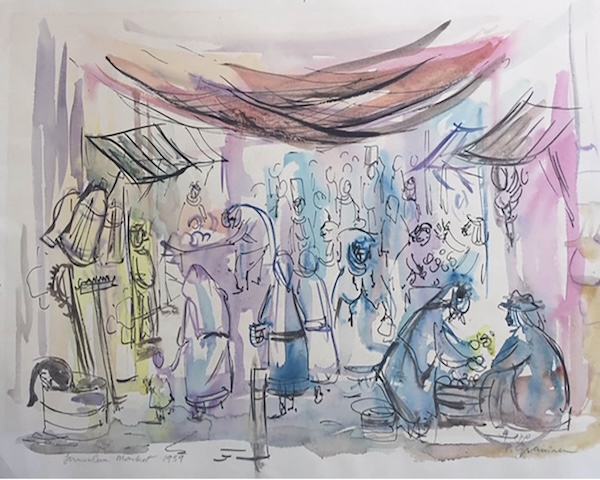
“Jerusalem Market, 1959,” watercolour and pencil, by artist Pnina Granirer, a graduate of Bezalel Academy of Art and Design in Jerusalem. Granirer will have a table of her artwork for sale in the atrium of the Jewish Community Centre of Greater Vancouver on Dec. 3, 10 a.m.-3 p.m., as part of the Chanukah Around the World party marketplace. The works will be unframed, priced from $100 to $500, with all proceeds being donated to Israel, in the hope that the donation will help it in its hour of need. For more on Granirer, go to pninagranirer.com.

The party is a joint event with multiple community partners: King David High School, Vancouver Talmud Torah, Richmond Jewish Day School, PJ Library, Camp Miriam, Jewish Museum and Archives of British Columbia, and the Kollel. In addition to the marketplace, it will feature games, iSTEAM activities, food, arts & crafts, museum displays, entertainment throughout, a community singalong and a JCC membership sale. Visit jccgv.com/jcc-chanukah-carnival.

Perfect gifts for holiday

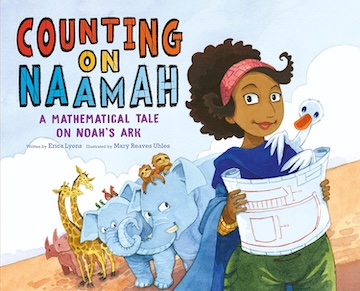
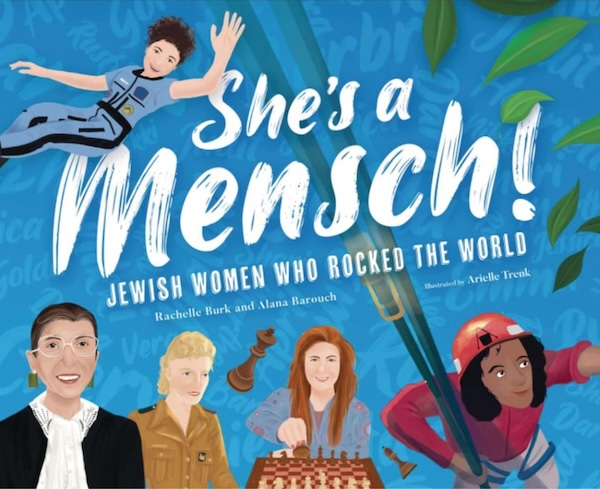
In 2019, NASA astronaut and scientist Jessica Meir was part of the first all-woman spacewalk. According to image - Counting on Naamah book cover: Jewish Women who Rocked the World, she “celebrated Hanukkah in space by wearing festive holiday socks and sending a Happy Hanukkah message to earth on social media.”

This is just one of the many “Fun Fact[s] to Mench’n” in this enlightening book written by the mother-daughter team of Rachelle Burk and Alana Barouch, and illustrated by Arielle Trenk. She’s a Mensch! is one of two books the JI received from Seattle’s Intergalactic Afikoman to review. The other is the perfect antidote to the “girl math” phenomenon popularized on social media, though hopefully kids under 9 aren’t engaging with that. Counting on Naamah: A Mathematical Tale on Noah’s Ark by writer Erica Lyons and illustrator Mary Reaves Uhles imagines Noah’s wife as being a genius in math and engineering.

Using the basics of the Noah story, Counting on Naamah offers a midrash of sorts. “A midrash is a tale that begins with a story from the Torah. Then it fills in the missing pieces to imagine the rest,” explain Lyons and Reaves Uhles at the back of the book. “The story of Noah leaves a lot to the imagination. What was it actually like to live on that ark? How did they take care of all those animals? And who was the generally unnamed ‘Mrs. Noah’? Counting on Naamah tries to answer these questions.”

The story begins when Naamah is a child, and uses her talents to help each of her three brothers – with market transactions, estimated herd transport times and archery angles. She has her own projects, as well, drafting plans for a desert sand scooter, for example.

When she meets and falls in love with Noah, the two become “impossible to divide,” but Naamah retains her agency and is a crucial help in building the ark, housing and feeding the animals, and more. And Noah knows just what to do to thank her.

Counting on Naamah is a charming story, creatively and colourfully illustrated. As is She’s a Mensch!, which is a nonfiction work that highlights 20 women who “rock!”

“Jewish women ‘round the world have talent, strength and smarts,” the book starts. “They shine like stars in every field from science to the arts.

“Jewish women through the ages have helped shape history. These mensches are authors and activists, athletes and adventurers, and everything in between.”

Indeed, the women featured range from writer Emma Lazarus in 1883 to Meir, in 2019. They include familiar – Golda Meir, Barbra Streisand, Ruth Bader Ginsburg – and less familiar names, like Marthe Cohn, who was a spy for France during the Second World War; Vera Rubin, who provided proof of dark matter in the 1970s; Nalini Nadkarni, who performed the first survey of rainforest treetops in 1981; and Judit Polgár, who became a chess grandmaster at age 15, in 1991. There’s a list of 18 honourable mentions.

Each entry in She’s a Mensch! has something different: unique drawings that connect the mensch to their chosen pursuit, a four-line poem and a short blurb about the mensch, often a fun fact, and always a mensch-related question to ponder, such as, How can you help others? (Henrietta Szold) What kinds of stories can you tell? (Judy Blume) and What great adventures do you dream of going on? (Cheryl and Nikki Bart)

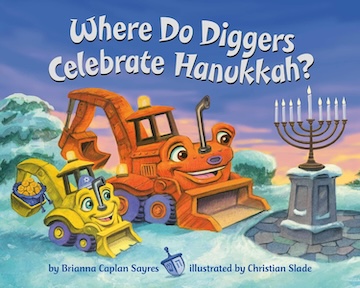
image - Where Do Diggers Celebrate Hanukkah? book coverBoth of these books would make great Hanukkah gifts for kids of any gender. As would this year’s Hanukkah addition to Intergalactic Afikoman publisher Brianna Caplan Sayres’ and illustrator Christian Slade’s Diggers series, which has more than 10 books, and counting.

Where Do Diggers Celebrate Hanukkah? (published by Penguin Random House) would be a happy addition to a kid’s Diggers collection, or a fun introduction to the series. For the diggers, cranes, mixers, armoured trucks, tankers, dump trucks and food trucks, we’re asked to wonder what each does for an aspect of the holiday. For example, “Does Mom dig up the ancient jar that held the precious oil?” And the cranes, “Do they decorate their construction site with ‘Happy Hanukkah’ all around?” After a day of serving meals outside, do food trucks “serve sufganiyot and other food that’s fried?” Inquiring minds will want to know. 

Exploring sufganiyot’s origins

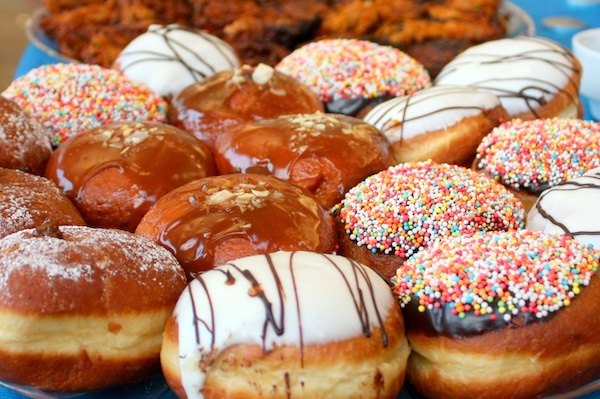
Sufganiyot (jelly doughnuts) for Hanukkah have come a long way, and now come in countless variations. (photo by Avital Pinnick / Flickr)

In Israel, sufganiyot (jelly doughnuts) have gone through a major revolution. For years, they were injected with strawberry jelly and dusted with confectioners’ sugar. In a recent ad by a well-known Israeli bakery, there were 14 variations of sufganiyot, including the “classic strawberry jam.” Twelve are dairy and two are pareve (can be eaten with milk or meat dishes).

For the pareve offerings, there are colourful sprinkles, dairy-free chocolate and ganache (filling made from chopped chocolate and heavy cream). Among the dairy choices are “Raspberry Pavlova,” filled with sweet cream and topped with raspberry ganache, pavlova (a meringue named after the Russian ballerina, Anna Pavlova), sweet cream and Amarena cherries; “Curly,” filled with cream and topped with Belgian chocolate and milk, dark and white chocolate curls; “Mozart,” filled with nougat-flavoured sweet cream, frosted with white chocolate strips and topped with Mozart cream (a chocolate liqueur) and chocolate curls; “Cheese Crumbs,” filled with cheese mixed with white chocolate and butter cookie crumb frosting and topped with cream cheese; and “Pistachio,” filled with pistachios, frosted with white chocolate ganache, and topped with pistachio cream and pistachio shavings.

Jewish law does not prescribe any special feasting or elaborate meal for Hanukkah as it does for other holidays. Maybe this is because the origin of Hanukkah is not in the Torah but in the Apocrypha, the books of literature written between the second century BCE and the second century CE, which were not incorporated into the Hebrew Bible.

The Books of Maccabees, of which there are four separate books, only say that the hero, Judah, “ordained that the days of dedication of the altar should be kept in their season from year to year by the space of eight days from the first and 20th day of the month Kislev, with mirth and gladness.”

So, where do we get all the food we eat? It is in the Talmud, where the so-called miracle of the oil burning for eight days is written. This myth was inserted to de-emphasize the miracle of military triumph and replace it with a more palatable idea, that of the intervention of G-d, which somehow would seem more a miracle than a fight of man against man, according to the sages of the time. (By the way, it is only within the past few years that children’s books about Hanukkah dare say the oil story is a legend or a myth.)

Practically every Jewish ethnic group has the custom of making and eating a form of food prepared in oil as a reminder of the “miracle” of the jar of oil.

The late Gil Marks wrote, in The World of Jewish Desserts, that doughnuts fried in oil, ponchikot, were adopted by Polish Jews for Hanukkah. The name is taken from the Polish word paczki, which led to the nickname ponchiks, the Polish name for jelly doughnuts. Ponchiks are similar to jelly doughnuts, only larger and more rich tasting, and were traditionally served on Shrove Tuesday, the day before Lent. They were made to use up shortening and eggs, which were prohibited during Lent.

Sufganiyot have a different history. In The Jewish Holiday Kitchen, Joan Nathan, an acquaintance of mine from our Jerusalem days and noted cookbook author and maven of American Jewish cooking, noted that she learned the origins of sufganiyot from Dov Noy (z”l), former dean of Israel folklorists.

Noy related a Bukhharian fable to Nathan, which says that the first sufganiya was a sweet given to Adam and Eve as compensation after their expulsion from the Garden of Eden. Noy said the word sufganiya came from the Hebrew word sof, meaning end; gan, meaning garden; and Ya, meaning G-d. Thus, the word means, “the end of G-d’s garden.”

According to Noy, this fable was created at the beginning of the 20th century, as sufganiya is a new Hebrew word coined by pioneers. Some say sufganiyot means sponge-like and that the doughnuts are reminiscent of the sweet, spongy cookie popular along the Mediterranean since the time of the Maccabees. Hebrew dictionaries say the word actually comes from the Greek word sufgan, meaning puffed and fried.

John Cooper, author of Eat and Be Satisfied: A Social History of Jewish Food, has another theory. He says Christians in Europe ate deep-fried pastries on New Year’s Eve, and Christians in Berlin ate jelly doughnuts. In that context, German Jews started eating apricot-filled doughnuts. When they immigrated to Palestine in the 1930s, they encouraged the population to eat the jelly doughnuts for Hanukkah.

One of my favourite pieces of research is the characteristics that sufganiyot are said to have: 

• they are round like the wheel of fortune; 

• they have to be looked at for what is inside, not for their external qualities; and

• they cannot be enjoyed the same way twice.

My research on the internet shows the calories for one sufganiya vary from 93 to 276, and gluten-free versions with rice flour are about 165 calories.

Whatever their origin – or number of calories – sample the real thing and you won’t forget it! 

Sybil Kaplan, z”l, was a Jerusalem-based journalist and author. She edited/compiled nine kosher cookbooks and was a food writer for North American Jewish publications, including the Jewish Independent. We communicated regularly, but mostly in the leadup to a holiday issue. Not having heard from her in advance of this Hanukkah paper, we reached out, getting the sad news that Sybil recently passed away. It was a pleasure working with her for these past 20+ years and we will miss her. She always provided more stories than we could use, so, in this issue, we run a few we had yet to publish, honouring her in our way. May her memory be for a blessing.

Appetizers for the holidays

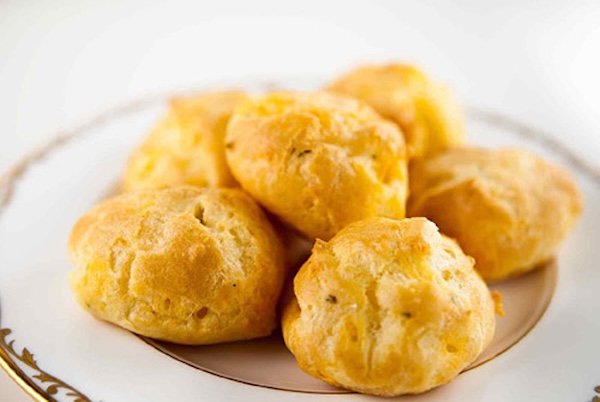
Cheese puffs (photo from jewishlink.news)

For a Hanukkah night gathering or on Dec. 31, as we move into a new secular year with a celebration, small or large, appetizers are a wonderful addition to any party. Here are some quick and easy recipes for appetizers when you’re hosting – or contributing to a potluck.

CHEESE PUFFS
(makes 40)

1 cup water
6 tbsp butter, cut into small pieces
salt and pepper to taste
1/2 cup flour
1 tbsp Dijon mustard
4 large eggs
1 cup coarsely grated kosher Swiss cheese

1.  Preheat oven to 425°F. Prepare several large cookie sheets with vegetable spray and flour.

2. In a saucepan, combine water, butter pieces, salt and pepper. Bring to a boil, add flour and stir vigorously about two minutes with a wooden spoon until mixture forms a ball and is firm. Remove from heat.

3. Beat in mustard, eggs and cheese.

4. Drop by heaping teaspoons onto cookie sheets one-and-a-half inches apart.

5. Place one sheet in top third of oven and one in bottom third of oven. Bake for 15 minutes.

6. Reverse position of sheets and bake five minutes more or until puffs are golden brown. Serve hot.

ARTICHOKE CHEESE SQUARES
(makes 8 servings)

2 six-ounce jars marinated artichoke hearts
1 small finely chopped onion
4 eggs
6 crushed crackers
2 cups kosher shredded sharp cheddar cheese

1. Preheat oven to 325°F and grease a large baking dish.

2. Drain artichoke hearts, reserving two tablespoons of marinade. Place in a bowl.

3. Place reserved marinade in a frying pan and sauté onions.

4. Remove from heat and add artichokes. Add eggs, crackers, cheese. 

5. Pour into baking dish and bake 35-40 minutes.

6. Cut into one-inch squares. Serve immediately or reheat before serving.

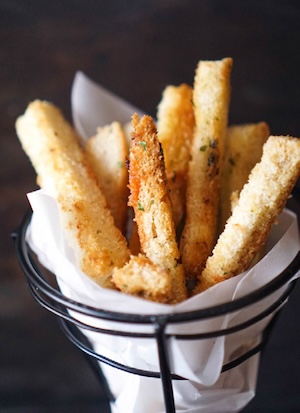
photo - Garlic bread “fries”
Garlic bread “fries” (photo from jewishlink.news)

GARLIC BREAD “FRIES”
(Grace Parisi is a well-known chef, and she created this party snack for Food & Wine. It makes 8-10 servings)

4 tbsp unsalted butter
1/2 cup olive oil
3 large minced garlic cloves
1/2 cup chopped flat leaf parsley
1 large split and halved baguette
1/2 cup freshly grated Pecorino-Romano or a sheep’s cheese

1. Preheat oven to 350°F.

2. In a frying pan, melt butter in olive oil. Add garlic and cook one minute.

3. Remove from heat and add parsley.

4. Place bread on baking sheet cut sides up. Spoon garlic butter on top, sprinkle with cheese and bake 10 minutes.

5. Turn on broiler and broil one minute.

6. Cut bread into half-inch “fries” so they look like bread sticks.

MARINARA “KETCHUP”

1/4 cup olive oil
3 peeled, halved garlic cloves
1 tbsp tomato paste
35 ounces canned, whole, peeled Italian tomatoes
salt and pepper to taste
pinch of sugar
2 sprigs basil

1. Heat olive oil in a saucepan. Add garlic and cook, stirring, five minutes.

2. Add tomato paste and cook one minute. 

3. Add tomatoes, crushing them with the back of a spoon. 

4. Add salt and pepper.

5. Stir in sugar and basil and bring to a boil. Simmer until sauce is reduced to three cups and thick. Discard basil and garlic. 

Sybil Kaplan, z”l, was a Jerusalem-based journalist and author. She edited/compiled nine kosher cookbooks and was a food writer for North American Jewish publications, including the Jewish Independent. We communicated regularly, but mostly in the leadup to a holiday issue. Not having heard from her in advance of this Hanukkah paper, we reached out, getting the sad news that Sybil recently passed away. It was a pleasure working with her for these past 20+ years and we will miss her. She always provided more stories than we could use, so, in this issue, we run a few we had yet to publish, honouring her in our way. May her memory be for a blessing.

A fresh take on Hanukkah

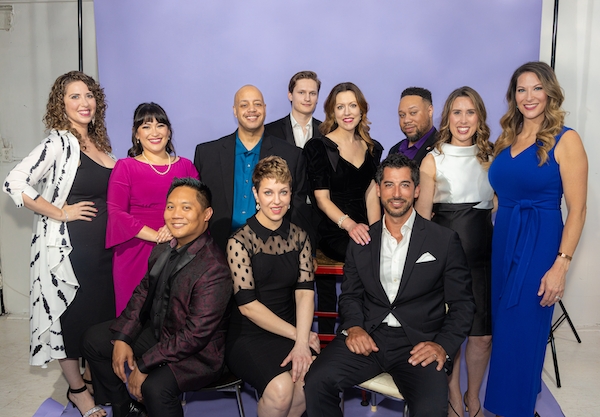
Chicago a cappella in June 2022. The ensemble released Miracle of Miracles: Music for Hanukkah last month. (photo by Kate Scott)

The CD Miracle of Miracles: Music for Hanukkah arrived at the Jewish Independent unsolicited. The album, released last month by Cedille Records, features a range of songs from the American Jewish musical tradition, performed by Chicago a cappella vocal ensemble. As someone who spent a good portion of her teenagehood in a choir at a Conservative synagogue and about a decade singing in another Conservative synagogue choir later in life, I have been happily singing along to this recording, enjoying the fresh take on songs with which I am mostly quite familiar.

Miracle of Miracles will appeal most, I think, to someone like me, who grew up in a Conservative Judaism milieu where a cantor and choir formed a large part of the service, or someone who appreciates classical music, as Chicago a cappella are classically trained A-listers, who perform a repertoire of music from the ninth to the 21st centuries. The current artistic director is John William Trotter, and Miracle of Miracles was recorded over a few days last January at Northeastern Illinois University in Chicago.

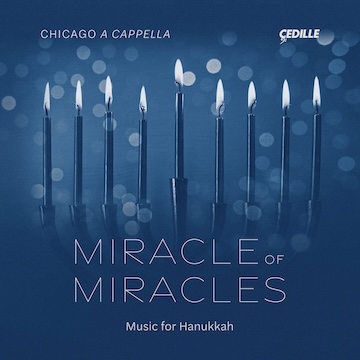
image - Chicago a cappella CD coverThe CD opens with an arrangement of “Oh Chanukah / Y’mei Hachanukah” by Robert Applebaum that the liner notes describe as “modern versions of the song form from the confluence of at least two streams, the first springing from Hebrew lyrics, the second flowing together from Yiddish and English sources. Turning again to [composer] Harry Coopersmith’s mid-20th-century collection … to create something of a mash-up of ‘Oh Chanukah’s’ popularity.”

There are several Applebaum arrangements. His “Haneirot Halalu” (“These Lights We Light”) mixes English translation and commentary into the traditional Hebrew lyrics, and his “Maoz Tzur” is a cantor-choir interplay that comprises elements most of us will recognize and be able to join initially, but then becomes more complex. His finger-snapping arrangement of Samuel E. Goldfarb’s well-known “I Have a Little Dreidl” – called “Funky Dreidl” – is in English with the Hebrew “nes gadol haya sham,” “a miracle happened there,” as a kind of chorus. It’s followed on the CD by a lively rendition of Mikhl Gelbart’s Yiddish “I Am a Little Dreidl (Ikh bin a kleyner dreidl).”

Other Yiddish offerings are Mark Zuckerman’s arrangement of “O, Ir Kleyne Likhtelekh” (“O, You Little Candle”), the lyrics of which were written by poet and lyricist Morris Rosenfeld, and an arrangement by Zuckerman of “Fayer, fayer” (“Fire, Fire”) by Vladimir Heyfetz, about burning the latkes while frying them.

Applebaum’s jazzy “Al Hanism” (“For the Miracles”) is one of three versions of the song on this recording. There is also an arrangement by Elliott Z. Levine that is the traditional, fast-paced version I’ve sung countless times and love, and the expansive, movie soundtrack-sounding arrangement by Joshua Fishbein.

Levine also contributes “Lo v’Chayil” (“Not by Might”), based on text from the Book of Zechariah, which is not a Hanukkah song per se, but, as the liner notes say, “rather the more transcendent spirit that underlies the commemoration of Hanukkah.” Translated from the Hebrew, the verse is: “Not by might nor by power, but by My spirit, saith the Lord of Hosts.”

Other composers/arrangers whose work is featured on this CD are Steve Barnett (“S’vivon” / “Little Dreydl”), Gerald Cohen (“Chanukah Lights”), Daniel Tunkel (four movements of his “Hallel Cantata”), Jonathan Miller (“Biy’mey Mattityahu” / “In the Days of Mattityahu”).

Two bonus tracks are included: an arrangement by Joshua Jacobson of Chaim Parchi’s Hanukkah tune “Aleih Neiri” and Stacy Garrop’s take on the prayer for peace “Lo Yisa Goy”: “Nation shall not lift up sword against nation, neither shall they learn war any more.”

In the program notes, Miller, who is Chicago a cappella’s artistic director emeritus, talks about the limited number of Hanukkah songs that are appropriate for an ensemble to perform, commenting that “Jewish choral music is a recent phenomenon, begun in earnest only about 200 years ago in Berlin, so there’s a simple quantity issue: we have much less repertoire to peruse than in other choral traditions. Given all of this, we are especially grateful for the composers and arrangers whose persistence and skill have given us the works found here.”

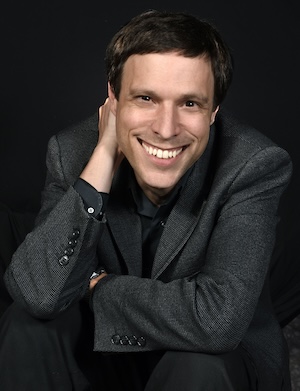
photo - Chicago a cappella artistic director John Trotter
Chicago a cappella artistic director John Trotter. (photo from Cedille Records)

Despite the dearth of Hanukkah choral music, Trotter, the ensemble’s current artistic director, observes that the CD comprises “a sprawling variety of styles.”

“There are at least two reasons for this breadth,” he writes. “On the one hand, we are in debt to the fertile imaginations of our composers, who envisioned so many different sound worlds and so many different ways to clothe these texts. But there is also the nature of Hanukkah itself, which offers so many different modes of personal, social and spiritual practice. Consider just three of these. Hanukkah offers the chance to reflect on the historical significance of the Maccabean revolt, with its consequences echoing through to the present day. It invites quiet contemplation of the candle flames, set aside from any utilitarian purpose. And it provides an opportunity to gather with family and have a really great party with really great food.”

Miracle of Miracles would provide a perfect acoustic background for a Hanukkah gathering. To purchase a CD or buy or stream the music digitally, visit cedillerecords.org/albums/miracle-of-miracles.

A first step to solutions?

Among other things, Hanukkah is about bringing light into the darkness. There is plenty of darkness in the world and a vast range of concerns calling for radiance.

Mainstream media seem to have taken the cue that Hanukkah is the moment to discuss the alarming and rising phenomenon of antisemitism. Time magazine declares: “Amid antisemitism, Hanukkah celebrations carry new weight.” USA Today explained a new tradition: “On Hanukkah, the ninth candle reflects how anyone can fight antisemitism by sharing truth.” Here in Canada, both Prime Minister Justin Trudeau and Opposition Leader Pierre Poilievre highlighted antisemitism in their annual Hanukkah messages. Expect to see similar expressions of concern in a few days, as the end-of-2022 reflections on the good and bad of the year just passed and hopes for the fresh new year fill pages and airtime during the slow news days of the winter holidays.

We are not complaining. This issue needs thorough and ongoing coverage. It just seems, somehow, that writing and talking about what is often called the world’s oldest bigotry lacks new insights. Many agree that this is a problem. Few, though, have solutions beyond platitudes. 

Finding innovative ways to think and talk about “the world’s oldest” anything is, by definition, a challenge. Some of the greatest scholars in the world have studied the problem, vast networks of activist organizations and Jewish communal agencies devote themselves to defeating it, and still it grows. If we had the definitive explanation or the silver bullet to solve it, you would not be reading it here – we would be sharing our wisdom from the dais of the Nobel Prize ceremony and as the lead story on the world’s media. Undaunted, a few thoughts:

The very phrase “antisemitism” may be problematic. The term was invented in the late 1800s by a proud antisemite to describe his orientation. But while there is a great deal of conscious and visible antisemitism in the world today that rightly raises alarms, there has always been an equally, perhaps more, worrying phenomenon in the form of unconscious bias about Jews that permeates many societies and individuals. This is more insidious and, therefore, more difficult to challenge. 

It is worth noting that antisemitism is often most prevalent where no or few Jews exist, making it easier to project onto a largely imaginary enemy the fears and hatreds carried by the individual or the society. Similarly, we see a projection of Jewishness onto any unpopular phenomenon, an example being the “Great Replacement” theory, a paranoid fantasy in which whatever the perpetrator despises (in this case immigration) is cast as a problem with Jewish roots.

Both of these phenomena touch on what we suspect is the nut of antisemitism: it is a problem that affects Jews but it is not a problem of Jews. That is, if Jews did not exist, the antisemites would have to invent them – which is, in essence, precisely what they have done with the caricatured “Jew” that is demonized by antisemites. 

This understanding, of course, does nothing to resolve the problem. And, again, a problem known as “the world’s oldest hatred” is not going to be solved in one generation with one easy antidote. It is encouraging, though, to see the range of responses to the problem, from more in-depth coverage in mainstream media to the statements of top leaders in Canada, as well as in the United States, where a major presidential effort against antisemitism is being led by Doug Emhoff, the second gentleman of the United States, who recently led a roundtable of leading thinkers, and in a host of other undertakings worldwide.

As is said in a different context, the first step to recovery is admitting you have a problem. As a society, we have a consensus that antisemitism is a growing problem. As we approach 2023, we hope those thoughts will turn to even more action in confronting this confounding blight. 

Lights shine united at RJDS

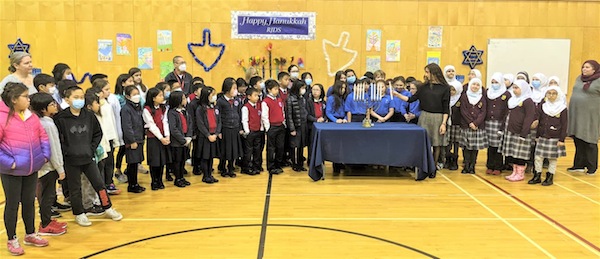
On Dec. 12, Richmond Jewish Day School hosted Cornerstone Christian Academy, Richmond Christian School and Az-Zahraa Islamic Academy. (photo from RJDS)

For the second year in a row, Richmond Jewish Day School hosted a holiday celebration at the school to promote community care, empathy and understanding.

On the morning of Dec. 12, the Shine a Light project saw three schools joining RJDS to share their winter traditions. The posting on RJDS’s Facebook page reads: “Cornerstone Christian Academy made 3-D stars to signify the star of Bethlehem, Az-Zahraa Islamic Academy made lanterns to represent light in Islam, Richmond Christian School made a stained-glass craft and talked about the advent season and, finally, our school taught the others how to play the dreidel game! We all have a role to play. Today, we dispel the darkness on antisemitism and hatred.” 

“Last year, we did an evening event during Hanukkah called A Celebration of Light and invited members of the Highway to Heaven community,” RJDS principal Sabrina Bhojani told the JI.

The No. 5 Road area in Richmond, which is home to RJDS, is also home to some 20 different religious and/or cultural institutions, hence the moniker “Highway to Heaven.” Richmond Mayor Malcom Brodie and Ezra Shanken, chief executive officer of Jewish Federation of Greater Vancouver, were among the attendees last year – and this year – along with several city councilors and others.

“This year, we changed the name and format to create a more kid-friendly celebration, and invited various schools to attend,” said Bhojani. “Activities of the students included those that showcased their personal winter-themed traditions and included singing and arts and crafts.”

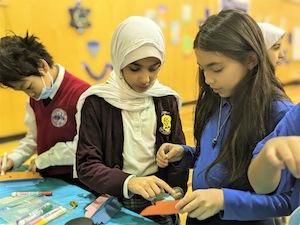
photo - This year's Hanukkah celebration featured several activities for the kids
This year’s Hanukkah celebration featured several activities for the kids. (photo from RJDS)

The Shine a Light program was made possible by a grant from the Jewish Federations of North America, said Bhojani.

In addition to her land acknowledgement on Dec. 12, Bhojani said, “We also acknowledge the Elders, the keepers of traditional knowledge, wisdom and Indigenous ways of knowing. We have much to learn about resilience and responsibility. We commit to asking questions, being open to learning from others and acknowledging that that which we do not know.

“We also commit to make the community we share with you a more peaceful, loving and safe place through the First Peoples’ principles of learning.”

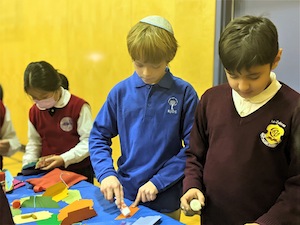
photo - kids doing arts and crafts
(photo from RJDS)

With regard to the day’s program, she said, it was “designed to help each of us develop our understanding and respect for one another’s faith and culture while growing in appreciation, understanding and commitment to our own faith traditions and their meanings. We hope that, through education and events like this one, we will collaboratively encourage people to work together, sharing the responsibility for addressing stereotyping, prejudice, racism, discrimination, antisemitism and social exclusion.”

She noted, “Today, as we gather together, we celebrate the unity and the unique religious coexistence of where we live. I hope you are reminded that is up to each and every one of us to be a ‘Shine a Light’ in the darkness of racism and discrimination.”

One parent who saw the event photos on Facebook wrote Bhojani an email. Having experienced antisemitism, they wrote: “What RJDS is teaching, its values, and [the] education the children are receiving, it’s world changing. It’s hope. It’s proof of a better future.”

Measure of a community

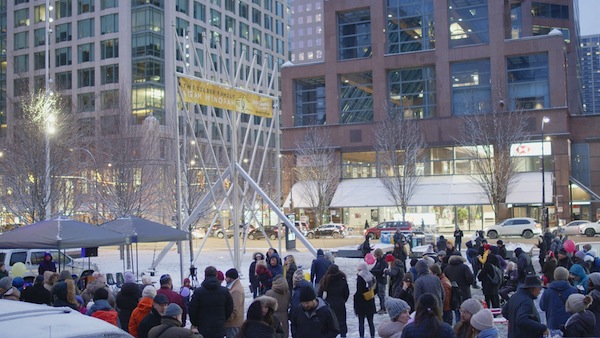
Several hundred people came to the Vancouver Art Gallery Plaza to participate in the annual lighting of the Silber Family Agam Menorah. (photo by Lior Noyman Productions)

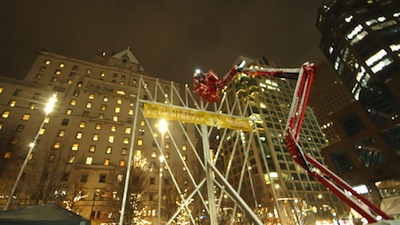
In some places in the world, the sun shines on Hanukkah. It’s warm and inviting, and people gather at the lighting of a public menorah. But the real measure of a community is when hundreds turn out despite the cold and snow, to celebrate Hanukkah in a spirit of camaraderie and festivity. Such was on the first night of Hanukkah in Vancouver, when several hundred people came to the Vancouver Art Gallery Plaza to participate in the annual lighting of the Silber Family Agam Menorah.

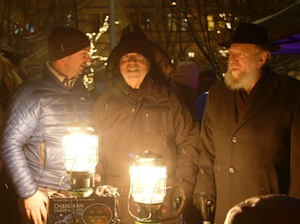
photo - Left to right: Ezra Shanken, Arnold Silber and Rabbi Yitzchak Wineberg try to keep warm at the lighting of the Silber Family Agam Menorah Dec. 18
Left to right: Ezra Shanken, Arnold Silber and Rabbi Yitzchak Wineberg try to keep warm at the lighting of the Silber Family Agam Menorah Dec. 18. (photo by Lior Noyman Productions)

Members of Parliament, of the legislature and of city council brought greetings from their respective governments. The current patriarch of the Silber family, Arnold Silber, delayed his vacation to warmer climes in order to be at the ceremony. His son, Steven Silber, spoke on behalf of the family, and noted that this year marked exactly 95 years since the family’s former patriarch, the late Fred Silber, landed in Canada from his native Poland, with almost nothing to his name. He built a beautiful family and a legacy to the Jewish and wider community.

photo - Lighting of the Silber Family Agam Menorah Dec. 18
Lighting of the Silber Family Agam Menorah Dec. 18. (photo by Lior Noyman Productions)

Rabbi Yitzchak Wineberg, executive director of Chabad Lubavitch of British Columbia, noted in his short address that the lesson of Hanukkah did not lose its impact on Fred Silber. The Maccabees were very small in number, against a mighty army of the Assyrian Greeks, who were well versed in the art of war. Hanukkah teaches us never to be deterred by challenges. Fred Silber may have arrived here with little but he left this world having left much for future generations.

Rabbi Dovid Rosenfeld read a letter from the Lubavitch Rebbe (Menachem Mendel Schneerson) z”l that explains the importance and value of public menorah displays, and the attendees enjoyed a choir performed by students of the B.C. Regional Hebrew Schools, of which Rosenfeld is a co-director with his wife, Chaya Rosenfeld.

Chabad Lubavitch BC gratefully acknowledged the support of Arnold Silber in making this event possible.

– Courtesy Lubavitch BC

Celebrating together

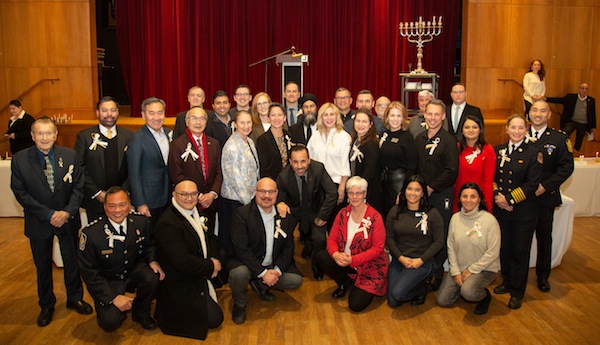
CJPAC and CIJA Dreidels and Drinks reception Dec. 19. (photo by Rhonda Dent Photography)

British Columbia’s Jewish community welcomed elected officials, community partners and volunteer leaders to celebrate the second night of Hanukkah at the Jewish Community Centre of Greater Vancouver for the CJPAC and CIJA Dreidels and Drinks reception.

The Canadian Jewish Political Affairs Committee is a national, independent, multi-partisan nonprofit. Its mandate is to engage Jewish and pro-Israel Canadians in the democratic process and to foster active political participation. It is dedicated to helping community members build relationships within the Canadian political arena. 

The Centre for Israel and Jewish Affairs is the advocacy agent of Jewish federations across Canada. CIJA represents the diverse perspectives and concerns of more than 150,000 Jewish Canadians affiliated with their local Jewish federation. As the Canadian affiliate of the World Jewish Congress, representative to the Claims Conference and to the World Jewish Restitution Organization, CIJA is also connected to the larger organized Jewish community. 

The annual CJPAC-CIJA Hanukkah soiree drew a diverse crowd of attendees, including multi-partisan representation across federal, provincial and municipal governments, members of the diplomatic corps, Vancouver Police Department, Vancouver Fire Rescue Services, and guests from civil society, who lit their own menorah at the front of the room while Rabbi Philip Bregman, interfaith liaison for the Jewish Federation of Greater Vancouver and the Rabbinical Association of Vancouver, officiated the candlelighting ceremony. 

PJ Library books were sent home with elected officials, along with a menorah, candles and chocolate gelt for their home/office. 

With the help of various community members and partners, the event highlighted how CJPAC and CIJA work together to create meaningful experiences for the Jewish community. To see photos from the celebration, visit CJPAC and CIJA’s social media pages or contact kmintzberg@cjpac.ca or nslobinsky@cija.ca anytime for more information. 

– Courtesy CJPAC & CIJA