Post-tumble, lights still shine

I recently celebrated Shabbat morning in a way I don’t recommend. I stepped out of my house for the dog walk, thought, “Oh, slippery!” The next thing I knew, I lost my footing. I fell down several stone steps. I ended up on the sidewalk. I’d let go of the leash. My large dog stood patiently, looking concerned, as I lay on the front walk, assessing the situation.

We’ve had a long and temperate fall here in Winnipeg. The light glaze of ice that covered everything was an unfortunate surprise. I’m very lucky. I was able to get up. I went back up the front stairs with the dog and got help. While I’m bruised and my hands were bloodied, nothing broke. While I would have preferred to go right back to bed, I stayed active enough to manage the rest of the weekend. My kids volunteer at services, so I still had to go there, too. Sometimes, what we want isn’t possible, so we make the best of the situation.

I think about Hanukkah, and the adversity that Jews face, in this way. In the best possible situation, we wouldn’t have to fight physically or verbally to maintain our traditions. We would be able to celebrate in a full-throated way, without hesitation. Yet, that option doesn’t always feel possible, even if we might think that embracing Jewish joy is the best way forward.

The issue arose for me recently when I participated in an accessible “make along.” This event, called Fasten Off, has a period each fall where knitting and crochet designers offer a big discount on their downloadable patterns. It is intended to be as accessible as possible to people with disabilities, as well as those with other challenges. There are multiple categories of challenges: non-gendered, low-vision, sizing for those who are taller or larger than average. For the first time, this year, there was a category on the form that one could tick off that said, “marginalized religious group.” I really didn’t know what to do. 

It’s true that my designs include kippot and a hamantashen baby rattle stuffie. I have never hidden my identity. Now, in Canada, Jews are a marginalized group, with documented hate crime numbers and antisemitism rising. However, I wondered what would happen if I checked off this box. Would it mean fewer people would buy my work? More? What benefit would it have? I both ticked off the box and contacted the organizer to mention my concern. I got no response at all, which made me feel even more worried.

My sales stats show what a huge shift the last two years have been. Previously, one of my kippah patterns, as an example, had been a dependable seller. I looked up this design’s sales and found I’d sold only about 16 kippah patterns (all styles) on three sales platforms during two years of the Gaza war. In the previous year, 2022/23, I sold 14 copies of this pattern on only one sales platform. As a result of this drastic sales drop (I have more than 80 designs online), I ended up taking a break from designing. It no longer became cost-effective to sink money into creating new designs when knitters no longer make even these small purchases. It doesn’t mean my business interests changed. The situation has. I’m still marketing my work, offering discounts and trying to attract interest – even while being part of a “marginalized group.”

Our tradition teaches us to pivot when things are challenging. In the Torah parsha (portion) Toldot, Isaac grows successful as a shepherd. (Genesis 26:13 and onwards) However, when he increases his household and flocks, he needs more water. When he digs new wells, he runs into trouble. First, the Philistines fill up his old wells and, then, as he moves onward, digging new ones, other herdsmen object. He pivots, digging new wells in new places until he finds one that works out. Meanwhile, in time, those who objected to him previously seek a reconciliation, seeing Isaac’s divine fortune, and they make peace. (Genesis 26:31)

After hearing this portion chanted in synagogue, a friend reminded me that sometimes being resilient means pivoting or waiting with patience when faced with adversity. Things don’t turn around right away. We both have engaged in a lot of Jewish advocacy and antisemitism education work over the past year together. She is a professional, public figure, while I tend to write and reach out behind the scenes as a volunteer. Sometimes, my efforts net quick responses, and I know what I said mattered. Other times, I have no idea if anyone received my email or if they read it. I keep trying, as I’m invested in this effort to make life better for Canadian Jews for the long haul.

I believe that bringing up issues concerning antisemitism education, equity reviews in schools and school curriculum matters makes a difference. Sometimes my message reaches the right reporter or school official. Sometimes, it doesn’t or it fails. Yet, in every situation, it’s important to pick myself up, dust myself off – and start all over again, even if the setbacks can hurt.

During Hanukkah, we celebrate the triumph of regaining religious freedom and peace. We use candles to illustrate the metaphor of bringing light to dark times. Sometimes that light is sweeter because of the struggle beforehand. 

I’m still very sore from tumbling down our icy front steps, but I’m also incredibly grateful. This morning, the dog barked, asking for her walk and, while I may still be hobbling and bruised for a bit, I was able to get outside again. 

That opportunity, to keep digging wells, reaching out to others and continuing to try? It matters. Some might see Jews as marginalized, but it’s also possible to take another read. Rather, we’re lucky and resilient, too, a people offering religious freedom and Hanukkah light to other nations. 

Joanne Seiff has written regularly for the Winnipeg Free Press and various Jewish publications. She is the author of three books, including From the Outside In: Jewish Post Columns 2015-2016, a collection of essays available for digital download or as a paperback from Amazon. Check her out on Instagram @yrnspinner or at joanneseiff.blogspot.com.
The Maccabees, old and new

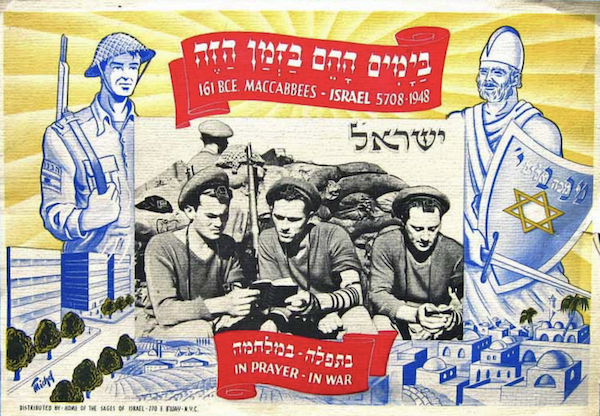
A postcard featuring the work “In Prayer – In War” by Polish-American artist and cartoonist Mitchell Loeb (1889-1968). (internet photo)

Of all the Jewish holidays, Hanukkah is the one most intimately connected to Israel and the Zionist dream. It mirrors the struggle to reestablish the Jewish state, and is perhaps more political in nature than religious. 

Hanukkah represents Jewish military power and Jewish independence, which, in the case of the Hasmoneans, lasted 80 to 100 years. The Hasmoneans and their fellow second-century BCE Judeans were able to establish a state despite having had to face a strong and well-equipped empire. The odds were heavily stacked against them, yet they prevailed. This is why some people say that the Hanukkah story parallels the struggles and achievements of Israel’s first Jewish residents and founding pioneers, surrounded as they were by hostile neighbours.  

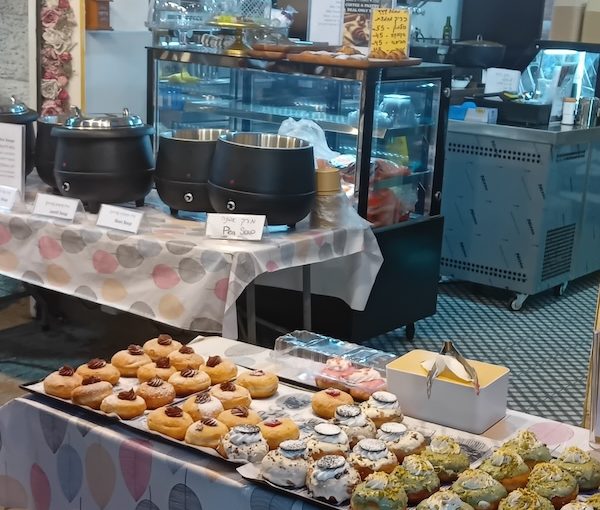
It is hard to claim that the miracle in which a tiny bit of oil lasted, not for one day, but for eight days, is a critical part of an Israeli Hanukkah. However, oil is a crucial part of the holiday. Sufganiyot (filled donuts), fried in oil, go on sale at least a month before the first candle is lit. (I saw them on sale in a Tel Aviv bakery on Nov. 10!) Nowadays, Jerusalem coffee houses and bakeries even have their sufganiyot rated by the media. 

Potato pancakes (levivot, in Hebrew; latkes, in Yiddish) take second place to sufganiyot. Perhaps because levivot are generally products of one’s private kitchen, rather than a bakery, or perhaps because, as an historically Ashkenazi Eastern European food, it appeals to only half the Jewish population in Israel. The other half is Sephardi, meaning people whose long-ago origins were in Iberia, while, in the United States, no more than 10% of the Jewish population is either Sephardi or Mizrachi (Jews who came from Muslim-ruled lands). I couldn’t find any recent figures for Canada’s Jewish population by these measures.

As for levivot, they are no longer made just with potatoes. There might be additions or substitutions like sweet potatoes or zucchini, featuring spices such as cumin and paprika.

As many know, Israel’s climate is well suited to growing olives, and olive trees have grown here for centuries. The trees like the semi-arid climate, with our long, hot, sunny summers and mild, cool winters, as well as Israel’s rocky terrain. Generally, Israeli-grown olives are ready for picking starting just before Hanukkah. There are olive-picking festivals and such events highlight another difference between diasporic and Israeli  observances of Hanukkah. 

Those living in pre-state Palestine knew what Hitler was doing in Europe. According to historian Benny Morris,  the Jewish population in Palestine was reading several newspapers at the time, like Ha’aretzDavar and Do’ar ha-Yom.

The pre-1948 cultural products reflect not only what Palestinian Zionists knew about the fate of European Jewry, but also an ideological effort at creating a new national character. This “new” Jew would not be a victim. He would be a kind of new Maccabee. According to historian Reuven Firestone, the new Zionist Jew would be strong, confident and effective, and the very act of developing the land of Israel would, in turn, develop the Jewish psyche and person.

So, Hanukkah songs written in either the pre-state or early statehood days focus on the success of Zionist fighters more than they do the accomplishments of the Maccabees. In 1936, Menashe Ravina composed the song “Mi Yimalel.” Its lyrics are: “Who can retell the mighty deeds of Israel, who can count them? / In every generation a hero will arise, a redeemer for the people. / Listen! / In those days in this time / The Maccabee saves and redeems / And in our day the whole people of Israel / Will join together and arise and be redeemed.”

In the 1940s, Sara Levi Tanay wrote the words and Emanuel Amiran wrote the music for “Ba’anu Choshech Legaresh.” The idea is that, by banding together, the state can survive: “In our hands are light and fire. / Each person is a small light, / And all of us a great light. / Go away darkness, away, obscurity! / Make way for the light.”

Starting in the 1940s, the Young Maccabees organization began a torch race on Hanukkah. This race was unique to Israel’s celebration of the holiday. It began in the Modi’in area, where it is believed the Maccabees are buried, and was held in all kinds of weather. In December 1954, for example, when the runners reached Jerusalem, it was pouring rain. Israeli youth organizations like the Scouts hold marches and hikes on Hanukkah. 

Ironically, the original torch races, called lampadedromia or lampas, took place in ancient Greece, as part of religious festivals honouring the gods of fire. I say ironically, as the Maccabees fought for their independence from the Syrian Greeks of the Seleucid Empire, which was a Greek successor state to Alexander the Great’s empire. The Seleucid empire, under Antiochus, ruled over Judea. It desecrated the Temple in Jerusalem and sought to forcefully impose Hellenistic culture and religion on the Jewish population.

Today, in both Israel and in the diaspora, chocolate coins, usually wrapped in gold or silver foil – the 1920s brainstorm product of Loft Chocolate Company – are given to children during Hanukkah. Probably not too many people are aware of this, but, according to Rabbi Deborah Prinz, this edible gelt (money, in Yiddish) recalls the booty, including coins, that the Maccabees distributed to Jewish widows, soldiers and orphans, possibly at the first celebration of the rededication of the Jerusalem Temple. Also, in ancient Israel, striking, minting and distributing coins expressed Hanukkah’s message of political autonomy. The Maccabees’ descendants, the Hasmoneans, ruled Judea, as mentioned above, and issued their own coins.

Finally, a column in the Great Mosque of Gaza once bore inscriptions in Hebrew and depicted a seven-branched menorah (like the one used in the Temple), a shofar and an etrog, indicating a Jewish community in the area during the Roman/Byzantine and talmudic eras. These inscriptions apparently disappeared after the First Intifada in 1987. The Hanukkah menorah, or hanukkiyah, by contrast, has nine branches, commemorating the eight days the oil burned in the rededicated Temple, plus a shamash (helper) candle to do the lighting of the symbolic candles. 

Deborah Rubin Fields is an Israel-based features writer. She is also the author of Take a Peek Inside: A Child’s Guide to Radiology Exams, published in English, Hebrew and Arabic.

My Hanukkah miracle

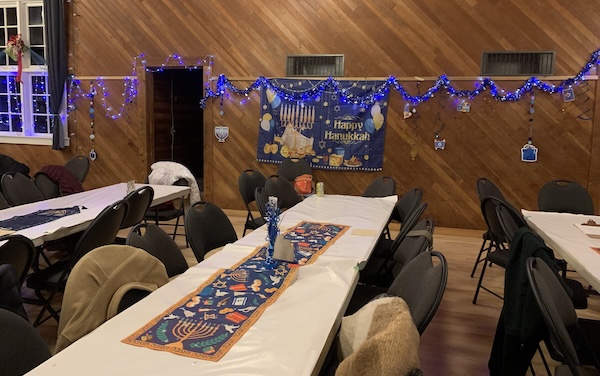
Last year, a great miracle happened here:  Beaver Point Hall on Salt Spring Island. (photo by R. Shefa)

Hanukkah is a celebratory festival with oodles of delicious food – mostly fried – songs, candles and gatherings.

It is also considered a miracle festival. Jews rededicated the Second Temple when a small amount of oil for the Temple menorah lasted for eight days. This is why we eat fried foods, such as potato latkes and melt-in-your-mouth donuts, which also increases our calorie consumption, so we sigh with relief on the last day of the holiday.

Personally, I consider any day that runs smoothly from beginning to end a miracle. Take this past Hanukkah, when I lost a hearing aid on Salt Spring Island.

I had been invited to sing at a Hanukkah party. Although it was a dark, stormy night, my husband and I were excited to meet the locals and unwind in the quaint and character-filled Beaver Point Hall. At 92 years old, the hall has been a regular staple in the community. It hosts a diverse range of activities, such as concerts, workshops, kids programs, dancing and weddings.

A large fire welcomed us and there were some 20 hanukkiyot waiting to be lit before the large potluck dinner began. However, despite numerous announcements to kindly wait until the candles were lit and blessings made, the crowd plunged into the myriad dishes: salads, kugels, mung bean hummus (hey, this is Salt Spring), perogies, lasagna, homemade breads. The volunteer latke makers rushed to serve the latkes.

The hall acoustics became poor, so I took out one hearing aid and placed it in my purse. I could now hear my voice clearly for singing.

As I headed to the smaller room to tune the guitar, the remaining left hearing aid, still in my ear, made its usual beeps to inform me that I had left an aid behind. I ignored it.

After a very pleasant evening, we made the 20-minute trek home to the other side of the island. My hearing aid did not.

After tearing through my handbag, guitar case and car, it was officially not with me. There were only two places it could be: at the hall, or in the garbage, which would have been carted to one of the volunteer’s homes.

We were leaving at noon the next day, so an urgent search was necessary. But the hall was closed and my friend was not answering her phone. After much thought, I Googled the hall’s website. It displayed the calendar with all the rentals, including a dance improv the next day.

Miracle #1: the dance improv’s contact information was on Facebook.

Miracle #2: the organizer responded to my request and messaged back that the hall would open at 9 a.m. for the cleaners.

Miracle #3: after several texts, the organizer decided it was safe to give me the lock code to enter. And so we did. At 11 p.m., my kind husband, Steve, drove me back to the hall, as it’s a bit tricky to drive in the dark on rough roads, with deer occasionally darting out and heavy rain falling.

Steve parked the car so the headlights shone on the lock code and I was inside. Finding the light switches took a good few minutes and I never did find the kitchen ones. I headed to the stage, where my purse had been. Nothing but a few decorations. And then, suddenly, my left hearing aid, still firmly in my ear, began to beep with excitement – its partner was in the hall!

Steve joined the search. My left hearing aid clutched to his ear, he looked in every possible nook. He got excited. When he walked into the middle of the room, he said the beeping was loudest there. If someone had walked into the hall at that point, they probably would have thought there were two aliens loose.

What motivated me to look under an electric outlet, I will never know, but that’s where I found my hearing aid – completely covered by some Hanukkah gelt wrappers, most likely swept under them by one of the volunteers.

It was truly the best Hanukkah miracle! 

Jenny Wright is a writer, music therapist, children’s musician and recording artist.

Improving the holiday table

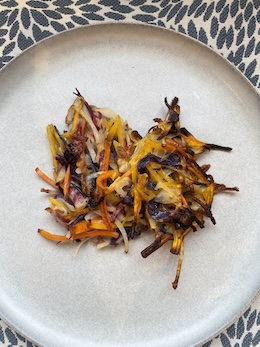
These latkes can be made vegan, gluten-free and with reduced oil – or not. (photo by Michelle Dodek)

They tried to kill us, we survived, let’s eat. This refrain encapsulates how Jews celebrate a number of holidays and view our tumultuous history. In September, Congregation Beth Israel hosted a three-part High Holiday Cooking series. It was so popular that classes have been scheduled throughout the coming months to coincide with various holidays. Luckily for those who like to learn new cooking techniques and the history and symbolism behind Jewish food, there are plenty of holidays between now and the end of May.

First on the list is Hanukkah. Associated with oil, this winter holiday is a chance for Greater Vancouver Jews to throw off the shackles of green smoothies and embrace greasy carbs, for religious reasons. 

The central event celebrated at Hanukkah is the liberation of the Temple in Jerusalem from the Seleucid Greeks, who had conquered the land of Israel and were attempting to forcibly convert all Jews. These events took place after the biblical era, so Hanukkah is not one of the holy days mentioned in the Torah. It is recorded in the Books of Maccabees.

Although not so religiously significant, Hanukkah is one of the most popular Jewish holidays, especially in North America. It’s dark outside and lighting candles to illuminate the darkness both literally and figuratively is cheering. In modern times, the heroic story of the small band of Jewish rebels taking on a mighty army and winning is especially poignant, given the many struggles facing the tiny modern state of Israel. And, let’s face it, having a fun Jewish foil to Christmas is helpful.

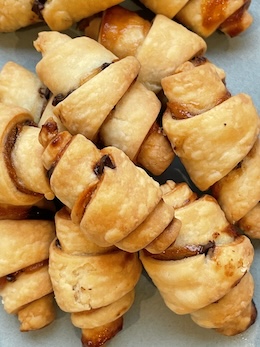
There is no requirement to refrain from work during Hanukkah, as there is for many other Jewish holidays. To accompany the week-plus of nightly candlelighting, we have special foods. Potato latkes are the most recognizable on the Ashkenazi menu, but rugelach are also traditionally prepared for Hanukkah. Why? The three ingredients in the dough are flour, butter and cream cheese. Lots of fat. Yum.

Sephardi and Mizrachi Jews connect the culinary dots much more succinctly. Sfinge is a delicious Moroccan free-form, deep-fried dough eaten on Hanukkah. Filled donuts, known widely as sufganiyot, have been part of Sephardi and Mizrachi traditions as well. Popularized in Israel by the Labour government in the 1950s, the making of donuts for Hanukkah was the tastiest of many job creation projects for Israel’s struggling economy. Although it was seasonal, encouraging bakeries to hire extra staff in November and December to fry up holiday cheer resulted in a national culture of amazingly tasty filled donuts.

The Dec. 2 Hanukkah cooking class at the BI was dedicated to helping people make out-of-the-box latkes with interesting toppings, as well as a couple of desserts that don’t require a pot of deep-frying oil. While the recipe for rugelach is simple, technique is needed to get the flakiest dough. There is a lot of room for creativity in the filling, but not everything will be a success, so spread thinly if you plan to try out the recipe below and see if your idea works first before producing a huge batch. 

For more “Kitchen Judaism,” watch for other holiday cooking classes at Beth Israel. Classes will include Tu b’Shevat Temptations; Stuffed for Purim, featuring two classic filled foods; Seder and Shabbat Dinner Vegetarian-style; and Shavuot Dairy Delights.

SEASONAL LATKES
(These latkes can be made vegan, gluten-free and with reduced oil. The substitution of vegetables other than potatoes lowers the glycemic index, making the latkes better for diabetics, and more satiating and visually attractive.) 

1 large onion, grated and  squeezed
4 cups of the any of the following, grated: beets, winter squash (like kabocha, acorn, banana or butternut), carrots, turnips or parsnips
2 eggs
4 tbsp corn or potato starch
salt and pepper to taste
oil for frying

photo - These latkes can be made vegan, gluten-free and with reduced oil – or not
These latkes can be made vegan, gluten-free and with reduced oil – or not. (photo by Michelle Dodek)

Once the vegetables are grated and the excess liquid is squeezed out, combine all the ingredients, coating the vegetables well. Take a heaping tablespoon of the mixture and drop it into the hot oil. Do not squish them down, just spread out the mixture so the edges are thin and the middle has some volume. Repeat, making sure the latkes are spaced out enough to flip. Once the edges begin to brown, flip the latkes and fry a few more minutes. If you plan to freeze and reheat, cook for fewer minutes, then cool on layers of paper towels. To freeze the latkes, fully cool them, remove the paper towel and lay the latkes out in individual layers on trays for best results. Once frozen, put them into an airtight container. 

To make a vegan version of this recipe, use flax eggs (one tablespoon of ground flax plus three tablespoons of water/”egg”). The baked version includes two tablespoons of olive oil in the mixture and is baked at 375˚F until brown.

RUGELACH

250g cream cheese (room temperature: leave out a maximum of 2 hours)
1 cup butter (room temperature: can be left out overnight)
2 cups flour
filling of choice: cinnamon, sugar, raisins, Nutella, jam (be creative)

photo - Rugelach are so much better when eaten the day they’re made
Rugelach are so much better when eaten the day they’re made. (photo by Michelle Dodek)

Mix the cream cheese and butter until well creamed. Add the flour and mix until a soft dough is formed.  Ideally, cover and refrigerate for two hours or overnight.

Preheat the oven to 350˚F. Line two cookie sheets with parchment or a baking mat. Divide the dough into four balls. Roll into three-millimetre-thick circles. They should be almost 25 centimetres wide.

Cover the dough with a thin layer of filling. Don’t be tempted to make it too thick because it will burn and make an enormous mess. If you’re using cinnamon and sugar, sprinkle three parts sugar and one part cinnamon all over the dough.

Cut the circles into 10 or 12 “pizza-shaped” slices. Roll from the outer edge into the centre, making a cute rolled-up shape. Put the rugelach on the cookie sheet and either freeze them on the pan and then transfer them to an airtight container or bake them immediately. Bake for 25 minutes or until lightly golden.

Rugelach really are 1,000 times better when eaten the day they’re made. 

Michelle Dodek is a long-time contributor to the Jewish Independent and is a cooking instructor who specializes in Jewish and vegetarian cooking.

Vive la différence!

French is one of the main languages one hears on the streets of multicultural Jerusalem today, along with Hebrew, Arabic, English and Russian. More than 2,170 French Jews moved to Israel in 2024. The number in 2025 is projected to exceed 3,000. The wave of aliyah – driven by antisemitism and violence targeting Jews – has resulted in the establishment of scores of new patisseries, boulangeries and charcuteries – all kosher. Seen here is Foodies on Yoel Moshe Salomon Street. Nearby is Napoleon, one in a cluster of gourmet restaurants in Kikar Hamusica (Place de la Musique), established by former Parisian Laurent Levy, who is building Le Grand Hôtel.  

From the archives … Hanukkah

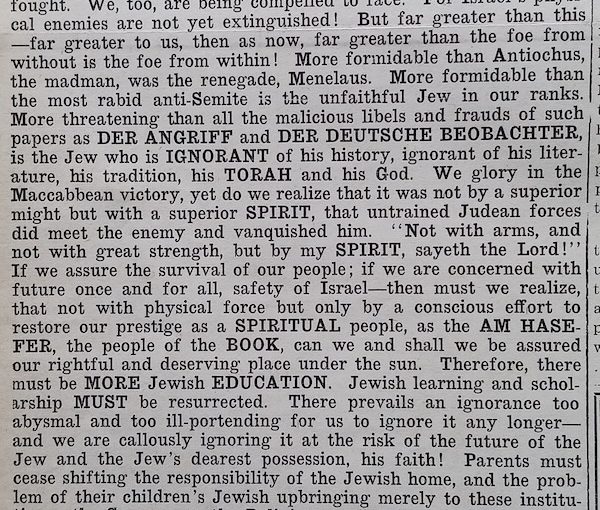
The editorial in the Dec. 8, 1939, issue of the Jewish Western Bulletin.

We’ve come a long way in many ways, though some readers may disagree. I read, kind of in horror, the newspaper’s Dec. 8, 1939, editorial in which the lesson drawn from Hanukkah was that, “More formidable than the most rabid anti-Semite is the unfaithful Jew in our ranks. More threatening than all the malicious libels and frauds of such papers as DER ANGRIFF and DER DEUTSCHE BEOBACHTER, is the Jew who is IGNORANT of his history, ignorant of his literature, his tradition, his TORAH and his God.”

I can appreciate the Maccabean victory “was not by a superior might but with a superior SPIRIT, that untrained Judean forces did meet the enemy and vanquished him.” I agree that Jewish education is vital to Jewish continuity, but yikes. I’m not sure all the “yelling” capital letters encourage the message that: “There must be a closer alliance, a sense of closer affinity, a warmer consciousness of brotherhood between Jew and Jew and between the individual Jew and Jewry at large if we are to succeed – nay, if we are to insure our future as a people!”

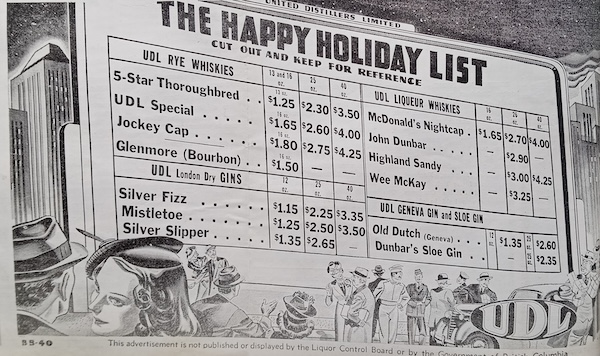
I am also always surprised at how much of the advertising in the early years of the Jewish Western Bulletin was for alcohol. As but one example, given the time of year, is the Dec. 24, 1941, ad from United Distillers Ltd., “The Happy Holiday List” that readers are asked to “cut out and keep for reference,” which I guess I’ve done, though I don’t think any of the brands still exist.

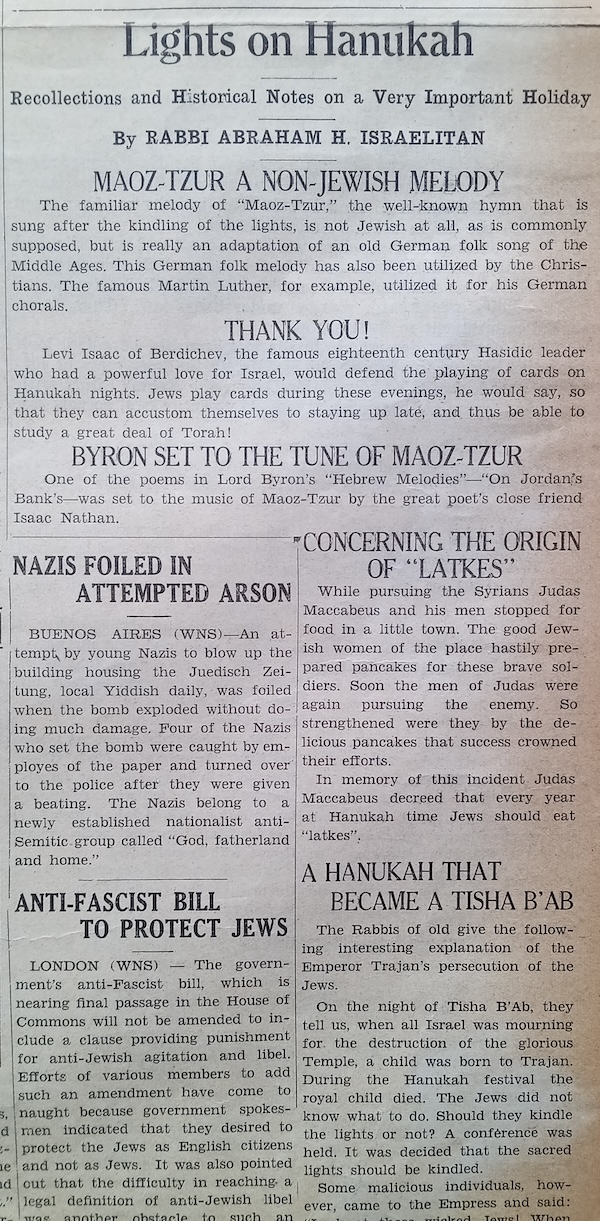
I did enjoy some of the Hanukkah trivia that made the front cover of the Dec. 11, 1936, paper, though it was a jarring juxtaposition with the world news. As it happens, the first item, on the melody of the traditional Hanukkah song “Maoz Tzur,” mentions Martin Luther, as does the article on the cemetery in the German City of Worms that is featured in this week’s issue – on this very page, in fact – which discusses briefly Luther’s legacy.

In his “Lights on Hanukah” article, Rabbi Abraham H. Israelitan points out: “The familiar melody of ‘Maoz-Tzur,’ the well-known hymn that is sung after the kindling of the lights, is not Jewish at all, as is commonly supposed, but is really an adaptation of an old German folk song of the Middle Ages. This German folk melody has also been utilized by the Christians. The famous Martin Luther, for example, utilized it for his German chorals.”

The rabbi also notes, “One of the poems in Lord Byron’s ‘Hebrew Melodies’ – ‘On Jordans Bank’s’ [sic] – was set to the music of Maoz-Tzur by the great poet’s close friend Isaac Nathan.” He goes on to reveal “the origin of latkes,” and a few more of what we now call “fun facts.” Israelitan was not a local rabbi. His article was distributed by Seven Arts Feature Syndicate, which, according to Google, was an American group that provided content to Jewish papers from the 1920s through the 1960s.

Holiday parties, concerts, menorah lightings and more have always been promoted or covered in the newspaper, of course. Almost every Hanukkah issue has included recipes, gift ideas, personal holiday stories. And pretty much every Hanukkah-themed editorial aims to point out what the Maccabees can teach us today or what light we can shine to diminish the darkness in the world – though we do it a little less harshly than the editors of 80, 90 years ago, I think. Most certainly, we do it with fewer capital letters. 

image - An adl in the Dec. 24, 1941, issue of the Jewish Western Bulletin
An ad in the Dec. 24, 1941, issue of the Jewish Western Bulletin.
image - An article on Hanukkah trivia in the Jewish Western Bulletin Dec. 11, 1936
An article on Hanukkah trivia in the Jewish Western Bulletin Dec. 11, 1936.

Celebrate, share light

Hanukkah is a holiday made joyous by its origins in the victory of the Jewish people over our oppressors and the liberation by the Maccabees of the Second Temple in Jerusalem. Now, thousands of years later, over eight nights, we light candles to honour our brave ancestors and to recognize the fortitude, across the millennia, of the Jewish people.  

The meaning of Hanukkah has acquired a new relevance: the bravery demonstrated by the people of Israel – especially since Oct. 7, 2023. 

It has been more than 15 months since, in the most shameful and grievous fashion imaginable, Hamas deliberately started a war, placing the people of Israel – and of Gaza and the entire region – in jeopardy. Israel continues to defend its residents and citizens from terror on multiple fronts, facing both assaults from Hamas and unprecedented attacks by hundreds of rockets from Iran-backed Hezbollah. Israelis and the global Jewish community continue to call for the release of 101 hostages who remain captive in Gaza. Families across Israel and the world continue to adjust to life without the 1,200 Israelis – and victims from 30 other nations – systematically murdered on Oct. 7. 

Yet, amid the chaos and terror of daily rocket attacks, the spirit and fortitude of the people of Israel remains as strong as ever. 

This year, as we light our candles over the eight nights of Hanukkah, we contemplate the history and symbolism of our Jewish traditions, and we have an opportunity to consider their meanings in our current reality. Just as we light our hanukkiyah with its eight, equally proportioned candles, we remember Jews have an admirable track record in fighting for social equality, and we consider where, today, there are inequalities to be addressed. 

photo - This year, as we light our Hanukkah candles, we contemplate the history and symbolism of our Jewish traditions, and we have an opportunity to consider their meanings in our current reality
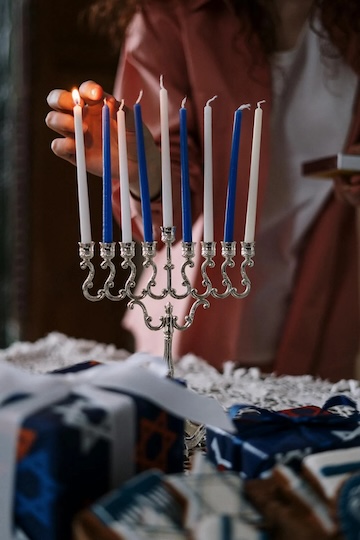
This year, as we light our Hanukkah candles, we contemplate the history and symbolism of our Jewish traditions, and we have an opportunity to consider their meanings in our current reality. (photo from pexels.com)

As we add candlelight to our homes, we remember our age-old obligation to bring light to our families, friends and neighbours. We encourage well-rounded education, free from hate, for all children; we advocate for a safe and welcoming learning environment for our post-secondary students and faculty; and we support the most vulnerable among us. 

There is much to do – what will your focus be over the coming year? To what cause will your efforts be directed? 

Can we hope that Gaza will be freed from the terrorist influence of Hamas? Will Lebanon emerge from under the sway of Iran-backed Hezbollah? Will Israel’s adversaries stop their war against the Jewish state?

Will our focus be on our own family, our close friends, our community, a charitable cause? Will we share the Jewish values we cherish, the triumph of light over darkness, freedom over oppression, and the importance of upholding one’s identity and beliefs?

And can we help our fellow Canadians uphold the values we hold dearest? How much light can we share this Hanukkah season? 

Let’s find out. 

Chag sameach. 

Judy Zelikovitz is vice-president, university and local partner services, the Centre for Israel and Jewish Affairs (CIJA).

Hanukkah as a messy middle

Hanukkah reminds us that miracles are possible and that seemingly unwinnable wars can be won. But it also holds lessons about partial victories, imperfect heroes and incomplete belonging.

We tell the story of Hanukkah, in our liturgy and in our songs and in the rituals we use to celebrate the holiday, as the decisive end of a frightening conflict: the good guys win, the bad guys lose, and the Temple is rededicated with Divine imprimatur.

But that is not the full picture of how Hanukkah was experienced in its day: alongside the joy and triumph, there was loss, uncertainty and ongoing strife. This reality of Hanukkah as the messy middle holds lessons of perseverance for us today as we celebrate the holiday while the state of Israel fights a war that could last a long time, and whose outcome is unknown.

Leading up to the victory of Hanukkah, Jews fought one another, heroes died and families mourned, and, as the martyrdom narrative of Hannah and her seven sons describes, civilians made profound sacrifices. It is easy to envision the experiences of people waiting for loved ones to return, of everyday acts of survival and kindness, of the fear experienced by individuals, families and communities. Even the victory of Hanukkah must have been tinged with deep loss.

What’s more, the Hanukkah victory did not end the war between the Seleucid-Greeks and the Maccabees: military campaigns continued for years thereafter. Statecraft was employed as alliances were made and broken; communities dedicated monuments to their fallen heroes, and even the great Judah the Maccabee died in battle. In short, Hanukkah did not decisively conclude the saga. Rather, it marked a crucial milestone amid continued sacrifice and uncertainty about the future. And yet, the Jewish leadership established the holiday to hail a crucial milestone.

image - “The Story of Hanukkah,” by Ori Sherman, 1985
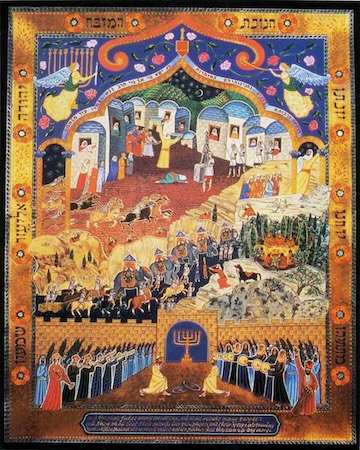
“The Story of Hanukkah,” by Ori Sherman, 1985. (from thecollector.com)

The Book of Maccabees describes a Jewish civil war in relation to Hanukkah. But that does not fully characterize the story of the Judean state that emerged after the war. True, that state (164 – 63 BCE) was rife with intra-Jewish bickering and general divisiveness, whether political, social or religious. However, the majority of Jews in the second and first century BCE did not belong to any sect.

Moreover, Jews who lived in vibrant communities outside of the land of Israel still viewed themselves as the close kin of Jews who lived in the land of Israel: identifying themselves as Jewish by observing Shabbat and the holidays, circumcising their baby boys, keeping dietary laws, and gathering regularly in synagogues to read and interpret their scriptural traditions. What bound all these Jews together was more powerful than what divided them.

The character of Hanukkah as we observe it was most explicitly shaped by a rabbinic establishment living hundreds of years after the Hasmonean period. And though the original Hasmoneans (the Maccabees) were the heroes of Hanukkah, these later rabbis viewed them as flawed. After all, the priestly Hasmoneans took over the throne, combining the priestly and monarchic functions in a way that denied the Davidic dynasty and compromised the separation of religious and political powers. Nonetheless, the courage of the Maccabees continues to inspire the collective Jewish imagination. This conveys the complicated truth that there are no perfect heroes. The people who stand up, and who are willing to take risks and make sacrifices, become the instruments of salvation – regardless of whether the people in their time, or the later sages, agree with all that they stand for.

These three lessons of the Hanukkah story should inform our celebration this year, at the same time as the realities of the war in Israel.

First, let’s appreciate partial redemptions. This includes the reunions that have happened of hostages with their families and the progress made by the Israel Defence Forces in eradicating Hamas. Acknowledging partial victories becomes a source of gratitude, and it equips us with resilience as we forge ahead, despite uncertainty and difficulty.

Second, let’s take seriously the gains we have made in our commitment to Jewish peoplehood. Oct. 7 has drawn the majority of Jews together, despite significant differences among us. We must try to sustain this sense of Jewish peoplehood without imagining that our disagreements will disappear.

And third, let’s accept the current need and ability to work even with flawed leadership. Many who spent the year before Oct. 7 protesting Israel’s current administration have chosen to prioritize the war effort, to focus on defeating Hamas and bringing our hostages home.

As we continue to navigate the messy middle of today’s conflict, may the more complex aspects of Hanukkah and its aftermath inspire within us the hope and faith we need to persevere as a people. 

Dr. Elana Stein Hain is rosh beit midrash and a senior research fellow at the Shalom Hartman Institute of North America. To read more from institute scholars, visit hartman.org.il.

A gift of light in winter

Thanks to Doodle the village orphan, the people of Chelm celebrated Hanukkah even during “The Long Winter of the Cabbage.” (image from reformjudaism.org)

In literature, a cabbage might be a symbol for anything and everything disagreeable. In the village of Chelm, however, a cabbage is sometimes just a cabbage.

They called it “The Long Winter of the Cabbage” and, in the village of Chelm, few people were happy. There was a food shortage – all there was to eat was cabbage. Cabbage for breakfast, cabbage for lunch, and cabbage for dinner. No one was looking forward to Hanukkah.

As Rabbi Kibbitz was heard to mutter, “A diet of cabbage may sustain, but it doesn’t make you want to sing with joy.”

Except for young Doodle, the village orphan, who honestly and truly loved cabbage, and reveled in every bite. Doodle, however, had learned to keep his appreciation for all things brassica to himself. When everyone else is miserable, they really don’t want to hear someone appreciate the things they dread.

In previous years, the villagers held a Hanukkah party in the social hall, lighting candles and then dancing, and complaining about Mrs. Chaipul’s lethal latkes.

But, this winter, the thought of Mrs. Chaipul’s latkes made from cabbage made everyone shudder. So, the Hanukkah party was canceled.

“It’s the weather,” Mrs. Chaipul said. “Too cold. Too wet. Too much snow. Too much ice. Too much wind.”

“I’ll say there’s too much wind!” said Reb Cantor, the merchant, before he withered under Mrs. Chaipul’s glare.

Reb Cantor himself was particularly unhappy. Recently, the villagers of Chelm had gotten into the habit of buying and giving gifts to each other to celebrate Hanukkah.

“They’re not Christmas presents,” explained little Shemini Schlemiel, who had come up with the idea. “They’re Hanukkah gifts!”

The problem with these Hanukkah gifts was that they had become a large part of Reb Cantor’s business. The merchant discussed this at great length with his friend Rabbi Yohon Abrahms, the school teacher, but their cabbage-addled brains devised no brilliant solution. Not even a foolish solution.

When the first night of Hanukkah arrived, with a cold wind and rain mixed with snow, that turned to muddy slush in the darkened streets, the villagers of Chelm stayed home. They shivered in front of their fires. They poked at their cabbage stews and their cabbage briskets (don’t ask).

Everyone wanted to complain, especially the children, who had become accustomed to getting presents, but nobody had the energy.

Except young Doodle, the village orphan, who had already finished a bowl of Mrs. Levitsky’s sweet and sour cabbage soup, and was about to ask for more, when he noticed the dark mood in the Levitsky house.

“What’s wrong?” Doodle asked.

“Nothing,” Martin Levitsky, the synagogue’s caretaker, said, glumly. “I’m tired of cabbage.”

“I think I’ll go to bed early,” Chaya Levitsky said, taking off her apron. “Help yourself to as much cabbage as you want.”

“But we haven’t lit the Hanukkah candles yet,” Doodle said.

“Meh.” Both Levitskys shrugged, and began making their way to their bedroom. “You do it, Doodle. We’re going to sleep.”

Now Doodle was really worried.

He ran to the window, looked outside, and saw that no other houses in the village had candles lit in their windows.

“Not again,” Doodle whispered. It was the time of year. Sometimes the cold and the dark…. Was everyone just too tired of cabbage to celebrate?

“Wait!” Doodle shouted.

This startled the Levitskys, who stopped in their tracks.

“You want us to have a heart attack, Doodle?” Reb Levitsky asked.

“No, I want you to wait two minutes while I light the Hanukkah candles.”

“All right.” Mrs. Levitsky sighed. “Go. Go already.”

Doodle ran to the cabinet and brought down the Hanukkah menorah. He set two candles, and began to sing the blessings.

At first, the Levitskys stayed quiet, but soon they began to hum.

When Doodle used the lit shammos to set the second candle’s taper alight, the Levitskys joined him.

And then, together, they all sang the words of the Shehecheyanu, giving thanks simply for being alive.

Moving quickly but carefully, Doodle set the lit menorah in the front window of the Levitskys’ house.

At that very moment, Reb Cantor the merchant happened to look out his window. As did the entire Schlemiel family.

So did Rabbi Kibbitz and Mrs. Chaipul, who had been in the middle of a three-way argument with Rabbi Yohan Abrahms. All three forgot what they had been fighting about.

Through the rain and the sleet, everyone in the village of Chelm saw the two lights burning in the Levitskys’ window.

They all fell silent. They all ran to their cupboards and shelves, got their hanukkiyahs, said or sang the blessings, and lit the candles.

Soon, there were bright lights burning in the windows of every home.

Even though it was still raining and snowing, and all there was to eat was cabbage, those small flames made everyone feel warmer. Songs were sung, children began to spin dreidels, gambling for cabbage, and a few brave souls tried to make cabbage latkes, but without much success.

That year in the village Chelm, there were no presents. The lights in the windows were gifts enough. 

Izzy Abrahmson is a pen name for storyteller Mark Binder. To find out more about ‘The Long Winter of the Cabbage,’ Mrs. Chaipul and Doodle, read The Council of Wise Women. This new novel for adults is available in print, ebook and audiobook. For purchase links, visit bit.ly/council-book.