Considering the extra challenges Jews have faced these last few years, there are many of us who have reacted by delving more into our Judaism and our Jewish identities. Perhaps that’s why a book the Independent received a handful of years ago seems even more relevant now – both as a way to explore one’s identity, but also one’s creativity. With summer approaching and school soon letting out, who couldn’t use some ideas on how to fill the coming increase in a young person’s unstructured hours?
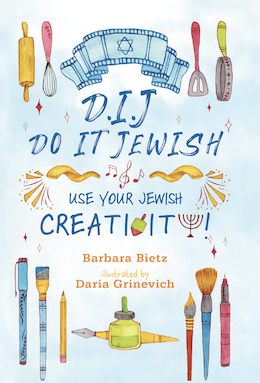
DIJ – Do It Jewish: Use Your Jewish Creativity! by Barbara Bietz, with colourful and playful illustrations by Daria Grinevich, is targeted to children 8 to 12 years old, but, honestly, any older person who has been contemplating their creative side would glean something, many things, from it. Published by Intergalactic Afikoman in December 2020, in the heart of the pandemic, it fell by the JI’s wayside, unfortunately, but not out of mind. So, while not hot off the press, it is hot off the JI bookshelf, and well worth adding to your household as a guide for worthwhile projects that could be used simply to pass the time in a fun, imaginative way, or it could spark a career or hobby path.
The book has chapters on filmmaking, cartooning and graphic novels, cooking, songwriting, painting and art, midrash, and Judaica. Each chapter comprises a main interview with a practitioner of the artform being presented, with the interview divided into four main sections: Doing It Jewish, Keeping It Going, Making It As Good As It Can Be, and Taking It Further. Then, there is a secondary artist spotlight.
Each chapter concludes with a how-to summary of sorts, featuring ideas of what to do and what questions you might ask yourself as you work through an idea. And, each chapter includes a list of necessary tools for the project, as well as a glossary of terms comprised mainly of Jewish words, like Talmud, kreplach, Shavuot or dreidel, but also script, graphic design, choreography and beatnik.
DIJ – Do It Jewish features almost 20 artists sharing some of their inspirations, processes and advice, as well as concrete steps for aspiring artists to embrace their Jewishness and express it creatively.
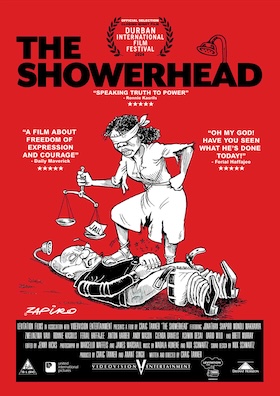
The South African Film Festival, which takes place Nov. 6-17, is primarily a streaming festival, but there are a few in-person cinematic experiences, including a screening of The Showerhead on Nov. 6, 6:30 p.m., at SFU Goldcorp Centre for the Arts.
The Showerhead is a feature-length documentary that examines the work of political cartoonist Jonathan Shapiro, aka Zapiro, tracing his journey from anti-apartheid activist and struggle artist to “conscience of the nation” and champion of freedom of expression in democratic South Africa.
The documentary delves into the origins, relevance and impact of an iconic feature in Zapiro’s work that gives the film its title: the plumbing hardware fixed to the head of Jacob Zuma, the former president of South Africa. Through Zapiro’s cartoons, the film explores Zuma’s scandal-ridden rise to power, his turbulent presidency and eventual downfall.
Zapiro’s cartoons also capture a range of critical issues that have plagued South Africa in the post-Mandela era: failures of leadership during the AIDS pandemic, corruption, chauvinism, cronyism, self-enrichment, subversion of the constitution and the rule of law, and escalating threats to freedom of expression.
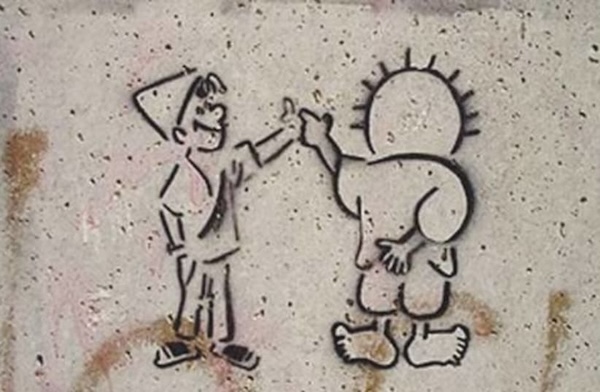
The ways in which the characters of Srulik, left, and Handala epitomize the historical and cultural narrative of the Israelis and Palestinians, respectively, imbue these cartoons with an impact stronger than words. (photo by Gil Zohar)
Driving east from Jerusalem on the winding Jordanian-built road that once led down from the Mount of Olives to the Dead Sea, one passes through a series of picturesque Arab suburbs and soon comes to a dead end in front of the grotesque West Bank barrier.
Called Geder ha-Hafrada (separation fence) in Hebrew and jidar al-fasl al-’unsuri (apartheid wall) in Arabic, the insurmountable (if still incomplete) eight-metre-high concrete barrier has no doubt contributed to a reduction in terrorism and car theft. However, my objection to it is more existential: like some of those in West Berlin who spray-painted their protest for freedom on the Bundesrepublik side of die Mauer even as armed GDR guards used deadly force to prevent anyone from approaching the wall’s eastern side, I believe all walls must fall.
It is a metaphor that has repeated itself from Joshua’s encircling of Jericho, to the Berlin Wall and its remaining East Side Gallery, to Garth Hewitt’s ballad “They’ve Canceled Christmas in Bethlehem,” about the stranglehold the wall has placed on both day-to-day life and religious pilgrimage in the place where Jesus, “the Prince of Peace,” was born 2,000-plus years ago.
The world today is caught between two conflicting ideologies: some democratic countries joining in unions with open borders, joint legal systems and a common currency, of which the European Union – notwithstanding its problems – is a great success. Then, there are other countries – many repressive and undemocratic – defending their borders with minefields and walls. Like John Lennon, I prefer the first vision – of a growing global union without barriers. Imagine that.
Thus, armed with the tools of the graffiti artist – an X-ACTO knife, cardboard stencil and spray paint – I recently made my way to Abu Dis with my friend Hajj Ibrahim Abu el-Hawa, my daughter Bareket and fellow artist Eva Feld to make our mark. Reasoning that a picture is worth a thousand words, we chose a symbolic image whose meaning is unequivocal.
The image we created depicts Handala raising hands with Srulik (see picture). The two iconic cartoon characters are respectively well known by Palestinians and Israelis – yet, each is equally unknown by the other. It is a symmetry of ignorance of the other’s narrative that will have to be overcome before true peace can be achieved.
Allow me to explain the mirror meanings of the twin caricatures.
Handala – an omnipresent image on T-shirts and key chains in the aswaq (plural of suq, market) of Jerusalem, the West Bank and Gaza Strip – was created by Naji al-’Ali in 1969. A 10-year-old child driven in 1948 from his Galilee village of ash-Shajara (14 kilometres from Tiberias) to the ‘Ain al-Hilweh refugee camp in Lebanon, al-’Ali went on to become the leading political cartoonist in the Arab world.
Before being assassinated in London in 1987, he produced more than 40,000 bitingly sarcastic cartoons lampooning Arab leaders and lamenting the stateless status of his people. His autobiographical image of Handala – a barefoot, faceless, refugee youth – remains a potent symbol of the struggle of the Palestinian people for justice and self-determination.
Al-’Ali wrote: “Handala is my signature. I gave birth to this child in the [Persian] Gulf. He was born 10 years old, and he will always be 10. At that age, I left my homeland and, when he returns, Handala will still be 10, and then he will start growing up. The laws of nature do not apply to him. He is unique. Things will become normal again when the homeland returns.”
Impish Srulik – a diminutive of Yisrael (Israel) – carries an equally rich symbolism in depicting nascent Israel and, in particular, its native-born Sabras. The illustrated character was first drawn in 1956 by the cartoonist Kariel Gardosh, better known by his nom de plume, Dosh. The Hungarian-born Holocaust survivor drew Srulik for decades in the pages of the daily Maariv, until his death in 2000.
Dosh generally depicted Srulik as a young man wearing a kova tembel hat, “biblical sandals” and khaki shorts. He drew him as a pioneering Zionist and lover of the land of Israel, a dedicated farmer who in time of need dons an Israel Defence Forces uniform and goes out to defend the state of Israel, equipped with an Uzi machine gun. In contrast to the antisemitic stereotype of the weak or cunning Jew, which appeared in the Nazi weekly Der Stürmer and other European and Arab newspapers and journals, Dosh’s Srulik was a proud, strong and sympathetic Jewish character.
Shalom Rosenfeld, editor of Maariv from 1974 to 1980, wrote: “Srulik became not only a mark of recognition of [Dosh’s] amazing daily cartoons, but an entity standing on its own, as a symbol of the land of Israel – beautiful, lively, innocent … and having a little chutzpah and, naturally, also of the new Jew.”
Introducing Srulik to Palestinians and Handala to Israelis is not a bad way to begin to redress each side’s ignorance of the other’s narrative. The ways in which they epitomize the historical and cultural narrative of their own people imbue these cartoons with an impact stronger than words.
When a peace treaty is ultimately implemented between Israel and Palestine (as I’m sure it must), perhaps the image of Handala and Srulik holding hands could be adopted as a neutral symbol of coexistence and nonviolence. Their creators, Naji al-’Ali and Kariel Gardosh, both knew firsthand of persecution and exile, and the iconic figures they bequeathed us share the hope of living in freedom and peace. When peace finally arrives, new and emotionally satisfying images and symbols will need to be created to bridge the chasm between Jews and Arabs in our broken Promised Land.
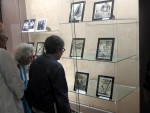
Attendees at the opening of the Avrom Yanovsky exhibit in Winnipeg in September. (photo by Stan Carbone)
The Jewish Heritage Centre of Western Canada (JHCWC) and the United Jewish People’s Order (UJPO) are co-hosts of an exhibit in Winnipeg of the political cartoons of Avrom Yanovsky (1911-1979).
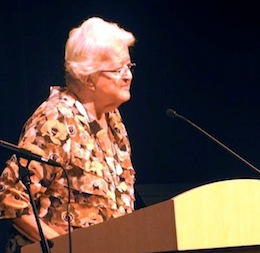
Anna Yanovsky, the cartoonist’s widow, speaks at the exhibit opening. (photo by Stan Carbone)
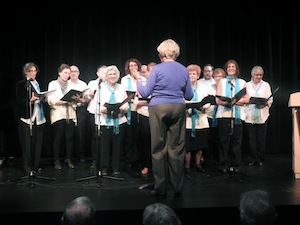
The exhibit opening took place Sept. 17 at the Asper Jewish Community Campus with guest speakers Ester Reiter, associate professor, School of Women’s Studies, York University; and Anna Yanovsky, the artist’s widow. The evening concluded with a performance by the North End Jewish Folk Choir.
With the event, Stan Carbone, director of programs and exhibits at JHCWC, said, “we attempted to provide a composite picture of Avrom Yanovsky placed within an historical and cultural milieu in which his Winnipeg years were critical in shaping and defining his intellectual development and his passion and commitment for social justice.”
According to a 2006 article by David Abramowitz in Outlook Magazine, Yanovsky was born in Ukraine “and came to Canada at the age of 2 with his widowed mother, her parents and his infant brother. They settled in Winnipeg, where Avrom attended the I.L. Peretz Shule. His 1925 graduating class included the late Nechama Gemeril, who later became his wife. The school provided an excellent grounding in the Yiddish classics and revolutionary politics, which stayed with Avrom throughout his life. His mother, a seamstress, and an active Bundist in the Old Country, became a labor Zionist and emigrated to Palestine with Avrom’s brother in 1931.”
Yanovsky was part of a generation of Jews arriving in Canada in the first decades of this century. He was old enough to remember the 1919 Winnipeg General Strike. He lived through and saw the suffering during the Depression, he witnessed the repressive government of the day in Canada, the rise of Hitler and rampant antisemitism.
Reiter said, “Those who knew him commented that had he just a bit of the capitalist in him, his enormous talents would have made him a very rich man … [he was] a rich man, but not in dollars.”
For a time, Yanovsky served as art director for a Yiddish children’s magazine, called Yungvarg (Youngsters), published in New York; for each issue, he did a cartoon story of one of the many Yiddish writers of the late 19th and early 20th centuries. In the late 1930s, Yanovsky began exhibiting with the Canadian Society of Graphic Artists, at the Art Gallery of Toronto, and was president of that organization for a number of years. His editorial cartoons appeared in many English and Yiddish publications, including the Vokhnblat, Canadian Tribune and Outlook.
“One of the cartoons you’ll see is that of the premier of Quebec, [Maurice] Duplessis [1890-1959], with a big padlock representing the padlock law,” said Reiter. “That enabled any person or organization deemed subversive [undefined] to have their house or building padlocked for a year.”
At one point, she said, Yanovsky was hired by a pest-control factory to create a mural. Even this, Yanovsky managed to politicize, using the theme to apply not just to the animal but to the human pests.
“He commented through his art on all aspects of the world, from labor to Canada’s increasing subservience to the United States, the struggle to make ends meet, and the concern for peace and human rights,” said Reiter.
“He targeted not only fat capitalists, but the CIA, the Mounties, antisemites, racists, fascists, fascist sympathizers, and most of Canada’s prime ministers.”
Reiter said, “Avrom was known to be a man of integrity and principle. He lived his politics, sharing his talents for not very much monetary gain. His art was tied to the life and daily experience of working Canadians. He made us laugh in his drawings and in real life.”
The exhibit now on display in Winnipeg was first shown at York University and originally curated by Dr. Anna Hudson of York with the title Free Discussion is the Key to Peace – The Political Cartoons of Avrom Yanovksy. It was remounted at Toronto’s Ashkenaz Festival and then at the Varley Art Gallery in Markham, Ont., together with his mural honoring Dr. Norman Bethune (1890-1939). It was hosted in Vancouver by the local UJPO in 2013.
“The exhibit is of his later cartoons, from 1950 to 1972,” explained Reiter. “And you can see … for him, his art and his politics were really one in the same. He used his art to express his politics. The cartoons that you’ll see, those particular cartoons, don’t give a sense of his profound commitment to Yiddish stuff, which he was profoundly committed to. His stuff was related to labor, to politics, to peace, stuff like that.”
The opening concluded with music from the North End Jewish Folk Choir. (photo by Stan Carbone)
Reiter was asked to speak at the event, as she is writing a book on the history of the Jewish left in Canada, which should be out in the spring. She wanted to be involved in the showings of his art because of her interest in history and the left. “He was so famous, certainly among the left,” she said. “People spoke adoringly of his work.”
While Hudson went through some of Yanovsky’s work with Anna Yanovsky for the exhibits, Reiter provided the context.
“The ink drawings on display here, with their collaged and corrected compositions, are just to give an idea of the range of Avrom’s work,” said Reiter. Quoting from Hudson’s notes from a previous exhibit, she pointed out, “You will recognize ‘a cast of easily recognizable characters: the moneybag, the banker, the capitalist and the politician,’ with his sidekick, the police or military. ‘We can laugh at the tragedy of economic inequity because Avrom speaks to us personally to remind us of our humanity, our common ground, and our collective strength.’”
Said Reiter, “He was a communist and he was a Jew with a deep love and respect for Yiddish language and culture.”

 Considering the extra challenges Jews have faced these last few years, there are many of us who have reacted by delving more into our Judaism and our Jewish identities. Perhaps that’s why a book the Independent received a handful of years ago seems even more relevant now – both as a way to explore one’s identity, but also one’s creativity. With summer approaching and school soon letting out, who couldn’t use some ideas on how to fill the coming increase in a young person’s unstructured hours?