Skip to content
  • Home
  • Subscribe / donate
  • Events calendar
  • News
    • Local
    • National
    • Israel
    • World
    • עניין בחדשות
      A roundup of news in Canada and further afield, in Hebrew.
  • Opinion
    • From the JI
    • Op-Ed
  • Arts & Culture
    • Performing Arts
    • Music
    • Books
    • Visual Arts
    • TV & Film
  • Life
    • Celebrating the Holidays
    • Travel
    • The Daily Snooze
      Cartoons by Jacob Samuel
    • Mystery Photo
      Help the JI and JMABC fill in the gaps in our archives.
  • Community Links
    • Organizations, Etc.
    • Other News Sources & Blogs
    • Business Directory
  • FAQ
  • JI Chai Celebration
  • JI@88! video

Recent Posts

  • עשרים ואחת שנים בוונקובר
  • Supporting the Iranian people
  • The power of photography
  • A good place to start
  • When boundaries have shifted
  • Guitar virtuosos play
  • Different concepts of home
  • Broadway’s Jewish storylines
  • Sesame’s breadth and depth
  • Dylan Akira Adler part of JFL festival
  • Mortality learning series
  • A new strategy to brighten up BC
  • Sharing latkes and light
  • Johnson awarded for human rights work
  • Cherished tradition ensured … Silber Family Agam Menorah
  • Nothing as lovely as a tree
  • Camp welcomes new director
  • Popular family camp expands
  • A life-changing experience
  • Benefits of being a counselor
  • Camper to counselor
  • האלימות בישראל מורגשת בהרבה מגזרים
  • טראמפ עוזר דווקא לנושא הפלסטיני
  • New rabbi settles into post
  • A light for the nations
  • Killed for being Jewish 
  • The complexities of identity
  • Jews in time of trauma
  • What should governments do?
  • Annie will warm your heart
  • Best of the film fest online
  • Guitar Night at Massey
  • Partners in the telling of stories
  • Four Peretz pillars honoured
  • History as a foundation
  • Music can comfort us

Archives

Follow @JewishIndie
image - The CJN - Visit Us Banner - 300x600 - 101625

Tag: Maoz Tzur

From the archives … Hanukkah

From the archives … Hanukkah

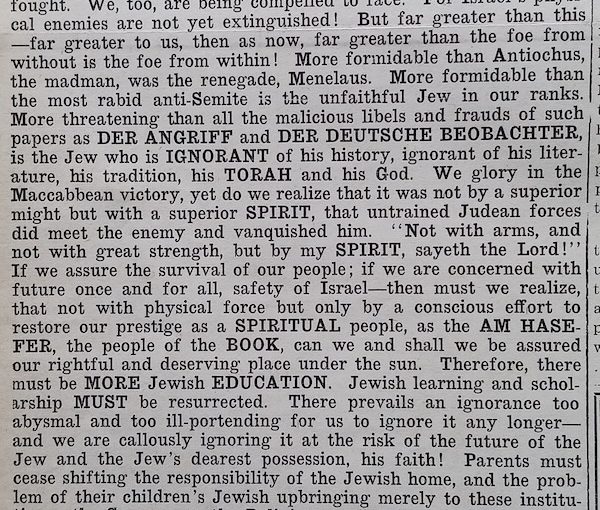
The editorial in the Dec. 8, 1939, issue of the Jewish Western Bulletin.

We’ve come a long way in many ways, though some readers may disagree. I read, kind of in horror, the newspaper’s Dec. 8, 1939, editorial in which the lesson drawn from Hanukkah was that, “More formidable than the most rabid anti-Semite is the unfaithful Jew in our ranks. More threatening than all the malicious libels and frauds of such papers as DER ANGRIFF and DER DEUTSCHE BEOBACHTER, is the Jew who is IGNORANT of his history, ignorant of his literature, his tradition, his TORAH and his God.”

I can appreciate the Maccabean victory “was not by a superior might but with a superior SPIRIT, that untrained Judean forces did meet the enemy and vanquished him.” I agree that Jewish education is vital to Jewish continuity, but yikes. I’m not sure all the “yelling” capital letters encourage the message that: “There must be a closer alliance, a sense of closer affinity, a warmer consciousness of brotherhood between Jew and Jew and between the individual Jew and Jewry at large if we are to succeed – nay, if we are to insure our future as a people!”

I am also always surprised at how much of the advertising in the early years of the Jewish Western Bulletin was for alcohol. As but one example, given the time of year, is the Dec. 24, 1941, ad from United Distillers Ltd., “The Happy Holiday List” that readers are asked to “cut out and keep for reference,” which I guess I’ve done, though I don’t think any of the brands still exist.

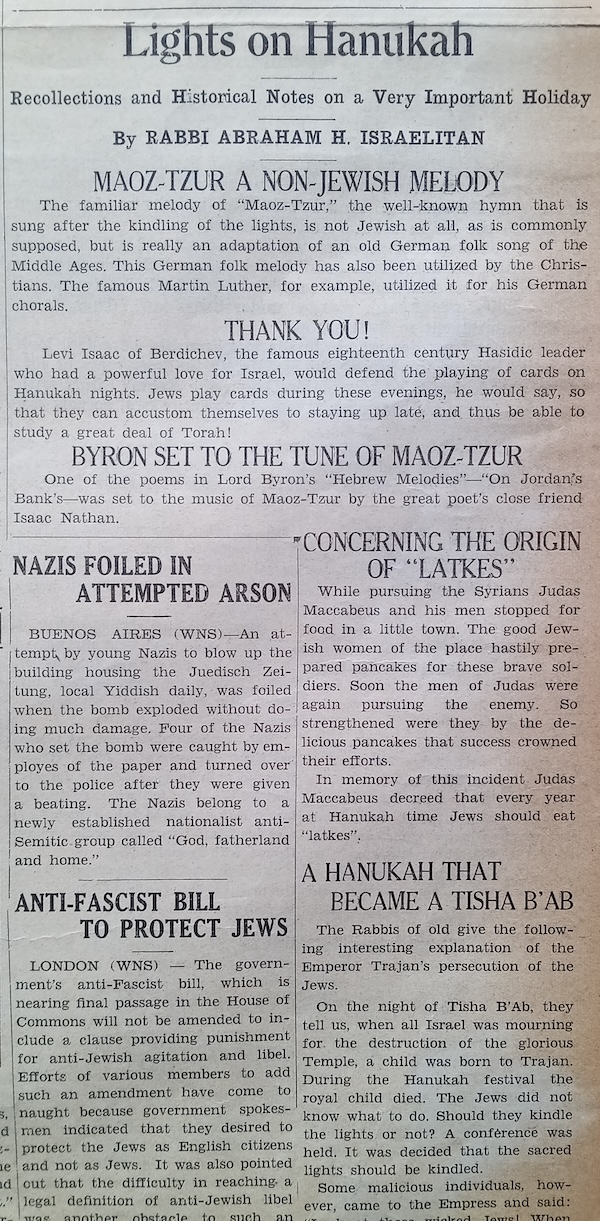
I did enjoy some of the Hanukkah trivia that made the front cover of the Dec. 11, 1936, paper, though it was a jarring juxtaposition with the world news. As it happens, the first item, on the melody of the traditional Hanukkah song “Maoz Tzur,” mentions Martin Luther, as does the article on the cemetery in the German City of Worms that is featured in this week’s issue – on this very page, in fact – which discusses briefly Luther’s legacy.

In his “Lights on Hanukah” article, Rabbi Abraham H. Israelitan points out: “The familiar melody of ‘Maoz-Tzur,’ the well-known hymn that is sung after the kindling of the lights, is not Jewish at all, as is commonly supposed, but is really an adaptation of an old German folk song of the Middle Ages. This German folk melody has also been utilized by the Christians. The famous Martin Luther, for example, utilized it for his German chorals.”

The rabbi also notes, “One of the poems in Lord Byron’s ‘Hebrew Melodies’ – ‘On Jordans Bank’s’ [sic] – was set to the music of Maoz-Tzur by the great poet’s close friend Isaac Nathan.” He goes on to reveal “the origin of latkes,” and a few more of what we now call “fun facts.” Israelitan was not a local rabbi. His article was distributed by Seven Arts Feature Syndicate, which, according to Google, was an American group that provided content to Jewish papers from the 1920s through the 1960s.

Holiday parties, concerts, menorah lightings and more have always been promoted or covered in the newspaper, of course. Almost every Hanukkah issue has included recipes, gift ideas, personal holiday stories. And pretty much every Hanukkah-themed editorial aims to point out what the Maccabees can teach us today or what light we can shine to diminish the darkness in the world – though we do it a little less harshly than the editors of 80, 90 years ago, I think. Most certainly, we do it with fewer capital letters. 
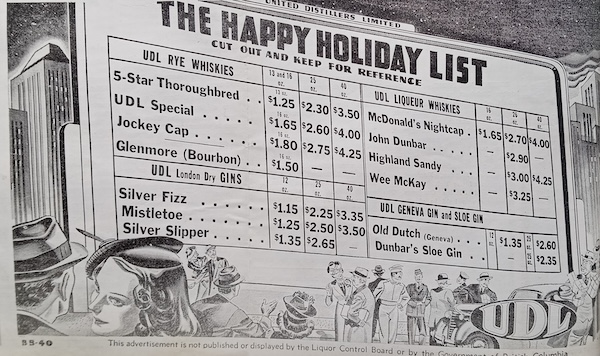
image - An adl in the Dec. 24, 1941, issue of the Jewish Western Bulletin
An ad in the Dec. 24, 1941, issue of the Jewish Western Bulletin.
image - An article on Hanukkah trivia in the Jewish Western Bulletin Dec. 11, 1936
An article on Hanukkah trivia in the Jewish Western Bulletin Dec. 11, 1936.
Posted on December 5, 2025December 4, 2025Author Cynthia RamsayCategories From the JITags archives, editorials, fun facts, Hanukkah, history, Maoz Tzur, trivia
Festival of light & song

Festival of light & song

Chanukah lights on Agron Road in Jerusalem, 2012. (photo from Djampa)

History tends to repeat itself or, as Sholem Aleichem put it, The Wheel Makes a Turn. In this story, he wrote about Chanukah, depicting a proud Jew lighting the nine-branched candelabrum, celebrating this festival of dedication and liberation with warmth and affection. Later in the story, this same Jew, now old and infirm, is barely allowed to light the chanukiyah by his assimilated son, while his grandson is not even allowed to watch. The story ends when the grandson is an adult, and celebrates Chanukah with his friends to the dismay of his “modern” parents who cannot understand why their son has rejected their assimilation and returned to his Jewish roots.

Chanukah is one of Israel’s favourite festivals, widely celebrated even by secular Jews. Unlike in the Diaspora, it doesn’t have to compete with the glamour of Christmas, with its shopping frenzy, Santa Claus, carols and other Christian symbols of the holiday, which can be very seductive, even to Jews.

In Jerusalem during the Festival of Lights, you can see chanukiyot and their tiny, multi-coloured candles on almost every windowsill and, at sunset, you’ll hear voices from quivering childish soprano to deep baritone, all singing “Maoz Tzur” (“Rock of Ages”). There is a candlelighting ceremony, as well as free sufganiyot (jelly doughnuts), in my local supermarket every evening for the whole eight nights, and a giant menorah burns atop the Knesset and many public buildings and water tower reservoirs throughout the country. Gifts are exchanged, children receive Chanukah gelt, often in the form of chocolate coins, and dreidels, spinning tops inscribed with the first letters of the Hebrew words for the phrase: “A great miracle happened here.”

The Zionist movement has used Chanukah as a symbol and historical precedent of national survival. The Maccabi sports organization was named after the Maccabees, who are the stars of the holiday, and it holds the Maccabiah Games every four years, just like the Olympics.

The singing of “Maoz Tzur” is a feature of the holiday with mysterious origins. The only clue to its composer is the acrostic of the first five stanzas, spelling out the name “Mordecai”; such naming was a common practice at the time and one used in a lot of zemirot (Sabbath songs). Many scholars believe the composer to be Mordecai ben Isaac, who lived in Germany in the 13th century.

There is a Chabad saying: “Song opens a window to the secret places of the soul.” It is hard to define what makes music specifically Jewish, and many categories exist, including Chassidic, Yiddish, Yemenite, Moroccan, Kurdish, Israeli, secular, religious … the list comprises a broad range.

There is nothing in Jewish law against creating new tunes for hymns. The Gerer Rebbe once stated: “Were I blessed with a sweet voice, I would sing you new hymns and songs every day, for, with the daily rejuvenation of the world, new songs are created.”

Rebbe Nachman of Bratslav wrote: “How do you pray to the Lord? Come, I will show you a new way … not with words or sayings, but with song. We will sing and the Lord on high will understand us.”

When we sing “Maoz Tzur” as a family, grouped around the candles, there is harmony of a special kind. The harmony is not just in the song, but in the sanctity and affection that binds the family and gives it a foundation as solid as a rock.

In painful times for Israel, which has seen so much suffering and loss throughout its history, it brings a measure of comfort to be able to recite the traditional blessing: “Blessed art Thou, O Lord our G-d, King of the Universe, who has kept us in life and hast preserved us, and enabled us to reach this season.” This year, amid the pandemic, the blessing resonates even more deeply. Happy Chanukah!

Dvora Waysman is a Jerusalem-based author. She has written 14 books, including The Pomegranate Pendant, which was made into a movie, and her latest novella, Searching for Sarah. She can be contacted at [email protected] or through her blog dvorawaysman.com.

Format ImagePosted on December 4, 2020December 2, 2020Author Dvora WaysmanCategories Celebrating the HolidaysTags Chanukah, chanukiyah, gratitude, history, Israel, Judaism, Maoz Tzur, singing
Proudly powered by WordPress