
These latkes can be made vegan, gluten-free and with reduced oil – or not. (photo by Michelle Dodek)
They tried to kill us, we survived, let’s eat. This refrain encapsulates how Jews celebrate a number of holidays and view our tumultuous history. In September, Congregation Beth Israel hosted a three-part High Holiday Cooking series. It was so popular that classes have been scheduled throughout the coming months to coincide with various holidays. Luckily for those who like to learn new cooking techniques and the history and symbolism behind Jewish food, there are plenty of holidays between now and the end of May.
First on the list is Hanukkah. Associated with oil, this winter holiday is a chance for Greater Vancouver Jews to throw off the shackles of green smoothies and embrace greasy carbs, for religious reasons.
The central event celebrated at Hanukkah is the liberation of the Temple in Jerusalem from the Seleucid Greeks, who had conquered the land of Israel and were attempting to forcibly convert all Jews. These events took place after the biblical era, so Hanukkah is not one of the holy days mentioned in the Torah. It is recorded in the Books of Maccabees.
Although not so religiously significant, Hanukkah is one of the most popular Jewish holidays, especially in North America. It’s dark outside and lighting candles to illuminate the darkness both literally and figuratively is cheering. In modern times, the heroic story of the small band of Jewish rebels taking on a mighty army and winning is especially poignant, given the many struggles facing the tiny modern state of Israel. And, let’s face it, having a fun Jewish foil to Christmas is helpful.
There is no requirement to refrain from work during Hanukkah, as there is for many other Jewish holidays. To accompany the week-plus of nightly candlelighting, we have special foods. Potato latkes are the most recognizable on the Ashkenazi menu, but rugelach are also traditionally prepared for Hanukkah. Why? The three ingredients in the dough are flour, butter and cream cheese. Lots of fat. Yum.
Sephardi and Mizrachi Jews connect the culinary dots much more succinctly. Sfinge is a delicious Moroccan free-form, deep-fried dough eaten on Hanukkah. Filled donuts, known widely as sufganiyot, have been part of Sephardi and Mizrachi traditions as well. Popularized in Israel by the Labour government in the 1950s, the making of donuts for Hanukkah was the tastiest of many job creation projects for Israel’s struggling economy. Although it was seasonal, encouraging bakeries to hire extra staff in November and December to fry up holiday cheer resulted in a national culture of amazingly tasty filled donuts.
The Dec. 2 Hanukkah cooking class at the BI was dedicated to helping people make out-of-the-box latkes with interesting toppings, as well as a couple of desserts that don’t require a pot of deep-frying oil. While the recipe for rugelach is simple, technique is needed to get the flakiest dough. There is a lot of room for creativity in the filling, but not everything will be a success, so spread thinly if you plan to try out the recipe below and see if your idea works first before producing a huge batch.
For more “Kitchen Judaism,” watch for other holiday cooking classes at Beth Israel. Classes will include Tu b’Shevat Temptations; Stuffed for Purim, featuring two classic filled foods; Seder and Shabbat Dinner Vegetarian-style; and Shavuot Dairy Delights.
SEASONAL LATKES
(These latkes can be made vegan, gluten-free and with reduced oil. The substitution of vegetables other than potatoes lowers the glycemic index, making the latkes better for diabetics, and more satiating and visually attractive.)
1 large onion, grated and squeezed
4 cups of the any of the following, grated: beets, winter squash (like kabocha, acorn, banana or butternut), carrots, turnips or parsnips
2 eggs
4 tbsp corn or potato starch
salt and pepper to taste
oil for frying
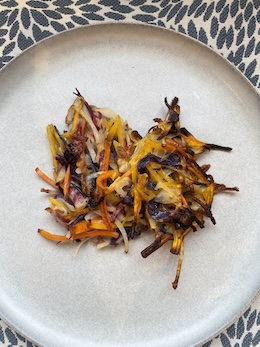
Once the vegetables are grated and the excess liquid is squeezed out, combine all the ingredients, coating the vegetables well. Take a heaping tablespoon of the mixture and drop it into the hot oil. Do not squish them down, just spread out the mixture so the edges are thin and the middle has some volume. Repeat, making sure the latkes are spaced out enough to flip. Once the edges begin to brown, flip the latkes and fry a few more minutes. If you plan to freeze and reheat, cook for fewer minutes, then cool on layers of paper towels. To freeze the latkes, fully cool them, remove the paper towel and lay the latkes out in individual layers on trays for best results. Once frozen, put them into an airtight container.
To make a vegan version of this recipe, use flax eggs (one tablespoon of ground flax plus three tablespoons of water/”egg”). The baked version includes two tablespoons of olive oil in the mixture and is baked at 375˚F until brown.
RUGELACH
250g cream cheese (room temperature: leave out a maximum of 2 hours)
1 cup butter (room temperature: can be left out overnight)
2 cups flour
filling of choice: cinnamon, sugar, raisins, Nutella, jam (be creative)
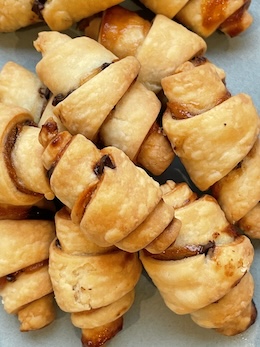
Mix the cream cheese and butter until well creamed. Add the flour and mix until a soft dough is formed. Ideally, cover and refrigerate for two hours or overnight.
Preheat the oven to 350˚F. Line two cookie sheets with parchment or a baking mat. Divide the dough into four balls. Roll into three-millimetre-thick circles. They should be almost 25 centimetres wide.
Cover the dough with a thin layer of filling. Don’t be tempted to make it too thick because it will burn and make an enormous mess. If you’re using cinnamon and sugar, sprinkle three parts sugar and one part cinnamon all over the dough.
Cut the circles into 10 or 12 “pizza-shaped” slices. Roll from the outer edge into the centre, making a cute rolled-up shape. Put the rugelach on the cookie sheet and either freeze them on the pan and then transfer them to an airtight container or bake them immediately. Bake for 25 minutes or until lightly golden.
Rugelach really are 1,000 times better when eaten the day they’re made.
Michelle Dodek is a long-time contributor to the Jewish Independent and is a cooking instructor who specializes in Jewish and vegetarian cooking.