The Jewish Federation of Greater Vancouver has released $400,000 to address the immediate needs of its local partner agencies over the next month. The funds will address needs in the key areas of food security, to increase the capacity of the food bank and other food distribution programs in our community; housing support, subsidies for community members unable to make their rent payments; seniors services, to help them stay safe, healthy and connected to community while they are self-isolating in their homes; tuition support so that families with children in Jewish day schools can keep their children enrolled; subsidies for Jewish programs, daycare, summer camps and part-time educational programs; and support so that Jewish supplementary schools can provide alternatives to classroom learning and maintain uninterrupted delivery of Judaic studies to the children and families they serve.
For more on Federation’s response to the COVID-19 crisis, as well as what other community organizations are doing at this time, visit jewishvancouver.com/covid-19-updates.
***
With the support of Jewish Federation, Jewish Family Services (JFS) has launched the JFS Community Care Hotline as an emergency response resource. It is available from 9 a.m.-9 p.m., seven days a week and staffed by JFS to provide emergency essential services. Priority services include meal or food bank grocery delivery; counseling/emotional support; and friendly phone “visiting.”
If you know anyone who needs to lean on JFS at this time, please share this information via your social media networks and other forms of communication. JFS also has a volunteer registration page, as many people have offered to help.
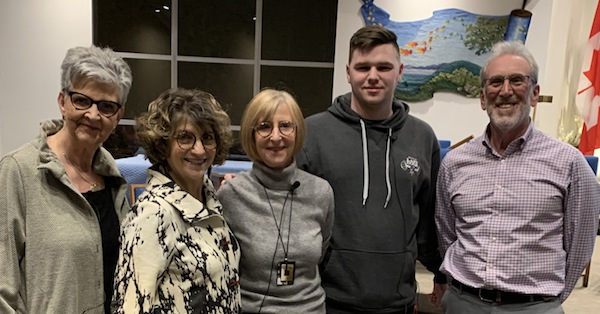
Left to right: Peggy Allen, Shelley Karrel, Shelley Rivkin, Jordan Bowman and Howard Harowitz. (photo from JACS Vancouver)
The capacity for transformation and healing was front and centre at the event Optimism and Hope: Erasing Stigma of Mental Illness, Addiction and Homelessness.
Co-sponsored by Jewish Family Services (JFS), Tikva Housing and Jewish Addiction Community Services (JACS) Vancouver, the panel discussion on Feb. 26 was held at Temple Sholom. It featured Shelley Rivkin of the Jewish Federation of Greater Vancouver, Abbotsford entrepreneur and volunteer Peggy Allen, and Jordan Bowman of Last Door treatment and recovery centre in New Westminster.
Temple Sholom’s Rabbi Dan Moskovitz welcomed those gathered by talking about the Aleinu prayer, which, he said, asks us “to go out into the world and do what we’re praying for. And so, if I can make a request of all of us, myself included, it’s to go out from this room and to do and to share what we’ve learned and what we’ve heard tonight with our families and with our broader circle. That’s our shlichut, that’s our sacred mission, beyond just coming here today to get what we need for ourselves.”
JACS Vancouver board chair Howard Harowitz briefly described the missions of each of the event sponsors before introducing the night’s speakers, beginning with Rivkin, who shared the stories of a few community members who have been impacted by the risk of homelessness. She prefaced her remarks by saying homelessness is not limited to people living on the street or who live in shelters. Rather, the growing concern in our community is “relative homelessness, the lack of suitable, consistent and predictable housing,” she said.
She also noted that “it is not a natural equation that addiction, mental health and homelessness are faced by all people” in need. “Each person has to be approached individually and uniquely,” she said, then listed six sources of support in our community: JFS, Tikva Housing, Yaffa Housing, JACS, the Kehila Society of Richmond and the community’s synagogues.
Originally from Regina, Sask., Allen has lived in Abbotsford for a long time. She lives in an area where homeless people have gathered since the Salvation Army moved into the neighbourhood in 2004. A wife and the mother of two children, the situation was very difficult initially. She shared stories of her young granddaughter witnessing people having sex and shooting up, and of being chased out of her home by a crack addict.
“I was quite a happy person and then the homeless moved in and I changed forever,” she said. “I got angrier and angrier and angrier and I ended up making, in 15 years, I made 463 calls to the police. And they came every time and did nothing, because what are they going to do?”
Allen said she became very depressed. Then, she was invited to a meeting at city hall about the homeless. She challenged attendees to come and see the extent of the problem for themselves, and two women from Fraser Health took her up on it. Over coffee, Allen shared with them her concerns and, despite her self-described antagonism to them, they invited her to speak at a meeting of the Drug War Survivors, a peer-based user group that participates in the development of harm-reduction policies, among other things.
Reluctantly, she agreed. Expecting an audience of maybe 10 drug addicts, “there were 110 of them,” she said. “I look around and I open my mouth and I just let it all out. I don’t know what happened, it was a miracle, really. I talked about my father and I talked about him beating my mother so desperately,” waking Allen’s sister, who was told to return to bed by their mother, and did. “That’s what we were raised with,” said Allen. “I had never spoken about it, and I just let it all out,” including how she was kicked out of a school in her teens for selling drugs.
After her remarks, audience members lined up, but she didn’t know why, so she started to leave. “As I’m walking out, the first guy comes up and hugs me. They were all standing there to hug me,” she said, holding back tears.
One of the men recognized Allen from secondary school. He shared with her that he was raised with such anger that he went down the path of drugs, whereas she – who his family warned him about as a teen, since she sold drugs – did not. He said to Allen, “I see now that I, too, can change my life.”
This interaction, she said, changed her life. “I went home, and I was walking up the driveway to get the mail and this crazy lady that lived on the street and was a huge drug addict and was nasty and did not like me, she came running up my driveway swearing and yelling at me with this other guy. I was so emotional, I went running at her, I don’t know what I was going to do, and I stopped. I changed my mind. I turned around and I went home. And my life changed. Everything on our street is still happening and nothing has changed much there, except me.”
Allen started giving to the homeless. She joined the city’s Business Engagement Ambassador Project, which works to build relationships between Abbotsford residents, business owners, homeless and others to strengthen the sense of community. “What I do is I speak all over the place and raise money to help them help themselves,” she said of those who are homeless.
The project is a year-and-half old and she described it as a success. One aspect in particular that is working, she said, is that the program pays homeless people to clean up area businesses and parks.
The last speaker, Bowman, now 22 years old, has been clean for just over four years. He is a youth program support worker at Last Door, the centre at which he was set on the path of recovery.
Bowman said he had a good upbringing, went to Jewish summer camp and day schools, was into sports, has lots of friends and has a great family. Having lost his mother to cancer when he was 10, he said, “That was obviously tough, but by no means do I point my finger at that and say, ‘that’s when I started using drugs.’”
He described his life as normal, living with his dad and brother. There were no indications, he said, that he would become an addict. Addiction does not discriminate, he said, and people need to know that. His family, he said, were completely surprised to find out about his drug use and were “unversed in the topic of addiction.” Luckily, he had a cousin who works as a drug and alcohol counselor and “she saved the day” when it came to him seeking help.
At age 14, Bowman started to experiment with marijuana. He couldn’t say exactly why he started using harder drugs, but perhaps he had just gotten in with the wrong crowd. He described the process as progressive. “It went from using once in awhile to using every day, to doing whatever it takes,” he said.
“I’m not going to get too much into the things I did to get to get high every day but it definitely involved a lot of stealing from the people very close to me. It didn’t matter if you would love me, if you would hate me, if you were older, if you were younger, if I had the chance, I would try and rip you off if I was with you, and that was the reality of my life.”
From age 16 to 18, he was using opiates every day, while still going to school, while still trying to cover up that he was an addict. “I wanted help, but I didn’t,” he said. “I wanted help because I knew in my mind that I could be a better person than I’m being right now but, in the other part of my mind, I was scared and I wanted to keep getting high.”
The breaking point came when he stole a significant amount of money from his brother. From that day, when his brother reacted with love rather than anger – Dec. 22, 2015 – the efforts at recovery began, with the help of his father, brother, cousin and others. There were a few false starts, a couple of detox and treatment centres, before he landed at Last Door in mid-January 2016. He has not used drugs since.
Waiting times and the cost of treatment were among the topics discussed in the question-and-answer period. Giuseppe Ganci, director of community development for Last Door Recovery Society, was in the audience. He explained some of the different levels of care, ranging from assisted living residences, for which there are minimal guidelines, to treatment centres, which will have psychiatrists and other professionals on site. The definitions of the levels differ between regions in the province, he said, making the system hard for people to understand and, therefore, access.
“The problem is,” he said, “you always hear there are not enough beds in British Columbia. That’s actually a myth. There are so many beds. Last Door runs probably at 80% capacity every day [and has] for years. We have about 100 beds and only 35 of them are funded [by government]; the rest, there’s no funding for them, so it’s a shortage of funding for treatment, it’s not a shortage of beds.” This means that people who can afford it are able to get treatment within 24 hours, rather than join the queue of six to eight weeks or longer, he said.
After a couple more questions, Harowitz wrapped up the event. Addiction is not a choice, he stressed, citing JACS speaker Steve Whiteside. “It’s not a weakness of character, it’s not anything other than any other kind of disease that people have,” he said, challenging the audience “to keep the conversation going.”
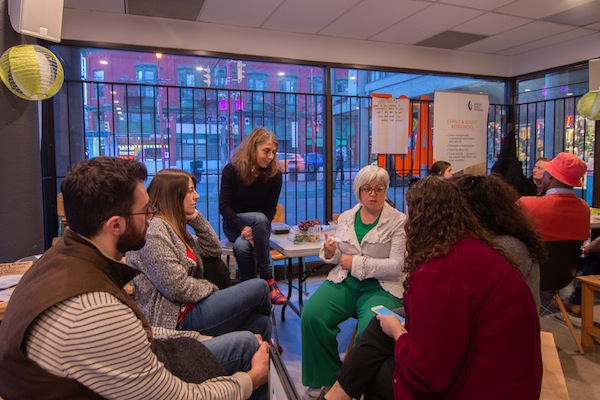
Transportation and sustainability consultant Tanya Paz, centre, participates in Tu b’Shevat Circle: Teachings from the Earth, an event spearheaded by Or Shalom Synagogue in partnership with Jewish Family Services, JQT Vancouver and UNIT/PITT Society for Art and Critical Awareness. Or Shalom’s Rabbi Hannah Dresner is seated on the stool to Paz’s right. (photo by Matt Hanns Schroeter)
More than two dozen individuals whose work involves food security and climate change issues met on Feb. 9 for Tu b’Shevat Circle: Teachings from the Earth, an event spearheaded by Or Shalom Synagogue in partnership with Jewish Family Services, JQT Vancouver and UNIT/PITT Society for Art and Critical Awareness.
Those who gathered work or devote time to such organizations as Grandview Woodland Food Connection, Sustainabiliteens, Coquitlam Farmers Market and Extinction Rebellion. They came together to explore various topics, including how their Jewishness intersects with their work in secular organizations, envisioning a sustainable world and the Jewish community’s role in social justice.
“I noticed that so many of these organizations are spearheaded by young Jews and felt it important to create an opportunity for them to see one another and recognize this aspect of kinship in their work … and whether this commonality enhances the work, draws them into kinship or stimulates any collaboration,” said Or Shalom’s Rabbi Hannah Dresner.
Or Shalom brought on Carmel Tanaka to organize a gathering. Through meetings with young adults and stakeholder groups, Tanaka met a number of people whose careers relate to food security and social justice, but most weren’t working for Jewish organizations nor were they connected to one another within a Jewish context. She and Dresner agreed it was worth bringing them together to see what conversations would blossom.
Tanja Demajo, chief executive officer of Jewish Family Services, said JFS provided funding for the event because they believed in the value of the project.
“There are a lot of Jewish and young Jewish people who are interested in food security and questions of accessibility, which is very interesting from a perspective of … whether this work is modulated by [Jewish] values and how this translates to day-to-day practice,” she said. “At the end of the day, it didn’t really matter if the different participants were working in a Jewish or non-Jewish community.”
Some attendees revealed that, for them, being Jewish is secondary to their focus on environmental issues.
“The room was full of people who identify in varying degrees with their Jewishness and, for some, it’s an important aspect of their identity and, for others, it isn’t integral,” Tanaka said.
Dresner spoke to the indelible connection between environmental action and Judaism. “In my understanding of Judaism, saving our world is at the heart of what it means to have a Jewish spiritual life,” she said. “Creative energy, or the vitality of spirit, is always flowing toward us. It’s what I’d call the ‘world that’s always coming,’ or the ongoing nature of creation. We can encourage and aid this vitality, helping to direct it where most needed, or we can impede the flow. When we are selfish and impede creative flow, the result is a deprivation of generative spirit, spirit denied to corners of creation, and we see results like species blinking into extinction.”
The rabbi wants to spend more time with young Jews working in social justice. “The Judaism I believe in mandates their work as the highest mitzvah of our moment,” she said. “It’s a misconception born of the compartmentalized Judaism in which many of us were raised not to understand that attention to the environment is a Jewish priority.”
Aaron Robinson, chair of Grow Local Society Tri-Cities, a food security group that runs the Coquitlam Farmers Market, said his work for the organization won’t ever have a Jewish mandate, but his Judaism is tied into what he does. “Personally, I can never underestimate the role that Jewish values play in the way I see the world, especially when it comes to tikkun olam,” he said, adding, “I guess it’s become engrained in me, but it was nice to bring it back to the surface to see, wow, there is this Jewish connection to all this work that we’re doing.”
Robinson appreciated the opportunity to connect with other Jews working in similar fields and hopes the conversations will continue.
Some people discussed not feeling supported by the Jewish community to undertake the work they do within a Jewish context. Tanaka said she believes the Vancouver Jewish community hasn’t focused attention on these issues until recently, citing the 2019 climate march and protests as a galvanizing factor, and said it’s time for the local community “to support young Jewish adults who are doing this kind of work … because these are Jewish issues at the end of the day.”
Some at the event suggested funding for environmental advocacy was needed. Dresner said there was also a desire for bridge building. “They seem to be asking for an arm of organized Jewish community to create some occasional containers for their gathering, just to share within the hybrid of their niche or to explore potential collaborations,” she said. “Or Shalom will be looking at finding funding to continue holding this group and its outgrowth in a loose, nurturing embrace.”
Demajo said the JFS food security program has already benefited from the event. “Being exposed to more city-wide programs and initiatives and being exposed to all different voices gives a different perspective to JFS,” she said, “because it opens up new ideas.”
Shelley Stein-Wotten is a freelance journalist and comedy writer. She has won awards for her creative non-fiction and screenwriting and enjoys writing about the arts and environmental issues. She is based on Vancouver Island.
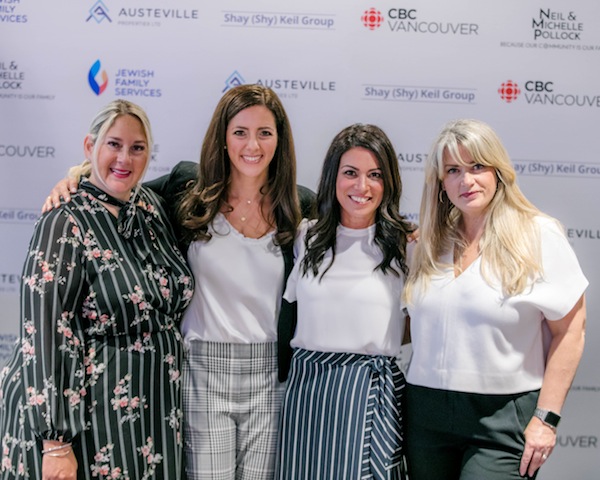
Jewish Family Services Innovators Lunch committee, left to right: Sherri Wise, Tamar Bakonyi, Candice Thal and Shannon Ezekiel. (photo from JFS)
On May 14, Jewish Family Services held its 15th annual Innovators Lunch at the Hyatt Regency downtown. The sold-out event was hosted by CBC broadcaster Gloria Macarenko and featured keynote speaker Lane Merrifield of CBC’s Dragons’ Den. Attended by 620 donors, partners, sponsors and volunteers, it raised an unprecedented $380,000 towards programs and services designed to improve quality of life for 2,000 Lower Mainland residents.
This year’s theme at JFS is “community.” At the luncheon, Richard Fruchter, the agency’s chief executive officer, spoke of JFS’s mission to provide life’s necessities: “food, shelter, accessibility and emotional stability.”
The audience was shown a video presentation created by Michael Millman, which revealed the wide-ranging benefits of JFS’s work. A single mother spoke candidly and with feeling about her struggles. “Before I reached out to JFS, I struggled with everything. We lived on almost nothing,” she said. JFS staff provided housing, food and food vouchers, as well as trauma counseling. JFS partner agency Tikva Housing provided the family with a townhouse in a new development. “It’s a beautiful place, right on the Fraser River … a lovely home for us to have for many years,” she said, adding, “JFS has given us a life. A way to be happy. It’s just been a huge blessing for us.”
A senior with disabilities spoke about how a spinal cord injury felled him at the age of 36. JFS has helped him remain independent with its Better at Home program. In the video, Cindy MacMillan, director of senior services at JFS, explained that a grant from the United Way made it possible for the senior to remain at home. Now he has a housekeeper come in to look after his home, and also enjoys companionship with weekly visits from a JFS volunteer. “It’s working out, I look forward to them!” he said.
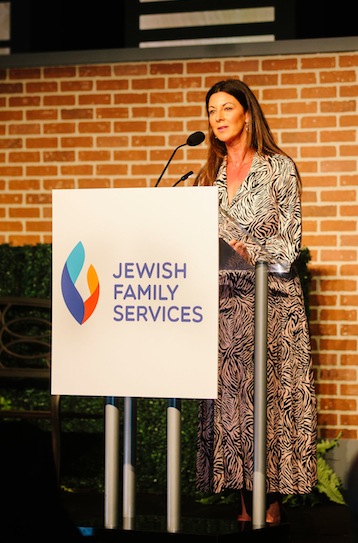
JFS board member Jody Dales spoke about her own family’s struggles. (photo from JFS)
“It’s helped him realize that people in his community care about him,” said MacMillan. “It’s really Jewish values in action, in the broader community. Those values of caring and healing happen every time we make a match with a volunteer.”
JFS board member Jody Dales gave a passionate speech about her own family’s struggles. Dales saw her grandmother turn away help when she was struggling with poverty. Having survived the Holocaust, her grandmother still felt that others needed the help more than she did, Dales explained. As a result, Dales said she applauds anyone who comes forward to seek support. Rather than being a sign of weakness, she said, “Only the courageous are able to say, ‘Help me.’” She acknowledged that people tend to experience “a sense of shame in asking for help. But nothing is certain. It could be any of us at any time.”
Dales also explained how big a difference can be made by even a small donation and told the audience, “Let your empathy guide your decisions.”
Merrifield, co-creator of Club Penguin, an online community for kids, spoke about building community in the business world. Designed to be a safe, collaborative environment for play and learning, Club Penguin is founded on an ethos of mutual reliance and philanthropy. Eventually sold to Disney for $350 million, Disney recruited Merrifield to lead the project, ensuring that Club Penguin maintained the integrity of its original goal, “inspiring change in the world.”
Merrifield urged people to work towards social entrepreneurship, where human concerns guide business decisions. Rather than focusing on capital investment, he advised the audience to “invest in people because that’s what keeps us healthy. Revenue is not what you chase for its own sake,” he said. “It is the by-product of creating a great product with a great team.”
Keynote speaker Lane Merrifield, left, and JFS chief executive officer Richard Fruchter. (photo from JFS)
Right from the beginning, the business plan for Club Penguin was based on philanthropy. A portion of subscriptions went to families that live on less than $51 per day, he said. But “there was no fanfare,” said Merrifield. “We didn’t want this to look like a gimmick.” In the first year, the company gave away hundreds of thousands of dollars.
Merrifield spoke of the need to galvanize the community of kids, teaching them to invest in their community with a “coins for change” program. This virtual fundraiser even allowed children to “ring bells” to attract the attention of other subscribers. Over one billion digital coins were donated annually, for a range of humanitarian causes. Self-organizing kids formed virtual marches, becoming activists in their own right; held candlelit vigils and themed parties.
Merrifield brings the same spirit of social responsibility to his work on Dragons’ Den. He and his fellow panelists (“dragons”) hear pitches by entrepreneurs who are looking for investment and choose which ones to support. Merrifield said he looks for companies that “use recycled materials, hire disabled applicants, plant trees, and make an effort to reduce waste in their packaging and lower their fuel costs.” So far, he has not been disappointed. “Most companies have pretty good answers and that gives me hope,” he said.
On the subject of giving back, Merrifield encouraged people to consider donations – such as those to JFS – not as losses to oneself, but as “investments in the future, to individuals who continue to pay it forward.”
He also asked the audience to engage everyone they could to further the cause of fearless generosity. “Use your collective strength and influence to create change for good,” he said.
He advised, “Pool your talents and leave this world far better than it was when we came into it.”
Shula Klinger is an author and journalist living in North Vancouver. Find out more at shulaklinger.com.
Michael Landsberg will deliver the
talk Darkness and Hope: Depression, Sport and Me on Feb. 13, as part of Jewish
Family Services’ Family Life Education Series. (photo from JFS)
Michael Landsberg is a Canadian sports
journalist and former host of Off the Record for TSN. He is also a
passionate advocate for removing the stigma around mental illness, and will be
coming to Vancouver next month to deliver the talk Darkness and Hope:
Depression, Sport and Me. A Jewish Family Services (JFS) Family Life Education
event, the talk will be held at Congregation Beth Israel on Feb. 13, with all
proceeds going to support JFS mental health initiatives in the community.
Landsberg, who suffers from depression and
generalized anxiety disorder, has in recent years been an ambassador for Bell
Let’s Talk, an initiative that raises awareness and encourages dialogue about
mental health. In 2013, his documentary, Darkness and Hope: Depression,
Sports and Me, was nominated for a Canadian Screen Award for best history
or biography documentary program or series. The Canadian Alliance on Mental
Illness and Mental Health has named Landsberg one of its Champions of Mental
Health. Landsberg is known for his Twitter hashtag #sicknotweak, which
encourages discussion around mental health and creates a forum for those
needing help.
“We’re thrilled and delighted to have Michael
Landsberg come and do a talk at Beth Israel,” said Alan Stamp, clinical
counseling director at JFS. “He has become an ambassador and a pioneer for
mental health. He took a risk coming out about his struggles, [and] for him to
come out and share his experiences is quite captivating. What he does best of
all is he addresses stigma and, when someone in his role can speak out, it
helps to lessen the suffering of the one in five Canadians – which is a
conservative estimate in my opinion – who experiences a mental health concern
over their lifetime.”
In Vancouver, Landsberg will be doing a
one-hour talk with a question-and-answer period afterwards. He spoke to the Jewish
Independent about helping people struggling with mental health issues.
“In general, sports mimics life,” he said.
“When I speak about life and the stigma around mental health, I know we’re not
as far ahead as we think we are. I don’t think we’re nearly as far ahead as we
would want to believe. We’ve been working hard and it’s way better, yet I hear
from people in the sports world all the time who are still in the closet, or
they’re feeling shame.”
A major focus of Landsberg’s work is combating
the idea that mental illness is a sign of weakness or is something
“self-inflicted.”
“That is the arrogance of mental health,” he
said. “Mentally healthy people sometimes believe that they would have been able
to overcome the illness – they don’t understand the reality that people with
mental health issues face, and how unchosen and beyond their control it can
actually be. I try to educate the non-sufferer to better understand what mental
illness is, and that it is like any other illness, no different from a physical
ailment.”
There are a number of reasons why both Stamp
and Landsberg feel sport is a good entry point for this discussion.
“I’m a huge believer that the best way to break
people of the stigma is to find really strong people, like Clara Hughes, who
have struggled with this, to talk about it,” said Landsberg.
Hughes, a Canadian cyclist and speed skater who
has won multiple Olympic medals in both sports, has struggled with depression.
“If [Hughes] was close at the end of the race, she would win. If you find that
even a person of that strength and accomplishment can suffer from depression,
it changes your perspective,” said Landsberg. “Everyone with depression feels
that they are not understood, [but] when you hear someone else talk about it,
then you know we all feel some things in common, and … that is incredibly
empowering. Real-life examples are great.”
Landsberg has also partnered with firefighters
who suffer from mental health issues, encouraging them to share their stories.
Landsberg and Stamp believe that reaching youth
is key to changing the future, and sports can be key in doing that.
“We have to help younger people to understand
that mental health concerns are a natural part of being alive,” said Stamp. “We
have to do that much younger, like 6 or 7 years old. They need to know that
when you feel distress, there is a way out.
“We have to start with language,” he said. “How
do we describe somebody who is struggling? Children can be injured by the
labels we use … we should be teaching youth and adults how to be listeners,
how to approach someone and see if they need help. Having some education around
a mental health problem is tremendously impactful. We need to be kinder,
gentler and more empathic in our dealings with people.”
Tickets to hear Landsberg speak are $10 and are available from jfsvancouver.ca or 604-257-5151.
Matthew Gindinis a freelance journalist, writer and
lecturer. He is Pacific correspondent for the CJN, writes regularly for
the Forward, Tricycle and the Wisdom Daily, and has been
published in Sojourners, Religion Dispatches and elsewhere. He
can be found on Medium and Twitter.
Storeys, the Diamond Residences, is among the affordable housing sites where the new TCL will be working. (photo from jfsvancouver.ca)
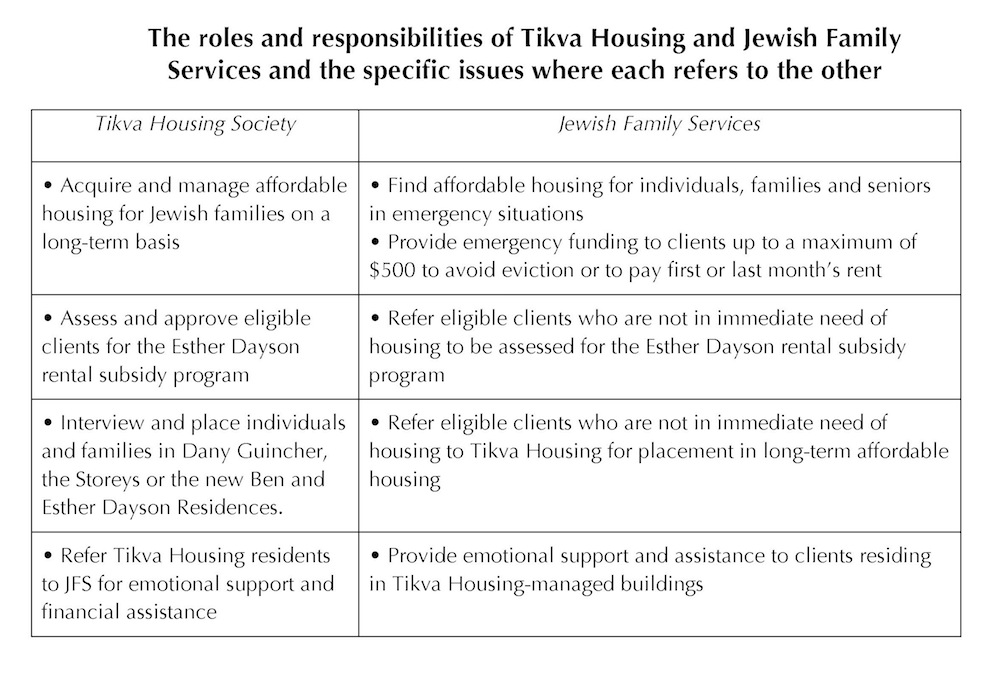
Jewish Family Services has launched a new tenant community liaison (TCL) position to provide stability and support for JFS clients receiving a Tikva Housing subsidy or who are housed in one of Tikva’s rental buildings for low- and moderate-income Jewish adults and families.
The purpose of the TCL position, which is funded by the Ben and Esther Dayson Foundation and a grant from the federal government, is to increase the long-term success of housing vulnerable and at-risk Jewish community members.
“Once JFS clients are settled in as new tenants, they often struggle to adjust to living in a permanent housing situation,” said Tanja Demajo, director of family and adult resources at JFS. “Many of our clients have a history of addiction, mental illness, a physical disability, and/or family abuse, so adapting to life in a new community is a challenge for them.”
The new TCL will act as a link between JFS and Tikva Housing to ensure that tenants who need support are settled in successfully and to help them understand their roles, rights and responsibilities. In addition, the TCL will provide workshops and counseling, as well as community-building activities, such as holiday celebrations and networking events. Tenants will also learn about appropriate services or resources.
Alice Sundberg, director of operations and housing development at Tikva Housing, said, “We value the collaborative relationship we have with JFS to make sure that those most in need in our community get access to affordable housing. The tenant community liaison will help to ensure that the people we serve have more than just a roof over their heads. We plan to work closely with the TCL to connect our more vulnerable tenants to support services, job and educational resources, as well as enhanced links to the Jewish community and culture.”
Affordable and social housing has become a critical issue in the Lower Mainland for almost all income levels. Following the trend in the general population, the part-time JFS housing coordinator has seen more than a 20% increase in the number of people asking for assistance, with an average of 55 new calls a week.
In the city of Vancouver, monthly rent of $1,730 for a one-bedroom unit is considered affordable. When a person on disability makes a yearly income below $18,000 per year and the minimum wage is $12.65 an hour, it is not surprising that the percentage of homelessness has increased by 30% since 2014. The 2017 Homelessness Count in Metro Vancouver confirmed that some of the main barriers to finding housing are the high cost of rent and the lack of income and shortage of units that suit clients’ needs.
As the Jewish community responds to the issue of affordable housing, the tenant community liaison is a step forward. “Lack of support for affordable and social housing damages clients lives and affects all of us directly or indirectly,” said Demajo. “Having a home is not a luxury, it is a basic need.”
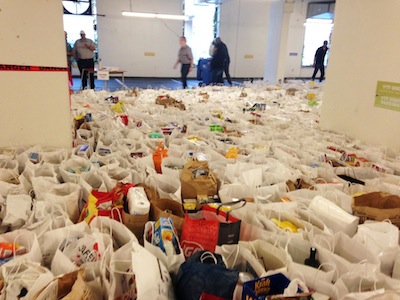
More than 80 volunteers came together to help Jewish Family Services sort the food on Sept. 26, organizing nearly 1,300 bags of food and toiletries. (photos from facebook.com/JFSVancouver)
During this year’s Project Isaiah food drive, the Metro Vancouver community donated four months’ worth of provisions for the Jewish Food Bank, which will feed and support the 300 households who turn to the Jewish Food Bank each month.
More than 80 volunteers came together to help Jewish Family Services sort the food on Sept. 26, helping unload, box and organize nearly 1,300 bags of food and toiletries. The collection is a huge effort and JFS could not have done it without all of its partners across the Jewish community, as well as the countless individuals who donated and volunteered, and Vancouver Talmud Torah and Congregation Beth Israel who offered the use of their facilities.
The number of those who rely on the Jewish Food Bank continues to rise. JFS’s services also include home delivery to seniors and people with disabilities, and the recently launched Jewish Food Link program extends the agency’s reach to serve people in the Tri-Cities and Richmond areas.
Jewish Family Services has launched a new program to provide short-term financial assistance to Jewish community members living in the Tri-Cities area, including Maple Ridge and Mission. This program is funded by a grant from a private donor through Jewish Federation of Greater Vancouver.
Called the Chesed (or Compassion) Program, the project responds to recommendations made by the Jewish Food Security Task Force, a joint collaboration between JFS and Jewish Federation, that identified the lack of regionally based Jewish food options as one of the top priorities to address.
According to a report from the Jewish Federation, 4,200 Jews in the Lower Mainland earn less than $30,000 annually and live below the low-income cut-off. Approximately 20% of these households live in the Tri-Cities, Mission, Langley and Maple Ridge. Another five percent of households in these areas earn less than $50,000. This means there are approximately 1,000 people living in these communities, many of whom are single-parent working families, who are considered food insecure.
Richard Fruchter, chief executive officer of JFS, said that, for those living in this situation, their day-to-day reality is dire. “Many do not have enough food to last the whole month without accessing a food bank,” he explained, and “some parents go without so that their children have enough to eat. Still others have poor diets, lacking sufficient income to purchase fresh fruit and vegetables.”
Nearly all Jewish programs and services are located in Vancouver and, despite the number of low-income Jewish households in these geographic areas, there are no Jewish-run social services available to them. Many are families that have requested assistance from JFS but, because of the distance to Vancouver or the Jewish Food Bank’s limited hours of operation, they are not getting the help they need. In addition, a significant number of these households are new immigrants, the majority of whom are Russians or Russian-Israelis. They would benefit from being connected to the Jewish community and having access to social and educational programs offered closer to their homes. The Chesed Program is a small but significant step in creating access to these social services.
The program is designed to offer up to six months’ short-term assistance for people in crisis where no other source of funding is available. Eligible are Jewish community members 18 to 65 years old who are residents of the Tri-Cities, Maple Ridge or Mission and can demonstrate financial need (i.e. bank statement, rent receipt, income tax statement, social assistance cheque, proof of income) and are willing to develop a long-term plan for addressing their financial needs, where possible. Individuals or families who meet the eligibility criteria will receive a loaded credit card that can be used for purchasing basic needs items.
For more information about the Chesed Program, contact Tanja Demajo, director of family and adult resources at JFS, at tdemajo@jfsvancouver.ca or 604-637-3316.
This year, Jewish Federation honoured, for the first time, an organization outside of the Jewish community. The inaugural recipient of the honour was the Vancouver Police Department.
***
At its annual general meeting June 19, the Jewish Federation of Greater Vancouver honoured four volunteers: Alex Cristall, Judi Korbin, Judith Cohen and Courtney Cohen. It also honoured, for the first time, an organization outside of the Jewish community – the Vancouver Police Department.
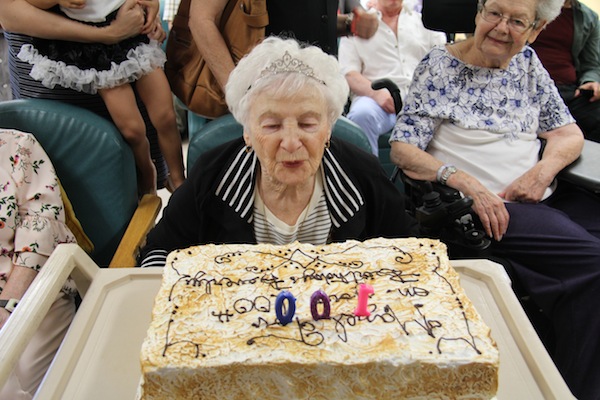
On June 18, L’Chaim Adult Day Centre celebrated its first 100th birthday, with program participant Beverly Klein.
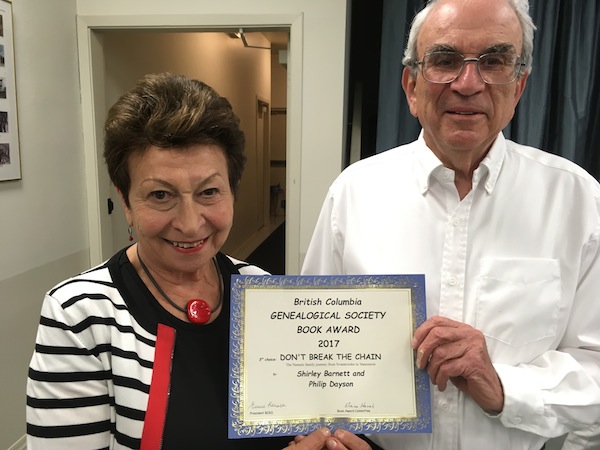
On the evening of June 13, siblings Shirley Barnett and Philip Dayson were honoured with the B.C. Genealogical Society Book Award.
On the evening of June 5, Jewish Family Services held its first annual Volunteer Appreciation Event, celebrating the dedicated volunteers of JFS and the Better at Home program.
Louis Brier Home and Hospital has successfully achieved accreditation with exemplary standing from Accreditation Canada.
Among the B.C. Civil Liberties Association’s Liberty Award winners on May 17 were Ken Klonsky, for excellence in the arts, and Peter Klein, for excellence in journalism.
***
At its annual general meeting June 19, the Jewish Federation of Greater Vancouver honoured four volunteers.
Alex Cristall was presented with the Harry Woogman Award, which recognizes a volunteer who leads consistently and conscientiously by example and has long-standing and diligent campaign involvement. Cristall is the outgoing annual campaign chair. His dedication and commitment to leadership excellence has made an enormous impact on Federation and the community as a whole.
Judi Korbin was given the Arthur Fouks Award, which honours leaders who demonstrate dedication to the goals and principles of Jewish Federation and who provide outstanding leadership to the annual campaign. Korbin is the outgoing chair of Federation’s endowment program, the Jewish Community Foundation, and is a past chair of the annual campaign.
The Kipnis-Wilson/Friedland Award went to Judith Cohen. As a past volunteer chair of women’s philanthropy, Cohen is no stranger to philanthropic work. She draws the inspiration for her community involvement from having grown up seeing her parents “pour their time and energies into the Jewish community.” She received the Kipnis-Wilson/Friedland Award from Jewish Federations of North America for demonstrating the highest ideals of leadership and involvement.
The Young Leadership Award was presented to Courtney Cohen for her extensive volunteer work with many Jewish organizations around Greater Vancouver. Just two examples among many are her involvement in Federation’s Axis program for young Jewish adults as the co-chair of the leadership development pillar, and her founding of Rose’s Angels, a care-package project created to honour her grandmother.
This year, Jewish Federation also honoured, for the first time, an organization outside of the Jewish community, with the first recipient of the honour being the Vancouver Police Department.
“Our Federation has had a long and valued relationship with the department and our staff have been able to count on their assistance and intervention during crisis situations and high-profile events attracting protesters, as well as being willing to provide education and training to our communal professionals on an as-needed basis,” said Bernard Pinsky, chair of Federation’s community security advisory committee, in presenting the award, which was accepted by Deputy Chief Lawrence Rankin on behalf of the VPD.
Pinksy expressed Federation’s “appreciation to constables Ryan Hooper and Dale Quiring for their support over the years,” and said Federation was looking forward “to a continued positive relationship with Constables James Hooper and Jacqueline Abbot.”
In introducing the video created for Federation’s 30th anniversary, board chair Karen James thanked “Jonathan and Heather Berkowitz, whose experience editing the Federation Magazine for many years was invaluable to this project, as well as past Federation president Sondi Green, whose father, Arthur Fouks, was a founder of our Federation, and Al Szajman, chair of our marketing and communications resource group for their work on this project.”
***
On June 18, L’Chaim Adult Day Centre threw a party for Beverly Klein’s 100th birthday.
On June 18, L’Chaim Adult Day Centre celebrated its first 100th birthday, with program participant Beverly Klein. Four generations of her family, friends, fellow program participants, L’Chaim board members, staff and volunteers, as well as Jewish community leaders, threw a party at L’Chaim to commemorate her reaching this milestone.
Knowing her love of music, she was honoured with the musical talents of Allison Berry, who performed classics from the 1940s. Beverly was delighted to receive congratulations and warm wishes from Prime Minister Justin Trudeau and the Queen’s representative, the governor general of Canada, Julie Payette.
Ezra Shanken, chief executive officer of the Jewish Federation of Greater Vancouver, spoke about Beverly and said that she didn’t look a day over 40, to which she replied, “Hey, I like this guy!”
A much-loved program participant since 2013, the birthday girl was born in Poland near Warsaw in Meserich, and was one of 11 children. A story treasured by her children is Beverly’s childhood memory of preparing for Shabbat by “building a floor” and “doing the stove” – her home’s dirt floors had to be swept and pounded down, and Beverly would pile up the bricks for the oven, which was then whitewashed. Her family immigrated to Canada in 1929 with only the clothes on their backs, which were sewn from potato sacks. During the Second World War, Beverly came to Vancouver to spend time with her sister Ruby, and she met her husband Dave. They married and had two daughters and a wonderful life together.
Beverly continues to live in her own home because of the love and devotion of her family. The Turnbulls – Wendy, husband Steve and boys Ryan and Gavin – and the Blonds – Arlene, husband Les and children Amanda and Ben – are all devoted to their mom and bubbie.
Both daughters Arlene and Wendy gave heartfelt speeches at the birthday party. Arlene said, “It’s very reassuring to families to know that their loved ones have a safe place to go where they are not only stimulated but treated like family.” Wendy said, “L’Chaim remembers that older people deserve respect for a lifetime of achievements and all that they are today. The sheer joy with which the staff planned Beverly’s party touched all of us.”
The L’Chaim Adult Day Centre strives to improve the quality of life of its participants by providing a caring and stimulating group experience for those who might otherwise be socially isolated, while also providing support and respite for care-giving families and friends. It is funded in part by Vancouver Coastal Health, Jewish Federation of Greater Vancouver, the Jewish Community Centre of Greater Vancouver and private donations from the larger community.
***
Shirley Barnett and Philip Dayson
On the evening of June 13, siblings Shirley Barnett and Philip Dayson were honoured with the B.C. Genealogical Society Book Award. Barnett and Dayson were recognized for their book Don’t Break the Chain, which describes the journey of Abraham and Toba Nemetz from Svatatroiske in Ukraine to Vancouver and points in between.
Fleeing from pogroms in 1922, Abraham and Toba began a new life in Canada. One of the pages in Don’t Break the Chain outlines how their family of nine children grew into 196 descendants. Family trees and portraits – both individual and group – are part of a fascinating picture of a family whose lives became an important part of both the Jewish and general communities of Vancouver.
In her acceptance of the award, Barnett said that, while researching the book, numerous family members (known and previously unknown) were reached with 100% cooperation from all of them in helping to compile information for the book. The title comes from Ben Dayson, Barnett and Dayson’s father. Although he married into the family, because of his belief in the value of family ties, Ben Dayson often “ended his conversations and speeches with the sentence, ‘don’t break the chain.’”
Barnett thanked the Jewish Museum and Archives of British Columbia for their support and rich accumulation of archival material. For more information, interested readers may access nemetzfamily.ca or the Jewish Museum at jewishmuseum.ca.
Congratulations to Shirley Barnett and Philip Dayson for being honoured by the B.C. Genealogical Society, who recognized the positive impact of their family and this book on the history and development of our province.
***
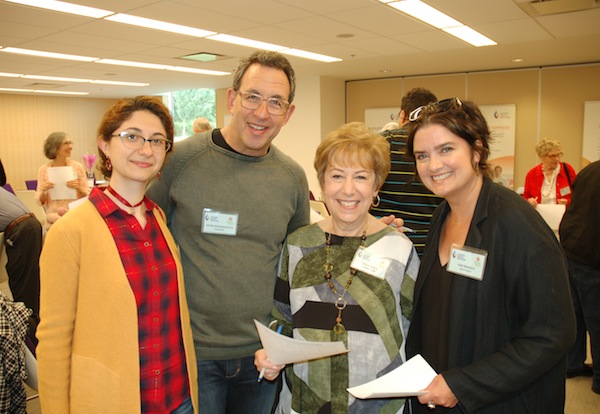
Left to right are Mariam Harutyunyan, Dr. Mark Rosengarten, Linda Glick and Kim Branch. Harutyunyan and Branch are Better at Home volunteers. Rosengarten and Glick are JFS volunteers.
On the evening of June 5, Jewish Family Services hosted more than 70 people at its first annual Volunteer Appreciation Event. It was a wonderful opportunity to celebrate the dedicated volunteers of JFS and the Better at Home program, a government-funded service for seniors managed by United Way and administered by JFS. The guest speaker, Dr. Rotem Regev, presented on the value of human connection, empathy and the power of giving back.
Richard Fruchter, chief executive officer of JFS, spoke about the commitment of volunteers to the agency, describing “volunteers as the life-blood of JFS.” It was volunteers, he said, who founded the Jewish Family Welfare Bureau of Vancouver (JFS’s original name) when it opened more than 80 years ago to assist the poor and elderly living in Vancouver, and to help resettle new immigrants fleeing antisemitism in Europe.
“Your commitment to uplifting lives, for our clients and community, is an example for us all,” Fruchter said. “By stepping up to help, offering your time, skills and resources, you are the reason we can meet more of the needs in our community and accomplish the work that we do.”
There are more than 170 people who volunteer regularly through JFS and Better at Home, and some have been serving for more than 15 years. JFS’s youngest volunteers are in grades 7 and 8 from Vancouver Talmud Torah and King David High School who help regularly at the Jewish Food Bank.
JFS volunteers are responsible for a wide range of work. They support the Jewish Food Bank at the Peretz Centre; seniors lunches and outreach services, such as grocery shopping, visiting and driving to and from appointments; English-language practice for newcomers to Canada; interviewing skills for job seekers; mental health outreach; and administrative support in the office. Chanukah helpers, Passover hampers, Rosh Hashanah activities and Project Isaiah are all programs that rely almost entirely on volunteers. For many individuals and families, these Jewish holiday programs are the only connections they have with their Jewish heritage.
For more information on volunteering with JFS, contact Ayana Honig at ahonig@jfsvancouver.ca or call 604-226-5151.
***
Louis Brier Home and Hospital has successfully achieved accreditation with exemplary standing from Accreditation Canada.
Accreditation Canada is an independent, not-for-profit organization that sets standards for quality and safety in health care and accredits health organizations in Canada and around the world. Louis Brier Home and Hospital voluntarily participated in accreditation because it believes that quality and safety matter to residents and their families/significant others. Improving the quality of care is a continuous journey – a journey to which Louis Brier is fully committed.
As part of the Qmentum program, the home and hospital has undergone a rigorous evaluation process. Following a comprehensive self-assessment, external peer surveyors conducted an on-site survey during which they assessed the organization’s leadership, governance, clinical programs and services against Accreditation Canada requirements for quality and safety. These requirements include national standards of excellence; required safety practices to reduce potential harm; and questionnaires to assess the work environment, resident safety culture, governance functioning and client experience. Results from all these components were considered in the accreditation decision.
The accreditation survey team spent four days at Louis Brier, and reviewed a total of 19 required organizational practices (ROPs), 216 high priority criteria and 295 other criteria for a total of 551 criteria. The accreditation surveyors determined that the Louis Brier successfully met 100% of the ROPs and 100% of the criteria evaluated.
“I am very proud of everyone at Louis Brier Home and Hospital,” said Dr. David Keselman, chief executive officer. “Our staff worked and continue to work incredibly hard to make sure we meet the needs of our residents in every possible way, helping them and their loved ones maintain optimal health status, control and dignity every day, every time. Receiving exemplary standing from Accreditation Canada is a real testament to the changing culture and focus at Louis Brier Home and Hospital. Accreditation Canada standards and requirements will continue to guide us into the future as we continue to evolve and continuously improve our practices and care delivery efforts.”
He added, “I will, of course, be remiss if I do not mention the ongoing support and generosity of the LBHH and WR [Weinberg Residence] and the [Louis Brier Jewish Aged] foundation boards, without whom this journey may not have been as smooth or possible.”
***
The B.C. Civil Liberties Association’s Liberty Awards recognize outstanding achievements to protect and promote human rights and freedoms in Canada. Among the 2018 award winners were Ken Klonsky, for excellence in the arts, and Peter Klein, for excellence in journalism.
Klonsky, co-author of Dr. Rubin Carter’s Eye of the Hurricane, is a former Toronto teacher and writer now living in Vancouver. He is a director of Innocence International, the organization conceived by Carter to help free wrongly convicted prisoners worldwide. His artistic works call readers to action to defend civil liberties and improve the justice system. His art and advocacy on behalf of those who have been wrongfully convicted has contributed greatly to the advancement of human rights in Canada and internationally.
Klein is a journalist, writer and documentary filmmaker. He has been a producer for the CBS newsmagazine 60 Minutes since 1999, produces video projects for the New York Times and writes columns regularly for the Globe and Mail. He is the founder of the Global Reporting Centre, a nonprofit organization dedicated to reporting on neglected global issues and innovating the practice of global journalism. His record of groundbreaking broadcast journalism exposing human rights abuses around the world deserves to be celebrated. His efforts are empowering the next generation to continue to hold the powerful to account.
The other 2018 Liberty Awards were Miranda Hlady (youth or community activism), Stockwoods LLP (legal advocacy, group) and Dr. Pamela Palmater (legal advocacy, individual). Hassan Diab, Rania Tfaily and Don Bayne, on behalf of the Hassan Diab Support Committee, were recognized with the Reg Robson Award, which is given annually to honour substantial contributions to the cause of civil liberties in British Columbia and Canada.
In mid-April, I attended the Jewish Family Services (JFS) donor appreciation event. My husband and I have always supported JFS and I have always thought very highly of the organization. But, recently, I became more involved and, this year, I joined the board.
At my first board meeting, I was blown away by the information I received about what just one facet of the organization does for its clients – the family and adult resources program, which includes helping with food vouchers, medical support, housing, etc.
At the next meeting, another group of employees came to discuss their services to seniors, which range from individual home support and care to outreach programs reaching hundreds of vulnerable seniors.
Then followed the employees who took care of assisting clients with employment, and settling new immigrants. The list went on … clinical counseling, the Jewish Food Bank, mental health outreach, emergency and transitional housing support, to name a few. About six months in, I am truly amazed by the breadth of services JFS offers and the number of clients they reach, but that’s not even the story.
I went to the volunteer appreciation evening event with my husband, as a board member and supporter, the first one we have attended. Some of our friends were there, many of my parents’ friends, some employees and some volunteers of the organization, as well as my dad. A JFS recipient spoke about his experiences with the agency and how much they helped him. He spoke about receiving counseling for depression after the failure of a business, support he was given to find work and on how to prepare his resumé after not having done so for decades. He then described the help he was given to prepare for job interviews and on how to present himself. He also praised other JFS services, such as the food bank, help with finding new housing and counseling after his divorce, and said he felt supported through these difficult years. All of a sudden, it hit me!
I looked at my dad, who was standing behind me, hand on my shoulder, and I said to him, “Oh, my G-d! You are my JFS!”
It was true. My mom and dad, throughout my entire life, have been my Jewish Family Services. From putting a roof over my head, feeding me, helping me through school, assisting me in all my university applications, editing my resumés, introducing me to potential employers and coaching me for interviews, to counseling me through difficult times, and the list goes on and on. Not to mention the help they provided other family members. All the services required to care for my four grandparents at various times in their lives closely resemble the ones offered through JFS. My parents drove them to appointments, helped get groceries, provided in-house care when necessary, brought them meals, managed their medications and advocated for them. They drove them to and from our Shabbat dinners and all the events in the community, ensuring they could attend shul, family celebrations, holidays and fundraisers.
We are always reminded that it takes a village to raise a child. When I reflect on my childhood or on my children’s lives thus far, it couldn’t be truer. The people in our lives that we rely on – friends, family members, professionals – all have played such an important role in getting us to where we are today. If we take a minute to reflect on how dramatically different our lives would be without this support system, I think we would be amazed.
So many of us are so blessed to have this network, this “village.” However, many people in our community are not so lucky. Thankfully and fortunately, they can access the village that is Jewish Family Services. If your story resembles mine in any way, I believe it is our good fortune that finds us in a life of comfort and security. I feel privileged to be part of this amazing organization and to be able to donate time and money to help those who aren’t as fortunate, so they can have affordable access to JFS and all the wonderful services they provide.