Investing in community

Leonard Brody talks about The Great Rewrite at the Jewish Family Services Innovators Lunch April 24. (Rhonda Dent Photography)

Sitting in the JFS client base are this community’s greatest and most hopeful assets,” said Jewish Family Services Innovators Lunch keynote speaker Leonard Brody. Donating to JFS is not charity, he said, but rather an investment with high returns.

The 600-plus attendees at the JFS’s main annual fundraising event obviously agreed. At press time, more than $350,000 had been raised for the agency’s work, and donations were still coming in, making this year’s lunch the most successful Innovators yet.

Event co-chairs Shannon Ezekiel and Candice Stein Thal welcomed those gathered at the Hyatt Regency Vancouver on April 24, and gave a brief overview of the JFS and of the organization’s new logo and look, which, they said, “inspired the theme for this year’s lunch: ‘Uplifting Lives.’”

Rabbi Jonathan Infeld of Congregation Beth Israel, who is the Rabbinical Association of Vancouver representative on the JFS board, did the blessing over the bread. “This week’s biblical portion is Acharei Mot-Kedoshim,” he said. “Kedoshim is really the essence of why we are here – ‘You shalt be holy,’ the portion begins, and then it gives us a litany of laws in which we are able to bring holiness into this world. A number of those laws do not ask, but demand, that we take care of those who are in need. And one of those laws in particular demands that we feed those who are hungry. Many of us here are hoping to make a difference in this world. We are here, maybe with the idea in mind of a business connection, but, really, the essence of what the JFS is all about is bringing holiness into this world by helping those who are in need.”

After a video, which told the stories of three individuals who were helped by JFS in some way, JFS board chair Bill Kaplan said a few words, stressing that, “most importantly, our volunteers and staff treat our clients with a respect and warmth that uplifts them, makes them feel part of the community and, if you ever visited, you’ll see, it becomes a social highlight for their week.”

All of the lunch guests were given a bag full of items – including some packaged food, toiletries, a poncho and gloves – and asked to give it to someone on their way to work or to a JFS client. The bags were packed by more than 80 kids and their families at Beth Israel a few weeks earlier.

Among those who Ezekiel and Stein Thal thanked were the event’s corporate sponsorship committee, chaired by Audrey Chan; the more than 40 sponsors at the lunch, who had “helped contribute over $183,500 … a record in sponsorship for this event”; the 28 table families; day-of-event chair Dr. Sherry Wise; and JFS’s Maya Dimapilis and her team. The lunch was co-presented by the Diamond Foundation, Austeville Properties Ltd. and Shay Keil; Neil and Michelle Pollock matched every new or increased portion of a donation raised through the lunch, up to $25,000, which was dedicated for the Jewish Food Bank.
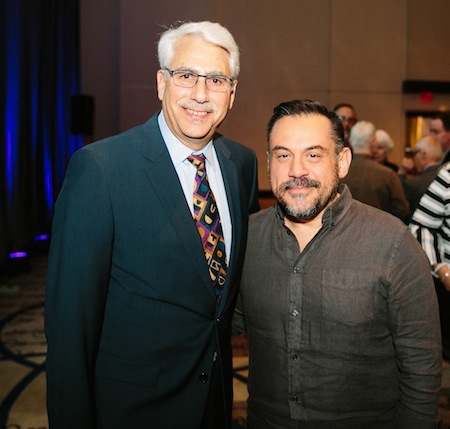
photo - Jewish Family Services executive director Richard Fruchter, left, and entrepreneur, venture capitalist and author Leonard Brody
Jewish Family Services executive director Richard Fruchter, left, and entrepreneur, venture capitalist and author Leonard Brody. (Rhonda Dent Photography)

JFS executive director Richard Fruchter spoke about JFS, its history and the expanding services it provides. It is because of this growth in the demand for JFS’s services, he said, that “it became important for us to be more visible in the community and tell our story to a much wider audience …. we’ve updated our logo and our name to reflect that. Our logo is a simple, elegant symbol – it conveys the warmth and heart of what we do here at Jewish Family Services.”

“For me, this is not just an amazing lunch with a marquee speaker,” said Keil before he introduced Brody. “It’s an opportunity for me to stand before you and proudly announce my support of the Jewish Family Services, and to thank the army of staff and volunteers … [for their] work in the community.”

Brody’s talk was on The Great Rewrite, a book he is creating with Forbes Magazine, based on a documentary series they produced. “Really what we’re doing this morning,” said the entrepreneur, venture capitalist and author when he took to the stage, “is talking about an evolution, an evolution in us, in our human story.”

Based on about a decade’s worth of research, he said, The Great Rewrite began with the question, “How is this moment in time different? We’ve been through a lot of innovation cycles, from the web and mobile, and now entering into AI and robotics… Is this vast amount of change that we’re all experiencing … substantively different from anything we’ve been through before? Is this a fourth industrial revolution?”

Humanity is “literally rewriting this planet from the ground up,” he said, arguing that we are currently undergoing “pretty much the largest institutional shift in the history of our species.”

The co-founder of four companies, Brody said, “The concept of this rewrite has nothing to do, for me, with just theory – it started as a theory but it’s really what we do and what I do every day for a living at CAA [Creative Artists Agency].”

Before looking at what we can expect in the next 730 days – the next two years – Brody explained how we, the humans of today, are nothing like the people of 100 years ago. For example, he said, the average person now lives 2.7 times longer and is three to four inches taller; the rate of poverty has been reduced from 90% in 1900 to 10% now, literacy increased from 12% to 85% and access to basic education risen from 17% to 86%. We are also “living in the lowest point of human death [caused by any factor] since we could record it, since 1400,” he said, and “the average human being living on this planet works about half the number of hours than someone living in 1900.”

We are fundamentally different people now, said Brody, and herein lies the challenge. “The houses we built don’t fit the people who live here any more,” he said. “We built institutions – I’m talking about all the institutions that govern your life, education, government, religion, work, the family unit – they are all going through massive pressure points today because they are structures based on assumptions, often technological, some patriarchal, that are just no longer true.”

So, he said, “The whole essence of this rewrite is you are living in the disconnect between the people we have become, the technological tools available to us today and the failure of our institutions to keep pace with that.”

One of the reasons for this, he explained, is “inversion.” Most of our institutions are organized as pyramids, with, for example, a head of state or religious figure at the top; however, the internet has flipped this power structure. Up to the mid-1990s, all the methods of communication, from radio to the telephone, had limited reach and were regulated by government, he said, but, with the internet, it “was the first time where millions of people could speak with millions of other people with virtually no hit on their disposable income” and where it was “impossible for governments to regulate.”

With respect to the internet, said Brody, “the average North American spends two-thirds of their working day in their virtual identity and not their physical one. The average Canadian, by the way, spends 63% of their time with close friends and family in their virtual identity and not their physical one, meaning not face-to-face. So, the virtual form of yourself is now the predominant human form, not the physical.”

And our behaviours are different online than in person. “You do things in your virtual identity that you would never dream of in your physical and vice versa,” he said. For example, the average internet user is four times more trusting than they are in person. He illustrated this using a question he asked his 83-year-old uncle: “When your children were babies, would you post their baby pictures on the lamp posts in your neighbourhood?” The response was an emphatic no. “So, then, why do you post hundreds of photographs of your granddaughter on Facebook and Flickr, which is a globally open, searchable and highly manipulated light post, and his face just went totally blank.”

As for how the internet has changed our institutions, Brody gave the example of marriage. As of the end of 2017, he said, “two-thirds of all new marriages in the Western world originated online” – and, for those who met their spouse online, the likelihood of divorce is 15 to 20% less. “The algorithms on these dating sites work from a data perspective,” he said. And, connected to the institution of marriage, he noted that, in the 2016 census, about 40% of Canadian adults reported themselves as living alone, while, in 1955, that statistic was four percent.

Brody went on to explain what CAA was doing in the field of entertainment with virtual reality and how, “in the next decade, roughly 30% of all ‘live’ entertainment will come from performers who are no longer living. You will take your children to go watch the Beatles and Michael Jackson and Elvis Presley – in fact, the Elvis tour has just begun; the estate just signed off on it.”

Currently, there are up to three-and-a-half billion people on the internet, he said, and, over the next two years, another billion people will join. This new billion will be “one of the most significant economic events in human history, if not the most significant,” he said, noting the amount of money to be made from e-commerce.

This coming two-year period, he added, “is the very beginning of a long journey in the rewrite of currency.” He said that traditional wealth generators, such as home ownership and the stock market, will not be profitable in the future, so currency “will become the new stock.”

Brody spoke about the fact that we’re about a decade away from creating machines able to think for themselves, and how computers can now create, for example, a Rembrandt painting that can fool the computers that detect fraud at top auction houses. “The reason I share that with you,” he said, “is because the very thing that makes us human is art. And, once machines begin to make art, you get a very clear indication of how different this world is going to be, and very clearly that we are on a path where humans may no longer be the predominant species on this planet. So, we have very important decisions to make in the next decade about how we regulate the ethics of artificial intelligence.”

He concluded, “Why are we talking about The Great Rewrite and the rewrite of this planet at a JFS Innovators Lunch? There are two specific reasons. The first is this massive shift in institutional power that’s coming…. And the second has to do with math, pure math; in particular, the number 70. Why 70? According to StatsCan, 70% of all charitable donations in this country come from primary donors – 70% come from a small group that make up the vast majority of the donations. So, I started to do a little bit of digging and I brought in my friends and partners at Forbes to help me out on it. It turns out, if you look through the Forbes millionaire and billionaire list, which many Canadians sit on, it turns out that … 70% of that [primary donors] group came from nothing” and could have been clients of an organization like JFS at one point in their lives.

“Benevolence and charity were the wrong lens” with which to look at giving, Brody said. “The right lens was investment. If it’s true, which it is, that the vast majority of donations to charitable causes in this country … and the vast majority of those individuals [who are giving] were, at some point in their lives, disadvantaged and downtrodden, then the math and the investment is very simple. An investment made in JFS today has the greatest statistical likelihood of identifying the next pillars in this community and the next great funders.”
Abuse comes in many forms

In the second of a series of articles on sexual harassment and violence in the Jewish community, the Jewish Independent speaks with Dr. Alan Stamp, clinical director at Vancouver’s Jewish Family Services.

The #MeToo movement, founded by Tarana Burke in 2006, is based on the concept that empowerment for scores of survivors is possible through empathy – from survivors knowing they are not alone. The movement aims to achieve radical community healing and disruption of all systems that have allowed sexual violence to flourish.

Dr. Alan Stamp, clinical director at Vancouver’s Jewish Family Services, stressed the particular need to protect children. From a psychological standpoint, around the age of 9, there is nothing worse than what is called a “boundary violation” of a young person inflicted upon him or her by an adult.

“Adults, parents, caregivers … are meant to keep kids safe,” Stamp told the Independent. “And when a child is abused by an adult figure, it breaks the trust that the child has – not only in that person, but it breaks their trust in the world. The world becomes an unsafe place to be.”

Stamp went on to explain that children have simple intellectual lives, in that they expect to be cared for in a way that is warm, nurturing and attentive. “When abuse happens, this is stripped away,” he said. “The impact on the developing psyche is that … I have to be vigilant, watchful, that there could be danger all around me…. And, it could be a teacher, an adult and/or a family member.

“The child puts a lot of focus on being vigilant rather than what they are meant to do, which is to learn through play, through relationships. So this is a very injurious act, probably the most injurious act a child can experience.”

Young people who have had this kind of experience develop all kinds of coping strategies – from withdrawing, to acting out, being aggressive and developing learning problems. These coping mechanisms can last a lifetime.

photo - Dr. Alan Stamp
Dr. Alan Stamp (photo from JFS)

“I’ve had many clients over my life who, when they are in their 60s, 70s or 80s, they tell me they’ve never told anyone this story before … and they launch into a story about being harmed … and that it has had an effect on all the relationships they’ve gone on to have in their lives,” said Stamp. “This is why it’s so injurious to a child. If you’re an adult and you have the horrible misfortune of being assaulted or abused, you have had more life experience to be able to manage it. If abuse happens to a youth, while not a child any more, they’re still at a tremendous disadvantage. For young people, getting help, intervening as soon as possible for an extended period of time, really increases the potential for people to do better later in life.”

Outside of explicit sexual abuse, other forms of abuse include emotional abuse, which can involve behaviour that is berating, condescending, hostile or threatening.

“This can be telling a young person that, if you don’t get a top mark in your class, you’re going to ‘suffer these consequences’ – like withdrawing food, be sent to the basement as punishment, neglect, or any manner of things,” said Stamp.

Another form of abuse is physical. “I’ve seen kids who’ve been hit by cast-iron frying pans on their head,” said Stamp.

“I can tell you what parents are meant to do,” said Stamp. A parent “is meant to provide their child with guidance, affection, warmth, food, shelter and education. And, when a parent or caregiver is withholding things, punishing without a clear reason, disciplining inappropriately for the offence – all of these things are felt as abuse to a child.

“This is different than simply being a strict parent by sticking to boundaries, having guidelines, curfews and insisting that homework or chores are done,” he clarified. “This may be strict, but it’s not abusive. It’s abuse when an act or reaction is an inappropriate response to behaviour. A child may think she or he is being treated unfairly, but it is not necessarily abuse. Abuse is something that will shake up the developmental life of the child and will cause them to look at the world through a different lens. Being a strict or controlling parent isn’t necessarily abuse, but the line can be crossed.”

Financial abuse is more often seen among adults, when someone is in a relationship – a spouse, significant other or adult child, for example – takes control of the other’s bank account. Stalking is a form of psychological abuse, making a person feel threatened and unsafe in their own home, neighbourhood or community. And there is sexual harassment. Violence can be two-sided, where both parties are abusive toward each other, or one-sided.

“Elder abuse is now happening with tremendous frequency, where adult children are abusing their elderly parents,” said Stamp. “This is something that’s almost a pandemic, I think, in many – even North American – societies.”

For people who are in an abusive relationship, it is often difficult to leave an abuser. Violence against women is a form of very fierce oppression, according to Stamp. “It oppresses their spirit. They often will say that they should have left and that they knew they had to, but that they couldn’t – that they felt paralyzed with fear for themselves or of harm coming to them, their child or to other family members … or that they didn’t have the confidence to leave,” he said.

“The psychological or physical abuse of a spouse or partner is very systemic,” he explained. “It affects them in many ways. Often, women will take up to eight years to leave an abusive relationship – that’s a very telling stat. When they do leave, they can look back on it and say that they should have left earlier. What I advise is, ensure that you are safe, that you have a safety plan … that you can get up and out of the house with your child within minutes.”

Stamp advises people in abusive relationships to always include in their escape plan talking to family and friends about the situation, as well as to identify resources in their community, just in case. “There are many resources in the community for women fleeing domestic violence,” he said. “It’s a very scary proposition, but, to get what you want, you have to give something up. You have to fight for yourself and become your own hero in many ways, your own best friend. There is help, there are resources…. Life is not meant to be lived being oppressed, threatened or being fearful for your safety.”

Stamp said it is important to remember that abuse is often passed down in families. If you were raised in a home where your parents yelled at each other, hurt each other, used foul language or were otherwise disrespectful, you have a much greater chance of being abusive yourself.

“Using one’s anger is a way of trying to gain control and to oppress others,” said Stamp. “Abuse is something that tends to be systemic, so it can be familial…. It can go back in time and come back to haunt us in the present.

“I’ve seen and worked with many men who were abusive and I’d say that 85% of those men came from homes where they were abused. So, unless we’re addressing that kind of family situation and the people who use abuse as a way to control or manage themselves and others, we’re going to continue to see this pattern throughout time.”

Stamp said the only way to create change is by means of awareness and education – through campaigns, schools, reporting, and by having community services that can positively intervene.

For more information about the counseling services offered by JFS, visit jfsvancouver.ca or call Stamp at 604-637-3309.

Rebeca Kuropatwa is a Winnipeg freelance writer.

How to cope with technology

Entrepreneur, venture capitalist, author and media visionary Leonard Brody is the keynote speaker at this year’s JFS Innovators Lunch April 24. (photo from JFS Vancouver

On Tuesday, April 24, Jewish Family Services (JFS) will be hosting its annual Innovators Lunch. The event, which encourages people to think as innovators and uplift lives to bring about meaningful and lasting social change, raises essential funds that go directly to serve JFS clients, programs and services. It has attracted more than 600 people in each of its 14 years.

This year, the keynote speaker is Leonard Brody, chair of Creative Labs, a joint-venture with Creative Artists Agency, the largest sport and entertainment agency in the world. He and his team are building new ventures and companies for some of the biggest celebrities and sports personalities in the world. He acts as principal in several venture capital funds throughout the world, and is behind the financing and creation of dozens of start-up companies every year. He is also one of the owners of Coventry City Football Club in England.

The award-winning entrepreneur, venture capitalist, bestselling author and two-time Emmy nominated media visionary has been called “a controversial leader of the new world order.” His upcoming book, in partnership with Forbes Magazine, is The Great Rewrite. In it, he addresses the rapid pace of change, innovation and disruption brought about by the internet and how to respond to its profound changes on our social and economic ways of life.

“Everything we do, from how we speak, how we buy, how we employ people, is being rewritten,” he told JFS. “The internet is the first time in our history where millions of people can speak directly to millions of other people at little cost, no regulation; the first time in our species that we have owned our communication at mass scale on a global level. The tools for innovation are nothing, the playing field is now level.”

Wherein lies the controversy? Brody argues that the resulting change in communication is “a massive disconnect between the institutions we’ve created and the people we’ve become.” He contends that it is the largest level of institutional shift in human history.

“Our world is inverted,” he explained. “We are fundamentally different than the people we were 100 years ago.” The institutions that run society are traditionally top down, he said. Take, for example, politics, with a prime minister at the top and the people at the bottom. Once the internet became ubiquitous, the power pyramids started to flip, or invert.

The pace can be disorienting, and Brody seeks to raise the level of our dialogue and provide a useful framework for action that people can look to and use. Through concrete stories, he provides many answers, ultimately offering a playbook on how we can engage in the world that’s being rewritten around us.

For tickets to JFS’s Innovators Lunch on April 24 at the Hyatt Regency Vancouver, visit jfsvancouver.ca/innovators. There is a limited number available, so book your space early.

Changes in community

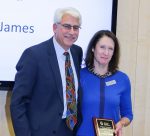
Jewish Family Services CEO Richard Fruchter with Karen James, who received the 2017 Naomi Gropper Steiner Visionary Award. (photo from JFS)

At Jewish Family Service Agency’s 81st annual general meeting on Nov. 29, Richard Fruchter, chief executive officer, announced that the agency will be shortening their name to Jewish Family Services. The organization has also launched a new logo and website at jfsvancouver.ca. JFSA has been in a period of growth over the past four years,” said Fruchter. “However, when it came time to looking at our website and logo, we knew they had difficulty connecting with current audiences.

“In response, we created a marketing task force that consisted of some key community members and professionals to guide us in refreshing our look and giving us the tools to present ourselves in a more vibrant and professional way.

image - The AGM also featured the unveiling of JFS’s new logo
The AGM also featured the unveiling of JFS’s new logo.

“As we discussed the logo, we naturally talked about our name,” he said. “We’ve been known in this community as Jewish Family Service Agency since 1958, but ‘agency’ is repetitive. Other Jewish organizations dropped that extra word from their name awhile ago and we felt that it made sense to do the same. We’re now referring to ourselves as Jewish Family Services or JFS. ‘Services,’ rather than ‘service agency,’ more accurately reflects the remarkable breadth of what we do.”

In addition to the new logo and look, Fruchter said, “We also have a new tag line, ‘Uplifting Lives.’ It’s exactly what we do here – we uplift the lives of families and individuals in our community who need our help. It works both ways, though – we also uplift the lives of our members and donors who are participating in tikkun olam and gemilut hasadim – repairing the world through acts of loving kindness.

“We’re proud to present these marketing initiatives on behalf of JFS to our community. We feel it’s a refreshing representation of who we are and the work we do, which is grounded in the values and mission of our organization.

“As we look ahead to the future,” he said, “our vision is to be a leader in the Jewish and broader communities, transforming the lives of individuals and families through quality services and innovative programming that responds to evolving community needs. With a new look, logo, name, tagline and website, we are more prepared than ever to do just that.”

The new website is now live at jfsvancouver.ca. JFS will be phasing out its old logo and branding materials by the end of 2017.

At the AGM, Karen James received the Naomi Gropper Steiner Visionary Award, given to a past board member who went over and above in their duties. She stepped into the top volunteer job at the agency at a critical time and guided JFSA to provide significantly more services to the community.

Shelley Ail received the Paula Lenga Award for her major volunteer contribution over a decade to the Jewish Food Bank and her commitment to coordinating volunteers and organizing JFSA’s annual Friends Campaign phone-a-thons.

Schara Tzedeck Congregation received the Community Partner Award.

JFS’s Volunteer Appreciation Award recipients were Ros Calof, for her work with the seniors lunch program, and Lina Moskaleva, for supporting its mental health outreach program.

The work of the staff was also celebrated – Staff Term of Service Awards went to Alan Stamp (10 years), Zanna Linskaia (10 years), Naz Gurbuz (five years) and Tanya Skovorodnikova (10 years).

Bill Kaplan, JFS board chair, introduced the new board members: Judith Cohen, Shannon Gorski, Peter Hotz, Simone Kallner and Michael Kaplen. Along with the nominating committee, Kaplan recruited a strong and talented group of community members.

***

The board of directors of Hillel BC Society has unanimously approved the appointment of Sam Heller as the next executive director of Hillel BC. The appointment will be effective July 1, 2018.

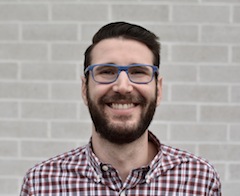
photo - Sam Heller will be the next executive director of Hillel BC
Sam Heller will be the next executive director of Hillel BC.

Over the years, Heller has repeatedly exhibited exceptional leadership skills in a variety of positions. While attending the University of British Columbia, where he received a bachelor’s in political science, he led the fight against antisemitism and anti-Israel activities on campus.

In an effort to make an even more significant contribution to the Jewish community, Heller moved to Israel and joined the Israel Defence Forces, where he achieved the rank of sergeant, Infantry Brigade, and earned an honour of excellence.

Heller returned to Vancouver and was hired by Hillel in 2015 to be the program/outreach coordinator responsible for directing social, cultural and educational programming at seven universities in the province. His ability to communicate with people of all ages, combined with his keen understanding of the campus and Vancouver Jewish communities, fluency in Hebrew and proficiency in social media marketing, have made him an invaluable member of the Hillel team. In recognition of these qualities, he was promoted to program director in 2016 and to managing director in June 2017.

Rabbi Philip Bregman will continue in a part-time basis as Hillel rabbi, whose duties will include Jewish chaplaincy and fundraising.