Skip to content
  • Home
  • Subscribe / donate
  • Events calendar
  • News
    • Local
    • National
    • Israel
    • World
    • עניין בחדשות
      A roundup of news in Canada and further afield, in Hebrew.
  • Opinion
    • From the JI
    • Op-Ed
  • Arts & Culture
    • Performing Arts
    • Music
    • Books
    • Visual Arts
    • TV & Film
  • Life
    • Celebrating the Holidays
    • Travel
    • The Daily Snooze
      Cartoons by Jacob Samuel
    • Mystery Photo
      Help the JI and JMABC fill in the gaps in our archives.
  • Community Links
    • Organizations, Etc.
    • Other News Sources & Blogs
    • Business Directory
  • FAQ
  • JI Chai Celebration
  • JI@88! video

Recent Posts

  • Legal help for students
  • Revisiting myth of Lilith
  • Wrong person rebuked
  • Canada’s mixed messages
  • Questions for museum
  • Symposium on antizionism
  • Making soccer political
  • CJPAC lauds Pulver’s impact
  • City recognizes Vrba’s legacy  
  • Organ donation saves lives
  • Theodore’s March premiere
  • A healing Shabbaton
  • Supplying healthy food
  • A chime of metal tags
  • Yellowknife seder a first
  • Ishai energizes, unifies
  • A Lag b’Omer to remember
  • Expanding the healing
  • Hannah Senesh – a unique hero
  • Community milestones … May 2026
  • Sharing her testimony
  • Fall fight takes leap forward
  • The balancing of rights
  • Multiple Tony n’ Tina roles
  • Stories of trauma, resilience
  • Celebrate our culture
  • A responsibility to help
  • What wellness means at JCC
  • Together in mourning
  • Downhill after Trump?
  • Birth control even easier now
  • Eco-Sisters mentorship
  • Unexpected discoveries
  • Study’s results hopeful
  • Bad behaviour affects us all
  • Thankful for the police

Archives

Follow @JewishIndie
image - The CJN - Visit Us Banner - 300x600 - 101625

Tag: JFS

Importance of food security

Importance of food security

Plans are for Jewish Family Services to open a food centre in the Mount Pleasant neighbourhood this year. (photo from jewishvancouver.com)

The Tu b’Shevat More Than a Bag of Food program – a day of giving, of cooking and of education on food security in the age of COVID-19 – concluded with a panel discussion on the importance of good food, supply chain challenges, and the ensuing impacts and issues facing the Vancouver Jewish community.

The Jan. 28 program was presented by Congregation Beth Israel and Jewish Family Services (JFS), and the discussion event featured Mara Shnay, founding member and chair of the JFS client advisory committee; Cindy McMillan, director of programs and community partnerships with JFS; Dr. Eleanor Boyle, an educator and writer on food and health; Krystine McInnes, chief executive officer of Grown Here Farms, a company that supplies more than 1.5 million families with produce in Western Canada; and Dr. Tammara Soma, assistant professor at the School of Resource and Environmental Management at Simon Fraser University.

Moderator Bernard Pinsky began by highlighting the connection of the Jewish community and providing food. “Feeding the needy is an act of chesed,” he said.

“For people who are food insecure, it is not about having enough for food,” explained Shnay. “It is about not having enough money for anything – to buy a new pair of shoes, to replace a phone, to go to the dentist or to take one’s kids to the movies, and it is about living in that kind of poverty. In Vancouver, housing security is inextricably linked to food security. The income of many JFS clients is less than their rent,” she emphasized.

COVID-19 has exacerbated the circumstances of many JFS clients, particularly seniors, who are at higher risk of contracting the disease and, therefore, should refrain from using public transport or going to stores. Consequently, shopping has become increasingly expensive for them.

McMillan said the food needs within the Jewish community more than doubled in the past year, with children comprising 20% of those seeking food services. The number of Jewish families and seniors living in poverty has been rising for several years in the Lower Mainland, well before the pandemic started, she added.

To help combat the challenge, JFS will open an as-yet-unnamed food centre in the Mount Pleasant neighbourhood in the spring of 2021. “There will be a community kitchen, a place for social gathering, opportunities for general food knowledge, cooking classes, meals and a warehouse with increased storage for dry goods and perishables,” said McMillan.

The centre will also have a market-style food pantry for people to choose their food according to their customs and cultures, and the offerings will extend to outlying communities in the Greater Vancouver area through a pop-up van. The centre’s emphasis will be on supplying healthy food in a dignified manner to those in need, she explained.

Boyle spoke of food security in a wider sense – “We have food security when everyone is confident they can put adequate, healthy food on the table,” she stated.

There are systemic problems in Canada, she pointed out, as the country exports half the food it produces. “Food is treated like any other consumer good, like cars or shoes. It is run largely by private industry and, for business, social good is not a priority, profit is,” Boyle argued.

She advised involving government in the food industry, as is done in other sectors, such as education, transportation and health. More money, she suggested, should go to those who have trouble buying food, perhaps in the form of guaranteed income. The federal government could also pay farmers to grow certain amounts of healthy foods, like lentils, which would be available at below-market rates to everyone. This would in turn enhance food security and health for everyone with no stigma attached to buying this food; rich and poor would be paying the same price at the grocery checkout, said Boyle.

“There needs to be a shift from big agriculture to a more diversified local system,” she continued. “We created these current systems, and they should work for us. Change can happen. We will need to face down climate change and make food systems more sustainable,” she said, urging support for local food that is sustainably produced, as well as for people to waste less food and to eat a more plant-based diet.

McInnes elaborated on Boyle’s points by listing a number of problems in the supply chain, the agriculture and retail sectors, and government policy. “We are in a game in which corporate interests win and farmers lose, and consumers don’t understand that they are playing the card of the unwitting party that made it all happen,” she claimed.

Reeling off some concerning figures, McInnes reported that 85% of the space in grocery stores is controlled by four or five companies, that retail mark-up of local produce is 150% to 200% on average and that 92% of Canadian farmers do not have a succession plan.

Soma, meanwhile, spoke of food as spirituality and food as a right. She questioned, from an ethical perspective, the policies of big agriculture, which, for example, kills male chicks because they cannot produce eggs.

“Food as a right is not a secular concept, it is an act of spiritual justice to promote equity,” said Soma. “Food is a means of building relationships and a means of showing that you care and love someone.”

She added, “Without food security, we will not have peace and we will not have unity. The further the distance between the food and the one who eats it, the more the waste. There is a loss of connection.”

To watch the food security panel discussion or the Hilit Nurick and Rabbi Stephen Berger cooking session that took place earlier on Jan. 28 (and to download their red lentil soup recipe), visit bethisraelvan.ca/event/tubishvat5781.

Sam Margolis has written for the Globe and Mail, the National Post, UPI and MSNBC.

Format ImagePosted on February 12, 2021February 11, 2021Author Sam MargolisCategories LocalTags Beth Israel, economy, education, Eleanor Boyle, ethics, food security, Jewish Family Services, JFS, justice, Krystine McInnes, Mara Shnay, Tammara Soma
Community milestones … JFS, Krell, Hart, Rappoport, Broca & Gottlieb

Community milestones … JFS, Krell, Hart, Rappoport, Broca & Gottlieb

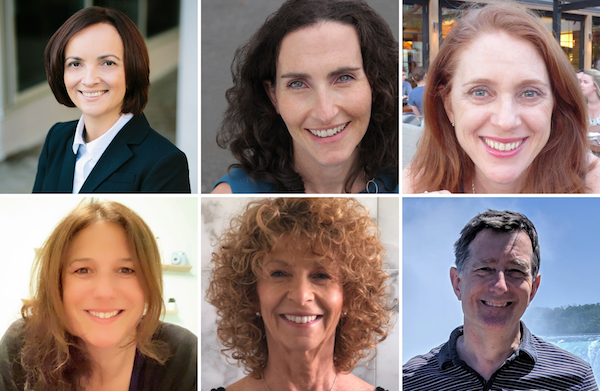
Clockwise from top left: committee members Tanja Demajo, Michelle Dodek, Michelle Gerber, Stan Shaw, Renee Katz and Simone Kallner. (photo sextet from JFS)

Jewish Family Services has formed a food security committee. This team will be responsible for leading the transition plan of the JFS’s Jewish Food Bank to its new and dedicated facility near Main and East 3rd Avenue in Vancouver. The committee, which reports to the board of directors, will be focused on supporting the Food Security program development project as a steering committee for the move into the new facility; and assisting as content advisors on an ongoing basis in the areas of food programs planning, security, building management, partnerships and community engagement, and communication.

Committee members have served on the Jewish Food Security Task Force and sit on several committees in the community. The committee co-chairs – Simone Kallner and Stan Shaw – also serve on the JFS board.

This year, a Food Security Project website will be launched to keep people apprised of the committee’s work. It will also contain upcoming town hall meetings, with the most current community stakeholder engagement and input opportunities.

* * *

Created in 1967, the Order of Canada is one of our country’s highest civilian honours. Its companions, officers and members take to heart the motto of the order, “desiderantes meliorem patriam” (“they desire a better country”). Appointments are made by the governor general on the recommendation of the Advisory Council for the Order of Canada and, on Dec. 30, it was announced that Dr. Robert Krell was among the 61 new appointees.

photo - Dr. Robert Krell
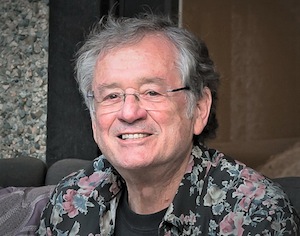
Dr. Robert Krell (photo courtesy)

Krell was appointed Member of the Order of Canada for “his contributions to our understanding of mass ethnopolitical violence, and for his advocacy on behalf of Holocaust survivors.”

A professor emeritus of the University of British Columbia, department of psychiatry, Krell’s research and interests are the psychiatric treatment of aging survivors of massive trauma; and antisemitism, racism and prejudice education.

Krell was born in Holland and survived the Holocaust in hiding. The Krell family moved to Vancouver, where he obtained an MD from UBC and eventually became professor of psychiatry. In his psychiatric practice, Krell was director of child and family psychiatry and also treated Holocaust survivors and their families, as well as Dutch survivors of Japanese concentration camps.

Krell established a Holocaust education program for high school students in 1976 and an audiovisual documentation program recording survivor testimony in 1978 and assisted with the formation of child survivor groups starting in 1982. He served on the International Advisory Council of the Hidden Child Gathering in New York in 1991, and he is founding president and board member of the Vancouver Holocaust Education Centre, which opened in 1994 and which teaches 20,000 students annually. He has authored and co-edited 10 books, 20 book chapters and more than 50 journal articles. He continues to write and speak on Holocaust-related topics.

* * *

With thanks to HaShem, Schara Tzedeck Synagogue members Alexander Hart and Kathryn Selby are honoured and delighted to announce the engagement in Jerusalem of their son Shmuel Hart to Reut Rappoport, daughter of Rabbi Jason and Meira Rappoport of Alon Shvut, Gush Etzion, Israel.

* * *

An article on the mosaic work of Lilian Broca has been published in the international peer-reviewed academic magazine Journal of Mosaic Research, out of Izmir, Turkey. It can be found at dergipark.org.tr/tr/pub/jmr (click on English version or translation if necessary), scroll down to article 18, which is “From Virtue to Power: Explorations in Female Heroism – The Mosaics of Lilian Broca,” and click on PDF on the upper lefthand side. The article was written by Angela Clarke, PhD, of the Italian Cultural Centre here in Vancouver.

* * *

Jerusalem-born, Montreal-based composer and vocalist Ayelet Rose Gottlieb released the album 13 Lunar Meditations: Summoning the Witches on Jan. 12, the first new moon of the new year.

image - 13 Lunar Meditations CD coverA collaborative project, this double-vinyl release includes poetry by more than 20 women and girls from around the globe, a choir of improvising vocalists conducted by DB Boyko, and features vocalist Jay Clayton. Through a multicultural approach, 13 Lunar Meditations is an acoustic exploration focusing on the moon, our relationship with it and its effects on us.

“The moon speaks to the universal and to the intimate female presence,” Gottlieb shared on her inspiration, from her personal journey as an artist and mother. “In this difficult time we live in, having a connection with each other, with the world around us and with the universe may be the most radical act of resilience.”

In 2015, Boyko commissioned Gottlieb to compose a new song-cycle for her VOICE OVER mind Festival in Vancouver. Gottlieb composed the first draft of this song-cycle for her own quintet and Boyko’s improvisers’ choir. Later that year, the piece was presented again at John Zorn’s the Stone, in New York City, where Clayton joined in for the first time.

Gottlieb’s song-cycle traces the phases of the moon, from birth to full glory and all the way back to emptiness. The compositions range in musical expression from wild and experimental, to melodic, rhythmic and light. All are laced with improvisation and rooted in jazz with Turkish and Armenian undertones. Primarily sung in English, also interwoven are Hebrew, German, French, Turkish, Arabic, Spanish and Japanese.

Gottlieb invited more than 20 women and girls to write texts on their personal relationship to the moon, which inspired her compositions. Ages 4 to 70, these contributors represent a global community from diverse backgrounds and nationalities – from Australia to Morocco, a poet, a gynecologist, a lawyer, an energy healer, a sex worker, a grandmother, and others.

Supported by Canada Council for the Arts and a Kickstarter campaign that concluded at 109%, the album was recorded in Montreal. On it, Gottlieb, Clayton and Boyko are joined by Coeur Luna, Turkish violinist Eylem Basaldi, guitarist Aram Bajakian, contrabassist Stéphane Diamantakiou and drummer Ivan Bamford.

The album and accompanying lunar calendar and box set of 13 postcards (with art by Sarit Evrani, designed by Dan Levi) are available for purchase at ayeletrose.com and ayelet.bandcamp.com.

For more about Gottlieb, see “A life of music-poetry” (2019) and other articles on jewishindependent.ca.

Format ImagePosted on January 29, 2021January 27, 2021Author Community members/organizationsCategories LocalTags Angela Clarke, art, Ayelet Rose Gottlieb, food security, Italian Cultural Centre, Jewish Family Services, JFS, Lilian Broca, mosaics, music, Order of Canada, Reut Rappoport, Robert Krell, Schara Tzedeck, Shmuel Hart
Jewish Housing Registry live

Jewish Housing Registry live

The Ben and Esther Dayson Residences, located west of the River District, is one of the residences managed by Tikva Housing, which is responsible for long-term housing solutions in the Jewish community, while Jewish Family Services works with those who require immediate assistance in finding a place to live. (photo from Tikva Housing)

On Dec. 2, Jewish Family Services (JFS), in partnership with Tikva Housing, announced the launch of the first-ever Jewish Housing Registry.

There are six agencies involved in the project: JFS, Tikva Housing, Vancouver Jewish Building Society, Yaffa Housing Society, Haro Park Centre Society and Maple Crest Apartments, each playing a role in addressing the issues of homelessness in the Jewish community in a variety of ways, including advocacy, financial aid and subsidies, and housing placement. Each agency has their own application processes, manages their own wait lists, and collects and stores their client data independent of one another even though their work often crosses over. Consequently, housing needs in the community are difficult to determine accurately. For applicants, a lot of time is spent completing similar applications for different housing providers.

The idea for the registry sprouted from a conversation almost 10 years ago among leaders of the Jewish community, including JFS, Jewish Federation of Greater Vancouver and spearheaded by Tikva’s executive director at the time, Susana Cogan (z’l). With the housing registry in British Columbia not set up to collect data on cultural background, and tenant selection priorities based primarily on the housing needs of applicants, a gap focused on community building was missing. The purpose of this new registry is to improve operational efficiencies and also fill that gap – addressing specific cultural needs of our community, which can be fostered within Jewish housing developments; a priority not currently being addressed through any other agencies in the province.

“It’s exciting to see the partnership between different agencies come to fruition,” said Tanja Demajo, JFS chief executive officer. “This is a unique opportunity for us to use the database as a tool to integrate data, help us meet clients’ specific needs and have a better understanding of the issues of homelessness in our community. Having an opportunity not just to house clients, but also support them by building a Jewish community, is what it means for people to ‘create a home.’”

Tikva’s director of operations and housing development, Alice Sundberg, added, “It is commonplace for applicants to register with multiple housing agencies in the Jewish community, resulting in duplicate records, leaving the JFS housing coordinator having to complete a number of similar application forms from each agency. By having this centralized database, that step only has to be completed one time. We look forward to having up-to-date information available in real-time. It will be a huge improvement administratively and will help us better meet the housing needs of applicants.”

Phase I of the registry launched on Dec. 1 for JFS and Tikva to use, and Phase II will launch shortly for Yaffa Housing, Haro Park Centre Society, Maple Crest Apartments and the Vancouver Jewish Building Society.

“We also want to acknowledge that this registry was made possible because of a grant from the Jewish Community Foundation. With their support, JFS and all the other agencies using this software will be better positioned to serve those in need in a timelier manner. Having more accurate data will also serve us in future projects related to housing advocacy and assistance,” said Demajo.

Tikva Housing is responsible for long-term housing solutions in the Jewish community, while JFS works with those who require immediate assistance in finding a place to live. JFS also provides emotional support and assistance to clients residing in buildings managed by Tikva Housing.

For more information about the registry, contact Maya Dimapilis, JFS director of development and communications, by email at [email protected] or by phone at 604-637-3306.

Format ImagePosted on December 18, 2020December 16, 2020Author JFS VancouverCategories LocalTags housing, Jewish Family Services, Jewish Housing Registry, JFS, Tikva Housing
Making safe, inclusive space

Making safe, inclusive space

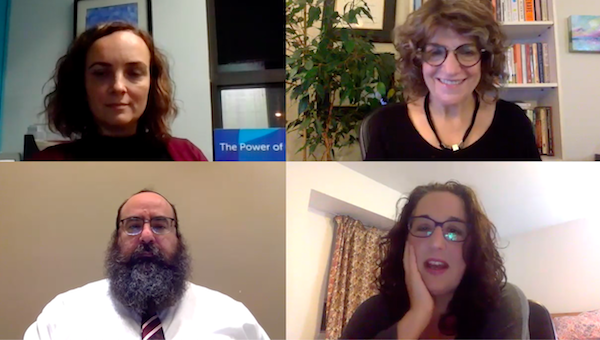
Clockwise from the top left: Tanja Demajo, Shelley Karrel, Amanda Haymond Malul and Rabbi Yechiel Baitelman participate in a JACS Vancouver panel discussion Oct. 15.

“When someone comes through the door and says, ‘I’m an addict. I’m a recovering addict,’ do they feel judged or do they feel accepted? Do they feel that we are putting them in a box, giving them a label?” asked Rabbi Yechiel Baitelman in a recent community discussion. “We have to identify the illness, there’s no question about that. But, is that the only way to view a human being? I think to respect every human being for their humanity, that’s what people are really craving – respect and love.”

Baitelman, director of Chabad Richmond, was one of three panelists on the topic Building Safe and Inclusive Spaces for Those Affected by Addiction and Mental Illness. He was joined by Tanja Demajo, chief executive officer of Jewish Family Services (JFS), and Amanda Haymond Malul, a community member in recovery, in the Oct. 15 event presented by Jewish Addiction Community Services (JACS) Vancouver. JACS Vancouver’s Shelley Karrel moderated the conversation.

Haymond Malul would like to see more community discussions on addiction and people being taught acceptance. She spoke of the need to “have support from the religious leaders of the community, from every single agency in the community, to start talking about it – make it acceptable, educate.” (See jewishindependent.ca/help-repair-the-world.)

And we need to ensure that what we are teaching is in line with our actions, said Demajo. “If we talk to children about acceptance, but we don’t actually practise that, that’s creating double standards where we talk about certain things, but that’s not what people experience,” she said. This could be damaging, she said, to people who “really need that support and want to trust.”

We must see each member of the community as a human being, said Baitelman. Love is important, but, he said, “Love is on my terms, respect is on your terms. If I love you, it’s more a reflection of who I am. But, if I respect you, it’s more of a reflection of how I see you, what you are about – and I think that’s really important. Respect the humanity. If you can love them, that’s even greater. But respect is more fundamental.”

When Karrel asked panelists for tangible ways in which people could be more accepting and inclusive, with love and respect, Demajo said agencies are overwhelmed with the number of people needing support. She said it is up to each of us to connect on a personal level with others, accepting that it will take time for them to trust us enough to share.

“You have to build a relationship, and a relationship is not built overnight,” said Demajo. “I had a client who I often think of, a person who spent a number of years [in the] Downtown Eastside being homeless, not having pretty much anything in his life…. He would come to see me … and we would speak about books, because he was a huge reader and I love reading. It took him six months until he really started talking about things that were going on in his life and what he actually needed, and we started working from there. Now, he has a regular life. He has a home. He brought his family back. He is working. So, things are in a place that he wanted … a number of years ago. Recovery is a process of being vulnerable and, so, if social services don’t have the time to invest in people, I think we are setting ourselves up for a really huge failure.”

All panelists agreed that having a drop-in centre with people who understand is absolutely essential and that, while professional support would be ideal, it is not essential. To be kind, respectful and loving, you do not need to be a professional, they said.

While there are recovery clubs in the general community, Haymond Malul said it would be great if there were also one in the Jewish community – “having a safe place for people to come and be able to drop in, and know that this is the Hillel House of Recovery,” she said.

However, having a community place might inhibit some people from coming out, due to fear of being exposed, warned Demajo. “The other piece is that I do feel that what Amanda has done tonight, speaking of her own experience and being in the community, and [talking about] some of the things that were helpful for her, is important to start with; having those opportunities to open up the conversation – not just for me, in a professional role, but from a personal place – because that is where the relationship happens. I do believe that is the core of whatever we come up with – the core is the relationship.”

Each of us is deserving of respect, regardless of our achievements, successes, failures or addictions, stressed Baitelman. “The fact that you were created by G-d makes you worthy of the highest form of respect and no judgment,” he said.

“Why would I not be involved with somebody who’s in recovery?” asked the rabbi. “After all, these people are accountable. They’re working on character development and are improving certain areas of their lives that they have the courage to acknowledge need to be corrected. They’re actively making amends with people around them. They are working on a conscious relationship with G-d rather than on other forms of success that society often judges success by. This is really an achievement.

“How many of us would like to change even one iota of our character, and people in recovery have changed more than one iota. They have made an incredible change, which is so admirable and should command respect. I think that’s part of the attitude that should be helpful in the broader community, and how we act with people, and the stigma.”

Karrel closed the discussion by giving a brief synopsis of JACS and its services. “We are working to diminish the stigma of addiction,” she told the Independent after the event. “Let’s keep this conversation going so we all feel we belong in our community.”

Rebeca Kuropatwa is a Winnipeg freelance writer.

Format ImagePosted on December 4, 2020December 2, 2020Author Rebeca KuropatwaCategories LocalTags addiction, Amanda Haymond Malul, Chabad Richmond, inclusion, JACS Vancouver, Jewish Family Services, JFS, mental health, recovery, Shelley Karrel, Tanja Demajo, Yechiel Baitelman
A shidduch like none other

A shidduch like none other

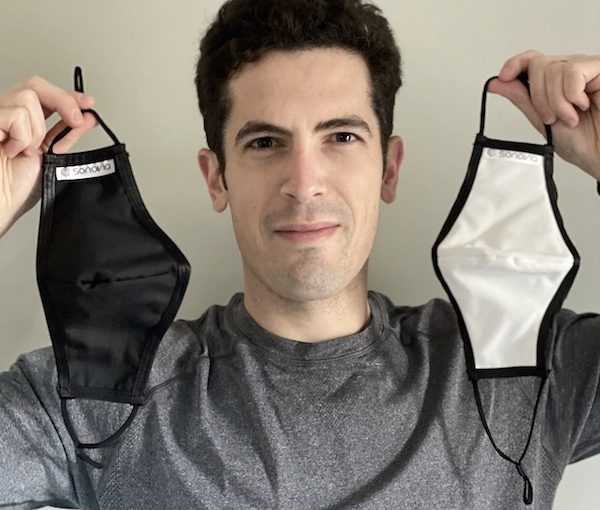
Brad Chenkis shows off a couple Sonovia masks. (photo from Tikva Housing)

It all began when Boris Chenkis, owner of After Five Fashions, was watching Israel Daily TV (ILTV) and saw an interview with Liat Goldhammer, the chief technology officer of an Israeli startup called Sonovia. She was talking about a new fabric-finishing technology for textile manufacturing developed at Bar-Ilan University, explaining that the technology could repel and kill bacteria located on clothing. Because it was in early January, a few weeks before COVID-19 became a worldwide pandemic, Chenkis just listened with interest.

On ILTV March 18, Dr. Jason Migdal, a microbiology researcher in Israel, discussed how the Sonovia technology mechanically impregnates metal nanoparticles into masks that destroy microorganisms in fabric. This was verified by two independent labs. It was also durable and washable. Now Chenkis was very interested.

With COVID becoming widespread, Sonovia had positively impacted Israeli doctors and health professionals by providing them with the technologically advanced masks. On May 12, Chenkis saw another interview about the Sonovia mask technology on ILTV – and an opportunity to get involved.

During his teenage years, Chenkis lived in Israel, studying and working at Kibbutz Rosh Hanikra. With this connection to Israel that never left his heart, he wanted to support an Israeli startup and so he purchased some masks to keep his family, friends and community safe. Soon after, he received an email from Sonovia, offering him an opportunity to help distribute the masks in Canada. Chenkis said yes. The masks were shipped from Ramat Gan to Vancouver and, within days, he was delivering hundreds to friends and family.

One of those who received the Sonovia mask was Yosef Wosk. Being both pleased and impressed with the technology, Wosk, like Chenkis, saw an opportunity to help not only the community here but also Israel. Wosk wondered how the masks could be made available locally to community members who might not be able to afford them, as they cost $65 each.

Wosk spoke with Shelley Karrel, chair of Tikva Housing, who contacted Tanja Demajo, chief executive officer of Jewish Family Services Vancouver. The need for the masks was confirmed and the shidduch almost complete.

Working with Chenkis’s son, Brad Chenkis, and with Wosk’s help, Tikva has acquired and will distribute 500 masks to residents of Tikva Housing, as well as clients of Jewish Family Services. It’s a win, win and win – tikkun olam, tzedakah and chesed.

For more information about the Sonovia masks, contact Brad Chenkis directly at [email protected].


Format ImagePosted on November 13, 2020November 11, 2020Author Tikva HousingCategories LocalTags After Five Fashions, Chenkis, coronavirus, COVID-19, health, Israel, Jewish Family Services, JFS, Shelley Karrel, Sonovia, Tanja Demajo, tikkun olam, Tikva Housing, tzedakah, Yosef Wosk
Community milestones … NCJW, JFS, Digby-Klein, Peretz, Federation, VHEC

Community milestones … NCJW, JFS, Digby-Klein, Peretz, Federation, VHEC

Newcomer to Vancouver and longtime National Council of Jewish Women of Canada member Rachel Ornoy, left, cheers the Purse Project volunteer gang on.

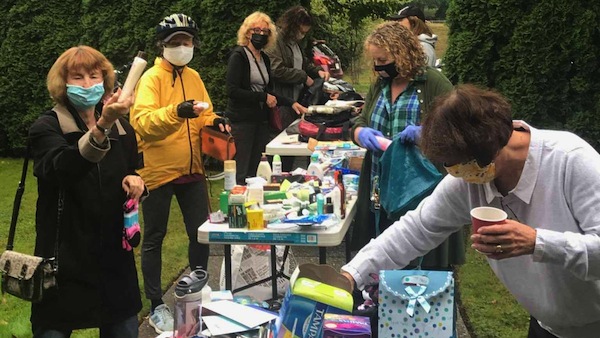
Members of National Council of Jewish Women of Canada, Vancouver section, under the guidance of Cate and Jane Stoller, stuffed purses with cosmetics, toiletries, comfort candles, chocolates, gift cards, pyjamas and other useful items on the morning of Sept. 27 for partner agency Atira Women’s Resource Society, a not-for-profit organization committed to the work of ending violence against women.

Thank you to everyone who dropped off purses, helped fill the bags and collect their contents – more than 100 purses were delivered to Atira. Also thank you to Jane Stoller for putting together the hostess table with coffee and Timbits. It was a lovely pre-Kol Nidre morning mitzvah and it was great to have a socially distant visit with our NCJWC Vancouver friends.

* * *

This year’s Project Isaiah campaign required Jewish Family Services (JFS) to change the way it looked at the traditional food drive. From Sept. 8 to Sept. 29, JFS ran its very first virtual community food drive, ending with a COVID-19-safe drive-thru drop off.

Despite the needs being greater than ever – more than double compared to last year – this year’s Project Isaiah campaign has been the most successful food drive in the past 10 years. Thanks to donors, the Jewish Food Bank will be able to feed 700 clients (up from 450 last year) over the next four to six months; recipients include 175 children and 118 elders within our community.

* * *

photo - Aaron Klein and Carolyn Digby
Aaron Klein and Carolyn Digby

Carolyn Digby and Aaron Klein were wed in a romantic ceremony, surrounded by family and friends, Nov. 9, 2019, at VanDusen Botanical Garden in Vancouver. The couple resides in Toronto, where both are pursuing studies, Carolyn in a clinical psychology counseling master’s program, and Aaron in aerospace engineering, doctorate program.

* * *

The Peretz Centre has appointed Liana Glass to lead the centre’s pnei mitzvah program. The Peretz pnei mitzvah – pnei (faces) rather than b’nei (“sons of”), to reflect a gender-neutral descriptor – is a two-year program in which students meet once every second week for two hours, culminating in a group ceremony. The next intake period is this fall.

photo - Liana Glass
Liana Glass

Glass, who has earned a master’s of community and regional planning at the University of British Columbia, has considerable experience in teaching and facilitating groups from diverse backgrounds, most recently as a research intern with Vancouver’s Social Purpose Real Estate Collaborative.

Glass’s path to secular Judaism was not a straight one. After studying Yiddish at the Vilnius Yiddish Institute’s summer program in 2017, she found that “Yiddish opened up a secular avenue for me to explore my Judaism and connect with it on a different level. It allowed me to reexamine Judaism in the larger context of my life and as part of my cultural identity. The prospect of helping pnei mitzvah students find that sense of connection through the various subjects we’ll explore in class is extremely exciting.”

“In our search, we indicated that we were looking for a candidate who is dynamic, enthusiastic and firmly committed to secular Jewish ideals and learning. Liana brings all that and so much more. We’re looking forward to working with her and seeing where she’ll be taking the program next,” said David Skulski, Peretz Centre general manager.

* * *

Jewish Federation of Greater Vancouver elected its 2020-2021 volunteer board of directors at its annual general meeting Sept. 30. New directors, elected for a two-year term, are Hodie Kahn, Shay Keil, Kyra Morris, Lisa Pullan and Stan Shaw. Each of them brings a background of community leadership and past contributions to Jewish Federation.

Kahn is currently chair of Jewish Federation’s Jewish Day School Council, whose work addresses the ongoing enrolment and financial stability needs facing the day schools; she is also a member of the Community Recovery Task Force. Keil is chair of major gifts for the Federation annual campaign and a member of the Jewish Day School Council; he is a past co-chair of men’s philanthropy. Morris is the new chair of the Axis steering committee, which oversees Federation’s programs for young adults. Pullan has lent her fundraising and leadership expertise to Federation for many years, including chairing women’s philanthropy and serving on the board in that capacity. And Shaw has held several leadership roles with Federation; he co-chaired the Food Security Task Force and is now bringing his cybersecurity expertise to the new cybersecurity and information protection subcommittee.

Returning directors elected for a two-year term are David Albert, Bruce Cohen (secretary), Alex Cristall (chair), Jessica Forman, Rick Kohn (treasurer) and Lianna Philipp. They join the following directors who are in the middle of a two-year term, and will be continuing their service on the board: Jim Crooks, Catherine Epstein, Marnie Goldberg, Candace Kwinter (vice-chair), Melanie Samuels and Pam Wolfman.

Joining or continuing to serve on the board are Sue Hector (women’s philanthropy co-chair), Karen James (immediate past chair), Jonathon Leipsic (campaign chair), Shawna Merkur (women’s philanthropy co-chair) and Diane Switzer (Jewish Community Foundation chair).

For more information, visit jewishvancouver.com.

* * *

At its Oct. 14 annual general meeting, the Vancouver Holocaust Centre Society confirmed the society’s board of directors: Rita Akselrod, Marcus Brandt, Jeremy Costin, Michelle Guez, Belinda Gutman, Helen Heacock-Rivers, Philip Levinson, Michael Lipton, Shoshana Krell Lewis, Jack Micner, Talya Nemetz-Sinchein, Ken Sanders, Joshua Sorin, Al Szajman, Robbie Waisman and Corinne Zimmerman. For more information, visit vhec.org/who-we-are/#board.

Format ImagePosted on October 30, 2020October 29, 2020Author Community members/organizationsCategories LocalTags Aaron Klein, AGM, Carolyn Digby, Jewish Federation of Greater Vancouver, Jewish Food Bank, JFS, Liana Glass, National Council of Jewish Women, NCJW, Peretz Centre, philanthropy, Project Isaiah, Purse Project, tikkun olam, Vancouver Holocaust Centre Society

Community milestones … JFS chosen for challenge, Krajden appointed OBC, Micner ordained

Following a North American call for submissions and an exhaustive selection process, Jewish Family Services (JFS) in Vancouver has been chosen by the Network of Jewish Human Service Agencies for participation in Year Two of the NJHSA Jewish Poverty Challenge, an offering of the network’s Centre for Innovation and Research. The goal of the program is to help NJHSA member agencies better analyze the marketplace, launch and manage solutions, and implement sustainable measures for success to address the many dynamics associated with responding to Jewish poverty.

NJHSA has partnered with Start Co., a venture development consultancy firm based in Memphis, Tenn., with an expertise in launching startup, entrepreneurial initiatives and engaging municipalities, corporations and nonprofits in poverty reduction responses. The team at Start Co. will provide expert consultation assistance as JFS rethinks and redesigns products and services, adjusting assumptions and organization models. Throughout, special attention will be paid to the impact of COVID-19 on service delivery methods.

“We are so honoured to have been selected to participate in this challenge,” said Tanja Demajo, JFS chief executive officer, in a press release. “The demand for our services has increased during COVID-19 and we have had to pivot quickly. Although we have adapted, we are experiencing growing pains. This opportunity through the NJHSA and with Start Co. is timely in helping us address our pain points in an innovative way so we can be more efficient and can operate at a pace our clients are demanding during this crisis.”

Reuben Rotman, president and chief executive officer of the network, added, “The COVID-19 pandemic has even further heightened the critical need for innovative solutions to the challenges of Jewish poverty. With newly vulnerable clients reaching out for assistance in unprecedented frequency, the agencies are challenged to identify new ways of working and new efforts to achieve sustainable solutions for those in need.”

For more than 80 years, JFS has delivered a continuum of social services to individuals and families of all ages and in all stages of life in the Greater Vancouver area; its pillars of support include food security, counseling and mental health, care management, financial aid and home support.

The Network of Jewish Human Service Agencies is an international membership association of more than 140 nonprofit human service agencies in the United States, Canada and Israel. Its members provide a full range of human services for the Jewish community and beyond, including healthcare, career, employment and mental health services, as well as programs for youth, families and seniors, Holocaust survivors, immigrants and refugees, persons with disabilities and caregivers.

***

photo - Dr. Mel Krajden
Dr. Mel Krajden (photo from bccdc.ca)

Dr. Mel Krajden is among those who will be appointed to the Order of British Columbia this year. The announcement of the 13 new appointments was made on BC Day, but the investiture ceremony will be postponed due to COVID-19 restrictions and held for recipients and invited guests at Government House in Victoria in 2021.

Krajden is medical director of the BC Centre for Disease Control (BCCDC) Public Health Laboratory and has made significant contributions to fields of research, including hepatitis, HIV, HPV and, most recently, COVID-19.

With the emergence of COVID-19, British Columbia and Canada needed urgent access to rapid, validated tests for the virus. Under his leadership at BCCDC, and relying heavily on his expertise, Krajden and his team were able to rapidly develop an assay for the province to commence testing in January 2020, weeks before other jurisdictions. Access to this test was an essential element in the management and control of the outbreak and the safety of British Columbians.

Krajden created the world-leading B.C. Hepatitis Testers Cohort, which integrates de-identified data on 2.4 million individuals tested for, or diagnosed with, hepatitis B, C, HIV and TB infections, linked to their corresponding healthcare administrative data since 1990, to create longitudinal medical histories. This cohort has produced influential pieces of evidence that shaped clinical and public health guidelines and policy in Canada and globally. He was instrumental in the development and continued progress of the Canadian Institutes of Health Research-funded Canadian Network on Hepatitis C, a multidisciplinary group committed to developing a national strategy for hepatitis C elimination.

Krajden was one of the key personnel in the STOP HIV initiative in British Columbia. This public health endeavour saw the implementation of acute HIV testing, allowing diagnosis during the most infectious period of the disease, resulting in timely interventions and communication to partners to reduce transmission. This undertaking helped lead to the lowest HIV incidence on a provincial scale in decades.

Krajden also played a pivotal role in global public policy changes in human papillomavirus (HPV) vaccine dosing regimen and the associated reduction of financial access barriers to care. Similarly, his work with respect to assessing the utility of HPV testing versus traditional Pap smears is expected to contribute to guidelines that will benefit women worldwide.

In his educational capacity, Krajden has the reputation of being a wonderful teacher and valued mentor, training researchers, health professionals and students at all levels. He is known for his willingness to provide input and advice despite numerous other commitments, contributing to the success of others. His dedication further extends into the clinical realm, where he always has patient interests at heart and never hesitates to devote his own time to make a difference in client outcomes.

In appointing Krajden to the Order of British Columbia, it is recognized that, over many decades, he has demonstrated exceptional innovation, leadership and sustained contributions to the province, country and the world. He is a highly respected visionary, scientist and educator who has inspired countless researchers and health professionals with his clinical excellence, dedication and generosity of spirit.

***

Rabbi Mimi Micner
Rabbi Mimi Micner

Tamara Micner, Rembrandt Koppelaar, Karen and Jack Micner and Dr. Talie Lewis are extremely proud to announce the ordination of Mimi Micner to the rabbinate. The virtual ceremony took place June 7 from Hebrew College in Boston. Mimi and Talie live in Watertown, a half-hour drive from Mimi’s new position, rab- bi at Temple Beth Torah in Holliston, Mass.

Mimi is the granddaughter of Kela (z’l) and Lito (z’l) Guincher, who are kvelling on the Richter scale above. She is also the granddaughter of Chaim (z’l) and Susie Micner, who are surely enormously proud as well.

Mazel tov, Rabbi Mimi! Bist 120!


Posted on August 28, 2020August 27, 2020Author Community members/organizationsCategories LocalTags BC Centre for Disease Control, BCCDC, coronavirus, COVID-19, food security, health, innovation, JFS, Judaism, medicine, Mel Krajden, mental health, Mimi Micner, Order of British Columbia, ordination, poverty, technology, tikkun olam

JFS uplifts with enewsletter

In the first eight weeks of Jewish Family Services Vancouver’s COVID-19 emergency response program, more than 400 calls were received, 1,500 meals and groceries were delivered, and 672 hours of service was provided on the Community Care Hotline. In addition to the challenges, JFS has also witnessed many stories of hope and gratitude, and has recently launched the enewsletter JFS Uplift, which every week will share highlights of what inspires JFS staff and volunteers to do the work they do. The lead story in the inaugural issue was on the new JFS Breakfast Club program.

On May 11, JFS staff came together to pack grocery bags full of healthy breakfast items and packets of Play-Doh as part of the club program. Fifty-eight families in several cities across Greater Vancouver received their goodies thanks to the help of volunteers.

“We realize parents are under much more stress during this time of uncertainty, especially given their added roles as teachers and ‘playmates.’ The Arnold and Anita Silber Family Foundation approached Tanja Demajo, the chief executive officer of JFS, to see where we could help. Together, we came up with the JFS Breakfast Club,” explained Arnold, Anita and Stacey Silber, sponsors of the club. “Breakfast is one of the most important meals of the day, so now healthy items are delivered to families. This is a great opportunity for us to get involved in supporting the health of young families. We hope to give parents one less thing to worry about during this difficult time.”

New families can register for the JFS Breakfast Club at jfsvancouver.ca/jfsbreakfastclub (some restrictions apply) and people who are interested in volunteering for JFS can email Kristina Moser at [email protected] or visit jfsvancouver.ca/emergencyvolunteer.

To subscribe to the JFS newsletter or for other information about JFS, visit jfsvancouver.ca.

Format ImagePosted on May 29, 2020May 28, 2020Author JFS VancouverCategories LocalTags COVID-19, families, JFS, Kristina Moser, Silber, tikkun olam

Emergency services available in community

The Jewish Federation of Greater Vancouver has released $400,000 to address the immediate needs of its local partner agencies over the next month. The funds will address needs in the key areas of food security, to increase the capacity of the food bank and other food distribution programs in our community; housing support, subsidies for community members unable to make their rent payments; seniors services, to help them stay safe, healthy and connected to community while they are self-isolating in their homes; tuition support so that families with children in Jewish day schools can keep their children enrolled; subsidies for Jewish programs, daycare, summer camps and part-time educational programs; and support so that Jewish supplementary schools can provide alternatives to classroom learning and maintain uninterrupted delivery of Judaic studies to the children and families they serve.

For more on Federation’s response to the COVID-19 crisis, as well as what other community organizations are doing at this time, visit jewishvancouver.com/covid-19-updates.

***

With the support of Jewish Federation, Jewish Family Services (JFS) has launched the JFS Community Care Hotline as an emergency response resource. It is available from 9 a.m.-9 p.m., seven days a week and staffed by JFS to provide emergency essential services. Priority services include meal or food bank grocery delivery; counseling/emotional support; and friendly phone “visiting.”

There are three ways to contact JFS for help: call 604-558-5719, email [email protected] or complete the form at jfsvancouver.ca/jfs-cares.

If you know anyone who needs to lean on JFS at this time, please share this information via your social media networks and other forms of communication. JFS also has a volunteer registration page, as many people have offered to help.


Posted on April 3, 2020April 1, 2020Author The Editorial BoardCategories LocalTags coronav, coronavirus, COVID-19, Jewish Federation, JFS
Talking helps reduce stigma

Talking helps reduce stigma

Left to right: Peggy Allen, Shelley Karrel, Shelley Rivkin, Jordan Bowman and Howard Harowitz. (photo from JACS Vancouver)

The capacity for transformation and healing was front and centre at the event Optimism and Hope: Erasing Stigma of Mental Illness, Addiction and Homelessness.

Co-sponsored by Jewish Family Services (JFS), Tikva Housing and Jewish Addiction Community Services (JACS) Vancouver, the panel discussion on Feb. 26 was held at Temple Sholom. It featured Shelley Rivkin of the Jewish Federation of Greater Vancouver, Abbotsford entrepreneur and volunteer Peggy Allen, and Jordan Bowman of Last Door treatment and recovery centre in New Westminster.

Temple Sholom’s Rabbi Dan Moskovitz welcomed those gathered by talking about the Aleinu prayer, which, he said, asks us “to go out into the world and do what we’re praying for. And so, if I can make a request of all of us, myself included, it’s to go out from this room and to do and to share what we’ve learned and what we’ve heard tonight with our families and with our broader circle. That’s our shlichut, that’s our sacred mission, beyond just coming here today to get what we need for ourselves.”

JACS Vancouver board chair Howard Harowitz briefly described the missions of each of the event sponsors before introducing the night’s speakers, beginning with Rivkin, who shared the stories of a few community members who have been impacted by the risk of homelessness. She prefaced her remarks by saying homelessness is not limited to people living on the street or who live in shelters. Rather, the growing concern in our community is “relative homelessness, the lack of suitable, consistent and predictable housing,” she said.

She also noted that “it is not a natural equation that addiction, mental health and homelessness are faced by all people” in need. “Each person has to be approached individually and uniquely,” she said, then listed six sources of support in our community: JFS, Tikva Housing, Yaffa Housing, JACS, the Kehila Society of Richmond and the community’s synagogues.

Originally from Regina, Sask., Allen has lived in Abbotsford for a long time. She lives in an area where homeless people have gathered since the Salvation Army moved into the neighbourhood in 2004. A wife and the mother of two children, the situation was very difficult initially. She shared stories of her young granddaughter witnessing people having sex and shooting up, and of being chased out of her home by a crack addict.

“I was quite a happy person and then the homeless moved in and I changed forever,” she said. “I got angrier and angrier and angrier and I ended up making, in 15 years, I made 463 calls to the police. And they came every time and did nothing, because what are they going to do?”

Allen said she became very depressed. Then, she was invited to a meeting at city hall about the homeless. She challenged attendees to come and see the extent of the problem for themselves, and two women from Fraser Health took her up on it. Over coffee, Allen shared with them her concerns and, despite her self-described antagonism to them, they invited her to speak at a meeting of the Drug War Survivors, a peer-based user group that participates in the development of harm-reduction policies, among other things.

Reluctantly, she agreed. Expecting an audience of maybe 10 drug addicts, “there were 110 of them,” she said. “I look around and I open my mouth and I just let it all out. I don’t know what happened, it was a miracle, really. I talked about my father and I talked about him beating my mother so desperately,” waking Allen’s sister, who was told to return to bed by their mother, and did. “That’s what we were raised with,” said Allen. “I had never spoken about it, and I just let it all out,” including how she was kicked out of a school in her teens for selling drugs.

After her remarks, audience members lined up, but she didn’t know why, so she started to leave. “As I’m walking out, the first guy comes up and hugs me. They were all standing there to hug me,” she said, holding back tears.

One of the men recognized Allen from secondary school. He shared with her that he was raised with such anger that he went down the path of drugs, whereas she – who his family warned him about as a teen, since she sold drugs – did not. He said to Allen, “I see now that I, too, can change my life.”

This interaction, she said, changed her life. “I went home, and I was walking up the driveway to get the mail and this crazy lady that lived on the street and was a huge drug addict and was nasty and did not like me, she came running up my driveway swearing and yelling at me with this other guy. I was so emotional, I went running at her, I don’t know what I was going to do, and I stopped. I changed my mind. I turned around and I went home. And my life changed. Everything on our street is still happening and nothing has changed much there, except me.”

Allen started giving to the homeless. She joined the city’s Business Engagement Ambassador Project, which works to build relationships between Abbotsford residents, business owners, homeless and others to strengthen the sense of community. “What I do is I speak all over the place and raise money to help them help themselves,” she said of those who are homeless.

The project is a year-and-half old and she described it as a success. One aspect in particular that is working, she said, is that the program pays homeless people to clean up area businesses and parks.

The last speaker, Bowman, now 22 years old, has been clean for just over four years. He is a youth program support worker at Last Door, the centre at which he was set on the path of recovery.

Bowman said he had a good upbringing, went to Jewish summer camp and day schools, was into sports, has lots of friends and has a great family. Having lost his mother to cancer when he was 10, he said, “That was obviously tough, but by no means do I point my finger at that and say, ‘that’s when I started using drugs.’”

He described his life as normal, living with his dad and brother. There were no indications, he said, that he would become an addict. Addiction does not discriminate, he said, and people need to know that. His family, he said, were completely surprised to find out about his drug use and were “unversed in the topic of addiction.” Luckily, he had a cousin who works as a drug and alcohol counselor and “she saved the day” when it came to him seeking help.

At age 14, Bowman started to experiment with marijuana. He couldn’t say exactly why he started using harder drugs, but perhaps he had just gotten in with the wrong crowd. He described the process as progressive. “It went from using once in awhile to using every day, to doing whatever it takes,” he said.

“I’m not going to get too much into the things I did to get to get high every day but it definitely involved a lot of stealing from the people very close to me. It didn’t matter if you would love me, if you would hate me, if you were older, if you were younger, if I had the chance, I would try and rip you off if I was with you, and that was the reality of my life.”

From age 16 to 18, he was using opiates every day, while still going to school, while still trying to cover up that he was an addict. “I wanted help, but I didn’t,” he said. “I wanted help because I knew in my mind that I could be a better person than I’m being right now but, in the other part of my mind, I was scared and I wanted to keep getting high.”

The breaking point came when he stole a significant amount of money from his brother. From that day, when his brother reacted with love rather than anger – Dec. 22, 2015 – the efforts at recovery began, with the help of his father, brother, cousin and others. There were a few false starts, a couple of detox and treatment centres, before he landed at Last Door in mid-January 2016. He has not used drugs since.

Waiting times and the cost of treatment were among the topics discussed in the question-and-answer period. Giuseppe Ganci, director of community development for Last Door Recovery Society, was in the audience. He explained some of the different levels of care, ranging from assisted living residences, for which there are minimal guidelines, to treatment centres, which will have psychiatrists and other professionals on site. The definitions of the levels differ between regions in the province, he said, making the system hard for people to understand and, therefore, access.

“The problem is,” he said, “you always hear there are not enough beds in British Columbia. That’s actually a myth. There are so many beds. Last Door runs probably at 80% capacity every day [and has] for years. We have about 100 beds and only 35 of them are funded [by government]; the rest, there’s no funding for them, so it’s a shortage of funding for treatment, it’s not a shortage of beds.” This means that people who can afford it are able to get treatment within 24 hours, rather than join the queue of six to eight weeks or longer, he said.

After a couple more questions, Harowitz wrapped up the event. Addiction is not a choice, he stressed, citing JACS speaker Steve Whiteside. “It’s not a weakness of character, it’s not anything other than any other kind of disease that people have,” he said, challenging the audience “to keep the conversation going.”

Format ImagePosted on March 13, 2020March 12, 2020Author Cynthia RamsayCategories LocalTags addiction, homelessness, JACS Vancouver, JFS, Jordan Bowman, Peggy Allen, recovery, Shelley Rivkin, Tikva Housing

Posts pagination

Previous page Page 1 … Page 3 Page 4 Page 5 Page 6 Next page
Proudly powered by WordPress