JSA AGM honours volunteers

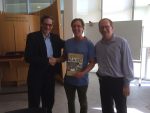
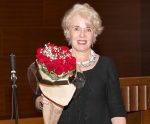
Karon Shear was one of the volunteers honoured at the Jewish Seniors Alliance AGM on Sept. 14. (photo by Alan Katowitz courtesy of Jewish Seniors Alliance)

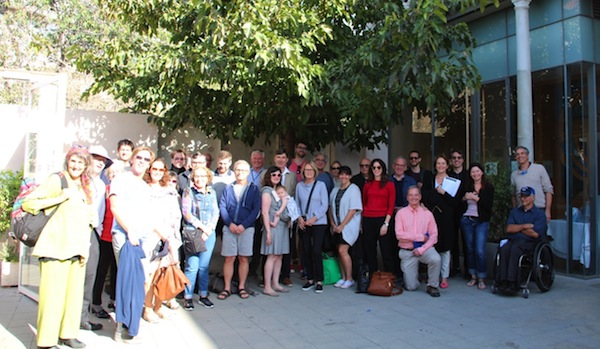
The annual meeting of the Jewish Seniors Alliance was held on Sept. 14 at Congregation Beth Israel. The business meeting was followed by a dinner and awards ceremony.

The business portion of the evening was called to order by JSA president Ken Levitt. Prior to the presentation of committee reports, a number of organizations offered greetings. A d’var Torah was delivered by Beth Israel’s Rabbi Jonathan Infeld, who emphasized that, according to Jewish law, we are not to cast aside seniors as they are at the heart of the community. And both Ezra Shanken, chief executive officer of the Jewish Federation of Greater Vancouver, and Gudrun Langolf, acting president of the B.C. Council of Senior Citizen Organizations (COSCO), also said a few words.

Following the approval of the agenda and the minutes of last year’s AGM, Larry Meyer delivered the treasurer’s report. He outlined the various funding sources of JSA – government, corporate and private grants, as well as the $18 annual fee from members/supporters. He also listed the programs this money supports, such as peer counseling, Senior Line magazine, the fall symposium, the spring forum and the Empowerment Series, as well as the website, jsalliance.org.

Pamela Ottem, chair of the Peer Support Program, outlined the various aspects of the service. Peer counselors are required to take 55 hours of training prior to being assigned a client. They are given ongoing support in their work by Grace Hann, who is also the trainer, and Charles Leibovitch, who is a social worker. It takes 15 hours of training to become a Friendly Visitor. These volunteers visit shut-ins and lonely seniors; another part of the program is friendly phone calls and service information and referral. The peer support program has 56 trained volunteers serving 70 seniors.

The JSA’s Ambassador Program, whose goal is to raise awareness of elder abuse, started with a one-year grant and has been incorporated into the other offerings. Hann, Leibovitch and some of the volunteers make presentations to other seniors groups about their activities.

Binny Goldman reported that JSA has 596 members/supporters, of whom 320 are individual members, 150 are members of the Most Russian Bridge group and 21 are from affiliate organizations.
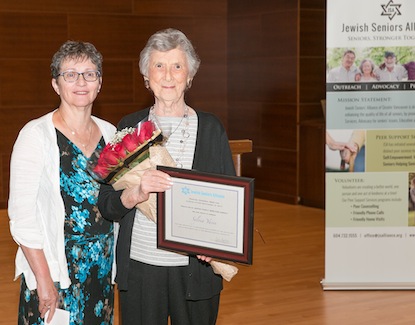
photo - Debbie Rozenberg, left, and Sylvia Yasin
Debbie Rozenberg, left, and Sylvia Yasin. (photo by Alan Katowitz courtesy of JSA)

In Levitt’s president’s report, he briefly reviewed the activities of the JSA, emphasizing that the organization would not exist if it were not for the active involvement of its volunteers. He pointed out that the peer support program alone, if it were carried out by paid staff, would cost much more than JSA’s total budget. He thanked everyone, both staff and volunteers, who have worked so hard and contributed so much over the past year.

Marilyn Berger presented the report of the nominations committee. She read out the slate for the coming year and moved for acceptance. Two former board members were mentioned, Edith Shier, who has passed away and was the previous editor of Senior Line, and Milton Adelman, who has retired from the board but was for many years the treasurer of JSA. Levitt then called for the adjournment of the business part of the evening and everyone was invited to move to the tables for dinner, volunteer recognition and musical entertainment.

Jazz singer Jill Samycia entertained the approximately 150 dinner guests, after which came the awards presentations to volunteers. As has become JSA’s custom, several organizations were asked to nominate senior volunteers who have spent time and energy enhancing the goals of their organizations.

Karon Shear, who was coordinator and administrator of JSA from 2005-16, was nominated by JSA. Her service to seniors, and enthusiastic marketing, played a vital role in the development and growth of the organization. In presenting her with the award, Serge Haber described her as the heart and soul of JSA. He spoke of the countless hours she spent, off the clock, on weekends, working at home; how she produced the Senior Line magazine basically on her own for a time.
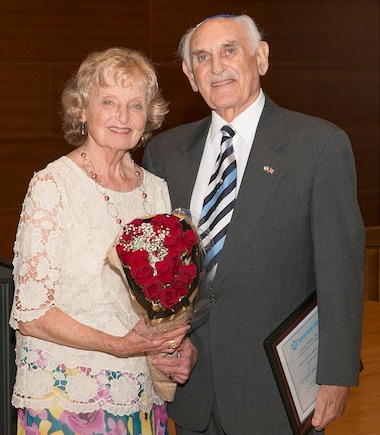
photo - Nassa and Arnold Selwyn
Nassa and Arnold Selwyn. (photo by Alan Katowitz courtesy of JSA)

Sylvia Yasin was nominated by the Jewish Family Service Agency. Yasin has volunteered for many years with the Jewish Food Bank and was instrumental in creating relationships with various groups and individuals and obtaining ongoing donations of supplies for school-aged children. She was presented with her award by Debbie Rozenberg, who noted that Yasin began volunteering while still working full time. Yasin has been involved with the Terry Fox Run and with ORT. Among other things, she organized the gift wrapping in shopping malls that raised funds for ORT. She also helps set up and clear for the seniors lunches at the Kehila Society and is still involved with the Jewish Food Bank.

Nassa and Arnold Selwyn were nominated as a couple for their longtime volunteerism at Congregation Beth Israel. Infeld talked about Arnold’s singing for the congregation and Nassa’s beautiful sewing of the parochet (ark curtain) and the siddur covers. Together they bring holiness into the world, said the rabbi. Both of them act as greeters and have been part of many other committees. They are also active in the general community and are part of Showtime, an entertainment group of seniors.

All of the honourees expressed their thanks and appreciation to JSA and the nominating organizations. The message to all was, volunteer whenever you can and wherever you can – it will bring you feelings of fulfilment and joy.

Samycia performed again, during dessert, and a number of the guests got up and danced to the music. The evening ended with a draw for door prizes.

Barbara Bronstein and Larry Shapiro were co-chairs of the event.

Tamara Frankel is a member of the board of Jewish Seniors Alliance. Shanie Levin, MSW, worked for many years in the field of child welfare. During that time, she was active in the union. As well, she participated in amateur dramatics. She has served on the board of the Jewish Federation of Greater Vancouver and is presently on the executive of JSA and a member of the editorial committee.

Housing, high-tech, musicals and more – this week in the community

Tikva welcomes residents: The Storeys Complex in Richmond. (photo from facebook.com/tikvahousing)

We are taught from an early age that giving, repairing the world and being kind are the tenets of living a Jewish life. In our community we don’t have to look very far to find people who fit this description. One of the latest projects that has come to fruition is the Diamond Residences in the Storeys complex in Richmond. Thanks to the generosity of the Diamond Foundation, Tikva Housing Society now owns 18 (chai!) units that are being rented at below-market rates to people in the community for whom stable, safe housing was unpredictable and unaffordable, at best.

Tikva Housing partnered with four nonprofit societies and the City of Richmond to build these and other apartments. Tikva worked hand in hand with community agencies such as the Jewish Family Service Agency to place tenants in need in these units, as well as with the Jewish Federation of Greater Vancouver and B.C. Housing. Most of the tenants will have moved into their units by the end of this month.

The Diamond Residences will house six singles and, of those, five are seniors. Also, 12 families and a total of 22 children will be living there. One 83-year-old woman cried when she was told she would be moving into a studio unit, as she has not had a place to live for years and was sleeping on someone’s couch. A single Israeli mother with two children is moving into a three-bedroom unit; her kids have never had their own rooms. Another single mother with three children has been sharing a two-bedroom place and has not had her own room in two years. One family has moved to Greater Vancouver from out of town and can now attend Shabbat services, be close to their family and the Jewish community. There are many more such stories.

 – Courtesy of Tikva Housing Society

* * *

Simon Fraser University recognized four distinguished alumni on Sept. 13 at Four Seasons Hotel. Among them was Gary Cristall, co-creator of the Vancouver Folk Festival.

The annual awards, presented by SFU and the Alumni Association, recognize those whose accomplishments and contributions reflect the university’s mandate of engaging the world. An advocate for the arts and human rights, Cristall has been a cultural groundbreaker, having co-founded the Vancouver Folk Music Festival in 1978. In an industry plagued with an unscrupulous reputation, Cristall has been instrumental in fighting for the rights of artists to be treated professionally and with respect while also defending their rights to fair performance fees and copyright ownership.

Cristall served as acting head of the music section of the Canada Council for the Arts and was the founding president of the Public Service Alliance of Canada, the first union at the Canada Council. Today, Cristall continues to serve as a prominent mentor and educator, assisting artists in building their careers and guiding communities in enhancing dynamic cultural interactions that enrich and benefit a healthy, democratic society.

* * *

After a grueling 33 hours of programming, DragonFruit – Benjamin Segall, Jacy Mark, Viniel Kumar and Pritpal Chauhan – completed StoryTree and demonstrated it live to a panel of judges at Hack the North, an international student hackathon held at the University of Waterloo in Ontario, which this year took place Sept. 15-17.

Canada’s biggest hackathon, Hack the North was founded and is organized by Techyon, a student-run nonprofit organization, in partnership with Waterloo Engineering. The event brings together 1,000 students from top universities across 22 countries in the world. Students collaborate and create impactful new hardware projects or mobile and web applications of their own design for a weekend at the University of Waterloo, all expenses paid.

DragonFruit’s StoryTree was one of the 14 projects chosen out of the more than 250 demonstrated at Hack the North. StoryTree is an online workspace for aspiring authors to collaborate on books together. All you have to do is write a paragraph or a chapter, or even just a sentence, and, as more and more people add or branch off from a story, that story you’ve always wanted to write becomes a reality.

DragonFruit will be continuing the project and are looking for alpha testers for January 2018. If anyone is interested in being a part of this project or for more information on it, contact them via facebook.com/dragonfruitcode or dragonfruitcode.com.

* * *

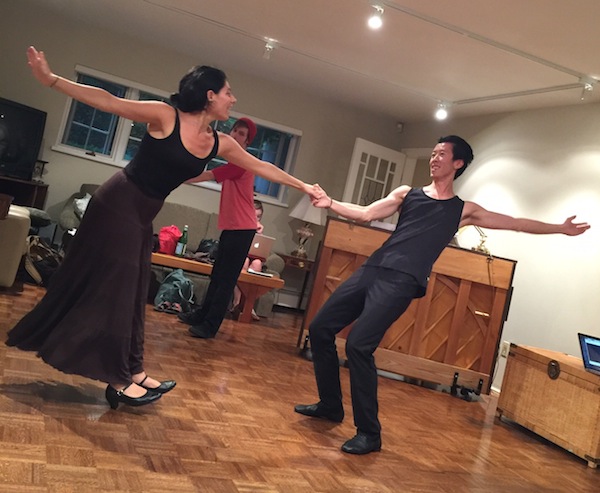
photo - Swinging Sylvia rehearsals: Advah Soudack and Sky Kao create a whirlwind of action in rehearsal of the second one-act play that comprises Two Views from the Sylvia
Swinging Sylvia rehearsals: Advah Soudack and Sky Kao create a whirlwind of action in rehearsal of the second one-act play that comprises Two Views from the Sylvia. (photo by Sue Cohene)

 Rehearsals have started for Two Views from the Sylvia, a new musical theatre production by Kol Halev Performance Society. This original production – which will be at Waterfront Theatre Nov. 8-12 – tells the story of the iconic Sylvia Hotel and its historic connection to the local Jewish community and the city of Vancouver.

Two Views from the Sylvia comprises two one-act plays.

The first play, Sylvia’s Hotel, is set in Vancouver in 1912. It brings to life the origin of the Sylvia Hotel, named for Sylvia Goldstein (Ablowitz) and the story of the Goldstein family who built it. Young Sylvia Goldstein and the legendary Joe Fortes, the beloved English Bay lifeguard, develop a bond that helps Sylvia realize her dreams.

In the second play, The Hotel Sylvia, the story continues as we meet the characters whose lives and loves became interwoven with the story of the Sylvia over her 100-year history. It includes vignettes revealed to the production’s researchers by Huguette, the front desk clerk who worked at the Sylvia for 35 years.

Jewish community members play key roles in both plays. In the lead roles are Advah Soudack (as Sylvia) and Adam Abrams (as Abraham Goldstein); Anna-Mae Wiesenthal and Joyce Gordon are cast in important supporting roles. Behind the scenes are Sue Cohene (producer) and Heather Martin (associate producer), as well as Gordon (assistant producer) and Abrams (graphic designer and webmaster) and Gwen Epstein (production team). Marcy Babins and Michael Schwartz collaborate in their roles at the Jewish Museum and Archives of British Columbia, which has created an historical photo display to accompany the production.

Two Views from the Sylvia is a project of Kol Halev in partnership with the B.C. Arts Council, Government of British Columbia, City of Vancouver, Granville Island Cultural Society, CMHC Granville Island and the JMABC. For information and tickets ($28), visit sylviamusical.com.

– Courtesy of Kol Halev

 * * *

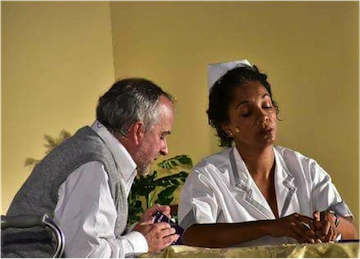
Bema Productions’ Victoria Fringe Festival play Horowitz and Mrs. Washington was a great success. All seven performances at Bema’s Black Box Theatre at Congregation Emanu-El were sold out and the production company’s work was once again as one of the best dramas in the Victoria Fringe.

photo - Bema Productions’ Victoria Fringe Festival play Horowitz and Mrs. Washington was a great success
Bema Productions’ Victoria Fringe Festival play Horowitz and Mrs. Washington was a great success.  (photo from Bema)

Mrs. Washington is hired to nurse Sam Horowitz, who’s been mugged and had a stroke. She’s a determined tyrant and he’s a bigoted Jewish widower. The two must find a mutually beneficial relationship when his daughter tries to make him leave his home. The play by Henry Denker reflects the attitudes of the 1970s and illuminates the power to be found in ordinary lives.

“The electric performance of the actors enabled the audience to visit uninhibitedly the issues of racism, stroke recovery and aging in place,” reads the review “Bravo Bema!” on Emanu-El’s website.

“For the most part,” said the review, “the actors were provided with a very humorous script that relied on stereotyping but went beyond it for its punchlines. The audience was asked to stretch their imaginations – who would have considered invoking Michelangelo to explain why the naming of a grandson ‘Douglas’ instead of ‘David’ was inappropriate? There were a few moments when the pace flagged but very few.”

While the play “revealed little about the face of contemporary racism,” the “potential disempowering of aging adults by their loving offspring is an issue of contemporary concern.”

The Bema production was directed by Zelda Dean and Angela Henry and was performed by David Macpherson, Rosemary Jeffery, Christine Upright, Alf Small, Cole Deo and Graham Croft.

– Courtesy of Bema Productions

 * * *

photo - Miki Mochkin teaches a class on baking challah
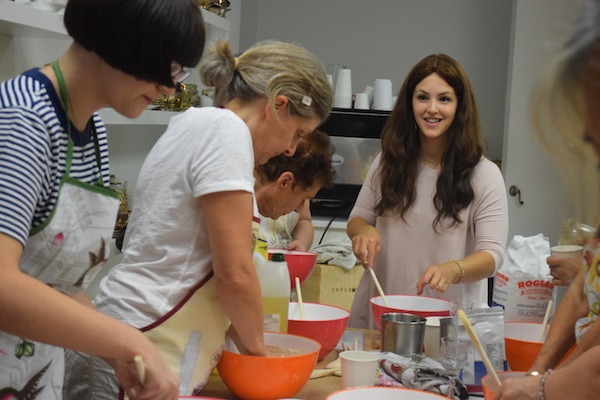
Miki Mochkin teaches a class on baking challah. (photo by Shula Klinger)

Chabad North Shore hosted a challah bake at Mia Claman’s store in West Vancouver on the night of Sept. 6. Miki Mochkin taught a class on baking challah to local women. While the bread was rising, she explained the significance of each ingredient for Jewish women. From the sweetness of the honey to the harshness of the salt, every element serves to remind the baker of its symbolic role in our lives as women and mothers.

– Courtesy of Shula Klinger

* * *

photo - Panelists at Congregation Beth Israel discuss the topic Our Leaders: Are They Above the Law?
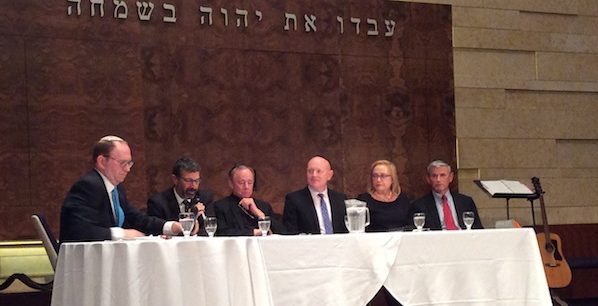
Panelists at Congregation Beth Israel discuss the topic Our Leaders: Are They Above the Law? (photo by Cynthia Ramsay)

In the photo, left to right, are Congregation Beth Israel Rabbi Jonathan Infeld, King David High School head of school Russ Klein, Vancouver Catholic Diocese Archbishop Michael Miller, Vancouver Police Chief Constable Adam Palmer, B.C. Court of Appeal Justice Sunni Stromberg-Stein and MLA Andrew Wilkinson. On Saturday night, Sept. 16, at the synagogue, this panel of speakers took on the topic Our Leaders: Are They Above the Law? Infeld framed the contemporary discussion around a talmudic discussion regarding an important rabbi in a community, rumours surrounding his conduct and whether the rabbi should be excommunicated. The panelists took this starting point to talk about their own professions, present-day accountability standards and various other issues.

– Courtesy of Cynthia Ramsay


Mystery photo … Sept. 29/17

Beth Israel National Confab (clergy), 1975. (photo from JWB fonds, JMABC L.09862)

If you know someone in this photo, please help the JI fill the gaps of its predecessor’s (the Jewish Western Bulletin’s) collection at the Jewish Museum and Archives of B.C. by contacting archives@jewishmuseum.ca or 604-257-5199. To find out who has been identified in the photos, visit jewishmuseum.ca/blog.

Mystery photo … July 21/17

Beth Israel Sisterhood panel, 1977. (photo from JWB fonds; JMABC L.09864)

If you know someone in this photo, please help the JI fill the gaps of its predecessor’s (the Jewish Western Bulletin’s) collection at the Jewish Museum and Archives of B.C. by contacting archives@jewishmuseum.ca or 604-257-5199. To find out who has been identified in the photos, visit jewishmuseum.ca/blog.

Mystery photo … June 30/17

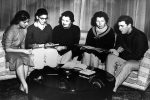
Beth Israel group reading, 1965. (photo from JWB fonds, JMABC L.09870)

If you know someone in this photo, please help the JI fill the gaps of its predecessor’s (the Jewish Western Bulletin’s) collection at the Jewish Museum and Archives of B.C. by contacting archives@jewishmuseum.ca or 604-257-5199. To find out who has been identified in the photos, visit jewishmuseum.ca/blog.

Mystery photo … May 26/17

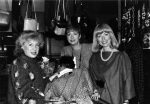
Beth Israel Sisterhood luncheon, 1983. (photo from JWB fonds, JMABC L.09853)

If you know someone in this photo, please help the JI fill the gaps of its predecessor’s (the Jewish Western Bulletin’s) collection at the Jewish Museum and Archives of B.C. by contacting archives@jewishmuseum.ca or 604-257-5199. To find out who has been identified in the photos, visit jewishmuseum.ca/blog.

Treating intergenerational trauma

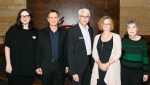
Left to right: Nina Krieger (Vancouver Holocaust Education Centre), speaker Mark Wolynn, Richard Fruchter (Jewish Family Service Agency), Nicky Fried (Congregation Beth Israel) and Shanie Levin (Jewish Seniors Alliance of Greater Vancouver). (photo by Rhonda Dent Photography)

On Feb. 15, Mark Wolynn, director of the Family Constellation Institute, spoke to an audience of almost 1,000 people at Congregation Beth Israel on the topic Understanding Intergenerational Trauma: How Inherited Family Trauma Shapes Who We Are and How to End the Cycle. The crowd sat in rapt silence as he unfolded his own story and the stories of some of the people his therapeutic approach has helped.

Introduced by Rabbi Adam Stein, assistant rabbi at Beth Israel, and Richard Fruchter, chief executive officer of the Jewish Family Service Agency, Wolynn quipped upon taking the stage, “The last time I stood at a synagogue pulpit was at my bar mitzvah.”

Wolynn said his work on intergenerational trauma has particular relevance for those who have survived genocide and war, such as First Nations people, refugees and Jews. His efforts to understand the effects of trauma began when, as a young man, he found himself going blind. He had “the bad kind of central serous retinopathy,” he said, “the five percent kind where it can lead to becoming legally blind.”

Plagued by grey blotches and blurs distorting his vision, Wolynn said he was terrified. He tried a litany of alternative medical cures, which didn’t help, and headed off on a quest for enlightenment.

After marathon meditation sessions and audiences with several gurus, Wolynn said he waited for hours for a satsang (sacred meeting) with a swami in Indonesia. When he finally made it to the front of the line, the guru looked at him for a moment and said, “Go home and make peace with your parents.” It wasn’t until he heard the same message from the next guru he visited that Wolynn returned home to begin his journey into healing his relationships with his family.

Years later, after making both personal and scientific study of the impact of family dynamics and inherited trauma (and healing his blindness), Wolynn has emerged with a persuasive vision of the role that unaddressed trauma can have in our lives – even if the trauma happened in previous generations, and even if you didn’t know about it. “Many of us spend our whole lives believing we are the source of our own suffering when we are not,” he said.

Wolynn presents his findings in terms of epigenetics, the study of how life experience can turn on or off certain genes. He points to findings in both humans and animals showing that the children of traumatized parents react with stress, fear or aversion to stimulus that traumatized their parents, even if the children themselves have no previous negative exposure to the trigger. “We think the effects – the alteration in the genes – may last for three generations,” he said.

Wolynn described several case studies in which patients had symptoms that could be addressed only after patients understood their source in something that had been done to (or by) a mother or grandfather. Wolynn challenged the audience to ask themselves what their greatest fear was and to put it into words, explaining that this was a clue to their “trauma language,” which could, in turn, be used “like breadcrumbs” to lead them back to the unrecognized traumas in their past.

Wolynn laid out a series of steps for uncovering intergenerational traumas and healing the brain. He also shared stories of his use of visualization, ritual and family communication to free both adults and children from chains they didn’t fasten themselves.

Alan Stamp, clinical director of counseling at JFSA, a co-sponsoring agency of Wolynn’s talk, told the Independent, “What Mark is doing is putting a new spin on how to get to the heart of it and resolve the difficulty. The past is alive in the present.”

Stamp said he knows of two people who attended a follow-up training session offered by Wolynn in Vancouver after the public lecture, and who have had success applying Wolynn’s method clinically; one of them being a counselor at JFSA. “It works,” said Stamp.

JFSA offers counseling for a wide variety of issues, and Stamp is hoping that attendees at Wolynn’s talk will be inspired to pursue healing, through JFSA or elsewhere.

JFSA, the Jewish Seniors Alliance of Greater Vancouver, Congregation Beth Israel and the Vancouver Holocaust Education Centre partnered to bring Wolynn to Vancouver, and the talk was additionally sponsored by the Lutsky families and Rabbi Rokie Bernstein. Banyen Books hosted Wolynn the day after his talk at the synagogue.

Matthew Gindin is a freelance journalist, writer and lecturer. He writes regularly for the Forward and All That Is Interesting, and has been published in Religion Dispatches, Situate Magazine, Tikkun and elsewhere. He can be found on Medium and Twitter.

Mystery photo … Jan. 20/17

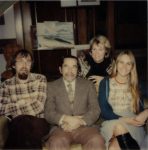
Beth Israel celebrations, 1971. (photo from JWB fonds, JMABC L.09840)

If you know someone in this photo, please help the JI fill the gaps of its predecessor’s (the Jewish Western Bulletin’s) collection at the Jewish Museum and Archives of B.C. by contacting archives@jewishmuseum.ca or 604-257-5199. To find out who has been identified in the photos, visit jewishmuseum.ca/blog.

Seminar on law and justice

Congregation Beth Israel Rabbi Jonathan Infeld, right, and Howard Mickelson, QC, receive the Schechter Haggadah from the president of the Schechter Institute, Prof. David Golinkin, at the Schechter Institute of Jewish Studies in Jerusalem. (photo by Linda Price)

A group of 20 lawyers and judges from Canada visited Israel for a five-day Law and Justice seminar at the Schechter Institute of Jewish Studies in Jerusalem. Meeting with some of their Israeli counterparts, participants immersed themselves in the topics of Maintaining Security, Rule of Law, Democracy and the Jewish Way of Life.

Mission delegates participated in a reception at the Rooftop Restaurant, Mamilla Hotel, followed by a talk by the Hon. Justice Dalia Dorner, former Israeli Supreme Court justice. Mission delegates, several of whom are not Jewish, heard Dorner’s explanation of the special character of Israel, which is both a Jewish and democratic state. She said, “Israel must unite both of these values. Indeed, certain Jewish values are very compatible with democracy. Furthermore, the founding fathers of Israel chose freedom, justice and peace as the basic values upon which the state is founded, and no one can change this.”

The next day, the jurists met with Justice Elyakim Rubinstein, vice-president of Israel’s Supreme Court and former attorney general. They also toured the award-winning building. Rubinstein explained the uniqueness of Israel’s Supreme Court and how it differs from those of other Western countries. He also discussed topical issues such as the appointment of Supreme Court justices and the proposed Regulation Law.

Afterwards, delegates traveled to the Ministry of Justice in East Jerusalem and met with Israel State Attorney Shai Nitzan, who spoke about the difficulties of safeguarding human rights during times of war and insecurity.

photo - Members of the group at the Neve Schechter in Tel Aviv
Members of the group at the Neve Schechter in Tel Aviv. (photo by Linda Price)

On the Thursday, Ambassador Efraim Halevy, the ninth director of Mossad, who was born in England, gave a talk on the interrelationship between Israel, the United States and Russia, and each country’s interest in the Middle East. Halevy said, “Israel cannot be destroyed” and that “Iran never was and cannot be an existential threat to the state of Israel. There is no state or entity that represents an existential threat to the state of Israel.”

On Friday afternoon, delegates visited the Neve Schechter Centre for Jewish Culture in Neve Zedek, Tel Aviv, and heard several lectures. Prof. Gideon Sapir from the faculty of law, Bar-Ilan University, and a candidate for the position of Supreme Court justice, gave a lecture explaining the issues of Israel’s “blue laws.” He noted the quandary of employing workers on the Sabbath in Israel and creative legal solutions to this dilemma, which counterbalances two values: one Jewish – the right to a day of rest; and the other democratic – the basic right to freedom of employment.

The mission was the initiative of Rabbi Jonathan Infeld of Vancouver’s Congregation Beth Israel and one of his congregants, attorney Howard A. Mickelson, QC. A group of Jewish and non-Jewish lawyers meets regularly in Vancouver, in a Law and Learn program for lawyers that deals with contemporary issues in civil law, bringing in guest lecturers. A Jewish law component is added to each session by Infeld.

Because of Infeld’s long-term connection to the Schechter Institute of Jewish Studies, Schechter was chosen to lead the mission and to implement the study program. The mission’s goal was to enable a group of Canadian leaders to study, up close, the social, military and political issues facing Israel as a democratic and Jewish state, both from a general legal and a specific Jewish legal/religious standpoint.

Mystery photo … Sept. 30/16

[Chant Torah?] at Beth Israel Synagogue, 1979. (photo from JWB fonds, JMABC L.09865)

If you know someone in this photo, please help the JI fill the gaps of its predecessor’s (the Jewish Western Bulletin’s) collection at the Jewish Museum and Archives of B.C. by contacting archives@jewishmuseum.ca or 604-257-5199. To find out who has been identified in the photos, visit jewishmuseum.ca/blog.