Remembering Muizenberg

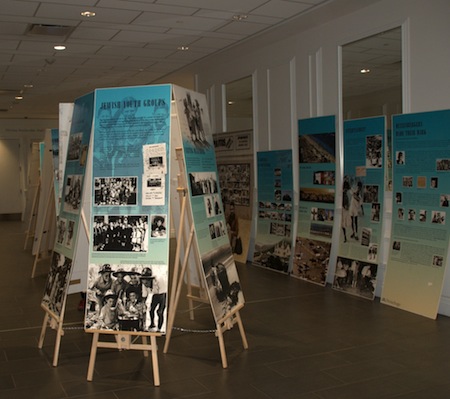
Muizenberg, South Africa, was a hub for Jewish families from the 1900s onward. (photo from Stephen Rom)

For Vancouverites who hail from South Africa, the name Muizenberg carries significant resonance. The small seaside town was a hub for Jewish families from the 1900s onward, a place where children played on the long stretch of white-sand beach, young people fell in love, business deals were discussed, family relationships deepened and friendships nourished. So, when the Memories of Muizenberg exhibit opens for its 15-day span at Congregation Beth Israel on July 10, there’s an excellent chance of hearing South African accents in the voices of attendees.

The exhibit was created in 2009, when it debuted in Cape Town, chronicling the Jewish presence in Muizenberg between 1900 and the early 1960s. After that, it began a whirlwind tour to Johannesburg, London, Israel, Perth, Sydney, Melbourne, Toronto and San Diego before it finally landed in Vancouver. For each of its moves a former South African Jew adopted the exhibition, gathering fundraisers, assistants and exhibit spaces in their respective cities. In Vancouver, that man is Stephen Rom, originally from Cape Town, who immigrated to Canada in 1986 and moved to Vancouver in 1992.

“I’m just a shlepper that was interested in the exhibit,” he said with a laugh. “When a friend told me the exhibit was in San Diego, I thought we needed to get it trucked up to Vancouver. I think it’s important to keep Memories of Muizenberg circulated – a hell of a lot of research went into it and it’s beautifully put together.”

photo - The exhibit opening in Toronto. Created in 2009, Memories of Muizenberg debuted in Cape Town and has been to Johannesburg, London, Israel, Perth, Sydney, Melbourne, Toronto, San Diego and, now, Vancouver
The exhibit opening in Toronto. Created in 2009, Memories of Muizenberg debuted in Cape Town and has been to Johannesburg, London, Israel, Perth, Sydney, Melbourne, Toronto, San Diego and, now, Vancouver.

Rom arranged for the crate containing the 40-panel exhibit to be stored in the warehouse of fellow former South African Lexie Bernstein, and solicited donors to cover the costs associated with transportation and opening night festivities. Muizenberg has a special place in his heart and memories, he confided.

“It was a place my family and extended family spent every Sunday – you loaded the car, took the food and you didn’t need to look for friends – they were always there,” he reflected. “No one phoned to say, are you going to Muizenberg? You just knew, everyone in your community was going to be there. You’d go swimming, get attacked by bluebottles, get knocked over and soaked by a wave from the creeping high tide, have the wind blowing in your hair and eat homemade rusks (cookies) mixed with sand. It was part of our DNA.”

Bernstein, who moved from Cape Town to Vancouver in 1987, recalls catching the train with his friends in the summer months to get to Muizenberg. “When the train pulled into the station, the conductor would shout out ‘Jerusalem!’” he said. “I think ex-South Africans in Vancouver will love this exhibition, and other Jews in the community will be fascinated about where we come from.”

Rom’s only regret about the exhibit is that it ends in 1962 instead of continuing. He’s asking former South Africans in Vancouver to email photographs that pertain to their history in Muizenberg and that might be shown as a slide show at the exhibit’s opening night, July 10, 7 p.m. To submit your memories, email Rom at srom@shaw.ca.

Lauren Kramer, an award-winning writer and editor, lives in Richmond. To read her work online, visit laurenkramer.net.


Hundreds scribe new Torah

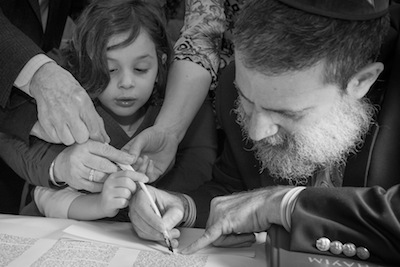
Nomi Fenson, left, and Debby Fenson help complete Congregation Beth Israel’s new sefer Torah with sofer Rabbi Moshe Druin. (Adele Lewin Photography)

Hundreds of people participated in a moving mitzvah over two recent weekends at Congregation Beth Israel. The congregation, still kvelling over its architecturally lauded new building, celebrated the arrival of a new Torah scroll, which was completed by members of the congregation with the help of a sofer, a Torah scribe.

It is one of the 613 mitzvot for each individual to scribe a Torah scroll: “And now, write for yourselves this song, and teach it to the Children of Israel. Place it into their mouths, in order that this song will be for Me as a witness for the Children of Israel.” (Deuteronomy 31:19)

The new sefer Torah was scribed in Israel, with the final 100 letters to be completed. A lottery was originally planned by the congregation to allocate the honor of scribing a letter, but a compromise was found to give the opportunity to everyone who wanted to participate.

“We asked if people would mind partnering with other families,” said Beth Israel’s Rabbi Jonathan Infeld. “And, despite the fact that we had 150 families or individuals who asked to participate, we had enough people who said they were willing to partner that everyone who asked to participate was able to do so.” In the end, about 600 people had a part in the process.

photo - Alexis with Rabbi Moshe Druin
Alexis with Rabbi Moshe Druin. (Adele Lewin Photography)

Participants had the opportunity to scribe with the guidance of Rabbi Moshe Druin, one of several “traveling sofrim” associated with a Florida-based enterprise called Sofer On Site, which facilitates events just like the one Beth Israel chose to undertake. Druin also helped complete a Torah scroll for Temple Sholom last year.

Each participant at Beth Israel proceeded through a variety of meaningful activity stations leading up to the scribing. Led by a volunteer guide, participants learned from teachers on a subject from the Torah. They then proceeded to a different area where they could decorate the new Torah binder, write a wish for the wishing tree, listen to storytelling or peruse the book corner. After handwashing, they prepared for the scribing, which they did with Druin. The sofer shared a teaching on the significance of each Hebrew letter and he filled in the letter as participants placed their hands on his hand or on the quill.

“The joy was palpable,” Infeld said of the event, which went all day Friday, Feb. 19, until Shabbat, then continued on Saturday night after Havdalah and again on Sunday. “The feeling of community was extremely strong.… Some people said this was one of the most meaningful experiences of their life and it was fantastic to see families of multiple generations participating in the activity.”

“It really is a once-in-a-lifetime experience,” said Audrey Moss, a congregation member who served as project chair for the Torah scribing and dedication. “The whole idea was that [participants] go through a spiritual journey. You prepare yourself spiritually and mentally before you go into the sanctuary for your one moment with Rabbi Druin…. I think Rabbi Druin really, really made the event.”

After the scribing, the Torah was dedicated on Shabbat the following weekend, when the congregation also celebrated the 10th anniversary of Debby Fenson’s role as ba’alat tefillah, Torah reader.

Fenson carried the Torah into the sanctuary and a music-filled procession welcomed the new scroll.

“We sang and walked the Torah around the entire shul so that everybody could see it and kiss it,” said Fenson, who admits that the dedication and surrounding ceremonies had a powerful effect on her.

“The whole morning was pretty emotional for me,” she said. “A lot of people came up to see me, and the dedication of the Torah was a special event.”

The Torah dedication was a first for both Fenson and Infeld. All of the synagogue’s existing Torah scrolls are more than 100 years old, said Fenson, so this was the first time a sefer Torah had been created specifically for the congregation. When the new synagogue was completed in 2014, the Torahs were carried into the ark, but this was different, Fenson said.

“People were very emotional and I was feeling that as well,” she said. “It was very exciting.”

Stand-up rabbi returns

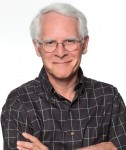
Rabbi Bob Alper will perform as part of Congregation Beth Israel’s Purim festivities on March 23. (photo by Sultan Khan)

It’s too good not to lead with – Pope Frances’ honorary comedic advisor, Rabbi Bob Alper, will be bringing his comic stylings to Congregation Beth Israel on erev Purim March 23.

A professional comedian for some 30 years now, Alper said his life hasn’t changed that much since he became the papal advisor last fall. “I now drive my very own popemobile in my hometown in Vermont,” he said. “It gets 150 miles to the gallon, but is not great in blizzards. Otherwise, nothing has changed, though I do ‘use’ the title whenever I can. It’s a great story.”

No doubt, Alper will be flying to Vancouver. He was invited by the congregation, “people who obviously know how to make Purim rock,” he said.

He’s been here twice before, “once for a show at Temple Sholom and, earlier, for a Federation event. One of the most difficult of my career, since it fell just two weeks after 9/11.

“I’ll only be in Vancouver for a day or two,” he added about this month’s trip, “but I hope to do the highlights. The best part of every trip, for me, is performing!”

Alper won the title of honorary comedic advisor to the Pope in a contest held by the Pontifical Mission Societies in honor of the Pope’s September 2015 visit to the United States and to raise awareness and money for three pontifical missions. He beat out more than 4,000 people from 47 countries, including fellow American funnymen like Bill Murray and Conan O’Brien. You can watch his video, as well as those of the other contestants, at jokewiththepope.org, but the joke is: “My wife and I have been married for over 46 years, and our lives are totally in sync. For example, at the same time I got a hearing aid, she stopped mumbling.”

“I grew up in a religious Reform family for whom our synagogue was central, and my uncle was a Reform rabbi,” said Alper of his background. “My father loved humor, and told long ‘shaggy dog’ stories, which, naturally, prompted me to take the opposite route into the quick-hit world of stand-up. Bob Newhart, Shelley Berman and Mel Brooks records were my childhood companions and, in Jewish youth group, in high school, I would memorize and perform their routines at regional convention talent nights, thereby attracting the hottest girls. Comedy is good.”

Nonetheless, Alper was ordained as a rabbi in 1972 and then worked in congregations for 14 years. It was another contest that led him to become a comedian.

“In 1986, living in a Philadelphia suburb and armed with a doctoral degree from Princeton Theological Seminary, Bob was charting a different path, trading congregational life for a counseling practice,” writes editor David Crumm in the introduction to Alper’s book Thanks. I Needed That. And Other Stories of the Spirit (Read the Spirit Books, 2013). “But, at that same time, comedy reared its ugly head in the form of a ‘Jewish Comic of the Year Contest.’ Bob entered, came in third behind a chiropractor and a lawyer, and went on to make stand-up a full-time career.”

Alper’s wife, Sherri, is a psychotherapist. On his website, it notes, “Professionally, he makes people laugh, while she helps people cry.”

With literally thousands of shows under his belt, Alper has made a lot of people laugh. “It gets easier and easier,” he said about performing. “That’s how comedy works. I agonized before I did my first five minutes in 1986. Now performing is a delight and, since stand-up is cumulative, I have tons of material from which to choose.”

Among Alper’s shows are duos with Muslim comedians.

“My Muslim colleagues include Ahmed Ahmed, of Egyptian background, Azhar Usman, of Indian background, and Mo Amer, a Palestinian born in Kuwait,” writes Alper in Thanks. I Needed That. “We do Muslim-Jewish shows, frequently enhanced by the addition of a Baptist minister, Rev. Susan Sparks. And we have so much fun at each performance, it’s almost criminal.

“We call our shows Laugh in Peace.

“Back in late 2001, Ahmed and I were brought together as a gimmick by a savvy publicist,” he continues. “Our relationship quickly developed into a friendship based on the camaraderie of fellow artists and the breezy banter of guys who really enjoy one another’s company. We laugh together a lot.”

Alper began working with Usman when Ahmed became more focused on acting, and he also works with Amer quite often.

He admits, “No question, Laugh in Peace was conceived initially as a way to further our comedy careers, to book more gigs, to raise our visibility. It would be disingenuous to suggest anything else. But as the act and our personal relationships evolved, we quickly understood how Laugh in Peace brought a sense of hope and relief and healing that shared laughter, especially shared laughter between communities in frequent tension, can provide.”

Alper is also the author of Life Doesn’t Get Any Better Than This, a collection of stories, and the cartoon book A Rabbi Confesses, and he has produced two CDs and a DVD. For more information and a five-minute demo of Alper’s comedy, visit bobalper.com. Readers can also watch the video “Rabbi Bob Alper’s dog respects religions” and many others on YouTube.com.

Beth Israel’s Purim celebration starts at 6:15 p.m. on March 23 with a kid-friendly Megillah reading and costume parade, followed by carnival activities. The full Megillah reading and comedy by Rabbi Bob Alper starts about 8:15 p.m. Food will be for sale during the evening. Visit bethisrael.ca for more information and to register for the kids events.

Young Lamplighters 2015, and other December milestones

Surrey Mayor Linda Hepner, left, White Rock Mayor Wayne Baldwin and Simie Schtroks of the Centre for Judaism present the 2015 Young Lamplighters Award to Sarah and Amy Aginsky on Dec. 13. (photo from Lauren Kramer)

Sarah and Amy Aginsky, 12-year-old identical twins from Richmond, are this year’s recipients of the Centre for Judaism of the Lower Fraser Valley’s Young Lamplighters Award. With this annual award, the Centre for Judaism honors individuals between the ages of 5 and 18 who have performed outstanding community service.

In March 2015, Sarah and Amy, Grade 7 students at Homma Elementary in Richmond, hosted a Street Store for the homeless and impoverished. The Street Store concept was founded in Cape Town, South Africa, in January 2014 to help the homeless. Based on retail shopping, it involves collecting clothes and other items, organizing a pop-up, one-day store and giving shoppers the opportunity to select apparel and shoes without the exchange of money. The Street Store provides people located all over the world with an infrastructure, support and inspiration to host their own such stores.

The twins’ parents were born in Cape Town and their grandparents and relatives live there to this day. They saw how the Street Store had helped the homeless in cities including Sao Paulo (Brazil), Kentucky, Brussels, Tepic (Mexico), Grande Prairie (Alberta), Tucuman (Argentina), Oslo (Norway) and Vancouver, among others, and were inspired to host a Street Store of their own.

Between January and March, Sarah and Amy collected truckloads of donated clothing and footwear, distributing them to the needy on March 6 at the Lighthouse Mission in Bellingham, Wash.

“It was humbling to see how much people were prepared to give and how eagerly they wanted to help us help others,” said Amy. “Seeing the appreciative faces of our Street Store shoppers was heartwarming and beautiful. Many of them have very little and are living difficult lives. It felt great to know we were helping others and that, as a result of our mitzvah project, their lives might get a little bit easier.”

Rabbi Falik and Rebbetzin Simie Schtroks, directors of the Centre for Judaism, with Surrey Mayor Linda Hepner and White Mayor Wayne Baldwin, presented the Lamplighters Award to Sarah and Amy at a public menorah lighting at the Semiahmoo Shopping Centre in White Rock on Dec. 13.

“Chanukah celebrates the victory of light over darkness and goodness over evil,” said Simie Schtroks. “This is a most appropriate opportunity to motivate and inspire young people to make this world a brighter and better place. By filling the world with goodness and kindness, that light can dispel all sorts of darkness.”

***

photo - Elizabeth Wolak and her daughter-in-law Anna Wolak
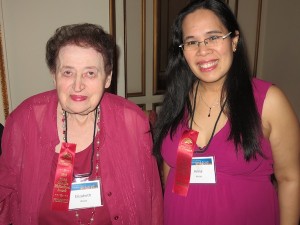
Elizabeth Wolak and her daughter-in-law Anna Wolak (photo from Arthur Wolak)

Elizabeth Wolak and her daughter-in-law Dr. Anna Wolak were both nominated for the 2015 British Columbia Multicultural Awards. As nominees, they were honored to attend the official awards gala evening, together with representatives from the provincial and federal governments, which took place at the Fairmont Hotel Vancouver in November.

The B.C. Multicultural Awards is an annual event hosted by the provincial government and the Multicultural Advisory Council to recognize and honor the multicultural accomplishments of individuals, organizations and businesses throughout the province. Elizabeth Wolak was nominated for her decades of multicultural work bringing the beauty of Jewish choral music to the attention of diverse ethnic communities through her numerous annual concerts. Dr. Anna Wolak was nominated for her health-care work, treating and educating patients and medical practitioners in British Columbia’s multicultural setting.

***

Leila Getz has been selected by Musical America Worldwide as a 2015 Influencer and is profiled in its MA 30 Professionals of the Year: The Influencers special report, released this month, which lists 30 honorees. The report’s editors, “recently asked the MA community to nominate 30 people who are making a difference in our business, either by virtue of their position, their creativity and/or their dedication – folks about whom you could say, ‘When they speak, we listen.’”

“Leila Getz looms large as one of the primary driving forces on the classical music scene in Vancouver, B.C.,” reads her profile in the report. “In 1980, at the age of 40, this South African native founded the Vancouver Recital Society, a presenting organization that has consistently aimed high and brought many of the world’s leading artists to a relatively isolated region.

“It seemed like a foolhardy project at first, especially since there was an economic recession in Canada in the early 1980s…. But the series gradually expanded from five events at the beginning to 20 in 2015….

“Most striking is Getz’s knack for finding major artists before they become widely known. She presented the Canadian debuts of mezzo-soprano Cecilia Bartoli, who reportedly stopped the first rehearsal cold after she sang her first note (the baton flew out of the amazed conductor’s hand), and pianist Lang Lang, who was all of 15 at the time. Other Canadian debuts on this series include those of violinists Joshua Bell and Maxim Vengerov, Anne Sofie von Otter and, one of Getz’s earliest discoveries, pianist András Schiff.”

For the full profile, visit musicalamerica.com/specialreports.

***

The Jewish Community Centre of Greater Vancouver has announced that Sharon Dwek has joined the centre as director of development.

photo - Sharon Dwek has joined the Jewish Community Centre of Greater Vancouver as director of development
Sharon Dwek has joined the Jewish Community Centre of Greater Vancouver as director of development. (photo from JCCGV)

Dwek comes with more than a decade of experience in development, fundraising, community service and marketing, in Vancouver, Israel and the United States. She most recently worked as the director of development at King David High School.

Eldad Goldfarb, JCCGV executive director, said the appointment of Dwek to this new position was a positive step for the centre. “Sharon’s wealth of experience and knowledge has already made her a key addition to the JCC family,” he said. “We view her appointment as a sign of our commitment to being a leading communal organization in our Jewish community.”

Goldfarb suggested the hiring was as much about the centre’s future as it was about its current success. “Our growing programs and our evolving vision for the future led us to look for an addition to our team who will fit in with our values and exceptional service,” he said. “It is very fortunate that we were able to find someone of Sharon’s calibre to fulfil this role.”

For Dwek, coming to work at the centre was a natural fit. “Five years ago, my family and I relocated to Vancouver and we turned to the JCC and immediately felt at home and connected,” she said. “As a place of connecting, care-giving and learning, the JCC has truly become our second home and I am honored to help usher the JCC into the next stage of its future growth and development.”

For more information on JCCGV programming or staff, visit jccgv.com.

***

The 613th mitzvah of the Torah is the obligation for every Jew to write a Torah scroll. In the words of the verse: “And now, write for yourselves this song, and teach it to the Children of Israel. Place it into their mouths, in order that this song will be for Me as a witness for the Children of Israel.” (Deuteronomy 31:19)

Congregation Beth Israel has been blessed to receive a generous gift of a new sefer Torah with the opportunity for its members to complete it by scribing the last 100 letters. As space is limited, participation is by lottery. For more information on the project, visit bethisraelvan.ca/asitiswritten. The deadline for entry into the lottery is Jan. 18, 2016.

Under the guidance of sofer Rabbi Moshe Druin of Florida, families will participate in scribing and other activities for all ages Feb. 19-21. The following weekend, Feb. 26-27, the dedication of the congregation’s new sefer Torah will take place, as will a celebration of Debby Fenson’s 10th anniversary as BI’s ba’alat tefillah.

There are 304,805 letters in the Torah and, if any is missing, the whole Torah scroll must be wrapped up and put away until it is repaired. Every letter in a Torah is vitally important. Now imagine all the Jewish people as one Torah scroll. Each person, big or small, rich or poor, a pious scholar or just a simple Jew, is one letter; all of us as important as each other.

Ready to welcome refugees

As of Nov. 24, the Government of Canada was processing 4,511 applications for privately sponsored Syrian refugees (not including Quebec, which has its own procedure). The map shows communities where private sponsors have submitted an application. (image from cic.gc.ca/english/refugees/welcome)

Vancouver’s Jewish community is mobilizing to welcome refugees from Syria. The federal government has announced that 25,000 Syrian refugees will come to Canada before the end of February. While most of those will be government-sponsored, groups of Canadians, including many in the Jewish community, are leaping at the opportunity to be a part of the resettlement project.

The Jewish Federation of Greater Vancouver has signed a memorandum of understanding with the Anglican church to streamline the process. The federal government has a number of sponsorship agreement holders, which are established, experienced groups that are engaged in aiding refugees on an ongoing basis. To expedite the process, the Jewish community is primarily working through the partnership with the Anglican Church of Canada so that synagogues and other Jewish groups that may want to sponsor can do so efficiently.

“The Anglican diocese, rather than setting up a separate relationship with each of the synagogues, proposed that there be one memorandum of understanding with the Jewish community,” said Shelley Rivkin, Federation’s vice-president for planning, allocations and community affairs. “We will be the holder of the memorandum of understanding so the synagogues will raise the funds and issue a tax receipt. The funds will then come to us and be in a restricted account and, as those funds are distributed, they will go directly through us so that the diocese is not having to deal with multiple parties.”

Or Shalom Synagogue has already raised two-thirds of the funds necessary to sponsor three families. Natalie Grunberg, a member of the Or Shalom Syrian Refugees Initiative, said they are expecting their sponsored refugees as early as January. The group has launched a series of events, including a concert of Syrian music, to raise awareness and money for the project. The federal government estimates the cost of sponsoring a refugee family for a year to be about $30,000, but Vancouverites involved in the process are working on an assumption of about $40,000, based on housing costs here.

Or Shalom is working through existing partnerships they have built over the years. Rather than going through the Anglican church, they are working with the United Church of Canada. Grunberg acknowledged that some in the Jewish community have differences with the United Church’s stand toward Israel, but the priority was to expedite the refugee sponsorship process and they believed working through existing relationships would be most effective.

Grunberg is noticeably proud of her congregation’s efforts so far.

“We’re a very small synagogue and we’re sponsoring three families,” she said.

Through existing relationships with the Syrian community here, Or Shalom will focus their sponsorship efforts on reunifying families that already have some members in Metro Vancouver and also on members of the LGBT community.

Temple Sholom is also rallying for refugees. Almost immediately after announcing the idea during the High Holidays, the synagogue raised enough money to sponsor one family.

“We’ve now decided to sponsor a second family,” said Rabbi Dan Moskovitz.

He acknowledges that there have been some anxieties among his congregation about bringing Syrian refugees here.

“I met with every person that voiced that concern to me,” he said. “I met with them personally. We talked about it. We talked about the people that we are bringing in – they were concerned about terrorists coming across – we talked about the difference between private sponsorship, as we are doing, and what we’ve been seeing in Europe with refugees flooding across borders … that we were sponsoring families with young children, that our sponsorships were family reunification, so they would have real roots here in B.C., particularly in Vancouver. We acknowledge the fears but at the same time we also recognize that this is a crisis and that the Jewish tradition teaches us quite clearly to love the stranger. Israel is doing things for refugees on the Syrian border right now with their hospitals and we had to do our part.”

Moskovitz cites Torah as the basis for his enthusiasm.

“Thirty-six times in the Torah, in the Bible, it says to love the stranger because you were once strangers in the land,” he said. “The Jews were once refugees ourselves and this goes all the way back to the land of Egypt and the slavery of the Israelites under Pharaoh, where we were running for our lives; in that case from the famine, according to the biblical story, and the Egyptian people welcomed the Jewish people, welcomed us in and gave us food and shelter and we lived there for 435 years, according to the Bible. From that and so many other times in the Bible, the most often-repeated commandment in all of Jewish tradition is to love the stranger, to love the immigrant; love the stranger, because that was you once.”

More modern Jewish history is also a factor, he added.

“We are largely still here even though throughout our history people have tried to destroy us because at critical times in our history some people took us in,” said Moskovitz. “We like to think we did it all by ourselves and there is no doubt that there is a tremendous resiliency of the Jewish people but, at the same time, we have been the beneficiary of others sheltering us at times of mortal danger.”

Congregation Beth Israel has created a task force to look into possibly sponsoring a Kurdish Syrian refugee family. Executive director Shannon Etkin said the group will analyze the resources available within the congregation community to provide for a family beyond the minimum requirements set out by the federal government.

Other synagogues, organizations and individuals who may not have the resources to directly sponsor a refugee or family are being encouraged to support on-the-ground efforts by the Joint Distribution Committee, which is aiding refugees in Turkey and Hungary. This support is being organized by the Jewish Federation of Greater Vancouver.

“They’re doing a lot of direct aid for women and children and also doing some work with frontline responders,” Rivkin said.

Duo’s message is “laughter heals”

The comedy team of Rabbi Bob Alpert and Ahmed Ahmed on their August 2015 Laugh in Peace Tour. (photo from Laugh in Peace)

“Both Jews and Muslims have a lot in common. What are we fighting over? Jews and Muslims don’t eat pork, we don’t celebrate Christmas, we both use ‘ch’ in our pronunciation, and we are both hairy creatures of God,” says comedian Ahmed Ahmed. “The only real difference between Jews and Muslims is that Jews never like to spend any money and Muslims never have any money to spend.”

So goes one of the dozens of jokes featured in the Laugh in Peace comedy routine of Ahmed and Rabbi Bob Alper. It’s one Arab, one Jew, one stage. The unlikely duo’s show was in Israel (Jerusalem, Tel Aviv and Haifa) and the Palestinian territories (Ramallah) for the first time from Aug. 12-17. Together, Ahmed and Alper have performed more than 150 times during the last 14 years – throughout the United States, Canada and England – at synagogues, churches, mosques, theatres and college campuses.

Their story began as a gimmick by a savvy publicist, said Alper, a Reform rabbi who spent more than a decade at pulpits in New York and Philadelphia – or, as he calls it, “14 years of performing in front of a hostile audience.”

Alper admits he was at first resistant to the idea of the combined show. “My publicist calls me one day and says, ‘Bob, why don’t you do a show with an Arab comedian?’ I said, ‘Do you have any other ideas?’”

Ahmed was skeptical, too. “I got this call, ‘My name is Bob Alper and I am a Reform rabbi.’… He says, ‘I have an idea. I thought it would be great to do a show together.’… Well, I said, ‘That sounds good, where do you perform?’ He says, ‘Well, I perform in synagogues.’ … I thought someone was playing a joke on me.”

But the timing was right. In 2001, at the height of the terrorism of the second Palestinian intifada (uprising) in Israel, people were primed for comic relief. Alper says, when people are tense or sad, “comedy is even more important.”

Over time, the two have been more than just a successful and sought-after show. They’ve become good friends. The women in Alper’s small Vermont town fell in love with Ahmed through his visits and regularly inquire about his well-being. Alper has eaten in Ahmed’s parents’ California home.

“Ahmed’s dad asked about my family,” Alper recalled. “When I told him my wife would be having shoulder surgery the following month, he looked gravely at me and ordered, ‘You must stop twisting her arm.’”

They also believe they have played a role in breaking down barriers between Muslims and Jews. On college campuses, where Jewish-Muslim tension and antisemitism run rampant over the issue of Israel, Ahmed and Alper perform for mixed audiences. Jewish males wearing yarmulkes and females in hijabs sit side-by-side, smiling and laughing.

“When people laugh together, it is hard to hate each other,” said Alper, recounting how at the University of Arkansas it occurred to him that they were guests of the Razorbacks – a Muslim and a Jew performing at a school whose mascot is a pig.

They keep their shows apolitical, though they do touch on their personal religious experiences in the 90-minute performances, which generally are divided between solo acts of 30-35 minutes and a joint opening and closing. The closing includes stories from their travels.


Read more at jns.org.

Among the 2016 shows listed on Bob Alper’s website (bobalper.com) is only one in Canada, and it just so happens to be at Congregation Beth Israel on March 23.

Consuls save thousands of lives

Consul General of Japan Seiji Okada, centre, Yasuko Okada and Dr. George Bluman. (photo from Vancouver Holocaust Education Centre)

There are Vancouverites who owe their lives to the wartime actions of the then-obscure Japanese diplomat Chiune Sugihara. The mid-level official, vice-consul in Lithuania for the imperial government of Japan, disobeying explicit and repeated orders, in 1940 issued Japanese transit visas to Jewish refugees fleeing the advancing Nazi onslaught.

Two of the people who received the visas were Nathan and Susan Bluman. Their son, Dr. George Bluman, delivered the keynote address Sunday at the 33rd annual Kristallnacht commemoration event, presented by the Vancouver Holocaust Education Centre in partnership with Congregation Beth Israel.

Bluman recounted the story of Sugihara’s life and the motivations for his actions, then addressed the magnitude of those events on his own family.

“There are thousands of stories like my parents’,” said Bluman, noting that this one family’s story is barely a footnote in the Sugihara narrative, but it means “the entire world for me and my family.”

Bluman, professor emeritus of mathematics at the University of British Columbia, said his parents were two of about 2,100 people who received life-giving visas from the Japanese consular official. Approximately another 600 individuals were aided by being included in the visas of others, mostly their parents, and perhaps 25% more were helped in their survival by forged versions of Sugihara visas.

Bluman explained that, after Germany invaded Poland and divvied the country up with the Soviet Union, many Jews fled to the Soviet-occupied portion. Unable to flee to the west, and having been denied entry by most Western countries, Jews were effectively trapped.

Nathan Bluman and his fiancée Susan lived in Warsaw, which was occupied by the Nazis. Nathan fled to the Soviet-occupied east and prevailed upon Susan to join him, which she did, though her father forbade them from marrying without his permission.

“She would never again see any of her parents or siblings,” Bluman said.

While Germany had occupied the Netherlands, Dutch embassies and consulates worldwide remained loyal to the Dutch government-in-exile, located in London. Jan Zwartendijk, the Dutch consul in Lithuania, began issuing visas to Curaçao, the Dutch colony in the Caribbean. Jewish refugees, including many Polish Jews like Nathan and Susan Bluman, made their way to Lithuania in hopes of obtaining a ticket to safety.

When the Soviet Union occupied Lithuania in 1940, all foreign embassies and consulates were ordered closed. In the short window available, the Dutch consul, with the support of his superiors in the government-in-exile, issued visas for Jewish refugees to enter Curaçao.

However, while Polish and Lithuanian Jewish refugees were free to travel in the Soviet Union, they could not go further without a visa to another country. That made a Japanese transit visa priceless.

While there is no evidence that Zwartendijk and Sugihara ever met, it was their combined actions that are credited with saving thousands of lives. While Zwartendijk acted with the authority of his superiors, Sugihara ignored explicit orders not to issue transit visas, an act of extraordinary disobedience for a mid-level Japanese bureaucrat and an action that not only put his job on the line, but threatened the lives of himself and his family.

Sugihara handwrote the visas day and night, issuing the equivalent of an average month’s worth of visas every day in the weeks before the consulate was forcibly closed by the Soviets.

The combination of a Dutch visa to Curaçao and a transit visa for Japan allowed refugees to make the arduous journey on the Trans-Siberian Railway to Vladivostok, board a ship to a Japanese port, take a train to Kobe and, in various ways, survive the war. In many cases, the refugees became stateless people, interned first in Japan and then in Japanese-occupied Shanghai.

Bluman’s parents managed to get on one of the last two ships heading to North America before the Japanese attack on Pearl Harbor launched Japan and the United States into a state of war and made passage impossible.

The Bluman family’s fate was influenced by one of those fortunate flukes that occurs in history. While in Japan, Nathan Bluman ran into an old professor from school in Warsaw, who told him that a ship, the Hei Maru, was to leave for Vancouver the next day. Bluman raced to the Canadian consulate to request one of the 25 visas being offered to skilled workers and it was granted. There were no provisions for spouses but Susan Bluman, using some sort of extraordinary persuasive power, managed to get the Canadian official to include her on her husband’s visa and they boarded the ship the same day, arriving in Vancouver on July 9, 1941.

That single transit visa was responsible for 17 lives, including Nathan and Susan Bluman, their children and grandchildren and three great-grandchildren born this year.

George Bluman estimates that, in all, 30,000 people worldwide owe their lives to Sugihara. Yet, it was not until 1968, when a survivor contacted him, that Sugihara began to understand the magnitude of what he had done during the war. In 1985, he was named by Yad Vashem as one of the Righteous Among the Nations.

Sugihara died in 1986, as did Nathan Bluman. But the Bluman and Sugihara families have had a long association and friendship that remains strong today to the third generation.

The event Sunday night at Beth Israel began with a solemn candlelight procession of local survivors of the Holocaust.

The annual event commemorates Kristallnacht, the “Night of Broken Glass,” a government-initiated pogrom across Germany and Austria on the night of Nov. 9-10, 1938. Hundreds of synagogues were burned, Jewish-owned businesses were destroyed, nearly 100 Jews were killed and 30,000 were sent to concentration camps.

Prof. Chris Friedrichs, a member of the commemoration’s organizing committee, noted that the Holocaust ended 70 years ago with the Allied defeat of the Nazi regime. But when did it begin? Kristallnacht is often cited as the moment when the increasingly repressive policies of the Hitler dictatorship turned into the violence that would culminate in the “Final Solution.”

But Friedrichs said that the Holocaust was not so much a direct result of events of that fateful night.

“It is what did not happen in the days that followed,” he said. After a day or two of headlines worldwide, said Friedrichs, there was nothing more. The world’s reaction, or lack of it, was the signal the Nazis needed to be assured that their policies of eliminating those “deemed unworthy of life” would meet with no resistance from the world community.

Referring to the procession of candle-bearing survivors that had just preceded him, Friedrichs said, “a candle may not seem very heavy to you.” But each of the survivors who mounted the bimah, said Friedrichs, belonged to a family, many of whom were almost completely destroyed, and the candles represent not just their families or hundreds or thousands of people, but millions.

Vancouver City Councillor

Andrea Reimer, deputy mayor of the city, broke down in tears while reading the mayor’s proclamation after telling the audience how the history of the Holocaust tests for faith in humanity.

Beth Israel’s Rabbi Jonathan Infeld thanked Bluman and expressed gratitude that Bluman is a member of his congregation.

“You are a key component of maintaining the history of the Holocaust in our community,” Infeld said.

Arthur Guttman, cantor emeritus of Temple Sholom, chanted El Moleh Rachamim, the memorial prayer for the martyrs. Ed Lewin, president of the Vancouver Holocaust Education Centre, introduced the survivors. Gary Miller, president of Beth Israel, introduced Reimer. Bluman was introduced by Prof. Richard Menkis, a member of the Kristallnacht commemoration organizing committee.


Mystery photo … June 30/15

Children with bicycles, possibly at a Beth Israel parade, Vancouver, 1970. (JWB fonds; JMABC L.09774)

If you know someone in the photo above or any of those below, please help the JI fill the gaps of its predecessor’s (the Jewish Western Bulletin’s) collection at the Jewish Museum and Archives of B.C. by contacting archives@jewishmuseum.ca.

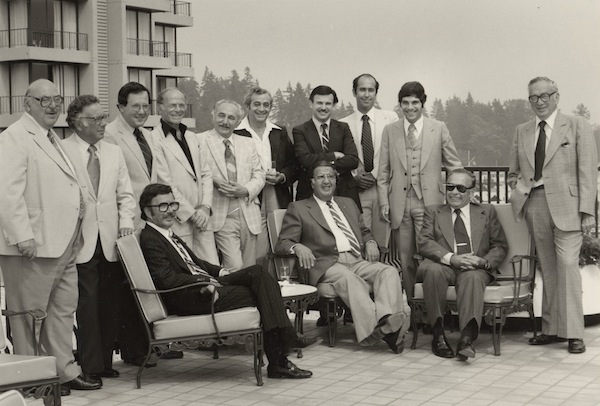
photo - Group of men on an outdoor patio, Vancouver, Aug. 30, 1979. Morris Wosk is standing, fifth from the left, and Joe Cohen is seated in the centre
Group of men on an outdoor patio, Vancouver, Aug. 30, 1979. Morris Wosk is standing, fifth from the left, and Joe Cohen is seated in the centre. (JWB fonds; JMABC L.14739)
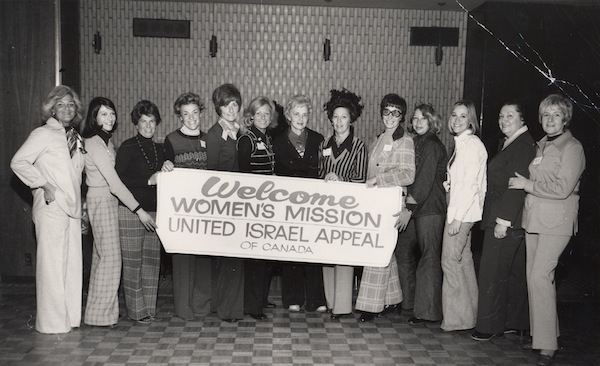
photo - Women holding the banner “Welcome, Women’s Mission, United Israel Appeal of Canada,” Vancouver, March 26, 1975
Women holding the banner “Welcome, Women’s Mission, United Israel Appeal of Canada,” Vancouver, March 26, 1975. (JWB fonds; JMABC L.15296)
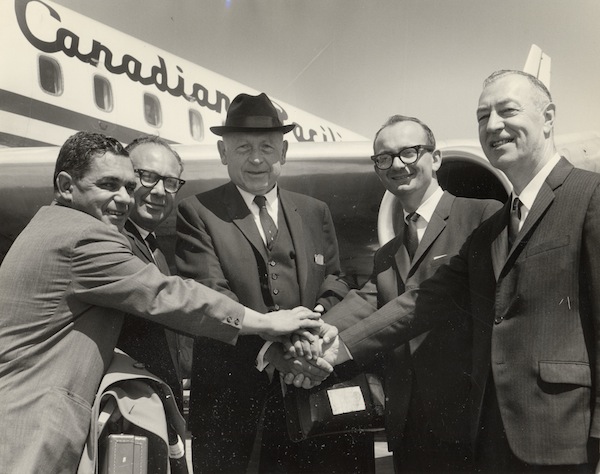
photo - Men alongside a Canadian Pacific aircraft with Karl Silberman, special representative for projects, Keren Hayesod, 1968
Men alongside a Canadian Pacific aircraft with Karl Silberman, special representative for projects, Keren Hayesod, 1968. (JWB fonds; JMABC L.15161)
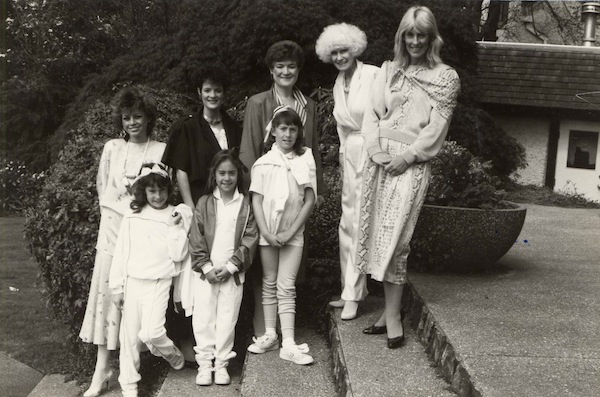
photo - ORT fashion show: Dianne Faber (extreme right), Leta Jones (third from the right), Vancouver, May 30, 1985
ORT fashion show: Dianne Faber (extreme right), Leta Jones (third from the right), Vancouver, May 30, 1985. (JWB fonds; JMABC L.14068)
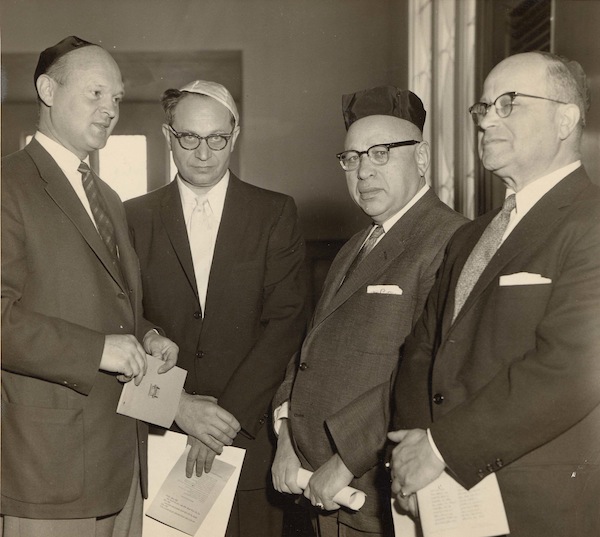
photo - Centenary presentation at Schara Tzedeck, Vancouver, circa 1955. Jack Diamond is second from the left
Centenary presentation at Schara Tzedeck, Vancouver, circa 1955. Jack Diamond is second from the left. (JWB fonds; JMABC L.14275)
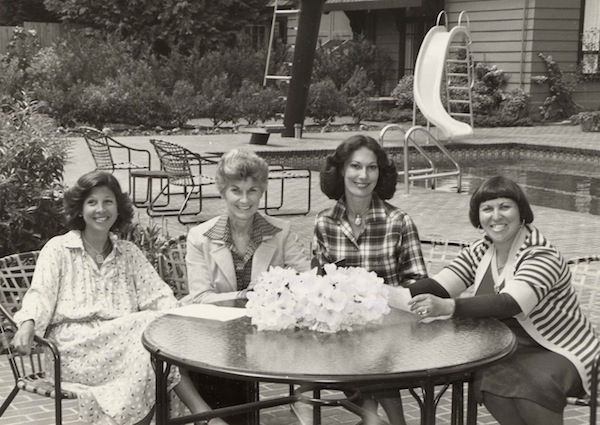
photo - Women at poolside table, Vancouver, 1980
Women at poolside table, Vancouver, 1980. (JWB fonds; JMABC L.14058)
photo - “Good old days” revived at B’nai B’rith picnic, 1972
“Good old days” revived at B’nai B’rith picnic, 1972. (JWB fonds; JMABC L.09560)

Beth Israel is hoping to be home for the High Holidays

Congregation Beth Israel’s former parking lot will be replaced by an underground parking garage with a 200-vehicule capacity. The roof will be an interconnected series of courtyards. (photo from Beth Israel)

This September, when construction is complete and Congregation Beth Israel reopens at Oak and 28th, Vancouver’s oldest Conservative synagogue will join a very special Vancouver membership. The structure will be on the city’s list of green buildings.

Vancouver is pushing to become the world’s greenest city by 2020 and, this year, it began phasing in bylaw changes that would require both residential and commercial construction projects to integrate more environmentally friendly features into their infrastructure. For BI, this means a building that uses less electricity, more natural resources like sunlight and outdoor carbon-reducing green spaces and, wherever possible, partners with neighborhood facilities to reduce energy usage.

BI executive director Shannon Etkin told the Independent that the congregation has known for a couple of decades that it would have to replace the 65-year-old building. “The air conditioning system was shot, the plumbing and electrical systems were very old and outdated and subject to continuous breakdowns, [and] the roof was well past its best-before date,” he said.

In addition to its age and the environmental concerns, the structure no longer fit the needs of the synagogue’s membership.

“We also wanted a space large enough [where] all of the congregation could be under one roof at High Holy Days instead of having to have a second service, or an alternative service for other people because we didn’t have space for them in our main building.”

“The spaces weren’t designed for the way we work with our congregation now,” said Etkin. “We also wanted a space large enough [where] all of the congregation could be under one roof at High Holy Days instead of having to have a second service, or an alternative service for other people because we didn’t have space for them in our main building. We didn’t have lounge spaces for people to gather informally. Some of the rooms were too small and some of the rooms were too big. The auditorium was not large enough for many families who wanted to have functions at the synagogue.”

The new building, said Etkin, will be attractive, as well as serve the needs of the 600-family congregation. “We are going to have a beautiful sanctuary…. It will feel intimate for various-sized numbers of people attending services,” he said, adding that the social hall will be able to accommodate larger wedding and other simchah receptions.

As well, people who want to sit and shmooze after services or while waiting for a class or a presentation will be able to do so. “We have informal spaces for people to lounge in and be able to talk to one another, [and] we will have new technology allowing us to project images in different rooms, a sound system, all those different things we didn’t have in the previous building,” explained Etkin.

BI Rabbi Jonathan Infeld said the changes will make a big difference to the atmosphere and functionality of the synagogue. “One of the other critical components of the building is lighting. The new sanctuary will have a skylight and lighting that will make the whole place bright. Dim, dark lighting like we had in our old building is depressing. Brighter lights are more uplifting and spiritually enhancing,” said the rabbi.

“The building will be extremely friendly for those with physical challenges,” he added. “Not just the bimah, which will be extremely accessible for someone with physical challenges, but washrooms as well.” And, he noted, “[The] heater will work in the winter, and the air conditioner will work in the summer, and not vice versa.”

photo - Gary Averbach, left, and Shannon Etkin at the kick-off of Beth Israel's capital campaign in May 2011.
Gary Averbach, left, and Shannon Etkin at the kick-off of Beth Israel’s capital campaign in May 2011. (photo from Beth Israel)

Despite all of the environmental improvements, Infeld said the congregation has decided not to seek LEED (Leadership in Energy and Environmental Design) certification through the Canadian Green Building Council, as doing so would cost upwards of another $100,000, and the congregation feels the money could be better spent on projects within the synagogue. However, the new building’s environmental features would allow it to apply for a gold rating as a LEED building. For example, Metro Vancouver’s design guide for LEED buildings points out that using daylight to enhance the brightness of the building’s interior is not only appealing, but energy efficient. Properly applied, it can reduce electricity usage and heating bills – as can the design of the overall structure.

In fact, said Mark Ostry, principal architect at Acton Ostry Architects, Inc. – the new building’s designer – many of the esthetic and functional changes will provide environmental benefits, including the congregation’s decision to keep the building’s original frame; a decision that was also a nod to its 82-year history (the congregation was incorporated in 1932 and completed the structure in 1949).

“Roughly 60 percent of the building area has been accommodated in the original building,” said Ostry. According to a 2012 study by Preservation Green Lab, an arm of the U.S. National Trust for Historic Preservation, construction retrofits that emphasize green techniques are often easier on the environment than new construction.

Ostry said they are also looking into BI joining a district energy system (DES) that would be run by the nearby B.C. Women’s and Children’s hospitals complex. Hooking up to a DES would mean that BI could reduce energy usage further. Shaughnessy Hospital introduced an earlier version that shared service with the Oak Street hospital complex back in the 1980s, and the proposed DES upgrade would allow BI to benefit from that network.

Ostry said other environmentally beneficial features include the landscaping that is going to serve as the roof to a shared underground parking lot.

“This [will allow] the synagogue to be wrapped with a network of interconnected courtyards,” said Ostry. “In addition to promoting biodiversity, the soft-planted landscaping contributes to storm water management…. Equally important, these courtyards establish a strong connection between the synagogue and the outside. Landscape areas have been designated to accommodate a gaga pit, chuppah, sukkah, outdoor services and various informal activities – all of which enhance the meaningfulness of the natural world in Judaism.”

BI’s reconstruction started in 2012 and, according to Etkin, it is expected to be complete in time for this year’s High Holy Day services. Almost all of the funding has been raised through donations, and the Jewish Federation of Greater Vancouver has contributed for a preparatory security review. He said the support from both congregation members and the larger community is what has allowed the redevelopment to move forward. With only $2 million of the targeted $18 million cost still to raise, BI’s new home is almost complete. And, in this new home, the “building will finally face east, toward Jerusalem,” said Infeld. It has been a long-term goal and, now, he said, “It will finally be correct.”

Jan Lee’s articles have been published in B’nai B’rith Magazine, thedailyrabbi.com and Voices of Conservative and Masorti Judaism. She also writes on sustainable business practices for TriplePundit.com. Her blog can be found at multiculturaljew.polestarpassages.com.