20 years on Willow Street

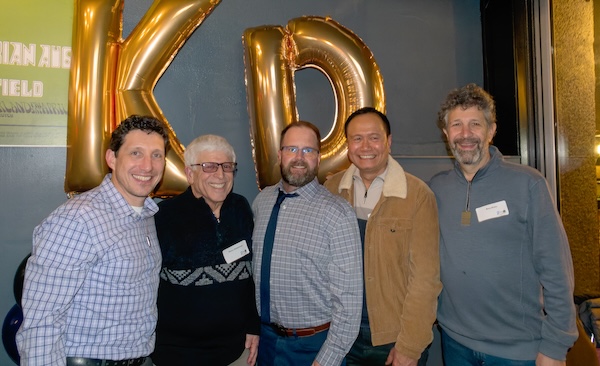
Left to right: Head of school Seth Goldsweig, former head of school Perry Seidelman, deputy head of school Alex Monchamp, head custodian and building manager Jess Sabado and former head of school Russ Klein at a February gathering of alumni to celebrate 20 years of KDHS on Willow Street. (photo from KDHS)

On May 14, with a party at Congregation Beth Israel, King David High School celebrates 20 years since it opened its doors on Willow Street.

“It’s a real blessing,” said KDHS head of school Dr. Seth Goldsweig about having a Jewish high school in the community. 

“Study after study shows that the most effective way to develop and maintain Jewish identity is to go to Jewish day school,” he said. “Our students can continue to develop their Jewish identities and turn into the Jewish leaders of tomorrow.

“We have a high school that stands up to the other amazing independent schools in the area,” he added. “This means that students can have a top-notch Jewish education combined with a rigorous and enriching academic experience. They get the best of both worlds.”

Goldsweig is KDHS’s third head of school, having started the position last fall, after Russ Klein retired. Klein was at the helm from 2008 to 2024.

“In this job, I found a community that I didn’t know I had,” Klein told the Independent last year, as his tenure was winding down. “That was beyond special. I really do think of this job, this position really, as a gift.”

Klein had taken over the position after Perry Seidelman retired. 

In 2001, Seidelman was hired as principal of Vancouver Talmud Torah High School – one of the iterations on the path that led from Maimonides High School, which was started in the 1980s, to KDHS. With 30 years prior experience and his approach to education, he was a key to the successful establishment of King David.

“Without Perry, there would be no school,” Larry Goldstein, president of the Jewish high school during the transition period, says in The Scribe’s Jewish Education in BC issue. “It’s as simple as that. Perry gave the credibility to other parents.”

“With growing interest in the school, a decision was made to build a permanent structure with financing from the Diamond Foundation,” Seidelman writes in The Scribe, which is the journal of the Jewish Museum and Archives of British Columbia. “It was to be built on a property at the southeast corner of 41st Avenue and Willow Street, directly across Willow Street from the Jewish Community Centre. Extensive discussions were held with the JCC administration, as intentions were to use the JCC for some programs, notably the JCC gymnasium for PE classes and the Norman [& Annette] Rothstein Theatre for drama productions.”

As enrolment grew, Alex Monchamp, who had been a teacher at the high school since its Maimonides days, was hired as vice-principal, according to The Scribe. Monchamp now holds the title of deputy head of school.

“I joined King David in July 2001,” Monchamp told the Independent. “I’d only been living in the city for a few months, and I saw a small newspaper ad for a small independent school looking for a half-time English and drama teacher. It was my first teaching job in BC!”

When asked why KDHS has proven successful, while previous versions of the high school struggled, Monchamp said, “I think the main turning point was the year I started, and the school had its biggest Grade 8 class, which I think was 25 or 26 students. Those connected to the school and who were vital in its foundation and ongoing viability made a real concerted effort to engage with the community and make a case for the importance and need for a sustainable Jewish high school. However, the real risk, the real investment, was when those Grade 8 families, and the families that came after, invested their most important resource – their children – in our school.

“When our families started to see that need and started to trust in the school, it allowed the school to grow and become more stable,” said Monchamp. “Stability turned into slow but steady growth, to more students, more teachers, and then our home on Willow Street. However, the building itself did not cement our future – it was also the school’s investment in good leadership and dedicated teachers that secured the future we enjoy today.”

photo - Then-student Nicole Grubner and Gordon Diamond at the 2005 inauguration of the KDHS building on Willow Street
Then-student Nicole Grubner and Gordon Diamond at the 2005 inauguration of the KDHS building on Willow Street. (photo from KDHS)

When Monchamp joined the high school, there were fewer than 70 students, programming was limited and there was no permanent school building, he said. Growth has occurred in multiple areas.

“There are obvious measures, like our student population is over 270 students, we have a vibrant arts program, a strong athletic program and our programming offers our students many ways to explore what they know, what they can do and who they’ll become,” said Monchamp. “All of that happens because we continue to have a team of outstanding teachers and dedicated adults who work extremely hard.

“The ultimate measure is not where our students go to university, the grades they earn or even how many of them are in the building each day,” he added. “There are bigger schools, there’s no shortage of kids going to university and no one is ever going to care what your math mark was in Grade 10. The true measure is that our students discover and develop their capabilities, figure out who they are and what it means for them to be Jewish in this world. In a world of uncertainty and change, our students have the capability to adapt and grow and the values and foundation to be a good person.”

KDHS’s director of development, Esther Mogyoros, who has worked at the school for the past 11 years, echoed Monchamp’s belief that there is more than one component to the school’s growth.

“Over the years,” she said, “King David has grown not only in student enrolment but also in its physical presence, thanks to the expansion of the east campus, made possible by the generosity of the Diamond Foundation and our supportive community. Our reputation has been built on a strong foundation of chesed programs, regular volunteer initiatives, and active participation in celebrations and community events. We take pride in nurturing students who not only excel academically but also continue their educational journeys and give back to the community long after graduation.”

Both Mogyoros and Monchamp said the best part of their jobs is when they connect with others.

“Connecting with students, parents, grandparents and the community at large,” said Mogyoros. “Building relationships and sharing my passion for Jewish education, Israel and the importance/impact of King David in the community.”

“The best part is when I can connect with a student, chat, find out more about them and then, if I can, find ways that I can support them,” said Monchamp. “It doesn’t happen nearly enough in a typical day, but I love it when it does.”

One of Monchamp’s standout moments at the school is when KDHS would take the Grade 9 students to Washington, DC, every spring to visit the US Holocaust Memorial Museum.

“We’d spend a full day at the USHMM, which is a lot, and our students always came away with information or artifacts they hadn’t encountered before and at times it was very emotive,” he said. “The trip also included a day at many of the Smithsonian Institution museums. It was always a treat to watch the kids see real historical items, like the Wright brother’s plane, the ruby shoes from The Wizard of Oz or Prince’s guitars. History is always more relevant to kids if they can get up close to it and connect to their own stories and memories.”

Over the past 20 years, there have been challenges, notably, the pandemic. 

“There was so much unpredictability and an immeasurable amount of learning we had to do on the fly,” said Monchamp of that time. “Despite the numerous challenges, it is moments like that which demonstrate what our school is all about. The overarching goal was what it has always been: putting our students first. And when that was our guiding principle, we figured out the rest…. It was also vital that our families trusted us. Before, during and after COVID, we have consistently demonstrated to our families that we take our role in their children’s growth very seriously and that we always perform in ways that support and benefit their growth.”

“Throughout those difficult years,” said Mogyoros, “our school’s resilience and compassion shone through – not only in maintaining academic standards but also in supporting one another emotionally during a time of unprecedented uncertainty.”

Monchamp hopes the school continues on its current path, becoming “a student-centred learning environment.

“Learning is an active experience and is most successful when students are actively engaged and can apply what they know and can do to their own experiences and contexts,” he said. “We have already seen the tremendous benefit of this shift. It’s what is keeping our school competitive and on par with other Vancouver independent schools and it’s setting up our students for their future successes.”

photo - The King David High School Class of 2019 celebrates graduation
The King David High School Class of 2019 celebrates graduation. (photo from KDHS)

“Our goal,” said Mogyoros, “is to empower students to be confident in their identities, excel in their chosen paths, and take pride in their Jewish heritage, traditions and love for Israel. We strive to inspire them to make a meaningful difference in the world around them.”

JWest is central to the high school’s future. The three-phase development project at 41st Avenue and Oak Street will see the construction of a much-expanded JCC, a new home for KDHS and two residential towers.

“Having a new building where we can continue to develop our programming, where we can engage our students and where we can host real ‘home games’ in our own gym in front of as many students and parents as possible is incredibly important,” said Monchamp. “The school is still very young and a new facility will allow it to continue to shape its identity. Additionally, our community can continue to take pride in the school and all of the many interconnected Jewish organizations in the city. I think the symbolism of one large, proud hub for the Jewish community sends not only a very strong message, but, more importantly, a unified message, one which the community can use as a foundation for its future.”

Mogyoros agrees.

“A larger campus will open doors to more programs, providing students with enhanced opportunities for learning, creativity and personal development,” she said. “We are especially excited about the addition of more space and new sports fields, which will enrich our athletic and extracurricular offerings and foster a vibrant, dynamic environment for our students.”

“We want to see the school continue to grow,” said Goldsweig. “Next year, we will be the biggest we have ever been. So many families have chosen to give their kids a Jewish high school education. We are so appreciative and hope that many more continue to make the same decision.”

The head of school says he has been warmly welcomed into the community, with Friday night dinner invitations every Shabbat, “an amazing staff,” a board that “has been supportive every step of the way,” and parents who “are dedicated to the success of the school and their children. 

“The most impressive group of all has been the students,” Goldsweig said. “They are so inspiring, and I know our future is in good hands.” 

To attend the May 14 gala, participate in the silent auction (which launches April 29), buy raffle tickets or donate to King David High School, visit goldenthreadgala.com.
Na’amat – 100 years of service

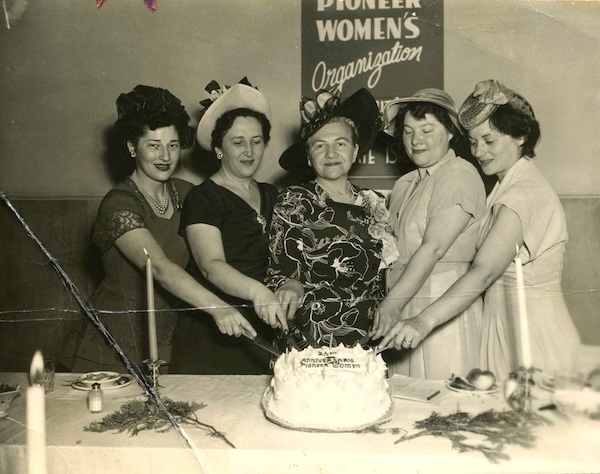
From 1925 to today, Na’amat volunteers across Canada and the United States continue to empower women and children in Israel and abroad. (photo from Na’amat Canada)

At a time when charities are fighting to survive, an organization that’s been helping women and children in Israel and North America is celebrating its 100th anniversary. 

Na’amat Canada and Na’amat USA, which began as a North American chapter in 1925, will mark the centenary at a gala conference in Toronto in May with delegates from across Canada and the United States. 

“It’s a huge deal. It’s a milestone,” said Vivian Reisler, executive vice-president of Na’amat Canada. “We’ve come a long way from Golda Meir sending a message that we need $100 to build X, Y, Z.” 

The forerunner of Na’amat was founded in 1921, in what would later become the modern state of Israel, to empower women, including providing vocational training and advocating for improved working conditions and equal pay.  

Four years later, a North American branch was born and Na’amat chapters were formed across Canada and the United States over the ensuing decades. Today, thousands of volunteers are continuing to empower women and children in Israel and abroad.

“The success of the organization is due to the dedication of the members, volunteers and donors – because, without them, we wouldn’t be where we are today,” said Reisler. 

Na’amat Canada president Susan Inhaber, a member of the organization for 25 years, agrees.

 “We just want to keep building, get our name out there, build the membership and thank all the donors, supporters and members who are making everything possible,” she said. “This is an exciting time for us to be together. It’s nice that we have an organization that’s lasted so long.” 

While the North American branch of Na’amat (a Hebrew acronym for “Movement of Working Women and Volunteers”) began in 1925, Na’amat Canada and Na’amat USA became two autonomous divisions in 1965.

“We were together, we split, and now we’re back together (informally, at the Toronto conference) celebrating 100 years,” said Reisler. 

Na’amat is the largest women’s organization in Israel. It provides a wide variety of services, including a daycare network for thousands of children, legal aid centres, technological high schools for students who have trouble succeeding in other classroom settings, boarding schools for underprivileged students, and the Na’amat Canada Glickman Centre for Family Violence Prevention.

photo - Na’amat Canada members at the Glickman Centre for Family Violence Prevention
Na’amat Canada members at the Glickman Centre for Family Violence Prevention. (photo from Na’amat Canada)

Established in 1993 in Tel Aviv, the Glickman Centre was the first women’s shelter in Israel. It has three distinct sections: the shelter, a counseling and treatment area, and the Rhodie Blanshay Benaroch Children’s Centre wing, a haven for children living in the shelter.  

The Rhodie Blanshay Benaroch Children’s Centre houses a computer room, baby nursery, kindergarten, audiovisual education corner, library, learning centre and outdoor playground, named in honour of Rhodie’s granddaughter, Rho Schneiderman. A musical playground was built in honour of Rhodie’s two granddaughters. Blanshay Benaroch was a dynamic third-generation Na’amat member who was committed to building a safe, loving environment for children who needed it most. 

Recently, Na’amat Canada was instrumental in building a new middle school at Kanot Youth Village. More than 300 students will now have a state-of-the-art school to enhance their education.  

In the aftermath of the Israel-Hamas war, Israel needs Na’amat’s help as much – or even more – than it did a century ago, said Doris Wexler-Charow, past national president of Na’amat Canada.

“I think that Oct. 7 changed everything,” she said of the deadliest attack against Jews since the Holocaust.

Everyone in Israel is suffering from PTSD, said Wexler-Charow, a retired social worker. “Everybody’s been traumatized,” she said, explaining that Na’amat is providing more counseling services than ever. “Israel needs us. It’s important for us to keep going. The cause is a good one and I think we need our young people to continue where we leave off.” 

– Courtesy Na’amat Canada

Community milestones … Gutman, Marks Pulver, Doduck & Simpson

Gloria Gutman, PhD, has been honoured with the King Charles III Coronation Medal, which recognizes individuals who have made a significant contribution to Canada, or an outstanding achievement abroad that brings credit to Canada. She will receive the medal in a ceremony March 21.

A research associate and professor emeritus at Simon Fraser University, Gutman founded the Gerontology Research Centre and the department of gerontology at SFU, serving as director of both units from 1982 to 2005. She is the author/editor of 23 books, the most recent (with Claire Robson and Jen Marchbank) titled Elder Abuse in the LGBTQ2SA+ Community (Springer, 2023).

photo - Dr. Gloria Gutman
Dr. Gloria Gutman (photo from SFU)

During her career, Gutman has held many prominent roles, including president of the Canadian Association on Gerontology, president of the International Association of Gerontology and Geriatrics and president of the International Network for Prevention of Elder Abuse. Currently, she is president of the North American chapter of the International Society for Gerontechnology, vice-president of the International Longevity Centre-Canada and a member of the research management committee of the Canadian Frailty Network. Previously, she served on the World Economic Forum’s Council on the Ageing Society, World Health Organization’s expert advisory panel on aging and health, and the CIHR-Institute of Aging advisory board.

“I am grateful to SFU for having nominated me for this award. 

Developing the gerontology department and Gerontology Research Centre, serving on boards, organizing conferences, and advocating for seniors in other ways nationally and internationally, has been a privilege and a pleasure,” said Gutman. “It could not have taken place without the strong support of FASS [the faculty of arts and social sciences] and senior administration.”

In 2012, Gutman was awarded a Queen Elizabeth II Diamond Jubilee Medal by the Government of Canada and, in 2016, she was appointed to the Order of Canada, the country’s highest civilian honour.

– Courtesy Simon Fraser University

* * *

photo - Lana Marks Pulver
Lana Marks Pulver (photo from Jewish Federation)

Jewish Federation of Greater Vancouver is proud to congratulate its board chair, Lana Marks Pulver, who was honoured by Jewish Federations of North America with the Kipnis-Wilson/Friedland Award for exemplifying the highest standards of philanthropy and volunteerism. Marks Pulver’s selection for this award is a testament to her exceptional dedication and leadership.

– Courtesy Jewish Federation of Greater Vancouver

* * *

The Louis Brier Jewish Aged Foundation is pleased to announce the appointment of long-time volunteer leaders Marie Doduck and Lee Simpson as co-chairs of the 2025/26 campaign. Please join board directors Harry Lipetz, Rick Cohen, Mel Moss, Bernard Pinsky, David Zacks, Michelle Karby and Abbe Chivers, and staff Ayelet Cohen Weil and Wendy Habif in congratulating and thanking them for their tireless commitment to our Jewish elderly.

– Courtesy Louis Brier Jewish Aged Foundation

Growing a garden together

Volunteers, seniors and youth dedicate their time each week to tending, planting and harvesting at the Vancouver Jewish Community Garden. (photo courtesy VJCG)

The Vancouver Jewish Community Garden (VJCG), which opened in May 2023, began as a dream – a vision shared by Vancouver Talmud Torah, Jewish Family Services Vancouver and Congregation Beth Israel. The dream was made possible by the Diamond Foundation, which secured a long-term lease of the land for future development and has allowed for the opportunity to use it for a Jewish community garden on a temporary basis. Significant seed gifts from the Ronald S. Roadburg Foundation and the Jewish Community Foundation also played a vital role in its creation.

photo - A Vancouver Jewish Community Garden volunteer
A Vancouver Jewish Community Garden volunteer. (photo courtesy VJCG)

Generous donors, volunteers, students, garden experts, builders, designers and a project manager all contribute to its success. Every seed planted, every helping hand and every heart involved makes a meaningful impact – both on those who tend the garden and those who benefit from its harvest. As Rabbi Shimon bar Yochai said, “A garden is not just a patch of soil, but a place for the cultivation of the soul.”

Reflecting on two years of growth – including a full harvest season – it is possible to truly appreciate the impact the VJCG has on the Vancouver Jewish community. Under the care of garden coordinator Maggie Wilson, the VJCG has blossomed into a hub for connection, learning and nourishment. Sacred spaces are woven among beds of fruits, vegetables and flowers. 

“The garden is more than a place to grow food – we’ve built a wonderful community where people can experience the healing effects of digging in the soil, and witness the miracle of nature,” said Wilson. “Some participants are having their first experience planting a seed or picking a fresh bean. They are learning what it takes to grow food, and understanding, in a concrete way, how their work contributes to tikkun olam.”

Volunteers, seniors and youth dedicate their time each week to tending, planting and harvesting, ensuring that fresh, nutritious produce reaches Jewish Family Services to support community members facing food insecurity. Beyond its bounty, the garden is also an outdoor classroom. Students engage in hands-on workshops, learning about sustainability, collaboration and the growth cycle.

The VJCG is a community treasure that needs the community’s support to continue to thrive. Feb. 20 will be the first-ever Day of Giving in support of the VJCG. Donations will help sustain the garden, expand programming and continue to provide nourishment, education and inspiration. To contribute, visit jewishcommunitygarden.ca. 

– Courtesy Vancouver Jewish Community Garden

Community a work highlight

Marcie Flom leaves the Jewish Community Foundation after 21 years, to pursue the next chapter of her professional life. (photo from Jewish Federation)

“I just want to say that I have been blessed to have had the opportunity to serve this community for as long as I have, and I want to acknowledge all the support of the staff and volunteers I have had the pleasure of working with,” said Marcie Flom, whose last day as executive director of the Jewish Community Foundation of Greater Vancouver was Dec. 27. “Community work is a team effort, and we are very fortunate in the Vancouver community to have a wealth of talented and passionate volunteers and professionals who care deeply and contribute wholeheartedly to its success.”

Flom leaves her post after 21 years.

“It is always good to leave on a high note and I achieved my personal goal of stewarding the Jewish Community Foundation over the $100 million mark,” she said. “There is a very strong and competent team in place at the Foundation and Federation and exceptional lay leadership in the Foundation governors under chair Howard Kallner.

“With all that in place, it is the perfect time for me to move on to pursue the next chapter in my professional life. I’m planning to continue my work with donors and families to assist them with their philanthropy – it’s the piece of life’s work that brings me the greatest joy and fulfillment.”

Flom joined the Jewish Federation of Greater Vancouver in 2004, when she was recruited by then-new executive director of Federation Mark Gurvis, who now serves as chief executive officer of the Ronald S. Roadburg Foundation, for the role of Foundation director. (The Foundation was founded in 1989 as the endowment program of Federation and has developed from there.)

“I had spent most of my career in the not-for-profit sector working in the arts, first for the National Ballet of Canada in Toronto and then for the Vancouver Playhouse Theatre Company,” said Flom. 

This experience in marketing and development is one of the reasons Gurvis reached out to her.

“I was a new mother and consulting at the time, and I felt strongly that I wanted to raise my daughter in the community,” said Flom about why she accepted the Foundation position. “It was also a challenging time in Israel, and I thought it was the perfect time to use my experience for the benefit of the community here and in Israel. It was an excellent role for me, and I saw a great deal of potential for growing the Foundation and raising my daughter in a caring community.”

Flom’s role at the organization also grew.

“After a few years as Foundation director,” she said, “the Federation recognized that it needed a more donor-centric and holistic approach to working with donors to match their interests to fill gaps in community services and to meet emerging needs. I had the relevant experience in marketing and fundraising to integrate those functions operationally into a new philanthropic model which addressed financial resource development across the organization.

“I moved into a VP role, which was largely operational. With the level of operational experience and knowledge that I cultivated, I was positioned to serve in greater capacity, culminating in my most recent role, with oversight of the community engagement and local and overseas allocations processes. It was the perfect role as I wrapped up my time with Federation, the integration of revenue and the distribution and granting of charitable funds. I also managed the allocation of our communities Israel Emergency Funds alongside chair Stephen Gaerber and the director of Federation’s Israel office, Rachel Sachs. I cannot begin to express how meaningful and impactful that process has been for me personally during one of the darkest periods in the history of the country.”

Federation is currently recruiting a senior development professional to fill the vacancy Flom’s departure leaves. Not an easy task.

“One of the things that stands out most about Marcie is her people-first approach,” wrote Ezra Shanken, Jewish Federation chief executive officer since 2014, in his weekly Shabbat message last November, when he announced Flom’s decision. “She has mentored many of our staff over the years, and has built authentic and long-lasting relationships with partners and donors who speak of her impeccable integrity, her strategic approach, and her genuine care for community.”

Shanken wrote that it was with “mixed emotions that we share that Marcie will be stepping down from her role with us at the end of this year. We will miss her, but she is ready to start a new chapter in her career, and we are excited for her.”

Among the highlights of her time at the Foundation, Flom said, “Of course, participating actively in our community’s growth and seeing the funding directly impact capacity across community has been incredibly rewarding, but I am also so grateful to have had the opportunity to work with so many community members to help them achieve their philanthropic goals through association with Federation and through their funds at the Foundation. That aspect of my work has always been a true pleasure, and it was only possible because of the many trusted relationships I have with the people I have worked with across our community, including lay leaders and the professionals. Those are treasured and greatly valued.”

There were challenges over the years, notably COVID and Oct. 7.

“I also distinctly remember the financial crisis of 2008,” said Flom. “Isaac Thau was chair of the Foundation’s investment committee at the time, the markets were significantly down and there was tremendous pressure related to portfolio performance. Isaac fondly recalls it as ‘the time that we couldn’t walk through the JCC lobby without wearing a helmet.’ It was challenging for sure, but the Foundation closed the year with a moderate loss compared to others like the Vancouver Foundation and, in the end, the way we navigated that time helped to build our reputation.”

That reputation no doubt helped the Foundation reach the milestone of more than $100 million in assets under management. 

“The growth is attributable to the strategic plan but, more importantly, the trust and confidence the Foundation has built in our community,” Flom affirmed. “The governance and committee structure in place, the passion, knowledge and expertise of our volunteers, particularly at the governor and investment committee tables, have all built confidence so more and more community members and charitable organizations are turning to the Foundation to manage their assets and assist them with their philanthropy.”

The Foundation distributes more than $3 million annually to “a broad range of charitable organizations and areas of service across community through its unrestricted grant program and from donor-advised and -designated funds,” she said. “The Foundation works with fund holders to meet new and emerging needs in the community, support organizations and their program delivery, and to provide legacy support for organizations to carry out their important work in perpetuity.” 

Diamonds bestowed Freedom of the City

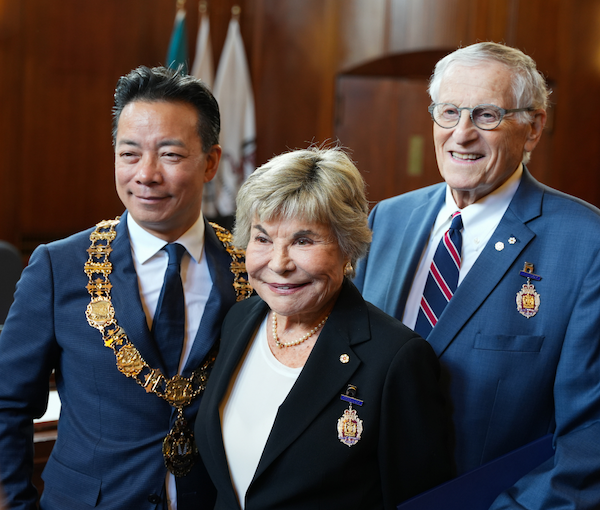
Vancouver Mayor Ken Sim, left, with Leslie and Gordon Diamond. (photo from Jewish Federation of Greater Vancouver)

To recognize their exceptional leadership and philanthropic impact in Vancouver and across the nation, Vancouver City Council unanimously agreed to bestow the Freedom of the City upon Leslie and Gordon Diamond. They were awarded the honour on Dec.12, 2023, and the award presentation was held Oct. 29, 2024.

“Leslie and Gordon have devoted their lives to the people of Vancouver,” said Mayor Ken Sim. “Their remarkable work in health care, affordable housing, community services and beyond has made a lasting impact, shaping not only our city’s history but also its future.”

An Officer of the Order of Canada and a recipient of the Order of British Columbia, Gordon Diamond founded the Diamond Foundation in 1984. Leslie, who is also a recipient of the Order of British Columbia, has worked alongside Gordon in driving initiatives that support affordable housing, social and seniors’ services, community development, education and health care.

The Diamonds’ philanthropic vision has catalyzed critical initiatives addressing health and substance use. Their contributions include landmark donations of $20 million each to Vancouver General Hospital’s Gordon and Leslie Diamond Health Care Centre and to the St. Paul Foundation’s Road to Recovery substance use disorder initiative.

As champions for the arts, the Diamonds have enabled countless underprivileged youth to access and enjoy the cultural fabric of the city. Their substantial support for the new Vancouver Art Gallery stands as a testament to their vision for arts accessibility and patronage.

“We are truly honoured to be recognized by the city we love,” said Leslie and Gordon Diamond. “To receive an award for doing what we love doing is humbling. Thank you.”

– City of Vancouver

Krell families give to JWest

The Krell, Lewis, Kallner and Singerman families are excited their gift will help in the creation of an expanded Vancouver Holocaust Education Centre. (photo by Rachel Topham)

The JWest capital campaign cabinet is grateful to Dr. Robert and Marilyn Krell and their families, Shoshana and Shawn Lewis, Simone and Howard Kallner, and Michaela and Matthew Singerman, for supporting the redevelopment of the Jewish Community Centre of Greater Vancouver site. The individual gifts from each of the four couples reflect two generations equally committed to building a strong Jewish future in Vancouver.

The Krell family has deep roots in Vancouver. Marilyn’s Polish grandfather, David Davis, who arrived in 1909, was one of the founding members of Congregation Schara Tzedeck. Robert, born in Holland, was hidden during the Holocaust and, after reuniting with his parents, arrived in Vancouver at age 10, in 1951. Both Robert and Marilyn were influenced by their parents’ involvement in the synagogue and a variety of Jewish organizations.

“Vancouver is where I became a Jew,” said Robert, who participated in Habonim as a child and became actively involved with the Canadian Jewish Congress as an adult. In 1971, he and Marilyn were married by Rabbi Marvin Hier, who was Schara Tzedek’s rabbi at the time. The couple raised their three daughters, Shoshana, Simone and Michaela, in a traditional Jewish home where Shabbat was always celebrated. The Jewish values that began at home were reinforced at Vancouver Talmud Torah, Camp Hatikvah and at the JCC. 

Robert, a founder of the Vancouver Holocaust Education Centre (VHEC), mobilized the survivor community from a concept in 1983 to a reality in 1994, when the centre opened as a museum and educational institute that ignited Shoah learning in British Columbia and beyond. The Krell daughters grew up witnessing the VHEC board meetings in their living room and attending award ceremonies that recognized their parents’ contributions to a variety of Jewish organizations.

“Through their actions and deeds, they taught us that you give when you can and volunteer when you can,” Simone said.  

Now with children of their own attending local Jewish institutions, the Lewis, Kallner and Singerman families have assumed leadership roles in the VHEC, VTT, Schara Tzedeck, Jewish Family Services, Jewish Federation of Greater Vancouver and the Jewish Community Foundation. As they saw their parents’ commitment to support JWest, they knew they were also ready to answer the call to help build a new infrastructure to support the future of the region’s Jewish community.

“We are excited to contribute to such an important and pivotal project that will be utilized and cherished not just by future generations of our Jewish community, but of the greater community as well,” said Michaela.

Her sisters expanded that idea by saying, “The JCC has played a role for five generations of our family and it shapes many of our fondest memories.”

The family is excited that their gift will also assist in the creation of an expanded Vancouver Holocaust Education Centre, an institute close to their hearts and lives. Founded with a mandate of Holocaust-based anti-racism education, the VHEC welcomes more than 25,000 students, educators and members of the public each year.

While it plays a crucial role in conveying the ongoing relevance of the Shoah, this teaching museum has long been challenged by a small footprint and its limited visibility in the lower level of the JCC. JWest will protect the legacy of the VHEC by significantly increasing its square footage and visibility. The new VHEC will be visible from West 41st Avenue and will feature state-of-the-art exhibit space for permanent and rotating exhibits. It will also have dedicated research and programming space to facilitate workshops that enhance learning and engagement. Its prominent location in the JWest campus’s Arts & Culture Centre will ensure that the VHEC remains a vital presence in the community well into the future.

“The VHEC was at the forefront of our upbringing and experience and it’s a highlight to see it being incorporated as an important component of JWest,” Simone said.

Shoshana echoed those sentiments. “It’s exciting to envision the future JCC as a hub that will encompass so many important institutions,” she said. “We want a safe space to house our next generation of Jewish institutions, so there’s an urgency for us to support this project as a commitment to the future of our children, our grandchildren and the community at large.” 

Alex Cristall, chair of the JWest capital campaign, had this response to the gift: “With five generations of active involvement in Vancouver’s Jewish community, the Krell, Davis, Kallner, Lewis and Singerman families continue to demonstrate the depth of their commitment through their gifts and volunteerism. Their generous gifts to JWest will secure and revitalize our Jewish institutions and we are deeply grateful for their support of this project.” 

As one of the largest capital projects underway in Vancouver, JWest is only possible with the support of donors and the encouragement of the community. In the coming months, the JWest capital campaign cabinet will continue to update and advise community members on the campaign’s progress and on opportunities to contribute to its philanthropic goal of $161 million.

For a full list of JWest donors, visit jwestnow.com. 

– Courtesy Jewish Federation of Greater Vancouver

Building on a legacy of hope

Dr. Oheneba Boachie, left, and Dr. Rick Hodes, centre, with patients. The JDC spine program in Ethiopia is seeing patients full-time and has evaluated more than 5,000 patients with spine deformities. (photo from Gary Segal)

The two previous Bring Back Hope events “were vital to getting us to where we are now,” Dr. Rick Hodes, American Jewish Joint Distribution Committee (JDC) medical director for Ethiopia, told the Independent. “They raised interest in our work and the financial gifts we received allowed us to expand, to operate on hundreds more patients, and to become the most important spine centre in the entire country of 120 million.”

Bring Back Hope III will take place Oct. 22 at the JW Marriott Parq Vancouver. The event, which was conceived by local businessman and philanthropist Gary Segal, will honour Hodes and raise funds to secure Hodes’ legacy by establishing a dedicated spine centre in Ethiopia and training doctors and medical staff.

Segal met Hodes on a Jewish Federation of Greater Vancouver/ JDC trip to Ethiopia in 2007. From Hodes, Segal learned about Tesfaye Anagaw, then a teenager, who had an extreme deformity in his spine that could not be operated on in Africa. Segal managed to get Anagaw the life-saving surgery he needed at Vancouver General Hospital in 2009. The experience inspired Segal to help others in similar circumstances by supporting Hodes’ work. Segal launched the Bring Back Hope Initiative (BBH) in 2012.

It wasn’t intended to be annual event, Segal told the Independent. “As a new cause with its somewhat unique origin, it took some time and thoughtful analysis to deploy the funds in a strategic manner – not just to fund the immediate and ongoing need for life-saving spine deformity surgeries, but also to increase training and capacity within Ethiopia. In addition to BBH working with JDC, the newly established BBH partnership with the UBC Branch for Global Surgical Care was unfolding methodically.

“As a result, the appropriate timing for BBH II just naturally turned out to be a five-year anniversary of the initial launch. With the similarly inspiring and even larger amount of funds raised at BBH II, I would say that, around three years later, the rumblings of a BBH III 10-year anniversary event began running through my head, only to be derailed by a couple of unforeseen ‘best laid plans of mice and men going awry’ events: COVID, followed by an outbreak of civil unrest and war in Ethiopia. So, here we are.”

One of the prominent aspects of Hodes’ work, which has been highlighted at previous BBH events, is the interfaith cooperation.

“It is not exactly a revelation to say that extremism, especially of political and religious beliefs, has historically led to much discord in the world,” said Segal. “In stark contrast, underpinning these BBH events, you have this remarkable story – rare humanitarian Jewish physician Dr. Rick Hodes, partnering with devout Baptist Ghanian-born spine surgeon Dr. [Oheneba] Boachie, working with the Catholic nuns of Mother Teresa mission in Addis Ababa, saving Muslim and Christian children. What an uplifting and powerful example of what interfaith cooperation can achieve.”

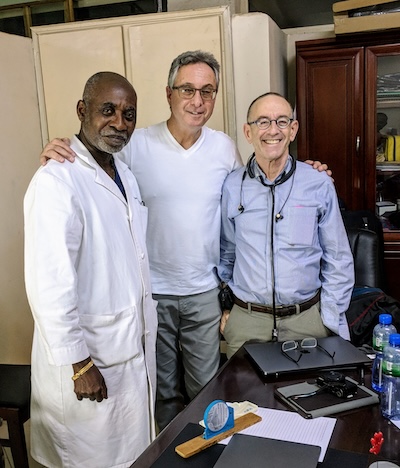
photo - From left to right: Dr. Oheneba Boachie, Gary Segal and Dr. Rick Hodes in the clinic office in Addis Ababa, Ethiopia
From left to right: Dr. Oheneba Boachie, Gary Segal and Dr. Rick Hodes in the clinic office in Addis Ababa, Ethiopia. (photo from Gary Segal)

An important development since the first BBH event is that the Ethiopian Ministry of Health has recognized the importance of the spine program.

Boachie and Hodes have been working together for almost 20 years, having met in 2005.

“In spring of 2006, we sent five patients and one staff person to Accra, Ghana. At the same time, Dr. Boachie and his team arrived from New York, and they operated on our patients and many others,” said Hodes. “The Ethiopian government was not making spine a priority, but now that we are seeing patients full-time and have evaluated well over 5,000 patients with spine deformities, they realize that this is a major cause of disability. They now are in favour of a national spine centre and are working with us to get this done. Their endorsement has shown us, and our donors, that we have ‘buy-in’ from the Ethiopian government.”

While the majority of surgeries took place in Ethiopia this year, Hodes said, “We also send patients to FOCOS Hospital in Ghana and Ganga Hospital in India for traction and for surgery. 

“We are sending Ethiopian surgeons to India for training, as well. Over the years, the majority of our difficult surgeries have been performed in Ghana, often preceded by months of ambulatory traction. Having our own centre will allow us to provide better care and to be in control of the process and the facility.”

Currently, they operate in a government hospital as well as in a private Christian hospital, said Hodes, “but we believe that a full-time, 100%-spine centre would provide better care to Ethiopians suffering from spine issues.

“I am the main doctor in the clinic, but, in the end, this must be a program run by Ethiopians for Ethiopians,” he stressed. “A national spine centre will allow this to happen. This means having a dedicated facility, as well as fully trained Ethiopian physicians, nurses, physical therapists and others to be able to evaluate, treat, operate on and rehabilitate our patients. It is a great opportunity to provide great care to our patients, and I would love to find an Ethiopian doctor to direct it.”

Hodes was in Vancouver more than once this summer, talking about his hopes for the spine program.

“I was here,” he said, “meeting people, speaking about my work and trying to interest people in our activities in Ethiopia, which involve identifying patients, evaluating and treating them, choosing people for surgery, coordinating care and arranging surgeries – and following them afterwards for years,” as care needs don’t end after the surgery is complete.

“The Dr. Rick Hodes/JDC spine program – over the last 20 years, part of JDC’s tikkun olam non-sectarian work – has not only saved and transformed countless lives, but has also served as an inspiring example and message to both the Jewish and non-Jewish world,” said Segal, who has been on the JDC board since 2012.

Hodes has been recognized for his work in various ways. Most recently, he was given the 2024 Walter P. Blount Award by the Scoliosis Research Society, whose membership “includes over 1,000 of the world’s leading spine surgeons, researchers, physician assistants and orthotists who are involved in research and treatment of spinal deformities.” The award honours “an individual who has provided outstanding service for those with spinal deformities, through their generous actions out of a sense of service to larger social and professional goals.” 

Segal and others have called Hodes “tireless” in his humanitarian work.

“I am surrounded by suffering, and it is my challenge to deal with this daily, to provide compassionate care and to raise funds for all of this,” Hodes told the Independent. “I realize that I can only help a small percent of the people who seek my care, and have to deal with that. I am motivated by my goal of helping people for whom there is no other alternative. It’s not easy. I lose sleep over this. It is never-ending.”

Hodes will return to Vancouver for BBB III. Also attending, said Segal, will be “Tesfaye, with his wife and son (whom I can’t wait to meet for the first time); two other patients whose lives were transformed through the Dr. Rick Hodes/JDC spine program; some JDC professionals from the USA, Israel and Ethiopia; and a senior Ministry of Health individual. There is also a special entertainment surprise with its own unique story and link to the evening.”

For tickets to BBH III, visit bringbackhope.com. 

Brier fêtes supporters

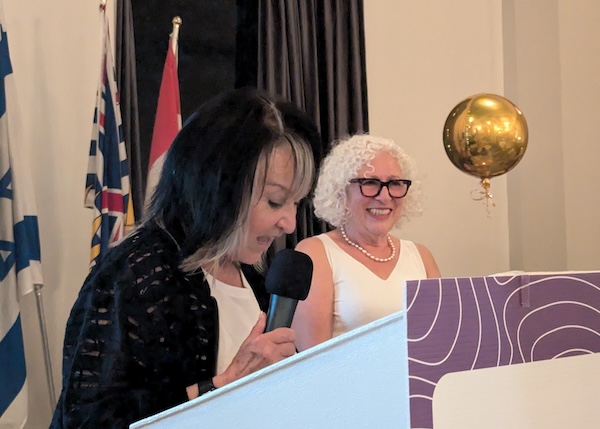
Event co-chairs Lee Simpson, left, and Helen Pinsky. (photo by Pat Johnson)

Celebration and admiration were the overriding emotions Sept. 5 at the Louis Brier Jewish Aged Foundation’s first community social event since the pandemic.

The festive occasion, which took place at Heritage Hall on Main Street, brought together supporters of the foundation and highlighted five individuals who have made profound contributions to the community. The question each was asked was “How do you do it?”

Emceed by Ayelet Cohen Weil, executive director of Louis Brier Jewish Aged Foundation, and hosted by co-chairs Helen Pinsky and Lee Simpson, the evening featured plenty of shmoozing over a kosher buffet.

Pinsky wandered the room, posing questions to individuals who have made a range of contributions to philanthropic life, beginning with Gary Averbach, who raised $600,000 for cancer research by walking from Calgary to Vancouver in weather that ranged from snow and slush to 40 degrees Celsius. His answer to the question “How did you do it?” was straightforward.

“One step at a time,” he said. 

photo - Gary Averbach
Gary Averbach (photo by Pat Johnson)

Averbach walks every day, and it struck him that he could string a lot of days together and make a major trudge across two provinces to raise money for a good cause. When a beloved cousin was diagnosed with cancer, Averbach took the opportunity to do good. His advice to people about getting involved in charitable causes was equally frank.

“I don’t know anybody who gets involved who hates it,” he said, insisting this is true even when the task at hand is something one doesn’t think they like.

“I never really enjoyed fundraising but apparently I was good at it,” he said. “It was always easier for me to write a cheque rather than ask for it. But I enjoyed the camaraderie, being with people, allegiances that were the same as mine. It was one of the most enjoyable periods of my life.”

He deflected the idea that his fundraising walk was selfless.

“I wouldn’t have done it if I hadn’t enjoyed it, so it was a really selfish thing,” he said.

photo - Marie Doduck
Marie Doduck (photo by Pat Johnson)

Marie Doduck, who published A Childhood Unspoken, her memoir of being a child survivor of the Holocaust and the life she made in Canada, was asked how she did it.

“It took me 40 years to write this book,” she said. “I’ve been fighting antisemitism my whole life. Since I came to Canada as a child, antisemitism was here. Survival is something survivors do. We have no other choice, so we do it.”

Since the book was released, as part of the Azrieli Foundation Holocaust Survivor Memoirs Program, Doduck has been traveling extensively speaking about the book, her life and the lessons to be learned from her experiences.

“The book is still in demand,” she said. “It’s coming out in French. [Doduck’s first language]. And the most surprised person alive is me. Why are people reading my book when it was a personal thing to do for my children and grandchildren and great-grandchildren?” 

She called her decades of community volunteering, “a love affair” and acknowledged that, like Averbach, there are parts she doesn’t enjoy but she does them because she can.

“Fundraising makes me ill, but I’m very good at it,” she said. 

Yvette Porte said she does what she does because she is inspired by the examples of others.

photo - Yvette Porte
Yvette Porte (photo by Pat Johnson)

“I feel that I get my inspiration from all the people I’ve met, the people who have come before me,” she said. “My mom always wanted to learn. Just before she passed away, a month before, she said, ‘I think I want to learn how to play mah jongg now.’ She was so interested in everything that went on around her. 

“My dad, who believed family was the most important thing in the world, that we always had to stick together and support each other – I learned that from him. My kids, they always learned about giving, about supporting the community…. It’s inspiring to be with everyone and I hope to pass on an example of supporting your community and supporting your family to my grandchildren and great-grandchildren.”

Sylvia Cristall spoke of the lesson she gained from her family growing up in Winnipeg.

“I couldn’t afford a lot growing up, but whatever we had, my dad said, even if you have $10, $5, you give it if you can,” she shared. “When you get older and you’re earning money, every bit counts. That’s how I grew up.”

photo - Sylvia Cristall
Sylvia Cristall (photo by Pat Johnson)

After moving to Los Angeles and then meeting and marrying Lorne Cristall, the couple started a family in Vancouver. A newcomer to the city, Sylvia asked Lorne as they were driving by 41st and Oak what that building was. He told her it was the Louis Brier Home and Hospital and that they do superb work.

“That was when we were very young,” she recalled, “and he had this feeling for the elderly. He always did. I knew that one day he would be doing something for it.” And he did. The late Lorne Cristall served as president of the Louis Brier, as well as of Vancouver Talmud Torah elementary school and Congregation Beth Israel. She is especially proud, she said, that her children have followed in their parents’ philanthropic footsteps.

Ken Levitt, the former chief executive officer of the Louis Brier and a current director on the board of the Weinberg Residence, was the last one to whom the question “How do you do it?” was posed.

“I wanted to make a difference,” he said. Levitt spoke of his earlier career, which was a two-decade stint in child welfare. 

photo - Ken Levitt
Ken Levitt (photo by Pat Johnson)

“I loved it,” said Levitt. “I worked my way from a protective worker to a senior manager.”

When he was looking for a change, he considered becoming the children’s guardian for southern Alberta but the other opportunity that presented itself was at the Louis Brier. “I fell in love with Louis Brier,” he said.

“I folded laundry and I stacked dishes for the dishwasher,” he recalled. “I got to know our residents – probably hundreds, maybe thousands, that I got to know. People who are Holocaust survivors, doctors and lawyers, people who were janitors, every walk of life. Everyone had a special story to tell because they were all special.”

And, he added: “We had a balanced budget for 16 years.”

Cohen Weil welcomed the audience, explaining that the event was a thank you to donors who have made the organization’s successes possible. While the evening was celebratory, she took a moment to recognize the pain the community has experienced since the Oct. 7 attacks and credited “our peculiar resilience as a people,” Jewish positivity, hope and compassion.

“This evening was to say thank you,” she said. “We all hope our lives will be long and independent. However, for those of us who are not so fortunate in that regard, the Louis Brier is there. We continually strive to be a better, more caring and more compassionate place for those who live here.”

The event also featured video greetings from Dr. David Keselman, CEO of the Louis Brier and the Weinberg, who was out of town, and a video featuring residents evoked the spirit of the home.

Harry Lipetz, president of the Louis Brier Jewish Aged Foundation, thanked the sponsors, who ensured that no foundation funds were expended for the gathering. These included Cristall Group Investments and the Cristall family, ZLC Financial Group, Porte Communities, the Simpson family, the Marsid Family Foundation, and WestCana Services, which is the culinary provider to the Brier.

The co-chairs, Pinsky and Simpson, spoke emotionally of the contributions the Louis Brier makes to the lives of elders in the community. 

Federation’s latest transfer of aid to Israel

Last month, Jewish Federation of Greater Vancouver transferred $9.3 million from its Israel Emergency Campaign. Additionally, the allocations committee approved a further $1.4 million for transfer.

It has been more than 10 months since Oct. 7, and the situation in Israel remains dynamic and unstable as a full-scale war looms in the north. Rachel Sachs, director of Federation’s Israel office, provided the following update: 

“Over the past few months, as the situation in the south stabilized and transitioned into rebuilding, the situation in the north has escalated, creating more complex challenges for displaced communities. 

“Mutual fire along the northern border has been steady since October 2023 but has escalated over the past few weeks. This means hundreds of homes along the border have been hit and damaged. Thousands of residents, who were evacuated … are still living in temporary housing or have settled in new homes in new communities, and do not plan to return to the Galilee when the war is over. The communities that were not evacuated have been living in an active war zone since then, under the threat of rockets, drones and missiles.”

Federation was notified by Elad Kozikaro, chief executive officer of the Kiryat Shmona Community Centres, “that a rocket hit close to Beit Vancouver causing some damage to the building. Thankfully, no one was hurt, but Beit Vancouver is home to thousands of children and teens and has left the community unnerved.”

Considering these developments, the IEC Allocations Committee, chaired by Stephen Gaerber, realigned its strategy to focus on the north. The following organizations are recipients of IEC allocations from February through June 2024: Society for the Protection of Nature in Israel (SPNI), Tzafon Medical Centre, Taglit Birthright Israel, Galilee Medical Centre, Kiryat Shmona Community Centre, Kiryat Shmona High School, Upper Galilee Regional Council, Tel-Hai College, municipalities in the East Galilee Cluster, Israel Medical Association, Dror Israel, Healthy Minds, JDC and Magen David Adom Israel.

For a full summary of the support, visit jewishvancouver.com/iec-allocations.