Skip to content

  • Home
  • Subscribe / donate
  • Events calendar
  • News
    • Local
    • National
    • Israel
    • World
    • עניין בחדשות
      A roundup of news in Canada and further afield, in Hebrew.
  • Opinion
    • From the JI
    • Op-Ed
  • Arts & Culture
    • Performing Arts
    • Music
    • Books
    • Visual Arts
    • TV & Film
  • Life
    • Celebrating the Holidays
    • Travel
    • The Daily Snooze
      Cartoons by Jacob Samuel
    • Mystery Photo
      Help the JI and JMABC fill in the gaps in our archives.
  • Community Links
    • Organizations, Etc.
    • Other News Sources & Blogs
    • Business Directory
  • FAQ
  • JI Chai Celebration
  • JI@88! video
image - Weizmann Canada Physics Tournament 2025
image - The CJN - Visit Us Banner - 300x600 - 101625

Recent Posts

  • היהירות היא אחד האויבים הגדולים ביותר של ישראל
  • Vrba monument is unveiled
  • Music to build bridges
  • A better future possible
  • Anne Frank exhibit on now
  • Human rights in sport
  • Telling the story of an icon
  • Crawl bigger than ever
  • JCC Maccabi in Toronto
  • A way to meet fellow Jews
  • Time to include
  • Add Jewish joy to the mix
  • Reminder of humanity’s light
  • From the archives … editorials
  • Year-round holiday recipes
  • מדוע עזבתי את ישראל ואינני חושב לחזור ארצה
  • OJC hosts Oct. 7 memorial
  • A journey beyond self
  • Antisemitism a problem
  • Young man is missed
  • Orr action sparks complaint
  • Prison sentence for hate
  • Etgar Keret comes to Vancouver
  • New fall lecture series
  • Series explores music
  • Doc on Zapiro screens Nov. 6
  • Joy of shared existence
  • Community milestones … October 2025
  • MAID vs Jewish values
  • Cheshvan a great month, too
  • Bull, bear or bubble?
  • From the archives … a coin, etc.
  • מדוע האנטישמיות הולכת וגואה בעולם
  • New bio gives Vrba his due
  • Joy brighter than ever
  • When approaches differ

Archives

Follow @JewishIndie

Tag: humanitarian aid

UNRWA faces deadline

Last week, the Israeli government announced that it would ban the operation of the United Nations Relief and Works Agency from operating in Israel, including in East Jerusalem.

For Arab citizens in East Jerusalem, this would mean an end to civic services like garbage pickup, three UNRWA-operated schools, and some health care and social services.

The laws passed by the Knesset would not preclude UNRWA from operating in Palestinian territories, but they would impede their work substantially. And they would eliminate any privileges or assistance UNRWA staff receive from the Israeli government, including easy passage across borders and through checkpoints.

UNRWA is a problematic organization. Begun in 1949, it has been criticized for perpetuating the Palestinian refugee crisis it was ostensibly created to resolve. By preventing Palestinian refugees from being resettled in host countries, UNRWA ensures that the refugees stand as living testament to the presumed injustice of Israel’s founding – the original sin in the anti-Israel narrative.

Through permissions granted by a bloc of Arab, Muslim and nonaligned states at the United Nations, UNRWA has expanded seemingly beyond the control of its larger parent body.

In the most illuminating example of UNRWA exceptionalism, the organization changed the definition of “refugee,” so it applies to Palestinians in ways it applies to no other people on earth. Palestinian refugee status is a heritable right, meaning descendants of the original refugees – now down to the third and fourth generations – are designated refugees when they may never have set foot in their ancestral homeland and may be second- or third-generation, for example, Jordanian- or Lebanese-born non-citizen residents. The objective of this strategy is clear: make the problem grow. The approximately 700,000 refugees of the 1948 war have grown exponentially, to 5.9 million people.

Operating in Gaza, the West Bank, Jordan, Lebanon, and Syria, UNRWA operates more than 700 schools, teaching about 500,000 Palestinian students. UNRWA clinics provide primary health care, mental health support and referrals to specialized medical services. The agency provides food assistance, welfare and other forms of support. During times of war and other crises, UNRWA provides emergency food, shelter and medical services to affected populations. They respond to needs created by violence, displacement and natural disasters. UNRWA is responsible for the most fundamental services in the refugee camps where generations of Palestinians live, including sanitation, water supply and housing.

So why is Israel banning this agency that is so clearly a lifeline to the Palestinian people – especially in a time of catastrophic war?

Israel has provided to the United Nations evidence that some of UNRWA’s 30,000 employees were involved in the Oct. 7 terror attacks and have collaborated with the terrorists before and after that dark day.

There are also older, systemic complaints. For decades, Israelis and others, including the European Union, have complained that the UNRWA-operated Palestinian education system is as much about inculcating antisemitism and a radical political agenda as it is inculcating the three Rs. 

As a politicized arm of the United Nations, UNRWA is both a weapon in the decades-long global campaign against Israel and an agency that provides desperately needed services to Palestinian civilians, never more than in a war that is wreaking destruction and death on the people of Gaza. 

Israel’s move looks punitive and vindictive in a moment when the world sees the humanitarian tragedy in Gaza. This is a bad PR move on the part of a country with a bad PR history. But PR should be among the last concerns in situations where thousands are dying. Banning UNRWA could have disastrous consequences on some of the most vulnerable people.

The Knesset’s vote to ban the organization is set to take place in 90 days. That is not a long time, certainly, but it is a window during which UNRWA and the larger UN apparatus has an opportunity 

to demonstrate goodwill. To date, they have effectively ignored Israel’s decades-long protestations that UNRWA is, for whatever necessary social services it provides, also a provocative source of incitement that promotes dependency rather than initiative and fosters antisemitic and anti-Israel activism and even terrorism.

After years of Israeli complaints and warnings, the Knesset finally put a time-limited threat to their concerns. The UN, NGOs, commentators and much of the world are up in arms over the announcement. Instead, they could be diverting those substantial energies into cleaning up the mess at UNRWA.

Perhaps the Knesset vote is an empty threat. Or rather, it could be an empty threat, if it’s primarily intended to make the larger UN body and the world take seriously the systemic problems UNRWA has exhibited through its long and troubled history. 

If UNRWA demonstrates it is willing to take seriously the rot at the heart of its operation, we hope that Israel will not enact the ban. No one can clean up the panoramic mess in three months, but we hope that evidence of goodwill would be met with flexibility on Israel’s side.

If, in the worst case scenario, the UN does not do what it should have done long ago, Israel has an obligation – humanitarian, moral and legal – to ensure that the necessities of life are provided to the people in territories it occupies. In the absence of the UN behaving responsibly, Israel must. And Israel should absolutely be able to call upon a community of humanitarian nations to assist in that process. The world’s leaders have had a great deal to say about the well-being of Palestinian civilians in the past year. This would be a moment for them to put their money where their mouths are. 

Posted on November 8, 2024November 7, 2024Author The Editorial BoardCategories From the JITags humanitarian aid, Israel, politics, refugees, terrorism, United Nations, UNRWA, war
Building on a legacy of hope

Building on a legacy of hope

Dr. Oheneba Boachie, left, and Dr. Rick Hodes, centre, with patients. The JDC spine program in Ethiopia is seeing patients full-time and has evaluated more than 5,000 patients with spine deformities. (photo from Gary Segal)

The two previous Bring Back Hope events “were vital to getting us to where we are now,” Dr. Rick Hodes, American Jewish Joint Distribution Committee (JDC) medical director for Ethiopia, told the Independent. “They raised interest in our work and the financial gifts we received allowed us to expand, to operate on hundreds more patients, and to become the most important spine centre in the entire country of 120 million.”

Bring Back Hope III will take place Oct. 22 at the JW Marriott Parq Vancouver. The event, which was conceived by local businessman and philanthropist Gary Segal, will honour Hodes and raise funds to secure Hodes’ legacy by establishing a dedicated spine centre in Ethiopia and training doctors and medical staff.

Segal met Hodes on a Jewish Federation of Greater Vancouver/ JDC trip to Ethiopia in 2007. From Hodes, Segal learned about Tesfaye Anagaw, then a teenager, who had an extreme deformity in his spine that could not be operated on in Africa. Segal managed to get Anagaw the life-saving surgery he needed at Vancouver General Hospital in 2009. The experience inspired Segal to help others in similar circumstances by supporting Hodes’ work. Segal launched the Bring Back Hope Initiative (BBH) in 2012.

It wasn’t intended to be annual event, Segal told the Independent. “As a new cause with its somewhat unique origin, it took some time and thoughtful analysis to deploy the funds in a strategic manner – not just to fund the immediate and ongoing need for life-saving spine deformity surgeries, but also to increase training and capacity within Ethiopia. In addition to BBH working with JDC, the newly established BBH partnership with the UBC Branch for Global Surgical Care was unfolding methodically.

“As a result, the appropriate timing for BBH II just naturally turned out to be a five-year anniversary of the initial launch. With the similarly inspiring and even larger amount of funds raised at BBH II, I would say that, around three years later, the rumblings of a BBH III 10-year anniversary event began running through my head, only to be derailed by a couple of unforeseen ‘best laid plans of mice and men going awry’ events: COVID, followed by an outbreak of civil unrest and war in Ethiopia. So, here we are.”

One of the prominent aspects of Hodes’ work, which has been highlighted at previous BBH events, is the interfaith cooperation.

“It is not exactly a revelation to say that extremism, especially of political and religious beliefs, has historically led to much discord in the world,” said Segal. “In stark contrast, underpinning these BBH events, you have this remarkable story – rare humanitarian Jewish physician Dr. Rick Hodes, partnering with devout Baptist Ghanian-born spine surgeon Dr. [Oheneba] Boachie, working with the Catholic nuns of Mother Teresa mission in Addis Ababa, saving Muslim and Christian children. What an uplifting and powerful example of what interfaith cooperation can achieve.”

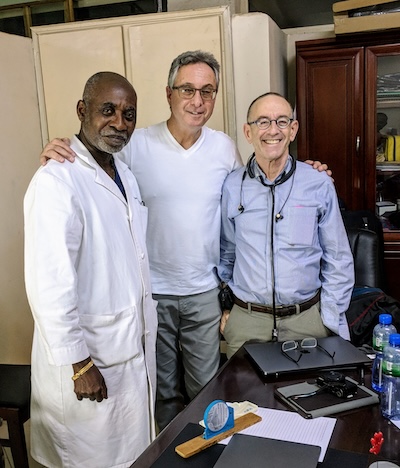
photo - From left to right: Dr. Oheneba Boachie, Gary Segal and Dr. Rick Hodes in the clinic office in Addis Ababa, Ethiopia
From left to right: Dr. Oheneba Boachie, Gary Segal and Dr. Rick Hodes in the clinic office in Addis Ababa, Ethiopia. (photo from Gary Segal)

An important development since the first BBH event is that the Ethiopian Ministry of Health has recognized the importance of the spine program.

Boachie and Hodes have been working together for almost 20 years, having met in 2005.

“In spring of 2006, we sent five patients and one staff person to Accra, Ghana. At the same time, Dr. Boachie and his team arrived from New York, and they operated on our patients and many others,” said Hodes. “The Ethiopian government was not making spine a priority, but now that we are seeing patients full-time and have evaluated well over 5,000 patients with spine deformities, they realize that this is a major cause of disability. They now are in favour of a national spine centre and are working with us to get this done. Their endorsement has shown us, and our donors, that we have ‘buy-in’ from the Ethiopian government.”

While the majority of surgeries took place in Ethiopia this year, Hodes said, “We also send patients to FOCOS Hospital in Ghana and Ganga Hospital in India for traction and for surgery. 

“We are sending Ethiopian surgeons to India for training, as well. Over the years, the majority of our difficult surgeries have been performed in Ghana, often preceded by months of ambulatory traction. Having our own centre will allow us to provide better care and to be in control of the process and the facility.”

Currently, they operate in a government hospital as well as in a private Christian hospital, said Hodes, “but we believe that a full-time, 100%-spine centre would provide better care to Ethiopians suffering from spine issues.

“I am the main doctor in the clinic, but, in the end, this must be a program run by Ethiopians for Ethiopians,” he stressed. “A national spine centre will allow this to happen. This means having a dedicated facility, as well as fully trained Ethiopian physicians, nurses, physical therapists and others to be able to evaluate, treat, operate on and rehabilitate our patients. It is a great opportunity to provide great care to our patients, and I would love to find an Ethiopian doctor to direct it.”

Hodes was in Vancouver more than once this summer, talking about his hopes for the spine program.

“I was here,” he said, “meeting people, speaking about my work and trying to interest people in our activities in Ethiopia, which involve identifying patients, evaluating and treating them, choosing people for surgery, coordinating care and arranging surgeries – and following them afterwards for years,” as care needs don’t end after the surgery is complete.

“The Dr. Rick Hodes/JDC spine program – over the last 20 years, part of JDC’s tikkun olam non-sectarian work – has not only saved and transformed countless lives, but has also served as an inspiring example and message to both the Jewish and non-Jewish world,” said Segal, who has been on the JDC board since 2012.

Hodes has been recognized for his work in various ways. Most recently, he was given the 2024 Walter P. Blount Award by the Scoliosis Research Society, whose membership “includes over 1,000 of the world’s leading spine surgeons, researchers, physician assistants and orthotists who are involved in research and treatment of spinal deformities.” The award honours “an individual who has provided outstanding service for those with spinal deformities, through their generous actions out of a sense of service to larger social and professional goals.” 

Segal and others have called Hodes “tireless” in his humanitarian work.

“I am surrounded by suffering, and it is my challenge to deal with this daily, to provide compassionate care and to raise funds for all of this,” Hodes told the Independent. “I realize that I can only help a small percent of the people who seek my care, and have to deal with that. I am motivated by my goal of helping people for whom there is no other alternative. It’s not easy. I lose sleep over this. It is never-ending.”

Hodes will return to Vancouver for BBB III. Also attending, said Segal, will be “Tesfaye, with his wife and son (whom I can’t wait to meet for the first time); two other patients whose lives were transformed through the Dr. Rick Hodes/JDC spine program; some JDC professionals from the USA, Israel and Ethiopia; and a senior Ministry of Health individual. There is also a special entertainment surprise with its own unique story and link to the evening.”

For tickets to BBH III, visit bringbackhope.com. 

Format ImagePosted on September 20, 2024September 18, 2024Author Cynthia RamsayCategories LocalTags American Jewish Joint Distribution Committee, BBH, Bring Back Hope, Ethiopia, fundraising, Gary Segal, humanitarian aid, JDC, philanthropy, Rick Hodes, spine surgery
Gondar in need of help

Gondar in need of help

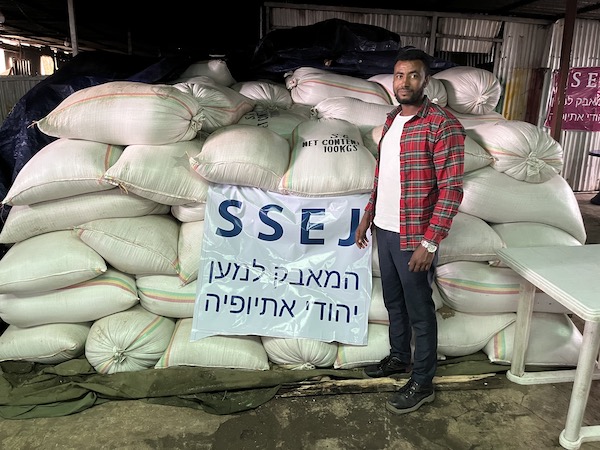
With the economy in crisis in Gondar, aid groups are moving quickly to bolster food supplies to cover 1,500 Jewish households. (photo from SSEJ)

The ethnic violence that engulfed Ethiopia’s Tigray region in recent years is now gaining a foothold in the Amhara region to the south, home to Ethiopia’s largest Jewish community.

Although the Ethiopian government and the Tigray People’s Liberation Front militia signed a peace deal in November 2022, ethnic and political tensions continue to run deep, not only in Tigray, but in the Amhara region’s principal city, Gondar, where some 6,000 descendants and relatives of Israel’s Beta Israel community continue to wait for aliyah. More than 600,000 people died during the two-year Tigray civil war. As many as half of those casualties, investigators say, were civilians whose deaths could have been prevented if adequate food stocks and humanitarian aid had been available. That fact has helped coalesce efforts by aid groups to bolster food supplies for Gondar’s Jewish community. But, as those aid organizations are finding, building the resources needed during an ongoing political conflict is difficult.

Last month, after Amhara’s local militia Fano took control of parts of the region, fighting broke out in Gondar that resulted in several days of gun battles, some within proximity of the Jewish community and synagogue. Government forces eventually retook the city, but not without casualties. At least one member of the Jewish community was killed.

As part of the government’s ongoing effort to subdue rebel forces, it declared a six-month state of emergency Aug. 4, including nightly curfews in Gondar. Businesses were forced to shutter during the fighting, and most have still not been able to reopen.

Avi Bram, co-founder for the British nonprofit, Meketa UK, which provides microloans for small businesses and other programs designed to increase economic self-sufficiency in the Jewish community, said the fighting made it unsafe for community members (and others) to leave their houses during the first two weeks, even to find food and water. Most residents in the Jewish quarter don’t have modern amenities in their homes like electricity, running water and refrigerators, he noted.

Bram said the biggest challenge right now is to guarantee residents have food. “Most houses have completely run out,” said Bram, “and it’s still very expensive to buy [supplies] at the moment in Gondar.”

Although some businesses like banks and grocery stores are now open, fighting in the outer areas of Amhara has disrupted supply chains from the capital. It’s also caused food prices to skyrocket. “So, we’re fundraising now,” Bram said.

Both Meketa UK and its North American partner, Meketa USA, which handles fundraising and educational programs in the United States and Canada, are reaching out to their donors and the general public for help. The plan is to build up basic food supplies so families don’t starve during the state of emergency. Bram said he expects the city’s economic recovery will take many months.

Two weeks ago, aid workers purchased the first large shipment of grain, oil and chickpea paste for the community. Volunteers began distributing the stocks to as many of the 1,500 homes as possible. Bram said they plan to repeat the process as more funds become available.

Like Meketa, the U.S.-based Struggle to Save Ethiopian Jewry (SSEJ) is racing to fortify its food stocks and medical supplies for the Gondar community. SSEJ is the largest humanitarian aid organization supporting Jewish descendants in Ethiopia, serving 5,000 meals a day to residents and providing a variety of medical and social services for those in need. Yet, SSEJ president Jeremy Feit admitted they are struggling right now to keep up with the increasing demand for food and support brought on by the conflict. “We continue to do what we can although we don’t have nearly enough funding,” he said.

SSEJ provides feeding programs for undernourished children, and pregnant and nursing mothers; supplemental education programs for school-age children; and a new pediatric clinic. It partners with Israeli nonprofit Operation Ethiopia, which runs an eye clinic staffed by Israeli specialists.

Feit said SSEJ hopes to work around supply chain problems by ordering food stocks from the United States and from other parts of Ethiopia. But that takes money and time. “We are also trying to get medical supplies in to service the larger Gondar area, Jewish and non-Jewish alike,” he said.

High Holy Day meals and foods are another significant demand, assisted each year by the North American Conference for Ethiopian Jewry.

With the military now visible in Gondar, Meketa co-founder Hila Bram said the sounds of gunfire are more distant. “There are a lot of government soldiers around – everyone is afraid, but the soldiers around makes it feel there is control.”  But not all of the Jewish community lives within city limits. “Many of the poorest families live in Belajek, which is an area outside the main city road, because it is cheaper there,” she said, adding that those residents still sleep with the presence of gunfire nearby.

Aid workers know that, even if the fighting ended tomorrow, it will likely be many months before economic stability is restored and everyone can return to work. While residents wait hopefully for an airlift to Israel, aid agencies are already planning the next emergency food shipments to tide them through winter.

For more information about Meketa UK/USA (meketausa.org), Struggle to Save Ethiopian Jewry (ssej.org), Operation Ethiopia (operationethiopia.com) and North American Conference on Ethiopian Jewry (nacoej.org) and how you can assist, visit their websites.

Jan Lee is an award-winning editorial writer whose articles and op-eds have been published in B’nai B’rith Magazine, Voices of Conservative and Masorti Judaism and Baltimore Jewish Times, as well as a number of business, environmental and travel publications. Her blog can be found at multiculturaljew.polestarpassages.com.

Format ImagePosted on September 1, 2023August 29, 2023Author Jan LeeCategories WorldTags Ethiopia, food shortages, Gondar, humanitarian aid, Meketa, SSEJ, Struggle to Save Ethiopian Jewry, war
IsraAID helps around world

IsraAID helps around world

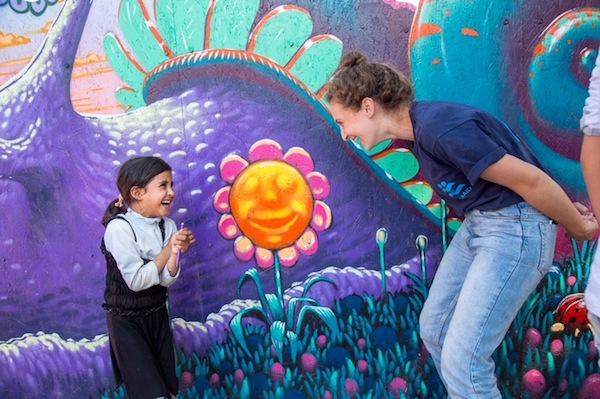
This picture of Molly Bernstein, right, was taken last year at the School of Peace, a program run in partnership by IsraAID and the Israeli Hashomer Hatzair Youth Movement on Lesbos, Greece. (photo from IsraAID)

“I say crisis with air quotes because I think that’s a bad attitude,” Molly Bernstein told the Independent. “It’s an opportunity.”

In discussing the number of displaced people in the world, usually referred to as “the refugee crisis,” Bernstein said, “I strongly believe that diversity is a social good for our societies. When we integrate new people into our communities, we learn more about ourselves and others, build bridges between communities, and build relationships that breed positivity in the world.

“When we open our doors and our hearts to refugees, we’re doing exactly this,” she said. “That’s why it’s an opportunity to expand our worldview and the spectrum of opportunities for doing good that stands before us.”

Bernstein, a 27-year-old resident of south Tel Aviv, works for IsraAID, an Israeli nongovernmental organization that works in emergency and long-term development settings in dozens of countries. The humanitarian aid organization responds to conflict, natural disasters, acute poverty, discrimination and displacement.

Bernstein, currently working in the communications department at IsraAID headquarters in Tel Aviv, spoke to the Jewish Independent during a recent trip to Vancouver, Jan. 31-Feb. 3.

“My parents were longtime members of Habonim,” she said, referring to the Zionist youth movement. “We lived in Israel for a time and I became interested in learning Arabic, so as to have a deeper understanding of the conflicts in Israeli society and how to address them. Learning Arabic opened up a lot of doors for me.”

Bernstein completed a bachelor of arts at the University of Maryland, College Park, then lived in Morocco, Jordan and Tajikistan. She began working with an Arab-Jewish Israeli NGO in Israel, the Abraham Fund Initiatives, which focuses on the creation of a shared society, and then landed a job with Ha’aretz.

It was while she was working at Ha’aretz, combing through pictures of the Syrian military’s chemical attacks on Syrian civilians, that she decided she wanted to do relief work. She had heard of IsraAID and considered working for them “an item from my bucket list.” So, when a job opportunity with the organization arose, she jumped at it, and got it. She was sent to the Greek island of Lesbos as head of missions, where she oversaw programs supporting refugees. Six months later, she was promoted to the NGO’s headquarters in Tel Aviv.

“IsraAID started when a group of buddies who were connected and had networks of doctors, nurses [and] engineers, and search-and-rescue folk would organize themselves and fly out and get some work done,” explained Bernstein. “When [the 2010 earthquake in] Haiti happened, they realized they needed a long-term response plan and so they started an NGO to develop that capability. They were in Haiti for eight years.”

Founded in 2001, IsraAID has an annual budget of about $10 million and has worked in emergency and long-term development missions in 46 countries, including the United States. Volunteers with IsraAID, for example, continue to work in Reno, Nev., with evacuees from the wildfires in Northern California. In 2017 alone, IsraAID worked in 20 countries.

As an Israeli aid organization, IsraAID sometimes finds itself in the crosshairs of those who want to view their work through the framework of either Zionist or anti-Zionist ideology. Bernstein said IsraAID is having none of it either way. “We are really just focused on the work,” she said. “Other people may want to raise other questions about it, but we’re just like, OK, you have that conversation, there’s a person I have to help over here.”

That said, the organization’s Israeli base means they have unique contributions to offer. “We are proud to bring technologies from the country we come from,” said Bernstein. “And it’s not a coincidence that we’re really good at water management and trauma processing. Those are two things Israelis have needed to become good at it.”

Bernstein is continuing her academic studies at Tel Aviv University, pursuing a master’s degree in Middle Eastern history, while working for IsraAID. Meanwhile, the NGO is looking to expand the ranks of their volunteers. They’ve opened a headquarters in Los Angeles and Bernstein said another North American base may follow, possibly even in Canada. In Vancouver? “It’s not impossible,” she said.

Matthew Gindin is a freelance journalist, writer and lecturer. He is Pacific correspondent for the CJN, writes regularly for the Forward, Tricycle and the Wisdom Daily, and has been published in Sojourners, Religion Dispatches and elsewhere. He can be found on Medium and Twitter.

Format ImagePosted on March 1, 2019February 27, 2019Author Matthew GindinCategories WorldTags humanitarian aid, Israel, IsrAID, Molly Bernstein
Humanitarian delivery

Humanitarian delivery

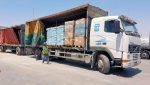
Humanitarian goods from Turkey arrive at the Kerem Shalom crossing point into the Gaza Strip; it was the first such shipment to arrive in Israel from Turkey since the reestablishment of ties between the two countries at the end of last month. (photo from Ashernet)

The families of Israel Defence Forces soldiers Oren Shaul and Hadar Goldin – both of whom were killed two years ago in Operation Protective Edge and whose bodies are still held by Hamas – were dissatisfied with the reconciliation agreement between the two countries, as it did not include the return of their sons’ bodies or the return of two Israeli citizens, Avraham Mengistu and Hisham al-Sayyad, imprisoned in the Gaza Strip. Many also objected at the apology by Israel to the Turkish government, together with a $20 million compensation package, over the May 2010 IDF raid on the Gaza-bound Turkish ship Mavi Marmara, which resulted in the deaths of 10 Turkish citizens after the activists on board attacked the IDF soldiers; it was this event that caused the break in Turkish-Israeli relations.

Format ImagePosted on July 8, 2016July 6, 2016Author Edgar AsherCategories IsraelTags Gaza, humanitarian aid, IDF, Israel, Turkey
Proudly powered by WordPress