Skip to content
  • Home
  • Subscribe / donate
  • Events calendar
  • Business Directory
  • FAQ
  • News
    • Local
    • National
    • Israel
    • World
    • עניין בחדשות
      A roundup of news in Canada and further afield, in Hebrew.
  • Opinion
    • From the JI
    • Op-Ed
  • Arts & Culture
    • Performing Arts
    • Music
    • Books
    • Visual Arts
    • TV & Film
  • Life
    • Celebrating the Holidays
    • Travel
    • The Daily Snooze
      Cartoons by Jacob Samuel
    • Mystery Photo
      Help the JI and JMABC fill in the gaps in our archives.
  • Community Links
    • Organizations, Etc.
    • Other News Sources & Blogs
  • JI Chai Celebration
  • JI@88! video

Recent Posts

  • Legal help for students
  • Revisiting myth of Lilith
  • Wrong person rebuked
  • Canada’s mixed messages
  • Questions for museum
  • Symposium on antizionism
  • Making soccer political
  • CJPAC lauds Pulver’s impact
  • City recognizes Vrba’s legacy  
  • Organ donation saves lives
  • Theodore’s March premiere
  • A healing Shabbaton
  • Supplying healthy food
  • A chime of metal tags
  • Yellowknife seder a first
  • Ishai energizes, unifies
  • A Lag b’Omer to remember
  • Expanding the healing
  • Hannah Senesh – a unique hero
  • Community milestones … May 2026
  • Sharing her testimony
  • Fall fight takes leap forward
  • The balancing of rights
  • Multiple Tony n’ Tina roles
  • Stories of trauma, resilience
  • Celebrate our culture
  • A responsibility to help
  • What wellness means at JCC
  • Together in mourning
  • Downhill after Trump?
  • Birth control even easier now
  • Eco-Sisters mentorship
  • Unexpected discoveries
  • Study’s results hopeful
  • Bad behaviour affects us all
  • Thankful for the police

Archives

Follow @JewishIndie
image - The CJN - Visit Us Banner - 300x600 - 101625

Tag: democracy

Opposition to policies

Opposition to policies

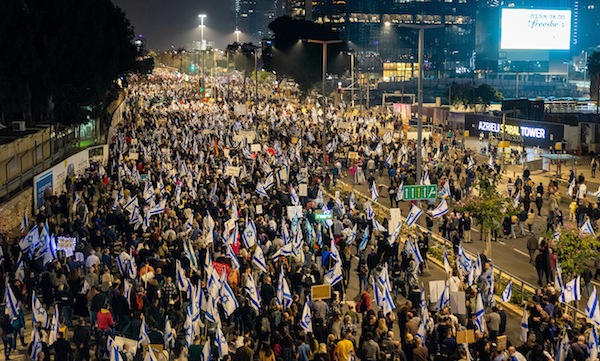
In Tel Aviv on Jan. 28, Israelis demonstrate against their government’s judicial reform proposals. A majority of Canadian Jews also oppose the proposals. (photo by Oren Rozen)

A new poll shows that most Canadian Jews oppose policies favoured by the current Israeli government. Fully three-quarters of Canadian Jews say they are emotionally attached to Israel. However, 56% claim that Israel’s government is moving in the wrong direction, compared to just 13% who say it is moving in the right direction.

Opposition is especially strong to laws proposed by members of the governing coalition that would allow gender segregation in some public places, ban Pride parades and legalize conversion therapy for LGBTQ+ people on religious grounds, with between 83% and 88% of Canadian Jews expressing opposition to such moves.

Some 73% of Canadian Jews oppose judicial reform that would make it easier for the Israeli government to reverse Supreme Court decisions, thus adding their voices to that of well-known Canadian jurist and former minister of justice Irwin Cotler, among others.

Two-thirds of Canada’s Jews oppose the idea of disallowing Palestinians from serving in the Israeli parliament, compared to just 15% who support the idea. About twice as many Canadian Jews oppose building new Jewish settlements in the West Bank and incorporating parts of the West Bank into the state of Israel as favour such initiatives.

The so-called “grandparent clause” in Israel’s Law of Return allows anyone with one Jewish grandparent to claim citizenship, but religiously Orthodox members want the clause removed. Some 58% of Canadian Jews oppose such a move, while 17% favour it – hardly surprising since fewer than one-fifth of Canadian Jews are Orthodox.

Israel’s minister of national security was once convicted of incitement to racism and supporting a terrorist organization. Israel’s minister of finance recently described himself on radio as a “proud homophobe.” JSpaceCanada and the New Israel Fund of Canada have proposed that the Canadian government refuse to meet or build relationships with these ministers. Nearly six in 10 Canadian Jews agree with that proposal, while just two in 10 disagree.

Commenting on the results, Joe Roberts, board chair of JSpaceCanada, said, “These results couldn’t be clearer, Jewish Canadians are overwhelmingly concerned with the direction and policy decisions proposed by Israel’s radical governing coalition. These are not the shared values that the Canada-Israel relationship was built upon. Jewish Canadians, like the hundreds of thousands of Israelis taking to the streets to protest the undermining of democracy and assault on the human rights of Palestinians, expect bold and decisive leadership on this issue from the government that represents us in Ottawa.”

Ben Murane, executive director of the New Israel Fund of Canada, said, “Canadian Jews are worried that a country that removes basic democratic checks and balances and eviscerates the independence of the judiciary can no longer be referred to seriously as a full democracy. They overwhelmingly oppose the Israeli government’s legislation stripping power from the country’s judiciary, one of the few remaining institutions willing to protect the rights of Palestinians, LGBTQ people, women and other vulnerable populations.”

The poll was funded by JSpaceCanada and the New Israel Fund of Canada, organizations that promote democracy and equality in Israel, as well as a two-state solution to end the Israel-Palestine conflict. It was designed and analyzed by Prof. Robert Brym of the department of sociology and Centre for Jewish Studies at the University of Toronto. Brym commented, “To corroborate these findings we need more polls with larger samples asking similar questions. However, this poll provides a fair baseline representation of Jewish community perspectives on issues of vital importance to the approximately 404,000 Canadians who identify as Jewish by religion or ethnicity.”

The poll, fielded between Feb. 16 and 28, 2023, by EKOS Research Associates, is based on a nationally representative sample of 288 Canadian adults who identify as Jewish by religion or ethnicity. Nineteen of 20 polls like this one would likely yield results with less than a 5.8% margin of error.

– Courtesy JSpaceCanada
Format ImagePosted on March 10, 2023March 9, 2023Author JSpaceCanadaCategories Op-EdTags Ben Murane, civil rights, democracy, Diaspora, governance, Israel, Joe Roberts, JSpaceCanada, justice, Netanyahu, New Israel Fund, NIFC, surveys
Israelis not that divided

Israelis not that divided

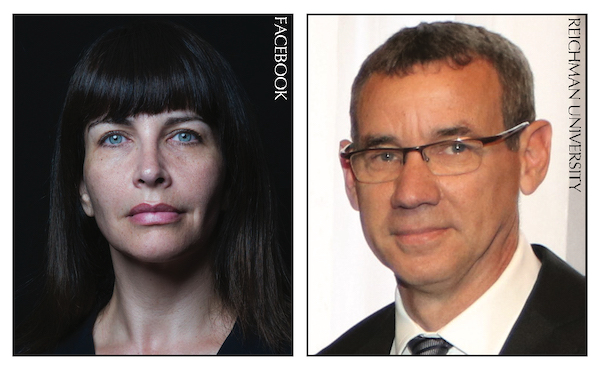
Dr. Einat Wilf and Mark Regev spoke at a Centre for Israel and Jewish Affairs event Feb. 9.

Canadian Jews who don’t like the look of Israel’s new government should not withdraw from engagement with that country and its discourse, but get more involved, says Dr. Einat Wilf, a former Labour party member of the Knesset.

Leaders in the North American Jewish community are expressing concerns over the new government and aspects of its policy agenda, while others worry that the always-present fear of schisms between Israeli and Diaspora Jewry could be reaching a breaking point. But Wilf said this is a time for overseas Jews to act strategically to influence policies that reflect their priorities.

Wilf, who served in the Knesset from 2010 to 2013, is an author, businessperson and one-time foreign policy advisor to Shimon Peres. She was part of a panel convened by the Centre for Israel and Jewish Affairs Feb. 9. Wilf engaged with Mark Regev, who is chair of the Abba Eban Institute for Diplomacy and Foreign Relations at Reichman University and a former spokesperson and senior foreign affairs advisor to Binyamin Netanyahu. He also served as Israel’s ambassador to the United Kingdom. Yaron Deckel, the Jewish Agency for Israel’s director for Canada and a veteran Israeli journalist, moderated the event.

Wilf said it is up to Canadian Jews to decide how to respond to the political situation in Israel. “But my personal view is that this is perhaps the time for Jews outside Israel to fund more and channel money and efforts to things that have to do not with welfare but actually with how Israel is Jewish,” she said. “North American Jews, if they want Israel to be hospitable to their kind of Jewish practice, they need to make a stark choice.”

The Conservative and Reform movements in Israel are simply too small to be major players in this discussion and so the more practical camp with which Diaspora adherents of those denominations can partner to meet their goals is the secular movement, Wilf said. This is the most likely way to advance policies such as egalitarian prayer at the Kotel, liberal interpretations of identity for aliyah and reducing the powers of the chief rabbinate.

Both panelists attempted to dispel some conventional wisdom, including that Israeli society is divided, turning its back on liberalism and getting more and more religious.

“Israeli democracy, as it stands now, is more inclusive, more representative of the greater diversity of voices than it has been probably throughout its history,” said Wilf. That diversity, by its very inclusiveness, has opened the door to ideas that can be considered contrary to traditional progressive Israeli values, she argued. “That means that more non-liberal voices are represented than ever before.”

Regev concurred. The “good old days” of early Israeli democracy were, he said, “a one-party state run by the Labour Party.… It was a much more conformist society, it was difficult for gays, it was difficult for women, it was a society that was more closed, it was difficult for Mizrahim,” he said. “Today, I have no doubt if you look at the trajectory, Israel is more liberal, more pluralist, more open, more free than ever before.”

A couple of decades ago, Regev noted, if you wanted to go out for dinner in Jerusalem on a Friday night, you had to travel to east Jerusalem. “Now, in Jewish Jerusalem, you have all sorts of places you can go to,” he said. “The idea that Israel is becoming only more religious, more Haredi, more Orthodox is just not true.”

One of the areas where most Israelis agree, said Wilf and Regev, is on the Palestinian issue. After Yasser Arafat ended the peace process and started the Second Intifada, and his successor Mahmoud Abbas demonstrated no more conciliatory a tone, Israelis realized the ball was not in their court. All they can do is wait for a change of leadership on the Palestinian side, both said.

The fiercest divisions in Israeli society right now are over proposals to reform the judiciary, including allowing the Knesset to override Supreme Court decisions by a majority vote and to hand the power of judicial appointments to politicians.

Deckel noted that Canadian legalist Irwin Cotler has warned that the judicial overhaul would make Israel a flawed democracy and other Jewish leaders in North America have spoken up in ways that are rare or unprecedented against some of what the new government is advocating.

“Is there really a threat to Israeli democracy?” asked Regev. “I’m not so sure. I don’t believe there is. I believe Israeli democracy is strong. I believe we can debate the pros and cons of the different judicial reforms put on the table without having to say this is the end of democracy.”

Both commentators think fears of the new government are overblown, although Wilf has a caveat. She has studied past Netanyahu governments and concluded their bark is generally worse than their bite or, at least, that the “hysteria” with which they were met was not commensurate with the policies they enacted.

“All Netanyahu governments, especially the one of 2015, were received with complete hysteria and none of it materialized,” said Wilf. “Sometimes the exact opposite. Netanyahu turned out to be much more centrist, careful, generally very much eschewing violence and conflict and even bringing peace agreements.”

A difference now, said Wilf, is that Netanyahu is head of a more ideologically narrow government, where in the past he had built fairly broad coalitions.

“For Netanyahu, that was very comfortable,” Regev said. “Because, when you have a coalition partner to the left of you and a coalition partner to the right of you, that allows you to be the conductor of the orchestra, so to speak.”

Regev sees a danger in Diaspora Jews who disagree with events in Israel airing dirty laundry, but Wilf said that is the least of her concerns. No matter who is in charge or what policies they advance, overseas opponents will make the same case, she said. “They still would have argued that Israel is a settler-colonial, apartheid, genocidal, white European blah blah blah,” she said. “That’s how they work.”

Addressing the widespread spike in antisemitism, Regev sees a silver lining. “You could be very cynical and you could say some things don’t change. But something has changed,” he said. “Something very important has changed. Unlike my father when he was a child and the Jews were stateless and defenceless and knocking on people’s doors [saying] ‘Please let me in so they won’t kill me,’ today we can proudly say that, if something has changed, the Jews have changed. We have a state. We have a successful state. With all our problems, Israel is a very successful country, politically, economically, diplomatically, militarily. We can protect ourselves.”

Gail Adelson-Marcovitz, national chair of the board of the Centre for Israel and Jewish Affairs, opened the online event, which attracted more than 1,000 participants. “Many of us believe that Israel is a state of the totality of the Jewish people and not just its citizens,” she said. “While it is the citizens of Israel who elect their government, that choice has ramifications for many aspects of our partnership and specifically impacts Diaspora Jews. We feel that our interest must, at the very least, be heard, if not respected, particularly in those areas where we are impacted.”

Format ImagePosted on February 24, 2023February 23, 2023Author Pat JohnsonCategories Israel, LocalTags Centre for Israel and Jewish Affairs, CIJA, democracy, Diaspora, Einat Wilf, Gail Adelson-Marcovitz, Israel, Mark Regev, politics

Obligation to criticize

Last Saturday, Israel’s ambassador to Canada announced he was resigning over differences with the new government back home.

Ronen Hoffman has served only about a year in the role. He was appointed by the last government and, before that, had been a Yesh Atid party member of the Knesset under the leadership of former prime minister Yair Lapid. So, Hoffman was a political appointee, which makes his resignation significant but not the bombshell it would have been had he been a career diplomat.

Nevertheless, this was perhaps the most conspicuous example in Canada of ripples of response to what media around the world have taken to calling Israel’s “most right-wing government ever,” which was sworn into office under the once-and-then-again-and-now-again Prime Minister Binyamin Netanyahu Dec. 29.

Having alienated, via policies or personality, a great number of potential allies on the centre and right, Netanyahu cobbled together a parliamentary coalition that includes some of the most extremist voices in Israeli society. As we mentioned in this space last issue, some of the approaches the new government seems bent on are not merely matters of policy but structural tampering with the fundamental tenets of Israeli democracy, including the courts, definitional foundations of citizenship, possible assaults on LGBTQ+ rights, as well as what appears to be a new bull-in-the-china-shop approach to governance and settlements in the West Bank.

In this issue of the paper alone, two separate Canadian organizations express concern about the impacts that perceptions of the new government in Israel will have on their work here.

Some Diaspora voices have been saying that this is the time for overseas allies to express in whatever ways possible to their Israeli counterparts, family and friends the impacts that certain policy approaches there will have on Jewish people here, and on relations between Jews in both places.

There is no doubt that the people who have made a cottage industry of attacking Israel in the past will continue to do so, using as fuel any evidence that the state of Israel is abandoning its commitments to human equality, democracy and pluralism. Haters gonna hate.

But there is another possibility, a conceivable glimmer of light shining through the cracks of Israeli-Diaspora relations.

There has always been a rhetorical disconnect between “anti-Zionism,” which by definition seeks the elimination of the Jewish state, and “criticism of Israel” or “criticism of particular policies,” which tends to be more nuanced. There has also been a casual accusation that pro-Israel voices are “uncritical” in their support for Israel, that there is a tendency to turn a blind eye toward things taking place in Israel that deserve condemnation.

Recent developments put these various positions in stark contrast.

There are now many issues and policies that probably the vast majority of Jews outside Israel (as well as inside Israel, as enormous protests in recent days have shown) find disagreeable, even abhorrent. For those who support Israel’s right to exist and for those who don’t, these issues and policies present an opportunity.

It is now especially necessary for supporters of Israel and allies to be absolutely clear that it is possible and reasonable to be emphatically, unequivocally supportive of the right of the Jewish people to self-determination in the form of the state of Israel while at the same time pointing at very specific policies with which we disagree vehemently.

There has often been far too much vagueness in this discussion, allowing people with unreasonable positions to appear reasonable, to allow people who would like to see Israel wiped off the map claim they are only criticizing “policy.” On the flip side, while there has always been a vibrant discourse among Diaspora Jews on events in Israel, critics have somehow been able to ignore that vibrancy and claim a monolithic Zionist hegemony of ideas. (This is, ironically, a conspiracy theory masquerading as a conspiracy theory.)

As this Israeli government proceeds with its agenda, and recognizing that Israeli voters have the final say, overseas Jews who for generations have supported and helped build the Jewish state have a right to express our opinions. We also have an obligation to be specific. There has perhaps never been a time when it has been easier to be clear: Israel has a right to exist. But efforts to chip away at the foundations of Israel’s judiciary, human rights and citizenship definitions are unacceptable, and it is right for Israelis and their overseas allies to say so in our loudest voices. Criticizing policies and being steadfast defenders of Israel have never been contradictory impulses. Now, more than ever, these are our obligations.

Posted on January 27, 2023January 26, 2023Author The Editorial BoardCategories From the JITags democracy, Israel, politics, Ronen Hoffman

Democracy in danger

A pageant of pandemonium consumed the United States House of Representatives last week as it took 15 votes to confirm Kevin McCarthy as speaker. The chaos was caused by a group of far-right congresspeople representing less than five percent of the total House membership. Eventually, McCarthy triumphed – well, squeaked through – by cutting backroom deals that will empower the extremists and weaken the office of the speaker.

Although the holdouts are on the far-right fringes of American society, personality was a major factor in the weeklong deadlock. The opponents have issues with McCarthy as a person and a politician as much as they have with his policies. To succeed, McCarthy had to agree to concessions and cough up inducements that defile the dignity of his office and put the House of Representatives in jeopardy of being hopelessly deadlocked and dysfunctional.

An analogous situation is unfolding in Israel, where Binyamin Netanyahu has returned to the prime ministership. To do so, he had to make some very grubby deals with some very distasteful people.

Here, too, personalities were at play, as much as policies. There is a swath of centre-right politicians who would have joined a coalition that was not headed by Netanyahu. As a result, to regain power, Netanyahu was forced to make deals with far-right figures who should never have been considered for inclusion in a democratic government.

Both of these situations speak to an unfortunate reality of parliamentary democracy. When a bloc fails to attain a comfortable majority, they can find themselves dependent on the support of narrowly focused, ideologically driven extremists that represent very few voters. In many cases, the extremist tail ends up wagging the dog.

This is regrettable and it is sometimes inevitable. Democracy is by no means without its downsides. In fact, Winston Churchill’s aphorism – “Democracy is the worst form of government – except for all the others that have been tried” – resonates here.

The foundational piece of democracy is free elections and the peaceful transition of power, a cornerstone that was attacked on Jan. 6 two years ago at the U.S. Capitol. That cornerstone is now under siege in Brazil, in a striking parallel – as if the supporters of defeated former president Jair Bolsonaro directly stole the playbook of the American Republicans’ “stop the steal” scheme to subvert the 2020 U.S. election.

Violent protesters ransacked Brazilian government buildings this week, stealing weapons and artifacts and vandalizing facilities. Brazil does not have as long a history of democratic infrastructure as Israel or the United States, which could make it more vulnerable to attack. One core difference in the Brazilian case, versus the Israeli or American situation, is that the threats, at this point, are coming from outside the government – the protesters are supporters of a defeated (and possibly self-exiled) former leader. In the United States, the insurgents have an apparent stranglehold on one of the houses of Congress and, in Israel, are fully in charge.

The biggest concern in a democracy comes when the extremist tail that wags the dog not only influences policies but actually begins chipping away at the institutional underpinnings of democracy itself. This is a legitimate concern in Israel, as some partners in the coalition are threatening the judicial system, the functioning of police and the very definition of Israeli citizenship. The vote for U.S. House speaker did not itself represent a threat to democracy, though the final votes poignantly took place on the second anniversary of the insurrection that was the greatest attack on American democracy since the Civil War – a moment from which the country and its democratic foundations still reel. And continued dysfunction in the House portends a difficult road ahead for U.S. democracy as voters tire of do-nothing legislative bodies and what some perceive as broken political systems.

Both Israel and the United States are on unprecedented precipices. (Brazil, ironically, probably less so.) However, in both Israel and the United States, entrenched civil society organizations and strong parliamentary opponents are in place to monitor and bolster the fundamentals of their societies. Those on the (geographical and/or ideological) outside should support in every way we can the movements for democracy, pluralism and tolerance in Israel, the United States and everywhere in the world where these values are threatened, including if we see dangers to them here at home.

Posted on January 13, 2023January 11, 2023Author The Editorial BoardCategories From the JITags Brazil, democracy, Israel, politics, United States

Rail against extremism

Coalition negotiations continue in Israel after the fifth election in less than four years. And the signs are ominous for the future of Israeli democracy, for women’s equality, for religious pluralism, for LGBTQ+ rights, for peace and for coexistence.

Bezalel Smotrich, head of the Religious Zionist party, will be a major player in the new government, as will the leaders of two parties with whom he ran in an electoral slate: Itamar Ben Gvir, head of Otzma Yehudit (Jewish Power), and Avi Maoz, head of the religious extremist faction Noam.

Smotrich will apparently have unprecedented influence over the growth and governance of West Bank settlements. The explosive issue of “who is a Jew” – which determines eligibility for immigration under the Law of Return – will fall in part to Maoz, who wants to delegitimize non-Orthodox conversions and narrow the parameters under which an immigrant is permitted under the Law of Return from grandchildren of Jews to those born to Jewish parents. In addition to determining Jewish identity, Maoz has a preoccupation with homosexuality and has promised to ban Pride Parades and  oppose equality for gay Israelis. (Netanyahu has said he won’t allow Maoz to diminish gay rights.) Netanyahu has promised to hand Maoz control over a NIS 2 billion budget (about $790 million CDN) for “external programming” in public schools.

Yair Lapid, the outgoing prime minister, railed against this allocation.

“If we don’t stop them, Avi Maoz and his unenlightened gang will put unenlightened, racist, extremist, misogynistic and anti-LGBT content into our children’s schools,” said Lapid.

Ben Gvir and his party call for the expulsion of Arabs they deem disloyal and he has suggested that the anti-Zionist religious sect Neturei Karta should be put “on a train.” Ben Gvir’s party advocates the absorption of the West Bank which, by necessity, would eliminate either the Jewish identity or the democratic nature of Israel – and we do not need to speculate on which Ben Gvir would be willing to discard.

The three horsemen have endorsed banning public transit and sports on Shabbat, eliminating a department that promotes women in the military, and snatching the power to appoint judges from a nonpartisan panel and putting it in the hands of politicians, in addition to a host of other far-right policy fetishes.

“This Israel is not going to be governed by talmudic law,” Netanyahu said in defence after attacks on his coalition agreements. This is precisely the direction his partners are headed, however, and the very fact that he was moved to make such a disclaimer is proof of how dangerously close the new government will be to crossing a religious-secular divide that the pioneers of the state consciously erected.

The jigsaw puzzle parliament is not Netanyahu’s fault – any prime minister was going to have to cobble together a mismatched majority. What is Netanyahu’s fault is the particularly rancid aspects of the coalition. Seeing the unlikelihood of the most hateful and divisive minor parties reaching the electoral threshold in the previous election cycle, Netanyahu personally intervened to urge them to band together to get into the Knesset. An historical precedent is worth reiterating: when the fundamentalist Rabbi Meir Kahane was elected to the Knesset in 1984, the entire chamber stood up and walked out when he spoke. By contrast, when Kahane’s ideological descendants were facing electoral oblivion in 2020, Netanyahu stepped in to help ensure their success. There are many cases in Israel (and other divided parliamentary democracies) where the extremist tail wags the more mainstream dog. In this case, to mix canine metaphors, the ostensibly mainstream leader laid down with dogs and woke up with fleas.

The controversies in Israel have already swept across the ocean. Diaspora Jewish communities are aflame in concern and condemnation. The longstanding divides between Israeli and Diaspora Jews are already being exacerbated – and the new government hasn’t even been sworn in.

The most stalwart voices of Diaspora Zionism are issuing warnings. Abe Foxman, longtime head of the Anti-Defamation League, came out of retirement to harrumph that his support for Israel is not unconditional. The usual suspects in the anti-Israel camp are crowing that their prognostications have proved spot-on. But, more worrying, are middle-of-the-road Jewish and non-Jewish voices who are looking at developments and wondering what it is they defend when they defend Israel. The multi-partisan support Israel has largely enjoyed in the United States, Canada and some other places will be further challenged by Israel’s nationalist, anti-pluralist and generally extremist policies.

In this space, we have repeatedly said that it is up to Israelis alone to determine what defence strategies are necessary to preserve life and limb against terrorist and other threats in Israel. It is Israelis who put their lives and the lives of their children on the line in national defence.

That exclusivity does not extend to policies like teaching homophobia in schools or limiting the role of women in the military – and it certainly doesn’t extend to policies, like the Law of Return, that directly affect Diaspora Jews.

People who care about the pluralist, democratic, inclusive Israel that was dreamed of and built by generations who came before us have a right – an obligation, in fact – to rail against what appears to be on the horizon for the country we care so deeply about, are invested in so much, and count on for Jewish safety and survival.

Posted on December 9, 2022December 7, 2022Author The Editorial BoardCategories From the JITags coalition, democracy, Diaspora, human rights, Israel, Netanyahu, politics, theocracy

Concerning elections

On Remembrance Day, we reflect on the sacrifices made by Canadians who fought to defend freedom. Many of us recall the solemnity of our childhoods standing in a school auditorium, first beginning to understand the meaning behind the poem “In Flanders Fields” and the moment of silence.

Similar ceremonies occur worldwide, including in places where the loss of life in wars has been far greater and more recent than our nation’s experience.

At the same time, it is impossible not to reflect on how some of the messages of tolerance, coexistence and peace seem to have been lost on leaders of various countries – as well as those who vote for them.

Across Europe, the Americas and some other places, extremism is growing. Far-right governments in Italy, Poland and Hungary advance xenophobic and scapegoating policies. While not yet reaching the highest echelons of power, far-right groups in Germany and France are growing in popularity. The defeat of Jair Bolsonaro, Brazil’s extreme-right and volatile president, is a bright spot, though the leftist Luiz Inácio Lula da Silva, who beat him only by a hair, demonstrated in his previous term as president that he is also no archetype of impeccable governance.

Enormously alarming were this week’s midterm elections in the United States. More than half of the Republican candidates for Congress and state offices, including crucial officials who oversee election processes, are “election deniers” who claim that the 2020 presidential race was not rightfully won by Joe Biden. The refusal of the former president to acknowledge defeat and accede to the peaceful transition of power, hand-in-hand with the insurrection at the Capitol on Jan. 6, 2021, represent the greatest threat to American democracy since that country’s Civil War. The last two years have shown how fragile this form of governance is and how dependent it is on the goodwill of its participants to abide by the rules and accept the will of the people. The fact that about half of American voters don’t seem the least bit bothered by this reality is the scariest part.

Then, and by no means least, are the results of Israel’s most recent national elections. The good news is that, after five elections in three years, the country will apparently have a stable coalition government. The bad news is that it will include individuals whose political and moral values should be scorned by people who support democracy, pluralism and respect. Itamar Ben-Gvir, leader of the third-largest bloc, was forbidden from serving in the Israel Defence Forces because military leaders deemed him too extreme. Until he decided to get serious about politics, Ben-Gvir had a framed photo in his home of Baruch Goldstein, the extremist who murdered 29 Palestinians in Hebron’s Cave of the Patriarchs in 1994. His policies include annexing the West Bank and forcibly expelling (at least some of) its residents, an idea that is, put mildly, against international law, and would almost certainly lead to a serious regional conflagration.

Israelis must deal with the situation they have created. Diaspora Jews and other supporters of Israel have a tough row to hoe as well.

Jewish organizations worldwide have issued unprecedented statements of concern and condemnation about internal Israeli affairs. There has always been tension, ranging from a low simmer to a full boil, between Israel and the Diaspora over a vast range of issues. Israelis, we must state, are the ones who put their lives, and those of their children, on the line to defend the Jewish state and they alone have the right to determine its direction. This does not mean, however, that the opinions and concerns of overseas family and allies do not matter.

Israel has always lacked dependable overseas allies. In far too many instances, this has been an unfair situation driven by geopolitical issues and, to an extent, bigotry and antisemitism. But Israel is not entirely blameless in its isolation. Decades ago, Golda Meir said, “I prefer to stay alive and be criticized than be sympathized.” Sometimes, Israel needs to make unpopular choices in the interest of its security.

There are moments when Israel’s hand has been forced, when its leaders have made choices that are unpopular among outside observers but deemed necessary for national security. This is not one of those moments. Israeli voters have chosen some extremely unsavoury people to represent them. They have sown the wind. It is the responsibility of decent people in Israel and abroad – including Jewish institutions – to advocate for tolerance and human rights in order to moderate the inevitable storm.

Posted on November 11, 2022November 9, 2022Author The Editorial BoardCategories From the JITags democracy, elections, Europe, extremism, far-left, far-right, Israel, politics, populism, United States
Civic election results

Civic election results

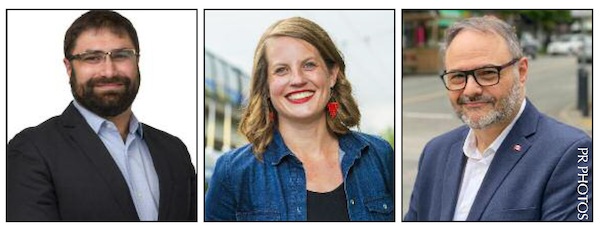
Jonathan Lerner, left, Christine Boyle and Dan Ruimy were among the winners in the recent municipal elections. (PR photos)

Municipal elections across British Columbia brought numerous surprises and a number of defeats for incumbent mayors, notably in both of the province’s largest cities.

Ken Sim defeated Kennedy Stewart, Vancouver’s incumbent mayor while, in a far closer race, Surrey’s mayor Doug McCallum was defeated by Brenda Locke.

Most of the community members featured by the Independent Oct. 7 were not successful in their races, with two exceptions.

Jonathan Lerner, a Jewish community member who has worked with organizations including the Vancouver Holocaust Education Centre, Hillel BC and Jewish Family Services, topped the polls on his first foray into elected office. He was elected to district council in Lantzville, which is north of Nanaimo.

Christine Boyle, who asked to be included in our coverage as part of a mixed family, was reelected to Vancouver city council as the sole successful candidate for the OneCity group, withstanding the onslaught of the overwhelming sweep by Sim’s ABC slate.

Former Liberal member of Parliament Dan Ruimy, a son of Jewish Moroccan immigrants to Canada, was elected mayor of Maple Ridge. He was inadvertently not included in our pre-election coverage.

Format ImagePosted on October 28, 2022October 27, 2022Author Pat JohnsonCategories LocalTags Christine Boyle, Dan Ruimy, democracy, elections, Jonathan Lerner, municipal politics

Race to the bottom

It may not be a total coincidence that one of the most recent conflicts over book banning is taking place in McMinn County, Tenn., less than an hour from the town of Dayton, in the same state, which was the site of the renowned Scopes “Monkey” Trial, 97 years ago.

The fight over whether Art Spiegelman’s graphic memoir about the Holocaust, Maus, is suitable reading for high schoolers echoes the earlier debate over whether teaching the theory of evolution was appropriate fare for students in a place and time where the biblical creation story was the only accepted narrative.

The debate over the banning of books and ideas is a hot topic these days, though hardly a new one.

Fortunately, we live in an age when banning ideas is nearly impossible in a free, or even partly free, society. Only in totalitarian and authoritarian regimes are governments able to block information. Around the world, in many countries, gaining access to forbidden ideas is relatively easy. In North America, the New York Public Library, among others, has made it easier for people anywhere to access specifically banned or challenged materials. People who want to seek out publications that authority figures try to limit are generally able to do so.

A phenomenon less easily addressed is the proliferation of misinformation and disinformation. This proliferation is the flip side of the ability to access banned ideas. In a world where anyone with a computer can access information, anyone with a computer can just as easily invent information and then circulate it widely.

Misinformation and disinformation have always existed. But almost certainly never have they so dramatically defined civil discourse. The difference between these two terms is important. One source calls misinformation “false information that is spread, regardless of intent to mislead.” Disinformation, from the same source, is deemed “deliberately misleading or biased information; manipulated narrative or facts; propaganda.” Both are problematic, but intent matters. Misinformation can sometimes be righted through correctives. Disinformation is often formulated in ways that actively deter correction.

For example, the greatest threat to American democracy right now is a narrative that has been formulated in such a perverse, Orwellian manner that the perpetrators of the lie that the 2020 U.S. presidential election was illegitimately “stolen” are the very people who are trying to steal a legitimate election. Those who perpetuate a lie accuse opponents of lying.

The first issue of The Atlantic magazine this year was almost entirely devoted to this subject and the thesis, if we may summarize crudely, is that, unless some dramatic corrective is applied, American democracy has less than two years to survive.

The internet, which is the keystone of our 21st-century ability to read and write virtually anything, has also emerged at a time of massive diffusion of so-called “mainstream media.” The grandchildren of those who grew up with three TV channels can now access thousands. We self-select our information and entertainment, with the impact that we have more, but smaller, frames of reference. One of the results of this is that we have largely been able to choose our own “truths.”

There are no simple solutions to these problems. But, if there is an antidote to ignorance, misinformation and disinformation, it is a recommitment to liberal values of free expression and unbridled academic inquiry. Applied to younger generations, this means inculcating in them an ability to assess and analyze context, information and sources. This sounds like a simple remedy but, of course, learning to think critically is a lifelong pursuit and cannot be taught in a single semester.

Yet, this is the primary way forward. As a society, we need to acknowledge that critical thinking is the foundation upon which democracy and civil society rests. We have abandoned balanced discussion and nuanced consideration of topics in favour of memes and slogans that suit our purposes.

We face a tough crawl out of the hole we find ourselves in – that is, assuming we have stopped digging – but confronting and contending with challenging ideas is the ideal we must strive for. Every banned book is another shovelful of dirt in our democracy’s race to the bottom.

Posted on May 20, 2022May 19, 2022Author The Editorial BoardCategories From the JITags Art Spiegelman, book banning, censorship, democracy, disinformation, freedom of speech, internet, Maus, misinformation
Stepping back from abyss

Stepping back from abyss

Daniel Sokatch, New Israel Fund chief, urges openness to narratives of both peoples. (photo from JCC Jewish Book Festival)

The experiences of Jews and Arabs in the area between the Jordan and the Mediterranean are complex and both peoples deserve to have their stories understood, according to a leading voice of progressive Zionism.

Daniel Sokatch was the keynote speaker at the closing event of the 2022 Cherie Smith JCC Jewish Book Festival Feb. 10. Sokatch is chief executive officer of the New Israel Fund, a U.S.-based nonprofit funding Israeli civil and human rights organizations and initiatives, which also engages in reconciliation and conflict resolution efforts between Israelis and Palestinians. He shared reflections from his new book Can We Talk About Israel? A Guide for the Curious, Confused and Conflicted, which was illustrated by Christopher Noxon.

“Over my years of service at NIF as the chief executive officer – I’ve been there for over 13 years now – I witnessed personally the discourse about Israel become more heated, more vituperative, more emotional and less fact-based,” Sokatch said. He wrote the book to give average people “a GPS to the conflict that would help them negotiate their own relationship to this complex issue.”

Israel was at the edge of an abyss before the new eight-party coalition government was sworn in last year, Sokatch said.

“This government is a Frankenstein’s monster made up of parties of the right, centre, left and Arab community that shouldn’t work but does work because enough people from all parties, except for the hard right-wing parties, knew that Benjamin Netanyahu was leading Israel over a cliff,” he said. “That was my editorial opinion but it is also the rationale for this government.”

A chunk of the Israeli public realized that Netanyahu was moving Israel toward neo-authoritarianism and a “democracy recession,” said Sokatch. This was exemplified, in part, by moves to abrogate the country’s balance between its Jewish and its democratic identities, he said.

image - Can We Talk About Israel? book cover“Israel passed a series of laws – most of them, I think it’s important to note, passed only barely – that really reduce the standing of Arab citizens of Israel to something that looked a lot more like second-class citizenry,” said Sokatch. “The worst of these laws was something called the Nation-State Law.… The Nation-State Law essentially said to Arab-Israeli citizens, you may have the right to vote but only Jewish citizens of the state have the right to what the law says is ‘self-determination.’… It stripped Arabic of its official language status…. The only reason you do things like that is if you want to throw red meat to your base and make a statement to the minority about where they stand. Anyone who has been to Israel recently – and by recently I mean at any point during its entire existence as a state – knows that the Jewish character of Israel is under no threat. In that sense, the alarm raised by Netanyahu and that Nation-State Law was like [former U.S. president Donald] Trump’s Muslim ban. It was a draconian solution for a problem that doesn’t actually exist.”

Reuven Rivlin, who was president of Israel at the time, acknowledged that he was obligated to sign the bill into law, but promised to sign in Arabic, which he did as a symbol of protest.

Sokatch addressed the recent Amnesty International report that accuses Israel of operating an apartheid system. He said that any honest and fair-minded left-wing observer who traveled the length and breadth of Israel would recognize that the apartheid label does not fit. But, he added, any honest and fair-minded right-wing observer who traveled the length and breadth of the West Bank would see things that could legitimately justify the terminology.

“I happen to think that the Amnesty report is deeply flawed,” he said. But, on the flip side: “To dismiss it all as antisemitism is to, like an ostrich, stick your head in the ground and ignore the reality of the problem.”

If Jews worldwide are held responsible for Israel’s actions, that is antisemitic, he said. Likewise, if Israel is depicted as a tentacled monster controlling the world, or if Jews are depicted as clannish, disloyal and the embodiment of “cosmic evil,” these are examples of antisemitism. The hostage-taking at a Texas synagogue in January is another example.

“Why did the guy go to a synagogue, instead of a church or McDonald’s or wherever?” Sokatch asked. “He went to the synagogue because he thought the Jews could get him what he wanted. He thought that we were so powerful in the United States that we could pick up the phone and tell Joe Biden to let the person he wanted let out of jail let out of jail. When criticism of Israel engages in those tropes, you can bet your life it’s antisemitism.”

But these examples of bias should not blind people to the legitimate criticisms being leveled against Israel, he warned. He hopes his book will open up more dialogue.

“Too often, I think, we are afraid to talk about the hard things,” he said. “What is the role of Israel’s Arab citizenry? What is the relationship between the U.S. and Israeli Jewish communities, the two largest Jewish communities in the history of the world? What is the deal with the settlements? Is Israel an apartheid state? What is the boycott, divestment and sanctions movement? I didn’t want to shy away from those things. But I also felt strongly that, in order to have an intelligent conversation about them, or to hold informed opinions about them, you have to know what you’re talking about.”

The first half of his book is mostly straightforward history, he said, with his analysis in the second half. He encourages a more fluent understanding of the narratives of both peoples.

“These are two peoples, Israelis and Palestinians, Jews and Arabs, who have been victims of the world, of each other and of themselves,” said Sokatch. “I felt that it was important to hold both of their stories with compassion and curiosity and concern, and to acknowledge that both parties have legitimate claims to this little place between the Mediterranean Sea and the Jordan River. Both of these peoples have real histories of trauma and persecution and both of them have stories that help them understand who they are and where they are in the world and their connection to this place, and I wanted to tell those stories rather than just one of the stories.”

Sokatch appeared virtually in conversation with Dana Camil Hewitt, director of the book festival. Rikki Jacobson, chair of the festival committee, welcomed the audience and thanked the speaker.

Format ImagePosted on February 25, 2022February 23, 2022Author Pat JohnsonCategories BooksTags Amnesty International, Daniel Sokatch, democracy, Israel, JCC Jewish Book Festival, New Israel Fund, NIF, Palestine

The light of democracy

Tomorrow is Black Excellence Day. The day is adjacent to the birth date of Martin Luther King Jr. and is being recognized in at least 20 B.C. school districts.

Founded last year to draw attention to the lack of Black history being taught in Canadian schools and to highlight the struggles of racialized Canadians, it was originally named Black Shirt Day. The name followed the pattern of other social justice days, such as Pink Shirt Day (anti-bullying) and Orange Shirt Day (truth and reconciliation). Unfortunately, the name Black Shirt Day carries unintentional connotations. The Blackshirts were fascist paramilitary thugs in Italy, akin to the German Nazi Brownshirts.

Many people in the Jewish community expressed concern over the name, as did the B.C. Human Rights Commission. Among the Jewish groups that spoke with the Ninandotoo Society, whose members initiated the commemoration last year, were the Vancouver Holocaust Education Centre and the Centre for Israel and Jewish Affairs (CIJA). In an interview with CBC, Geoffrey Druker, Pacific region chair of CIJA, said, “We were kind of gutted. It was painful because we still have Holocaust survivors among us and anybody who suffered from fascism and black shirts would have been hurt.”

In response to the comments, the Ninandotoo Society created Black Excellence Day, which still focuses on the ongoing civil rights struggle of Black and racialized Canadians and the need for a mandatory curriculum on Black history.

Kamika Williams, president of the society (“nina ndoto” means “I have a dream” in Swahili), told CBC, “For us, it wasn’t a matter of should we change the name, it was what should we change the name to. It would be very hypocritical of us to fight against racism within the Black community and then turn the other cheek when other racialized groups inform us of the racist nuances within their community.”

She said most of the discussions focused on “building solidarity … how do we move forward, how do we work together, how do we stay unified and combat racism together.”

Despite the fascist connotations, however, another group, Anti-Racism Coalition of Vancouver, is still going ahead with a Black Shirt Day, with the imprimatur of Independent Jewish Voices of Canada, among others.

Black Excellence Day (Jan. 15) and Martin Luther King Day (this year on Jan. 17 though his actual birthday is Jan. 15) fall just over a week after Jan. 6. This year, Jan. 6 was a time of widespread reexamination of the insurrection at the U.S. Capitol a year earlier. CNN, MSNBC and other mainstream networks provided exhaustive reviews of the events of that day and insights into the larger meaning for its victims – Capitol police, elected officials, staffers, their families and so forth – while right-wing media perpetuated their line that the attempted coup was nothing more than rambunctious tourists.

The Atlantic magazine’s current issue, with the cover story “January 6 was practise,” devotes almost every word in the magazine to the events of that day and what it means for the future. Relatively obscure civil servants and elections administrators were, in some instances, the main bulwark against Trump’s efforts to subvert the will of voters in states like Georgia, Arizona and elsewhere. But, argues the Atlantic, supporters of the insurrection and the “big lie” that Trump won and the election was stolen are now taking their places at the most sensitive (if least understood) nexus of the election bureaucracy. The alarming, pessimistic tone of the magazine’s issue could be summed up as: American democracy has about three years to live.

Various media have raised alarms about these attempts to grab the election levers – and revisited how it was not so much institutions or constitutional niceties that prevented Trump’s coup attempt from succeeding but a very small number of stiff-backed individuals, including then-vice president Mike Pence, who provided the frail barricade around the will of the country’s voters.

The health and survival of American democracy, put mildly, is not a matter of concern for Americans only. Its demise would eliminate what moral suasion the country holds in the world – to say nothing of the potential for misuse of military power. For Canadians, chaos on the other side of the world’s longest undefended border would be cause for serious concern. And any threat to democracy is a threat, foremost, to the most vulnerable and marginalized, Jews included.

Sadly and scarily, this phenomenon is not exclusive to the United States – illiberal strains are gaining ground in various places in Europe, Latin America and elsewhere. What is needed (among many other things) is a mass cultural movement recognizing these dangers and ensuring the health of democracy – or at least giving it a fighting chance if a chunk of the population rejects the outcome of future elections.

While the United States, Canada and pretty much every democracy have not always lived up to their promise – indeed, they have failed in serious ways – democracy is our collective best chance to achieve just societies. For countless Jews, and millions of others yearning to breathe free, America has been a beacon, despite its flaws. We must not just hope, but take action to help make sure its light – and that of other democracies – does not go out.

Posted on January 14, 2022January 13, 2022Author The Editorial BoardCategories From the JITags anti-racism, Black Excellence Day, Blackshirts, Canada, civil rights, democracy, fascism, history, Kamika Williams, Ninandotoo Society, politics, racism, United States

Posts pagination

Previous page Page 1 … Page 3 Page 4 Page 5 … Page 9 Next page
Proudly powered by WordPress