Skip to content
  • Home
  • Subscribe / donate
  • Events calendar
  • News
    • Local
    • National
    • Israel
    • World
    • עניין בחדשות
      A roundup of news in Canada and further afield, in Hebrew.
  • Opinion
    • From the JI
    • Op-Ed
  • Arts & Culture
    • Performing Arts
    • Music
    • Books
    • Visual Arts
    • TV & Film
  • Life
    • Celebrating the Holidays
    • Travel
    • The Daily Snooze
      Cartoons by Jacob Samuel
    • Mystery Photo
      Help the JI and JMABC fill in the gaps in our archives.
  • Community Links
    • Organizations, Etc.
    • Other News Sources & Blogs
    • Business Directory
  • FAQ
  • JI Chai Celebration
  • JI@88! video

Recent Posts

  • Sharing her testimony
  • Fall fight takes leap forward
  • The balancing of rights
  • Multiple Tony n’ Tina roles
  • Stories of trauma, resilience
  • Celebrate our culture
  • A responsibility to help
  • What wellness means at JCC
  • Together in mourning
  • Downhill after Trump?
  • Birth control even easier now
  • Eco-Sisters mentorship
  • Unexpected discoveries
  • Study’s results hopeful
  • Bad behaviour affects us all
  • Thankful for the police
  • UBC needs a wake-up call
  • Recalling a shining star
  • Sleep well …
  • BGU fosters startup culture
  • Photography and glass
  • Is it the end of an era?
  • Taking life a step at a time
  • Nakba exhibit biased
  • Film festival starts next week
  • Musical with heart and soul
  • Rabbi marks 13 years
  • Keeper of VTT’s history
  • Gala fêtes Infeld’s 20th
  • Building JWest together
  • Challah Mom comes to Vancouver
  • What to do about media bias
  • Education offers hope
  • Remembrance – a moral act
  • What makes us human
  • המלחמות של נתניהו וטראמפ

Archives

Follow @JewishIndie
image - The CJN - Visit Us Banner - 300x600 - 101625

Tag: democracy

Who stops the hate?

Who stops the hate?

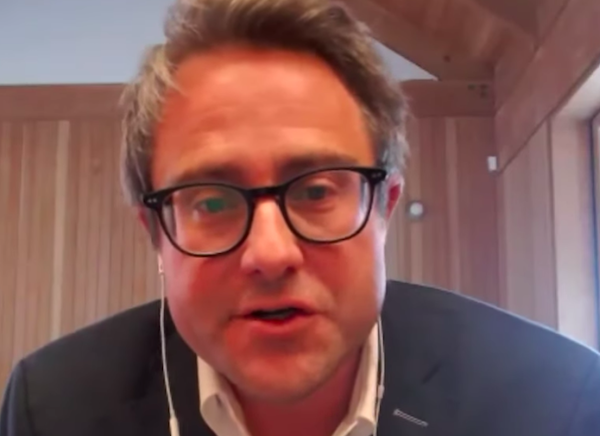
Taylor Owen speaks at the third annual Simces and Rabkin Family Dialogue on Human Rights, Nov. 9. (screenshot)

Canada, like most of the world, is behind in addressing the issue of hate and violence-inciting content online. In attempting to confront this challenge, as the federal government will do with a new bill in this session of Parliament, it will be faced with conundrums around where individual freedom of expression ends and the right of individuals and groups to be free from hateful and threatening content begins.

The ethical riddles presented by the topic were the subject of the third annual Simces and Rabkin Family Dialogue on Human Rights, Nov. 9, in an event titled Is Facebook a Threat to Democracy? A Conversation about Rights in the Digital Age.

The annual dialogue was created by Jewish Vancouverites Zena Simces and her husband Dr. Simon Rabkin. It was presented virtually for the second year in a row, in partnership with the Canadian Museum for Human Rights.

The featured presenter was Taylor Owen, who is the Beaverbrook Chair in Media, Ethics and Communications, the founding director of the Centre for Media, Technology and Democracy, and an associate professor in the Max Bell School of Public Policy at McGill University. He presented in conversation with Jessica Johnson, editor-in-chief of The Walrus magazine.

The advent of the internet was seen as a means to upend the control of a society’s narrative from established media, governments and other centralized powers and disperse it into the hands of anyone with access to a computer and the web. Instead, as the technology has matured, online power has been “re-concentrating” into a small number of online platforms like Facebook, Twitter and YouTube, which now have more global reach and cultural power than any preexisting entity.

“Understanding them and how they work, how they function, what their incentives are, what their benefits are, what their risks are, is really important to democratic society,” said Owen.

These are platforms that make money by selling ads, so it is in their interest to keep the largest number of people on the platform for the longest time possible, all while collecting data about users’ behaviours and interests, Owen said. These demands prioritize content that is among the most divisive and extreme and, therefore, likely to draw and keep audiences engaged.

The sheer volume of posts – in every language on earth – almost defies policing, he said. For example, in response to public and governmental demands that the company address proliferating hate content and other problematic materials, Facebook has increased resources aimed at moderating what people post. However, he said, 90% of the resources dedicated to content moderation on Facebook are focused on the United States, even though 90% of Facebook users are in countries outside of the United States.

A serious problem is that limitations on speech are governed by every country differently, while social media, for the most part, knows no borders.

Canada has a long precedent of speech laws, and Parliament is set to consider a controversial new bill intended to address some of the dangers discussed in the dialogue. But, just as the issues confounded easy answers in the discussion between Owen and Johnson, attempts to codify solutions into law will undoubtedly result in fundamental disagreements over the balancing of various rights.

“Unlike in some countries, hate speech is illegal here,” said Owen. “We have a process for adjudicating and deciding what is hate speech and holding people who spread it liable.”

The United States, on the other hand, has a far more libertarian approach to free expression.

An example of a country attempting to find a middle path is the approach taken by Germany, he said, but that is likely to have unintended consequences. Germany has decreed, and Owen thinks Canada is likely to emulate, a scenario where social media companies are liable for statements that represent already illegal speech – terrorist content, content that incites violence, child exploitative content, nonconsensual sharing of images and incitement to violence.

Beyond these overtly illegal categories is a spectrum of subjectively inappropriate content. A single media platform trying to accommodate different national criteria for acceptability faces a juggling act.

“The United States, for example, prioritizes free speech,” he said. “Germany, clearly, and for understandable historical reasons, prioritizes the right to not be harmed by speech, therefore, this takedown regime. Canada kind of sits in the middle. Our Charter [of Rights and Freedoms] protects both. The concern is that by leaning into this takedown regime model, like Germany, you lead platforms down a path of over-censoring.”

If Facebook or YouTube is threatened with fines as high as, say, five percent of their global revenue if they don’t remove illegal speech within 24 hours, their incentive is to massively over-censor, he said.

Owen said this will have an effect on the bottom line of these companies, just as mandatory seatbelts in cars, legislation to prevent petrochemical companies from polluting waterways and approval regimes governing the pharmaceutical industry added costs to those sectors. Unfortunately, the nuances of free speech and the complexities of legislating it across international boundaries make this an added burden that will probably require vast resources to oversee.

“It’s not like banning smoking … where you either ban it or you allow it and you solve the problem,” said Owen. There are potentially billions of morally ambiguous statements posted online. Who is to adjudicate, even if it is feasible to referee that kind of volume?

Rabkin opened the dialogue, explaining what he and Simces envisioned with the series.

“Our aim is to enhance the understanding and create an opportunity for dialogue on critical human rights issues, with the hope of generating positive actions,” he said.

This year’s presentation, he said, lies at a crucial intersection of competing rights.

“Do we, as a society, through our government, curtail freedom of expression, recognizing that some of today’s unsubstantiated ideas may be tomorrow’s accepted concepts?” he asked. “Unregulated freedom of speech, however, may lead to the promulgation of hate towards vulnerable elements and components of our society, especially our children. Do we constrain surveillance capitalism or do we constrain the capture of our personal data for commercial purposes? Do we allow big tech platforms such as Facebook to regulate themselves and, in so doing, does this threaten our democratic societies? If or when we regulate big tech platforms, who is to do it? And what will be the criteria? And what should be the penalties for violation of the legislation?”

Speaking at the conclusion of the event, Simces acknowledged the difficulty of balancing online harms and safeguarding freedom of expression.

“The issue is, how do we mitigate harm and maximize benefits?” she asked. “While there is no silver bullet, we do need to focus on how technology platforms themselves are structured. Facebook and other platforms often put profits ahead of the safety of people and the public good.… There is a growing recognition that big tech cannot be left to monitor itself.”

The full program can be viewed at humanrights.ca/is-facebook-a-threat-to-democracy.
Format ImagePosted on December 10, 2021December 8, 2021Author Pat JohnsonCategories LocalTags democracy, Facebook, free speech, hate speech, human rights, legislation, politics, Simon Rabkin, social media, Taylor Owen, Zena Simces

Fight Jew-hatred – and lies

The U.S. Congressional committee investigating the Jan. 6 insurrection is limping along in the face of a near-total absence of cooperation from the Republicans who make up almost half of Congress and of the American voting public. Despite reams of video evidence, there is legitimate worry that justice will not be served in the case of an attempted coup at the heart of American government.

Those who tried to overthrow the will of the people and who even called for the murder of the vice-president of their own party are venerated by their supporters as patriots, while those who seek justice for those events are vilified as traitors.

The very people who tried to subvert the democratic decision of the American people last November – those who are trying to steal the election from President Joe Biden – chant “Stop the steal!” apparently without a hint of irony or self-awareness.

But the fight over Jan. 6 is a small puzzle piece in a larger social disorder. We are seeing verifiable truths dismissed as lies and what should be summarily debunked as lies revered as gospel. Listening to some of these voices, it is difficult to tell whether they are trying to create a reality based on what they wish were true – Trump won, Democrats eat babies, whatever – or whether they truly believe these falsehoods. It’s probably some of both.

Are we approaching a tipping point where a healthy society that has at least a modicum of shared consensus on what is true and what is false slides into a moral terrain that has no agreed-upon truth or lies, right or wrong, good or evil?

The pandemic has brought this problem into clear relief. Doctors say that they are treating people who, on their deathbed, continue to insist there is no such thing as COVID. There is a spectrum, from outright denial of the existence of the virus to conspiracies that it was invented for nefarious purposes to the idea that the virus itself is legitimate but is being exploited by governments (or other disreputable entities) to take away some amorphous “freedoms.”

Recently, parents opposed to mask mandates chased fellow parents (and their kids) at a school in California, screaming that the kids could not breathe through the masks. When some parents responded with what, by any fair measure, is common sense, one protester screamed back: “You were propagandized.… You are not being told the truth!”

To put a fine point on it, people who have been propagandized and who are convinced of a lie are shouting at others that they have been propagandized and do not know the truth.

Recently, South Carolina Senator Lindsey Graham, speaking to a Republican crowd that should have been in his back pocket, said, “If you haven’t had the vaccine, you ought to think about getting it because if you’re my age –” At this point, he was drowned out by screaming and booing. When he was able to speak again, he told the Republican crowd, “Ninety-two percent of the people in the hospitals in South Carolina are unvaccinated.” To this, some audience members began screaming “Lies!”

The New York Times Magazine’s ethics columnist, Kwame Anthony Appiah, wrote recently of the “strange mirror game” being played by conspiracy theorists and hucksters. “They peddle hoaxes that warn of hoaxes, scams that warn of scams. They dupe their victims by cautioning them not to be duped.”

Lies have been around forever. But it seems we are in another realm now. When Kellyanne Conway, a counselor to Trump, defended then-White House press secretary Sean Spicer’s false claims that attendance numbers at Trump’s 2016 presidential inauguration were the largest in history, Conway asserted that there were facts and then there were

“alternative facts.” This was not the genesis of a culture of gaslighting, but it did represent, along with Spicer’s lies, a turning point. The Trump administration operated in a world that rational observers would view as existing in an alternative universe of alternative facts.

Jews and supporters of Israel who forgive Trump’s many affronts because they deem him to be on “our side” on one issue suffer from something that might be equated to the difference between the weather and the climate.

Trump may indeed have taken steps that people view as being to Israel’s advantage. But, in nearly everything else Trump and his supporters have done, they have assaulted truth, facts and rationality. They call black white and up down. Legitimate media are “fake news” and darkweb rantings are trustworthy sources.

In a story in the last issue of the Independent, the commentator Bret Stephens said: “We now have come to a place where, increasingly, we are a nation that can bring ourselves to believe anything and a nation that can bring itself to believe anything … sooner or later, is going to have no problem believing the worst about Jews.”

Trump, Spicer, Conway and their crowd did not invent the situation where lies are gospel and truth is rejected, but they did their best to perfect it.

It should not need saying that such people should not be trusted, since their loyalty and sincerity are worthless. Republicans who, on a dime, turn into an angry mob screaming “Hang Mike Pence!” should not be trusted when it comes to something as sacred as the security and the fate of Israel and its people.

More gravely still, there is a reason why Jews are often referred to (as dehumanizing as the term is) as “canaries in a coalmine.” When antisemitism emerges, it is a sign of broader societal disorder. It is no surprise that the spike in antisemitism we are witnessing coincides with a phenomenon where verifiable facts are regarded as debatable assertions and the most ludicrous assertions are not only accepted as truth but defended with fanaticism and violence.

In the late 20th century, Canadian Jewish Congress and other groups adopted an approach premised on the idea that the best way to ensure the safety of Jewish people was to advance an ideal that protects allminorities. There might always be people with antisemitic motivations, but, if we can inculcate in society a transcendent commitment to equality for all, we may create a firewall against the worst antisemitism.

As CJC and others did several decades ago, it may be time for Jewish people and others who care about fighting antisemitism to rededicate ourselves to strengthening the most fundamental principles of our democratic societies, the very foundations that we too often have taken for granted, even after Jan. 6. This includes not only ensuring basic things like civil and voting rights and protecting the institutions of democratic government, but it calls on us to contest outright lies and to defend basic truth. If, in the process, we manage to yank our democratic societies back from the abyss of lies and the frightening places they lead, we will have made things better not only for the Jewish future, but for everyone’s.

Posted on October 22, 2021October 21, 2021Author Pat JohnsonCategories Op-EdTags antisemitism, Canadian Jewish Congress, civil rights, democracy, racism, Trump, voting rights

Democracy in danger

There has been a trend among some pro-Israel people and others to depict the U.S. Democratic party as having fallen prey to a far-left agenda, a wolf of extremism seeking to reinvent the social fabric of the country in the sheep’s clothing of “progressive” values.

There are indeed some voices in the Democratic party that press the party to views that are less mainstream – as there are in the Republican party. There is no Democratic equivalent to the radical Republican misanthropes like Lauren Boebert, Paul Gosar and Marjorie Taylor Greene, who have plumbed the depths of dark web conspiracies. Yet members of the so-called “Squad,” a group of Democrats, have taken positions on Israel and Palestine that reject the traditional bilateral American support for Israel’s security. This was never starker than during the recent vote to fund Israel’s Iron Dome defensive anti-missile shield. Members of the Squad, and a handful of other members of Congress, held up a vote on a massive budget bill until American support for Israel’s defence was removed.

The capitulation by senior Democrats was condemned by many, but the victory of the anti-Israel voices was short-lived. The next day, the House voted by a 420-9 landslide to provide the very funds that had been excised from the bigger bill the day before. The numbers could not be clearer. American leaders remain overwhelmingly committed to the bilateral relationship and to Israel’s defence.

The Iron Dome was depicted by some of the dissenting members of Congress as a tool of Israeli oppression. It is, however, a defensive technological wonder whose sole purpose is to save lives. Opposing American support for the program based on economic concerns could be justifiable – a billion dollars is no small change. But those who voted against it have given no indication of thriftiness. Interested in raising taxes on the wealthiest and spending more on domestic programs, as well as passing the Build Back Better Act, which would increase spending on social programs and infrastructure, lower spending does not seem to be a defining motivation for these congresspeople. President Joe Biden has already said he will approve the funding.

We see plenty of Republicans condemning the more extreme members of the Democratic caucus. And we see Democrats condemning the members of the opposition that the late senator John McCain memorably dubbed “whackadoodles.” But perhaps we should all be looking in our own backyards to get our own houses in order.

Speaking of which, Canada is not immune to offside officials. Jenica Atwin was a Green MP who accused Israel of apartheid before huffing across the floor from the Green party to the governing Liberals, where she was quickly forced to retract her earlier comments. The People’s Party of Canada, while not gaining a seat in the recent election, nevertheless significantly expanded their support base across the country, while advancing intolerant, often conspiratorial ideas. Still, Canadian extremists look like small potatoes next to the American examples.

When winning at any cost becomes seen as crucial – because the other side has been demonized to such a degree that their victory is seen as an existential threat – it is easier to accept the unacceptable if it comes from “our” side and to condemn it with self-righteous indignation when it appears on the other side.

Partisanship is too often preventing us from doing the right thing. This behaviour is self-defeating, put mildly. Ignoring inherent malevolence for immediate gain is a recipe for long-term failure, not only for a party’s political fortunes but, far more gravely, for our democratic, pluralistic society as a whole.

Posted on October 8, 2021October 6, 2021Author The Editorial BoardCategories From the JITags democracy, Democrat, identity politics, Iron Dome, Israel, politics, Republican

Volunteer during election

Oct. 21, 2019, seems like a lifetime ago, doesn’t it? That was the date of the last Canadian federal election. Since then, it’s been a world of endless uncertainties and instability.

The Jewish community has witnessed levels of antisemitism that haven’t been seen for decades. Hate crime numbers are way up. The aura of anti-Israel sentiment, especially following the conflict earlier this year in Gaza, has created an environment that has many feeling unsafe and anxious. The silence of many within the political sector has been cause for concern. On top of all of this, the havoc of the COVID pandemic is still felt daily.

Let’s be real: people are upset and worried. The past 22 months since the last election have presented incredible challenges to our well-being and shown that nothing is guaranteed. The Canadian Jewish community has demonstrated its resilience and fortitude but there is a lot more to do, especially when it comes to elections. We’ve seen firsthand what an important role the government plays in our lives, especially regarding the pandemic, so it’s vital that we extend our efforts more effectively in the political realm.

The Jewish community makes up less than 1.1% of the population and is concentrated in just a handful of ridings – 10 out of 338. That’s only three percent. Our numbers are continuing to decline. In politics, relationships matter. If we limit ourselves to involvement in only three percent of ridings and three percent of candidates, we are at a major disadvantage when it comes to our community and the things we care about.

To ensure our voices are heard, members of the Jewish community must continue to build relationships and educate MPs in ridings from coast to coast. This starts with political engagement, and it starts with each of us. As Rabbi Tarfon said, “It is not your duty to finish the work, but neither are you at liberty to neglect it.”

The good news is that we have the tools to get engaged so we can work beyond the local ridings where we vote. While the Canadian Jewish Political Affairs Committee (CJPAC) does not engage in or facilitate lobbying and advocacy, we do act as a concierge, helping members of our community to get engaged politically.

Another important factor is that change is inevitable with elections. In 2019, 98 first-time MPs (27%) were elected, 60 of whom were in ridings that flipped seats. A third of those 60 MPs defeated the second-place finisher by less than five percent of the vote. As for this election, at the time we wrote this, 26 incumbents had decided not to run for reelection. Many more ridings will change hands. This means that, no matter which way the election goes, our community will need to build new relationships with new parliamentarians.

We can jumpstart that process. Community members like you can volunteer and acquaint yourselves with candidates from beyond your own riding and across the country. Every campaign is in dire need of volunteers, and even just a few hours can be a huge help. Often just a few more volunteers can make the difference between winning and losing a race. Plus, the appreciation for a volunteer’s work – no matter how big or small – is something that’s not easily forgotten.

There is, of course, one element that’s changed the game with this election: COVID. While it’s still possible to engage in traditional methods of volunteering – door-knocking, handing out literature in the community, putting up lawn signs or working in a polling station – understandably, some are hesitant to participate under pandemic circumstances.

But fear not: there are many physically distanced ways to volunteer, including from your own home. And you don’t have to be politically experienced to do it. All you have to do is raise your hand and show up. CJPAC will connect you to the campaign of your choice.

For those who feel more comfortable with a bit of instruction, CJPAC’s team makes it simple by training you on the basics of campaign volunteering. You can volunteer in your local riding or in one of the other many ridings where a strong Jewish presence is absent. Perhaps that means traveling 20 to 30 minutes away from your home or simply making phone calls from your couch for a candidate in a more remote part of the country.

The first step is to sign up at cjpac.ca/volunteer, and CJPAC will connect you with the campaign or candidate of your choice.

As Jews, we are committed to community service and contributing to the greater society. While it’s been a rough several months, we don’t have to stand alone. It doesn’t matter what party you align with: it’s vital to the health and safety of the Canadian Jewish community to build relationships with all parties. We can accomplish that together by getting engaged.

Jeffrey Feldman is chair of the Canadian Jewish Political Affairs Committee and Mark Waldman is the executive director of CJPAC. This op-ed was first published on thecjn.ca.

Posted on September 10, 2021September 9, 2021Author Jeffrey Feldman & Mark Waldman CJPACCategories NationalTags Canada, Canadian Jewish Political Affairs Committee, CJPAC, democracy, elections, politics, volunteering
Canadians head to the polls

Canadians head to the polls

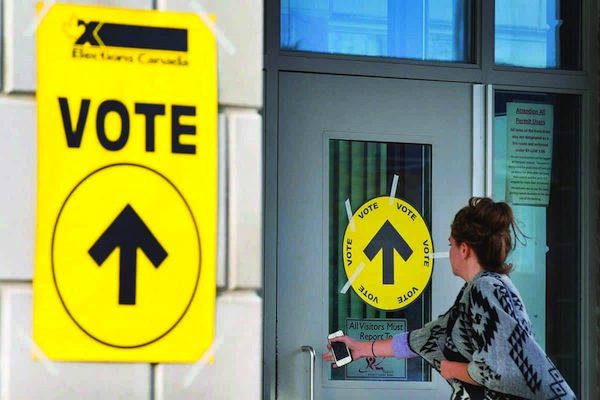
(photo from cija.ca)

A federal election has been called, with the last voting day on Sept. 20, erev Sukkot. While the final day to vote does not fall on a High Holiday, the timing will have implications for Jewish Canadians.

Over the last few months, the Centre for Israel and Jewish Affairs (CIJA) has communicated to Prime Minister Justin Trudeau, many members of Parliament and Elections Canada its concerns about an early-autumn federal election potentially conflicting with the High Holidays. It will continue to work with Elections Canada to protect democratic participation for all Jewish Canadians.

To help the Jewish community participate fully in Canada’s democracy, CIJA has set up an elections hub, with information and resources on various policy issues and voting locations and dates, at cija.ca/canada-votes2021.

– Courtesy Centre for Israel and Jewish Affairs

* * *

Canada’s 44th Parliament is about to be formed and you can help shape it. The Canadian Jewish Political Affairs Committee (CJPAC) is able to connect Jewish community members with the campaign of their choice and get started.

Unprecedented challenges have dominated the past year and a half. The COVID-19 pandemic has upended all of our lives and the Jewish community has witnessed levels of antisemitism unseen for decades. Hate crime numbers are way up. The aura of anti-Israel sentiment has created an environment that has many feeling unsafe and anxious.

These times of uncertainty, however, are the perfect reason to get engaged and involved. Not just for you, but also for the community.

Elections are happening in 338 ridings across the country, so there is a whole lot of opportunity to get involved in whatever campaign you choose.

There are also many different ways to volunteer, all of which are COVID safe, including in person and from the comfort of your home.

Visit cjpac.nationbuilder.com/vfe21.

– Courtesy Canadian Jewish Political Affairs Committee

Format ImagePosted on August 20, 2021August 19, 2021Author CIJA and CJPACCategories NationalTags Canadian election, democracy, Election, volunteer, vote

Down but not out

Prior to the Six Day War, which took place 54 years ago this month, the pages of this paper were filled with foreboding and ominous news of enemy militaries amassing adjacent to Israel’s borders. The very next issue was triumphal and jubilant – the war already had ended.

Such is one of the challenges of publishing a weekly newspaper. When a war only lasts six days, it presents difficulties for a journal that comes out every seven. Since the beginning of the pandemic, we have been on a twice-monthly publishing schedule, adding to the challenges of bringing you news in a time of fast change.

Of course, as regular readers know, we recognize our limitations and strengths and, as the internet has made information accessible 24/7, we have adapted to provide thoughtful, contextualizing essays and ideas, complemented by coverage of local events that only we can deliver.

Still, commenting on events that are subject to rapid flux remains a reality. This week, as we go to press, many or most observers assume that Naftali Bennett will soon replace Binyamin Netanyahu as Israel’s prime minister. Netanyahu continues to insist that such a new government represents something undemocratic. Indeed, his choice of language has been incendiary, and the imagery employed by some of his supporters veers into the realm of the demonization that we saw in the lead-up to the assassination of Yitzhak Rabin. Whatever his political objectives, Netanyahu should beware not to lead Israel down a path of “scorched earth,” as Bennett warned this week.

Bibi seems to be taking a page from the playbook of his ally Donald Trump, who emerged again recently to rehash his lies about stolen elections and assorted nonsense, including his imminent reinstallation in the White House. While scarily huge swaths of Americans (Republicans mostly, of course) believe that Joe Biden is not the legitimate president, we have more trust in the intelligence of Israeli voters to know that whoever is prime minister by the time the dust settles is there by due process.

If, as seems likely, Netanyahu is replaced, do not expect to hear the last of him. Again, like his friend in Florida, Bibi is clearly not done yet. He has been defeated before and returned to hold the position, becoming the country’s longest-serving leader.

Perhaps the biggest variable will be whether his Likud party stands behind him, as Trump’s Republican base has apparently stood by their man. Already, Yuli Edelstein, Netanyahu’s health minister, has said he would challenge Bibi for the party leadership should they lose power.

If successful, Edelstein, or any alternative Likud leader, would almost certainly cause an immediate tectonic shift in politics. That’s because the binary in that country’s politics is now cemented as “pro-Bibi” and “anti-Bibi.” With anyone but Netanyahu at the helm, some of the right-leaning partners in the new, broad coalition would likely look afresh at a deal with the party that has, by a large margin, the most seats in the Knesset.

Netanyahu may yet pull another rabbit out of his hat before Bennett can take his place. More likely, we are about to see a political shift that will see Netanyahu out but not down. That is, he seems to have enough capital to remain a major player in Likud and Israeli politics in general. The corruption case currently proceeding against him may affect that, but it has done little so far to dislodge his defenders.

If, as smart money has it, Netanyahu is unseated in the next few days, we will truly see a new era in Israeli politics. But we would caution that such a new era will begin with a time of flux. The new coalition is unwieldy and may not hold. Netanyahu has been the centre of gravity for Israeli politics for a very long time. In his absence, everything changes.

Our next issue is June 25. We promise this: plenty will have changed by then.

Posted on June 11, 2021June 10, 2021Author The Editorial BoardCategories From the JITags Bennett, democracy, elections, Israel, Netanyahu, politics
CHW’s Brunch with Bakan

CHW’s Brunch with Bakan

Joel Bakan spoke at a CHW Vancouver Book Club event May 30. (photo from thecorporation.com)

The Canadian Hadassah-WIZO (CHW) Vancouver Book Club hosted a far-reaching 90-minute discussion with author, filmmaker, musician and University of British Columbia law professor Joel Bakan on May 30. Moderating the event, entitled Brunch with Bakan, was Toronto-based writer (and former Vancouverite) Adam Elliot Segal.

Bakan’s widely acclaimed 2004 book The Corporation: The Pathological Pursuit of Profit and Power explored the formation and behaviours of modern-day industrial behemoths. It was later turned into an award-winning film. His new book, The New Corporation: How “Good” Corporations are Bad for Democracy, released in 2020, also has a film attached to it – The New Corporation: The Unfortunately Necessary Sequel, which Bakan co-directed with Jennifer Abbott.

In the CHW event, Bakan shared tidbits about his upbringing, first in East Lansing, Mich., then moving to Vancouver at age 11. “I was a very young draft dodger,” he recalled, as his parents decided to move north at the height of the Vietnam War.

“Family and Judaism have been two of the pillars of my life,” he said, recounting how much of his current activism could be traced to his immigrant grandparents.

“Jewish people, by virtue of their history, understand persecution, they understand injustice. They haven’t had a choice but to understand injustice. Injustice has always been in their face. It’s no coincidence that Jewish people were leaders in the civil rights, labour and other movements,” said Bakan.

“Jewish people have always had an activist sensibility and I think it’s rooted, not only in that history, but in the ethics of the religion – chief among them is tikkun olam, that we have a duty to repair the world, which is very much a duty I take seriously,” he added.

In his recent book, which moderator Segal called a “tour de force” and “meticulously researched,” Bakan tackles such subjects as deregulation, the aviation industry and what he describes as the destructive dependence on technology. In it, he interviews not only influential legal and economic scholars but also references pop culture to explain more difficult concepts.

“I wanted the book to be readable,” he said. “I am an academic by trade, but I am a writer. I want the reader to feel pulled into a story. In all my writing for a popular audience, I try to get away from the academic notion of laying out the facts and instead lull the reader in by telling some good stories. And, once I have the reader, I try to engage them with some more analytical or informational kinds of things.”

Segal asked about Bakan’s Trump-era trip to the World Economic Forum in Davos, Switzerland, for the recent Corporation documentary project. It turned out to be a coup of sorts for a film crew to be allowed access to the normally secretive meetings of the world’s political and corporate elites in the Swiss Alps.

In this work, Bakan discusses the concept of corporate social responsibility, which, he contends, cannot do nearly enough to combat rising global social and environmental threats. He distinguishes between individuals at the top of corporations and the corporations themselves.

An example of this approach is Lord John Browne, the former chief executive officer of British Petroleum, whom Bakan portrays as a very cultured man and one of the “good guys,” who tried to get his firm to be at the forefront of corporate responsibility. However, the problem is that even the most benign, well-intentioned CEOs are hamstrung by their fiduciary and legal responsibilities to their shareholders, according to Bakan.

“A CEO can go a certain distance in trying to do a better job in terms of social or environmental responsibility, but you can’t go further in that direction in terms of what will be profitable,” said Bakan. “It’s great if corporations try to be a little better, but let us not be deluded into believing that they can go far enough to get us out of the mess we are in, be it the social mess or the environmental mess.”

The conversation turned to sports and the recent failed attempt by Europe’s top soccer clubs to form the Super League. The common thread with other societal issue is the goal of corporations or capitalism to commoditize everything, whether it be water, utilities, education or entertainment. In the case of the Super League, the vested corporate interests behind the initiative were trying to increase profits by “taking the local out of sports.”

“If you put the Toronto Maple Leafs in Dubai, they would make more money,” said Bakan. “The Super League stopped because the people and governments rose up.”

The discussion ended on an uplifting note for the future. Bakan advocated extolling the virtues that our societies value, such as democracy, freedom and equality, to create a world “in which people can flourish, where they can thrive, where they can be free, not just of government restrictions but ill health, hunger and poverty, where they can live lives of meaning and purpose in which their material needs are met.”

The past 40 years have seen corporations as drivers of policy rather than as tools, argues Bakan. “We need to understand that our democracy is what matters and its capacity to serve human flourishing and planetary survival. When we think about our policies, they need to be aimed at how we can use markets and corporations towards those ends – not how they can use us to serve markets and corporations.”

The film version of The New Corporation is available on several streaming services in Canada. As well, the CHW talk is available for anyone who donates $18 to CHW, for which a full tax receipt also will be provided. Visit chw.ca/thenewcorporation to register, or call the CHW Vancouver office at 604-257-5160. CHW supports programs and services for children and women, in healthcare and education, in Israel and Canada.

Sam Margolis has written for the Globe and Mail, the National Post, UPI and MSNBC.

Format ImagePosted on June 11, 2021June 10, 2021Author Sam MargolisCategories LocalTags business, Canada, Canadian Hadassah-WIZO, children, CHW, CHW Vancouver, corporations, democracy, healthcare, Israel, Joel Bakan, politics, women

Reason to worry a lot

With 13 parties in the Knesset – and several of those umbrellas encompassing a variety of factions – patching together a coalition will be a challenge. It may not be possible at all, meaning Israelis would see their fifth election within a little more than two years.

Whatever pileup of strange bedfellows eventually manages to form a government, one particular possibility should be especially disconcerting.

To enhance their chances of passing the electoral threshold, three far-right parties united under the banner of Religious Zionism and succeeded in taking six Knesset seats. The Religious Zionist party, led by Bezalel Smotrich, seeks to annex all (or part, depending on which faction you listen to) of the West Bank and adheres to a familiar litany of Israeli far-right policies.

For this round of elections, they partnered with another small faction, called Noam, whose platform ostensibly seeks to create a halachic theocracy. In practical terms, the party is obsessed with homosexuality and seeks to delegitimize LGBTQ+ Israelis and roll back legal protections and equality. In addition to attacking gay people, the party has equated Reform Jews with Nazis and Palestinian terrorists who “want to destroy us.”

The third rail in this extremist triumvirate is Otzma Yehudit (Jewish Power), which is a descendant of the outlawed racist party Kach, led by the American-born fanatic Rabbi Meir Kahane, who was assassinated in 1990.

When Kahane was in the Knesset, before a law was passed to bar overt racists from elected office, all other members of the assembly would walk out when he rose to rant against Arabs. In an eerie echo of the Nuremburg Laws, Kahane sought to legally prohibit sexual relations between Jews and non-Jews, among other far-reaching extreme positions.

An indication of the shifts in Israel’s body politic over the decades is evidenced by the fact that the incumbent prime minister, Binyamin Netanyahu, worked behind the scenes to get these small extremist factions to cooperate in order to reach the electoral threshold. While previous prime ministers – and every other member of the Knesset at the time – refused to listen to the hateful rhetoric of Kahane, this prime minister helped ensure his ideological successors would be represented in the Knesset.

It is bad enough that these ideas will be given a legitimacy they do not deserve by mere dint of their advocates being members of the Knesset. As a small rump of crazed zealots, they should be ignored and shunned. Instead, they will play a central role in the determination of who (if anyone) forms the next government.

It is worth recalling an incident in Austria, in 2000, when the xenophobic, racist and arguably neo-fascist Freedom Party, led by Jörg Haider, entered into a governing coalition in that country. The government of Austria to which Haider belonged was sanctioned and condemned by governments worldwide and other member-states of the European Union ceased cooperation with Austria’s government.

While the Abraham Accords have reduced Israel’s diplomatic isolation dramatically, the country still faces unjust judgment in the court of global opinion. If a new governing coalition includes a segment of enthusiastic homophobes, misogynists, racists and ethno-religious supremacists, a universe of denunciation would rain down on the country. And rightly so.

In what may be an irony of historical proportions, that ugly scenario could be prevented by another stunning development on the other end of the political (and ethno-cultural) spectrum.

A new Arab party, called Ra’am, has bolted from the conventions of the Arab political sector and adopted a pragmatic approach. Rather than the purely oppositional stands taken by the other Arab parties for decades, Ra’am seems prepared to play the game that small Jewish parties have excelled at. In a fractured political culture, the tail often wags the dog. Ra’am, led by Mansour Abbas, seems to understand the opportunity this presents. Strangely, this Arab religious party could find common cause with Jewish religious parties on issues like funding for parochial education and other community needs (as well as its apparently virulent hatred of homosexuality).

As the horse trading begins in earnest this week to patch together a quilt of some ideological consistency in the Knesset, Ra’am is sitting in one of the most enviable positions of potential power, possibly able to extract all sorts of treasures out of a leader desperate for their crucial four votes. The only thing they have explicitly ruled out is any situation that would enable groups like Religious Zionism, Otzma Yehudit and Noam.

How ironic it would be if Israel were saved from its own worst angels by an Arab political party that learned its capacity for power from watching the fringe elements on the other side of the Knesset.

Posted on April 2, 2021March 31, 2021Author The Editorial BoardCategories From the JITags Binyamin Netanyahu, coalition, democracy, elections, homophobia, Israel, Mansour Abbas, politics, racism, Ra’am, Religious Zionism
Can King Bibi hang on?

Can King Bibi hang on?

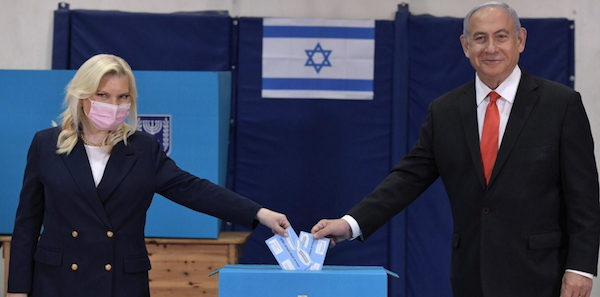
Israeli Prime Minister Binyamin Netanyahu and his wife, Sara, vote on March 23. While the prime minister’s party won the most number of seats in the Knesset, he will still struggle to form a government. (photo from IGPO)

Israeli Prime Minister Binyamin Netanyahu makes a stunning deal with lawmakers to abandon his post and replace Reuven Rivlin as president of the country when the president’s term expires later this year. An agreement to pardon Netanyahu around corruption charges he currently faces is part of a deal that leads to Netanyahu ending his run as the country’s longest-serving leader. With “King Bibi” finally in a sinecure of symbolic eminence, the polarized Knesset manages to cobble together a coalition and stave off the fifth round of elections in two years.

This was one of the most fantastical possibilities mooted in a webinar presented by the Centre for Israel and Jewish Affairs (CIJA) March 25, just two days after Israelis voted in the fourth of a series of elections during a two-year period of instability.

The panelists were CIJA’s chief executive officer Shimon Koffler Fogel and Adir Krafman, the agency’s associate director for communications and analytics. They sifted the entrails of the convoluted election outcome.

While ideological schisms divide Israeli politics, as does the secular-religious divide and other fractures, Fogel and Krafman concurred that the elephant in any discussion of the next Knesset is Netanyahu. CIJA is a nonpartisan organization and Fogel emphasized that the panelists, and moderator Tamara Fathi, were not advocating any outcomes, merely commenting on possibilities.

And the possibilities are almost endless. The vote sent 13 parties into the 120-seat Knesset. Some of these are not even parties, so much as umbrellas under which different factions coalesced for electoral purposes, so the mosaic of the chaotic chamber could refract in countless ways. But, while there are myriad permutations of possible coalitions and strange bedfellowships, Fogel, Krafman and most commentators in Israel and abroad think the most likely outcome is a fifth election. That is how difficult it would be for either side to patch together 61 members of the Knesset to govern.

Krafman presented graphic evidence of the challenges the pro- and anti-Netanyahu factions face in reaching that magic number. The pro-Bibi side likely has 52 dependable seats; his opponents probably have 57. That means an anti-Netanyahu coalition could form with the support of Naftali Bennett’s Yamina party, which holds seven seats. For Netanyahu to eke out 61 seats would require the backing not only of Bennett but also of the four seats won by the Arab party Ra’am. Such a partnership would be historic and would have been almost unthinkable in the recent past. But Netanyahu of late has been making amenable noises toward Arab Israelis in general and to the Arab parties in particular. However, even if the prime minister and his unlikely allies in the Arab sector made a deal, it could upend the consensus on the other side, as some on the right would probably balk at joining a coalition that includes Ra’am.

Ra’am is one of the big stories of the election. Exit polls indicated the party would not make it over the 3.25% threshold to win any Knesset seats. That created a scenario where Netanyahu and his probable allies were seen as almost certain to form a government.

But, as actual counting took place through the night and into the morning, it became clear that Ra’am would cross the minimum support for representation. Instantly, the calculations shifted.

If Ra’am were to enter a coalition government, or even if it merely supported a government from the sidelines, it would be a turning point in the role Arab parties play in Israeli politics. Ra’am has already upended conventional Arab approaches to politics. The umbrella of Arab parties, recently running under the banner of the Joint List, has always played a spoiler role. They are oppositionist and anti-Zionist groups that are as much protest movements as conventional political parties.

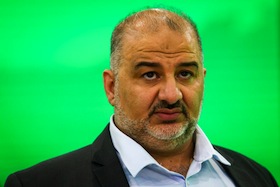
photo - Ra’am leader Mansour Abbas has put his party into a potentially advantageous position
Ra’am leader Mansour Abbas has put his party into a potentially advantageous position. (photo from hamodia.com)

Perhaps learning a lesson from the outsized power of small, right-wing and Jewish religious parties, Ra’am adopted a more pragmatic and transactional position than their former allies in the Arab bloc. The leader, Mansour Abbas, has not ruled out supporting a coalition or playing a role in government. Like smaller Jewish parties, he would be expected to come to coalition discussions with a shopping list of demands, such as more funding for projects and programs that benefit his constituents.

Ra’am’s success makes it an unqualified winner in the election sweepstakes. Fogel and Krafman discussed other winners and losers.

“The first loser, I think, is Netanyahu,” said Fogel. “Despite his party winning the most number of seats, 30 seats out of 120 in the Knesset, [he] is still not able to form a government.”

That might have been survivable if other parties that are Netanyahu’s likely backers did not also come up short.

“The other two losers are other right-wing parties,” Fogel added. Naftali Bennett, whose Yamina took seven seats, and Gideon Sa’ar, whose New Hope party took six, had hoped to siphon off a larger chunk of Likud’s votes.

“Both of them really failed to do that, winning only a handful of seats,” said Fogel.

It is a profound statement about tectonic changes in Israel’s ideological fault lines that the Labour party, which took seven seats, and another left-wing party, Meretz, which took six, are viewed as having had a good night. In the days leading up to the vote, there were questions whether either party would overcome the minimum threshold. The Labour party was the indomitable establishment political party for the first three decades of Israel’s existence.

Another loser, Fogel said, was Avigdor Lieberman and his Yisrael Beiteinu party. Lieberman is a right-wing but avowedly secularist politician. He ran a campaign promoting separation of religion and state and against Charedi privileges. His message may have backfired: while turnout was down overall from the last election, Charedi voters turned out in greater numbers, possibly in reaction to Lieberman’s message.

The discussion turned again to what may be the most likely path for a right-wing government, which could be the exit of Netanyahu. There are centrist parties, Fogel said, that do not have issues with Likud policies so much as they do with the prime minister personally. With him gone, a bloc of anti-Bibi members might engage with Likud under a new leader and form a centre-right coalition.

As unlikely as this scenario might be, it would stave off another unsavoury development.

Any hope of forming a Netanyahu-led coalition probably depends on support from the extremist grouping called Religious Zionism. This new umbrella of racist, misogynistic and homophobic extremists, which holds six seats, would taint any coalition as the most far-right government in Israel’s history. (Click here to read this week’s editorial.)

Whatever happens – whether someone can manage to hammer together a government, or whether exhausted Israelis will trudge to the polls for a fifth time – there are serious issues facing the country.

“There are some pretty daunting challenges out there,” Fogel said. “Most especially on the economic side. We see that some other countries have already begun to emerge [from the pandemic] with a fairly robust recovery. Israel isn’t there yet…. There is a sense of urgency that they do have to get an Israeli government in place that is going to be able to effectively address these issues and it’s not clear that the election result will offer that to Israelis, so I think it makes a situation, if anything, more desperate.”

Format ImagePosted on April 2, 2021April 1, 2021Author Pat JohnsonCategories IsraelTags Adir Krafman, Bibi, Centre for Israel and Jewish Affairs, CIJA, coalition, democracy, elections, Israel, Netanyahu, politics, Shimon Koffler Fogel
Israeli election jigsaw puzzle

Israeli election jigsaw puzzle

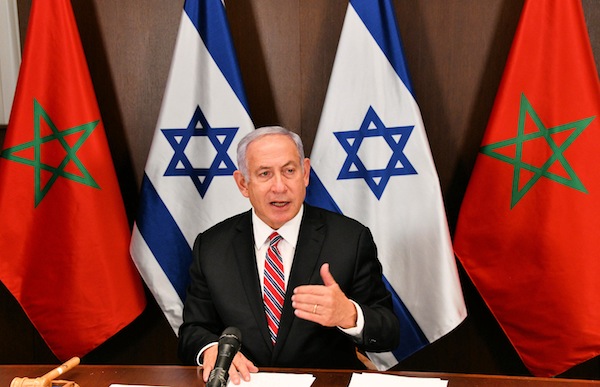
Prime Minister Binyamin Netanyahu at the start of a cabinet meeting this past January in Jerusalem. The two outside flags are the Moroccan national flags, placed there to celebrate the fact that Israel and Morocco had just established diplomatic relations. (photo by Haim Zach/IGPO via Ashernet)

The Israeli elections, which take place March 23, are not turning on conventional ideological schisms, according to two top observers. Rather than a left-right divide, the ballot question for most voters is yes-Bibi/no-Bibi.

Lahav Harkov, diplomatic correspondent for the Jerusalem Post, and Chemi Shalev, senior columnist and U.S. editor for Haaretz, analyzed the possible outcomes in a virtual event presented by the Centre for Israel and Jewish Affairs March 2.

Israel is in its fourth election cycle in two years, an unparalleled time of political turmoil. Harkov said she tends to err on the side of optimism but expects a fifth election before too long.

“I don’t see how we get out of this mess,” she said.

Shalev concurred, using a sports metaphor. “There is a saying in soccer, or football,” he said. “You play soccer for 90 minutes and, in the end, the Germans win, meaning no matter what you think during the game, the result is always that the German team wins and, in soccer, it’s usually true. In Israeli politics, it is also usually true.”

In each of the past three election campaigns, Shalev said, media and opponents of Prime Minister Binyamin Netanyahu convince themselves he is headed for defeat. Then the votes come in and coalition talks begin and he holds onto office.

True to script, said Shalev, polls suggest Netanyahu’s support is faltering, estimating his Likud party will take about 28 of the 120 Knesset seats, down from the 36 he holds now. But, as much as Netanyahu will face an uphill climb to cobble together 61 votes to form a working coalition, his opponents face even steeper challenges.

Netanyahu, nicknamed Bibi, has led Likud since 2006 and has been prime minister since 2009. Having also served for three years in the late 1990s, Netanyahu is the longest-serving prime minister in Israeli history and his doggedness in holding on to power has earned him another nickname: King Bibi.

Shalev depicted Netanyahu’s manoeuvrings after the last vote, in March 2020, as a sheer political masterstroke. Benny Gantz led Kahol Lavan (Blue and White), a centre-left coalition whose principal promise was to keep Netanyahu from another term. When coalition talks appeared doomed and another election inevitable, Gantz entered into a power-sharing agreement that delivered another term to Netanyahu and, in the process, exploded the Blue and White coalition. The broad spectrum of centre-left politics that had come together under Blue and White disintegrated and some of those voters have drifted off to the right and may never return to the left, said Shalev.

Gantz is running again but, while the question last election was whether he could best Netanyahu, the issue now appears to be whether he can garner the 3.25% threshold needed to eke out any Knesset seats whatsoever.

In fact, many parties are hovering in the polls around the cutoff mark, which could be a defining factor in the outcome. The Labour party, once the indomitable force in national politics, is on the ropes. Likewise, another erstwhile force on the left, Meretz, could also be wiped out of the Knesset. On the other hand, the smaller parties that do cross the electoral threshold will have outsized influence on whether Netanyahu hangs on or whether another leader can topple him.

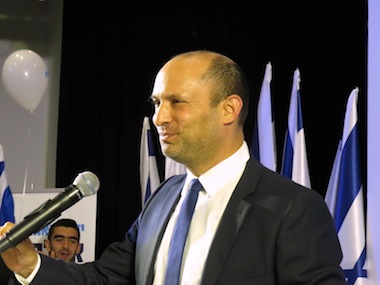
photo - Naftali Bennett speaks in Ramat Gan, in 2019. Among the parties Binyamin Netanyahu would need to form a governing coalition is Yamina, which is led by Bennett
Naftali Bennett speaks in Ramat Gan, in 2019. Among the parties Binyamin Netanyahu would need to form a governing coalition is Yamina, which is led by Bennett. (photo from IGPO via Ashernet)

Netanyahu’s political survival will depend on the ability of small right-wing parties to pass the electoral threshold to enter the Knesset and help him get to 61 seats. Among the parties Netanyahu would need to depend on are Yamina, led by Naftali Bennett, which is seen as an ideological heir to the defunct National Religious Party.

He would probably also need to rely on another new entity, called the Religious Zionist Party, which iss in an electoral agreement with two other small, far-right factions. The RZP, which tends to represent settlers and Charedi voters, is in partnership (for this round of elections, at least) with Noam, a party whose primary issue is opposition to rights for LGBTQ+ Israelis, which party adherents equate with the “destruction of the family.” The third party in the triumvirate is the extremist party Otzma Yehudit (Jewish Power), which Harkov said is a descendant of the outlawed movement of the late Rabbi Meir Kahane.

Kahane was an anti-Arab politician whose speeches in the Knesset were usually boycotted by all other members, leaving him to speak to a room consisting only of the speaker and the transcriptionists. In 1985, the Knesset passed a law banning parties that incite racism, effectively outlawing Kahane’s Kach party. He was assassinated in New York City in 1990 by an Egyptian-born terrorist.

While Kahane and his compatriots were shunned in their time, Harkov noted that Netanyahu intervened with the smaller right-wing parties, encouraging them – including Otzma Yehudit – to band together to help them collectively pass the electoral threshold.

“If they had not run together, they probably wouldn’t have made it into the Knesset,” she said, adding that tens of thousands of right-wing votes would have been effectively wasted.

Harkov added that she found it “interesting and sad” that, in the first of this four-election cycle, Netanyahu encouraged the small right-wing parties to run together and this caused a huge scandal, given the extremism of Otzma Yehudit.

“When Kahane was in the Knesset, everyone would walk out, no one would listen to Kahane speak when he would have his racist rants in the Knesset,” Harkov said. “Now, the prime minister is encouraging them to be in the Knesset.”

She credits an exhaustion with politics for the lack of outrage over the alliance this time around.

Shalev agreed. Israelis have had more than enough, he suggests.

“I have never seen such fatigue and, if I venture something about the elections, [friends] all look at me as if I’m a lost case,” he said.

Where the fault lines in Israeli politics were once left versus right, that paradigm is at least temporarily inoperable. The Israeli left is in disarray and Netanyahu’s greatest challenges come from the right, including several former allies. Gideon Sa’ar challenged Netanyahu for the Likud leadership last year and was soundly defeated. Frozen out by the prime minister, he left the party and formed New Hope.

“Policy-wise, they’re not that different from Likud,” said Harkov. “Sa’ar is quite right-wing.” He is pinning his hopes on voters seeking more of the same with less of the corruption surrounding the incumbent, who is under indictment on a number of bribery, fraud and breach of trust charges.

The second-largest party in the current Knesset is Yesh Atid, led by Yair Lapid. This more centrist, secular grouping could bridge some of the divide and make Lapid a possible successor to Netanyahu, but, like all scenarios, would require a coalition-building process akin to a jigsaw puzzle. While there are factions that would be happy to support Netanyahu and others that would support anyone but Bibi, the divisions are exacerbated by internal grievances and personality clashes.

Given the moving parts in any coalition talks, Shalev predicted a potential “outrageous scenario.” Netanyahu has been courting Arab voters and, with the Arab Joint List in disarray, he hopes he can dislodge some votes from those quarters. However, after the election, he would face a new challenge. Cobbling together 61 members might require recruiting Arab parties, which would likely be met with flat-out rejection by the far-right and religious parties Netanyahu would also need to hold. Likewise, religious and secular factions that might agree on supporting a particular candidate for prime minister might balk at joining a coalition with one another. In other words, while there might be 61 members ready to support Netanyahu, they might refuse to do so if it required sitting alongside ideological enemies. Every potential prime minister faces a similar dilemma.

A recent high court decision threw the issue of religious-state separation and the influence of the ultra-Orthodox on national policy and life into the headlines. The ruling recognizes conversions by Reform and Masorti (Conservative) rabbis in Israel (but not abroad). While this re-ignition of the divide between secular and religious Israelis is significant, it may or may not have a major impact on voters. Yesh Atid is avowedly secular, as is Avigdor Lieberman’s Yisrael Beiteinu party. Whether they will gain any political traction from the issue is a mystery.

While overseas observers assume the big political issues in Israel are the Palestinian conflict, Iran and national security, Harkov and Shalev say voters are more focused on bread-and-butter topics, including the pandemic and pocketbook issues. But the biggest question of all for voters, they both agree, turns on personality – primarily that of Netanyahu and voters’ feelings toward him.

Harkov believes Netanyahu has benefited from the Abraham Accords. It also won’t hurt him that Israel leads the world in the rollout of the coronavirus vaccine.

A particular challenge that a reelected Netanyahu would face is building a relationship with the new administration in Washington. Netanyahu bound his fortunes so personally to Donald Trump that Shalev believes it is impossible to build a meaningful connection with the Biden administration. Netanyahu was not an outlier on this front, he noted, citing opinion polls that suggested Israelis, were they able to vote for a U.S. president, would have supported Trump by a massive landslide.

Format ImagePosted on March 19, 2021March 18, 2021Author Pat JohnsonCategories IsraelTags Binyamin Netanyahu, Centre for Israel and Jewish Affairs, Chemi Shalev, CIJA, democracy, elections, Haaretz, Israel, Jerusalem Post, Lahav Harkov, politics

Posts pagination

Previous page Page 1 … Page 4 Page 5 Page 6 … Page 9 Next page
Proudly powered by WordPress