Skip to content
  • Home
  • Subscribe / donate
  • Events calendar
  • News
    • Local
    • National
    • Israel
    • World
    • עניין בחדשות
      A roundup of news in Canada and further afield, in Hebrew.
  • Opinion
    • From the JI
    • Op-Ed
  • Arts & Culture
    • Performing Arts
    • Music
    • Books
    • Visual Arts
    • TV & Film
  • Life
    • Celebrating the Holidays
    • Travel
    • The Daily Snooze
      Cartoons by Jacob Samuel
    • Mystery Photo
      Help the JI and JMABC fill in the gaps in our archives.
  • Community Links
    • Organizations, Etc.
    • Other News Sources & Blogs
    • Business Directory
  • FAQ
  • JI Chai Celebration
  • JI@88! video

Recent Posts

  • Eby touts government record
  • Keep lighting candles
  • Facing a complex situation
  • Unique interview show a hit
  • See Annie at Gateway
  • Explorations of light
  • Help with the legal aspects
  • Stories create impact
  • Different faiths gather
  • Advocating for girls’ rights
  • An oral song tradition
  • Genealogy tools and tips
  • Jew-hatred is centuries old
  • Aiding medical research
  • Connecting Jews to Judaism
  • Beacon of light in heart of city
  • Drag & Dreidel: A Queer Jewish Hanukkah Celebration
  • An emotional reunion
  • Post-tumble, lights still shine
  • Visit to cradle of Ashkenaz
  • Unique, memorable travels
  • Family memoir a work of art
  • A little holiday romance
  • The Maccabees, old and new
  • My Hanukkah miracle
  • After the rededication … a Hanukkah cartoon
  • Improving the holiday table
  • Vive la différence!
  • Fresh, healthy comfort foods
  • From the archives … Hanukkah
  • תגובתי לכתבה על ישראלים שרצו להגר לקנדה ולא קיבלו אותם עם שטיח אדום
  • Lessons in Mamdani’s win
  • West Van Story at the York
  • Words hold much power
  • Plenty of hopefulness
  • Lessons from past for today

Archives

Follow @JewishIndie
image - The CJN - Visit Us Banner - 300x600 - 101625

Tag: Jerusalem Post

War is also fought in words

War is also fought in words

David Jablinowitz, opinion editor for the Jerusalem Post, answers a question at one of his March talks at Congregation Beth Israel. (photo by Pat Johnson)

The intensely emotional debate in Israel right now centres on whether the government and military should be negotiating with Hamas for release of the hostages, extending the war or finding some combination of approaches to the situation.

David Jablinowitz, opinion editor for the Israeli English-language newspaper and media platform Jerusalem Post, spoke in Vancouver March 20. He shared with audiences at Congregation Beth Israel the rock and the hard place Israelis – including Israeli media – are between in the current crisis. Beth Israel’s Rabbi Adam Stein introduced Jablinowitz and emceed the discussion. The journalist spoke again the next night, at Shabbat services.

The Israeli government estimates that there are 59 remaining hostages in Gaza, of which 24 are believed to be alive. Testimony from rescued and released hostages say Hamas terrorists are poised to murder the captives if Israel Defence Forces ground troops approach – and this danger is in addition to the possibility that Israeli military strikes could unintentionally kill or injure Israelis held in Gaza. 

“This is why there is such an emotional dispute in Israel right now,” Jablinowitz said. “Are we going to lose these 24? Because some Hamas terrorists, of whatever level, the highest or the lowest, have orders that the moment the Israelis get close, you kill the hostages.”

At the same time, Hamas is unsurprisingly not negotiating in good faith, he said. Although the terror regime has been significantly weakened, they continue to behave as though they have the upper hand.

“Hamas is playing hardball,” he said. When an individual or a group is in a weakened position, rational behaviour would see them become more amenable to compromise. Hamas appears to respond otherwise, making counter-demands that Jablinowitz characterizes as “totally unacceptable.”

“Why are they doing that? Why does Hamas have the gall to do this?” he asks. “Because it plays into their own hands.”

Israeli intelligence officials, he said, know that Hamas has been using ceasefires as an opportunity to rebuild and prepare for fresh rounds of violence.

“They keep saying, ‘No, that proposal by Israel is not good.… That’s almost good, but do that, so I can do this,’” he said. “While negotiations are going on, weeks and weeks and weeks, what’s happening on the ground in Gaza is the rebuilding of infrastructure [and] recruiting terrorists. They are just building themselves up because, as far as they are concerned, if they have their way, there will be another Oct. 7 – because the dispute with Hamas is not a dispute over territory. Hamas does not want Israel anywhere. Their charter says so. They won’t accept a Jewish state – any non-Muslim state at all, but certainly not a Jewish state.”

Another reason why Hamas feels emboldened, he said, is because the international community, like the European Union, often treats Israel and Hamas as two legitimate actors on an equivalent moral plane.

The role of Qatar, which has been wrongly accepted by world leaders as a legitimate intervenor in the conflict, deserves a far more critical eye, argued Jablinowitz.

Qatar should be on the list of state sponsors of terrorism, he said. “They are pulling the wool over the eyes of the world.” 

Qatar is pretending to be a constructive party, while funding Palestinian terror, providing a haven to terrorists, and flooding the world with jihadist propaganda on social media and through their funding of courses in North American and European universities, Jablinowitz said. 

This support for propaganda, among other factors, helps explain the world’s approach to the conflict.

“I’m not saying Israel is all good, I’m not saying there aren’t innocent Palestinians,” said Jablinowitz. But he takes exception to the widespread expressions of concern around blameless Palestinian civilians.

“I have to tell you, soldiers who have served there, and among the [freed] hostages themselves [in] their testimony, have said, ‘Don’t give me the “civilian innocent” business. We were there, we saw the people. There was nobody, nobody, who came to our rescue.’”

Palestinian kids and other civilians came to see where the hostages are and, Jablinowitz said, “Nobody, nobody lifted a finger to do anything.”

Relatedly, the pass the world community seems to give the Palestinians is not extended to Israel’s military, even when it goes out of its way to minimize Palestinian casualties.

“What other countries say to a terrorist, or to their enemy, ‘At 4 o’clock Wednesday afternoon, I’m attacking you, and I’m attacking you here’? But that’s what we do in order to keep down the civilian deaths,” he said. “How does the world report it? What do European and other leaders say? ‘Oh, Israel is evicting the Palestinians.’ We are trying to save their lives and save our lives at the same time. We are better to Palestinian civilians in Gaza than Hamas is to Palestinian civilians in Gaza.”

The rebuilding of Gaza, if and when it occurs, must address not only the physical devastation but the indoctrination of kids, who have been taught that “Jews are bad people, the Jews were meant to be killed,” said Jablinowitz.

“As long as you’re going to have that education, there’s no point in doing anything,” he said. 

Jablinowitz acknowledged at least two contesting attitudes toward Israel’s overseas PR battle.

One side, typified in a Jerusalem Post op-ed by Alan Baker, Israel’s former ambassador to Canada, is that Israel should ignore global criticism.

“Enough. There is no point,” Jablinowitz summarizes this approach. “We have to do what we have to do.

“An alternative opinion is that maybe it’s not the hasbara [PR approach] that’s a problem, but the government’s policies,” he said.

He thinks the answer may be simpler.

“I honestly think that our cause is not as appealing. The Palestinians are so good at it because they are the downtrodden,” said Jablinowitz. 

Israel had good PR when they were seen in the world’s eyes as the David to the Arab world’s Goliath.

“We were doing great in 1967, when … [it would have been] so easy to just decimate our country,” he said. “We were popular.”

That changed after Israel won the Six Day War, which remains contested in terms of who started the conflict, since Israel attacked its neighbours as they were preparing an offensive.

“That’s why we preempted in 1967,” Jablinowitz said. “You see what happens when we don’t preempt? Oct. 7 happens when we don’t preempt.” 

Format ImagePosted on April 11, 2025April 10, 2025Author Pat JohnsonCategories LocalTags David Jablinowitz, Gaza, Hamas, hasbara, history, Israel, Israel-Hamas war, Jerusalem Post, media, PR
JP’s legal correspondent

JP’s legal correspondent

Michael Starr (photo from Michael Starr)

Canadian Michael Starr, who joined the Jerusalem Post in 2021, started a new position last month: that of legal correspondent.

Starr was born and raised in Toronto, but has a B.C. connection. His parents, Steven Starr and Iris Green-Starr, both doctors, moved the family to Victoria, where they still live, “because it is a lovely place and there is more nature there.” It was in Victoria that Starr attended high school.

Starr made aliyah at the age of 18 and joined the Israel Defence Forces later in the year, at the age of 19, serving in the infantry from 2009 to 2012.

“I grew up in a religious and Zionist household, and Israel was a large part of my cultural heritage,” he told the Independent about why he made aliyah. “My grandmother was born in Israel and my grandfather served in the Haganah and IDF. Further, there comes a time in every young man’s life in which he needs to leave his father’s home and put himself in a new environment to truly allow him to become himself.”

His brother, Joseph, came in 2012 and served in the Israeli army; today, he is in the Canadian military. Starr’s younger brother, Sam, is currently part of the IDF’s Golani Brigade.

Starr received a bachelor’s degree, majoring in government studies, and a master’s in terrorism and counterterrorism operations from Reichman University in Herzliya. (Reichman is Israel’s first and only private university, founded in 1994 as the IDC or Interdisciplinary Centre, a private college, before being rebranded in 2021.)

When a friend mentioned that there was a job opening at the Jerusalem Post, he applied and got the job.

“I never set out to be a journalist,” he said. “My interests are security and diplomacy.”

In March of 2021, he started writing for the Jerusalem Post magazine and the Post itself. From March 2020 through December of last year, he was on the breaking news desk.

“When the legal affairs correspondent position opened up, the end of November, I accepted because I wanted to be a journalist and it was a promotion, a step up,” he said. “I also like writing and this would be an opportunity to do more.”

On Jan. 1, Starr started that new position, “where I am reporting on the judicial reforms, which are not just one proposal but many different provisions. It was lucky I studied international law; this is a new field for me.”

Although Starr admits, “I’m a bit of a workaholic,” he runs for enjoyment and takes long walks.

Sybil Kaplan is a Jerusalem-based journalist and author. She wrote Witness to History: Ten Years as a Woman Journalist in Israel, set against the history of Israel in the 1970s, and Hatzaad Harishon, A “First Step” Love Story, relating her experiences as the first youth leader of the first black Jewish youth group in New York. She has edited/compiled nine kosher cookbooks and is a food writer for North American Jewish publications.

Format ImagePosted on February 10, 2023February 9, 2023Author Sybil KaplanCategories IsraelTags Israel, Jerusalem Post, journalism, judicial reform, Michael Starr
Israeli election jigsaw puzzle

Israeli election jigsaw puzzle

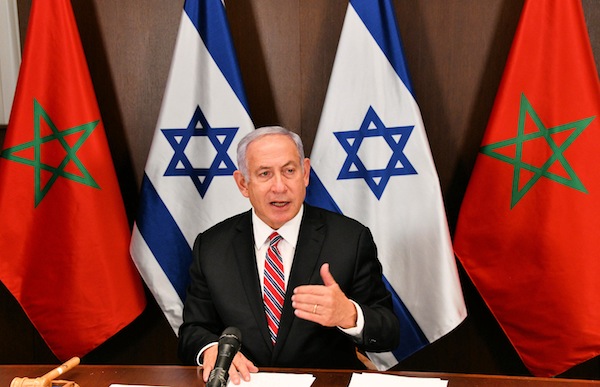
Prime Minister Binyamin Netanyahu at the start of a cabinet meeting this past January in Jerusalem. The two outside flags are the Moroccan national flags, placed there to celebrate the fact that Israel and Morocco had just established diplomatic relations. (photo by Haim Zach/IGPO via Ashernet)

The Israeli elections, which take place March 23, are not turning on conventional ideological schisms, according to two top observers. Rather than a left-right divide, the ballot question for most voters is yes-Bibi/no-Bibi.

Lahav Harkov, diplomatic correspondent for the Jerusalem Post, and Chemi Shalev, senior columnist and U.S. editor for Haaretz, analyzed the possible outcomes in a virtual event presented by the Centre for Israel and Jewish Affairs March 2.

Israel is in its fourth election cycle in two years, an unparalleled time of political turmoil. Harkov said she tends to err on the side of optimism but expects a fifth election before too long.

“I don’t see how we get out of this mess,” she said.

Shalev concurred, using a sports metaphor. “There is a saying in soccer, or football,” he said. “You play soccer for 90 minutes and, in the end, the Germans win, meaning no matter what you think during the game, the result is always that the German team wins and, in soccer, it’s usually true. In Israeli politics, it is also usually true.”

In each of the past three election campaigns, Shalev said, media and opponents of Prime Minister Binyamin Netanyahu convince themselves he is headed for defeat. Then the votes come in and coalition talks begin and he holds onto office.

True to script, said Shalev, polls suggest Netanyahu’s support is faltering, estimating his Likud party will take about 28 of the 120 Knesset seats, down from the 36 he holds now. But, as much as Netanyahu will face an uphill climb to cobble together 61 votes to form a working coalition, his opponents face even steeper challenges.

Netanyahu, nicknamed Bibi, has led Likud since 2006 and has been prime minister since 2009. Having also served for three years in the late 1990s, Netanyahu is the longest-serving prime minister in Israeli history and his doggedness in holding on to power has earned him another nickname: King Bibi.

Shalev depicted Netanyahu’s manoeuvrings after the last vote, in March 2020, as a sheer political masterstroke. Benny Gantz led Kahol Lavan (Blue and White), a centre-left coalition whose principal promise was to keep Netanyahu from another term. When coalition talks appeared doomed and another election inevitable, Gantz entered into a power-sharing agreement that delivered another term to Netanyahu and, in the process, exploded the Blue and White coalition. The broad spectrum of centre-left politics that had come together under Blue and White disintegrated and some of those voters have drifted off to the right and may never return to the left, said Shalev.

Gantz is running again but, while the question last election was whether he could best Netanyahu, the issue now appears to be whether he can garner the 3.25% threshold needed to eke out any Knesset seats whatsoever.

In fact, many parties are hovering in the polls around the cutoff mark, which could be a defining factor in the outcome. The Labour party, once the indomitable force in national politics, is on the ropes. Likewise, another erstwhile force on the left, Meretz, could also be wiped out of the Knesset. On the other hand, the smaller parties that do cross the electoral threshold will have outsized influence on whether Netanyahu hangs on or whether another leader can topple him.

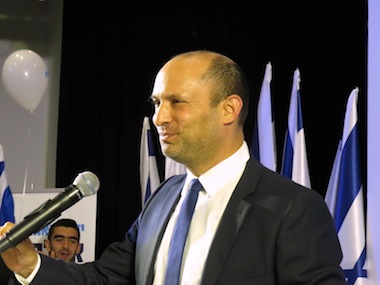
photo - Naftali Bennett speaks in Ramat Gan, in 2019. Among the parties Binyamin Netanyahu would need to form a governing coalition is Yamina, which is led by Bennett
Naftali Bennett speaks in Ramat Gan, in 2019. Among the parties Binyamin Netanyahu would need to form a governing coalition is Yamina, which is led by Bennett. (photo from IGPO via Ashernet)

Netanyahu’s political survival will depend on the ability of small right-wing parties to pass the electoral threshold to enter the Knesset and help him get to 61 seats. Among the parties Netanyahu would need to depend on are Yamina, led by Naftali Bennett, which is seen as an ideological heir to the defunct National Religious Party.

He would probably also need to rely on another new entity, called the Religious Zionist Party, which iss in an electoral agreement with two other small, far-right factions. The RZP, which tends to represent settlers and Charedi voters, is in partnership (for this round of elections, at least) with Noam, a party whose primary issue is opposition to rights for LGBTQ+ Israelis, which party adherents equate with the “destruction of the family.” The third party in the triumvirate is the extremist party Otzma Yehudit (Jewish Power), which Harkov said is a descendant of the outlawed movement of the late Rabbi Meir Kahane.

Kahane was an anti-Arab politician whose speeches in the Knesset were usually boycotted by all other members, leaving him to speak to a room consisting only of the speaker and the transcriptionists. In 1985, the Knesset passed a law banning parties that incite racism, effectively outlawing Kahane’s Kach party. He was assassinated in New York City in 1990 by an Egyptian-born terrorist.

While Kahane and his compatriots were shunned in their time, Harkov noted that Netanyahu intervened with the smaller right-wing parties, encouraging them – including Otzma Yehudit – to band together to help them collectively pass the electoral threshold.

“If they had not run together, they probably wouldn’t have made it into the Knesset,” she said, adding that tens of thousands of right-wing votes would have been effectively wasted.

Harkov added that she found it “interesting and sad” that, in the first of this four-election cycle, Netanyahu encouraged the small right-wing parties to run together and this caused a huge scandal, given the extremism of Otzma Yehudit.

“When Kahane was in the Knesset, everyone would walk out, no one would listen to Kahane speak when he would have his racist rants in the Knesset,” Harkov said. “Now, the prime minister is encouraging them to be in the Knesset.”

She credits an exhaustion with politics for the lack of outrage over the alliance this time around.

Shalev agreed. Israelis have had more than enough, he suggests.

“I have never seen such fatigue and, if I venture something about the elections, [friends] all look at me as if I’m a lost case,” he said.

Where the fault lines in Israeli politics were once left versus right, that paradigm is at least temporarily inoperable. The Israeli left is in disarray and Netanyahu’s greatest challenges come from the right, including several former allies. Gideon Sa’ar challenged Netanyahu for the Likud leadership last year and was soundly defeated. Frozen out by the prime minister, he left the party and formed New Hope.

“Policy-wise, they’re not that different from Likud,” said Harkov. “Sa’ar is quite right-wing.” He is pinning his hopes on voters seeking more of the same with less of the corruption surrounding the incumbent, who is under indictment on a number of bribery, fraud and breach of trust charges.

The second-largest party in the current Knesset is Yesh Atid, led by Yair Lapid. This more centrist, secular grouping could bridge some of the divide and make Lapid a possible successor to Netanyahu, but, like all scenarios, would require a coalition-building process akin to a jigsaw puzzle. While there are factions that would be happy to support Netanyahu and others that would support anyone but Bibi, the divisions are exacerbated by internal grievances and personality clashes.

Given the moving parts in any coalition talks, Shalev predicted a potential “outrageous scenario.” Netanyahu has been courting Arab voters and, with the Arab Joint List in disarray, he hopes he can dislodge some votes from those quarters. However, after the election, he would face a new challenge. Cobbling together 61 members might require recruiting Arab parties, which would likely be met with flat-out rejection by the far-right and religious parties Netanyahu would also need to hold. Likewise, religious and secular factions that might agree on supporting a particular candidate for prime minister might balk at joining a coalition with one another. In other words, while there might be 61 members ready to support Netanyahu, they might refuse to do so if it required sitting alongside ideological enemies. Every potential prime minister faces a similar dilemma.

A recent high court decision threw the issue of religious-state separation and the influence of the ultra-Orthodox on national policy and life into the headlines. The ruling recognizes conversions by Reform and Masorti (Conservative) rabbis in Israel (but not abroad). While this re-ignition of the divide between secular and religious Israelis is significant, it may or may not have a major impact on voters. Yesh Atid is avowedly secular, as is Avigdor Lieberman’s Yisrael Beiteinu party. Whether they will gain any political traction from the issue is a mystery.

While overseas observers assume the big political issues in Israel are the Palestinian conflict, Iran and national security, Harkov and Shalev say voters are more focused on bread-and-butter topics, including the pandemic and pocketbook issues. But the biggest question of all for voters, they both agree, turns on personality – primarily that of Netanyahu and voters’ feelings toward him.

Harkov believes Netanyahu has benefited from the Abraham Accords. It also won’t hurt him that Israel leads the world in the rollout of the coronavirus vaccine.

A particular challenge that a reelected Netanyahu would face is building a relationship with the new administration in Washington. Netanyahu bound his fortunes so personally to Donald Trump that Shalev believes it is impossible to build a meaningful connection with the Biden administration. Netanyahu was not an outlier on this front, he noted, citing opinion polls that suggested Israelis, were they able to vote for a U.S. president, would have supported Trump by a massive landslide.

Format ImagePosted on March 19, 2021March 18, 2021Author Pat JohnsonCategories IsraelTags Binyamin Netanyahu, Centre for Israel and Jewish Affairs, Chemi Shalev, CIJA, democracy, elections, Haaretz, Israel, Jerusalem Post, Lahav Harkov, politics
Proudly powered by WordPress