Skip to content
  • Home
  • Subscribe / donate
  • Events calendar
  • News
    • Local
    • National
    • Israel
    • World
    • עניין בחדשות
      A roundup of news in Canada and further afield, in Hebrew.
  • Opinion
    • From the JI
    • Op-Ed
  • Arts & Culture
    • Performing Arts
    • Music
    • Books
    • Visual Arts
    • TV & Film
  • Life
    • Celebrating the Holidays
    • Travel
    • The Daily Snooze
      Cartoons by Jacob Samuel
    • Mystery Photo
      Help the JI and JMABC fill in the gaps in our archives.
  • Community Links
    • Organizations, Etc.
    • Other News Sources & Blogs
    • Business Directory
  • FAQ
  • JI Chai Celebration
  • JI@88! video

Recent Posts

  • Sharing her testimony
  • Fall fight takes leap forward
  • The balancing of rights
  • Multiple Tony n’ Tina roles
  • Stories of trauma, resilience
  • Celebrate our culture
  • A responsibility to help
  • What wellness means at JCC
  • Together in mourning
  • Downhill after Trump?
  • Birth control even easier now
  • Eco-Sisters mentorship
  • Unexpected discoveries
  • Study’s results hopeful
  • Bad behaviour affects us all
  • Thankful for the police
  • UBC needs a wake-up call
  • Recalling a shining star
  • Sleep well …
  • BGU fosters startup culture
  • Photography and glass
  • Is it the end of an era?
  • Taking life a step at a time
  • Nakba exhibit biased
  • Film festival starts next week
  • Musical with heart and soul
  • Rabbi marks 13 years
  • Keeper of VTT’s history
  • Gala fêtes Infeld’s 20th
  • Building JWest together
  • Challah Mom comes to Vancouver
  • What to do about media bias
  • Education offers hope
  • Remembrance – a moral act
  • What makes us human
  • המלחמות של נתניהו וטראמפ

Archives

Follow @JewishIndie
image - The CJN - Visit Us Banner - 300x600 - 101625

Tag: democracy

New and old voices unite – NCJW, turning 100, partners with startup Beyond a Ballot

New and old voices unite – NCJW, turning 100, partners with startup Beyond a Ballot

Amanda Alvaro, left, and Rachael Segal cohost the podcast Beyond a Ballot, on which they will interview former BC premier Christy Clark live on stage at the Waterfront Theatre on March 25. (photo from NCJW)

International Women’s Day is marked today, March 8, and this month one of Canada’s oldest women’s organizations is partnering with a new female-focused startup to encourage greater engagement with politics.

National Council of Jewish Women, Vancouver branch, is holding a special event March 25 with Beyond a Ballot. The social enterprise launched by Rachael Segal, a Vancouver woman with extensive experience in politics and broadcast journalism, aims to encourage women to get more informed and involved in politics at every level. Segal is cohost of the Beyond a Ballot podcast, which will be recorded in front of a live audience for the first time at this month’s event. She and Amanda Alvaro will interview former BC premier Christy Clark on stage at the Waterfront Theatre on Granville Island. 

The collaboration between one of Canada’s oldest Jewish women’s groups and one of the newest innovations on the Canadian political scene is a product of the friendship between Segal and Jordana Corenblum, Vancouver chapter president of National Council.

Corenblum took over less than two years ago as president of the local section of NCJW, which is marking its 100th anniversary this year. The chapter is in the process of a major generational shift, she said, and partnering with a new female-focused organization on a live podcast fit the group’s vision. It is also a consequence of their personal connection.
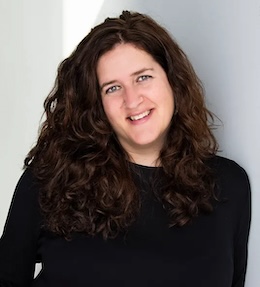
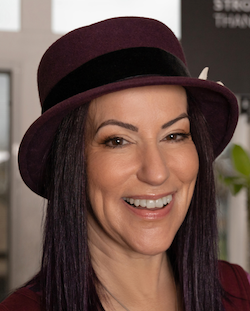
photo - Jordana Corenblum, Vancouver chapter president of National Council of Jewish Women
Jordana Corenblum, Vancouver chapter president of National Council of Jewish Women. (photo from NCJW)

Corenblum’s first job out of university was as a youth director at Congregation Beth Israel, where she met a 14-year-old Segal. They have remained tight ever since.

Corenblum, who is a career youth worker, said she had been urging Segal for some time to create something that educates and encourages women to get more involved in politics. With

Segal launching Beyond a Ballot last year and Corenblum taking over the local branch of National Council, a partnership was a cinch.

Segal holds a master’s in law and worked on Parliament Hill with Conservative members of Parliament, ministers and senators. She has extensive broadcast experience in TV and radio and is a commentator on CBC’s Power and Politics. During her undergraduate studies at the University of Victoria, she was president of the Canadian Federation of Jewish Students and she has worked with the Canadian Jewish Political Affairs Committee. She has served as senior director of the BC Liberal party.

Segal’s podcast cohost, Alvaro, who lives in Toronto, runs a communications agency and has also worked as a political advisor for provincial and federal Liberals. She is a regular commentator on CBC TV’s Power and Politics and appears regularly in national print media. 

“For a generation, we’ve been talking about putting your name on the ballot,” Segal said. “We need more women in the Legislature. We need more women in the House [of Commons]. But nobody was ever talking to the women who didn’t want to put their name on the ballot, [who] just wanted to be more engaged. I decided to launch this company, which uses media product, educational product and the building of community to try to talk to women differently about politics.

“My goal is for every woman in Canada to have a daily touch point with politics, whether that means having a conversation with your girlfriends, talking to your kids about something in the news, reading a news story or maybe that means deciding to run,” she said. 

The podcast has been “astronomically successful, beyond belief,” Segal said. “Amanda and I put hours and hours a week on it.”

Future plans for Beyond a Ballot include developing a mentorship model that allows women to engage in smaller, more intimate groups, and hosting national conferences to give a platform to women in politics. 

“Nothing like that exists right now in this country,” she said.

Beyond a Ballot is all about multi-partisanship and that comes through in the podcast.

“We don’t care what your position is, just that you have one,” said Segal. “Amanda is from the Liberal side, I’m from the Conservative side, but we have a really interesting conversation, where it is not divisive. We don’t go after people based on their political positions. It’s really about education above all else.”

While Segal started Beyond a Ballot from scratch last year, Corenblum took over as the new face of an established organization already in progress.

The Jewish community has a long history of women’s philanthropic and leadership organizations, which have had huge impacts over more than a century. Social changes – not least the increase in women working outside the home in the past several generations – have had an impact on these groups. Moreover, as happens in any volunteer agency, leaders burn out or simply weary of the commitment.

Local leaders approached Corenblum, who had not been involved previously, and urged her to take a role.

“The people who had been involved in the leadership for decades were all stepping back,” said Corenblum. “They were looking to the next generation and courting me and my friends and really flattered us and said, we need you young people to be involved. When you’re in your mid-40s and somebody’s calling you young, it’s flattering. We’ll listen to anything they have to say.”

The relevance of National Council, she said, has not diminished, as there is backsliding on some of the issues facing women. More than many other women’s groups of longstanding, NCJW has always been deeply engaged in political issues, she said.

“I think there’s a lot of overlap between this vast array of Jewish women’s groups,” she said. “The unique piece about National Council is that it is specifically focused on social justice work. They have a long history of being involved in political advocacy.… The entire focus of the organization is about social justice and engagement of women in tikkun olam.”

Corenblum and the mix of new and experienced local leaders are conscious of the embarrassment of riches the Jewish community has in terms of organizations doing good works. 

“There doesn’t need to be another organization that is doing programming,” she said. “We don’t need to get in and continue to offer more, because our community has so much to offer. What we really want to focus on is collaboration with organizations that are doing work or have values that are aligned with ours and doing things with them and supporting them in their work.”

One new NCJW initiative is working with Jewish Family Services on a garden-to-table project where they join with families planting vegetables in a community garden, then nurturing and harvesting the produce and cooking healthy meals.

Ideas sometimes fall into their laps. A thread on an online Vancouver Jewish moms group indicated that several families were coming to Vancouver from Israel for a respite from the chaos there. People were asking for car seats, warm clothing, highchairs, toys and other needs for families visiting for a few weeks.

“With National Council support, we were able to create a new local program called Warm Welcome,” Corenblum said. Before long, they had more donations than they could handle.

Ongoing projects the group runs include Books for Kids. 

“It’s about getting kids books to families and institutions that don’t necessarily have access to new beautiful books for families and children to take pride in,” she said. 

In January, as a local part of a national fundraiser, NCJW organized a games day that raised $8,000 in Vancouver alone to support a counseling service in Israel that has been overwhelmed with demand since Oct. 7.

“The thing that I love about this organization is that it so incredibly flexible,” said Corenblum. “People who are doing small projects around BC can apply to us for funding to help with whatever projects that are going on.”

She calls on anybody who has a passion project or is excited about an idea to reach out and make it happen together. “We really want this to be a grassroots organization for things that matter on the micro scale – and sometimes on the macro scale,” she said.

Corenblum acknowledged that her own politics do not mesh with those of the guest at the live taping her group is sponsoring – but that dialogue across divides is precisely the point, she said.

For Segal, Clark is a great get.

“Christy was on our A-list for our dream conversations,” Segal said, “so she very kindly agreed to do this one not only with us, but in person, which is amazing.”

The partnership with NCJW is an opportunity to reach new audiences, Segal added. “They approached us with this idea,” she said. “I think it’s pretty awesome that they’ve recognized the importance of this conversation and they have been incredible partners and hosts for this event.”

Segal said that, as a Jewish woman in the current climate, finding a supportive community is important. 

“We saw everything with Selina Robinson on the provincial level, we’ve seen international issues, and I think there’s a lot of women who are feeling like they want to do more,” she said. “Beyond a Ballot aims to provide women with that opportunity. Engaging with us and knowing that you have a community across the country that is here to support whatever issues are important to you, and give you the tools to be a better advocate for your community, is what women across Canada should know about Beyond a Ballot.”

Tickets for the March 25 event, at 7 p.m., are $18 and available online at eventbrite.ca.

“If you’re going to go and engage in Women’s Month events, please consider putting this one on your calendar because it may not be the sexiest of all topics, but it is definitely the one that impacts your life every day,” Segal said. 
Format ImagePosted on March 8, 2024March 7, 2024Author Pat JohnsonCategories LocalTags Amanda Alvaro, Beyond a Ballot, Christy Clark, democracy, Jordana Corenblum, National Council of Jewish Women, NCJW, politics, Rachael Segal, women
Talking on democracy

Talking on democracy

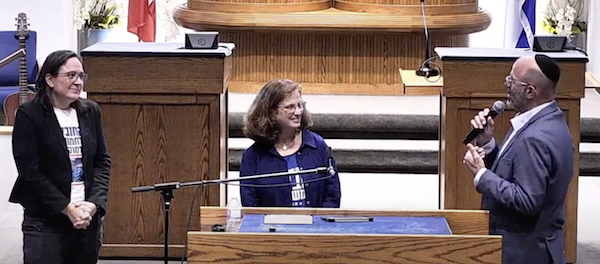
Left to right: Ora Peled Nakash of the America-Israel Democracy Coalition and Michal Muszkat-Barkan of Safeguarding Our Shared Home listen to a question posed by Temple Sholom Rabbi Dan Moskovitz at an event Sept. 26. (screenshot)

More than 300 people pre-registered to attend Hear From Leaders in the Israeli Protest Movement at Temple Sholom on Sept. 26 and the sanctuary was full. Presented by the synagogue, UnXeptable Vancouver, the America-Israel Democracy Coalition, and Safeguarding our Shared Home, in partnership with JSpaceCanada, New Israel Fund of Canada, Ameinu Canada and Arza Canada, this was the first time that a Canadian Jewish establishment hosted protesters from Israel’s pro-democracy movement on Canadian soil.

Speaking before the Hamas terror attacks on Oct. 6, Michal Muszkat-Barkan of Safeguarding Our Shared Home, and Ora Peled Nakash of the America-Israel Democracy Coalition were touring as part of an effort to educate North American diaspora Jewry on the judicial coup attempt and other fundamental issues with which Israel’s society has been grappling this past year. The unprecedented protest movement was, at 39 weeks, the longest sustained protest movement in modern Israeli history. In response to the war, however, the movement suspended protests in Israel and around the world, including Vancouver, standing in solidarity with their fellow Israelis.

The Sept. 26 evening began with Rabbi Laura and Charles Kaplan singing Oseh Shalom, Salaam (Od Yavo) and Lu Yehi followed by Temple Sholom Rabbi Dan Moskovitz’s introduction of the partner organizations. He said, “We have tried to partner at every opportunity we can to bring a dialogue about Israel, to bring an understanding of the challenges Israel faces and the reality that it faces, as well, through a lens of Zionism that is pro-Israel, pro-democracy, pro-human and civil rights.”

Daphna Kedem, lead organizer of UnXeptable Vancouver, spoke about the global protest movement started by Israeli expats, which has grown from 24 to 70 cities, with chapters in five Canadian cities. She said, “The only reason [the current Israeli government] has not succeeded [with the judicial coup] is millions of determined protesters in Israel and around the world who have been fighting for 38 weeks in a row to save Israeli democracy.”

A shortened version of the speech that American-Israeli author and journalist Yossi Klein Halevi, this year’s resident scholar at Temple Sholom, gave at the synagogue during Rosh Hashanah was played. Klein Halevi said: “Now, in Israel, we’re confronting a situation for the first time that I’ve experienced where there are no two sides. There are no two legitimate sides – one side is trying to destroy the foundations of Israeli democracy and the other side, the side that is in the streets every week for the last 37 weeks, sometimes more than once a week, waving giant Israeli flags, that side is trying to save the Israel that’s embodied by the two flags on the bima [pulpit of Temple Sholom]. These two flags represent the entwinement of Jewish and democratic values – that is the Israel that the diaspora fell in love with and that is the Israel that we’re fighting to preserve.”

Temple Sholom member Rina Vizer, in introducing the two main speakers of the evening, dubbed them “the new wonder women, ahead of Gal Gadot,” for their dedication to their cause, taking a 17-hour flight just as Yom Kippur ended in Israel, landing in Seattle, and driving to Vancouver, arriving mere hours before the event.

Peled-Nakash is a software engineer from Kibbutz Ramat David, just outside of Haifa. She was the first woman to graduate the naval officer’s academy and first woman to serve on a missile ship. She is a member of Forum Dvorah, a nongovernmental organization with a network of professional women in an array of fields relating to Israel’s national security and foreign policy.

Muszkat-Barkan is a professor of Jewish education at Hebrew Union College. She is the director of the department of education and professional development and heads the Rikma program in pluralistic Jewish education in partnership with the Melton Centre for Jewish Education at Hebrew University. She is also the founder and head of the Teachers’ Lounge, a professional development program for Arab and Jewish Educators in Jerusalem.

Peled-Nakash presented a slideshow about what brought her to quit her day job at IBM and volunteer full-time with the protest movement. As the first woman to graduate from the naval officer’s academy, she was inspired by the Alice Miller Supreme Court ruling in 1995, she said. When Miller – who had made aliyah from South Africa with her family when she was 6 years old – applied to the Israeli Air Force Flight Academy in 1993, she was rejected based on her gender. Miller sued the Israel Defence Forces, with the case ending up at the Supreme Court, where the rejection was deemed unconstitutional.

Tying the Miller case to the current attempt by Israeli Justice Minister Yariv Levin to weaken the Supreme Court, Peled-Nakash said, “Alice’s appeal to become a fighter pilot, that completely changed the course of my life…. I didn’t become a fighter pilot but I became a naval officer … following the same steps [as Miller], of opening equal opportunities for women in military service, which is a fight that is actively going on.”

Peled-Nakash has two daughters, ages 8 and 12, and regularly brings them to protests. She sees this act as a continuation of her family’s long Zionist legacy – to fight for Israel as a democracy, whether you live in Israel or in the diaspora.

Muszkat-Barkan grew up in an Orthodox Zionist home in Jerusalem. She spoke of the liberation of Jerusalem following the Six Day War in 1967 and how the night of celebration was also one that opened her eyes to those around her. “I just looked up, I don’t know why, and I saw a hand closing a window and I said to myself, ‘Oh my God, someone is living there and it’s four o’clock in the morning. How come I didn’t think about that? How come we are all here singing and shouting and we didn’t think that someone is living up there?’”

This experience is what led her to dedicate her life to multiculturalism and pluralism, her realization that we are not all the same, but we must live together and respect one another.

It was a WhatsApp message that led Muszkat-Barkan to begin the Jerusalem-based protest group Safeguarding our Shared Home with a few of her friends. The movement grew, with more people coming out to the streets every weekend. “If you came to Jerusalem to protest with us,” she said, “you would see groups of people against the occupation … you would see groups of religious people, you would see Reform people, educators, many groups all together.”

In wrapping up the question-and-answer period, Peled-Nakash left the audience with two messages for diaspora Jews.

“I would ask each and every one of you to take a hard look at how you are supporting, financially, current causes,” she said, “and to make sure that they are in line with your values because the fact is we’ve seen a lot of this coup has been funded by well-intended people that actually thought they were supporting Israel but they weren’t aware of which kind of Israel they were supporting. So, start with an audit to make sure that the causes you’re currently supporting are in line with the values we’re talking about.”

A recording of the entire presentation can be found on Temple Sholom’s YouTube channel.

Maytal Kowalski is a board member of JSpaceCanada and the New Israel Fund of Canada. Based in Vancouver, she serves as the executive director of Partners for Progressive Israel, a New York-based nonprofit dedicated to the achievement of a durable and just peace between the state of Israel and its neighbours.

Format ImagePosted on October 12, 2023October 12, 2023Author Maytal KowalskiCategories LocalTags America-Israel Democracy Coalition, Charles Kaplan, Dan Moskovitz, Daphna Kedem, democracy, Israel, Laura Duhan Kaplan, Michal Muszkat-Barkan, Ora Peled Nakash, protest movement, Rina Vizer, Safeguarding our Shared Home, Temple Sholom, Yossi Klein Halevi

Dialogue on democracy

Next week, Temple Sholom and UnXeptable Vancouver, with Israeli protest group Safeguarding our Shared Home and US-based registered charity America-Israel Democracy Coalition, will host a discussion about how the Jewish community in Vancouver can support the pro-democracy protest efforts in Israel.

The event, scheduled to take place at Temple Sholom on Sept. 26, beginning at 7 p.m., will feature a discussion with Michal Muszkat-Barkan, PhD, of Safeguarding Our Shared Home, and Ora Peled Nakash of the America-Israel Democracy Coalition. Attendees will hear their perspectives and engage in a dialogue about the efforts by the Israeli democracy movement to build a strong civil society upholding Israel’s Declaration of Independence and its commitments to Jewish history, Jewish values, democracy, equality and justice.

Israel’s pro-democracy movement brings together nearly 200 different organizations. These organizations span various facets of Israeli society, including religious and secular groups, LGBTQ+ and women’s rights advocates, military veterans, medical professionals, anti-occupation activists, and many community-specific groups.

“The pro-democracy movement isn’t about politics, it is about the soul of the country,” said Jonathan Barsade, president of the America-Israel Democracy Coalition. “In modern history, the soul of Israel has been a critical element for the well-being of the Jewish community worldwide. That is why it is so important for the Israeli movement to engage and include the international Jewish community in this momentous event.”

In partnership with JSpaceCanada, Arza Canada, Ameinu Canada and the New Israel Fund of Canada, the gathering at Temple Sholom mirrors in many ways the inclusivity of Israel’s pro-democracy movement, by bringing together the leading organizations of progressive Jewry in Canada to engage in dialogue at a critical time in the history of the Israel-Canada relationship. It will be the first opportunity in Canada for Canadian Jews to meet with Israeli protest leaders live and in-person.

“We are honoured to host this event at Temple Sholom, which provides a platform for open dialogue and the exchange of ideas,” said Rabbi Dan Moskovitz of Temple Sholom. “By bringing together these influential Israeli protest leaders and showcasing the multifaceted nature of Israel’s pro-democracy movement, we aim to promote understanding and empathy while answering their call for solidarity from diaspora Jews.”

Daphna Kedem, lead organizer of UnXeptable Vancouver, added, “as an Israeli expat and proud member of the Vancouver Jewish community, I know how much pain both these communities feel about the current political climate in Israel. It is my hope that, through listening to those on the ground most affected by the potential regime change in Israel, we can work together – diaspora and Israeli Jews – to keep Israel Jewish and democratic, as stated in its Declaration of Independence.”

The Sept. 26 event is open to the public, and all interested individuals are encouraged to attend. Admission is free, and light refreshments will be provided following the discussion. All those wishing to attend should RSVP at bit.ly/SaveIsraeliDemocracy.

– Courtesy Maytal Kowalski, Press Pause Collective

Posted on September 22, 2023September 21, 2023Author Maytal KowalskiCategories LocalTags Ameinu Canada, America-Israel Democracy Coalition, Arza Canada, Dan Moskovitz, Daphna Kedem, democracy, Israel, JSpaceCanada, New Israel Fund of Canada, pro-democracy movement, Safeguarding our Shared Home, Temple Sholom, UnXeptable Vancouver
Keep Israel Jewish and democratic

Keep Israel Jewish and democratic

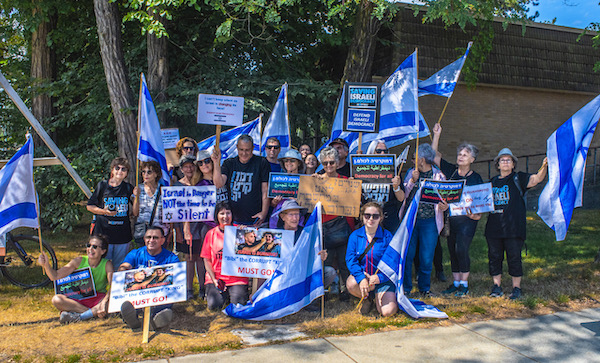
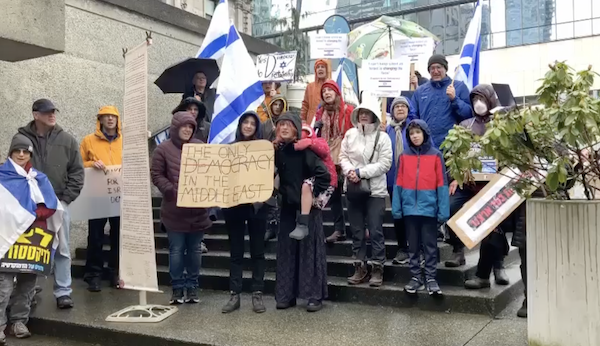
UnXeptable Vancouver has been rallying for Israeli democracy for 28 weeks. Here they are on 41st Avenue near Oak Street. (photo from UnXeptable Vancouver)

It has been many months since we first wrote to the Jewish Independent with our plea to voice our concern for democracy in Israel.

On Jan. 17, when the new government came to power, we saw the writing on the wall: the end of Israel as was envisioned in its Declaration of Independence – that Israel “will uphold the full social and political equality of all its citizens, without distinction of race, creed or sex; will guarantee full freedom of conscience, worship, education and culture; will safeguard the sanctity and inviolability of the shrines and holy places of all religions; and will dedicate itself to the principles of the Charter of the United Nations” – meaning Jewish and democratic.

Hundreds of thousands of Israelis have been going to the street for 31 weeks, holding flags and demanding democratia, democracy. And we have been echoing this outcry in Vancouver for 28 weeks – we joined 64 other cities around the world, as part of UnXeptable.

You might have seen us at Robson Square or, lately, around 41st Avenue and Oak Street. As we gather for our weekly rallies, holding Israeli flags, we try to hold onto the fabric of the Israel that we know and love. We try to hold onto one another in this ongoing rollercoaster, and we end each rally with Hatikvah (The Hope). We hope that Israel’s forces of liberty, freedom and diversity will overcome the agenda of this government – a government that is working towards its own personal interests rather than the good of the Israeli people.

We are fully aware of what happens when good people are silent, as bad things are happening. We cannot be silent as we see Israeli democracy crushed in front of our eyes. Dictatorship, orchestrated by a government that has lost its legitimacy, is turning out to be the biggest existential danger to our country.

We fear for Israel. We fear a civil war, as the rift and hatred that was stoked by the prime minister is growing. We fear for the security of Israel and its ability to defend itself, as soldiers no longer feel that they can commit to a government that does not adhere to the basic agreement, based on the accountability of the government to the judicial system.

The Knesset’s passing of the clause limiting the Supreme Court’s power to rule on the “reasonableness” of government decisions was a fatal blow to Israeli democracy. This clause provides the temporary majority of 64 members of the parliament (out of 120) the ability to legislate any unreasonable law. The government has more than 200 laws in its queue as the beginning of sweeping changes that will make Israel unrecognizable to us, or anybody that has any reference to Israel.

Day after day, things are getting darker for Israeli democracy. We fear that a constitutional crisis is looming. In the past week, the prime minister of Israel, Binyamin Netanyahu, when approached, would not guarantee to the Israeli people that he would obey the ruling of the court if this law were to be struck down.

What illuminates the darkness is the rising of the Israeli liberal forces, protesting and reviving the spirit that brought about the “Israeli magic” – Israel’s economic, political, cultural and scientific rise. Their nonviolent, spirited and creative protests, week after week, are the engine that drives the locomotive of hope. It carries the young and the elderly, Sephardim, Ashkenazim, religious and secular people to resist, sometimes facing the violent response of police acting under government orders. Our group seeks to resonate this protest and, at the same time, provide support to our families and friends in Israel.

After many efforts, the Jewish Federation of Greater Vancouver agreed to set up a meeting between chief executive officer Ezra Shanken and Nico Slobinsky of the Centre for Israel and Jewish Affairs and members of our group, UnXeptable, plus a limited number of people of the community at large. Our members addressed the meeting, illuminating different concerns we all share, as Israel is facing these contentious times. The meeting took place on July 24, just two days before Tisha b’Av, and we could hear the wings of history. We reiterated our two main requests:

  1. A town hall meeting, open to the whole community, not limited by the size of the room, with the objective of clearly bringing forth the complex issues Israel is facing.
  2. A clear and public statement from the Jewish Federation of Greater Vancouver to the community that outlines where they stand, as our leaders, on the judicial overhaul.

If not for the amazing protest movement, Israel would already be a dictatorship, a government in which a small group possesses absolute power without effective constitutional limitations.

UnXeptable voices Israel’s cry for democracy all over the world. Recently, the Philadelphia UnXeptable group, through its continued protests, succeeded in getting billionaire Arthur Dantchik – a main contributor to the Kohelet Policy Forum – to withdraw his donations to the organization, one of the designers of the judicial coup in Israel.

At the moment, 64 members of the Knesset are derailing Israel from being a strong country, of law and order, with a strong economy and a strong army, to being a dark, weak country – economically, militarily, internationally – ruled by a prime minister indicted on three charges, an MK convicted of bribery, Haredim trying to legitimize their refusal to serve in the army and, last but not least, religious zealots seeking to legitimize the occupation and to govern Israel by religious law. There have been warnings from all sectors, including the previous head of Israel’s General Security Service and Israel Defence Forces, banking professionals, the International Monetary Fund and many heads of state.

We believe that the Federation, based on its support of human rights and Jewish values, should take a stand supporting the protesters in Israel and the values they are trying to protect, helping us save the national homeland of the Jewish people, which was established, after thousands of years in exile, with a vision to be Jewish and democratic. In historian and philosopher Yuval Harari’s words: “either a messianic dictatorship will rise or a democracy for all [will be established]. It is in our hands.”

We call for our local leaders to stop sitting on the fence. Come to Israel’s defence to prevent it from becoming a messianic, poor state that discriminates against minorities. Help us protect and keep Israel Jewish and democratic as per the Israeli Declaration of Independence.

– The UnXeptable Vancouver team (Rina Vizer, Dalite Har Toov,
David Berson, Edna Leyland, Ornit and Ron Haber,
Noga and Gideon Levit, and Daphna Kedem)

Format ImagePosted on August 18, 2023August 17, 2023Author UnXeptable VancouverCategories LocalTags Binyamin Netanyahu, democracy, Israel, judicial reforms, protests, rallies
Spotting disinformation

Spotting disinformation

On May 30, the Global Reporting Centre’s Peter Klein will give the talk Disinformation and Democracy. (photo from VST)

Emmy Award-winning journalist Peter Klein will be the keynote speaker at this year’s Making Meaning in a Time of Media Polarization conference, organized by the Vancouver School of Theology (VST). Klein’s talk on the evening of May 30 – titled Disinformation and Democracy – is free and open to the public.

Klein, a professor at the University of British Columbia School of Journalism, Writing and Media, also heads the Global Reporting Centre, an independent news organization based at UBC that focuses on innovating global journalism. His lecture will explore the role that disinformation plays in both confusing the public and in undermining journalism.

“Open information is central to democracy,” said Klein. “There is no open society without open dialogue. In the past, the challenge was simply to restrict governments from curtailing the media. That was a challenge in itself, but, today, there are so many forces of propaganda and disinformation, many much more subtle than dictators arresting journalists.”

The origins of disinformation go back a long way, Klein noted. He referred to a Jan. 24, 2018, message on World Communications Day from Pope Francis who spoke of the “crafty serpent” in the Book of Genesis that created “fake news” to lure Adam and Even to “original sin.”

Klein will focus his talk on more contemporary efforts to lead people astray – from Germany’s Hitler to the Russian newspaper Pravda to Iraq’s Saddam Hussein. He will first look at disinformation from a North American context, then provide several international examples.

The Global Reporting Centre recently competed a study on disinformation attacks on journalists, or what he refers to as a “special subset of disinformation.”

“Attacking the messenger is an old trick that people in power have traditionally used, but social media has made it so much easier to undermine the authority of journalists,” said Klein, who has served as a producer for 60 Minutes, created video projects for the New York Times and written columns for the Globe and Mail, among other publications.

“Publish a critical story about a politician or business leader, and there’s a chance they or their supporters will come after you any way they can,” said Klein. “What we found in our study is that those wanting to undermine media do so by attacking on basis of race, gender and a number of other factors, which vary geographically.”

Though social media is what Klein calls “the pointy end of the stick,” mainstream media has, sometimes through disinformation, become polarized, too, he said. The Dominion Voting Systems case against Fox News, ending in April when the network paid a $787 million US settlement, is a clear example. Fox had falsely claimed that Dominion manipulated the results of the 2020 American presidential election.

“Fox had to pay for this, but they’re still standing, and I don’t necessarily see much change at the network,” Klein said.

The latter part of Klein’s talk will examine ways to combat disinformation. A key element of lessening the problem comes down to “public sophistication,” said Klein.

“We’re awash in fake news, not just political but calls to your cellphone that the RCMP is going to arrest you because of unpaid taxes, ads for incredible deals on household goods that just need a small deposit to hold the item, and the classic Nigerian prince scheme. I think we’re getting better at spotting that kind of fake information, although people still fall for it on a regular basis – including me recently, when looking for a deep freezer. As the public gets more sophisticated, so do the scammers.”

The same holds true for disinformation, according to Klein, and people need to improve their ability to identify falsehoods. He spoke about the visit a few years ago to the Global Reporting Centre by a journalist who exposed that torture was being committed by Iraqi special forces fighting ISIS. Following the visit, an Iraqi graduate student arrived at Klein’s office and presented a video that portrayed the journalist as a fabulist and a torturer himself.

“It turned out this video was part of a disinformation campaign in Iraq meant to undermine his embarrassing reporting, but she fell for it. We’re all susceptible, but if we can be better educated about disinformation and better equipped to spot it, we have a chance to combat it,” Klein said.

“In many ways, we’re more powerful than those who are combating traditional heavy-handed censorship and attacks on media. My parents fled Soviet-controlled Hungary, where public dialogue that was not in line with the state narrative could get you tossed in jail. We have the agency to combat it,” he said.

photo - Rabbi Laura Duhan-Kaplan, director of the conference Making Meaning in a Time of Media Polarization, which looks at how religious communities might respond to a crisis in public discourse
Rabbi Laura Duhan-Kaplan, director of the conference Making Meaning in a Time of Media Polarization, which looks at how religious communities might respond to a crisis in public discourse. (photo from VST)

Making Meaning in a Time of Media Polarization, which will be held May 30-June 1, will be VST’s eighth annual inter-religious conference on public life. Its participants will seek answers on how spiritual and religious leaders might proceed at a time when social media, politicians and some news organizations sow polarization and cultivate outrage.

“Under COVID restrictions, our society’s stress points started to crack. We saw bad actors use media and social media to divide people, and we saw innocent, well-meaning people get drawn in,” said Rabbi Laura Duhan-Kaplan, director of Inter-Religious Studies and professor of Jewish studies at VST, who is the conference director.

“Ideally, in spiritual communities, people learn how to live a meaningful life with others. So, we started to think about how religious communities might respond to a crisis in public discourse,” she said. “We designed a conference where media experts can help us understand the crisis, and religious teachers can help us respond.”

To register for Klein’s talk – which will take place at Epiphany Chapel in-person, as well as online – visit vst.edu/inter-religious-studies-program/conference.

Sam Margolis has written for the Globe and Mail, the National Post, UPI and MSNBC.

Format ImagePosted on May 12, 2023May 11, 2023Author Sam MargolisCategories LocalTags democracy, disinformation, education, Global Reporting Centre, journalism, Laura Duhan Kaplan, law, media, misinformation, Peter Klein, polarization, Vancouver School of Theology, VST
חודש שלישי ברציפות של הפגנות

חודש שלישי ברציפות של הפגנות

(photo by Roni Rachmani)

בוונקובר כמו בעשרות רבות של ערים ברחבי העולם ממשיכים ישראל ויהודים מקומיים להפגין נגד המהפכה המשפטית של ממשלת נתניהו, ובעד שמרית הדמוקרטיה בישראל. ההפגנות בוונקובר נערכות זה החודש השלישי ברציפות עד כה נערכו כבר שנים עשר אירועים, בכיכר רובסון בדאון טאון בסמוך לוונקובר ארט גלרי – בימי ראשון בשתיים עשרה בצהריים. משתתפים בהן בין עשרים לחמישים איש לכל היותר. למארגני האירוע ברור שמטבע הדברים לישראלים וליהודים שגרים כאן אין רצון להשתתף באירועים קהילתיים כאלה או אחרים, או בהפגנות הקשורות בישראל. חשוב להם להראות שגם כאן יש הפגנות תמיכה בדמוקרטיה הישראלית ונגד הצעות החוק של נתניהו ואנשיו להריסתה, גם אם המשתתפים בהן הוא מועט באופן יחסי לערים אחרות בעולם

מארגני ההפגנות בארץ ובעולם כותבים באתר שלהם בפייסבוק: “עכשיו זה הזמן. הזמן השחור. עכשיו זה הרגע לקום ולזעוק: הארץ הזאת בנפשנו היא
מה שקורה בה היום יקבע מי היא תהיה ומי אנו וילדינו נהיה. (דויד גרוסמן)

ישראל נמצאת כעת תחת מתקפה על בסיס קיומה – על הדמוקרטיה שלה. מול המתקפה הזו קמה מחאה חסרת תקדים בישראל, בקרב ישראלים רבים ברחבי העולם. בשבת נצא מהבית – מוונקובר ועד סידני כדי לקחת חלק במאבק לעצירת המהפכה המשטרית, כדי להשמיע את קולנו במלחמה על

הדמוקרטיה. תביאו שלטים ודגלים, תביאו כלים מוזיקליים.
תבואו צבעוניים. אנחנו רוצים לשתף את הקהילות הפלורליסטיות וססגונית תזמינו את החברים שלכם, את המשפחות שלכם, את הילדים שלכם, את ההורים שלכם. תזמינו חברים שאוהבים את ישראל ורוצים לתמוך המאבק שלנו על הדמוקרטיה בארץ. הפיצו ושתפו”

בן הסיסמאות שמופצות בהפגנות בוונקובר ובערים אחרות בעולם כולל בישראל: “שקרן קטן”, “בא לריב”, “מלשכת ראש הממשלה מבקשים להבעיר”, “נתנהיו הסיר את הדמוקרטיה מהקבוצה”, “עשבים שולטים”, “אף אחד לא מדבר על צדק”, “יחריב לוין”, “שמחה ואסון”, “שהמדינה תישרף”, “דיקטטורה בעזרת אשם”, “מושחתים שתו אותנו בקשית”, “צדק עזב את הקבוצה”, “חירות עזב את הקבוצה”, “חירות סוף”, “אנו מחריבים בזאת”, “אתה ואני נהרוס את העולם”, “חיקקה בנוסקר”, “השר לביטחון על הפנים”, “משנכס אדר מרביצים בשמחה”, “ישראל מתפרקת”, “אני ימני דמוקרטי”, “הועדה למינוי שפוטים”, “איך אומרים איראן בעברית”, “אל תקרע לי עם”, “ביי-טק. ההפיכהמרסקת את הכלכלה”, “ביבי איבדת את זה”, “נלחמנו למען המדינה, עכשיו נילחם עליה”, “לא יהיה כלום, כי לא נשאר כלום”, “Jוקה עכשיו”, “אנחנו חרדים!”, “שלוש רשויות: מבצעת, מבצעת, מבצעת”, “אין לכם רשות (שופטת)”, “דמוקרטיה על מלא”, “אנחנו המחנה המשותף (הרוב הדמוקרטי)”, “אחדות עכשיו”, “שלא ידע דמקורטיה”, “נבצרות עכשיו”, “מר קלקלה”, “רפורמה עושים לאט לאט. הפיכה עושים מהר מהר”, “לא לדיקטטורה! נלחמים על הדמוקרטיה”, “חובה להתנגד”

מרבית המשתתפים בהפגנות בוונקובר כו העמיתים בישראל די מיואשים ממה שקורה בארץ, משלטונו המפחיד של בנימין נתניהו, שכל שחשוב לו הוא לשמור על כיסא ראש הממשלה. רבים לא מאמינים שאפשר לחזור אחורה לשלטון אחר – ללא נתניהו. לרבים ברור שכיבוש השטים כתוצאה ממלחמת ששת הימים מצד אחד ריבוי הילודה אצל החרדים ויוצא מדינות ערב, הביאו למצב הנוכחי, שבו הימין, החרדים והקיצוניים עושים כמעט כרצונם. מספר מפגינים שחזרו מישראל סיפרו על מצב הרוח שם שהוא קודר ביותר. לכולם כמעט ברור שהאשם העיקרי במצב הבלתי נסבל הזה שמביא נזק גדול ישראל הוא נתניהו. הוא נמצא בשלטון כבר למעלה מחמש עשרה שנים

Format ImagePosted on May 3, 2023May 1, 2023Author Roni RachmaniCategories עניין בחדשותTags democracy, demonstrations, Israel, judicial reforms, Netanyahu, UnXeptable, Vancouver, דמוקרטיה, המהפכה המשפטית, וונקובר, ישראל, נתניהו, פגנות
Diaspora voices its concerns

Diaspora voices its concerns

The message on the Facebook post of this video from UnXeptable, who have been gathering weekly at Robson Square to protest the Israeli government’s proposed judicial reforms, reads: “Rain never stops Vancouver 🇨🇦 from supporting you in your struggle ❤️🇮🇱” (screenshot from Facebook.com/DefendIsraeliDemocracy)

Reverberations from the political tumult in Israel continue to rumble across the Diaspora, including here in British Columbia.

For 10 weekends in a row now, a few dozen Vancouver-area residents, many of them Israeli expats or Israeli-Canadians, have gathered in downtown Vancouver. On March 30, an “emergency meeting” took place at Or Shalom synagogue, titled Saving Israeli Democracy.

Daphna Kedem, one of the organizers of unXeptable, which is behind the rallies, told the group at Or Shalom that similar events are now taking place in more than 50 Diaspora communities.

“There is a point to going out in the street and saying we are here and we care and we want a lot of others to share what we feel,” she said, noting that between 20 and 50 people tend to show up at the weekly gathering at Robson Square.

“It would be great to be 200,” she said, adding that the masses of Israelis taking to the streets have forced a delay in the government’s proposals, but the fight is far from over.

The protests in Vancouver, in Israel and around the world centre on so-called “judicial reforms,” which would remove an existing multifaceted process of appointing Supreme Court justices and centralize it in the hands of the government executive, the cabinet. Among the reams of related proposals is a bill that would allow the Knesset to overturn Supreme Court decisions by majority vote.

Dr. Erez Aloni, an associate professor at the Allard School of Law at the University of British Columbia, said the proposals are “not a legal reform” and that it is “not a joke” to call what the government of Binyamin Netanyahu is attempting to do “a revolution.” Aloni is one of some 200 signees to the “Statement by Canadian jurists on proposed transformation of Israel’s legal system,” which was issued Feb. 9.

“A democracy needs checks and balances and these checks and balances include checks and restrictions on the government so we can enforce laws against the government, so we make sure that the government doesn’t abuse its right, in particular against minorities,” he said. “In Israel, the only checks, the only restrictions on the government, on the executive, is the Supreme Court.”

The power of the cabinet, the lack of a second chamber of parliament, the strictness of party discipline, the absence of a presidential veto, and the lack of a written constitution all combine to put extraordinary reliance on the Supreme Court to rein in any potential overreach by elected officials, said Aloni.

The proposals, which would give the government effective veto power over Supreme Court appointments, is a dramatic step, he said.

“The coalition, the executive, is going to be almost solely responsible for selecting judges by themselves,” Aloni explained.

Not only would this impact the Supreme Court, he argued, but any lower court judge with aspirations of appointment to the highest judicial body would presumably consider political repercussions when handing down decisions.

In addition to the proposals to alter the judiciary, Aloni told the audience that the government is also threatening “independent public broadcasting, control of academia, immunity for IDF soldiers and police actions, increasing jurisdiction of the rabbinical courts and so forth.”

Video-recorded remarks from Achinoam Nini, the well-known Israeli singer commonly known as Noa, were aired at the meeting, with portentous background music.

“The situation is not good,” said Nini. “In fact, Israel is on the verge of the worst tragedy in her short history, worse than any war so far: the death of her democracy and a total system breakdown. The so-called judicial reform … is no such thing. It is rather an antidemocratic coup, a grab for limitless power by a democratically elected government composed of convicted criminals, messianic zealots, corrupt opportunists and ultranationalists, turning democracy against itself and against the citizens of Israel.”

Dr. Lisa Richlen of the David Abraham Centre for International and Regional Studies at Tel Aviv University spoke of the impacts the proposals would have on nongovernmental organizations, especially those she works with that serve non-Jews, non-citizens and asylum-seekers. She addressed the apparent absence of Arab citizens of Israel in the demonstrations.

“I want to make the point that, for them, they haven’t felt that it’s a democracy since even before this,” she said, adding that the apparent attack on minorities has struck a chord with mainstream Israelis.

“When you start with weaker social groups,” said Richlen, “what you have is what you see today, where the mainstream of Israeli society is starting to feel increasingly threatened.”

Dr. Itai Bavli of UBC’s School of Population and Public Health echoed Richlen’s concerns for the rights of those outside the Green Line. He also disputed the idea that opponents of the government’s proposals are overstating the threat to democracy.

“Democracy is disagreeing and I get it that you have political differences, that’s the idea of democracy,” he said. “But these people, they don’t want democracy.… We have to oppose, we have to fight against these forces and support democracy in Israel.”

Rabbi Hannah Dresner, spiritual leader of Or Shalom, spoke and David Berson emceed.

The gathering was only one of many discussions in Jewish communities worldwide, some more public than others, around events in Israel and their impacts inside and outside that country. A February poll commissioned by JSpaceCanada and the New Israel Fund of Canada showed that, while three-quarters of Canadian Jews are emotionally attached to Israel, 73% oppose the judicial reforms (jewishindependent.ca/opposition-to-policies).

“Tensions that had been brewing for months in Israel came to head earlier this week, with the prime minister ultimately postponing the judicial reforms until the next legislative session,” wrote Jewish Federation of Greater Vancouver chief executive officer Ezra Shanken in his March 31 community email. “It is a very welcome decision, and, if our calculations are correct, it gives all parties until sometime in the summer to work out a compromise. A pause is not a halt and we implore the parties to come to the table with President [Isaac] Herzog, which is what we have advocated for since the start.”

The Jewish Federations of North America, the umbrella of 146 Jewish federations and more than 300 communities, released a brief open letter to Israel’s prime minister and opposition leader in February, stating, in part: “[W]e urge you to make clear that a majority of just 61 votes of the Knesset is not sufficient to override a decision of the Supreme Court. The essence of democracy is both majority rule and protection of minority rights. We recognize that any system of checks and balances will be different than those in our own countries, but such a dramatic change to the Israeli system of governance will have far-reaching consequences in North America, both within the Jewish community and in the broader society.”

On March 27, the Centre for Israel and Jewish Affairs, the advocacy voice of Jewish federations in Canada, lauded the Israeli government’s decision to delay the judicial reform legislation and urged more consensus on any changes.

Shimon Koffler Fogel, president and chief executive officer of CIJA, issued a statement, which noted, “The government’s decision must be met with a good faith effort on the part of the opposition parties, engaging in a constructive dialogue and ensuring people feel part of the policy process. Israel was founded on the principle of inclusion and must reaffirm those values at every opportunity. While there may not be uniformity around every decision, Canadian Jews must express unity around the existence of Israel and her contributions to the world, and acknowledge healthy debate is part of a continually evolving and growing democracy.”

Format ImagePosted on April 14, 2023April 12, 2023Author Pat JohnsonCategories LocalTags Achinoam Nini, CIJA, Daphna Kedem, David Abraham Centre, democracy, Erez Aloni, Ezra Shanken, governance, Israel, Itai Bavli, Jewish Federation, JSpaceCanada, judicial reform, Lisa Richlen, New Israel Fund Canada, Nini, Shimon Koffler Fogel, UBC, UnXeptable
If we forget, thee, Jerusalem

If we forget, thee, Jerusalem

The Western Wall, Jerusalem, Israel. (photo from Wikimedia Commons)

When I was a teenaged member of the Zionist youth group Young Judaea in Saskatchewan, we recited this pledge: “If I forget thee, O Jerusalem, may my right hand lose its cunning; may my tongue cleave to the roof of my mouth.”

Well, I haven’t forgotten, and I’ve learned that, as never before, Jerusalem needs our help. In my Israel today, governmental criminal corruption and disinformation is so bad that citizens can’t have a rational discussion about politics without getting angry. Fear and anger at the government has brought hundreds of thousands of demonstrators into the streets of Israel’s major cities.

The fear and despair has spread to us here in the Diaspora. Our lovely ideals about our lovely, peaceful, democratic Israel are being systematically extinguished by a band of radical religious politicians, some with criminal records. Some of us here are going so far as to wonder that, if Israel is now being led by a covey of self-serving rascals, why should we ever repeat the age-old hope, “Next year in Jerusalem”? Now that I am an older man, I remember my pledge and I issue a warning. We’re in danger of losing our Israeli democracy.

Israel’s government today can be compared to a dog being wagged by its tail. The tail in this case is a small alliance of ultra-Orthodox Jews who hold the balance of power in the Netanyahu government. Two small political parties – Jewish Power and Religious Zionists – call the shots and their chief target is the Supreme Court. They want to gain control over it. And for what reasons would they promote such a radical step in the name of “judicial reform,” and why would they so endanger Israel’s democracy?

There has been a history of battles between the Supreme Court and the ultra-Orthodox community about who has the power to regulate religious law in Israel.

Round One: Supreme Court versus the Government of Israel on the thorny question of which converts are legally Jewish citizens of Israel. For years, the Orthodox rabbinate ruled that you had to be converted in Israel by an Orthodox rabbi.

Bring on the Supreme Court. In 2021, after more than 15 years of debate, the Court ruled that non-Orthodox converts to Judaism in Israel are Jewish and thus entitled to become citizens. The decision includes those who convert to Judaism through the country’s Reform and Conservative movements. “Jews who during their stay in Israel were legally converted in a Reform or Conservative community must be recognized as Jews,” the Court wrote in its majority decision.

Despite that this ruling would only affect some 150 Israelis, Aryeh Deri, leader of the ultra-Orthodox Shas party, who, at that time, was interior minister, condemned the decision. He said it constitutes “a mortal blow to the Jewish character of the state. I promise to fix the law to ensure that only conversions under Orthodox religious law will be recognized in the state of Israel.” Deri was a minister in the current coalition, but was fired earlier this year because the Supreme Court ordered Netanyahu to do so, as Deri has a criminal record.

Round Two: As far back as 2007, women were being beaten on buses for refusing to sit at the back, as the ultra-Orthodox community ruled. In response to a petition submitted against the ultra-Orthodox Mehadrin sect, the Supreme Court ruled that you can’t tell a woman where to sit on a bus.

Round Three: The battle over chametz (foods with leavening, products not kosher for Passover). Recently, the ultra-Orthodox got even with the Supreme Court, which had struck down another religious law. This one forbade hospitals to allow chametz to be brought into hospitals on Pesach. Hospital visitors had to open their bags to be searched by security guards, and there was public outrage at being treated as criminals for concealing food.

The Supreme Court declared the law unnecessary and as offensive to non-Jews as well as Jews. Then, in March this year, the ultra-religious parties snuck in a new chametz law just before Passover. This time, the law allowed hospitals to decide whether or not to search bags or to reprimand people, and the bill passed the Knesset. Score one for the ultra-Orthodox alliance.

Round Four: Military exemption for ultra-Orthodox yeshivah students and the birth of the idea of “judicial reform.” As a condition for joining the Netanyahu government coalition, the ultra-Orthodox wanted to pass a law exempting yeshivah bochers from the military service that all Israelis are obligated to make. And they want to ensure that the Supreme Court can’t strike down the law. The Knesset, they maintained should be able to reverse the Supreme Court’s decisions if they rule against the law. Enter the idea of “judicial reform.”

When they talk about “judicial reform,” what the ultra-religious group really wants strikes at the very heart of Israeli democracy. They want the Knesset to be able to pick and choose which laws the Supreme Court can overturn. They want to give the government the power to make any laws they want without restrictions. They want the Supreme Court to be impotent.

This fearsome, anti-democratic power grab is what sends shivers down the spines of democracy-loving Jews everywhere, and brings thousands into the streets to protest “judicial reform” planned by the Netanyahu government.

In Canada, all the laws passed by Parliament must go through several hoops. First, the law must be approved by the House of Commons. After that, it goes up for debate at the Senate, which can send it back to the House of Commons for revision. Third, the law must be signed by the governor general, who can withhold signature if she feels that the law is repugnant to democracy. Finally, our Supreme Court can either demand that the law be changed or strike it down totally if it finds that it contravenes our Bill of Rights.

Israel has only the Supreme Court to protect its citizens from religious fanatics or rogue governments. Legal scholars are agreed:

allowing any government to reverse judgments of the Supreme Court would not only remove the protections of the Court; it would make Israel a dictatorship.

Rogue government? Look who Netanyahu hired to help him govern.

• The most dangerous and outrageous appointment is a man with a long criminal record, Itamar Ben-Gvir. The army refused to draft him because of his extremist ideas. To secure Ben-Gvir’s support, Netanyahu appointed this ultra-Orthodox Jew with a criminal record to the job of minister of national security and, incredibly, he now oversees police forces in Israel. He also holds the balance of power in the Netanyahu government. Anything that Netanyahu wants to do has to go through Ben-Gvir, who, in the face of widespread demonstrations gave his permission to temporarily halt progress on judicial reform.

• Haim Katz, a former minister of labour who was given a six-month suspended sentence for graft has been given the job of tourism minister.

• As stated above, Aryeh Deri, leader of the ultra-Orthodox Shas party, was appointed minister of health despite going to prison for taking bribes as interior minister and, earlier this year, being given a suspended sentence and a fine for tax offences.

• Netanyahu himself faces charges of corruption.

Is it any wonder that hundreds of thousands of people have taken to the streets to oppose the government’s judicial reform plan? Is it any wonder that the majority of Canadian Jews are also against the reform proposals?

Like them, I know that Israel needs me and that is why I write about it. Neither should you “let your tongue cleave to the roof of your mouth.” Join the Jews around the world who are speaking out for Israel’s democracy. And, while you’re at it, say a prayer for the state of Israel; she needs all the help that she can get.

Stan Goldman is a retired English teacher who lives in Richmond.

Format ImagePosted on April 14, 2023April 12, 2023Author Stan GoldmanCategories Op-EdTags corruption, democracy, gonvernance, Israel, judicial reform, ultra-Orthodox
Join rally to support Israeli democracy

Join rally to support Israeli democracy

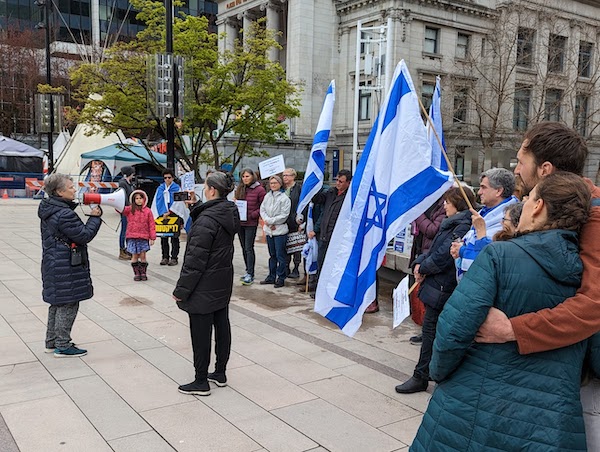
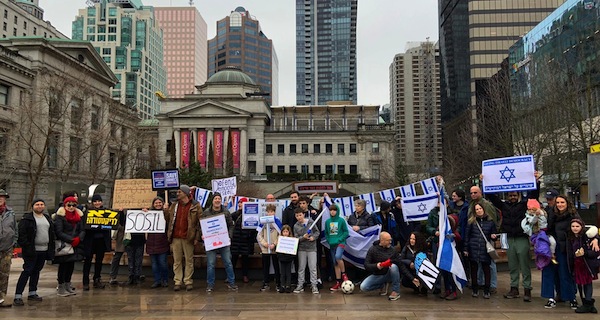
The Vancouver action group UnXeptable has been rallying on Sundays, at noon, at Robson Square, as part of an international grassroots movement to save Israeli democracy. (photo from Daphna Kedem)

We are a group of Israelis and Canadian Jews watching the grim news from Israel closely and feel that Israel’s democracy is on a very slippery slope, without brakes. The judicial crisis is leading to a dramatic loss of checks and balances in a state that has been democratic since its inception. It is shaking Israel and tearing apart its very fabric. We are terrified that the road to dictatorship will be quick and abrupt.

Israelis have been going to the streets in masses for the last many weeks. The biggest demonstrations drew more than 300,000 people to the street, yet we don’t see reference to these events in our local community. It seems that Jewish organizations and leaders are choosing to be on the sidelines, by toning down the crisis. Some are choosing to be silent altogether.

We are utterly frustrated by this silence. We know very well the horrific consequences that silence can bring about. But we realize that unprecedented events have been unfolding. Israel has been our source of pride throughout changing times and because events are happening fast, leaders might feel lost, without a compass in an uncharted territory.

We would highlight the facts as we see them: the Israel that we have known has changed.

Recent elections brought to power a group of people with personal interests counter to the public interest. One is a convicted criminal (bribery) who wants to clear his way to be a minister. The religious parties seek to release religious young people from army service, which is compulsory in Israel. A messianic, racist party wants to spread its agenda. And the prime minister is a defendant in three indictments and, in our opinion, to get away from his trial, he is promoting a change of regime in Israel, a radical move that will eliminate the separation of powers and the independence of the Supreme Court. The legal system will become part of the ruling party.

Until now, the selection of judges to the Supreme Court required agreement between the representatives of the judges and the representatives of the government. But the coalition has voted on a series of laws that approve a change in the judicial system. According to the new proposal, only the representatives of the coalition will be able to choose judges for the court. It seems clear that a preliminary committee will appoint judges that will dismiss the defendant, Binyamin Netanyahu, from all his charges.

The core issue is that the Netanyahu we knew from his 15 years in power previously is not the same Netanyahu. In his previous terms, he defended the Supreme Court as an anchor for freedom and justice. The new Netanyahu’s trial is going into its third year.

Israel has no constitution and no other checks and balances. The Supreme Court is the sole judicial body that secures the rights and freedoms of individuals and minorities. We would like to encourage our local leaders and the community at large to address these issues that will no doubt influence the close and delicate relationship we have with Israel. We would like to encourage people to stand up in defence of Israel’s democracy – our family members in Israel, our friends and colleagues, and the democratic forces in Israel need our help.

We urge you to join the Vancouver action group UnXeptable – Vancouver, which is part of an international grassroots movement in more than 30 cities to save Israeli democracy. Rabbis and community leaders have come out to such rallies around the world to speak out and support the movement. We hope that you, too, will join us. Our next rallies will be held on March 12 and 19, at noon, at Robson Square in downtown Vancouver.

Format ImagePosted on March 10, 2023August 17, 2023Author Daphna Kedem and Rina Vizer and Dalite Har ToovCategories Op-EdTags democracy, Diaspora, governance, Israel, justice, Netanyahu, protests, rallies, UnXeptable
Rallying in Rishon Le-Tzion

Rallying in Rishon Le-Tzion

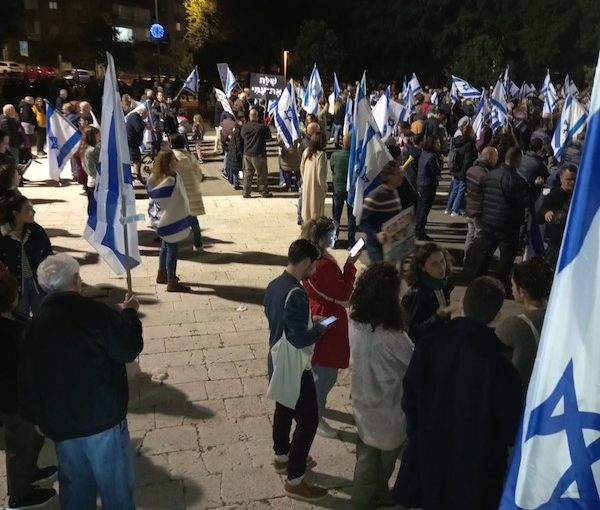
Protesters in Rishon Le-Tzion Demonstrating against judicial reform February 25, 2023. (photo by Hayden)

It was a valuable experience to attend a protest rally in Rishon Le-Tzion. Several hundred people gathered in a city square to express concerns about the dramatic changes being initiated by the new Israeli government. The rally was more poignant, given that it was held in a square that commemorates people from this city who have died in combat.

As a Canadian, I had mixed feelings about attending. Who am I to be here protesting, as I don’t pay taxes and haven’t served in the army? On the other hand, the changes proposed by the government are going to affect Jews around the world and not just in Israel. Also, having three grandchildren in Israel increases my interest in what happens.

Rishon Le-Tzion, established in 1882, is well known as one of the first cities to be established in modern Israel. Its name, translating as “first in Zion,” says it all. The first Israeli Hebrew school was established here. Baron Edmond de Rothschild established what evolved to be a thriving wine industry here. The city predates the establishment of Tel Aviv by 27 years.

The square itself commemorates the large number of Israelis from Rishon Le-Tzion who have died in combat. Engraved in a monument is a listing, year by year, of names of the deceased. Israel today is one of the most successful countries in the world. When you visualize the large number of names engraved on these walls, it is clear that Israel’s achievements did not come without major losses of life.

The rally itself consisted of many people waving large Israeli flags. There were people of all ages, including many children present.

One of the speakers, Meir Sheetrit, served as minister of several different portfolios in previous Likud governments. Sheetrit was so respected that his name was brought forth as a candidate for the presidency of Israel in 2014. As a Likudnik, he decried the changes taking place and asserted that the current government is deviating radically from the direction of previous Likud governments.

Another speaker was Yair Golan, who was a member of the Knesset and has served on government committees. He was a former general in the Israel army and, at one point, was considered for the position of army chief of staff. He said he values a democracy that is based on law and not on tyranny, a press that is free and not based on peoples’ whims and a government that will protect the rights of minorities.

Merav Michaeli, the leader of the Labour party, was in attendance. She circulated through the audience, but, according to the protocols of the demonstration, being a sitting member of the Knesset, she was not permitted to speak.

The audience was mainly attentive, though occasional side conversations took place. People frequently erupted with Boosha! (Shame) in reference to various proposed government changes. The slogan De-mo-cra-tia frequently reverberated through the audience.

Periodic references were made to the diminishing status of women, LGBTQ+ people and minorities, especially Arab minorities, with the thought that these groups will bear the brunt of the changes.

Jews of non-Orthodox denominations feel that their rights will be diminished under the new government. The Women of the Wall fear they will always be relegated to second-class citizens when they pray at the Kotel. Several of the new government ministers want to cancel the annual Gay Pride parades. Many Israelis and leaders of other countries think the new government will end the possibility of ever having a two-state solution.

Most of all, people are concerned about the future of Israel’s fiercely independent judiciary. In a bill recently introduced into the Knesset, the government will have the ultimate say in who is appointed to the courts. Also, the Knesset will have the ability with a simple majority to overrule decisions of the Supreme Court. Many people, including a large number of Canadian judges and lawyers, have spoken out against these changes.

I came to Israel with major concerns about the new government’s policies and directions. It was instructive to see that a large percentage of the Israeli population shares similar feelings.

The demonstration I attended was only one of many that took place that night. According to reports in the press, there were 40,000 demonstrators in Tel Aviv, 20,000 in Haifa, 2,000 in Beersheva and smaller rallies all over the country. Clearly, a large percentage of the Israeli population strongly objects to the proposed changes. Large demonstrations occur every Saturday night, but also at other times during the week. If public engagement is a sign of a functioning democracy, then Israel is a healthy society.

Will these protests make a difference? So far, the new government has been firm in its conviction that major new directions are needed and is not backing down.

Rallies such as the one in Rishon Le-Tzion raise many questions. Are rallies an effective way to advocate for change in a society? Do democratic governments need to respond to what people participating in rallies are advocating? Are the proposed changes going to lead to a better or worse Israel? Is it important for Diaspora Jews to express their opinions about what is happening in another country far away?

As a Canadian, I came back with a firm opinion about the latter question. Diaspora Jews, who can be greatly affected by what is happening in Israel, need to express their opinions about the changes that may affect them. People who support democratic systems should weigh in anywhere in the world when they perceive that democracy is threatened.

But it is up to Israelis themselves to answer the basic questions as to what type of electoral and judicial systems they prefer. For the sake of the Jewish Diaspora and the rest of the free world, we hope that they will make the right decisions.

Larry Barzelai is a semi-retired physician living in Vancouver. He’s always had strong ties with Israel through the Canadian Zionist Federation, CJPAC and the annual Public Speaking Contest. His main connection now is his three grandchildren who call Israel their home.

Format ImagePosted on March 10, 2023March 9, 2023Author Larry BarzelaiCategories Op-EdTags democracy, Diaspora, governance, Israel, justice, Netanyahu, protesters, rallies, Rishon Le-Tzion

Posts pagination

Previous page Page 1 Page 2 Page 3 Page 4 … Page 9 Next page
Proudly powered by WordPress