Skip to content

  • Home
  • Subscribe / donate
  • Events calendar
  • News
    • Local
    • National
    • Israel
    • World
    • עניין בחדשות
      A roundup of news in Canada and further afield, in Hebrew.
  • Opinion
    • From the JI
    • Op-Ed
  • Arts & Culture
    • Performing Arts
    • Music
    • Books
    • Visual Arts
    • TV & Film
  • Life
    • Celebrating the Holidays
    • Travel
    • The Daily Snooze
      Cartoons by Jacob Samuel
    • Mystery Photo
      Help the JI and JMABC fill in the gaps in our archives.
  • Community Links
    • Organizations, Etc.
    • Other News Sources & Blogs
    • Business Directory
  • FAQ
  • JI Chai Celebration
  • JI@88! video
image - Weizmann Canada Physics Tournament 2025
image - The CJN - Visit Us Banner - 300x600 - 101625

Recent Posts

  • היהירות היא אחד האויבים הגדולים ביותר של ישראל
  • Vrba monument is unveiled
  • Music to build bridges
  • A better future possible
  • Anne Frank exhibit on now
  • Human rights in sport
  • Telling the story of an icon
  • Crawl bigger than ever
  • JCC Maccabi in Toronto
  • A way to meet fellow Jews
  • Time to include
  • Add Jewish joy to the mix
  • Reminder of humanity’s light
  • From the archives … editorials
  • Year-round holiday recipes
  • מדוע עזבתי את ישראל ואינני חושב לחזור ארצה
  • OJC hosts Oct. 7 memorial
  • A journey beyond self
  • Antisemitism a problem
  • Young man is missed
  • Orr action sparks complaint
  • Prison sentence for hate
  • Etgar Keret comes to Vancouver
  • New fall lecture series
  • Series explores music
  • Doc on Zapiro screens Nov. 6
  • Joy of shared existence
  • Community milestones … October 2025
  • MAID vs Jewish values
  • Cheshvan a great month, too
  • Bull, bear or bubble?
  • From the archives … a coin, etc.
  • מדוע האנטישמיות הולכת וגואה בעולם
  • New bio gives Vrba his due
  • Joy brighter than ever
  • When approaches differ

Archives

Follow @JewishIndie

Tag: Yossi Klein Halevi

Talking on democracy

Talking on democracy

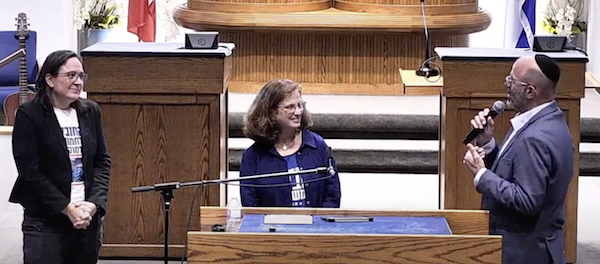
Left to right: Ora Peled Nakash of the America-Israel Democracy Coalition and Michal Muszkat-Barkan of Safeguarding Our Shared Home listen to a question posed by Temple Sholom Rabbi Dan Moskovitz at an event Sept. 26. (screenshot)

More than 300 people pre-registered to attend Hear From Leaders in the Israeli Protest Movement at Temple Sholom on Sept. 26 and the sanctuary was full. Presented by the synagogue, UnXeptable Vancouver, the America-Israel Democracy Coalition, and Safeguarding our Shared Home, in partnership with JSpaceCanada, New Israel Fund of Canada, Ameinu Canada and Arza Canada, this was the first time that a Canadian Jewish establishment hosted protesters from Israel’s pro-democracy movement on Canadian soil.

Speaking before the Hamas terror attacks on Oct. 6, Michal Muszkat-Barkan of Safeguarding Our Shared Home, and Ora Peled Nakash of the America-Israel Democracy Coalition were touring as part of an effort to educate North American diaspora Jewry on the judicial coup attempt and other fundamental issues with which Israel’s society has been grappling this past year. The unprecedented protest movement was, at 39 weeks, the longest sustained protest movement in modern Israeli history. In response to the war, however, the movement suspended protests in Israel and around the world, including Vancouver, standing in solidarity with their fellow Israelis.

The Sept. 26 evening began with Rabbi Laura and Charles Kaplan singing Oseh Shalom, Salaam (Od Yavo) and Lu Yehi followed by Temple Sholom Rabbi Dan Moskovitz’s introduction of the partner organizations. He said, “We have tried to partner at every opportunity we can to bring a dialogue about Israel, to bring an understanding of the challenges Israel faces and the reality that it faces, as well, through a lens of Zionism that is pro-Israel, pro-democracy, pro-human and civil rights.”

Daphna Kedem, lead organizer of UnXeptable Vancouver, spoke about the global protest movement started by Israeli expats, which has grown from 24 to 70 cities, with chapters in five Canadian cities. She said, “The only reason [the current Israeli government] has not succeeded [with the judicial coup] is millions of determined protesters in Israel and around the world who have been fighting for 38 weeks in a row to save Israeli democracy.”

A shortened version of the speech that American-Israeli author and journalist Yossi Klein Halevi, this year’s resident scholar at Temple Sholom, gave at the synagogue during Rosh Hashanah was played. Klein Halevi said: “Now, in Israel, we’re confronting a situation for the first time that I’ve experienced where there are no two sides. There are no two legitimate sides – one side is trying to destroy the foundations of Israeli democracy and the other side, the side that is in the streets every week for the last 37 weeks, sometimes more than once a week, waving giant Israeli flags, that side is trying to save the Israel that’s embodied by the two flags on the bima [pulpit of Temple Sholom]. These two flags represent the entwinement of Jewish and democratic values – that is the Israel that the diaspora fell in love with and that is the Israel that we’re fighting to preserve.”

Temple Sholom member Rina Vizer, in introducing the two main speakers of the evening, dubbed them “the new wonder women, ahead of Gal Gadot,” for their dedication to their cause, taking a 17-hour flight just as Yom Kippur ended in Israel, landing in Seattle, and driving to Vancouver, arriving mere hours before the event.

Peled-Nakash is a software engineer from Kibbutz Ramat David, just outside of Haifa. She was the first woman to graduate the naval officer’s academy and first woman to serve on a missile ship. She is a member of Forum Dvorah, a nongovernmental organization with a network of professional women in an array of fields relating to Israel’s national security and foreign policy.

Muszkat-Barkan is a professor of Jewish education at Hebrew Union College. She is the director of the department of education and professional development and heads the Rikma program in pluralistic Jewish education in partnership with the Melton Centre for Jewish Education at Hebrew University. She is also the founder and head of the Teachers’ Lounge, a professional development program for Arab and Jewish Educators in Jerusalem.

Peled-Nakash presented a slideshow about what brought her to quit her day job at IBM and volunteer full-time with the protest movement. As the first woman to graduate from the naval officer’s academy, she was inspired by the Alice Miller Supreme Court ruling in 1995, she said. When Miller – who had made aliyah from South Africa with her family when she was 6 years old – applied to the Israeli Air Force Flight Academy in 1993, she was rejected based on her gender. Miller sued the Israel Defence Forces, with the case ending up at the Supreme Court, where the rejection was deemed unconstitutional.

Tying the Miller case to the current attempt by Israeli Justice Minister Yariv Levin to weaken the Supreme Court, Peled-Nakash said, “Alice’s appeal to become a fighter pilot, that completely changed the course of my life…. I didn’t become a fighter pilot but I became a naval officer … following the same steps [as Miller], of opening equal opportunities for women in military service, which is a fight that is actively going on.”

Peled-Nakash has two daughters, ages 8 and 12, and regularly brings them to protests. She sees this act as a continuation of her family’s long Zionist legacy – to fight for Israel as a democracy, whether you live in Israel or in the diaspora.

Muszkat-Barkan grew up in an Orthodox Zionist home in Jerusalem. She spoke of the liberation of Jerusalem following the Six Day War in 1967 and how the night of celebration was also one that opened her eyes to those around her. “I just looked up, I don’t know why, and I saw a hand closing a window and I said to myself, ‘Oh my God, someone is living there and it’s four o’clock in the morning. How come I didn’t think about that? How come we are all here singing and shouting and we didn’t think that someone is living up there?’”

This experience is what led her to dedicate her life to multiculturalism and pluralism, her realization that we are not all the same, but we must live together and respect one another.

It was a WhatsApp message that led Muszkat-Barkan to begin the Jerusalem-based protest group Safeguarding our Shared Home with a few of her friends. The movement grew, with more people coming out to the streets every weekend. “If you came to Jerusalem to protest with us,” she said, “you would see groups of people against the occupation … you would see groups of religious people, you would see Reform people, educators, many groups all together.”

In wrapping up the question-and-answer period, Peled-Nakash left the audience with two messages for diaspora Jews.

“I would ask each and every one of you to take a hard look at how you are supporting, financially, current causes,” she said, “and to make sure that they are in line with your values because the fact is we’ve seen a lot of this coup has been funded by well-intended people that actually thought they were supporting Israel but they weren’t aware of which kind of Israel they were supporting. So, start with an audit to make sure that the causes you’re currently supporting are in line with the values we’re talking about.”

A recording of the entire presentation can be found on Temple Sholom’s YouTube channel.

Maytal Kowalski is a board member of JSpaceCanada and the New Israel Fund of Canada. Based in Vancouver, she serves as the executive director of Partners for Progressive Israel, a New York-based nonprofit dedicated to the achievement of a durable and just peace between the state of Israel and its neighbours.

Format ImagePosted on October 12, 2023October 12, 2023Author Maytal KowalskiCategories LocalTags America-Israel Democracy Coalition, Charles Kaplan, Dan Moskovitz, Daphna Kedem, democracy, Israel, Laura Duhan Kaplan, Michal Muszkat-Barkan, Ora Peled Nakash, protest movement, Rina Vizer, Safeguarding our Shared Home, Temple Sholom, Yossi Klein Halevi
Laying out Israel’s case

Laying out Israel’s case

Yossi Klein Halevi’s Letters to My Palestinian Neighbour is recently out in paperback. (photo by Ilir Bajraktari / The Tower)

Yossi Klein Halevi grew up in the right-wing Zionist youth movement Betar, the ideological stream of Ze’ev Jabotinsky and Menachem Begin. As a youth, he wore a silver outline of the land of Israel “as we understood it” that included not only the West Bank but also the area that became the kingdom of Jordan, which the British had severed from historic Palestine. As he’s aged, he’s emphatically mellowed.

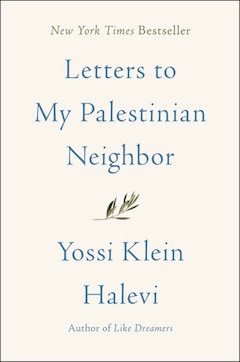
His book Letters to My Palestinian Neighbour, recently out in paperback, is, he writes, “an attempt to explain the Jewish story and the significance of Israel in Jewish identity to Palestinians who are my next-door neighbours.”

He lives in the French Hill neighbourhood of Jerusalem and repeatedly throughout the book reflects on how he is face-to-face with the division between their places.

Each chapter – essay, really – begins with “Dear neighbour.”

image - Letters to My Palestinian Neighbour book cover“From my apartment, I can just barely see the checkpoint you must cross – if you have a permit at all – to enter Jerusalem.” He talks about when, “before the wall was built, before so much else that went wrong, I tried to get to know you.”

In 1998, he set out on a pilgrimage into Islam and Christianity, a religious Jew “seeking not so much to understand your theology as to experience something of your devotional life. I wanted to learn how you pray, how you encounter God in your most intimate moments.”

During those comparatively placid times, he recalls, Israelis made little effort to accommodate their neighbours.

“For many years we in Israel ignored you, treated you as invisible, transparent. Just as the Arab world denied the right of the Jews to define themselves as a people deserving national sovereignty, so we denied the Palestinians the right to define themselves as a distinct people within the Arab nation, and likewise deserving national sovereignty. To solve our conflict, we must recognize not only each other’s right to self-determination but also each side’s right to self-definition.”

Klein Halevi made aliyah from the United States in 1982. Now a senior fellow of the Shalom Hartman Institute – “Israel’s preeminent centre for pluralistic Jewish research and education” – he co-directs the institute’s Muslim Leadership Initiative, is the author of numerous books and is a prolific commentator and former contributing editor of the New Republic. He has made the book’s Arabic translation available to download for free.

He argues that each side must be allowed to define themselves.

“So who are the Jews? A religion? A people? An ethnicity? A race?… That question impacts directly on our conflict. It goes to the heart of the Arab world’s rejection of Israel’s legitimacy as the nation-state of the Jewish people,” Klein Halevi writes. “Even Palestinian moderates I’ve known who want to end the bloodshed tend to deny that the Jews are an authentic nation. So long as Palestinian leaders insist on defining the Jews as a religion rather than allowing us to define ourselves as we have since ancient times – as a people with a particular faith – then Israel will continue to be seen as illegitimate, its existence an open question.”

He acknowledges that the problem occurs on both sides.

“Some Jews continue to try to ‘prove’ that Palestinian national identity is a fiction, that you are a contrived people. Of course you are – and so are we. All national identities are, by definition, contrived: at a certain point, groups of people determine that they share more in common than apart and invent themselves as a nation, with a common language, memory and evolving story. The emergence of a nation is an inherently subjective process.”

But he attempts to disabuse Palestinians and Arabic readers of the idea that Israel can be overcome.

“I’ve often heard from Palestinians that, just as the Ottoman Turks came here and left, and the British came here and left, so, too, will the Zionists one day leave. That analogy ignores Zionism’s singular achievement. None of those invaders founded a thriving society, let alone a sovereign state. They eventually went back to their own homelands. More than anything else, I need you to understand this: the Jews succeeded where the Crusaders and the Ottomans and the British failed because we didn’t merely come here. We returned.”

This sense of destiny is evocatively expressed when Klein Halevi writes about the War of Independence.

“Our side began the war with three tanks and four combat planes. And we were alone. That, as it turned out, was a crucial advantage, because desperation forced us to mobilize our entire society for a war of survival. If your side had prevailed, few if any Jews would have been left here. As a result, the Jews fought with such determination that only a handful of our communities fell. There was nowhere left to run; we’d reached the final shore of Jewish history.”

But the author makes an effort to acknowledge some of the harsh realities of that victory and the subsequent Israeli control of Palestinian areas and its effect on people. He recalls a moment during a call-up during his reserve service.

“A chubby teenage Palestinian boy, accused of stone throwing, was brought, blindfolded, into our tent camp. A group of soldiers from the border police unit gathered around. One said to him in Arabic: ‘Repeat after me: one order of hummus, one order of fava beans, I love the border police.’ The young man dutifully repeated the rhymed Arabic ditty. There was laughter.… That last story haunts me most of all. It is, seemingly, insignificant. The prisoner wasn’t physically abused; his captors, young soldiers under enormous strain, shared a joke. But that incident embodies for me the corruption of occupation. When my son was about to be drafted into the army I told him: there are times when as a soldier you may have to kill. But you are never permitted, under any circumstances, to humiliate another human being. That is a core Jewish principle.”

He acknowledges his pain over an eventual partition that would, for example, see the Jewish holy city of Hebron as part of an independent Palestine. But, he says: “The only solution worse than dividing this land into two states is creating one state that would devour itself. No two peoples who fought a 100-year existential war can share the intimate workings of government. The current conflict between us would pale beside the rage that would erupt when competing for the same means of power. The most likely model is the disintegration of Yugoslavia into warring ethnic and religious factions – perhaps even worse. A one-state solution would condemn us to a nightmare entwinement – and deprive us both of that which justice requires: self-determination, to be free peoples in our own sovereign homelands.… If Jaffa belongs to you and Hebron belongs to me, then we have two options. We can continue fighting for another 100 years, in the hope that one side or the other will prevail. Or we can accept the solution that has been on the table almost since the conflict began, and divide the land between us. In accepting partition we are not betraying our histories, neighbour; we are conceding that history has given us no real choice.”

Near the end, Klein Halevi reflects that some simple human goodness could have made a massive historic difference.

“Israel is a restless society of uprooted and re-rooted refugees and children of refugees, and the dark side of our vitality is a frankness that can easily become rudeness, the antithesis of Arab decorousness. Israelis often don’t know how to treat each other with respect, let alone those we are occupying. We are a people in a hurry to compensate for our lost centuries of nationhood, a people that doesn’t pay attention to niceties. Sometimes I think that, if only we’d known how to show your people simple respect, so much could have been different here.”

The new paperback edition includes an epilogue of “letters” in response to his neighbourly missives. Some, the author admits, are predictably harsh, dismissive and threatening. But many are long, thoughtful and inspiring. Klein Halevi has started a conversation. It is invigorating and heartily recommended to be a part of it as a reader.

Format ImagePosted on September 20, 2019September 17, 2019Author Pat JohnsonCategories BooksTags civil society, history, Israel, Israeli-Palestinian conflict, lifestyle, philosophy, Yossi Klein Halevi
Proudly powered by WordPress