Skip to content
  • Home
  • Subscribe / donate
  • Events calendar
  • News
    • Local
    • National
    • Israel
    • World
    • עניין בחדשות
      A roundup of news in Canada and further afield, in Hebrew.
  • Opinion
    • From the JI
    • Op-Ed
  • Arts & Culture
    • Performing Arts
    • Music
    • Books
    • Visual Arts
    • TV & Film
  • Life
    • Celebrating the Holidays
    • Travel
    • The Daily Snooze
      Cartoons by Jacob Samuel
    • Mystery Photo
      Help the JI and JMABC fill in the gaps in our archives.
  • Community Links
    • Organizations, Etc.
    • Other News Sources & Blogs
    • Business Directory
  • FAQ
  • JI Chai Celebration
  • JI@88! video

Recent Posts

  • Sharing her testimony
  • Fall fight takes leap forward
  • The balancing of rights
  • Multiple Tony n’ Tina roles
  • Stories of trauma, resilience
  • Celebrate our culture
  • A responsibility to help
  • What wellness means at JCC
  • Together in mourning
  • Downhill after Trump?
  • Birth control even easier now
  • Eco-Sisters mentorship
  • Unexpected discoveries
  • Study’s results hopeful
  • Bad behaviour affects us all
  • Thankful for the police
  • UBC needs a wake-up call
  • Recalling a shining star
  • Sleep well …
  • BGU fosters startup culture
  • Photography and glass
  • Is it the end of an era?
  • Taking life a step at a time
  • Nakba exhibit biased
  • Film festival starts next week
  • Musical with heart and soul
  • Rabbi marks 13 years
  • Keeper of VTT’s history
  • Gala fêtes Infeld’s 20th
  • Building JWest together
  • Challah Mom comes to Vancouver
  • What to do about media bias
  • Education offers hope
  • Remembrance – a moral act
  • What makes us human
  • המלחמות של נתניהו וטראמפ

Archives

Follow @JewishIndie
image - The CJN - Visit Us Banner - 300x600 - 101625

Tag: Beth Tikvah

A story of survival and safety

A story of survival and safety

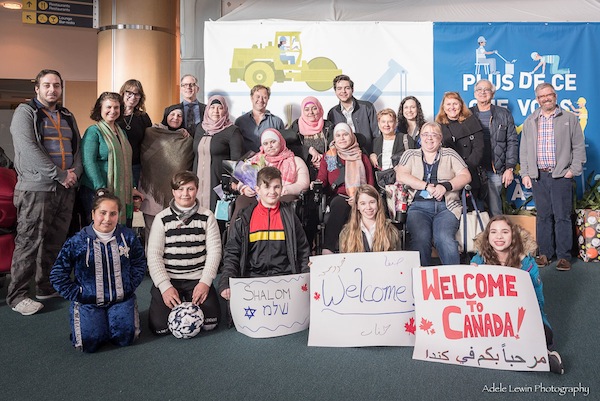
Welcomers of the Alsedawe family at Vancouver International Airport Jan. 21. (Adele Lewin Photography)

More than three years ago, Hanan Alsedawe’s family story of survival began as a waiting game on both sides of the ocean. But, on Jan. 21, 2019, the wait became a welcome as Hanan and her children stepped foot on Canadian soil.

In early 2015, congregations Beth Israel and Beth Tikvah began the long process of sponsoring and reuniting a Syrian refugee family with family who already lived in Vancouver. We worked with the government-approved sponsorship agreement holder – the Anglican Diocese – to prepare and submit our private sponsorship application to the Canadian government. It was a journey requiring perseverance by our coordinating committee, and patience and understanding from the many donors of both synagogues who demonstrated belief in our efforts regardless of the length of time it was taking.

On the Jordanian-Saudi Arabian border, in the Azraq Refugee Camp, Hanan and her two children – Mahros and Safa – shared limited resources with more than 55,000 refugees. Their extended family had made their way to Canada under government sponsorship, but Hanan had stayed behind, in Duma, Syria, because her husband, Raslan Abdulmalik, had been taken away by Syrian government forces and she had no idea of what had happened to him. She waited, she hoped, she prayed, but, eventually, with no sign of Raslan being alive, yet with no confirmation that he was either in prison or dead, Hanan decided to escape from Duma. She made her way with her two young children to Amman, Jordan, and eventually was placed in the Azraq refugee camp. There, she waited for a miracle.

Sept. 2, 2015, was a watershed moment that captured the hearts of people around the world and galvanized Canada into accepting 25,000 Syrian refugees into the country. Hanan’s mother and five siblings came to our shores under those auspices. But it would take years of work and hope to bring the last of Fayzeh Alsedawe’s daughters, with her children, to join the family here.

More than three years after initiating the sponsorship, Beth Israel and Beth Tikvah fulfilled Hanan’s dreams of joining her mother and siblings in Vancouver. On Jan. 21, representatives of both synagogues were on hand at Vancouver International Airport to welcome their sponsored family.

On any given day, at any given time, the international arrivals hall at YVR is a kaleidoscope of colours. On that Monday in January, the full spectrum was visible, augmented by the cacophony of diverse languages and a blending of bodies. Clearly, Canada is at its most multicultural in an airport setting.

photo - Members of the Alsedawe family at YVR: Fayzeh, Hanan, Mahros and Hanadi
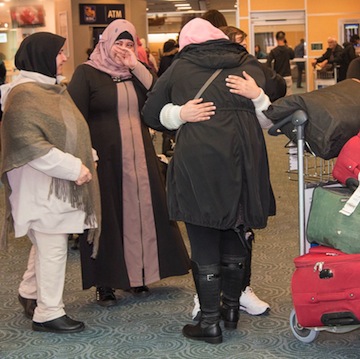
Members of the Alsedawe family at YVR: Fayzeh, Hanan, Mahros and Hanadi. (Adele Lewin Photography)

Also palpable was the range of emotions. There was the full gamut of human feelings on display among those awaiting families, friends and strangers to enter the hall. Contrasts abounded: joy competed with sadness, anticipation with angst, relief with uncertainty. Each person arriving searched for familiar faces, welcoming arms and handwritten signs, indicating that someone was there for them.

In this swirl of humanity were representatives of Beth Israel and Beth Tikvah, their dream to sponsor a refugee family from Syria finally reaching fruition. Sharing this moment – indeed, at the centre of this moment – was the local family: the mother, Fayzeh, and her five adult children, Hanadi, Huda, Maha, Hatem and Mohammed, who had arrived in Canada three years ago and had waited anxiously to be reunited with the remainder of their family.

There was something so surreal, yet so tangible and in the moment at that airport reunion. Words are inadequate to describe the outpouring of relief and love when Hanan and her children emerged in the arrivals hall. An invisible bubble enclosed the family, as they looked at each other for the first time in more than four years. And then, quickly, the bubble grew, as our delegation surrounded the family with our own contributions of hugs, gifts and welcome. One gift in particular seemed to unite the new family with our Canadian sponsors – a Whitecaps soccer ball given to 13-year-old Mahros. Soccer, a universal language for children and adults alike!

Every family has a history, a story that captures the essence of their character and experiences. The Alsedawes’ story is one of courage and hope. Their life in Syria was destroyed by war but their determination to escape, under circumstances almost impossible for us to comprehend, means that, today, their story is one of hope and gratefulness. In Hanan’s own words to the committee, “I thank God and I thank you.”

Settlement requires patience. Never has the Hebrew word savlanut meant so much to our small committee. Patience was required in the very lengthy process from application to arrival. Patience is required as we work to settle the children in school, the mother in English-as-a-second-language classes and the family into a way of life totally foreign to them. Within weeks of their arrival, the family had visited a family physician, dental appointments were booked, the children were enrolled in public school, bank accounts were set up and, important in this day and age, cellphones and tablets were provided to them.

Our year of sponsorship has only just begun, but this journey has been undertaken with the generosity of many people. Our donors have compassion and commitment, and understand that, “There but for the grace of God go I.”

Rosalind Karby is co-chair, with Miranda Burgess, of Beth Israel Congregation’s Committee for the Syrian Refugee Sponsorship Initiative.

Format ImagePosted on April 12, 2019April 10, 2019Author Rosalind KarbyCategories LocalTags Beth Israel, Beth Tikvah, immigration, refugees, Syria, tikkun olam
Mystery photo … Dec. 14/18

Mystery photo … Dec. 14/18

Women at the Beth Tikvah Sisterhood spring conference, which took place at Beth Israel, 2000. Shelley Ail is the first on the right, but the others are unknown. (photo from JWB fonds, JMABC L.11302)

If you know someone in this photo, please helpthe JI fill the gaps of its predecessor’s (the Jewish Western Bulletin’s)collection at the Jewish Museum and Archives of B.C. by contacting [email protected] or 604-257-5199. To find out who has been identified in the photos,visit jewishmuseum.ca/blog.

Format ImagePosted on December 14, 2018December 12, 2018Author JI and JMABCCategories Mystery PhotoTags Beth Israel, Beth Tikvah, history, Jewish museum, JMABC, Sisterhood
Judaica in Metro Vancouver

Judaica in Metro Vancouver

Among the items featured in Buchan’s Judaica section is a set of six hammered liquor cups on a pomegranate branch from Yair Emanuel, for any Shabbat or holiday table. (photo from facebook.com/BuchansKerrisdaleStationery)

If you’re looking for a new menorah or some cool Chanukah gifts over the next few weeks, you’ll want to target your search to three stores that have become the only hotspots for Judaica in the Lower Mainland. Sure, there are items here or there that you can find elsewhere, but not with much selection. And, you can shop online, but the problem with click-and-purchase is you don’t get to hold the weight of an object in your hand, to see the real symmetry of a piece from your screen, how it will fit into your home. Here’s where to go if you’re in the market for Jewish objets d’art.

Buchan’s Kerrisdale Stationery sits right next door to Garden City Bakery in Richmond, the Lower Mainland’s number one challah maker. The store has had a small selection of Judaica for several years but, when Inna Vasilyev took ownership a year ago, she decided to up the ante and significantly increase the variety. Vasilyev, who also owns the original Buchan’s Kerrisdale, on West 41st Avenue in Vancouver, aims to please everyone in her product choices. You’ll find 99 cent Chanukah candy, inexpensive wooden dreidels over which small kids can drizzle candle wax, fancy hand-painted dreidels and the plastic ones that disappear into the corners of a house each year. Buchan’s has Chanukah games, gelt, colouring books, tea towels, napkins with Jewish designs and menorot.

photo - Beth Tikvah’s gift store offers several different styles of menorot and a host of other Chanukah gifts, including shaped cookie cutters, games and books
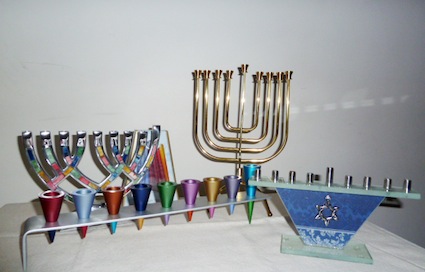
Beth Tikvah’s gift store offers several different styles of menorot and a host of other Chanukah gifts, including shaped cookie cutters, games and books. (photo from btikvah.ca/support/beth-tikvah-gift-shop)

“We have designer pieces by well-known designers and a good selection of candles, too, from simple ones to deluxe ones that burn for ages and smell beautiful,” she said.

Vasilyev also stocks non-Chanukah-related Judaica like mezuzot and candlesticks. For shoppers averse to crossing the bridge into Vancouver (or into Richmond), this accommodating store owner will transfer product between the stores to make life more convenient. She’s in the throes of updating her website and hopes to eventually display all her products on it.

Also in Richmond is one of the Lower Mainland’s longest-lasting synagogue stores, the gift shop at Beth Tikvah. Vicki Northy has been the manager and chief volunteer for the past seven years.

In the hours the office is open, office staff will gladly open the store to shoppers and handle the transactions. Northy buys new products every year, choosing a variety of fun items like bagel spreaders and mensch mugs, functional items like Kiddush cups, candlesticks and challah boards, and Judaica art by well-known artists including Yair Emanuel, Gary Rosenthal, Lily Art, Adi Sidler and Agayof. The store will be open 11 a.m.-12:30 p.m. on Dec. 3 and 10 this year to accommodate Sunday shoppers.

Olive+Wild, the gift and home décor store at 4391 Main St., is quite possibly Vancouver’s only retailer selling Judaica. Owners Simon and Bella Zaidel have 18 different menorah designs in stock right now, ranging from menorot that will get your kids excited about Chanukah to artistic beauties in brass, silver and glass.

photo - Olive+Wild has some 18 different menorot from which to choose, as well as Judaica for Shabbat and other Jewish holidays and occasions
Olive+Wild has some 18 different menorot from which to choose, as well as Judaica for Shabbat and other Jewish holidays and occasions. (photo from oliveandwild.com/collections/judaic)

“We stock Judaica designs by Nambé, Michael Aram, Yair Emmanuel and Carrol Boyes. And, given the demand, we’ve expanded our collection with various price points to make our products available to all different budgets,” Simon Zaidel said. The store opened last September and the response from the community has been “incredible,” he added. “Since Temple Sholom’s gift store closed down, there’s a limited availability of Judaica in Vancouver,” he noted. “We carry Kiddush cups, Shabbat candles, tzedakah boxes, Havdalah sets, challah covers and boards, kippot, tallises, mezuzahs, hamsas and Judaic jewelry, most of the products made in Israel.”

After the sugar-rush from the combination of Chanukah gelt and sufganiyot has worn off and the aroma of frying latkes is leaving your kitchen, you’ll want to begin “the Great Menorah Cleanup.” If there’s candle wax on your glass surface, it’s a relatively easy job involving a dollar store scraper and a hairdryer to melt any stubborn excess wax. Candle wax on silver candlesticks can be harder to eliminate without scratching your metal. Experts suggest placing your candlestick holder or menorah in the freezer for at least 20 minutes and then using your fingernails to flick off the frozen wax. A cotton ball with silver polish or rubbing alcohol can also be a useful resource to swap the area until it’s clean.

Lauren Kramer, an award-winning writer and editor, lives in Richmond. To read her work online, visit laurenkramer.net.

Format ImagePosted on December 1, 2017November 29, 2017Author Lauren KramerCategories Celebrating the HolidaysTags Beth Tikvah, Buchan's, Chanukah, Judaica, Olive+Wild, Shabbat
Beth Tikvah’s rabbi

Beth Tikvah’s rabbi

Rabbi Adam Rubin, wife Judith and their children. (photo from Rabbi Adam Rubin)

When Rabbi Adam Rubin and his family visited Congregation Beth Tikvah in February of this year, they fell in love. “They seemed to like us, too, I guess, because I got the job,” the rabbi told the Jewish Independent.

Rubin was born in Santa Monica, Calif., and grew up in Tustin, a small community outside of Los Angeles. He went to a public high school, which had only a few Jews, and first found a connection to Jewish community when he went to Jewish summer camp in northern California.

Rubin worked as a counselor in his college years, then furthered his journey into Jewish culture with a trip to Israel. He had a remarkable experience there, staying with a working-class Israeli family and wandering around Jerusalem for hours every day, fascinated. After a friend handed him a brochure for Pardes Institute of Jewish Studies, he was intrigued and made plans to study there.

After graduating from University of California, Berkeley, with a degree in American and European history, Rubin spent two years at Pardes. Despite the traditional yeshivah curriculum, there is no expectation of Orthodox observance. Free to experiment and find his own relationship with Judaism, Rubin became observant.

He studied Israeli politics and history and went on to do his doctorate at University of California, Los Angeles, in Jewish history, focusing on the Hebrew culture of the Yishuv in the 1920s and 1930s, in the era of Hayim Nahman Bialik. He was interested in people who came to Palestine to refashion Jewish life, as Ahad Ha-am (Asher Ginsberg) and the followers of cultural Zionism did. Cultural Zionism was more focused on the renewal of Jewish culture than the political renewal of a Zionist state.

Rubin settled into an academic life in Los Angeles, teaching rabbinical students at Hebrew Union College (HUC) as well as students at University of Southern California (across the street). After several years in academia, though, he was less than happy.

“The core thing in an academic life is research and writing,” he said. “I can do that, but I’m a people person, very social. I love to be with people, and my favourite part of the job was the faculty connection to the broader community, which HUC required of its teachers.” Also, over time, “the love of history faded and was replaced with the love of Torah.”

By that time, Rubin had become “egalitarian observant,” was involved in an independent minyan and had enjoyed a study chavruta (group, literally friendship) for years. He was “living a meaningful, wonderful Jewish life,” he said, “and didn’t feel like I needed to be a rabbi to do that.”

As he increasingly wanted to serve the Jewish community more directly and to be with people, he turned to the rabbinical path. After his ordination at Ziegler School of Rabbinic Studies, he became assistant rabbi at Beth Shalom, a Conservative synagogue in Seattle.

“I wouldn’t have been able to make this major transition without the support of my wife Judith,” said Rubin, noting that he needed to take a significant loss of income and become a student again to become a rabbi. His wife, an experienced elementary school teacher, will be teaching secular studies at Richmond Jewish Day School.

Although Rubin had a “great experience” at Beth Shalom, he wanted his own pulpit. “I used to joke that I was the oldest assistant rabbi in the U.S.,” he said.

The Rubins have two children: Elior, 7, who will be going to RJDS, and Na’amah, 3, who will be going to a francophone preschool.

The rabbi is looking forward to taking up the spiritual helm at Beth Tikvah.

“I love that Beth Tikvah congregation has a do-it-yourself spirit – a great deal of the religious life of the shul is done by the congregants themselves. I love how deeply committed our members are to the flourishing of the community, and how much they love and support one another.”

When asked what he hoped to bring to Beth Tikvah, Rubin replied, “My passion for exploring the spiritual riches of the Jewish tradition and sharing the sacred experience of living a life of mitzvot, combined with a commitment to the intellectual rigour and seriousness of deep Torah study.”

Matthew Gindin is a freelance journalist, writer and lecturer. He writes regularly for the Forward and All That Is Interesting, and has been published in Religion Dispatches, Situate Magazine, Tikkun and elsewhere. He can be found on Medium and Twitter.

Format ImagePosted on August 25, 2017August 25, 2017Author Matthew GindinCategories LocalTags Adam Rubin, Beth Tikvah, Judaism, Richmond
Preschool widens catchment

Preschool widens catchment

Naomi Hazon’s daughter, Maayan Cohen, with the striped sleeves, has been attending Beth Tikvah’s Shalom Preschool for a year. The youngsters have supervised access to an outdoor play area and garden. (photo by Naomi Hazon)

Watching parents pick up their kids at Beth Tikvah Congregation’s Shalom Preschool and then touring the facility with teacher Esther Karasenty once the hallways had cleared, it is hard to believe that only a year ago, the program was in danger of closing for lack of enrolment. No such problem now, however, and parents wanting to check out the school for their 2.5- to 5-year-old should visit sooner rather than later.

Karasenty has been teaching at Shalom Preschool since 2008.

“Esther has the skills and training to work with children and a very natural ability to connect with children…. She’s able to build trust and make connections,” parent and schoolteacher Naomi Hazon told the Jewish Independent about Karasenty.

Karasenty is “the next best thing to when Mommy’s not around. I don’t feel worried, ever, when I leave my daughter here,” Hazon said.

In addition to her teacher credentials and extensive experience – in early childhood education and instruction, and in teaching special needs children – Karasenty also speaks five languages: English, Hebrew, Portuguese, Spanish and French. Yet, even with such a capable teacher, when Hazon went to register her daughter Maayan last year, she was told that the preschool was probably going to close within a year because of low enrolment.

About that situation, Karasenty said, “The population around here changed a little bit. Young couples started selling their homes and moving away from Richmond, so we didn’t have a lot of new children that belonged to Beth Tikvah itself,” and the preschool was previously “directed toward the community of Beth Tikvah.”

When Hazon found out that the preschool she herself had attended as a child might close, Karasenty said, “She just said no.” Hazon “worked really hard to bring it back to life. It was amazing,” said the teacher. When she joined forces with Beth Tikvah to open it up beyond the synagogue community, “she reached out to everybody and that made the difference,” said Karasenty.

“In the matter of a few months, we had several open houses,” said Hazon, as well as “families through in the evenings.”

Hazon also contacted Lissa Weinberger from Congregation Beth Israel, who sent an email to the Jewish children’s book mail-out program PJ Library, to build “community connections and get the word out.”

As well, Beth Tikvah hired a new program director, Hofit Indyk, who has worked with Hazon to advertise and market the preschool.

“We have updated our website and we advertise more on social media,” said Hazon.

Preschoolers whose families are not members of Beth Tikvah “just pay a slightly different fee for being non-members,” Hazon explained, “and members’ children are obviously welcome, and we are also open to non-Jewish families that are also in our community.”

This fall, five of the eight students will be Jewish. Other cultures represented include Japanese and Indian. “So, we have really mixed families,” said Hazon.

“Even within the Jewish families,” she added, “it’s often a place where families who have mixed marriages and maybe one parent hasn’t converted, they feel welcome here.”

Hazon shared the story of a family who recently moved here from Brazil. “Their child speaks barely any English and, by word of mouth, they hear that [Karasenty] speaks Portuguese, and [their son] is able to speak his first language with her and he was able to settle in right away.”

When Hazon was signing her daughter up for Shalom Preschool last year, the Jewish Community Centre of Greater Vancouver program for 2-year-olds had a lengthy waiting list. She describes Shalom Preschool as a “hidden gem” because it is providing Jewish education to her daughter “with an incredibly gifted and talented teacher in a small group setting and it’s local and, you know what, it’s affordable … and it’s inclusive.”

Karasenty explained her approach to teaching. “I see my position in the class as a facilitator. I facilitate the children’s interaction with the world around them. I facilitate their interaction with each other and I give them skills to communicate and to express their needs…. I respect children. I don’t lie to them, I always tell them the truth. I always see them as intelligent human beings. They may be short human beings, but they are human beings.”

Karasenty derives her approach from Maria Montessori who, explains Karasenty in Beth Tikvah’s December 2015 newsletter, “was an Italian physician, educator and innovator, acclaimed for her educational method that builds on the way children naturally learn. At Beth Tikvah Shalom Preschool, I follow those guidelines, creating an environment that will promote children’s development: offering them cognitive, physical and emotional experiences that will help them in becoming critical thinkers, human beings who will have the clarity of vision to direct and shape the future of our society.”

As the Jewish community becomes more dispersed – the latest figures cited by the Jewish Federation of Greater Vancouver show that 46% of Lower Mainland Jews now live outside of Vancouver – Hazon said, “It is important that people access what’s locally available to them and that you give back to your community to keep things going.”

“Beth Tikvah is here,” said Karasenty, “to keep on the feeling of community.”

Shalom Preschool runs Monday through Friday, 9 a.m.-noon, with Shabbat-themed programming every Friday. The preschool is still accepting registration for the fall. For more information, visit btikvah.ca/learn/shalom-preschool or call 604-271-6262.

Zach Sagorin is a Vancouver freelance writer.

Format ImagePosted on July 8, 2016July 6, 2016Author Zach SagorinCategories LocalTags Beth Tikvah, children, education, Hazon, Karasenty, Montessori, preschool
Showtimers wow audience

Showtimers wow audience

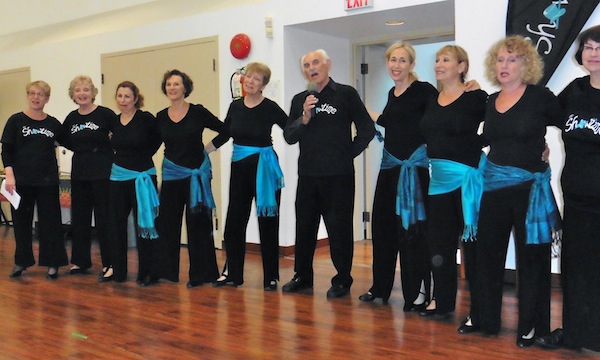
JCC Showtime’s cowgirl dance was an audience favorite. (photo by Binny Goldman)

The duet sung by Maurice Moses and Debbie Cossever, “Teach the World to Sing,” set the tone for the entire afternoon performance by JCC Showtime at the last of this year’s JSA Snider Foundation Empowerment Series, which had as its theme, “A Smile on Your Face, a Song in Your Heart.”

Toby Rubin, executive director of Kehila Society of Richmond, welcomed the crowd of 100 who gathered June 29 at Congregation Beth Tikvah for the Jewish Seniors Alliance of Greater Vancouver and Kehila event.

Rabbi Howard Siegel, who led the Hamotzi, joked with those assembled that the reason there was no clock on the wall was because it would not suffice to record the length of his sermon (which he said he was about to deliver), as his would require a calendar.

After the BBQ lunch catered by Stacey Kettleman – and just before a huge cake honoring all the volunteers was served – Rubin called up a number of those volunteers from her various committees and presented them with certificates.

Rubin said that, in the audience, there were people from the Louis Brier Home and Hospital, L’Chaim Adult Day Centre, JSA, Angels There for You, CARP and seniors from Beth Tikvah, as well as people who had heard about the event through publicity.

The program began with “Happy Opening“ and showcased the talents of the JCC Showtime performers, accompanied on piano by Muriel Morris and with Gary Zumar as sound technician.

photo - Arnold Selwyn leads other JCC Showtimers in a song
Arnold Selwyn leads other JCC Showtimers in a song. (photo by Binny Goldman)

Each number presented new and charming scenarios, which included quick and clever costume changes. Some crowd favorites were the duets “Together” and “Let’s Call the Whole Thing Off” by Arnold and Nassa Selwyn; the guest appearance of “Dolly,” Marshall Berger dressed as a woman; Cossever belting out “Can’t Get a Man with a Gun”; Moses engaging the crowd with “Beautiful Morning”; and the striking cowgirl dance, as well as “Chattanooga Choo Choo.” Two of the last songs, “Tzena Tzena” and “Hava Nagila,” led by Moses and Arnold Selwyn, took the crowd to Israel as they sang along.

Complex choreography and the blink-of-an-eye costume changes were all conceived and created by the founder of JCC Showtime, Beryl Israel, who immigrated in 2002 from South Africa, where she had been involved with a similar program.

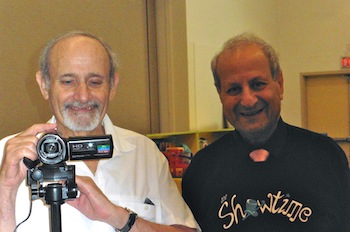
photo - Videographer Stan Shear, left, and performer Maurice Moses
Videographer Stan Shear, left, and performer Maurice Moses. (photo by Binny Goldman)

Rounding out the Showtime lineup were Sara Bernstein, Rona Black, Lisa Conn, Andria Engel, Tamar Glaser and Susan Goldstein.

Just as the performers were about to leave the stage, Berger was handed the microphone and asked to sing “Happy Birthday” to his wife, Marilyn Berger, president of JSA, who was celebrating her birthday that afternoon. He was joined by all the performers in the singing of a touching rendition of the song.

Marilyn Berger thanked the performers for a wonderfully joyful afternoon that traveled down memory lane and she also gave a short talk about JSA, highlighting its advocacy and its peer support program. She then handed out gifts for each of the cast, helped by Kenneth Levitt, one of JSA’s vice-presidents.

Stan Shear, with Karon Shear, JSA coordinator, by his side, made a video of the performance, which will be posted at jsalliance.org.

It was an afternoon that definitely put smiles on faces and songs in hearts.

Binny Goldman is a member of the Jewish Seniors Alliance of Greater Vancouver board.


Format ImagePosted on July 10, 2015July 8, 2015Author Binny GoldmanCategories LocalTags Beth Tikvah, JCC Showtime, Jewish Seniors Alliance, JSAGV, Kehila Society

Purim in our modern days

Purim, at its heart, is a story about unseen forces. Throughout the entire Megillat Esther there are numerous instances of divine intervention, even though G-d’s name is not mentioned even once. In that way, Purim provides a microcosm of our lives, even in this day.

As we all know, this holiday offers an opportunity to be merry and celebrate our nation’s survival at the brink of destruction. But this chag also gives us the chance to consider and appreciate the often positive and unrecognized forces at work in our lives, which help shape our families, relationships and, indeed, our Jewish community.

By way of background, my husband and I moved to Richmond from Israel just a few years ago. We both had successful jobs in Tel Aviv and were living a block from the beach, but we knew that when we wanted to start a family, we wanted to be closer to our parents.

Last September, my husband and I welcomed our son, and began to seriously consider the important role a synagogue would play in our child’s life – for his Jewish identity, education, relationships and milestone occasions.

It was just a few short weeks later that we all had the chance to attend a Shabbat service at Beth Tikvah, a 200-family-strong congregation in Richmond. The services had ruach and intent and the congregation was warm, welcoming, comfortable and child-friendly – in short, it was a perfect fit for us.

Just like the story of Purim, where “natural events” can seem random, so, too, could our introduction to Beth Tikvah be viewed as serendipitous. But it is possible to discern the unseen divine in the human forces at work – in this case, through a special congregation, whose members and leadership reached out to us like family.

These types of inspired instances are all too common in all our lives. I’ve seen it firsthand.

I’ve seen the parents who run their children around town so they can attend Jewish day schools, participate in Hebrew school activities on weekends and evenings, and participate in Jewish-oriented programming. All so their children – the next generation – will have a strong Jewish identity and foundation upon which to grow.

Or, our teens and young adults, who participate in chesed programs and tikkun olam projects, exemplifying Jewish values and displays of kindness. Not only do they brighten up the days of those they help, but they help make our community strong and their actions inspire others.

This Purim, we should celebrate. Not only the unseen miracles of Purim, of which there were many, but also the often-unsung forces that drive our Jewish community every day. The congregations and their members who welcome newcomers into their fold. The parents who instil Jewish values and identity in our children. The youth who devote their time to helping those less fortunate and repairing the world one small step at a time. These are the tangible forces of our modern-day Purim, and they are miraculous in their own right.

There are many events around Purim, so go out and celebrate with friends, family, and your community. I will be celebrating with my Beth Tikvah family, and invite everyone to join. For more information about Beth Tikvah – and other – Purim programming and activities, please see the Jewish Independent’s Community Calendar, either in this issue and online.

Hofit Indyk is program coordinator at Congregation Beth Tikvah.


Posted on February 20, 2015February 19, 2015Author Hofit IndykCategories Celebrating the HolidaysTags Beth Tikvah, Purim

Easing leadership transition

Change is hard. Ending one thing and beginning another can cause stress, and can even end up feeling like a poignant loss. It’s no different in the realm of synagogue life. When a long-serving rabbi leaves his or her position, the congregation may feel as though they exist in a vacuum and may need to go through a sort of grieving process before moving on.

photo - Rabbi Howard Siegel
Rabbi Howard Siegel (photo from Rabbi Siegel)

The local community is in the unique situation of having had two rabbis of well-established congregations leave their pulpits in the course of one year. Both Beth Tikvah Congregation, Richmond’s Conservative synagogue, and the Renewal synagogue in Vancouver, Or Shalom, are in the process of adjusting to life after the leadership of rabbis who had been with them for nearly a decade.

Beth Tikvah’s Rabbi Claudio Kaiser-Blueth has retired from synagogue leadership, serving over the years as a congregational rabbi in both South and North America. Or Shalom’s Rabbi Laura Duhan Kaplan, who got smicha (rabbinical ordination) after a career as a university philosophy professor, has returned to academia; she is now interim director of Iona Pacific Inter-Religious Centre at the Vancouver School of Theology at the University of British Columbia.

The vacuum left by the departure of two such well-loved rabbis is not easy to fill. Both congregations have taken the course recommended by their movements for rabbi replacement: hire an interim rabbi to assist with the transition.

According to Rabbi Howard Siegel, Beth Tikvah’s interim rabbi, the position of interim rabbi is now a career choice, even for young rabbis starting out.

“The Reform movement has a very sophisticated course for interim rabbi training,” he told the Independent. “There is a seminar the Conservative movement provides to specialize in this area, as well.” Siegel has acted as interim rabbi for a number of congregations over the course of his career and mentioned that he could lead the seminar with the experience he has accumulated.

Prior to becoming a rabbi, Siegel earned a bachelor of science from the University of Minnesota, a bachelor of Hebrew literature from the University of Judaism in Los Angeles and a master of arts in Judaica from the Jewish Theological Seminary, where he also received his smicha in 1978.

photo - Rabbi Louis Sutker
Rabbi Louis Sutker (photo from Rabbi Sutker)

Or Shalom’s interim rabbi also has unique qualifications for helping congregants deal with the transition to a new permanent spiritual leader. Rabbi Louis Sutker recently retired from practising psychology. Prior to working in private practice, he was a professor of psychology at the University of Victoria. Sutker came into his smicha later in life, training at the same time as Duhan Kaplan, and he has experience as acting spiritual leader of Victoria’s Congregation Emanu-El before they found their current permanent rabbi.

“Being a psychologist is good preparation for being a rabbi, and thinking like a rabbi is good for being a psychologist,” said Sutker when asked about his decision to do formal rabbinic studies. He said he is enjoying the experience of working with congregants in a variety of ways, and towards helping them choose their next rabbi.

“Being an interim rabbi is a great experience,” he explained. “The expectations are clear. I’m here to help with the transition, to act as a place-marker, and encourage the possibility of doing things differently.”

Siegel agreed that congregations become set in their ways and need to redefine their goals when choosing a new rabbi. “The search for a new rabbi is a process. They first need to redefine their mission and purpose … they need to know their goals and find a rabbi to meet the objectives of the community.”

Unlike Sutker, who knows his term will end in June 2015, Siegel said that he’s happy to stick around for a couple of years. He feels it’s his role to slow the congregation down so they don’t hire the wrong person. Or Shalom, however, is farther along in the process; they will be soon hosting candidates at the shul.

One bonus of being an interim rabbi, said Sutker, is that he or she has the opportunity for change, as well, while helping a congregation transition.

Siegel, who hopes to retire with his wife to Austin, Tex., once Beth Tikvah fills the permanent position, sees it another way, too. He is thrilled to be in his position, not only because one of his four children lives in Richmond but also because he can be especially forthright as an interim rabbi. “If I’m not happy, I can be open and I don’t have to worry that my contract won’t be renewed!” he joked.

Michelle Dodek is a freelance writer and community volunteer living in Vancouver.

Posted on November 14, 2014November 13, 2014Author Michelle DodekCategories LocalTags Beth Tikvah, Howard Siegel, Louis Sutker, Or Shalom

Siegel new rabbi at Beth Tikvah

Beth Tikvah Congregation has hired Rabbi Howard Siegel as interim rabbi for the coming year. Siegel is no stranger to the Vancouver and Richmond Jewish community. He served as assistant and associate rabbi of Congregation Beth Israel from 1978-81 and 1986-88. He also served Beth Tikvah as rabbi from 1983-86.

photo - Rabbi Howard Siegel will be with the congregation through June 2015
Rabbi Howard Siegel will be with the congregation through June 2015. (photo from Beth Tikvah)

After leaving Vancouver in 1988, Siegel served congregations in Minneapolis and in Houston. In addition to his congregational work, he was the founding director of the Solomon Schechter Day School in St. Louis and the Jewish Information Centre of Texas (an outreach program to unaffiliated Jews in the Houston and Austin communities). In recent years, he has been an interim rabbi in Los Angeles and San Antonio. Siegel and his wife, Dr. Ellen Lefkowitz, currently make their home in Austin.

Beth Tikvah will be looking to Siegel for advice and counsel in revitalizing their religious school, enhancing religious services, and preparing to search for another full-time rabbi.

“My role is to offer Beth Tikvah continuing rabbinical presence while assisting in strengthening their Jewish presence in Richmond and the Lower Mainland,” said Siegel, who is currently officiating at Beth Tikvah and will be with the congregation through June 2015.

Posted on September 19, 2014September 18, 2014Author Beth Tikvah CongregationCategories LocalTags Beth Tikvah, Howard Siegel

Posts pagination

Previous page Page 1 Page 2 Page 3
Proudly powered by WordPress