Skip to content
  • Home
  • Subscribe / donate
  • Events calendar
  • News
    • Local
    • National
    • Israel
    • World
    • עניין בחדשות
      A roundup of news in Canada and further afield, in Hebrew.
  • Opinion
    • From the JI
    • Op-Ed
  • Arts & Culture
    • Performing Arts
    • Music
    • Books
    • Visual Arts
    • TV & Film
  • Life
    • Celebrating the Holidays
    • Travel
    • The Daily Snooze
      Cartoons by Jacob Samuel
    • Mystery Photo
      Help the JI and JMABC fill in the gaps in our archives.
  • Community Links
    • Organizations, Etc.
    • Other News Sources & Blogs
    • Business Directory
  • FAQ
  • JI Chai Celebration
  • JI@88! video

Recent Posts

  • Sharing her testimony
  • Fall fight takes leap forward
  • The balancing of rights
  • Multiple Tony n’ Tina roles
  • Stories of trauma, resilience
  • Celebrate our culture
  • A responsibility to help
  • What wellness means at JCC
  • Together in mourning
  • Downhill after Trump?
  • Birth control even easier now
  • Eco-Sisters mentorship
  • Unexpected discoveries
  • Study’s results hopeful
  • Bad behaviour affects us all
  • Thankful for the police
  • UBC needs a wake-up call
  • Recalling a shining star
  • Sleep well …
  • BGU fosters startup culture
  • Photography and glass
  • Is it the end of an era?
  • Taking life a step at a time
  • Nakba exhibit biased
  • Film festival starts next week
  • Musical with heart and soul
  • Rabbi marks 13 years
  • Keeper of VTT’s history
  • Gala fêtes Infeld’s 20th
  • Building JWest together
  • Challah Mom comes to Vancouver
  • What to do about media bias
  • Education offers hope
  • Remembrance – a moral act
  • What makes us human
  • המלחמות של נתניהו וטראמפ

Archives

Follow @JewishIndie
image - The CJN - Visit Us Banner - 300x600 - 101625

Tag: Beth Tikvah

Issues surrounding inclusivity

On June 9, the United Synagogue of Conservative Judaism (USCJ) hosted the webinar Embracing Diversity: Wisdom from an Interfaith, Interracial Jewish Family. The event addressed the issues involved in creating an inclusive setting within a congregation and keeping an open mind about Jewish intermarriage.

Keren McGinity, the USCJ’s interfaith specialist, led the inaugural event, which took place on Zoom. Interfaith is one of four areas of diversity synagogues should hope to include, she said; the others being LBGTQ+, people of colour, and people of all neurological and physical abilities; occasionally, there is overlap.

It was mentioned that the webinar took place close to Loving Day (June 12), which marks the anniversary of the 1958 marriage – and subsequent arrest – of Mildred Jeter and Richard Loving, an interracial couple in Virginia. In 1967, the United States Supreme Court legalized interracial marriage in its Loving v. Virginia decision.

Guest speakers for the afternoon were Shira and Derrick, an interfaith and interracial couple. Shira grew up in the northeast United States and was raised in the Conservative movement; Derrick was born to Ghanaian parents and raised in an evangelical Christian environment in the Midwest. The pair met at university and began dating in their senior year. Because of their different upbringings, neither believed at the outset that the relationship would last. To their surprise, however, it did. They fell in love, ultimately got married and are now raising a baby daughter.

“There was a lot of internal struggle for both of us,” Shira admitted, explaining that they both wondered whether they were going to go through with it. Also, from Shira’s friends and family, there was concern, not that Derrick is black but that he is Christian.

“When I came to the realization that I would be marrying the love of my life, and not a Christian, it led to a lot of changes in thinking about what relationships meant,” Derrick told the Zoom audience.

“Whenever two people come together, there are always gaps that need to be bridged. What really matters is what are the things that are important to you and what are you willing to talk about,” he said, when asked about the cultural, religious and geographic differences the couple had when entering the relationship.

Intellectually, Shira understood that getting a rabbi to officiate would be challenging, yet, emotionally and spiritually, she could not come to terms with that fact because she knew in her heart that her relationship with Derrick was “the right thing.”

After sharing aspects of their personal journey as a couple, Shira and Derrick were asked by McGinity what the Jewish community could do to be more inclusive. Derrick described the reactions he generally receives when entering a synagogue with Shira. First, people look shocked, then, when they realize they are not supposed to make that face, they come over and make some awkward small talk.

Though Derrick understands the need to maintain certain traditions to make a religious setting what it is, the problem for him “is constantly feeling like the other, despite having a desire to being a part of that space, and not being treated like others who are entering the space.”

For her part, Shira said she thinks people are overcompensating because they are uncomfortable. “We have an idea of what Jewish looks like and assume that Jews look a certain way, even though there are examples in front of us.” One of those examples is their daughter.

“I don’t expect everyone to be completely comfortable with me walking into a room, because I look a little bit different than the majority of those in the Conservative shuls I have attended. What I do recognize is that there is going to be progress,” Derrick said, referencing the Loving case. He pointed out that the Supreme Court verdict was only 54 years ago and that his own marriage would have been illegal in a different era.

“To expect that not everyone in a Conservative shul is going to be comfortable is reasonable,” he stressed. “What I do expect is an openness and recognition that change is coming, and the recognition that there are going to be some awkward conversations. I expect that. What I don’t want is to be the warrior to help explain that to everyone.”

“If someone is in a Jewish space, they’re there to do Jewish things,” Shira said. “And that’s what matters.”

Richmond’s Congregation Beth Tikvah is one of the participating synagogues in the USCJ’s Embracing Diversity program.

Sam Margolis has written for the Globe and Mail, the National Post, UPI and MSNBC.
Posted on June 25, 2021June 25, 2021Author Sam MargolisCategories WorldTags Beth Tikvah, interfaith, interracial, Judaism, United Synagogue of Conservative Judaism, USCJ
Dementia care is self-care

Dementia care is self-care

Karen Tyrell, founder of Personalized Dementia Solutions, spoke recently at an online event hosted by Beth Tikvah and the Kehila Society. (photo from dementiasolutions.ca)

To care for people with dementia, caregivers must first ensure they care for themselves. That was a message from Karen Tyrell, an expert with 25 years’ experience assisting people with dementia and those who care for them.

May is caregiver awareness month and Tyrell, who founded Personalized Dementia Solutions, was speaking at an online event May 19, sponsored by Beth Tikvah Synagogue and the Kehila Society of Richmond. Tyrell, who is also author of Cracking the

Dementia Code: Creative Solutions to Cope with Changed Behaviours, teaches people how to deal with dementia in loved ones through one-on-one and group consultation.

Common symptoms of dementia include impairment of memory and thinking, judgment and communication problems and personality changes.

Tyrell noted that the stress caused by caregiving for a person with dementia can result in physical and emotional health issues, some of which themselves can exacerbate the causes that bring on dementia. So, it can become a cycle in families.

She offered a range of strategies, such as breathing exercises, for caregivers dealing with stress. She also emphasized the need to share your concerns with others before they evolve into a crisis.

“As soon as you notice your stress levels are starting to climb and you’re having a hard time to breathe because of what you’re going through, please reach out, tell someone,” she said. “Reach out to your community, reach out to your doctor, reach out to a counselor, reach out to the Alzheimer’s Society in the community that you’re in. Reach out to someone to tell them, because, when you talk about it, then others will give you suggestions on what you can do.”

She urged caregivers to accept help when offered.

“Please don’t think that you’re going to be fine or that you’re going to be an inconvenience to others,” she said. “You need that help. Nobody can handle caring for someone with progressive dementia all by themselves. It’s not humanly possible from the beginning to the end.”

Another tip is to have realistic expectations.

“If you are thinking, I can do this all on my own because I’m the wife and this is my duty, in some ways, I would tell you, that’s great. You’re doing great,” Tyrell said. “But is it realistic that you can do this all on your own?”

Setting boundaries is another key.

“It’s hard to say no to people, but, when you’re setting boundaries for what you will and will not do, and say no to certain things, then you’re going to take better care of yourself,” she explained. For example, some people accept that they can continue to care for their loved one at home until, for example, the person becomes incontinent more than once a day, or until the person with dementia is no longer able to go to their twice-a-week adult day program, giving the caregiver a short respite.

An inability to get proper sleep is a dangerous cycle, Tyrell warned. Exhaustion on the part of the caregiver is a recipe for disaster. Melatonin for the caregiver or the person with dementia could help, or a paid worker to sleep on the couch for a limited period in case they are needed, she said. If possible, the caregiver might get away for a couple of days or the loved one could go into a few days of respite care.

Developing negative emotions and responses is understandable, she added, but finding ways to be positive is critical.

“Try to find some of the positives of your situation,” she said. “One fellow said him and his dad never got along all of their life, they had a really rocky relationship, but when he started to develop dementia, his personality changed and they became best friends. He looked at the positive: ‘It’s not fun to see my dad go through this but I found something good in this.’”

Laughter is a medicine, she added. Remaining social – even via the computer if the pandemic makes in-person socializing difficult – and having laughs with friends can go a long way to keeping a caregiver healthy.

Meditation, yoga, prayer, relaxing exercises or activities are also important tools.

“Exercise is proven to help us burn adrenaline,” she said. “So, when you’re stressed, go for a walk, try to burn off some of that adrenaline. Move that body. Walking is a great exercise.

“Eating healthy is helpful,” she added. Dark green vegetables and all sorts of berries, but especially blueberries, have antioxidants that help slow the aging process.

The presentation is available for viewing at btikvah.ca.

Format ImagePosted on May 28, 2021May 27, 2021Author Pat JohnsonCategories LocalTags Beth Tikvah, caregiver, dementia, healthcare, Karen Tyrell, Kehila Society, mental health, Personalized Dementia Solutions, respite care
Navigating gender, sexuality

Navigating gender, sexuality

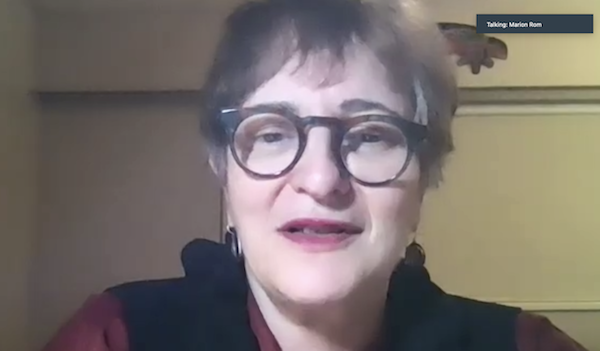
Marion Rom, who works with gender-diverse youth, spoke as part of a Beth Tikvah-hosted panel on the topic Navigating Gender and Sexuality in the 21st Century. (screenshot)

“Almost one-third of people who have gender dysphoria will attempt suicide and have mental health issues, and that’s why we often have such a high rate of kids with eating disorders who are transgender,” said Marion Rom, a counselor who works with gender-diverse youth in the Lower Mainland.

Rom was speaking as part of a March 11 panel on the topic Navigating Gender and Sexuality in the 21st Century. She defined gender dysphoria as when “your body doesn’t match the sense of who you are.” She also explained to the 65-plus attendees of the discussion the difference between sex and gender, some of the terminology around gender, and a few resources for those who want to learn more.

The panel, which was hosted by Beth Tikvah Congregation, also included Dean Kaplan, who joined the conversation from Washington, D.C., and the Abelson family – Kay, Bernard and their son Jason – who live here. The discussion was started by the congregation’s spiritual leader, Rabbi Susie Tendler.

“I think that we have a special mission, as the Jewish people, of finding people who have a potential to be marginalized and always elevating them, along with elevating everyone, to ensure that we are all in a sacred space,” said Tendler. She described her rabbinate as being “about opening doors” and a kehila kedosha, holy community, as one that creates pathways for everyone to be welcome in sacred spaces. She thanked the Zoom participants for their efforts in opening the door of community wider to “welcome everyone as their authentic selves because that’s the only way that, I believe, we really approach God.”

Rom was asked to speak by BT congregant Linda Steiner, who had heard Rom’s talk at a Habonim alumni meeting last year. The presentation was geared to older people, like Rom herself, who is 63.

She defined sexuality, and explained several terms, including lesbian (a female attracted to another female), heterosexual (females attracted to males and vice versa), bisexual (someone attracted to both males and females) and pansexual (someone attracted simply to the person, irrespective of gender). She broke down the acronym LGBTQ+ (lesbian, gay, bisexual, transgender, queer; with the plus including but not limited to asexual, two spirit, and allies). She also went through some of the gender terminology, such as cisgender (“either male or female”) and transgender (someone whose sense of self doesn’t match their birth gender). She spoke briefly about hormone therapy and gender reassignment surgery.

For people wanting to start learning more about gender and sexuality, Rom suggested the books Love Lives Here by Amanda Jette Knox and Transgender Children and Youth: Cultivating Pride and Joy with Families in Transition by Elijah Nealy, the Israeli documentary Family in Transition and the narrative film The Danish Girl (or the book from which it was adapted, written by David Ebershoff).

Dean Kaplan, 28, who goes by the pronouns they, them and their, came out as non-binary a couple of years ago. They spoke about how they see themselves and their relationship to how the world sees people like them. Describing themselves as Jewish, white and having grown up upper-middle-class and with privilege, Kaplan acknowledged that these factors have “contributed to me being able to live as myself comfortably.”

Despite that comfort, Kaplan first came out as queer in terms of their sexuality, at the age of 17 or 18, before identifying as gender-nonconforming.

“An important part of identifying as queer in almost any part of the world,” said Kaplan, “is not only understanding who you are, but also, in some ways, accepting this label as ‘deviant’ by society.”

In their early 20s, Kaplan began to realize “I very much enjoy connecting with parts of myself that would be considered feminine,” such as having longer hair and wearing tights.

From a young age, they said, “I’ve had this latent sense of difference in how I want to emotionally connect with people and that played a lot into my sense that I was gender-nonconforming. I think also a little bit of it is this sense that I want to live in a world and exist in space without a lot the negative aspects of masculinity that I was raised to cherish in a lot of ways. I’m still aware of the fact that almost all of my male friends are embarrassed to cry, even alone; it’s a sign of anti-masculinity. And so, being non-binary for me is very freeing in a lot of ways. I can be who I want to be and who I feel I am without the kind of embarrassment or labels that go with certain actions for certain genders.”

That said, the reactions to their coming out were mixed and some were hurtful. They get misgendered every day – “sometimes I correct, sometimes I don’t,” said Kaplan. That will depend, for example, on whether the person making the mistake is a superior at work or a peer. “Power and economics play into my ability to be myself in the spaces I happen to be in,” they said.

Jason Abelson, 24, started his transition in 2012, but his first memory of wanting to be a boy goes back to a gymnastics class when he was in preschool, so 4 or 5 years old. Initially, he attended an Orthodox elementary school in South Africa, where he was born, but his parents switched him to a public school. He used the fact that he was a swimmer to cut his hair short in Grade 4. He hated it when his parents would correct people who would mistake him for being a boy. “I just wanted to go and hide somewhere,” he said.

When his chest began to develop in puberty, he would try and hide it, but, eventually, he quit swimming. He has since picked the sport up again, and has joined an LGBTQ+ team.

When he was younger, he said, “I didn’t know what transgender was. I didn’t know that you could transition, that the feelings I had for wanting to be a boy were experienced by anyone else until an Oprah show that my mom was watching one summer’s afternoon. In that Oprah show, they had a transgender guy and his family, and shared his story.”

Seeing the possibilities for himself, Abelson thought about next steps and started the process of transitioning, one part of which is convincing a psychologist “that you are transgender.” He then saw an endocrinologist. In Grade 10 at the time, he stayed at the same school throughout. “I finished the first semester as a girl; came back five days later as a boy,” he said. “All we did was we changed the name on the class list.”

While he was given a key to the teacher’s washroom, he didn’t want to call attention to himself, so he avoided using the facilities. “Bathrooms still do give me a little bit of anxiety,” he said.

He started hormones nine years ago, at age 15. About a year after that, he had top surgery – prior to that he had used binders to keep his chest down.

With respect to going to an Orthodox shul after he started his transition, Abelson was told that he could come to services but would have to sit in the women’s section. Even now, attending a new synagogue and sitting on the men’s side, he said, “I don’t feel like I have a place in the shul. Being gay as well, I can’t get married in that shul, so that’s still a world that is being navigated.”

Kay Abelson spoke about both the emotional journey and the “very practical life journey.” She said she struggled with those early years when her son was asserting his identity – in his clothing choices and in his desire to cut his hair short, for example.

“I found it really hard, as a mother,” she acknowledged. “And it did cause some conflict in our family.” However, she noted, “For me, the time before Jason’s transition was more of a struggle than once he transitioned…. I found the earlier time hard, before we knew what we were dealing with. Bernard and I both always had a sense that there was something with Jason when he was growing up, but we just could not put our finger on it. And so, that moment of him watching the Oprah show and having that ah-ha moment was a huge turning point for all of us.”

It took time for her and her husband to understand and digest what was happening. She had fears about what people would think and say, but people were supportive and accepting, she said.

“When you start thinking about the history and the background about all those situations that Jason mentioned,” said Bernard Abelson, such as the first time he cut his hair short. “All I wanted to do was get him earrings so that he could look more feminine.” When people would refer to his son, “I was immediately defending, ‘This is my daughter.’… I thought I was

defending him. That’s the irony of all that, is that, as a parent, you think you’re doing the right thing by

defending them … but, at the end of the day, for him, as you’ve heard, it wasn’t working for him at all.”

One thing that helped the family was watching the documentary Becoming Chaz, about Chaz Bono’s transition. Watching it helped Bernard Abelson to accept, “This is real.”

“It’s been an incredible, incredible journey for all of us,” said Kate Abelson.

While some parents go through a mourning period for the son or daughter they once had, Kay Abelson said, “I never felt like I lost anything. In fact, I actually gained something through the process because, before Jason’s transition, as you heard in his story, he never felt comfortable with who he was. He was always yearning to be someone different, so he was never really happy within himself…. When he transitioned and he could actually stand loud and proud and be who he was … it was just so exciting.”

Rom reentered the conversation by stressing that the level of grieving varies among families. She then opened the question-and-answer session that included Dean Kaplan’s dad, Des Kaplan, talking about some of his challenges in understanding his child’s gender and sexuality. There was also discussion about Jewish tradition, which identifies at least six genders, and that some Jewish communities have changed the b’nai mitzvah rituals to be more gender-inclusive.

To watch the panel discussion, without the Q&A, visit btikvah.ca/inclusion-and-diversity.

Format ImagePosted on April 2, 2021March 31, 2021Author Cynthia RamsayCategories LocalTags Bernard Abelson, Beth Tikvah, Dean Kaplan, diversity, education, gender, inclusion, Jason Abelson, Judaism, Kay Abelson, Marion Rom, Rabbi Susie Tendler, sexuality, transgender
Spreading joy on Purim

Spreading joy on Purim

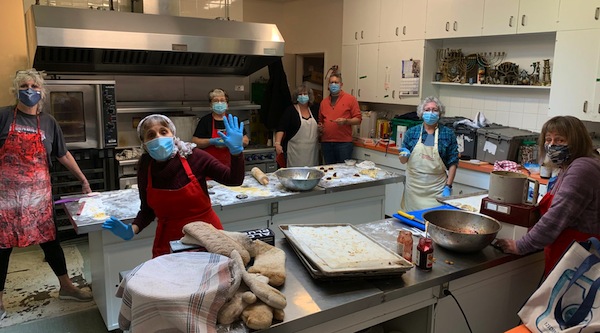
In the kitchen, left to right, are Stacey Kettleman, Leah Reghatti, Francie Steen, Deborah and David Freedman, Shelley Ail and Linda Rothberg. (photo from Beth Tikvah)

This Purim, Beth Tikvah Congregation packaged more than 240 holiday bundles, delivering one to every member household – spreading not only joy, but raising funds for the synagogue’s preschool and Hebrew school.

“As we enter the month of Adar, our tradition teaches, we must increase joy,” explained Rabbi Susie Tendler, the congregation’s spiritual leader. “The talmudic statement (Ta’anit 29a) is not specific about whose joy we are increasing, rather that it is incumbent upon us to spread joy and cheer, brightening these dark days. Communities around the globe have certainly been wrestling with how to deepen connections and spread joy this past year. Beth Tikvah decided to take the wisdom of our tradition and do so through festive and colourful mishloach manot, Purim packages, that went to every member family living in British Columbia.”

photo - More than 1,000 hamantashen were baked and more than 240 mishloach manot delivered
More than 1,000 hamantashen were baked and more than 240 mishloach manot delivered. (photo from Beth Tikvah)

The effort was multigenerational. There were the volunteers in the kitchen, who made more than 1,000 hamantashen. B’nai mitzvah families and the congregation’s youth groups (USY and Kadima) helped assemble the packages. There were the volunteers who counted, sorted and put the finishing touches on the packages, and those who picked up and delivered the packages all over Richmond and Vancouver. And, of course, the whole endeavour would not have been possible without those who funded it.

photo - More than 240 mishloach manot were delivered
The finished packages. (photo from Beth Tikvah)

In addition to all the congregants who ordered the mishloach manot and volunteered in various ways, Isha L’Isha was a sponsor of the initiative, Leanne Hazon supported the program “relentlessly during all hours of the day,” Alon Sabi designed the ordering system, and BT program manager Yvette Sabi created the boxes.

“For me,” said Tendler, “particularly during COVID, the opportunity to hang a bundle from someone’s door, ring the bell, and then step back three metres or so, and wish someone a happy holiday personally was splendid. However, the joy did not stop there. We received an outpouring of communications from people testifying to the joy and surprise felt from these packages which, in turn, deepened the joy felt by all of the volunteers. It is true, sometimes the little things bring the biggest smiles, and one smile significantly sparks another smile.

Format ImagePosted on March 19, 2021March 18, 2021Author Beth Tikvah CongregationCategories Celebrating the HolidaysTags Beth Tikvah, coronavirus, COVID-19, Judaism, mishloach manot, Purim, Susie Tendler, synagogue
Beth Tikvah welcomes rabbi

Beth Tikvah welcomes rabbi

Rabbi Susan Tendler, her husband Ross Sadoff and their daughters Sofia and Daniella moved from Chattanooga, Tenn., to Richmond, where Tendler is the new spiritual leader of Beth Tikvah Congregation. (photo from Rabbi Susan Tendler)

Moving to a new city and starting a demanding and highly visible new job would be a challenge in the best of times. For Rabbi Susan Tendler, the recently arrived spiritual leader at Richmond’s Beth Tikvah Congregation, and her family of four, it was a little more complicated.

Not only has the COVID pandemic added complexity to every detail, the family was moving from the United States. This meant that, once they made it to British Columbia after a long, though enjoyable, drive across the continent, during which they took in some national parks and historical sites, they had to go into two weeks of quarantine in their new home.

The lemons of COVID were turned to lemonade by the reaction of the Beth Tikvah community. Tendler calls their reception “extraordinarily unbelievable.”

They arrived at the house, which had been equipped with bedding, toiletries, kitchenware and small appliances, a stocked pantry and refrigerator, and almost everything the new arrivals could want.

“People would from a distance greet us and somebody brought us dinner every single night that week. And people checked on us and would just drop off some milk or whatever we needed for the next week,” she said. While her husband, Ross Sadoff, returned to the States to collect their other vehicle, the rabbi and her daughters, 10-year-old Hannah Sofia and Daniella, who is 8, settled into quarantine.

“My girls and I sat in kind of a tent in our driveway,” she said, while congregants brought socially distanced greetings. “They drove by, honked at us and welcomed us. They had signs and balloons to make us feel welcome. The community, honestly, has gone above and beyond and really demonstrates what a caring community could be and just really made us feel welcome.”

The family moved from Chattanooga, Tenn., where Tendler had been rabbi for eight years at the Conservative B’nai Zion Congregation. She also served on the faculty of Camp Ramah Darom, in the foothills of Georgia’s Blue Ridge Mountains.

She grew up in Virginia and previously held positions in congregations there and in North Carolina. Her undergraduate degree from the University of Virginia is in religious studies with concentrations on Islam and Judaism. At the Jewish Theological Seminary of America, she received her rabbinical ordination and her master’s of education in informal Jewish education. She also completed a two-year rabbinic track at the Institute for Jewish Spirituality. She describes herself as “an ardent Zionist.”

Coming to Canada generally and Beth Tikvah specifically seems bashert. Tendler and Sadoff met at a wedding at the Richmond shul. In fact, that was one of three coincidental meetings that happened before Tendler decided maybe she should consider them an omen.

“I started thinking, wow, maybe I should pay attention to this,” she said. “Why do I keep running into him?”

She had first met Sadoff in New York, when she was en route to Israel and he was rooming with a friend of hers. On a different trip to Israel, for a cousin’s bar mitzvah, the pair met again. The Beth Tikvah meetup was third time lucky.

Relocating to Canada was not in the cards until recently, but it was something like a long-held dream.

“My husband used to say to me years ago, hey, do you think we can move to Canada?” Tendler recalled. “I’d say, Ross, I’m a female rabbi. The chance of that, at this point in time, is very slight. A decade ago, there were many fewer female rabbis in Canada.”

In fact, Tendler is the first female pulpit rabbi in a Conservative shul in British Columbia.

A few factors account for the family’s attraction to Metro Vancouver. For one thing, they wanted a Jewish day school, which Chattanooga has not had for a number of years.

“We are very excited about RJDS [Richmond Jewish Day School] because we think it will offer the flexibility that our kids will greatly benefit from,” she said.

The family loved Chattanooga, but even at one of the most diverse public schools in town, not being Christian was sometimes an issue.

“In some ways, we felt like we were undermining our family values,” said Tendler in the context of raising their kids. “We just wanted them to fully embrace and love who we were raising them to be and the values we were raising them to honour and realizing that, in some ways, we were undermining them constantly.”

A lockdown that took place after false alarms of a threat at the kids’ school made Tendler and her husband ponder school security and the prevalence of gun violence in their country.

“We say things are going to be different but nothing changes,” she said. “I went to Washington, D.C., after the shooting in [Parkland] Florida and we say things are going to change but nothing changes. At some point, you have to do something different. The lobbies are too strong and we can’t even talk in the States about gun safety. It’s all like, you’re taking away my rights. Well, what about public safety?”

Possibly above all, the family just thought that British Columbia would feel like home.

“I think that, in many ways, my family moved here for holistic health reasons,” she said. “We just wanted a place that felt healthier and was more aligned with our values.”

Even comparatively small things like an efficient recycling program make Tendler feel kinship with her new hometown. “It’s a small thing but, in general, I just feel that our values and what we want to teach our children are more in line with Canada, at least with British Columbia and Vancouver, with open-mindedness and, I would say, respect for other people.”

While the transition to their new hometown was complicated, they made the best of it. During the transcontinental road trip, they stopped at sites like the St. Louis Arch, the Badlands, Yellowstone and Mount Rushmore.

“We took some little hikes and saw bison and prairie dogs,” said Tendler. “It was fun.”

Format ImagePosted on September 11, 2020September 10, 2020Author Pat JohnsonCategories LocalTags Beth Tikvah, coronavirus, COVID-19, immigration, Judaism, Susan Tendler, synagogue
Sponsoring a refugee family

Sponsoring a refugee family

The Alsidawi family, sponsors and congregants at the Vancouver International Airport, January 2019. (photo by Adele Lewin Photography)

Canadian Jews have a long history of standing up for the rights and welfare of refugees. And while Jewish immigrants have often been at the receiving end of this generosity, Vancouver Jewish congregations have played a frequent and often crucial role in ensuring the safe relocation of many non-Jewish refugees as well. They have sponsored refugees from Tibet, families from Vietnam, as well as helped relocate Jews from North Africa and Hungary during times of political unrest. When Canada announced its intention to accept some 25,000 immigrants from in and around wartorn Syria in 2015, many Vancouver congregations once again stepped up to help.

The news of a little Syrian boy whose body had washed up onto a Turkish resort beach in 2015 became a haunting symbol of the war for many Canadians, Rosalind Karby and Miranda Burgess told the Independent. In November of that year, the two women, along with a small cadre of volunteers from congregations Beth Israel and Beth Tikvah, launched an appeal to sponsor a Kurdish family’s immigration to Canada. Karby, who is no stranger to philanthropic initiatives, said the decision to mobilize a sponsorship was a “no brainer” for her, and for many in the local Jewish community. “There’s no question. That [image] sort of galvanized us.”

By 2016, the effort to save Syrian civilians in peril had become an egalitarian issue: Orthodox, Conservative Reform and Renewal congregations here were finding their own ways to fundraise and reach out. In the Lower Mainland, Schara Tzedeck members voted to contribute funds to the Joint Distribution Committee’s humanitarian aid efforts, while Or Shalom, Temple Sholom, Beth Israel and Beth Tikvah applied to the federal government for permission to sponsor families to Canada.

Burgess said, for many, the decision to help fleeing Syrian families emanated from longstanding Jewish experience. “From wandering Aramaeans and other dispossessed Jews to post-Holocaust migrations, to a situation like this, it felt like a very direct line, I think, to a lot of people,” she said.

But, if the ethical decision to provide a lifeline for refugees was a “no brainer,” as Karby put it, the path to bringing that sponsorship to fruition was anything but simple. It was not merely a matter of overseeing their resettlement in Vancouver. There would be a long list of forms to fill out. There were meetings with immigration representatives and members of the Anglican Church archdiocese, which coordinated the sponsorship process for this program. And there were lengthy virtual meetings with the applicant family, who, for the time being, was living in a crowded refugee camp in eastern Jordan.

There was also an “exhaustive” number of details to collect, often over spotty wireless connections, to verify the family’s eligibility: education backgrounds, family histories, residences and connections for all adults. In all, about 40 pages of forms to fill out, said Burgess.

For the family, the application process had its own challenges. For Hanan Alsidawi, the mother, it meant repeated trips to the capital, Amman, an hour-and-a-half drive away from the refugee camp, to secure paperwork, signatures and permission. Her husband, who had been reported missing when the family fled Syria, had not been found. Making it to Canada safely now rested on Hanan’s own initiative and the kindness of strangers thousands of kilometres away in Vancouver.

Sponsoring a refugee family came with considerable financial responsibility. According to the Canadian government, the sponsors were in charge of covering all out-of-pocket costs for the family for one year, including food, lodging and incidentals. That meant the sponsors would need to have a minimum of $40,000 in the bank to qualify. Moreover, Burgess and Karby estimated, that was actually low: for a family of three, the cost of living would be closer to $50,000 a year. The team would need to raise at least $10,000 more than mandated by the government.

“At the time, BI had just completed five years of fundraising for the [synagogue’s] new building,” Karby said. It was also just wrapping up its annual High Holy Day Appeal, another important humanitarian project that relied on the congregation’s support. Asking the entire congregation to take on a third project – and quickly – seemed unrealistic.

After some thought, the sponsorship team decided to take a different tack: they would reach out to a smaller, select group of family and friends who might be able to cover the sponsorship. And they would put a top limit on each donation.

“We determined a maximum gift of $1,000 so that no one person would feel that they should just pay the whole thing and no one person could feel they had to meet up to some high standard,” Karby explained.

But that still meant coming up with at least 40 to 50 donations.

“So, we cast a wide net,” Burgess said. “We worked our networks.”

They appealed to donors both inside the congregations and out. They contacted people they knew had contributed to humanitarian initiatives before. And they appealed to friends far away.

“I went to graduate school in the United States and I have a big network south of the border,” Burgess admitted, noting that the idea struck a chord with American residents as well, “who, because of their own governmental circumstances weren’t able to do sponsorships but felt the same urgency.”

By the end of the appeal, they had received donations from as far away as Michigan, Massachusetts and Maryland. “All were very small, but contributed to the whole,” said Burgess.

They had met their goal – and then some. Karby said Beth Tikvah’s donation of $10,000, whose fundraising was coordinated by David Numerow, put the project over the top, bringing the total to just over $50,000.

Still, it took more than two years for the family to receive approval to immigrate. In January 2019, Hanan and her two children, Mahros and Safa, arrived at Vancouver International Airport to a fanfare of elated family and Jewish congregants. Some of the Alsidawi clan was already living in Vancouver, so Hanan and her children would be able to count on help with things like language interpretation and getting settled in their new city.

We were strangers, too

According to Congregation Beth Israel president Helen Pinsky, quite a number of BI congregants stepped up to support the initiative privately when it was announced. She said she chose to donate because the endeavour resonated with her values as a Jew.

“Many of us had been involved in sponsoring the Vietnamese refugees in the 1970s,” she said. “It had been a very happy, very successful experience for me.”

She said the experience taught her the value of such initiatives. The sponsorship, she said, “is certainly in keeping with our beliefs and how we should behave, according to our forefathers, and it seems like it is consistent with an organization of people who have strong feelings about pikuach nefesh, the saving of a soul.”

Rabbi Jonathan Infeld, who serves as Beth Israel’s head rabbi, said helping others is a core principle to the Jewish faith, specifically because of the historical experiences of the Jewish people.

“Torah tells us that we were foreigners in a foreign land and we need to care about foreigners, and people suffering,” Infeld said. That’s why the congregation – and other synagogues as well – felt it was essential to help Syrian families in distress. “We wanted to take up what the Torah told us in a very real, concrete way.”

Even though sponsors’ financial responsibilities ended in January, their bond with the Alsidawi family has not. Burgess and Karby continue to visit Hanan and her children and check up on their progress. By law, the sponsors are not permitted to offer further funding, and Karby admits that the transition will continue to take time for the small family.

For the volunteers, the past four years of effort was more than a gesture of generosity. It was crucial they help.

“You save one life, you save a world, and we were fated to do what, well, any human being should do, really,” said Karby. “But I think that our Jewish tradition of helping the needy, of trying to save a life definitely propelled Miranda and me.”

“Saving one life is as if you saved a whole world,” Burgess agreed. “And, now that geopolitics has intensified the Syrian crisis again and people are once again fleeing in vast numbers, I am so thankful we were able to help one family. I wish we could have helped all families, but to help one family is something and we were grateful we were able to do it.”

Jan Lee’s articles and blog posts have been published in B’nai B’rith Magazine, Voices of Conservative and Masorti Judaism, Times of Israel, as well as a number of business, environmental and travel publications. Her blog can be found at multiculturaljew.polestarpassages.com.

***

Note: This article has been amended to correct Rosalind Karby’s first name, which was misspelled in the original version.

Format ImagePosted on May 15, 2020June 5, 2020Author Jan LeeCategories LocalTags Alsidawi, Beth Israel, Beth Tikvah, Miranda Burgess, refugees, resettlement, Rosalind Karby, Syria, tikkun olam
Sharing legends of Mossad

Sharing legends of Mossad

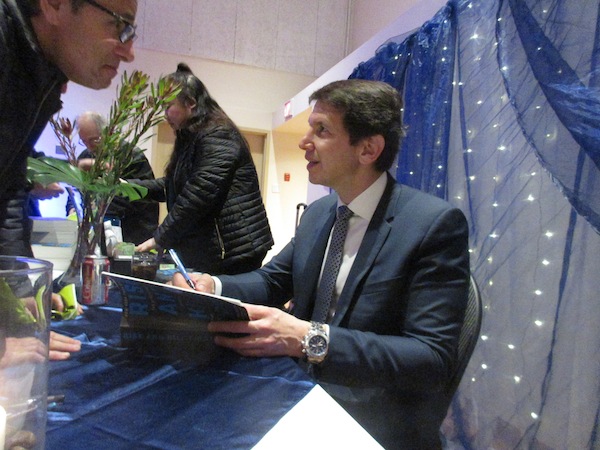
Ronen Bergman signs a copy of his book Rise and Kill First: The Secret History of Israel’s Targeted Assassinations for an attendee of his talk at Congregation Beth Tikvah Feb. 2. (photo by Pat Johnson)

Ronen Bergman, perhaps the leading historian on Israeli intelligence, spoke in Richmond recently, engaging a packed sanctuary at Congregation Beth Tikvah Feb. 2 with stories that make Ocean’s Eleven pale in comparison.

Bergman, a staff writer at The New York Times Magazine and senior political and military analyst for the Israeli daily Yedioth Ahronoth, shared the history of the Mossad as told in his bestselling book Rise and Kill First: The Secret History of Israel’s Targeted Assassinations. One had an extremely timely conclusion.

Imad Mughniyeh was the military commander of Hezbollah, who Bergman called “the most wanted and most capable and most diabolical terrorist who ever walked the face of the earth.” Mughniyeh is believed responsible for the 1983 bombing of the U.S. embassy in Beirut and truck bombings in the same city, which killed hundreds of U.S. and French military personnel, and also was involved in the 1992 bombing of the Israeli embassy in Buenos Aires and the 1994 bombing of the AMIA Jewish community centre there, as well as countless other atrocities worldwide.

“He was wanted by 41 different countries and the only thing they had from him is a vague photograph from 1983,” said Bergman. Finally, the Mossad located Mughniyeh in a safe house in Damascus, but, since Israel does not have diplomatic relations with Syria and, therefore, does not have an embassy there, they were at a disadvantage. Embassies are a great boon to spies, he said.

“You can have diplomatic immunity, you have cars, you have diplomatic mail, you can smuggle, it’s wonderful,” he said. “But they couldn’t get to him, they couldn’t kill him in Damascus, because it was so hard to operate, so Mossad turned to the only organization that could: the CIA. Because the CIA had something that Mossad will never have in Damascus: an embassy.”

The CIA required permission from then-U.S. President George W. Bush, so Ehud Olmert, who was then Israel’s prime minister, flew to Washington for a secret meeting with Bush and urged the president to help Mossad take out the terrorist, noting the number of Americans Mughniyeh had killed.

“George Bush was convinced, but he said on one condition – no collateral damage,” Bergman said. No bystanders or associates were to be harmed.

Working with the CIA, the Mossad set up the scenario and then aborted the operation 53 times because the target was not within the defined kill zone or because he was not alone or because, on one occasion, his identity could not be 100% verified because he was wearing a scarf due to inclement weather.

On Feb. 12, 2008, Mughniyeh left the safe house and the Mossad was about to push the button when they realized he was not alone.

“He’s walking with a man,” Bergman recounted. “Someone looks at the monitor and says, oh that’s not just a man, that’s Good Dog. Good Dog was the codename for Qasem Soleimani,” the top Iranian general and commander of the Quds Force, responsible for clandestine operations and global terror.

“So, someone said, how wonderful, let’s take them both,” said Bergman. “They called Meir Dagan [director of Mossad], who was sitting shivah for his mother. He calls Olmert and Olmert says no, abort, I promised President Bush that only Mughniyeh is killed.”

Later that same day, Mughniyeh was found alone outside the safe house and killed by an exploding car as he passed on foot. But Soleimani would live another dozen years – until he was killed Jan. 3 of this year, on orders of U.S. President Donald Trump, sparking a conflict that nearly led to all-out war between the United States and Iran.

Bergman, a lawyer and author of six bestselling books, recently received the Sokolov Prize, Israel’s equivalent of the Pulitzer. In undertaking Rise and Kill First, Bergman discarded all previous work on the subject and interviewed 1,000 intelligence officials and others with inside information on the Mossad and its operations. The book is now being turned into an HBO series.

Bergman recounted how, in 2018, Israel stunned the world when Prime Minister Binyamin Netanyahu invited the media to view a massive cache of documents and other materials related to the Iranian nuclear project. The moment was the culmination of two years of planning, involving 500 operatives, including 18 who located and infiltrated a secret archive outside Tehran, then swooped in, with a five-and-a-half-hour window in the middle of the night, to execute the deed and escape, relocating the ayatollah’s nuclear secrets to Israel.

Even with the Mossad’s expertise at safe-cracking, the team knew that they would not have time, once inside the archive, to fiddle with locks.

“So, Mossad establishes a front company in Europe who orders two empty safes from the same Iranian manufacturer. They ship the safes to Paris, then ship them to the Mossad lab in Tel Aviv, where they start drilling into them, trying to find what’s the fastest way to open them.”

They determined that it would require at least 3,600 degrees Fahrenheit to break into the archives’ security.

“Now imagine what sort of energy you need to shlep with you to Tehran in order to create such energy and do that in four different places because you need to open all the vaults,” said Bergman. They also had to bypass other security systems and interfere with video surveillance to make the cameras continue broadcasting as if nothing untoward was happening.

In the morning, when the heist was discovered by archives security officials, Bergman said, “no less than 12,000 troops, Revolutionary Guards, policeman, army” and others descended on the place, but could not discern how anyone could get in, grab all the contents and get out undetected. It would be two months until Netanyahu went public and the Iranians could finally confirm that the perpetrators were Mossad.

“Someone could ask, why should we write a book about the history of the Mossad? This is secret, right?” Bergman said. He acknowledges he left out a great number of secrets, some of which he will take to the grave, but added that it is impossible to tell the story of Israel without telling the story of the Mossad because any major decisions, any turning points in the dramatic story of the country, have the imprint of the intelligence services on it.

He warned, though, that this is not all derring-do and triumph. “If you want to read a book just glorifying Israeli intelligence, I suggest you don’t read Rise and Kill First,” he said. “Sometimes, the Jewish James Bond looks more like Inspector Clouseau.”

Many people ask Bergman how he got the top intelligence officials in the country – former heads of agency, high-level operatives, spies and agents – to talk, usually quite freely and almost always on the record.

“It was easy,” he said. “I smiled. When you smile to people, they feel comfortable to talk. But that’s not the whole answer. These people wanted to talk because they wanted people to know … what they have done in order to keep Israel safe.”

Some interviewees said they told Bergman things they had never told their spouses. But, when subjects were not forthcoming, he had a trick.

“If someone was not that enthusiastic to speak, I did to him or her the one thing that makes Israelis more ballistic and furious than anything else,” Bergman said. “I told him someone else took credit for his operations.”

He mooted a typical response: “What? He said that he was behind enemy lines, that he planned the operation, that he risked his life? Now I’m going to tell you the truth,” Bergman deadpanned. “Always works.”

In a remarkable number of the interviews, a single phrase frequently stood out: a quote from the Babylonian Talmud: “Whoever comes to kill you, rise up and kill him first.”

“Because the way they saw it, they had no other choice,” said Bergman, noting that outsiders cannot understand the DNA, the genome, the motives of Israelis, without understanding the imprint of the Holocaust and the determination to never be powerless again.

Hamas has bragged that they have more volunteers for suicide bombings than they have suicide belts.

“It turns out the only thing that stops these people from coming is the most extensive campaign of targeted killing ever launched in history – and not against the suicide bombers,” said Bergman. “When the Shin Bet [Israel’s internal security service] and Israeli Air Force started to target the layer above them – the bomb-makers, the indoctrinators, the recruiters, the regional commanders – then it turns out that these people who have no problem with sending everybody to their death, once the price tag is attached to themselves and their families, they say, well, we’ll die, but maybe not today.”

The targeting approach, said Bergman, was adopted by the United States, whose military leaders came to realize that taking out the top leadership of the enemy was ultimately less lethal and costly than the alternatives.

“And so, the CIA started following the successful Israeli experience, started to perform targeted killings,” said Bergman. “Do you know the president who organized the largest number of targeted killings in history? Barack Obama, because he realized that this is the weapon that, at the end of the day, takes less human lives than going into an all-out war. And it’s effective.”

Leanne Hazon, Beth Tikvah’s vice-president of programming, welcomed the audience and noted the size of the crowd despite it being Super Bowl Sunday. Rabbi Adam Rubin introduced Bergman. The author signed copies of his book after his talk.

Format ImagePosted on February 14, 2020February 12, 2020Author Pat JohnsonCategories BooksTags Beth Tikvah, journalism, Mossad, Ronen Bergman
Compassion over hate

Compassion over hate

Tony McAleer, who helped found the organization Life After Hate, spoke at Congregation Beth Tikvah last month, along with fellow Life After Hate member Brad Galloway. (photo by Pat Johnson)

A former leader in Canada’s far-right white nationalist movements says targets of white supremacist extremism should not be expected to “hug a Nazi.” But, as difficult as it may be, seeing the humanity in everyone and finding compassion for people who lack compassion may be key to reducing the problem of racist extremism.

Tony McAleer was a member of the so-called White Aryan Resistance and his early embrace of technology and the internet helped propel that movement into the digital age. He later helped found the organization Life After Hate and now works with others who want to leave the neo-Nazi movement. He shared his personal history at Beth Tikvah synagogue, in Richmond, on Sept. 8. He has also spoken at other synagogues and venues in recent weeks.

“While we condemn the activities, while we condemn the ideology, we don’t condemn the human being,” McAleer said of his organization’s strategy. “It’s coming from that place of compassion.… The hardest thing to do in the world is to have compassion for people who don’t have compassion. We do that as harm reduction – hurt people hurt people, and we can bring them back from that place of hurt so they don’t do it anymore.”

McAleer grew up in a stable, comfortable Dunbar home, which contradicts some stereotypes, he said. He attended private Catholic school but lost respect for authority figures when he caught his father with a woman who was not McAleer’s mother.

“Can anyone remember the day when God fell off the pedestal?” he asked. His grades fell, his behaviour deteriorated and he was regularly sent to the principal’s office for canings.

“When I look back on it, I don’t think that I’ve ever felt more powerless than I did in that office time after time after time after time,” he said. “It didn’t make my grades go up. I continued to tune out.… I went from listening to Elton John and Queen to the Clash and the Sex Pistols. I was angry and the music I listened to was angry. It eventually led me down the road into the punk scene and later into the skinhead scene. And, in the skinhead scene, I found an outlet for my anger.”

Ideology is secondary, at best, as an attractant to racist groups, he said.

“What we find in the young men and women who are drawn to these movements is there’s an underlying rage, underlying vulnerability that makes the ideology so seductive,” he said. “I want to be very clear here. I’m not for a minute blaming anything I did on my childhood. Everything I did I chose to do and I take accountability for that and I always will. I work for Life After Hate, do things like this to pay back for that.”

He shares the story of his early life as an explanation, not as a justification, he said.

“What I found in the movement, what I found from being a skinhead – I found a sense of power, a sense of purpose, a sense of meaning,” McAleer said. “I got power when I felt powerless. I got attention when I felt invisible and I got brotherhood, camaraderie and acceptance when I felt unlovable.… Those are the vulnerabilities that make the ideologies so seductive. If you have those in a healthy way, the ideology doesn’t make sense to you. But, for somebody craving those things, the ideology becomes something powerful, a false seduction.”

When he was 21 years old, McAleer’s girlfriend gave birth to a baby girl.

“For the first time, I connected to another human being. Up until that point, I was completely cut off from my heart, I was completely dehumanized,” he said. “I believe that the level to which we dehumanize other human beings is a mirror reflection of how internally disconnected and dehumanized that we are.”

That began the transformation. He had a son months later and was soon a single father being assisted by his mother who, he said, “never gave up on me.”

“It’s safe to love a child,” he said. “They see the magnificence in us when we can’t see it ourselves when we look in the mirror…. The more I can connect to my humanity, the more I can connect to the rest of humanity. I couldn’t connect to the rest of humanity because I couldn’t connect to myself.”

Though he was heavily involved in antisemitism, it wasn’t about Jews, he said.

“I was projecting my crap and I had a vehicle to project it onto – the Jewish people – and that’s what I did.”

The compassion Life After Hate promotes must be accompanied by healthy boundaries and consequences, he said.

“It doesn’t mean we let people off the hook. It doesn’t mean we don’t hold people accountable,” he said. “We do hold them accountable. It’s like tough love. But we need to see the humanity, even in someone whose heart is filled with hate. I don’t think we can afford to dehumanize anybody regardless of how inhuman their behaviour. I believe that nobody is irredeemable. It’s tough work.”

Brad Galloway, who is also a member of Life After Hate, joined McAleer at the event. Also a former white supremacist, Galloway is now completing a degree in the school of criminology and criminal justice at the University of the Fraser Valley. He researches extremism and participates in interventions with members of hate groups to help them leave the movements.

Galloway too came from a middle- to upper-class home. After a fairly typical adolescence and a period of struggling to find his identity, he ran into a childhood friend who was involved in the white power movement.

“I was looking for an identity,” said Galloway. “I was looking for something to belong to, something that I can call my own. He gave me the chance. We’ll give you brotherhood, we’ll back you up, we’ll be there for you … some sort of pseudo-support network which never, never came to fruition. They never provided any of those things for me.”

photo - Brad Galloway
Brad Galloway (photo by Pat Johnson)

Like McAleer, it was fatherhood that made Galloway realize his extremism was putting his family at risk.

He also reflects on compassion he received from police and others during his time in the far-right.

“Why do these people care about me?” he wondered, adding that he began to recognize that individuals who were kindest to him were often members of the very cultural groups he demonized. After a gang brawl where Galloway was nearly killed, he saw compassion in action.

“I ended up in a hospital and I’m lying on the table and a doctor walks in and he’s an Orthodox Jew. I’m lying there with a swastika shirt on, blood all over me, thinking this guy should not help me. I do not deserve to be helped at all right now…. I felt like I was a terrible person and I didn’t feel I deserved this person’s time,” said Galloway. “He did not mention anything about me. He just did his job as a doctor and provided me exactly what I needed. That moment made me start to think about all these different times when minority communities had been good to me.”

Since the racist rally in Charlottesville, Va., in 2017, Life After Hate has been inundated with requests for help. About 300 new cases have opened, about half of which are people trying to leave the movement, the other half family seeking help to extricate their loved ones.

Cpl. Anthony Statham, one of two members of the RCMP’s B.C. Hate Crimes Unit also spoke, outlining the legal strategies employed to fight extremism.

McAleer’s book, The Cure for Hate: A Former White Supremacist’s Journey from Violent Extremism to Radical Compassion has just been released by Arsenal Pulp Press.

Format ImagePosted on October 11, 2019October 11, 2019Author Pat JohnsonCategories LocalTags antisemitism, Beth Tikvah, books, Brad Galloway, lifestyle, racism, The Cure for Hate, tikkun olam, Tony McAleer, white supremacism
Series finishes on high notes

Series finishes on high notes

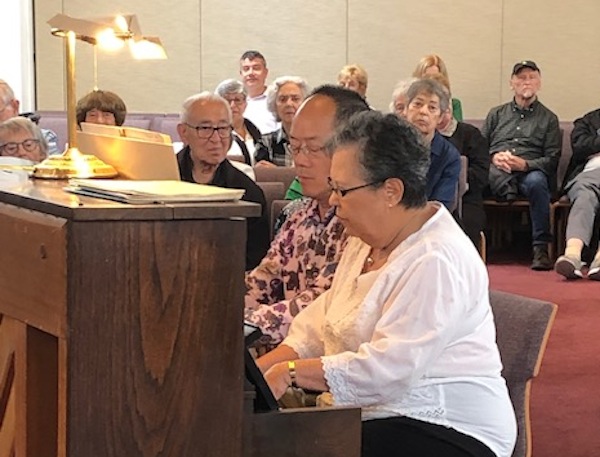
“Dueling pianists” Lester Soo and Marilyn Glazer entertain at the last Empowerment Series session of the season. (photo from JSA)

Co-sponsored by Jewish Seniors Alliance and the Kehila Society of Richmond, the fifth session of this season’s JSA Snider Foundation Empowerment Series took place at Congregation Beth Tikvah. It more than lived up to the series’ theme this year: “Renewing and Reinventing Ourselves.”

As usual, the program was preceded by a lunch provided by Stacey Kettleman. Beth Tikvah’s Rabbi Adam Rubin did the Hamotzi and Toby Rubin, co-executive director of the Kehila Society, welcomed everyone. Among the 120 or so attendees were members of the Kehila Society and of JSA, as well as a group from L’Chaim Adult Day Care.

The entertainment portion of the program took place in the sanctuary, where Ken Levitt, president of JSA, spoke briefly and Rubin introduced the “dueling pianists”: Marilyn Glazer and Lester Soo, both of whom are accomplished musicians and piano instructors. The two have known each other for 35 years and have been playing duets for much of that time – one piano, four hands. At the Empowerment Series performance, they began with four Hungarian rhapsodies and continued with Mozart’s Eine Kleine Nachtmusik. They then played a number of Gershwin tunes and ended with Cole Porter.

Rubin thanked the pianists for their wonderful performance, which was the last event of the 2018/19 Empowerment Series. The series will begin again in the fall, with a new lineup of events presented by JSA with other seniors groups in the community.

Shanie Levin is an executive board member of Jewish Seniors Alliance and on the editorial board of Senior Line magazine.

Format ImagePosted on July 12, 2019July 10, 2019Author Shanie LevinCategories MusicTags Beth Tikvah, Jewish Seniors Alliance, JSA, Kehila Society, piano, seniors
A wonder-full evening

A wonder-full evening

Illusionist Vitaly Beckman can seemingly change a driver’s licence photo. To witness the feat in person, check out his June 5 show at the River Rock Casino. (photo by Galina Sumaneeva)

“I rarely have a chance to perform in my own town, so it’s a privilege and I am really looking forward to it,” illusionist Vitaly Beckman told the Jewish Independent about his June 5 show, Vitaly: An Evening of Wonders, at the River Rock Casino, which is a fundraiser for Richmond’s Beth Tikvah Synagogue.

Beckman is constantly performing on the road. “My favourite trip was to Puerto Montt, in Chile – I got to perform in a beautiful theatre situated right over a lake and witness some breathtaking views,” he said. “Other recent highlights include doing an off-Broadway run last summer. I was performing eight shows a week for 16 weeks straight. It was surreal to see my own face appear on the Times Square buildings, and was a dream come true.”

Every show is unique, he said. And, in every show, “there are things that do not go according to plan, and I have to adjust and improvise. Especially when I invite audience members up on stage, you never know what to expect. It’s part of the fun and makes it more interesting and memorable.”

This is one of the reasons Beth Tikvah asked Beckman to perform.

“The synagogue wanted to try something unique and different from the usual,” board member Allan Seltzer told the Independent. “We wanted to be able to invite congregants, Jewish community members and the general public of all ages to an exciting ‘evening of wonders.’”

Magician Stephen Kaplan will also perform on June 5.

Noting both performers’ “great stage presence and showmanship,” Seltzer said, “Vitaly emigrated from the former Soviet Union as a boy and has been wowing audiences with his world-class show for over 15 years. Vitaly has appeared on television around the world and recently fooled Penn and Teller on their WB televised show.”

Beckman told the Independent he is always coming up with new illusions, but that he needs to section off parts of the year to actually work on them. “I find that I need no distractions in order to create new material, as the creative process requires an absolute focus and to think of nothing else,” he said. “Oftentimes, I take the summers off to do that, and sometimes find small breaks in between shows.”

As for Kaplan, Seltzer said he “has been performing and entertaining audiences across B.C. for over 25 years. His unique brand of illusions and comedy make him the ideal opening act for Vitaly.

“Both artists are Jewish and are proud to be assisting Beth Tikvah for this special evening,” he said.

Also participating in the evening’s entertainment will be emcee and fellow community member Howard Blank, who, said Seltzer, “is known throughout B.C. for his vast philanthropic work on stage at over 50 galas and events annually … [and] has been bestowed with the Sovereign’s Medal for Volunteers by the governor general in Ottawa. Howard celebrates his Jewish Vancouver roots by donating his time to numerous Jewish events, including the JCC Sports Dinner, Chabad, Talmud Torah and our Evening of Wonders.”

Funds raised from the River Rock show will be put toward Beth Tikvah programs and services, which include a preschool, religious school, social and educational youth programs, adult education, Jewish holiday programming, conversion classes, Israel programming, interfaith panels and lifecycle events, said Seltzer. He added about the youth activities that “many of our participants are Jewish children and youth who are in public schools, and their only exposure to Judaism and the Jewish community is through our youth and religious school program.”

VIP ticketholders will get a chance to meet Beckman after the show and sponsors will be recognized in the evening’s program, said Seltzer.

As for what the audience can expect, Beckman said, “They will witness art coming to life – photos will come to life, drawings come out of a page and even their face will disappear on their own driver’s licences. If they like, the photo on their ID will be replaced by another face, whoever’s they choose. It has never been done before by anyone else. There is also a new piece, dedicated to Salvador Dali, whose work also inspired some of the visuals in the show.”

For tickets to Vitaly: An Evening of Wonders, visit ticketmaster.ca or call Beth Tikvah at 604-271-6262.

Format ImagePosted on May 17, 2019May 16, 2019Author Cynthia RamsayCategories Performing ArtsTags Beth Tikvah, fundraiser, Howard Blank, magic, philanthropy, Stephen Kaplan, Vitaly Beckman

Posts pagination

Previous page Page 1 Page 2 Page 3 Next page
Proudly powered by WordPress