Protests, picketing alarm Jews

Screenshot of Nelson City Council’s Oct. 22, 2023, meeting. Left to right, Topaz Zafrir, Yael Finer and Judy Banfield of the Kootenay Jewish Community Association present their concerns about the rise in anti-Israel and antisemitic events to the council.

Last October, as tensions in Canada were mounting over the Israel-Hamas war, three members of the Kootenay Jewish Community Association in Nelson paid a visit to the city council meeting to convey a request: that the council refrain from taking sides when it came to the emotionally charged protest rally that had taken place the day before. Nelson residents Judy Banfield, Yael Finer and Topaz Zafrir said they were also there to ask the police to continue its protection of Jewish community events, as it had in previous years. “We are very grateful for that,” Banfield said. “Right now, our community is frightened.” 

The week before the meeting, Hamas had called to its supporters for a “day of rage.” The response was swift in Nelson, a college town that has seen an escalation of pro-Palestinian sentiment and anti-Israel demonstrations in recent years. About a hundred people turned out to hear speakers who gave accounts of what they believed was happening in Gaza. According to Kootenay Jewish community leader Yael Finer, the presentations included assertions about Israel’s role in Gaza that had already been debunked. The purpose of the rally, she felt, was to incite antisemitism and anti-Israel sentiment in the city. Finer, an Israeli-Canadian who moved to Nelson in 2016, told the council that one of the speakers also made a pitch on behalf of Hamas.

“A final speaker said, ‘Don’t hate Hamas. They’re our brothers, our sons, our fathers,’” Finer recounted.

“The event was supposed to be about peace and education,” she said. “I actually reached out to the organizer, asking to speak at the event as one of the Israeli or Jewish [residents].”

Finer told the council that she empathizes with the Palestinian people and shares concern over the current situation in Gaza. She had gone to the rally to learn. She said her request to speak at the event was denied. 

Finer added that one of the speakers was a city council member, “creating a perception of legitimacy” for the demonstration. The mayor later released a statement clarifying that only the mayor’s office represented the views of the city government, including at public events.

Not a new phenomenon

Banfield, who is a former Selkirk College instructor and has lived in Nelson since 1990, said antisemitism isn’t a new phenomenon in the city. She said the planned speech in 2013 of Greta Berlin, an accused antisemite, put the community on edge. Eventually, the Nelson library rescinded the offer for her to speak, but she was later offered a venue at the United Church. Although the gathering remained peaceful, Banfield said anti-Israel and antisemitic behaviour have only grown more evident.

“I have been in Nelson a long time and we’ve always been very open that we’re here and inviting,” she told the Jewish Independent about the local Jewish community. She said that, until recently, religious celebrations used to be open to the Nelson public. However, a couple of years ago, demonstrators picketed a Jewish holiday celebration.

“People were picketing us, basically as being Jews, being responsible for what is going on in the Middle East,” said Banfield. Since then, she said, the community has had to ask for police protection at religious and other community events and to conceal their locations from the public. “We do not feel safe gathering together in an announced venue,” she told the Nelson council.

Last November, demonstrators held another rally, this time calling on the city to formally advocate for a ceasefire. According to several attendees, there were also calls for boycotting local businesses that were assumed or known to do business in or with Israel.

Jeff Shecter, another long-time resident and one of the Jewish community’s first leaders, said even more people turned out for that rally. He said the protests and “river to the sea” chants have unnerved the Israeli members of the community.  “[They] were more shocked than the rest of us who were maybe used to it,” Shecter observed. While he said he is not afraid, “to have a demonstration supposedly in support of Palestine without anyone, not a single soul, denouncing what happened on Oct. 7 was a travesty.”

Zafrir, one Nelson’s most recent arrivals from Israel, told the council that the community isn’t trying to stifle anyone’s voice. “We’re not asking you to take sides,” she said. “The Palestinians and whoever supports them have the right to protest, as we have to do so, and still feel safe in our community. Any person in Nelson should feel safe, despite disagreement or place of origin.” 

On Dec. 5, acknowledging that it had received numerous calls for action, the city issued a formal letter “calling for peace in Gaza” and appealing for a “cessation of hostilities from all involved parties.” While the information shared among council members briefly mentioned the Oct. 7 attack by Hamas, the letter that was disseminated to the public did not. Nor did it mention the death toll from the terror attack or that more than 240 people had been abducted by Hamas and most were still missing.

Banfield said she is sympathetic of the pressure that the city council is under. “I mean, they did end up passing a resolution promoting a ceasefire. And I know there was a lot of discussion about it on council and they made it as lukewarm as possible,” she said. “And I guess at this point, the biggest thing for us is that they have given us protection.”

Asked whether she felt the city council understands the Jewish community’s concerns about safety at this time, Finer shook her head. “No,” she said, adding that she had hoped others would understand that anti-Israel protests and picketing of Jewish sites is alarming. “[Even] though there was no direct threat to the Jewish people in the town, it was implied. And that makes me feel terrified,” Finer told the council.

Still, Finer hasn’t given up hope that things could change in Nelson. As the new leader of the Kootenay Jewish Community Association, she’s already thinking about ways to bridge differences and enhance dialogue with those who don’t know, or don’t understand, Nelson’s small Jewish community. 

Jan Lee is an award-winning editorial writer whose articles and op-eds have been published in B’nai B’rith Magazine, Voices of Conservative and Masorti Judaism and Baltimore Jewish Times, as well as a number of business, environmental and travel publications. Her blog can be found at multiculturaljew.polestarpassages.com.
Rabbis’ emotional journey

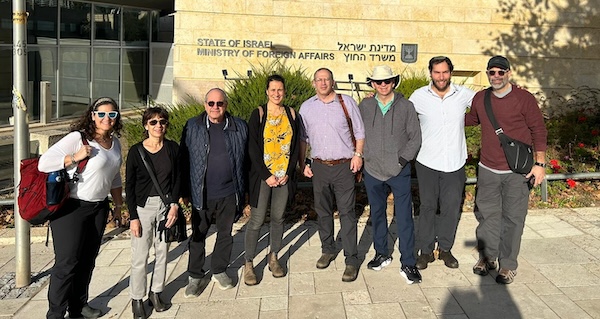
Left to right: Rabbis Susan Tendler, Hannah Dresner, Philip Bregman, Carey Brown, Andrew Rosenblatt, Jonathan Infeld, Philip Gibbs and Dan Moskovitz in Israel last month. (photo from facebook.com/jewishvancouver)

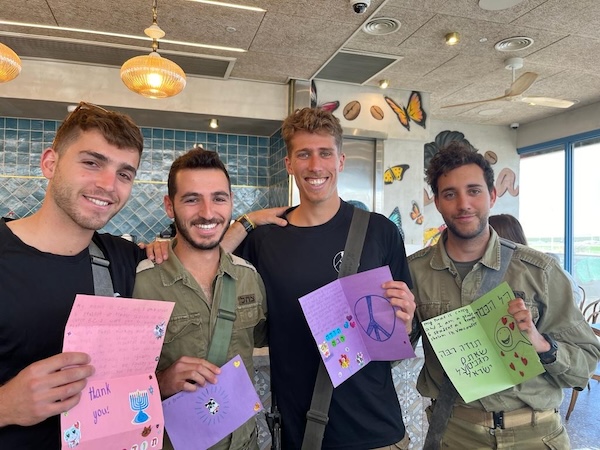
Eight Vancouver-area rabbis recently visited Israel where, among many other things, they handed out cards and letters prepared by Jewish day school students and members of Vancouver’s Jewish community to soldiers and other Israelis. The response, according to one of the rabbis, was overwhelming.

“I saw soldiers taking these cards and then dropping down to the sidewalk and crying,” said Rabbi Philip Bregman. “Holding them to their chest as if this was a sacred piece of text and just saying, ‘Thank you. To know that we are not forgotten….’”

photo - The rabbis’ mission included the delivery of thank you cards to Israeli soldiers
The rabbis’ mission included the delivery of thank you cards to Israeli soldiers. (photo from facebook.com/jewishvancouver)

Bregman, rabbi emeritus at the Reform Temple Sholom, was almost overcome with emotion while recounting the experience, which he shared in a community-wide online presentation Dec. 17. The event included seven of the eight rabbis who participated in the whirlwind mission, which saw them on the ground for a mere 60 hours. Rabbi Andrew Rosenblatt of the Orthodox Congregation Schara Tzedeck was part of the mission but did not participate in the panel because he extended his time in Israel.

According to Ezra Shanken, chief executive officer of the Jewish Federation of Greater Vancouver, who emceed the event, the Vancouver mission was unique in Canada and possibly in North America for bringing together rabbis from across the religious spectrum. The close connection of most local rabbis, facilitated by the longstanding Rabbinical Association of Vancouver (RAV), set a foundation for the mission, which took place in the second week of December.

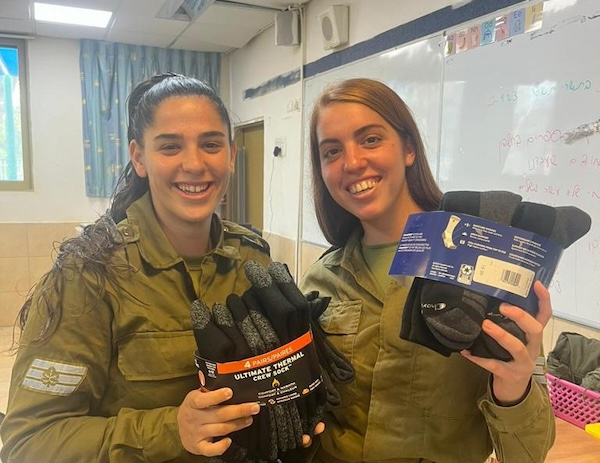
The eight rabbis transported 21 enormous duffel bags, filled with gear like socks, gloves, toques and underwear, mostly for military reservists.

photos - The rabbis delivered warm clothing, including socks, to Israeli soldiers
The rabbis delivered warm clothing, including socks, to Israeli soldiers. (photo from facebook.com/jewishvancouver)

Shanken, who visited Israel days earlier with Federation representatives and five Canadian members of Parliament, said nothing prepared him for what he encountered there. Bregman echoed Shanken’s perspective.

“It’s one thing to have that as an intellectual understanding,” said Bregman, “It’s another thing when you are actually there to witness the absolute pain and trauma. People have asked me how was the trip. I say it was brutal.”

The reception they received from Israelis was profound, several of the rabbis noted. 

“I’ve been to Israel dozens of times,” Bregman said. “People are [always] happy to see us. Nothing like this.”

Rabbi Dan Moskovitz, senior rabbi at Temple Sholom, said the mission was to bear witness and also was a response to what rabbis were hearing from congregants about the centrality of Israel in their lives. He told the Independent that he was able to connect with two philanthropists in Los Angeles who funded the mission. Rabbi Carey Brown, associate rabbi at Temple Sholom, and Rabbi Susan Tendler, rabbi at the Conservative Beth Tikvah Congregation, in Richmond, handled logistics, with input from the group.

The unity of Israelis was among the most striking impressions, said Brown.

“It’s so all-encompassing of the society right now … the sense that everyone’s in this together,” she said. The unity amid diversity was especially striking, she noted, when the rabbis visited the central location in Tel Aviv known as “Hostage Square.”

Brown said Israelis asked about antisemitism in Canada and seemed confounded by the fact that there is not more empathy worldwide for the trauma their country has experienced.

Tendler reflected on how Israelis were stunned and touched by the fact that a group of Canadians had come to show solidarity.

The rabbis were able to experience a microcosm of Israeli society without leaving their hotel. At the Dan Panorama Tel Aviv, where they stayed, they were among only a few paying guests. The hotel was filled with refugees from the south and north of the country who are being indefinitely put up in the city. 

Several rabbis spoke of incidental connections in which they discovered not six degrees of separation between themselves and people they ran into, but one or two.

Rabbi Jonathan Infeld of the Conservative Congregation Beth Israel, who is chair of RAV, told of being approached by members of a family staying at their hotel who heard they were from Vancouver. They asked if the rabbi knew a particular family and he replied that he not only knew them but that a member of that family had just married into his own.

Likewise, Tendler ran into people who went to the same summer camp she did and the rabbis found many other close connections.

“The idea [is] that we are spread out but, at the heart of it all, we honestly really are one very small, connected people,” said Tendler. “We are one family, one community and that was the most important, amazing thing of all.”

Close connections or not, the rabbis were welcomed with open arms. Rabbi Philip Gibbs of West Vancouver’s Conservative Congregation Har El told of how he was walking past a home and glanced up to see a family lighting Hanukkah candles. They insisted he come in and mark the occasion with them.

Gibbs also noted that the political divisions that had riven the society before Oct. 7 have not disappeared, but that the entire population appears to have dedicated themselves to what is most important now.

The rabbis met with scholars, including Israeli foreign ministry experts and many ordinary Israelis, including Arab Israelis, as well as the writer Yossi Klein Halevi, who told them that many Israelis feel let down by their government, intelligence officials and military leadership.

The rabbis traveled to the site of the music festival where 364 people were murdered, more than 40 hostages kidnapped and many more injured on Oct. 7. They saw scores of bullet-riddled and exploded vehicles. All of them will be drained of fuel and other fluids before being buried because they contain fragments of human remains that ZAKA, Israel’s volunteer rescue, extraction and identification agency, could not completely remove from the vehicles.

Rabbi Hannah Dresner of the Jewish Renewal-affiliated Or Shalom Synagogue was not the only rabbi to compare the mission with a shiva visit.

“I was just so amazed at the care that was being given, that each of these vehicles was now being siphoned of any remaining flammable materials so that each one of them could be buried according to our halachah,” Dresner said, “so that none of the human remains would be just discarded as junk. I found that overwhelmingly powerful.”

Relatedly, the group visited an exhibit at Expo Tel Aviv, which recreates the music festival site and features unclaimed property from the site, including the historically resonant sight of hundreds of pairs of shoes.

photo - The visiting rabbis went to an exhibit at Expo Tel Aviv, which featured unclaimed property from the music festival site where hundreds were murdered
The visiting rabbis went to an exhibit at Expo Tel Aviv, which featured unclaimed property from the music festival site where hundreds were murdered. (photo from facebook.com/jewishvancouver)

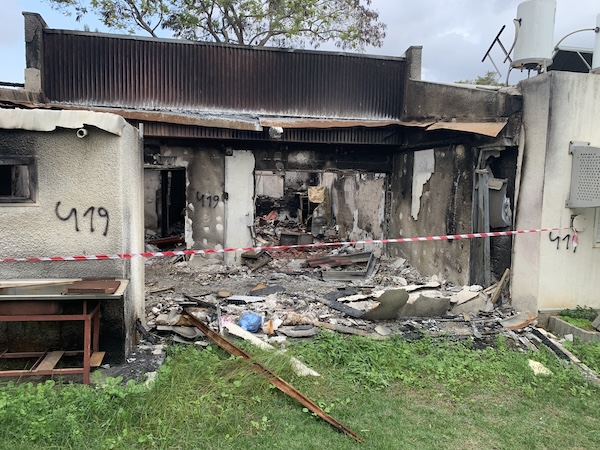
The rabbis visited Kibbutz Be’eri, where more than 100 people were murdered, and saw the devastation and destruction, some of it not from Oct. 7 but from days after, when explosives planted on that day detonated. It was also at this kibbutz that the Israel Defence Forces found a copy of the Hamas playbook for the atrocities. 

“It sounded as if it could have been written by Eichmann or Hitler,” said Bregman. “[The intent] was not only to destroy the body but to destroy the mind, the soul, the psychology, the emotional and spiritual aspect of every Jew.”

The plan included strategies for setting fire to homes in order to force residents out of safe rooms, then specified the order in which family members were to be murdered – parents in front of their children. 

photo - As part of their mission to Israel, Vancouver rabbis visited kibbutzim that were attacked by Hamas on Oct. 7
As part of their mission to Israel, Vancouver rabbis visited kibbutzim that were attacked by Hamas on Oct. 7. (photo from facebook.com/jewishvancouver)

While the trip may have had the spirit of a shiva visit, the mood of the Israelis, Dresner said, was “can-do resourcefulness.”

“It’s felt to me over the past couple of years that Israelis have been kind of depressed,” she said, referring to divisive political conflicts. “But they are full force embracing their ingenuity and turning the energy of the resistance movement into this amazing volunteer corps to supply really whatever is needed to whatever sector.”

Groups that had coalesced to protest proposed judicial reforms pivoted to emergency response, she said, ensuring that soldiers and displaced civilians have basic needs met and then creating customized pallets of everything from tricycles to board games, bedding and washing machines, for families who will be away from their homes for extended periods.

The rabbis also went to Kibbutz Yavneh and paid their respects at the grave of Ben Mizrachi, the 22-year-old Vancouver man and former army medic who died at the music festival while trying to save the lives of others. They had a private meeting with Yaron and Jackie Kaploun, parents of Canadian-Israeli Adi Vital-Kaploun, who was murdered in front of her sons, an infant and a 4-year-old.

On the final evening of their visit, the rabbis hosted a Hanukkah party for displaced residents of Kiryat Shmona, the northern Israeli town that is in the Vancouver Jewish community’s partnership region.

At the party, Temple Sholom’s Rabbi Brown spoke with a woman whose two sons are in Gaza fighting for the IDF.

“I told her that we do the prayer for tzahal, for the IDF, in our services in our shul,” Brown said, “and she was so surprised and touched, and she said, ‘Keep praying, keep praying.’” 

Focus during distracted times

As a freelancer, I often find interesting work opportunities that don’t pan out. I spent time in December applying for an editor gig that involved editing summaries of literature to provide students with educational support. I used to think these supports were “cheating,” using these kinds of guides, but now I know differently. Students with special needs deserve access to these stories. I recognize that every student has the right to learn, read great pieces of literature and access education, even if they struggle along the way. So, I dutifully filled out the form, sent off my CV and submitted an application. One application question irked me. “What’s your favourite piece of literature and why?”

Two things bothered me. One is that this response had a word limit on the form, so nobody could wax eloquent about whatever they chose. The second thing is that, as someone in mid-life who reads voraciously, I thought it was ridiculous to ask what someone’s all-time favourite was. I couldn’t possibly name only one, but I thought about it. I’ve been reading Talmud daily for about four years. I must like it. Further, it has helped me gain a lot of insight into the ancient world, and reflects further on ancient cultures, law systems and storytelling.

I tried to fit this into the form, but I had reservations. The organization had a big “We do not discriminate” statement on its page but, after Oct. 7, I wondered if I was risking something to say that the Babylonian Talmud was my current favourite. My concerns might have been warranted. On Dec. 25, in the morning, I received a vague form email telling me my application hadn’t been successful. My household laughed about the timing of the form letter. What were they indicating? That Jews should work as usual on Christmas, a North American statutory holiday? Or that my choice of literature was so egregious they couldn’t wait for a business day to reply? Perhaps something else about my qualifications didn’t meet their needs. It’s best not to work for a place that isn’t a good fit. Although this part-time gig had great potential, I wasn’t a contender. That’s OK.

This experience made me reflect on my lifelong relationship with reading. I’ve always loved to read. One of my undergraduate majors was in comparative literature. A  favourite moment during my graduate work in English education came when the professor put different things on a table and asked us to list which things were “literature.” The professor included newspaper articles, fiction and nonfiction, plays and song lyrics, advertisements, and more. Her point was that we often couldn’t predict what piece of writing would stand the test of time. Further, all of us would have different answers to this question about how to define literature and its meaning. She was right.

Since Oct. 7, I’ve had a hard time focusing. For a long time, I couldn’t read a book. Don’t get me wrong – I’ve been glued to the news and social media, reading many articles and much political analysis. I listened to completely “fluffy” fiction audio books as I cooked but, eventually, I had to stop renewing a book I’d checked out from the public library. It was nonfiction, a book about the US Great Migration called The Warmth of Other Suns, by Isabel Wilkerson. It was well-written and engaging. I felt like apologizing to the author. I couldn’t focus enough to remember the various narrative threads or finish it.

Later, on Dec. 25, I managed to complete reading On the Way Home, the short diary of Laura Ingalls Wilder, which recounted her trip from South Dakota to her new home in Mansfield, Mo., in 1894. This brief chronicle transported me, giving me a window into travel during a period of US history that I could only imagine. Was it literature? Perhaps, because it worked the way literature should. I spent time in my imagination in a different place and time. It offered a brief respite. Perhaps it’s the start of being able to focus on reading again? I can only hope.

I wondered why I’d made it through this (admittedly short) volume I’d found at a neighbourhood Little Free Library. It made me reflect on what aspects of literature are valuable and what allows us to focus on it. Perhaps it’s about escape or the imagination. Maybe it helps us learn about relationships, history and culture.    

Four years ago, I resolved to start Daf Yomi, reading a page of Talmud a day, on Jan. 5. It was my birthday and close enough to the start of the secular new year to be a “resolution” that truly stuck. After four years of reading a page a day, I am still immersed in this experience. Even though I read mostly in English, and barely skim the surface of each page, I’d argue this is a good read. I’ve learned a lot, but it has taken work and research to make meaning. Sometimes, I have to struggle with finding connections with the rabbis who lived 2,000 years ago. Even as the rabbis struggled with practical issues, I sometimes have to read commentaries and make a leap to figure out how the issues applied then as compared to today. 

Great literature is about history and context, as well as mystery, and it’s all there, wrapped up for us like a big gift in Jewish literature. Religious texts like Torah and Talmud, as well as all the other Jewish stories that came afterwards, add meaning and depth to our lives. Surprisingly, I haven’t had trouble focusing on these narratives.

Here, too, is another lesson that literature is teaching me – we Jews are a small people but have incredibly rich literary and spiritual resources. As Israel struggles physically with war, these texts remind me what we’re fighting to maintain. Doing the work to understand these texts offers us so much history, context and tradition, I’m grateful to have the opportunity. It’s the least I can do when so much is at stake. 

Joanne Seiff has written regularly for CBC Manitoba and various Jewish publications. She is the author of three books, including From the Outside In: Jewish Post Columns 2015-2016, a collection of essays available for digital download or as a paperback from Amazon. Check her out on Instagram @yrnspinner or at joanneseiff.blogspot.com.

From poems to songs

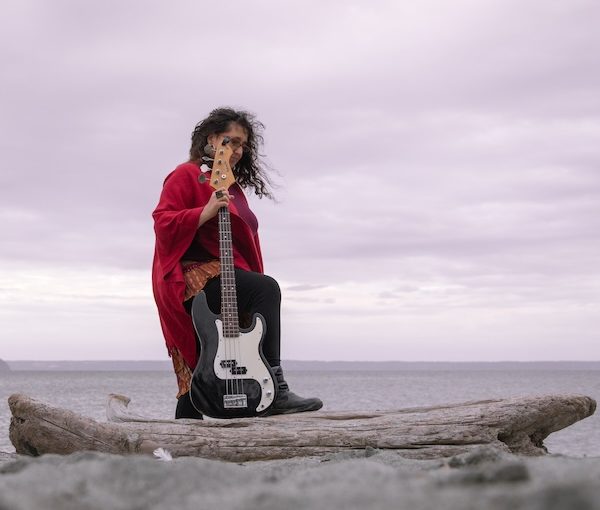
Loolwa Khazzoom (photo by Moriel O’Connor)

“Dear Hostages, as the world rallies to celebrate your desecration I will not forsake you,” begins the poem written by Seattle-based multimedia artist and educator Loolwa Khazzoom. Posted on her Facebook page, with a #BringThemHomeNow poster featuring photos of Israelis kidnapped on Oct. 7, it continues, “My instinct is to deprive myself of oxygen / Because you are underground / And I will not forget you // But I know that you would dance / In the sun / If given the chance / So I now rise up / And dance for you.”

Many of Khazzoom’s songs begin as poems. In this case, she told the Independent, “I felt as if I could not breathe and as if I did not even want to breathe, out of solidarity with the hostages and with all of Israel, in particular, all the victims of the Oct. 7 massacre. It’s like I wanted to physically feel their pain and suffering, as a way of physically demonstrating that I would not forsake them or forget them.”

In a traumatized mental state, Khazzoom returned to the “healing tools of poetry and music,” which was another way she could show her solidarity and do her part in keeping the issue of the hostages in front of people.

Similarly, Khazzoom and her band, Iraqis in Pajamas, recently released another poem-turned-song, “#MahsaAmini.” They did so this past Sept. 16, the first anniversary of the death of 22-year-old Mahsa Amini at the hands of Iranian “morality police.”

Finding out about Amini’s murder soon after it took place, from TikTok videos posted by Iranian women, Khazzoom “jumped into action.” She wrote to her political representatives, raised funds for United 4 Iran and reposted Iranian women’s videos on her feed constantly, to help boost the content’s views. “In addition,” she said, “a day after I found out about what happened, a poem with my feelings poured out of me, and I posted it on social media. Months later, I put that poem to a melody, and the band developed it into a full band song, which we released on the [anniversary of the] day of Amini’s murder.”

The death affected Khazzoom deeply for many reasons.

“First, the women in my family wore the abaya, the Iraqi equivalent of the hijab – Jewish women throughout the region were subject to Muslim dress codes, so it’s a Jewish issue, too,” she said. “Second, so many people assume that Islam is indigenous throughout the Middle East and North Africa, but it’s not. Arab Muslims rose up from the Arabian Peninsula and conquered the entire region, forcibly converting masses under the threat of death. So many indigenous ethnicities and religions predated the Muslim conquest, including Jews, Persians, Berbers and Kurds. The Iranian women protesting and burning their hijabs felt to me like challenging that Muslim conquest and awakening the ancient Persian warriors. Third, Persia is central to Jewish history and the origins of the Mizrahi community, dating back nearly three millennia ago…. And, lastly, the fire of these women, and the men who joined them, and their willingness to risk their lives for their dignity and freedom was just breathtaking and profoundly inspirational.”

Another of Iraqis in Pajamas’ releases this year was also intensely personal for Khazzoom.

“I wrote ‘The Convert’s Quest’ in response to some friends on social media sharing how hurt they were, coming under attack during the process of their conversion to Judaism. I had ample experience witnessing variations on this theme throughout my life – both first-person, seeing it happen to friends, and through my research as a Jewish multicultural educator. For decades, I felt very disturbed by this seemingly growing trend.

“I am the daughter of a Jew by choice, as my mother called herself, so the matter of conversion to Judaism is very personal for me,” she said. “I remember understanding very clearly as an Orthodox Jewish child that, according to halachah (Jewish law), once you convert, you are no longer to be called ‘a convert,’ but rather, a Jew, period. So, even from a religious Jewish perspective itself, I was very distraught by the ways that Jewish leaders and communities were rejecting or harassing converts, or even all-out forbidding people from converting. It all flies in the face of Jewish history, theology and practice.”

The band released “The Convert’s Quest” on May 24, on the harvest holiday of Shavuot, which celebrates the giving of the Torah to the Jewish people and on which the Book of Ruth is read. It tells the story of Ruth, a Moabite woman who converted to Judaism, whom Jewish tradition teaches will be the ancestor of the Messiah.

“To me, Jewish converts are the lifeblood of the Jewish people,” said Khazzoom. “I have a provocative line in my song, saying that converts are ‘the most Jewish Jews of all,’ because they are intentionally and consciously practising the foundational precepts of Judaism, which so many either take for granted or do rote, as is often the case in the Orthodox Jewish world where I was raised. In addition, amidst life-threatening levels of racism and violence against Jews, converts choose Judaism…. Why would we reject, in any way, from subtle to blatant, someone with such a heroic Jewish soul?”

Even when delivered in a playful manner, Khazzoom’s song are serious to the core. The campy “Kitchen Pirate,” for example, “emerged from my choice to reject the conventional option of surgery, in the wake of a cancer diagnosis in 2010,” she said. “Instead, I chose to radically alter my diet and lifestyle. Simply by overhauling my diet, I cold-stopped the growth of the nodules, which remained stable for the next five years – neither growing nor shrinking – until I returned to my lost-love of music, following which they began shrinking.”

Khazzoom said her songs “are always questioning, always challenging, always defiant. Sometimes, it’s more explicit, other times it’s embedded in silliness, which, parenthetically, I also see as defiant. I am and forever will be a curious, playful and awe-inspired child. I think that, if and when we ‘outgrow’ that, we die inside. And I refuse to capitulate to that norm of expected behaviour once we enter adulthood. By way of example, to this day, at age 54, when I am flying in a plane, if there is nobody sitting next to me, I will stretch out my arms and pretend I’m a bird, during takeoff.”

Not everyone has appreciated this aspect of her personality. “I have constantly gotten into trouble for it and have been at odds with my family, my community and society at large,” said Khazzoom. “I have endured terrible loneliness and often even self-doubt as a result. But I always come back to my core. And all of my songs emerge from that place – that raw, gut-wrenching place of being fiercely alive and allowing the clash with everything around me, and then writing about it.”

It is this enthusiasm that Victoria-based band member Mike Deeth enjoys about being in Iraqis in Pajamas, whose third member is Chris Belin.

“Loolwa and Chris are both easy-going, creative people. The energy is very positive, which makes collaborating with them fun and organic,” Deeth told the Independent. “Further, I appreciate the passion Loolwa has for the subject matter she writes about. One thing I always struggled with as a musician is ‘What do I have to say?’ At the end of the day, I’m a privileged guy who has never had to face oppression, hate, war or genocide. I have a lot of respect for artists who have experienced darker parts of humanity and have the courage to bring that perspective into their art.”

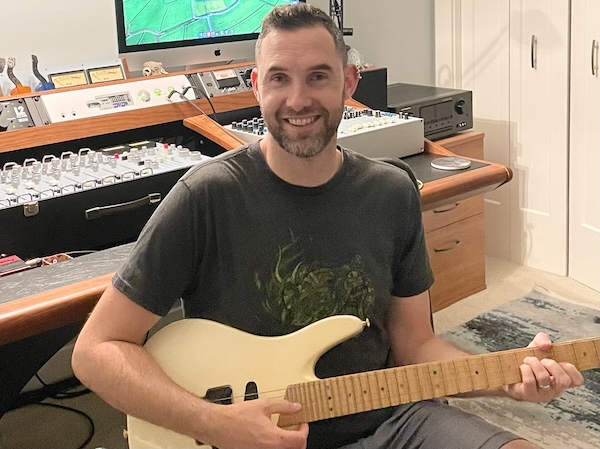
Born in Toronto, Deeth, who is not Jewish, spent most of his adolescence in Calgary, and moved to Vancouver Island when he was 18. He first picked up a guitar a few years earlier and has been playing ever since. “I was in my first band at 18 and played in bands throughout my 20s. For the past several years, I have been mainly focused on recording,” he said.

photo - Mike Deeth
Mike Deeth (photo from Mike Deeth)

Deeth got hooked on music production in his teens, getting his first digital recorder at age 16. “I still remember pulling all-nighters with friends trying to write songs and get ideas down on tape. Production was always fascinating to me, as I could layer parts together into something bigger than I could ever play on my own.”

Deeth and Khazzoom met a couple of years ago through a Craigslist posting. “She was looking for a guitarist to contribute to an early version of her track ‘The Convert’s Quest,’” he explained, complimenting Khazzoom on the fact that she “puts her full heart into her songs.”

“I recorded some initial guitar demos and, about a year later, we reconnected and worked up the current releases,” he said.

Deeth adds guitar to the songs and completes the mix and master of the songs when they are ready for those steps. Khazzoom sings, writes and plays bass, while Belin – who lives in Pennsylvania – composes the drum parts and performs them.

Among his other music ventures, Deeth has “played the guitar with Bryce Allan, a country musician here on the island, and recorded a few tracks with him. I also work closely with Jennie Tuttle, another musician from Victoria. We have been recording together for seven or eight years now.”

For Deeth, “recording is such an interesting combination of art and science. I get to be musically creative, but I also get to play with cool machines, solve problems and think about gain staging, compression ratios and other technical aspects. I thoroughly enjoy both the artistic and scientific parts of the process – they work my mind in different ways.

“I also love how each project starts as a blank canvas and ends with a new piece of music out in the world. There are an almost infinite number of possibilities when recording a track (all the possible settings on the equipment, the subtleties of different instruments) and it always fascinates me how each song takes shape during the process.”

“Mike has an exquisite sensitivity in his musical composition, performance and recording,” said Khazzoom. “He’s not only super-talented and -skilled, but he’s warm, upbeat, enthusiastic and professional. It’s a joy to create music with him. As is the case with our drummer Chris Belin, Mike has an uncanny ability to capture the essence of the songs I write, to the point that I feel he is playing back to me the sound of my soul. I have literally sat and cried after hearing the mixes.”

For more on Khazzoom, visit khazzoom.com. For more on Deeth’s production and sound services, visit glowingwires.com. 

Identifying the victims

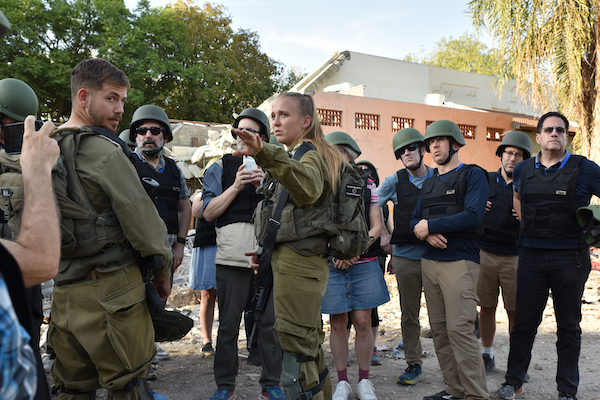
On Oct. 31, among the ruins of Kibbutz Be’eri, Israel Defence Forces personnel brief a delegation of Conservative rabbis and lay leaders from the United States, Canada and Britain, which was on a three-day solidarity mission organized by the Fuchsberg Jerusalem Centre. (photo by Boaz Pearlstein)

WARNING: Extremely graphic reporting.

Since Hamas’s Oct. 7 cross-border assault on multiple army bases, kibbutzim, cities and a music festival in the Gaza Strip periphery, staff at the Israel Defence Forces’ Shura base have been working around the clock to identify the remains of the 1,100 civilians and 315 IDF soldiers, reservists and police officers massacred by jihadi terrorists. With so many bodies, the victims were initially kept in refrigerated milk trucks in the morgue’s parking lot. Plain wooden coffins are stacked in the corridors, waiting for a positive identification so the remains may be released to their families for burial at a military or civilian cemetery. Only then can Judaism’s seven-day period of mourning begin.

A month on, the sickly smell of death lingers. Pathologists at this normally quiet IDF logistics centre and home base of the military rabbinate corps – located on the outskirts of Ramla, a mixed Jewish-Arab city not far from Ben-Gurion Airport – continue their painstaking, harrowing but holy forensic mission.

Dismembered limbs and badly decomposed bodies continue to be delivered. The human remains are sniffed out under the rubble of destroyed buildings by IDF canine units, staff told a 33-person Oct. 31 delegation of Conservative rabbis and lay leaders from the United States, Canada and Britain.

Initially, it is often impossible to determine if the remains are those of victims or perpetrators, Col. Rabbi Haim Weisberg, head of the IDF’s rabbinic division, told the religious leaders. Many are mutilated with limbs and heads dismembered, making the ghoulish jigsaw puzzle even more complex.

“We are in an abnormal situation and that is why it is taking so much time to identify the bodies. In most cases, we have had to identify people via deep tissue DNA or dental records because there is nothing left,” he explained.

The complex identification process has been compounded because so many of the victims were not Israeli residents.

Pathologists can take several hours to assess a body, photograph it and document the fatal wounds. Out of respect for the dead and their families, the IDF is not releasing those photos.

Weisberg spoke not only about whole bodies but also about charred and incomplete remains, including what in one case turned out to be a corpse so severely burned that only a CT scan revealed it was a mother and baby bound together in a final embrace.

The grisly job is complicated by uncertainty over the tally of victims. According to constantly updated data from the IDF, more than 1,400 Israelis and foreigners were murdered. Some 238 people are believed to be held hostage by Hamas inside the Gaza Strip and the fate of dozens of others is unknown. Some may be held inside Gaza by other terrorist groups, like Palestinian Islamic Jihad, or even by individuals. Others may still be among the dead, yet to be identified by the staff at Shura.

When drafted, all IDF recruits provide samples of their DNA and fingerprints, and have their teeth X-rayed. The army does not rely exclusively on identification made through a soldier’s twin dog tags kept in their combat boots and worn on a chain around the neck.

According to halachah (Jewish law), fallen soldiers are buried in a coffin in their blood-soaked uniform. They are not ritually washed in the tahara ceremony – the Jewish tradition of purification of the dead – nor are they wrapped in shrouds. The intention is that God should be angered by witnessing the fallen defenders among his Chosen People. Personal effects like a cellphone, watch or wallet are washed of blood and then returned to the family of the deceased. Artifacts that cannot be cleansed of blood are buried with the deceased.

By contrast, civilian dead are ritually washed and wrapped in shrouds. Generally, in Israel, they are interred directly in the ground without a coffin.

While dental records can allow straightforward identification of dead soldiers, that information is often unavailable for civilians. Many dental offices in the city of Sderot near Gaza were destroyed, and with them their files.

Ritual washing is tasked to male and female reservists who have volunteered for the mitzvah (commandment) of chesed shel emet (true kindness).

Women soldiers perform tahara for the hundreds of girls and women who were murdered. The team is working in shifts around the clock. Among them is Shari, an architect living in Jerusalem whose surname may not be released under IDF security regulations. She volunteered for the unit when it was established more than a decade ago to ensure that the modesty of female recruits killed in action was protected.

“We saw evidence of rape … and this was also among grandmothers down to small children,” she stated.

Shari said she and the other volunteers received specialized training from the IDF, which prepared them practically and mentally to care for the bodies of the dead. Until Oct. 7, she had not been called for active duty.

“I’ve seen things with my own eyes that no one should ever see,” she said, describing how she took care of the dead women. Many were still dressed in their pajamas. Their bodies had been booby-trapped with grenades, and the remains bore evidence of extreme brutality.

Shari’s duties begin with opening the body bags to remove the dead person’s clothes, jewelry and any other personal possessions in order to return them to the families.

“The only colour among the blood and dirt was their nails, beautiful manicures, painted the brightest colours,” Shari said, adding, “Their nails made me weep.”

“We gathered this group of 33 Jewish communal leaders from across North America to witness the horrors our brothers and sisters have suffered,” said Dr. Stephen Daniel Arnoff, chief executive officer of the Fuchsberg Jerusalem Centre – a home for Conservative and Masorti Judaism in Israel, which organized the three-day solidarity mission. Located in Jerusalem, the centre offers opportunities to study, pray and explore within an egalitarian and inclusive setting, creating multiple pathways for finding personal and communal meaning.

The solidarity group included the first civilians to tour the devastated remains of Kibbutz Be’eri, where terrorists went house to house slaughtering the inhabitants. Wearing flak vests and helmets, the clergy and communal leaders recited the El Male Rachamim and Kaddish prayers for the dead as soldiers continued their search for human remains.

“We literally saw the blood of our people crying out to us from the ground,” said Arnoff.

“It is our moral obligation to make sure that the world knows what happened there.”

Gil Zohar is a writer and tour guide in Jerusalem.

Tidbits about life now

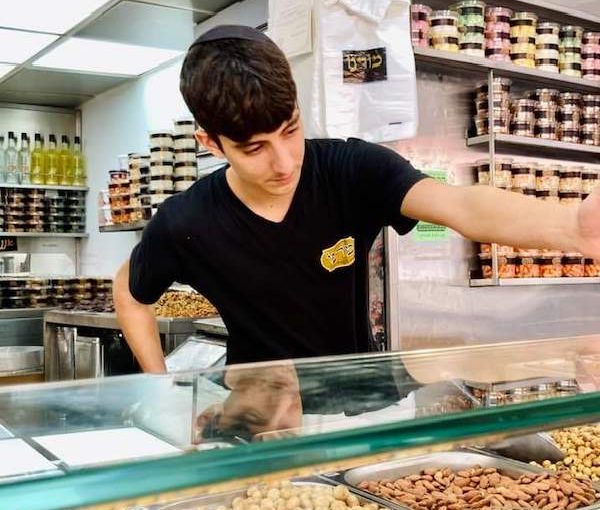
Teenagers are filling in for drafted reservists at Jerusalem’s Machane Yehuda market. (photo by Gil Zohar)

With the horrors of Oct. 7 embedded in our minds, in our hearts and in our souls, Israel has come together in so many ways, including for war. The effects are so broad and deep. Here is a bird’s-eye view from my narrow perch.

  • All the booms in the air, coming from far-off (and not-so-far-off) mid-air missile collisions – bravo Iron Dome! The swoosh of our fighter jets overhead – bravo Israeli Air Force! And all those customized Red Alert apps buzzing away on everyone’s cellphones – bravo Elad Nava, tech entrepreneur extraordinaire! It’s starting to sound like an orchestra out there.
  • Social media was calling for Israelis to sing, to go out on our patios at 9 p.m. and belt out Hatikvah. We did. And it felt great! So darn cathartic. What a sense of solidarity. As it turns out, on this particular evening, Hamas warned Tel Aviv of a missile barrage at 9 p.m. Guess our singing acted as type of musical Iron Dome, as no barrage arrived. Which is not to say Tel Aviv hasn’t had its share of missiles, just not at this particular time.
  • Driving to work, traffic slowed down considerably due to some “jackass” up ahead. Turned out to be a convoy of military jeeps carrying weapons and personnel to our north. As I passed them – 12 vehicles – I slowed down (in the left lane), gave a friendly honk and a thumbs up to each. Twelve times. Cars behind me did the same.
  • With 75 seconds to reach our safe room and with missile attacks being random with no real pattern, the stress and uncertainty prevents me from enjoying my private bathroom time, sitting down with a newspaper or book or my smartphone. But not under current circumstances. Just want to get in and out of there as quickly as I can..
  • Same for showering. No more basking under a warm spray of fresh water. No more humming a few showtunes while lathering up. Nope. Just a quick soaping and get out of there. For shaving, I’m getting use to a three-day growth cycle.
  • And, getting really personal … in the bedroom with the wife, I am now suffering reverse performance anxiety. I just get it done and move on. Don’t want to get caught with my pants down when the sirens sound.
  • Bravo to McDonald’s – giving McHappy meals free of charge to our soldiers. The restaurant stepped up, and many businesses are doing the same. From banks, to other restaurants, to retailers, providing goods or services at discounted prices to relieve some of the burden weighing on the country. Wonderful to see this coming together.
  • I miss my exercise routine. Was swimming a couple time a week. Now, not. The pool closed due to homeland security restrictions limiting gatherings at places of leisure. Who would categorize exercise as leisure? Anyway, I don’t think I’d hear the missile alert with my head bobbing in and out of the water while doing the breaststroke or front crawl. More so, there’s no running along the poolside, so would not make the saferoom in time.
  • We are not immune to panic buying. A few nights into the war, based on some rumour or other, I went grocery shopping to stock up on water, canned goods, candles, matches, toilet paper…. Didn’t get out of there until almost 11 p.m. The checkout line snaked all the way to the meat section. It was long, the joke being that, by the time we reach the checkout counter, Netanyahu will have negotiated a hudna (truce in Arabic). Ha.
  • I keep saying I’ll do it. Need to put more than just a half dozen bottled waters and a few inhalers in our safe room. Should stock it with canned goods, more medicine, flashlight, battery-powered radio and other survival aids. Maybe tomorrow.
  • If someone forgets their house key and knocks at our now always-locked door, they need to say a password before we’ll open the door. The theory being, if a Hamas terrorist is holding a gun to their head, they won’t say the password. Talk about paranoid. Probably run-of-the-mill war-related stress.
  • Joe Biden. His Oct. 11 “Don’t” speech was amazing! Talk about geopolitical alliances, commitments, pacts, and the such – I won’t. I’ll simply say I fell in love that evening.
  • Joe Biden. His Oct. 18 “We’ve got your back” speech was TREMENDOUS! I fell in love with him. Again. With a lightning visit to Israel, he kind of reminded me of Clint Eastwood in his glory days. He had that “make my day” squint in his eyes. Might have been him struggling to read the monitor, but he came across as a Dirty Harry kind of guy.
  • There are still a handful of Israelis – OK, maybe more than a handful – who just don’t get it. Now is not the time for divisiveness and finger pointing. There was utter failure. But the hard questions and difficult answers will come later. Now is the time for unity!
  • My wife and daughter volunteered at a high-end event (my wife works in the industry) to help arrange 1,000+ meals for our soldiers. There will be some very satiated soldiers enjoying gourmet meals in cardboard boxes and with disposable utensils.
  • And the sweet smell of my wife’s chocolate chip cookies and brownies baking in the kitchen. She slaps my hand as I go for a cookie: “Not for you! For our soldiers.” It’s that spirit of coming together.
  • My daughter left the house early the other morning and returned about an hour later with a huge orange garbage bag full of…. “What’s that?” I inquired. “Laundry. From a family in the south who was evacuated to some hotel. Mom volunteered.” As much as we get preoccupied with the war, with survival, sometimes it’s the mundane that really makes a difference.
  • Ouch. Our currency at its weakest since 2015. Pretty painful when you are sending US dollar instalments to your son studying in the States.
  • I know the diaspora is busy raising money for Israel at speeds and amounts like never before. But don’t stop once you give. Give more. This war will cost Israel billions. If you have given, please give again. Sderot is Israel’s front line. Israel is the diaspora’s front line.

Bruce Brown is a Canadian and an Israeli. He made aliyah … a long time ago. He works in Israel’s high-tech sector by day and, in spurts, is a somewhat inspired writer by night. Brown is the winner of the 2019 AJPA Rockower Award for excellence in writing, and wrote the 1998 satire An Israeli is…. Brown reflects on life in Israel – political, social, economic and personal.

Tensions at university

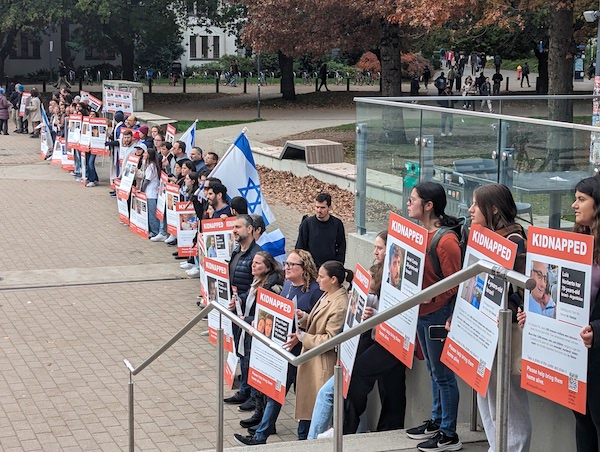
On Nov. 1, about 200 Jewish students and their supporters engaged in a low-key demonstration, with many holding posters of kidnapped Israelis. (photo by Pat Johnson)

When the new president of the University of British Columbia arrived for his first day on the job Nov. 1, he already had a full plate, including a 9 a.m. meeting with Jewish representatives and an urgent letter from community organizations expressing concerns about the safety of Jewish students on campus.

Dr. Benoit-Antoine Bacon starts his tenure at a contentious time, as Jewish, pro-Israel, anti-Israel and other students engage, sometimes constructively but often much less so, with events taking place in the Middle East.

Rob Philipp, executive director of Hillel BC, was joined by his assistant executive director, Ohad Gavrieli, and Nico Slobinsky, Pacific region vice-president for the Centre for Israel and Jewish Affairs, at the meeting with Bacon. Afterward, Philipp told the Independent the university has been on the right track but needs guidance.

“Generally speaking, I would say UBC has been very supportive of us, to the best of their ability,” he said, noting that Bacon’s welcoming of Jewish representatives is a good sign. “I had one of the very first meetings with him, so that speaks to how important this is on their radar.”

The university administration has been “somewhat consistent,” said Philipp.

“We are seeing support,” he said. “We don’t always see the right action, so that’s where we have to help and guide them.”

The larger issues, he said, are the serious affronts to civility on campus during the weeks since the start of the war between Israel and Hamas.

“There are so many red lines being crossed right now, it’s incredible,” said Philipp. “It seems OK now to kill civilians, to murder people for the ‘just’ cause and it keeps spilling over. People aren’t always understanding the details behind it all, so it’s as difficult a time as I have ever seen in this community – and it’s not just UBC, it’s all the university campuses all over North America.”

Hours after the meeting with the university president, about 200 Jewish students and their supporters engaged in a low-key demonstration, walking from Hillel House to the student union building, with many marchers holding posters of kidnapped Israelis. A student entered the building to deliver a letter to the president of the student government, the Alma Mater Society, expressing the group’s collective concerns. An emailed response to the letter from the AMS president was characterized by Hillel officials as positive.

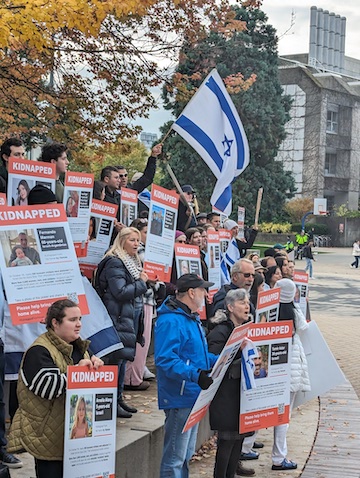
photo - Jewish students and their supporters at the University of British Columbia on Nov. 1
Jewish students and their supporters at the University of British Columbia on Nov. 1. (photo by Pat Johnson)

A Jewish student leader from Simon Fraser University who asked that her name not be published said she came to the rally to protest the antisemitism in the world and, specifically, the lack of regard among student bodies to recognize what happened in Israel.

“It’s an extremely complex conflict that isn’t just black-and-white and I wish people would pay more attention or just seek a more nuanced view on the subject,” she said, adding that the climate at Simon Fraser does not seem as negative as at UBC, but that could change. In the last couple of years, the student government at SFU has demonstrated unbalanced, anti-Israel approaches, including adopting a motion on Israel and Palestine for which they consulted what the student called “tokenized [Jewish] fringe groups” while excluding Hillel and other mainstream Jewish voices.

Other participants at the rally said they felt the need to attend to be seen, and to register empathy with Israelis overseas and with Jewish students in Canada.

“We are here today so UBC acknowledges what’s going on in Israel – the kidnapped kids, elderly, children, women, Israelis – and what happened on Oct. 7,” said a 21-year-old Israeli-born woman who is not a student but came to support her brother, who is.

“I’m feeling very alone and feeling a lack of empathy and sympathy with what’s going on in Israel, feeling like people are too quick to comment sometimes,” she added.

Several non-Jewish students participated in the rally.

“I’m here because even though I’m not Jewish, I have a lot of Jewish friends and I believe the Hamas attacks against Israel are terrorism,” said fourth-year political science student Joe Latam. “The university’s attitude towards these literal terrorist organizations has been completely inadequate and they need to take better action.… The Jewish people have been systematically discriminated against for thousands of years and Israel is the one place where they can feel safe.”

Zara Nybo, who is also not Jewish, was motivated in part because her partner is Jewish and she sees the impact of events on him and his family.

“It’s important for me to stand up against terrorism and help spread the word that there are still innocent hostages who have been taken out of their home country,” she said. “We see a lot on the news that is politicized and very emotionally heartbreaking. I’m not here to say that Palestinian citizens have not died in this war, but I am here to say that death is death and we need to be able to recognize that heartbreak is heartbreak, so we are all here together.”

A first-year student who is Sikh called statements he has seen from peers and student leaders “frankly shameful.”

“I think there are many international students here that have been espousing hate, that have been espousing terrorist beliefs,” he said. “They have been saying they are pro-Hamas, they are saying [the Oct. 7 attacks were] a ‘beautiful act of resistance.’ I think we should double-check whether they deserve to be students at our wonderful university institutions.”

Bar Wolpert, an Israeli doing a one-semester landscape architecture exchange at UBC, said he was accosted by someone who tried to “shame” him as an Israeli.

“He just approached me out of the blue,” said Wolpert. “He was [aiming] his camera in front of my face.”

The person asked Wolpert if he supports “genocide.”

“I’m holding a [poster of a] kidnapped woman,” he said. “I am Israeli. I have a loss. So, please, first, respect my loss, respect my grief. And we are all standing here with many signs of kidnapped people and dead people, that is what is mattering for us right now, so before you are attacking me, respect my loss.”

Also at the rally were two brothers, Israeli high school students, whose parents sent them to stay with Canadian friends and family during the conflict.

A mother, walking with her young adult daughter, teared up when she realized that the poster she was carrying of a 21-year-old French-Israeli hostage could have been her own daughter.

“I can understand the pain,” said Evelyn Fichmann. “I think anybody can understand the pain.”

As he walked alongside scores of Jewish students and allies, a UBC student said the event gave him much-needed optimism.

“It really gave me some hope about unity,” he said.

A call for toughness

Rabbi Dr. Michael Berenbaum spoke at Congregation Schara Tzedeck on Nov. 5. He said: “We can’t raise a generation that is scared of being Jewish.” (photo from kolotmanagement.com)

The mood at Congregation Schara Tzedeck was solemn Sunday night, Nov. 5, when parents, grandparents and students from the Jewish community gathered to listen to Rabbi Dr. Michael Berenbaum, an American professor who is considered one of the world’s preeminent Holocaust scholars. Berenbaum came to discuss the importance of campus conversations, and specifically how to handle the critics of Israel who are voicing their support of Palestinians vociferously on college campuses throughout Canada and the United States.

Until the Oct. 7 terror attacks, Berenbaum said, our children had never known serious difficulty as Jews. “They’ve had the privilege of living in the greatest time to be Jewish, maybe in the history of the Jewish people,” he said. “Now, we’re asking our kids to toughen up, because they’re now going to face difficulty, pain, anguish and danger – physical or intellectual – for being Jews. This is our test of the hour, and it comes with the shattering of easily held assumptions about Jewish life.”

The Oct. 7 pogrom, he said, was worse than the 1906 Kishinev pogrom and worse than Kristallnacht in 1938 in terms of the number of Jews killed and the vehemence with which they were killed. “We believed Israel was founded to protect its people from these pogroms, and yet we were not safe.”

Berenbaum said it is crucial for Jewish students to be armed with accurate knowledge so they can counter the anti-Israel rhetoric they hear on campus. That means refuting claims that Israel is committing genocide. “Understand that this is war, and it has both direct and collateral consequences,” he said. “You cannot deal with war at this point without significant civilian casualties. While Israel is taking significant steps to avoid that, it’s unavoidable.” He noted that, since March 2011, the conflict in Syria has claimed the lives of 500,000 people – “and the rest of the world has heard nothing about this.”

On the claim that Israel is “occupying Gaza,” he clarified that Israel left Gaza in 2005, displacing 8,000 settlers so that Gazans would take control of their lives. “Israel is the only country in the world who has sacrificed land for normalization. We gave up Sinai for normalization with Egypt, and the reason the invasion happened now was because it appeared Saudi Arabia would establish a certain kind of peace with Israel,” he said. “Normalization represented a danger to the lateral forces in the region and that’s why this broke out now.”

On the claim that “Jews are colonizers,” he noted that Jews have never forsaken their connection to the land of Israel, and that there have been five cities with a permanent Jewish settlement in Israel. “When they came to Israel, they settled and worked the land, which is the opposite of colonization,” he said. “They didn’t take its resources and export it elsewhere.”

He noted that Palestinians were offered a state in 2000 and again in 2006, and they turned both opportunities down. “The Palestinians have never lost an opportunity to lose an opportunity, because their leadership is weak and corrupt,” he said.

There are a few things we can do now to ensure we are strong, he continued. One is to educate ourselves on the history of the state of Israel and Zionism. Another is to ensure we have solidarity by reaching out to one another.

 “These are not easy times and we need Jewish toughness and resilience,” said Berenbaum. “We can’t raise a generation that is scared of being Jewish. I want our Jewish students to be proud, tough and confident enough to accept the animus that will come their way, but to have the human capacity to respond to it.”

He ended his talk by calling Jews the “canary in the coalmine. You want to know if a society is healthy? See how it treats its Jews. We’re living in a world that’s fundamentally unhealthy, but it’s important to remember that we have many friends, we are not alone. We have to cultivate and respect those friendships, and not take them for granted.”

The events of Oct. 7 precipitated an earthquake, he added, “and the ground won’t settle for awhile. But earthquakes give the opportunity to build in a different way. We are in for a tough and difficult time, which will demand the best of us. But I fundamentally believe we have it in us to rise to the occasion.”

Lauren Kramer, an award-winning writer and editor, lives in Richmond.

Under the bed, in the closet

If you’ve ever seen the movie Monsters, Inc. or its sequels, you may have an immediate visual image of what the craziest monsters look like when kids imagine what’s under the bed or in the closet. A few weeks ago, I started approaching this when we essentially moved. To clarify, we moved into our “new” house, built in 1913, more than a year ago. However, we’d all camped out in temporary spaces on the third floor while there were renovations done to the first and second floors.

We weren’t making cosmetic updates, these were basic needs like bathrooms that worked, a kitchen with heat, and other essentials. Turns out that, after more than 100 years and some poorly done, decades-old renovation choices along the way, it’s a good idea to have things fixed and updated – insulation and asbestos removal, new plumbing and safe wiring, too. We had scheduled our big “move” to the renovated second floor bedrooms for the Simchat Torah/Thanksgiving weekend. We would have had three days to manage the chaos. Little did we know that Hamas scheduled its horrific Israeli invasion and massacre for the same weekend.

Fueled by anxiety and a looming school and work deadline, we moved all four of us and dog beds downstairs. We set up kids’ clothes areas and adults’ nightstands, while we parents furtively looked at increasingly upsetting news online. I’ll probably always remember this moment in our Canadian character home renovation as when this massacre and the war against Hamas started.

We cleaned up the nearly vacated third floor, then set it up sufficiently to host another family who was visiting town the very next weekend. During the visit, we walked them over to see the Manitoba Legislature grounds while monitoring when each pro-Palestinian/anti-Israel rally might occur. There have been several now in Winnipeg, complete with pro-Israel counter-protests, with conflicts that required police intervention. We kept plowing forward amid the nightmare of the news.

Like many other places, Winnipeg has experienced acts of antisemitism. Some of it hit us personally. There was graffiti that my kids reported at middle school, and some of the bigger incidents have happened nearby or to people we know.

Like many other people have experienced, there are times when I have felt paralyzed and isolated by the overwhelming nature of the conflict. I am miserable about the loss of life, the impossibility of Israel’s situation, the fear for the hostages amid the knowledge that Hamas broke a ceasefire when it attacked Oct. 7, and that a ceasefire alone will not resolve this situation. I cannot bear the news. I also cannot look away.

The hardest task of this latest move has been the one where we open any closet door. I am still cleaning up boxes of belongings we have stored for more than a year. Things fall on me and surprise me. The worst part is the fear, the moment when the unknown jumps out at us and causes panic. Even if the box is labeled or the animated monster is in a movie, our startle instincts still cause fear when the unexpected and awful occurs.

When my kids told me about the hateful words on the test-taking dividers in math class, I didn’t feel afraid, but purposeful and angry. I wrote the teachers to report the situation and acted promptly. Within a few hours, the physical issue was addressed. The graffiti may be gone, but out there, some kid is still capable of writing more hate or worse.

Making lists, doing constructive activities – whether they are our daily obligations, additional volunteer efforts, or taking on new mitzvot (commandments) or prayers – may make us feel stronger. Also, in Mr. Rogers’ words, we can “look for the helpers.” We can ask for support from friends, neighbours, teachers, and others. We stay alert to the dangers and also strengthen ourselves with steps to make change during an incredibly difficult time.

There are lists on social media of how to protect our mental health and warnings for how to be proactive about protecting ourselves further. While this feels like new territory for us, it is, in fact, an ancient path. The prayer we use is the most compassionate call to free captives, and it begins with “Acheinu,”  “our brothers.” Old-fashioned translations call it our “brethren.” We pray for Israel, for those in captivity, and for the soldiers, too. For those who feel this leaves something out, remember that our tradition is one of shalom, peace. We pray for peace at every turn in our religious services. We’re not praying for any innocent person’s death.

I can’t say we’re all tidied up at our house and that everything has found its proper place. Daily, I discover items that we put away and then lost during this renovation and life transition. The metaphor extends to this difficult period as Jews in Israel and the diaspora. We’re not in a good place. We need to manage a truly dangerous situation. We’re losing things. Scary things surprise us. The unknown at the back of the closet is terrifying and is a living nightmare for many.

Let’s pray, if you’re the praying sort – or hope, if you’re not – for peace, for safety, for the return of captives and for the strength of those who fight on our behalf, in Israel and elsewhere in the world. Also, make yourself a list. Figure out how you’re going to get through this time. Try and focus on the light. I’m going to keep emptying moving boxes, too.

Joanne Seiff has written regularly for CBC Manitoba and various Jewish publications. She is the author of three books, including From the Outside In: Jewish Post Columns 2015-2016, a collection of essays available for digital download or as a paperback from Amazon. Check her out on Instagram @yrnspinner or at joanneseiff.blogspot.com.