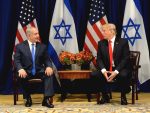
Many good things happened

Prime Minister Binyamin Netanyahu presents the nuclear secrets of Iran at a special press briefing in Jerusalem on April 30, 2018. (photo from IGPO courtesy Ashernet)

It has been a year of diplomatic success for Israel, as more countries upgraded their relations with the Jewish state. This took, in general, two forms: heads of government making an official visit to Israel or Prime Minister Binyamin Netanyahu visiting other countries; and the establishment of the embassies of the United States, Guatemala and Panama in Jerusalem, Israel’s capital.
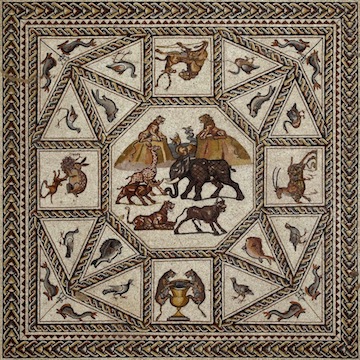
photo - The newly discovered Lod mosaic.
The newly discovered Lod mosaic. (photo from IGPO courtesy Ashernet)

In April, at a special press conference hosted by Netanyahu, the world learned of the secret storage facilities in Iran that housed Iran’s nuclear ambitions. It is not known exactly how Israel managed to find out the location of the files, or how they were copied and brought back to Israel, but the revelations served Israel well, and the files were instrumental in making the United States renege on the nuclear agreement that President Barack Obama had made with the Iranian regime.

It was a long, hot summer in more ways than one. The latest form of terrorist aggravation was for Gazans to assemble in the thousands along the Gaza-Israel border and launch kites and balloons to which were attached flaming torches that set fire to forests and agricultural fields in Israel, causing uncountable damage and destruction. A variation of this procedure was for terrorists to attach flaming torches to lines attached to the legs of kestrels who managed to survive long enough to set trees alight in Israeli forests near the border.
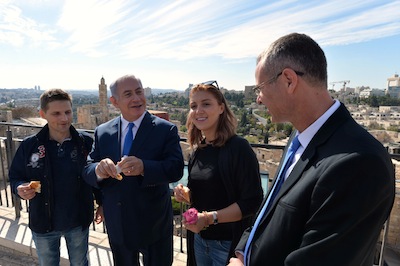
photo - In November last year, the three millionth tourist of 2017 arrived in Israel. He and his partner were shown around Jerusalem’s Tower of David Museum by Prime Minister Binyamin Netanyahu
In November last year, the three millionth tourist of 2017 arrived in Israel. He and his partner were shown around Jerusalem’s Tower of David Museum by Prime Minister Binyamin Netanyahu. (photo from IGPO courtesy Ashernet)

In better news, this year Israel became the focus of the world’s cycling fraternity. Due to the generosity of Israeli-Canadian billionaire Sylvan Adams, one of the three most important annual cycling races in the world, the Giro d’Italia, started in Jerusalem with a time trial and then took the cyclists from Haifa to Tel Aviv, with a third stage from Be’er Sheva to Eilat. All this was made possible by an $80 million donation to the federation organizing the event. It was one of the biggest sporting events ever staged in Israel and was seen by tens of thousands on television around the world.

The Jewish year opened with the announcement that one of the most outstanding mosaics ever found in Israel, from the Roman era, was going to be incorporated in a new museum in the city of Lod, where it had been found during preparations for building works. This beautiful mosaic was one of many important archeological finds in Israel in the past 12 months.
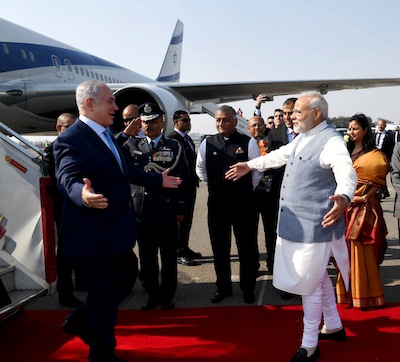
photo - Prime Minister Binyamin Netanyahu is welcomed by Indian Prime Minister Narendra Modi in New Delhi in January 2018.
Prime Minister Binyamin Netanyahu is welcomed by Indian Prime Minister Narendra Modi in New Delhi in January 2018. (photo from IGPO courtesy Ashernet)

Also at the start of the Jewish year, tourism in Israel hit a new high, with the three millionth tourist of 2017 arriving at Ben-Gurion International Airport in November. And, this summer, Prince William made an official visit to Israel, where he was received by President Reuven Rivlin and Netanyahu. Members of the British Royal family have been to Israel before, but never on an official visit.

As always, Israeli technology, universities and medical prowess was remarkable over the year. And, when natural disasters occurred around the world, such as earthquakes and floods, Israel was among the first to send aid.

Not all the news was good for Netanyahu, who, for a major part of the year, was being investigated and questioned by Israel Police for allegedly obtaining inappropriate large-scale benefits from businessmen – charges Netanyahu strenuously denied. Ari Harrow, Netanyahu’s former chief of staff, signed a deal to become a state witness to testify against the prime minister.
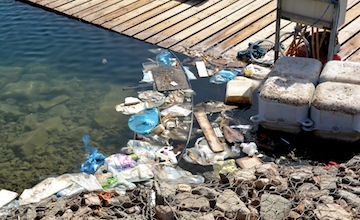
photo - Plastic waste accumulates in an inlet along Eilat’s Red Sea coast. A worldwide problem, much is being done in Israel to manage the correct disposal of plastic, paper and glass
Plastic waste accumulates in an inlet along Eilat’s Red Sea coast. A worldwide problem, much is being done in Israel to manage the correct disposal of plastic, paper and glass. (photo from IGPO courtesy Ashernet)

The Jewish year also saw Netanyahu’s wife Sara receiving a lot of negative press. In the previous year, the Jerusalem Labour Court awarded an employee of Sara Netanyahu’s the sum of $46,000 as he claimed that she had been abusive towards him and withheld wages at times. While she appealed the ruling, it was turned down. She is now being investigated for allegedly ordering expensive meals at the prime minister’s official Jerusalem residence at government expense, despite the fact that the prime minister’s official residence employed a cook. She refutes the accusations.

Despite these problems, Binyamin Netanyahu maintains a high international profile – he has the ear of presidents Donald Trump and Vladimir Putin, for example.
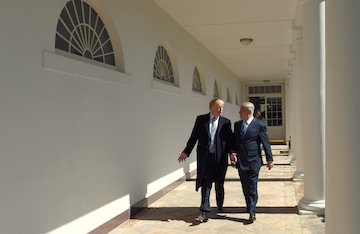
photo - U.S. President Donald Trump and Prime Minister Binyamin Netanyahu at the White House in January 2018
U.S. President Donald Trump and Prime Minister Binyamin Netanyahu at the White House in January 2018. (photo from IGPO courtesy Ashernet)

As 5778 closes, Israel has the pleasurable problem of deciding how best to market the huge natural gas finds that are presently churning about below the waves of the Mediterranean Sea, well within Israel’s exclusive continental shelf.
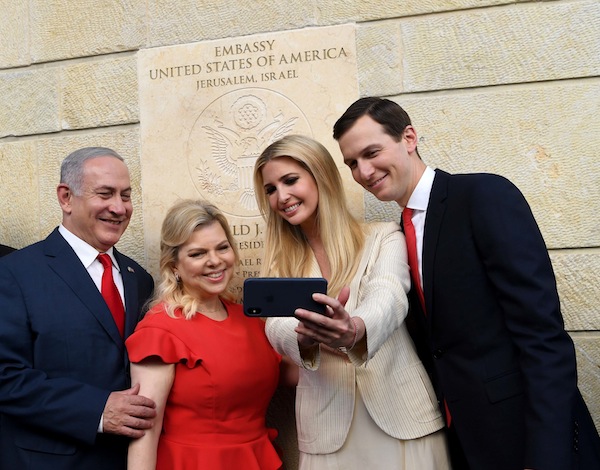
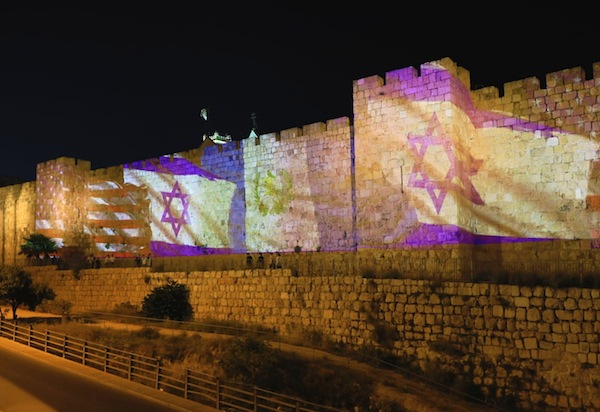
 

photo - Left to right: Prime Minister Binyamin Netanyahu, Sara Netanyahu, Ivanka Trump and Jared Kushner at the opening of the U.S. embassy in Jerusalem
Left to right: Prime Minister Binyamin Netanyahu, Sara Netanyahu, Ivanka Trump and Jared Kushner at the opening of the U.S. embassy in Jerusalem. (photo from IGPO courtesy Ashernet)
photo - The Guatemalan flag is projected on Jerusalem’s Old City walls in anticipation of Guatemala moving its embassy from Tel Aviv to Jerusalem
The Guatemalan flag is projected on Jerusalem’s Old City walls in anticipation of Guatemala moving its embassy from Tel Aviv to Jerusalem. (photo from IGPO courtesy Ashernet)
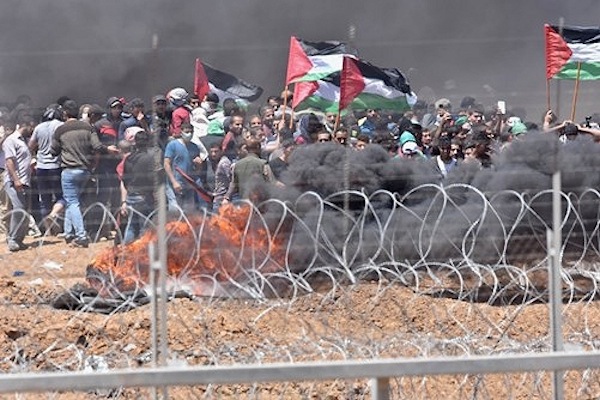
photo - Violence along the Gaza border
Violence along the Gaza border. (photo from IGPO courtesy Ashernet)
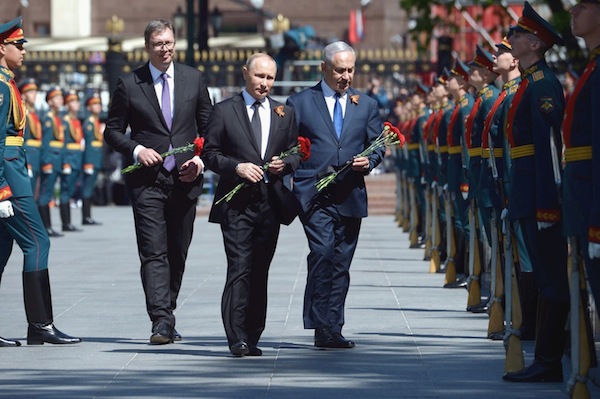
photo - Prime Minister Binyamin Netanyahu and Russian President Vladimir Putin in Moscow
Prime Minister Binyamin Netanyahu and Russian President Vladimir Putin in Moscow. (photo from IGPO courtesy Ashernet)
photo - The Giro d’Italia time trials in Jerusalem
The Giro d’Italia time trials in Jerusalem. (photo from IGPO courtesy Ashernet)
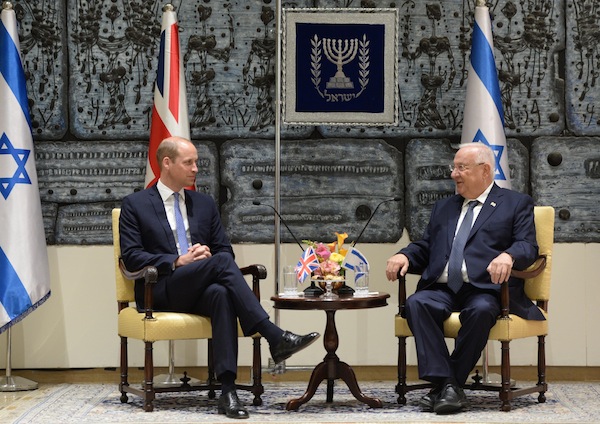
photo - Prince William and President Reuven Rivlin in Jerusalem
Prince William and President Reuven Rivlin in Jerusalem. (photo from IGPO courtesy Ashernet)

Israel’s 70th

(photo from Ashernet)

Israeli Prime Minister Binyamin Netanyahu addressed a special meeting of the Israeli cabinet in Independence Hall in Tel Aviv on April 20 in honour of the 70th anniversary of the proclamation of the modern state by Israel’s first prime minister, David Ben-Gurion. Plans are to restore Independence Hall and turn it into a museum, where the Declaration of Independence will be displayed publicly for the first time. The document is currently stored at the State Archive in Jerusalem.

Challenges in Mideast

The Russia- and Iran-backed Assad regime in Syria employed chemical weapons against its own citizens again last week. It’s hard to imagine that the atrocities in Syria could be any worse. Indeed, it is chilling to imagine what Syrian forces would be doing right now had Israel not neutralized that country’s nuclear capabilities in 2007.

Despite the horrific images coming out of Syria, much of the world’s attention, including that of the United Nations, was focused on Israel’s response to rallies on the Gaza border. It was striking to hear the outrage about Israel’s reaction to the Gaza events while a few hundred kilometres away the most atrocious acts were being perpetrated on a people by their own government. That said, the loss of life in Gaza is startling and we hope that the Israel Defence Forces can find non-lethal ways to defend against the protesters.

At the same time, it has been difficult not to be frustrated about the placement of blame. Portrayed by apologists as a peaceful rally – the so-called March for Return – the Friday events, for the second consecutive week, were a violent assault on the Israeli border. The planned action featured Gazans burning hundreds of tires in order to obscure the visibility of IDF soldiers. While tallying up the number of dead – 26 have been killed, according to the Associated Press Monday – it’s clear that the associations of some of the dead have been lost on most audiences, as at least 10 have been reported to be known combatants in the al-Aqsa Martyrs’ Brigade, Islamic Jihad and Hamas’ terrorist wings.

On Friday, the leader of Hamas in the Gaza Strip, Yehya Al-Sinwar, was employing what outside observers will likely dismiss as flowery rhetoric for domestic audiences when he exclaimed on Al-Jazeera that “We will take down the border [with Israel] and tear out their hearts from their bodies.”

Whether the actions of the IDF are deemed justified, the Diaspora community must continue to press for a non-military solution where possible and demand that the IDF remain restrained when demonstrators are unarmed. With a video surfacing that allegedly shows an IDF sniper shooting an unarmed Palestinian man while other soldiers cheer, there are calls for an investigation within Israel from across the political spectrum. As one Israeli politician said in the Times of Israel, “The battle isn’t just between us and Hamas; it is also for ourselves, for our values and for the identity of Israel society.”

It was, however, a leading figure in the Fatah government of Mahmoud Abbas, which runs the West Bank, who pointed out what should be obvious to the world. Dr. Mahmoud Habbash, a supreme judge in the Palestinian Authority Islamic court and Abbas’s adviser on religious and Islamic affairs, accused Hamas of “trading in suffering and blood, trading in victims” to get sympathetic headlines worldwide.

It seems to be working. “Solidarity” marches around the world included chants of “From the river to the sea, Palestine will soon be free.”

Against this backdrop, it may seem odd to raise the issue of Israel’s treatment of African refugees. As a Jewish newspaper, we feel it is our obligation to defend Israel from unjust accusations and attacks, and it is our duty also to condemn actions by Israeli governments or others that betray what we believe to be the just course.

Last week’s flip-flop by Prime Minister Binyamin Netanyahu was a disgrace and an insult to the values on which Israel prides itself.

A week ago Monday, Netanyahu announced an agreement with a United Nations refugee agency to alleviate a conflict about what to do with 38,000 African asylum-seekers currently in legal limbo in Israel by relocating about half of them to Western countries, including Canada. The next day, after getting pushback from right-wing members of his coalition and some aggressive residents of south Tel Aviv (where most of the migrants live) who want few or no migrants to remain in Israel, the prime minister reneged on the deal, seeking again to eject all 38,000.

As we have said in this space previously, it is ludicrous to suggest that 38,000 Africans – or half that – threaten the Jewish nature of the state. Neither, contrary to Netanyahu’s allegations, would the acceptance of these refugees – who fled violence and war – create a precedent.

If Israel wants to create a situation where it can avoid unwanted refugees while ensuring that it meets the obligations of a democratic state, it must develop the systems to appropriately adjudicate refugee claims. At present, situations like this – affecting the lives of 38,000 individuals – are being addressed arbitrarily and inappropriately. Israel, like Canada, Germany and other democracies, needs to have a standard by which the world’s homeless, who happen to find temporary refuge within its borders, are assessed and treated fairly within clearly defined legal parameters that recognize both the rights of individual non-citizens and the necessities of Israel, from the perspective of both the security of its citizens and the Jewish nature of the state. These are not incompatible objectives.

There is no shortage of challenges facing the Middle East. The situations in Gaza and Syria seem intractable. The fate of 38,000 migrants should not be so difficult to resolve.

עם או בלי נתניהו

קנדה תקלוט כאלפיים פליטים מישראל. (צילום: Wikimedia Commons)

ראש ממשלת ישראל, בנימין נתניהו, הוכיח שוב כי המדיניות שלו היא לא מדיניות באמת, וכי הוא משנה את דעתו על הזמן. וזאת בהתאם לכיוון שאליו נושבת הרוח. כך גם החלטתו האחרונה לשלוח למעלה משישה עשר אלף פליטים- מסתננים מאפריקה (ממדינות ארתיריה וסודן) שביקשו מקלט בישראל, למספר מדינות במערב. בהן לדבריו גרמניה, איטליה וקנדה. ולטענתו לאחר שכביכול הוא הגיע להסכם עם נציבות הפליטים של האו”ם בנוגע למשלוח המסתננים למדינות אלה, למרות שלהן לא היה ידוע על כך. מענין!

לפי ההסכם עם האו”ם 16,250 מבקשי מקלט מישראל יקלטו במדינות המערב. ישום ההסכם יבוצע בשלושה שלבים ויתפרש על פני חמש שנים תמימות. ובמקביל כ-16,250 מהפליטים יקבלו מעמד חוקי בישראל. הם יפוזרו באופן מאוזן ברחבי ישראל. וכן תוקם אף מינהלה מיוחדת שתעסוק בשיקום אזור דרום תל אביב הרעוע (וזאת על חשבון ההשקעה במתקן חולות לכליאת הפליטים שיסגר).

לאחר הודעתו כי הגיע להסכם ותוך שעות ספורות ביטל נתניהו בעצמו את החלטתו הקודמת, והחליט שלא לשלוח פליטים מישראל למדינות המערב. ומדוע? זאת לאור זעם במפלגות הימין בישראל שהביעו התנגדות נחרצת כי בעקבות החלטת נתניהו להעברת למעלה משישה עשר אלף הפליטים למערב, יקלטו במדינה השאר – כשמונה עשר אלף פליטים-מסתננים.

בקנדה החליטו שלא להמתין להחלטותיו התמוהות של ראש ממשלת ישראל וכיאה למדינה הקולטת כל הזמן הגירה ממדינות מצוקה, הוחלט לקלוט כאלפיים פליטים-מסתננים מישראל. וזאת במהלך עצמאי ללא בקשה של ממשלת ישראל, שהחליטה לפני מספר חודשים לגרש את הפליטים האפריקנים מישראל בחזרה לאפריקה. הארש ז’אסוול, עוזר מיוחד לשר ההגירה, הפליטים והאזרחות של הממשלה הקנדית, אחמד חוסיין, מסר את ההודעה הבאה בנושא: “הממשלה שלנו כבר הוכיחה שהיא מובילה עולמית לקבל בברכה פליטים שנמלטים ממלחמות ורדיפות. ישוב פליטים אלה הוא חלק בהמסורת ההומנטרית הגאה של קנדה. אנו מוכחים שוב כי יש לנו אחריות משותפת לסייע לאלה שנעקרו, שהם נרדפים ומרביתם זקוקים להגנה ועזרה. אנו עוקבים מקרוב אחרי המתרחש בישראל, ונמצאים בקשר ישיר עם ממשלת ישראל. הגענו להסדר עם הרשויות בישראל להשעות את גירושם ומעצרם של פליטים שהגישו בקשה לעבור לקנדה, בעזרת נותני חסויות פרטיות מקנדה – עד לשיושלם הטיפול בעניינם. אנו ממשיכים ביחד עם נותני החסויות הפרטיות שיתכן ובקשותיהם מושפעות ממה שקורה בישראל. נציגות של משרד ההגירה, הפליטים והאזרחות הקנדי בתל אביב, יספק מכתבים למבקשים בקרב הפליטים להגר לקנדה, במסגרת החסויות הפרטיות, כדי לאשר שבקשותיהם נמצאות בהליך של אישור על ידנו. הם יוכלו להציג את המכתבים האלה בפני הרשויות בישראל. נכון לשלושים ואחד בדצמבר אשתקד אנו מטפלים בקרוב לכאלפיים בקשות של פליטים אפריקנים לעבור מישראל לקנדה, כאמור במסגרת נותני חסויות פרטיות מקנדה. וללא קשר במקביל, אנו ממשיכים בהתאם להכרזת ממשלת קנדה, בקליטת כארבעת אלפים פליטים מאריתריה, עד לסוף הנה הנוכחית”.

לדברי סוכנות האו”ם לפליטים השוכנת באוטווה, יש הסכם שקנדה תקלוט השנה לא פחות מכעשרת אלפים פליטים. באופן כללי יתכן שחלקם של פליטים אלה יגיעו אפילו מישראל.

במרכז לענייני ישראל והיהודים בקנדה הזדרזו לברך את שר ההגירה, הפליטים והאזרחות הקנדי, אחמד חוסיין, על הסכמתו כביכול לקלוט פליטים מישראל. במרכז אמרו והוסיפו עוד כי: “ישובם מחדש של מבקשי מקלט מישראל, הוא אתגר בינלאומי המצריך פתרון בינלאומי. ואכן קנדה נטלה על עצמה תפקיד מוביל בנשיאה באחריות הבינלאומית לישובם מחדש”.

This year at Purim

Purim is a time when we play with identities, dress in disguises and revel in deceptions. There is an aspect of great fun to this holiday, and there are lessons that are deeply serious.

One of the timeless aspects of the Jewish calendar is that, while the dates and texts may remain the same – Purim again will start the night of 13 Adar and the Megillah will not have changed – we, the readers, are different than we were last year and the circumstances of the world we live in have changed since our last reading.

As with many Jewish holidays, Purim includes a lesson about the importance of continuity and survival against existential enemies. This is, sadly, an enduring reality.

Just this week, at the annual conference on international security policy, in Munich, Germany, Israel’s Prime Minister Binyamin Netanyahu reiterated the danger posed by Iran’s nuclear program and warned that regime not to underestimate Israel’s resolve in confronting it.

There are other threats, as well, in the form of growing antisemitism among far-right parties in Europe and in the British Labour Party, online and in the number of antisemitic incidents reported in North America and elsewhere.

We are still trying to uncover whether antisemitism played a role in the mass murder of 17 students and teachers at a Parkland, Fla., school last week. The tragedy led a white supremacist group to claim the perpetrator was one of theirs, but, despite being widely reported, this claim has been debunked.

Five of the 17 victims were Jewish – the high school is in an area with a significant Jewish population – and the murderer’s online rantings were teeming with hatred of African-Americans and Jews. In one online chat, he claimed that his birth mother was Jewish and that he was glad he never met her. Per usual, we are engaged in debating what motivated the perpetrator – easy access to guns, mental illness, pure evil or various combinations of these. As usual, we will engage in a nearly identical cycle of shock, grief, argument and ultimate apathy the next time this occurs, and the next time.

Threats of another kind are also top news right now, with charges recently laid against a number of Russian individuals and groups who are alleged to have interfered with the 2016 U.S. presidential election. The deception appears to have involved creating and stealing social media identities, as well as starting fake political pages intended to divide Americans. A rally against Islam, in Houston, Tex., in May 2016, was met with a counter-rally against Islamophobia. Both rallies, it now appears, were incited by Russian troublemakers.

More seriously still, the allegation is that deceptive and outright false statements were made in online posts and advertisements, which had the apparent impact of suppressing support for Hillary Clinton in key swing states, thus electing Donald Trump president. As each new allegation and example of proof has arisen, Trump has misrepresented reality, deflecting charges that his campaign (including members of his family) was engaged in collusion with the Russians, and claiming vindication at every turn.

A better president would pledge to get to the bottom of whatever is (or isn’t) real in the matter. Instead, this president plays partisan games and, unlike King Ahasuerus, does not take wise counsel willingly.

So, identity, disguises and deception are not only central to our Purimspiels, but woven through our news cycles and sensibilities every day, demonstrating again the eternal relevance of our narratives. Each year, on this holiday as on other days, we recognize and gird ourselves against the threats to our identity and existence. But we also celebrate our survival and rejoice in our not insignificant good fortune.

America’s UNESCO exit

The United States and Israel will withdraw from UNESCO. The United Nations Educational, Scientific and Cultural Organization is one of the most impressive and vital global agencies addressing international cooperation on this range of human endeavours. Unfortunately, like the United Nations itself, which exemplifies unfulfilled promise, it has been coopted into the service of Israel-hating forces.

UNESCO does vitally important work advancing education as a basic human right, fostering cultural diversity and dialogue, and promoting heritage as “a bridge between generations and peoples.” It is also committed to “full freedom of expression; the basis of democracy, development and human dignity.”

The irony here is that, by succumbing to the influence of Israel-bashers, UNESCO is in cahoots with countries that betray the most basic concepts of free expression and democracy.

The U.S. State Department announced last week that it would quit UNESCO and, while insisting that Israel was unaware of the impending announcement and that the decision was uncoordinated between the two countries, Israel’s Prime Minister Binyamin Netanyahu announced that Israel would follow its ally and also leave the agency.

Coincidentally or deliberately, UNESCO elected its first Jewish director general just days after the United States’ announcement. France’s former minister of culture, Audrey Azoulay, was elected to the leadership role, outpolling the Qatari perceived frontrunner, in a vote by UNESCO’s executive last Friday.

The United States was in arrears to UNESCO to the tune of $550 million and even a U.S. State Department spokesperson didn’t deny that money figured into the calculation. The United States stopped paying its dues to UNESCO in 2011, when the agency admitted “Palestine” as a full member state.

In July, UNESCO declared Hebron an endangered World Heritage site, diminishing the Jewish people’s ancient and contemporary connections to the city, home to the tombs of the Patriarchs and Matriarchs.

UNESCO has also adopted resolutions that call Jerusalem “occupied” territory, acknowledge Muslim but not Jewish historical connections to the Temple Mount area and repeatedly reinforced a common Palestinian position that Jews have little or no historical connection to the land of Israel.

The question is, do you stay and fight or give up and decamp in protest? A similar paradox occurred at the United Nations-sponsored World Conference Against Racism, in Durban, South Africa, in 2001. When it became clear that the event had been commandeered not only by anti-Zionist elements, but by some of the most antisemitic forces in the world, the United States and Israel walked out. Canada stayed. The Liberal government of the time justified the decision by saying they could remain as a voice of critical reason. There are legitimate cases to be made for both positions.

In choosing to leave the organization as a member but remain as an observer state, the United States found the right balance. They can continue to make their opposition to UNESCO excesses heard, without countenancing them morally or financially.

At least, that is how it would work in a world in which Donald Trump was not president of the United States. In this, as in so much, Trump changes everything. While the administration’s decision on UNESCO may be a decent one, in context with other decisions of the Trump administration, it becomes part of a retraction of American influence in and engagement with the world. Trump is motivated by spite, not by principle. While another president could have made the same move and explained it as a principled defence of the country’s most important ally in the Middle East, this president’s lack of principle and surfeit of malevolence relocates even defensible positions into a constellation of petty pique. Despite its manipulation by anti-Zionist ideologues, UNESCO remains an invaluable institution, doing much good work in the world. Even while maintaining observer status, the U.S. decision is likely to be read by critics not as a repudiation of what UNESCO does wrong, but as part of an ongoing American trend against all that is good in culture, science and education.

Context matters. Like Richard Nixon in China – OK, perhaps not really like that, but at least in the respect that a president with some credibility in areas relevant to UNESCO could get away with repudiating it – a president Hillary Clinton (or Bill Clinton, or Barack Obama) could have withdrawn from UNESCO and not made their country look like a collection of petty Philistines. When a president who has little demonstrated respect for culture, education or science withdraws from a global organization dedicated to these pursuits, it probably legitimizes UNESCO more than it delegitimizes it.

Worse for Jews, this tight friendship between Trump and Netanyahu reinforces perceptions of the Jewish people – or, at the very least, the Jewish state – as ideologically entwined with a figure who seems destined to go down as the most ineffectual and destructive president in American history. Not an enviable place to find oneself.

Trump-Bibi bromance

Israeli Prime Minister Binyamin Netanyahu, left, with U.S. President Donald Trump in New York. (photo from Israel’s Government Press Office via Ashernet)

A great deal of diplomacy depends on intangibles like whether the parties involved like or dislike each other. Israeli Prime Minister Binyamin Netanyahu made little effort to hide his frustration with Barack Obama, the former U.S. president. The feeling was blatantly mutual, as even the most obtuse reader of body language could interpret from photographs of the two men together. Netanyahu and the current resident of the White House … this is whole new meeting of minds.

There are similarities and differences of style and substance between Bibi and Donald Trump. One thing worth noting is that each has their core of stalwart domestic supporters and another, possibly even more virulent, bloc of detesters.

Seeing the two leaders together in New York this week, present for the annual United Nations General Assembly, was a reminder of how big a role mutual affection or irritation between two leaders can affect international relations.

The Israeli prime minister engaged in a Trump-like tweetstorm Monday morning, including this one: “Under your leadership, @realDonaldTrump, the alliance between the United States and Israel has never been stronger.”

This may not be true – the relationship has always been extremely tight – but it is certainly true that the alliance between the two countries’ leaders is strong.

It’s always wise for Israeli leaders to seek good relations with the American president, but this particular relationship is double-edged. A recent poll indicated that 21% of American Jews view Trump favourably, while 77% view him unfavourably. This puts Netanyahu in a difficult position of his own choosing – hitching his wagon to a politician who is deeply distrusted by the largest population of Diaspora Jews.

There is also something odd about Netanyahu’s interpretation of the Israel-U.S. relationship. Just a couple of years ago, at the depths of the Netanyahu-Obama snit, commentators wondered if the bilateral relationship had ever been lower. (Calmer heads insisted that, despite the childishness at the top, on every issue of bilateral substance, everything remained tickety-boo.) Now, just 10 months into a new administration, the Israeli leader alleges that the alliance has never been better. Was a change in the White House all it took for things to go from bad to super-awesome? If so, upon what kind of a foundation does this relationship rest? And, what are the metrics?

The reality is that, for reasons pragmatic and ideological, the Israeli-American bond is strong and indivisible. What Netanyahu did in New York this week is simply the flip side of the coin he tossed when Obama was in office. Then, he betrayed diplomatic processes to accept an invitation from U.S. congressional leaders. Now he’s got a man he likes in the White House and he’s throwing bouquets at him. In both instances, he is crudely poking around in the internal politics of the United States, a strategy that has (in ordinary times) about a 50-50 chance of blowing up in a foreign leader’s face. And these are not ordinary times. Trump is a divisive and potentially dangerous figure who is supported by the worst elements in American society, including racists and antisemites. By wrapping himself in Trump’s flag, Netanyahu is playing a risky game.

Even so, coming just hours after the Emmy awards, the Donald and Bibi show had its fleeting moments of humour, if unintentional. To wit, Trump lent his inimitable erudition to the promise of Mideast peace.

“Most people would say there’s no chance whatsoever. I actually think with the capability of Bibi and frankly the other side, I really think we have a chance,” Trump said. “I think Israel would like to see it and I think the Palestinians would like to see it. And I can tell you that the Trump administration would like to see it.”

Apparently we’d all like to see it. Yet every administration since Truman has tried, to one extent or another, to facilitate peace between the Israelis and their neighbours. The best and brightest among the presidents have proved incapable of the task. Is it possible that this one will counterintuitively succeed? The definition of insanity is said to be doing the same thing again and again and anticipating a different outcome. President after president has taken a similar approach to this problem and failed. No one can accuse Trump of doing things the conventional way. And, he’s put his best man on the job – son-in-law Jared Kushner – whose qualifications appear to be, well, mostly matrimonial.

Trump, the self-proclaimed great deal-maker, has repeatedly failed to find any common ground with a House and Senate led by his own party and has so far been able to achieve none of his signature initiatives. A modest achievement like solving the Israeli-Arab conflict would be something worth bragging about. As Trump and Netanyahu plot that little rabbit trick, we will watch with interest or, if you’re a praying person, maybe do that.

Express your opinion

The good news is we’re again debating “who is a Jew.” This is good news, of course, only because it’s a topic that divides Jews mostly when external threats abate enough to allow the luxury of pilpul around denominational rights and definitions.

We can only assume that the state of the world – the Iranian threat, the unhinged American administration, Syria in collapse – looks fine enough from the Israeli prime minister’s office that we have the freedom to indulge in family squabbles.

A year-and-a-half ago, the Israeli government finally agreed to create an egalitarian prayer space at the Western Wall. The Charedim who legally control Israel’s Jewish religious character, including practices at the Wall, have imposed a strict gender division on prayer and ritual at the holy site. This has sent the message to Conservative, Reform and other non-Orthodox Jews that the holy site is not wholly theirs and, by extension, that their forms of Judaism are not authentic or proper. The creation of an egalitarian section was hailed as putting an end to a painful and divisive aspect of Israeli-Diaspora relations.

An egalitarian space would permit families to visit the Kotel together, allow girls to read from the Torah during their bat mitzvahs and give women the right to pray out loud, rather than following the existing rules by which women must pray quietly so that their voices may not be heard by men on the other side of the divided plaza. The agreement for a new egalitarian space would not alter the existing men’s and women’s areas, but rather add a new, third space, south of the traditional prayer areas.

At the time the agreement was reached, Anat Hoffman, chair of the board of Women of the Wall, a group that has been at the fore in advancing the goal of an egalitarian space and whose members are routinely arrested for praying at the Kotel with prayer shawls, said the decision by Israel’s cabinet was an acknowledgment “that there is more than one way to be Jewish.”

Last week, the Netanyahu government changed its mind and decided there is not.

Bending to pressure from the ultra-Orthodox members of his coalition, the proverbial tail that so often wags the dog in Israel’s political system, Netanyahu called a snap vote on whether the decision taken in January 2016 to create the egalitarian space should indeed proceed. Ministers who last year voted in favour last week voted against.

In for a penny, in for a pound, the government at the same time advanced a bill that would reinstate the Orthodox monopoly on conversions and lifecycle events, including marriage and burials. Among the implications is that Jews not converted under the auspices of the Chief Rabbinate – in other words, by Conservative, Reform or other non-Orthodox rabbis – would not be recognized as Jews.

On most issues, Israel should take Diaspora concerns into consideration only secondarily to what is right for Israel. We have said in this space before, for instance, that Israeli defence policies should be determined with the security of Israelis as the priority, not the comfort of Diaspora Jews who have to live with the political consequences, but not the life-and-death consequences facing Israelis.

This is different. Rules regarding prayer at the Western Wall – who, where and how – should be made with the interests of the Jewish people – not just Israelis – foremost in mind. Of course, if the rules were made with the majority of Israelis in mind, they would reflect the diversity of religious observance both in Israel and in the Diaspora. Instead, what we have is a narrow reflection of ultra-Orthodox priorities that is more a result of political realities in the Knesset than religious reality anywhere outside that chamber.

Ultimately, these decisions are a result of political, not religious, considerations. The political needs of the Netanyahu government’s coalition appear to be superseding the Jewish state’s respect for diversity and pluralism within the global Jewish peoplehood.

“We believe in Jewish unity, not uniformity,” states a letter to Netanyahu signed by scores of Canadian rabbis. “The spectrum of Jewish practice is diverse, but it need not lead to divisiveness. Our differences are eclipsed by all that unites us: millennia of shared history and a shared future. What happens to Jews today – no matter where they live or where they attend synagogue – invariably affects us all.… We are an indivisible people, which is why we are deeply concerned by these and any other actions that unnecessarily foment division within amcha.”

Most of us do not have a vote in Israel, but each of us has a voice. The Centre for Israel and Jewish Affairs is urging each of us to contact the Israeli embassy to express our views on this vital matter. Please do.

Unceremonious end

(photo by Andrew Shiva / Wikipedia)

Israel’s government shut down the country’s public broadcaster last week, an act so contentious that it has the potential to bring down the government and spark fresh elections.

The Israel Broadcasting Authority was widely viewed as a dysfunctional and wasteful structure that Israeli observers from across the spectrum agreed needed reform. But the manner in which the deed was done – which involved both blatantly political motives and insensitivity to long-time employees – has turned the situation into a potential political firestorm.

The country’s press council expressed fears that media freedom in Israel is “at risk.” The country’s president, Reuven Rivlin, weighed in, saying, “Without public broadcasting, there is no democracy.… Without public broadcasting, the state of Israel isn’t the state of Israel.”

The incident inspired beastly analogies from journalists, with one saying, “They not only killed us, but they gave us a donkey’s funeral,” and another commentator declaring: “One does not close an institution the way one drives a stray dog out of the house…. One does not give an ignominious burial to what used to be the leading light of Israeli broadcasting.”

“This is a blow to the most important part of democracy – the news,” said Yitzhak Herzog, the opposition leader.

From the government side, there was little effort to deny the evidence of political interference.

“It can’t be that we’ll set up a broadcasting authority and not control it,” said Miri Regev, the Likud culture minister.

Neither does it appear to be an ad hoc effort to change the media dynamic in support of the Netanyahu government. Prime Minister Binyamin Netanyahu appointed himself communications minister and, in forming his coalition, he exacted from every party the promise to support whatever changes he introduced regarding the media.

The fact is there is still a state broadcaster in Israel. A new entity was created to replace the IBA, and some of the IBA’s staff – apparently somewhat less than half –have been hired by the new national agency that will replace the defunct broadcaster. But many of Netanyahu’s critics suspect the new channel is designed specifically to be more amenable to intervention from those with political power.

The print media in Israel has also experienced a shakeup that raises questions of political interference. American billionaire Sheldon Adelson has invested millions to produce the free daily Israel Hayom, which quickly rose to become the largest-circulation daily in the country, at least partly because it is free. Adelson is a strong supporter of Netanyahu, and the paper has been accused of being a mouthpiece for the Likud government.

Netanyahu has a relationship with the media that bears some resemblance to that of Donald Trump, the U.S. president. He picks personal quarrels with reporters with whom he disagrees and even used the term “fake news” recently in referring to CNN and the New York Times, echoing a familiar refrain from the head of the American government.

It was not only the action of shutting the IBA that has caused outrage, but the crassness with which the whole thing was handled.

The 49-year-old flagship TV news program was given one hour’s notice before its final airing, leaving on-air personalities in tears as they said their goodbyes. The program – and the channel – was slated for closure May 14 and the show was planning a farewell episode for Sunday night with nostalgic and historical clips and reflections. The sudden decision to shut it down on May 10 was seen as an unnecessary indignity.

Officials in the prime minister’s office insisted Netanyahu did not know that the abrupt end was planned and agreed that is was disrespectful.

Canada’s public broadcaster has not been above political interference – successive governments have cut funding in what is one of the most destructive forms of interference – but there has been nothing to compare with what has happened to Israel’s state broadcaster.

Israel has a reputation for a disputatious and vibrant media and public discourse. It will not be felled by one government. But recent developments are not encouraging and their impacts will be closely watched to see what effects they have on politics and society in Israel. There are also, of course, independent private media outlets in the country and, we may see – in the way that the loss of one sense results in greater acuity in another – the private broadcasters rise to keep the government effectively in check.

Unnecessarily divisive

Donald Trump’s first international trip as president of the United States will include Israel, Saudi Arabia and the Vatican. This breaks a longstanding tradition of a new U.S. president shuffling north or south to drop in on one of America’s nearest neighbours.

The snub of Mexico, if that’s what it is, is not surprising. Trump has built his political career on demonizing Mexicans. If his first official foreign visit is also a snub of Canada, that also should not surprise, given Trump’s recent extemporaneous attacks on our supply management system and his general beefs with NAFTA.

Trump’s choice of Israel and Saudi Arabia is strategic. He is signaling support for the countries he sees as America’s leading allies in the war on terror. Of course, while Saudi Arabia produces its share of terror (including most of the 9/11 perpetrators), it is officially a close ally of the West, in spite of its atrocious human rights record, in part because it is the regional bulwark against Iran. On Israel, Trump has been bombastic, insisting when he was still Candidate Trump: “I’m going to be great for Israel.” Israel’s Prime Minister Binyamin Netanyahu has hit it off better than most world leaders have with Trump, so the coming visit will probably cement that chummy relationship. (The Vatican? God only knows what that meeting will produce.)

Israel and Saudi Arabia, for their vast differences, are the most important allies of the United States in the Middle East. With Saudi Arabia, the friendship is certainly a matter of pragmatism over principle. The West needs their oil and the stability and counterbalance they provide in the region.

The Israeli relationship is quite different. While American politicians and diplomats will focus on military and intelligence cooperation, as with Saudi Arabia, they also salute Israel’s democracy and our shared values. The long history of friendship between the United States and Israel also frequently comes up. What is less prominent in words of friendship is Israel’s Jewishness. This is common even among pro-Israel voices. We extol Israel’s democracy, diversity, the immense contributions to science and medicine, technology, culture, foreign aid – even Tel Aviv’s funky nightlife. But we don’t always emphasize the foremost case for Israel’s existence: that the Jewish people deserve and require self-determination in our ancient and modern homeland.

This is an interesting tendency. Are we acknowledging that, perhaps, Israel’s democracy, scholarship, vibrancy and beaches are all great selling points, but its Jewishness is not? Maybe we are. And maybe we’re right. But, by not continually promoting Israel’s right to exist as the Jewish homeland, we undercut the most important case we can make and, in the process, probably bend our position somewhat to suit the tastes of casual antisemites.

We need to make the case forcefully that Israel is the homeland of the Jewish people and deserves to exist for that reason – first among the many reasons Israel deserves to exist and be respected. However, there is an effort afoot in Israel to affirm its Jewishness in a way that is divisive, exclusionary, even possibly racist.

On Monday, Netanyahu threw his support behind a so-called “nation-state” bill proposed by Likud Knesset member Avi Dichter that would enshrine Israel as “the national home of the Jewish people.” This statement is undeniable – or it should be. But the bill goes on to declare that “the right to realize self-determination in the State of Israel is unique to the Jewish people” and would revoke Arabic as an official language in Israel. These latter aspects of the bill deliberately insult and diminish the rights of non-Jewish citizens of Israel.

Here is the difference between the case we made about Israel’s Jewishness and the bill’s intent: Israel is the homeland of the Jewish people – but Israel is also the homeland of people who are not Jewish, up to one-quarter of the population. These two things need not be exclusive, but the bill would make it so and, in the process, expressly deny the equality of minority populations.

The prime minister called the bill “the clearest answer to all those who are trying to deny the deep connection between the People of Israel and its land.” This is a morsel of red meat for hungry Zionists because we are tired of people diminishing or outright denying the right of Jewish people to live in Israel. So, the bill might deliver a frisson of delight for those of us who bristle at the latest United Nations nonsense or campus apartheid week.

Yet, whatever the merits of such a bill, it is an unnecessary and intentional hot stick in the eye of Israeli minorities – and indeed those of us in the Diaspora who make the case for Israel as a diverse, welcoming, multicultural and multifaith place. Though the comfort of Diaspora Zionists should not direct Israeli policy, this example is merely harming Israel’s cause with no commensurate upside.

That said, one person who would see this kind of exclusionary, divisive, unnecessarily nasty bill as a good idea is going to be visiting there soon: the president of the United States.