Bibi’s visit to Washington

Israeli Prime Minister Binyamin Netanyahu’s visit to the White House generated more buzz than policy direction. But there’s nearly as much to be gleaned from what he and U.S. President Donald Trump didn’t say as from what they did. Here are some takeaways.

Trump is eerily out of touch with antisemitism. Given the apparent spike in antisemitic incidents across the United States, including 60 bomb threats to Jewish community centres across North America in January alone, one reporter asked Trump what he planned to “say to those among the Jewish community in the States and in Israel, and maybe around the world, who believe and feel that your administration is playing with xenophobia and maybe racist tones.” In response, Trump opened bizarrely with a reference to the number of Electoral College votes he received. Then he deployed the classic “some of my best friends are Jewish” evasion by mentioning his Jewish daughter and son-in-law and grandchildren. He concluded by saying, “you’re going to see a lot of love.” On the heels of omitting the mention of Jews from the White House statement on International Holocaust Remembrance Day – though his opening remarks mentioned “survival in the face of genocide” – this evasion continues the chill.

Does Trump know what a one-state solution means? Trump seemed to roll back the longstanding U.S. commitment to two states by saying, “So I’m looking at two-state and one-state, and I like the one that both parties like.”

It’s not clear that Trump is aware of what he means by a “one-state” solution, particularly since people tend to use it very differently. The Israeli right-wing has, in recent years, spoken of a one-state solution involving various forms of West Bank annexation. In this scenario, it’s unlikely that Palestinians would be given full rights. However, Israeli President Reuven Rivlin has recently called for annexing the West Bank and providing full voting rights to Palestinians. On the left, the one-state solution has certainly meant a single, democratic state. In that scenario, refugees would likely be given full rights of return and the culture and identities of both national peoples would be elevated. It’s unlikely that Israel would accept such a situation. But, given the extent of settlement entrenchment in the remaining territory, which would have been allocated for a Palestinian state under a two-state scenario, all of these ideas need to be explored.

As for settlements, Trump was more critical of Israeli settlements than one might have expected, given his settlement-supporting pick for ambassador to Israel, David Friedman. “I’d like to see you hold back on settlements for a little bit,” he told Bibi.

A Jewish state is not what it seems. Bibi has done a masterful job over the last several years in pointing the world’s attention to the fact that the Palestinian Authority has not recognized Israel as a “Jewish state.” No less than five times in

Netanyahu’s remarks at the Washington press conference did he declare that Palestinians must recognize “the Jewish state.” At the same time, he hid the fact that the Palestinians have, in fact, recognized Israel’s right to exist in peace and security. On Sept. 10, 1993, the day before the Oslo Agreement was signed, Palestine Liberation Organization head Yasser Arafat wrote to Israel’s then-prime minister Yitzhak Rabin that the PLO “recognizes the right of the state of Israel to exist in peace and security.” Bibi need not look far for the texts of these letters of mutual recognition. They are on Israel’s own Ministry of Foreign Affairs website.

As for Israel’s demand that the Palestinians recognize Israel specifically as a “Jewish” state, observers realize that this is code for denying Palestinian refugees the right of return. This is a contentious issue and will have to be part of the final status negotiations. In sum, it is not up to the Palestinians to recognize

Israel’s Jewish character; that is an internal matter. It’s up to the Palestinians to recognize Israel’s existence, entailing safety and security – and that, they already have done.

What’s the substance? Skilled orator that he is, Bibi stressed he wanted to deal with “substance,” not “labels,” uttering the word “substance” five times. By substance, he made clear he wanted the Palestinians to recognize Israel as a “Jewish state” (see above) and wanted Israel to retain security control in the eastern part of the West Bank. Wouldn’t it be something if, by “substance,” Bibi meant that everyone in the areas currently under Israeli control is entitled to basic civil rights and human rights? Maybe that’s too substantive. One can dream, though.

Mira Sucharov is an associate professor of political science at Carleton University. She is a columnist for Canadian Jewish News and contributes to Haaretz and the Jewish Daily Forward, among other publications.


 

There is danger in autocracy

Last week, an Israeli artist erected a life-sized golden statue of Israeli Prime Minister Binyamin Netanyahu in Tel Aviv’s Rabin Square. Reminiscent of the golden calf with its connection to forbidden idolatry, artist Itay Zalait said he was making a statement about freedom of speech in Israel and what he sees as a type of idolatry growing around the man sometimes called King Bibi.

Citizens gathered around the statue, arguing about its meaning and various interpretations. Because the installation was erected without a permit, city officials ordered it removed but, before the artist could do so, it was toppled by a bystander and left laying on its side like the figure of a deposed despot.

In addition to the prime minister’s office, Netanyahu occupies the portfolios of foreign minister, economy minister, minister of regional cooperation and communications minister.

In this latter role, Netanyahu has appointed figures to oversight positions that have allowed them to put a finger on the scale in support of media outlets that are sympathetic to the government. Similarly, American casino magnate Sheldon Adelson bankrolls the newspaper Israel HaYom, which is widely seen as a propaganda machine for Netanyahu.

The Netanyahu government is also seen as threatening the broadcast news sector, having undertaken an effort to replace the state-run broadcaster with a more complimentary version, only to reverse course when it appeared the new agency would also be insufficiently uncritical. Like other politicians in democratic countries, Netanyahu has found some popularity among his supporters by picking fights with the media, including individual reporters who report things unfavorable to the prime minister.

While discourse in Israel remains legendarily vibrant, evidence that the government may be attempting to influence or control aspects of journalistic freedom are rightly drawing deep concern. And this concern is exacerbated by evidence of other tendencies within Israeli society that seem to reflect authoritarian, anti-democratic and discriminatory inclinations.

Education Minister Naftali Bennett is having “ethical rules” drawn up for what university lecturers can and cannot say about politics. Culture Minister Miri Regev has promoted a bill to retroactively cut funding to cultural institutions that do not meet the government’s standard of “loyalty” to the state of Israel.

On a different, but similarly ham-fisted front, there is the attempt to legislate the public broadcast of the muezzin, the five-times-a-day call to Muslim prayer, which begins before dawn. Granted, not everyone is keen to have daily pre-dawn loudspeaker broadcasts, whatever the purpose, but such a move against a religious minority already experiencing myriad forms of discrimination calls into question fundamental issues of multiculturalism and respect for religious freedom and pluralism that need to be addressed.

The rabbinate has also weighed in on a few issues that have outraged progressive and feminist Israelis.

Crediting a 15th-century scholar, the Sephardi chief rabbi Yitzhak Yosef declared that women and yeshivah scholars are forbidden from serving in the Israel Defence Forces or performing national volunteer service. He claimed that women had been permitted to go to war at times in Jewish history, but only to cook and clean. The comments come at a time when Israel has seen a four-fold increase in the number of women combat soldiers and as some segments of the political spectrum and civil society are speaking up against what they see as the unsustainable tradition of military exemptions for the ultra-Orthodox.

Then there is Eyal Karim, who was recently sworn in as chief rabbi of the IDF. During his confirmation hearings, Karim was forced to explain earlier comments that seemed to justify the rape of non-Jewish women during wartime. He apologized, saying that his comments were a theoretical consideration of biblical permissions and prohibitions. Karim has also stated that women should not serve in the IDF, or sing at army events.

These and other developments have combined with the Netanyahu government’s warm reaction to Donald Trump’s election to raise alarm among some that Israel is on a path similar to the populist, authoritarian phenomenon seen in the United States and much of Europe. In so many ways, Israel’s body politic is sui generis, utterly unlike any other democracy on earth. Yet it should not surprise that what emerges among its closest allies should also find a place among Israelis.

Trump, tweeting from his gold-embossed chambers in Manhattan, is exhibiting plenty of monarchical characteristics. European political upstarts are glorifying strongmen of the past and, in some cases, of the present, in the form of the Russian leader Vladimir Putin. When these sorts of autocratic inclinations arise in Israel, they should be opposed there, just as they should be everywhere.

A year of diplomacy, terror

Prime Minister Binyamin Netanyahu kisses Adel Banita’s 2-year old son on the forehead in Hadassah Hospital on Oct. 5, 2015. Netanyahu was visiting Banita, who was stabbed by a Palestinian terrorist in Jerusalem’s Old City. Her husband, Aharon, 22, died later of his injuries. (photo from Ashernet)

The Jewish year 5776 could be probably best described as a year of diplomacy and terror. Despite the toll of death and misery being inflicted by radical Islamic terror groups around the world, Israel this past year has been relatively quiet in so much as it has not had an outright war with its neighbors. Terror, however, has been present, with the knife and automobile being the weapons of choice to inflict fear and mayhem on the long-suffering citizens of Israel.

Radicalized, mostly young, Arab terrorists have been responsible for murdering or seriously injuring innocent men, women and children by stabbings or ramming their vehicles into groups of people, usually standing at bus stops or hitchhiking posts. Death and injury have also been caused by throwing large stones at passing cars in the West Bank. In several instances, firearms have been used by terrorists to kill people enjoying an evening out. On Aug. 17, a terrorist from the West Bank shot dead four people and injured a further six individuals at a restaurant in Tel Aviv. Perhaps the most outrageous attack was the murder of 13-year-old Hallel-Yaffe Ariel as she slept in her bed in her home in Kiryat Arba on June 30.

The year has been marked by intensive diplomatic activity, particularly as far as the African continent is concerned. Major countries, such as Kenya, Uganda, Ethiopia and Rwanda, played host to Prime Minister Binyamin Netanyahu this past summer. Their leaders have also visited Israel and trade agreements were signed. One African leader said the visit of the Israeli prime minister to Africa was to “reset Africa’s diplomatic relations with Israel.” Many African countries are anxious to use Israeli technology for water management and agricultural development. It is also worth noting that many African nations have also been victims of radical Islamic terrorism.

Israel’s Mediterranean neighbors were not forgotten this past year. Mutual interests of both energy and security have brought Greece, Israel and Cyprus closer. Greece and Israel have conducted military exercises in each other’s country, and the three countries are working together to maximize the natural gas deposits that have been discovered in the eastern Mediterranean.

Despite the tensions in the Middle East, beneath the surface, much is happening between Israel and its neighbor Jordan. Perhaps the most significant long-term change is the soon-to-be-completed Jezreel Valley railway project. Apart from the advantage for Israelis living in the north and working in the Haifa area, the new rail link will enable Jordanians to have a Mediterranean trade outlet, via Haifa. The only link to the sea for Jordan at present is at Aqaba on the Red Sea.

Another project between Israel and Jordan concerns the rapid evaporation of the Dead Sea. Already the lowest point on earth, the sea level is getting lower every year. Also, the annual replacement of water from rivers in the north does not reach the Dead Sea. This river water is being used for agriculture and domestic purposes. In principle, the two countries have agreed to build a water feed from the Gulf of Eilat to the Dead Sea. On the way, the flow of water would power generators to produce electricity.

As regards her other neighbors in the region, the terrible humanitarian crises being played out in Syria and Libya have once again demonstrated that Israel will never turn her back on those in need. As thousands of refugees have been pouring onto some Greek islands via Turkey to escape the unrelenting wars in the Middle East and North Africa, Israel’s aid organizations and medical teams have been on hand to offer help and expertise.

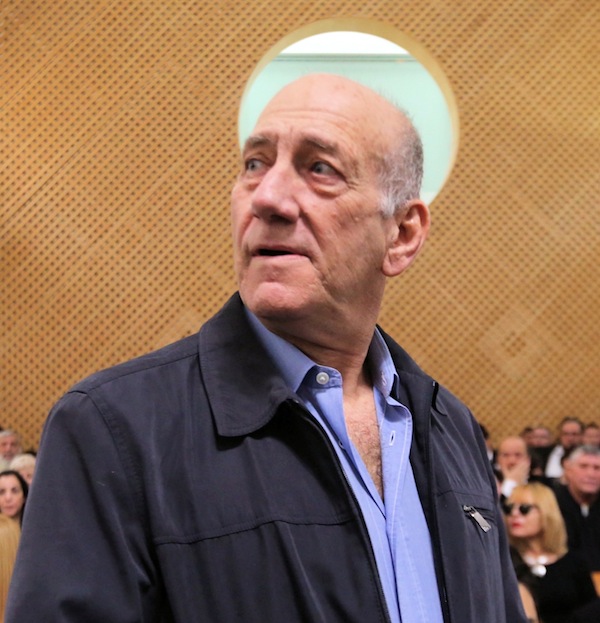
Among other happenings during the year, another state-of-the-art submarine was delivered during the summer from a German shipyard to augment Israel’s submarine fleet. And, finally, former prime minister Ehud Olmert was sent to prison after being found guilty of corruption and bribery. The positive side of this? The rule of law is the same in Israel for all of its citizens.

photo - Medical and rescue teams from IsraAID attend to Syrian refugees who have just landed in a rubber boat on the Greek island of Lesbos after the perilous crossing from Turkey
Medical and rescue teams from IsraAID attend to Syrian refugees who have just landed in a rubber boat on the Greek island of Lesbos after the perilous crossing from Turkey. (photo from Ashernet)
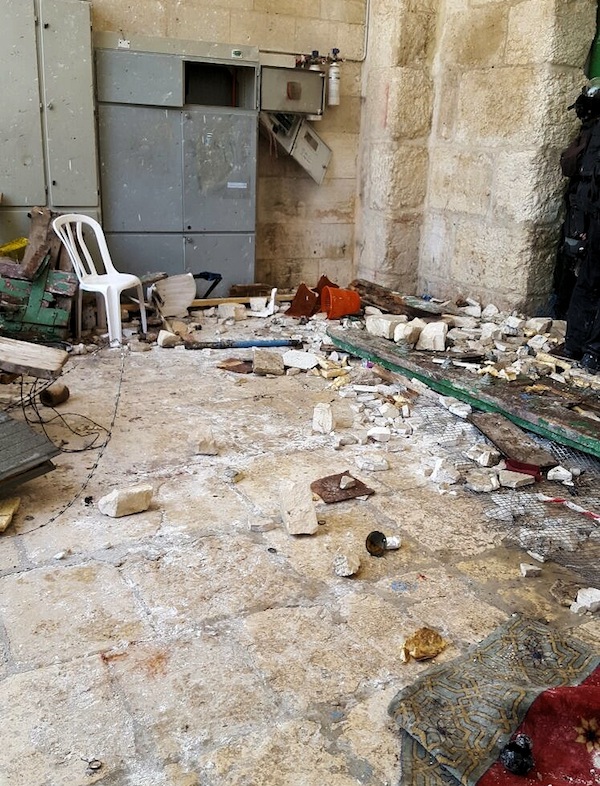
photo - The entrance to Al-Aqsa Mosque on the Temple Mount in Jerusalem after rioters tried to prevent police from arresting Arab stone-throwers
The entrance to Al-Aqsa Mosque on the Temple Mount in Jerusalem after rioters tried to prevent police from arresting Arab stone-throwers. (photo from Ashernet)
photo - In Tel Aviv in October 2015, thousands of Israelis came together to remember the 20th anniversary of the assassination of Yitzhak Rabin, who was murdered by Yigal Amir in this square
In Tel Aviv in October 2015, thousands of Israelis came together to remember the 20th anniversary of the assassination of Yitzhak Rabin, who was murdered by Yigal Amir in this square. (photo from Ashernet)
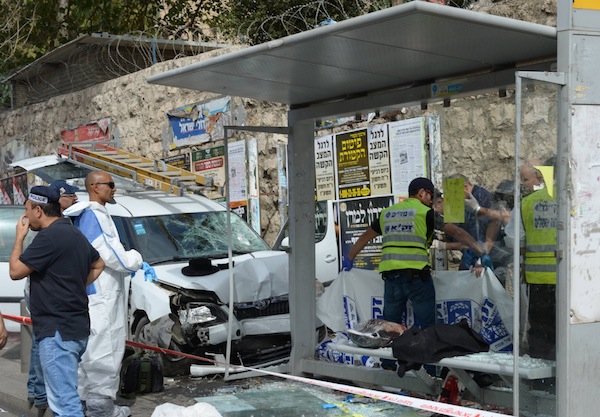
photo - A bus stop in Jerusalem’s Malkei Yisrael Street after a terrorist drove his car into the stop, killing one man, and then got out of his vehicle to stab others at random
A bus stop in Jerusalem’s Malkei Yisrael Street after a terrorist drove his car into the stop, killing one man, and then got out of his vehicle to stab others at random. (photo from Ashernet)
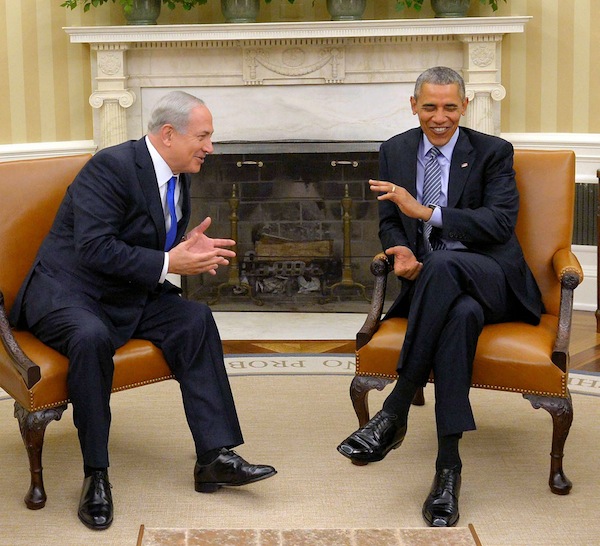
photo - Prime Minister Binyamin Netanyahu and President Barack Obama in Washington, D.C.
Prime Minister Binyamin Netanyahu and President Barack Obama in Washington, D.C. (photo from Ashernet)
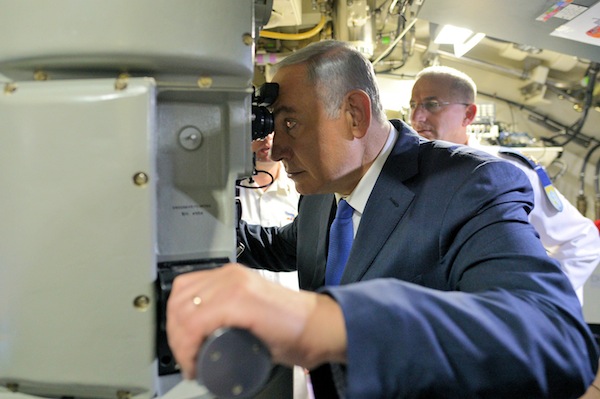
photo - Prime Minister Binyamin Netanyahu looks through the periscope of the latest submarine to be delivered to the Israeli navy by the German government
Prime Minister Binyamin Netanyahu looks through the periscope of the latest submarine to be delivered to the Israeli navy by the German government. (photo from Ashernet)
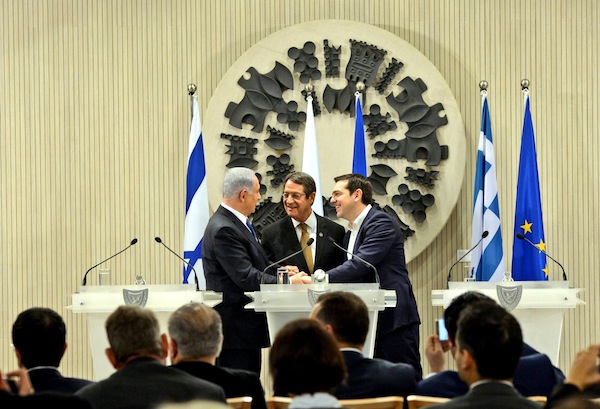
photo - Prime Minister Binyamin Netanyahu, left, Cypriot President Nicos Anastasiades, centre, and Greek Prime Minister Alexis Tsipras at a meeting in Nicosia to cement trilateral relations
Prime Minister Binyamin Netanyahu, left, Cypriot President Nicos Anastasiades, centre, and Greek Prime Minister Alexis Tsipras at a meeting in Nicosia to cement trilateral relations. (photo from Ashernet)
photo - Former Israeli prime minister Ehud Olmert at the Supreme Court in Jerusalem following the court’s decision to uphold his prison sentence
Prime Minister Binyamin Netanyahu, left, Cypriot President Nicos Anastasiades, centre, and Greek Prime Minister Alexis Tsipras at a meeting in Nicosia to cement trilateral relations. (photo from Ashernet)
photo - The Tamar gas rig in the Mediterranean, off the Israeli coast
The Tamar gas rig in the Mediterranean, off the Israeli coast. (photo from Ashernet)
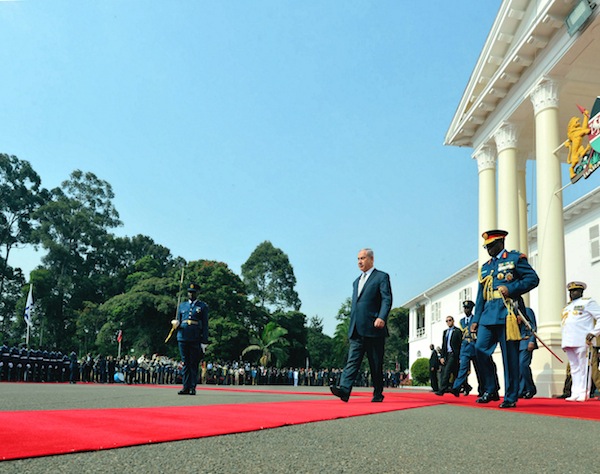
photo - Prime Minister Binyamin Netanyahu outside Government House in Kenya, stepping out to inspect the honor guard
Prime Minister Binyamin Netanyahu outside Government House in Kenya, stepping out to inspect the honor guard. (photo from Ashernet)
photo - The almost-complete Jezreel Valley railway that goes from Haifa to the Jordanian border
The almost-complete Jezreel Valley railway that goes from Haifa to the Jordanian border. (photo from Ashernet)
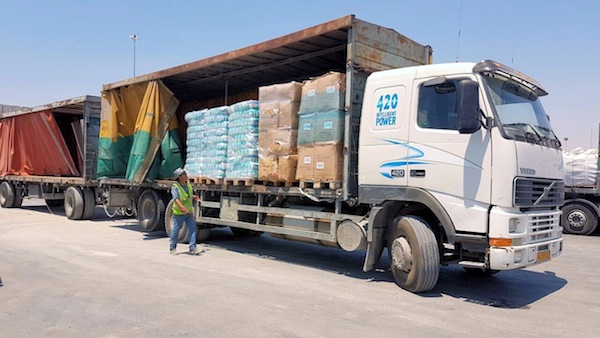
photo - Goods from Turkey enter the Shalom Crossing into Gaza with goods from Turkey. Recently, Turkey and Israel resumed normal diplomatic relations for the first time since the 2010 Mavi Mamara affair
Goods from Turkey enter the Shalom Crossing into Gaza with goods from Turkey. Recently, Turkey and Israel resumed normal diplomatic relations for the first time since the 2010 Mavi Mamara affair. (photo from Ashernet)

Will state be free?

Binyamin Netanyahu may not have expected the international reaction he received when he accused opponents of Jewish settlements in the West Bank of supporting the ethnic cleansing of Jews. While he went too far, there is some truth to be learned from the fallout.

The Israeli prime minister made the comments in a video, where he noted that nobody suggests that two million Arab citizens of Israel are an obstacle to peace. Yet the presence of Jews in the areas most people assume will eventually be Palestine under a two-state solution, he said, is repeatedly held up as proof that Israel is not acting in good faith toward a two-state objective.

Netanyahu was pointing out one of the glaring hypocrisies in the discussion of an eventual peace agreement and a two-state solution. He was intentionally inflammatory but, in the process, he set off a reaction that is illuminating and worth consideration.

First, we need to understand this basic fact: nobody expects Jews living outside the Green Line to voluntarily become citizens of a future Palestinian state. The entire discussion is an exercise in rhetoric. But this fact, too, raises other issues. Not many believe that Jews in an independent Palestine could live as citizens the way Arab citizens of Israel do under law (however imperfect this ideal might be in practice), partly because it’s probable that nobody would be free in an independent Palestine. If history is any measure, an independent Palestine might be a theocracy run by Hamas, a kleptocracy run by Fatah or some hybrid thereof. Regardless, Palestinian Authority President Mahmoud Abbas, among others, has insisted that no Jews will be permitted to live in an independent Palestine. The world ignores these racist statements, or excuses them as the legitimate reaction of a people long oppressed by the Jewish state.

Since most Jews would flee of their own volition if they found their homes outside the new borders of Israel, Netanyahu’s claims of ethnic cleansing can be seen as inflammatory and false, since it is not the Palestinians who would evacuate the Jews from the West Bank, but the West Bank Jews themselves, knowing the place held no future for them. But, while Netanyahu should be criticized for exploiting the term ethnic cleansing, perhaps to deflect criticism from the settlements, he has also drawn attention to the uncomfortable truth that the dream of Palestinian “freedom” for which so many in the world (including, for instance, most delegates to the recent Green Party of Canada convention) have devoted so much of their energies, is in fact a cause that may instead create a country that is nobody’s dream of a free and independent homeland.

Netanyahu is guilty of poking a hornet’s nest. However, his critics, too, should look at their own assumptions and motivations. The prime minister went too far in summoning imagery of mass deportations, but others have not gone far enough in addressing the reality that the movement for Palestinian independence in infused with unhealthy ideologies, of which excluding Jews from citizenship is just one.

Perlman wins Genesis Prize

(photo from Ashernet)

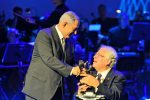
Prime Minister Binyamin Netanyahu awards this year’s Genesis Prize to violinist Itzhak Perlman at a June 23 ceremony in Jerusalem. The annual prize of $1 million is given to “an exceptional human being who has attained outstanding excellence and international renown in his or her chosen field, is a role model in the community and who can inspire the next generation of Jews worldwide.” Perlman said he plans to direct his prize money to philanthropic projects in the fields of music and support for individuals with disabilities.


Yisrael Beitenu in coalition

Avigdor Lieberman takes his seat in the Knesset on the afternoon of May 30 in his new role as defence minister. (photo from Ashernet)

For some time now Prime Minister Binyamin Netanyahu has been trying to enlarge his right-wing coalition government. Apart from holding several important portfolios, including foreign affairs and economy, it was becoming increasingly difficult for the government to carry out its policies with a majority of only one seat in the 120-seat Knesset. As well, within the coalition there was pressure over issues that were of special interest to particular factions.

A Knesset vote of 55-43 approved Avigdor Lieberman’s Yisrael Beitenu (Israel Our Home) party to join the coalition and gives Netanyahu 66 seats. Lieberman was appointed minister of defence. In the Israel Defence Forces, he attained the rank of corporal.

Lieberman’s predecessor was Moshe Ya’alon, a former IDF chief of staff, who had warned of the rising tide of extremism in the Likud and resigned from the party and the Knesset on May 20.

Be prepared to speak up

On Sunday, it appeared that Norbert Hofer had been elected president of Austria. By Monday, when absentee ballots were counted, he had lost by a mere 31,000 votes out of 4.6 million. The election captured worldwide attention because Hofer represents the Austrian Freedom Party, one of a string of extreme-right parties catching fire across Europe.

Hofer’s defeat was a relief to many, including Jewish organizations, but the narrowness of it is being declared a wake-up call. It wouldn’t be the first such warning. There have been multiple close calls, going as far back as 2002, when Jean-Marie Le Pen, the antisemitic founder of France’s Front National, made it to the presidential runoff. But never has any far-right figure come as close as Hofer to becoming head of state of a European country.

Hofer’s campaign of anxiety and scapegoating used Middle East immigration and associated (and unassociated) crime as an accelerant. As is happening in various places, including the “Brexit” referendum in the United Kingdom on June 23, countries are reconsidering their positions as part of the larger community of European nations. Part of this, again, goes back to the immigration issue, as some seek to bring immigration decision-making back to national capitals from the European Union.

While Europe appears a hotbed of emerging far-right parties, some Israelis are sounding the alarms over recent events there.

Over the past few days, Israel’s Prime Minister Binyamin Netanyahu has closed the door on a possible unity government with the left-leaning Zionist Union, setting the stage for an alliance with Yisrael Beitenu, and its leader, Avigdor Lieberman, to become defence minister, a position that Moshe Ya’alon abandoned in a flurry of disgust and condemnation of Netanyahu last week.

Some commentators say the result will be the most right-wing government Israel has ever seen. Ehud Barak, former Labor Party prime minister, said the developments amounted to “the seeds of fascism.” Three-time defence minister Moshe Arens predicts a “political earthquake.”

Lieberman, a settler himself and a leader in the movement representing Jews who live outside the Green Line, has a strong base among Russian immigrants, of which he is also one, and a reputation for antagonizing Palestinians and international diplomats. Originally a high-level member of Netanyahu’s Likud, Lieberman broke with Netanyahu over what he saw as Netanyahu’s overly conciliatory approach to the Palestinians during the 1997 negotiations that resulted in the Wye River Memorandum. Lieberman opposed Ariel Sharon’s Gaza disengagement and dismisses land for peace – the primary approach Israel has operated under for years in negotiations with its neighbors – as a “critical mistake” that will destroy Israel.

Suffice to say that politics is a vocation that invites hyperbole. Yet developments in many places – in Europe, in the United States, in Israel – invite strong reactions. The political spectrum has changed; terminology and policies differ with the times. While antisemitism has always been a defining characteristic of the far-right, some extreme-right European parties are now highly pro-Israel and eerily even philosemitic, seeing Israel as a bulwark against the “real” enemy – Islamism (or, less specifically, as is their wont: Islam). While the United States has seen its share of demagogues, it is equally true that, should fascism of some native form find root there, it would almost certainly be led by a buffoon who people underestimated for too long.

Canada sometimes seems like a blessed island in a roiling world – something we should never take for granted. It may be tempting to be smug, but instead Canadians should use our comfort and whatever influence we have to evangelize, to reclaim a phrase, for a world where moderation and tolerance prevail. While we might be more comfortable currently with politely withholding our opinions, the time may be upon us when we are truly called upon to register our disapproval of events – next door, in Israel or anywhere. We shouldn’t be afraid to speak up.

Changes at Shin Bet

Nadav Argaman, left, is congratulated by Prime Minister Binyamin Netanyahu at the Prime Minister’s Office on May 8, as he takes over as head of Israel’s Shin Bet security service. In the centre is outgoing head Yoram Cohen, who had led the security service since 2011. Argaman became deputy head of the service in 2011. Prior to that, he was the chief of operations from 2003 to 2007 and, from 2007 to 2011, he was Shin Bet’s representative in the United States. (photo from Ashernet)

Iran dominates AIPAC talks

Republican presidential hopeful Donald Trump upset AIPAC organizers when he criticized President Barack Obama. (photo by David Zam)

There were clear signs of discord in Washington, D.C., as representatives of AIPAC publicly rebuked presidential hopeful Donald Trump after he harshly criticized the sitting president.

At the pro-Israel organization’s policy conference last month, in front of some 18,000 attendees, visibly upset AIPAC president Lillian Pinkus admonished Trump on stage for his remarks a day earlier.

“Whatever policy disagreements we may have, we must not condemn the sitting president on stage,” she said. “There are people in our AIPAC family who were deeply hurt last night and, for that, we are deeply sorry.”

Chairman of the board Robert A. Cohen said that booing and clapping speakers when they attack another person was unacceptable at the event, and that “AIPAC doesn’t pick sides.”

Trump, who was cheered wildly for noting that it was President Barack Obama’s last year in office, said that “Obama rewards our enemies” and “Hillary was a total disaster as secretary of state…. Obama and Hillary have been very bad to Israel. Obama may be the worst thing to happen to Israel.”

Every major party candidate for president spoke at the dais, except the senator from Vermont, Democrat Bernie Sanders, who is Jewish. All candidates who spoke placed heavy emphasis on Iran.

GOP frontrunner Trump didn’t mince words. He called the Iran deal brokered by the P5+1 – the United States, China, Russia, France and the United Kingdom plus Germany – “awful” and “bad for Israel, the Middle East and the world.”

The $150 billion channeled to Iran in the agreement, by his reckoning, was “unbelievable” with “nothing in return,” and that the Islamic Republic will have a nuclear bomb within several years.

As president, Trump said he would “stand up to Iran’s aggression” because “I know how to deal with aggression and that’s why I’ll win.”

The Middle East’s terror activity has Iran’s fingerprints all over it, he continued, including Hezbollah in Lebanon, Hamas in Gaza, reward money for Palestinian terrorists, and influence in at least two dozen other countries.

“I will dismantle Iran’s global terror network,” Trump said. “We will enforce this deal like you’ve never seen a contract enforced before.”

The New York billionaire mogul and reality TV host took aim at two other threats to Israel, the United Nations and Palestinian terror activity.

“The UN is incompetent and no friend of Israel,” he said. “A [peace] agreement imposed by the UN would be a total disaster. And the U.S. must use our veto, which I will use 100%.”

The Jewish state, he said, has always been willing to strike a deal with its neighbors, noting that prime minister Ehud Barak in 2000 offered nearly the entire West Bank as a Palestinian state, but the offer was dismissed by then-PLO leader Yasser Arafat. Other times, he said, “Palestinian leadership has rejected very good offers.”

Trump noted that, under his purview, the U.S. embassy would move “to the eternal capital of the Jewish state, Jerusalem.”

Texas Senator Ted Cruz, trailing a distant second to Trump in GOP delegates, began his speech, “America will stand with Israel and defeat Islamic terror.”

He spoke about his three trips to Israel as senator, including a visit to Israeli hospitals that treated Syrian refugees. He noted that he had proposed legislation to ban the Iranian ambassador to the UN from entering the United States since he was involved in the 1979 Iranian hostage crisis. It passed in both the Senate and House.

Taking a jab at the Obama administration, he said it was “unjust” for them to impose a travel ban on Israel in the summer of 2014. He further called out Democrats for boycotting Israeli Prime Minister Binyamin Netanyahu’s speech last year at AIPAC.

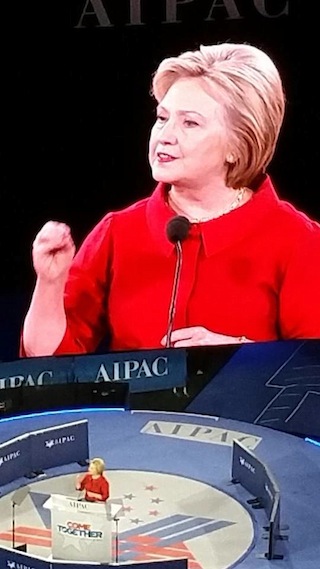
photo - At AIPAC, Democrat frontrunner Hillary Clinton advised a three-pronged approach to global security, focusing on Iran, extremism and the attempts to delegitimize Israel
At AIPAC, Democrat frontrunner Hillary Clinton advised a three-pronged approach to global security, focusing on Iran, extremism and the attempts to delegitimize Israel. (photo by David Zam)

Hillary Clinton, the Democratic presidential frontrunner, was taken to task for saying that Hamas fires rockets from civilian areas because Gaza is tight for space. “Rather,” said Cruz, “it’s because Hamas are beasts who use human shields.”

As for the “fundamentally immoral” Iran deal, Cruz said he will “rip it to shreds on the first day,” since the Islamic Republic won’t follow it anyway.

“Hear my words Ayatollah Khomeini: If I am president and Iran launches a missile test, we will shoot that missile down,” said Cruz. “And, in January 2017, we will have a commander-in-chief who says under no circumstances will Iran be allowed to acquire nuclear weapons: either you will shut down your nuclear program or we will shut it down for you.”

Cruz compared the Iran deal to the failed 1938 agreement between British prime minister Neville Chamberlain and Adolf Hitler, which led to the Third Reich’s takeover of Czechoslovakia and allowed its continued military build-up.

If elected president, Cruz said he would move the U.S. embassy from Tel Aviv to Jerusalem, yank federal funds from schools that boycott Israel and veto any UN unilateral declaration of a Palestinian state.

Governor of Ohio John Kasich, running third in the GOP delegate count, noted his 35-year support for Israel and his role in helping erect a Holocaust monument in his state.

He called for the suspension of the Iranian nuclear deal, particularly after recent test missiles in contravention of international treaties. As president, he would “defeat ISIS and stop arms flows to Hezbollah.”

He also spoke out against the boycott, divestment and sanction movement, and antisemitism on campus. On Israel, he noted the “culture of death that the Palestinian leadership has promoted for decades,” and that “Palestinians cannot continue to promote hatred.” In sum, he called Jerusalem the eternal capital of Israel.

When she took to the stage, Clinton noted that the “the ideological gap between the parties has increased, but there’s still common agreement on Israel.”

She took a three-pronged approach to global security: Iran’s aggression, the growing tide of extremism, and efforts to delegitimize Israel. “The deal with Iran is making the world safer, including Israel,” she said. “The supreme leader still calls all the shots in Iran, but we should support voices who want to bring change in Iran.”

Regarding other parts of the region, she said that “ISIS must not be contained; it must be defeated.”

On the issue of Israel, she noted that Palestinian leadership has to stop inciting violence. “Children should not be taught to hate in schools,” she said, adding that she would oppose any attempts to “push a [unilateral two-state] solution,” including in the UN. “Palestinians should be able to govern themselves in their state,” she said, while adding that Israeli “settlements are not helpful to peace.”

She condemned BDS and said, “we have to fight against it” because “antisemitism has no place in American society.”

Meanwhile, U.S. Vice-President Joe Biden took a risk mentioning to the 18,000 attendees at the policy conference that Israeli “settlements are a barrier in the way of a two-state solution.” That risk was welcomed by a chorus of boos – despite attendees being cautioned by AIPAC leadership to not do so.

Biden insisted that, notwithstanding political differences, the United States is “united in our unwavering commitment to the Jewish state of Israel.”

However, “violent acts of retribution must stop,” he continued, “terror is terror is terror … and it must be stopped.”

The White House “stands with Israel against delegitimization” and believes that “Israel is stronger today because of the Obama-Biden administration,” he said.

Biden touted last year’s Iran deal as a “success,” explaining that many “Iranian facilities are dismantled and destroyed” and that “Iran is further away from the possibility of being nuclear. If Iran violates [the deal] there will be consequences.”

Speaking by video link from Israel, Netanyahu both criticized, and suggested salvaging, the U.S.-brokered Iranian nuclear deal.

“Those who worked for the deal and against the deal can work together to ensure that the deal is followed,” he insisted, noting that, in March, Iran tested a missile that posed a threat to Israel.

“The writing isn’t just on the wall; it’s on the missile,” said Netanyahu.

He said that Israel is singled out for condemnation at the UN and said he hopes the United States will continue its moral voting record at the Security Council.

With regard to Israel’s neighbors, he said Palestinian children are taught to hate, and showed a video of television broadcasts that illustrate his point.

“We cannot compromise with terror and must defeat it,” he said. “We need a two-state solution with a demilitarized Palestinian state.… We are ready for negotiations anywhere and anytime without preconditions.” But, he said, Mahmoud Abbas, the leader of the Palestinian Authority, “isn’t ready or willing to come” to the negotiating table.

David Zam has covered political, cultural and historical events for Landmark Report, including the 50th anniversary of the Selma to Montgomery voting rights march as White House-approved press, two AIPAC policy conferences and several other political conventions. He has degrees in history and law.

עדיין נחשב לידיד קרוב של ישראל

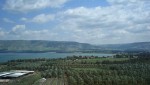
תצפית אל דרום הכנרת מהכביש היורד מיבניאל. (צילום: אלה פאוסט)

ג’סטין טרודו: מברך את העם היהודי לחג הפורים, מתקומם על החרם נגד ישראל, אך מתנגד להתנחלויות בשטחים

ראש ממשלת קנדה מטעם המפלגה הליברלית, ג’סטין טרודו, מביע לאחרונה את דעתו בפומבי בנושאים שקשורים ליהודים ולישראל. שלא כמו קודמו בתפקיד, סטיבן הרפר, טרודו לא עומד אוטומטית מאוחרי ישראל בכל עניין ועניין והוא אינו חבר של ראש ממשלת ישראל, בנימין נתניהו, אבל עדיין נחשב לידיד קרוב של ישראל.

טרודו פרסם בשבוע שעבר אגרת ברכה לאזרחים היהודים בקנדה לקראת חג הפורים. בברכה נאמר: “חג הפורים מציין את סיפורה של אסתר המלכה והדוד שלה מרדכי, אשר הצילו את העם היהודי בתקופת פרס העתיקה. אירוע זה מזכיר לנו שוב את כוחו ועוצמתו של העם היהודי, אשר שרד וגבר על הרדיפה הבלתי הנתפסת הזו. בזמן שאנו קוראים את מגילת אסתר אנו מאשרים מחדש את המחויבות הקיימת שלנו לנקוט פעולה ולעמוד נגד האנטישמיות, נגד ביטויים אחרים של שנאה ואפליה בקנדה ומחוצה לה”.

רק לפני כחודש חזר טרודו על הבטחתו מקמפיין הבחירות שלו להתנגד לכל חרם על ישראל. טרודו ומרבית חברי המפלגה הליברלית שבראשותו תמכו ב-22 בפרואר בהצעת המפלגה הקונסרבטיבית מהאופוזיציה, לגנות את כל מי שמחרים את ישראל. הפרלמנט הקנדי אישר את ההחלטה הזו ברוב גדול של 229 מול 51 מתנגדים. לפי הצעת הקונסרבטיבים על הממשלה הקנדית לגנות כל ניסיון לקדם את תנועת החרם והסנקציות נגד ישראל בקנדה ומחוצה לה. עוד נאמר בהחלטה כי תנועת החרם הבינלאומית של ‘הבי.די.אס’ פועלת לעשות דה-לגיטימציה ודמוניזציה של מדינת ישראל. שר החוץ הקנדי, סטפן דיון, אמר מספר ימים קודם לכן בצורה ברורה כי העולם לא ירוויח דבר מהחרמת ישראל ויש להילחם באינטישמיות על כל צורותיה השונות.

לעומת כל זאת טרודו לא מהסס להעביר ביקורת פומבית של מדיניותה של ישראל בשטחים. הוא אמר לאחרונה כי ישראל עושה דברים מזיקים כמו למשל ההתנחלויות הבלתי חוקיות. טרודו: “יש זמנים שאנחנו לא מסכימים עם בעלי הברית שלנו, ואנחנו לא נהסס לומרת זאת בקול רם. זהו עניין שחברים צריכים לדעת לעשות. כמו למשל ההתנחלויות שהן בלתי חוקיות”. שר החוץ דיון אמר באותו נושא קודם לכן את הדברים הבאים: “ההתנחלויות פוגעות ביכולת להגיע לפתרון צודק באזור”.

בנושא טרודו והרפר כתב ניצן הורביץ בעיתון ‘הארץ’ בין היתר: “ראש הממשלה החדש הוא איש פתוח, מתקדם ובעל חוש הומור. תשע השנים הרפר היו די והותר לקנדים. הם הבינו שהמדיניות התקציבית המרסנת שלו וההסתמכות העיוורת על חברות אנרגיה הביאו אותם אל עברי פי פחת. לעומת זאת טרודו נמצא בצד הנכון של ההיסטוריה. הוא כבר הציג ממשלה שווה של נשים וגברים”.

האם פיצה גנובה טעימה יותר: שישה שליחי פיצה נשדדו בססקטון לאחרונה

שישה נהגים שמובילים פיצות בריכבם נשדדו החל מסוף פברואר ובמהלך מרץ בעיר ססקטון. באחד מסופי השבוע נשדדו ארבעה שליחים ולאחר מכן נשדדו עוד שניים. המשטרה המקומית מאמינה שיש קשר בין כל ששת המקרים בהם משתתפים שני שודדים. המשטרה קוראת לנהגים להגביר את הזהירות ואמצעי האבטחה. עדיין לא ידועה זהות השודדים שכנראה גם מכורים למגשי פיצות חמות וטריות.

השודדים כנראה ממוצא אינדיאני (בגילאי 18-20) לבושים בשחור ופניהם מכוסות במסכות, פועלים בשעות הבוקר המוקדמות וחמושים בשלל של כלים מאיימים: צמידים מברזל, מפתח צינורות, מוטות מברזל וסכינים. צמד השודדים מאיים על הנהגים המופתעים וגונב את הכסף שבידם עם חלק מהפיצות שברכבם.