Jewish diversity exists

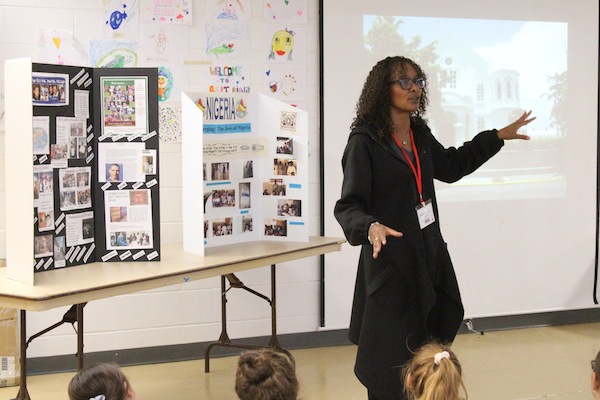
Rivka Campbell, a co-founder of Jews of Colour Canada, speaks at a school event. (photo from JOCC)

The spirit of openness and inclusion that many Jewish organizations express in their literature and social media posts is frequently not felt by Jews of colour, according to several members of the community.

Jews of colour, who are said to represent about 12% of the overall Jewish community, constitute a broad spectrum of people, including those of African, Middle Eastern, East Indian, Asian, Indigenous and Latin American descent, yet they are vastly underrepresented in congregation attendance, on organizational boards and throughout the community as a whole.

Rivka Campbell, a co-founder of Jews of Colour Canada (JOCC), says the unwelcoming feeling happens immediately upon entering a Jewish institution. She refers to it as the “question or questions” that are asked: Do you know this is a synagogue? What made you decide to visit? When did you convert?

“These are not the sorts of questions that most Jews who attend a synagogue or other places associated with Judaism have to answer, and it is really none of anybody’s business,” Campbell told the Independent.

In a recent Jews of colour webinar run by Moishe House Montreal, participants relayed numerous negative and often disturbing experiences, some of which caused them to distance themselves from Jewish circles.

“I have withdrawn from synagogue life and gone into online mode,” Deryck Glodon, Campbell’s JOCC co-founder, stated. “I don’t want to be in a position where people make you feel uncomfortable or unwelcome. People don’t know that Jewish diversity exists.”

Another participant mentioned a rabbi who once told him to choose between being black and being Jewish. Yet another recalled several untoward remarks made in Jewish settings about Filipino people, which happened to be part of this person’s heritage.

“It’s driving many Jews of colour away from any involvement within the broader community,” noted Campbell, who is executive director for Beit Rayim, a Conservative synagogue and school in Richmond Hill, Ont.

Campbell, the sole Canadian recipient of the Union of Reform Judaism’s JewV’Nation inaugural fellowship – a leadership development program – has had numerous encounters with misconceptions. She is often asked if she is Ethiopian. Once, at a Kiddush, she had to explain to someone that being a person of colour does not correspond to a fondness for fried foods.

A noticeable thread during the Moishe House webinar was the wide disparity between the progressive causes supported by Jewish leaders and the experiences of people of colour within the community.

Many Jews of colour feel that, despite some good intentions by Jewish organizations, there are always those moments when they have to prove who they are, when they just want to be, Campbell explained. The hope, she said, is that, one day, Jews of colour won’t have to spell out what Jewish diversity is.

“Rabbi Abraham Joshua Heschel’s solidarity with Dr. Martin Luther King happened 55 years ago – we need to do something now and not rest on our progressive laurels,” she said. “Nor should we forget that Rabbi Heschel was not universally praised from within the Jewish establishment for his civil rights stand.”

As for what clergy and lay leaders can do, Campbell pointed to the resources found on Union of Reform Judaism website regarding diversity, equity and inclusion for all members of the community.

For the broader community, she said, “It is not a big deal to be welcoming. Treat me the same as anyone else. You have to see me as a Jew first. ‘Shabbat Shalom’ should flow off the tongue as easily with me as anyone else.”

She continued, “Our diversity as Jews of colour adds to the diversity of Judaism. This can be turned into a very positive thing.”

On this hopeful note, in 2017, Campbell started work on a documentary that shares several stories of people from various backgrounds within the Jewish community and is designed to show the richness therein. Its objective is “to discuss how we are starting to embrace our differences and how we can do a better job of celebrating our diversity.”

Campbell’s first involvement with Jews of colour groups began at the time social media was gaining momentum. After locating ones on Facebook, she found their focus to be American-centric. In 2012, she started her own Facebook group, A Minority Within a Minority: Jews of Colour, a Canadian-focused group.

The need to move beyond Facebook ensued and, together with Glodon, she started a website and reached out to “people in the real world to have gatherings and lunches.”

“The aim was to have an in-person connection, to do things like teaching, research and advocacy,” said Campbell. The group was incorporated as a nonprofit and, at some point, she would like it to be a charitable organization.

JOCC hopes to expand its presence outside of Ontario and Quebec, and would like to have more exposure in British Columbia. Campbell spoke at Beth Tikvah

in July.

For more information about Jews of Colour Canada, visit jewsofcolour.ca or their Facebook page, facebook.com/joc.canada.


Sam Margolis has written for the Globe and Mail, the National Post, UPI and MSNBC.
Starting repair process

Among the many things this year has brought us is a reconsideration of race, equality and justice, spurred in part by racism and racially motivated violence, not least that perpetrated by police. In response, the Jewish community, locally and in the United States and beyond, is engaged in a discussion about how to respond as individuals and as a community.

Jews have long been involved in advancing racial equality and other progressive issues. Hundreds of U.S. Jewish organizations and individuals recently signed on to a message of support for the Black Lives Matter movement, despite some concerns by some about antisemitism in small parts of that movement. What too few have done, as we read the news from Kenosha or Louisville or other cities roiled by racist and civil unrest, is consider the issue from a perspective that is closer to home.

Earlier this year, three Jews of colour began a modest movement to specifically raise this topic more visibly, forming a group called No Silence on Race, which issued an open letter “from Black Jews, non-Black Jews of colour and our allies to Jewish organizations in Canada.” (See story at jewishindependent.ca/working-to-advance-equality and their website, nosilenceonrace.ca.) The letter asked organizations in the community to take tangible steps based on nine pillars they outlined: allyship, education, Indigenous education, equity consultancy, employment, anti-racism advisory, JOC leadership, programming and partnerships, and JOC voices. The Jewish Independent endorses this letter.

The letter requested that organizations in the community consider making a statement detailing tangible ways they will seek to hear, engage with and empower Jewish people of colour. In response, the editorial board of the Independent has met as a group and also individually considered these issues. We offer this statement in an effort to voice our commitment to equity and justice for Jews of colour within our community and within the specific scope of our own organization, the community newspaper of Jewish British Columbians. We believe that not all nine pillars are specifically applicable to the unique role that a news platform plays in the community, though as we proceed along this process, we remain open to reconsidering all assumptions.

In demonstrating allyship, in particular, there are several specific, tangible, realizable goals we have identified and to which we commit to undertake. These include:

  1. Redoubling our efforts to feature stories involving Jews of colour, their experiences, lives, accomplishments, challenges, specific issues, and events, as well as addressing intra-community conflicts and reconciliations between Jews of colour and the broader Jewish community;
  2. Continuing to advance a model of journalism that encourages reconciliation between Indigenous Canadians, Jews and all Canadians;
  3. Intentionally holding space for new and less frequently heard voices, including prioritizing writers who are Jews of colour and gender-diverse people, and actively seek out such voices, recognizing the deep well of experience and expression that has not traditionally been heard or amplified;
  4. Partnering with, and encouraging others to partner with, individuals and organizations that elevate a diverse range of Jewish diasporas, histories and lived experiences;
  5. Undertaking to learn and exemplify diverse ways to understand language, gender, ability and other forms of human difference;
  6. Amplifying, through our coverage, resources from other community organizations dedicated to these goals, in the interest of education and sharing resources;
  7. Encouraging, in our reporting and commentary, inclusive and progressive decision-making around community allocations and fundraising, and engaging in educating about a vision of community philanthropy that advances these objectives.

We make these commitments conscious of our shortcomings as individuals and as a small, struggling community institution, and strive for their fruition to the best of our abilities.

We recognize and appreciate the emotional labour required by Jews of colour, and of others who are self-advocating, and will strive to minimize this burden through self-education and using existing resources that do not place added demands on individuals and organizations engaged in this critical work.

You are likely reading this still in the Jewish month of Elul, traditionally a time to reflect on our actions over the year and to ready ourselves for the power of the High Holidays. Indeed, the Jewish concept of teshuva, of atonement, literally “return,” provides a roadmap for doing things differently and better. For those transgressions between people, wrongs must be righted and forgiveness is only possible from the person we’ve harmed. We invite you – individuals and community institutions alike – to join us as we use this time to consider specific, actionable ways each of us may take responsibility for repairing any damage we may have done to beloved members of our community who have been excluded, questioned, silenced, marginalized or otherwise made to feel outside. At the Independent, we do this reflection and the work of repair with joy and a sense of purpose. Wishing each one of you a shana tova u’metuka, a good and sweet year.


No Silence on Race: an update

It’s been almost two months since we launched our open letter on June 30 and so much has happened since then!

We have received hundreds of signatures of support from the Jewish community across Canada and several Canadian organizations, congregations and initiatives have written public statements outlining their commitment to our pillars. We have published these statements on our website and you can view them at nosilenceonrace.ca/statements. We’ve also received some coverage in Jewish publications across the country. We have made them available on our website as well. Although our set date of July 29 has passed, we are still accepting signatures and statements.

We have had conversations with leaders in our community and we know that many organizations are committed to action and to change. The work of creating inclusive, anti-racist and equitable Jewish spaces is a daily pursuit and we are encouraged to see the way our community has embraced our letter and the need for action and accountability.

Many of you have expressed interest in learning more about our pillars. Our team has launched a resource page (nosilenceonrace.ca/resources) on our website dedicated to furthering the conversation on each of our pillars and on how our community can collectively enact meaningful systematic change. We have also included equity consultants on this page that organizations can connect with directly to begin and continue this work.

Thank you to all of you who have reached out to us directly expressing your support and desire to get involved with our team and our work. We will be reaching out to you all soon. If you are reading this and would like to get involved with us, we’d love to hear from you! Please fill out our Get Involved page (nosilenceonrace.ca/get-involved) on our website to join us as we continue our work and create opportunities to connect with the community, grow our platform and take action.

We look forward to a time where we can create an in-person event and come together as a community. Until then, we encourage everyone to keep the conversation alive with your family, friends, communities and workplaces.

– Sara Yacobi-Harris, Akilah Allen-Silverstein and
Daisy Moriyama, co-founders, No Silence on Race

Working to advance equality

Akilah Allen-Silverstein, a co-founder, with Sara Yacobi-Harris and Daisy Moriyama, of No Silence on Race. (photo from NSR)

Amid a global reckoning around race, a group of Canadian Jews of colour is calling on the community to advance inclusivity and racial equity in Jewish spaces. And rather than generalized good wishes for more equality, No Silence on Race has created nine pillars to guide community organizations through a comprehensive process.

The group emerged at the end of June, when founder Sara Yacobi-Harris and co-founders Akilah Allen-Silverstein and Daisy Moriyama released a letter to the community introducing their work and their nine pillars.

“We are Black Jews and non-Black Jews of colour,” the letter said. “We are Jewish community board members, educators and leaders. We write from a place of love for our Jewish identities and community, while also grappling with the cultural erasure, exclusion and structural racism that we experience in Jewish spaces. Nevertheless, we are compelled to be in Jewish community because it is who we are.”

They began by sending the letter to agency leaders and posting it on Jewish social media and discussion platforms. Organizations circulated it further and began to request meetings.

“We are working to make a change in the culture, recognizing that the Jewish community is multifaceted in identity and making sure there is an awareness and an education around the diversity of the Jewish community,” Allen-Silverstein told the Independent in a recent interview.

In addition to asking individuals and organizations to sign their open letter, the group is asking community agencies to issue statements of their own and commit to the nine pillars.

The nine pillars guide agencies through developing allyship and educational approaches around race, as well as relationship-building. They move from more general approaches to applied processes such as hiring an equity consultant and developing inclusive employment and recruitment policies; creating leadership strategies for Jews of colour in the organization and amplifying their voices. The process is anticipated to evolve over three- to five-year periods. The entire text is easily accessible online at nosilenceonrace.ca.

“We are asking every organization to make a public statement, but, within this public statement, it’s not just about solidarity or signaling that you’re with us or you feel the same,” said Allen-Silverstein. “Our pillars are intentional in that the first three are ‘free’ and we’re very cognizant that it’s COVID right now and a lot of these organizations are just working to keep the lights on. But the first three pillars –allyship and education and relationship-building – these are things that will mostly be individual work. The organization can help facilitate by sending out reading lists, book lists, articles to give people the context, because, if you just run ahead and skip to steps four, five, six, you’re trying to create proposals or rules and guidelines without the context of the education to understand where the issues are, what people of colour have faced for years and their experiences within the Jewish community, and we are not going to be putting together any policies that actually make sense or help.”

No Silence on Race is cautious to express that, in employment and recruitment, the group wants to avoid tokenizing. “Tangible efforts could include mentorship programs for Jews of colour to be groomed for leadership positions,” she said. “We realize that takes time but that should just be done intentionally.”

Working to amplify the voices of Jews of colour, Allen-Silverstein added, means not just expecting Jews of colour to come and share what “for some of us can be very painful and exhausting, to do this for free constantly.”

Allen-Silverstein, a financial planner, is the daughter of an Ashkenazi father from London, Ont., and a mother from St. Kitts in the Caribbean. Jews of colour, she said, can come from intermarriage, but the broad category also includes Sephardim, Mizrahim, Ethiopians “and others who have always been Jews of colour,” she said.

Acknowledging and condemning antisemitic remarks and actions that have come from some prominent African-American athletes, artists and religious figures, as well as some incidents within the Black Lives Matter movement, Allen-Silverstein said the incidents speak to a communication problem.

“It just shows the breakdown between both communities,” she said. “I think, if you look historically, the similarities and the oppression that both communities have faced, we should be allies more than any other two groups. It’s sad. All we can do is honestly be that person who tries to explain it to both sides and that generally happens.”

Amid the hundreds of chapters of the Black Lives Matters movement, she acknowledged, there are some who have expressed extreme ideas. Allen-Silverstein sees two approaches in response.

“Sometimes, it’s noise and we really have to ignore that. One person speaking out and saying something stupid doesn’t mean that everybody else feels that way, and I think we need to be careful not to do that,” she said. The other step is to get to the root of the matter – “Let’s figure out where they’re getting this terrible message,” she said.

There has been forward movement in the fight for racial equality, as well as some backsliding, over many decades. Like others working for racial justice, Allen-Silverstein looks at the current moment with cautious optimism.

“It is inspiring that people are really listening and seem really genuinely interested to move forward, to acknowledge past things that have been done, whether it’s unconscious or consciously as well,” she said, adding that there appear to be more people engaging in the issue. “We are seeing, too, many things that make it very obvious that there was an element of people within the community who just considered these issues not theirs and not something they needed to participate in. That, for us, wasn’t acceptable as people who obviously walk both lines, being both members of that community and the Jewish community.”

Inspiring students’ research

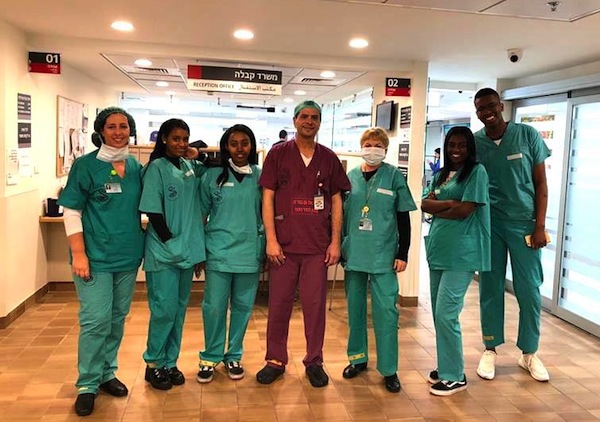
Students and staff of the recent Arrow Project on a tour of Sheba. In the centre is Prof. Eldad Katorza. Student Yair Jalmar is at the far right. (photo from IMP)

Sheba Medical Centre, Israel’s national hospital, enjoys a reputation for medical innovation, but many are unaware that it is also at the forefront of societal integration among various minority groups in Israel. In the past several years, Sheba has integrated hundreds of new Ethiopian olim (immigrants) into the hospital workforce, going as far as providing them with free classes to help them navigate Israeli bureaucracy and improve their language skills.

Recently, Prof. Eldad Katorza, senior physician at Sheba and director of the Arrow Project, decided to give youth from the Ethiopian community a head start by incorporating them into his pilot program.

The Arrow Project (Chetz in Hebrew, the initials of chokrim tze’irim, meaning “young researchers”) is an apprenticeship program for medical students, designed to pave their way into the world of research. Established in 2006, the initiative matches selected students with experienced researchers who serve as their mentors. During once- or twice-weekly meetings, the student-mentor teams work through every stage of medical research, from formulating the initial question, to collecting and analyzing data, to presenting the results at medical conferences.

This year, for the first time, each research duo also included a third tier: high school students from the Ethiopian community.

Katorza believes in the importance of encouraging students to pursue research, noting that, in med school, they do not receive sufficient exposure to research thinking or methodology.

“I believe that research makes a doctor more knowledgeable, more curious, more creative,” he said. “A doctor who engages in research is a much better doctor.”

Employing this premise, Katorza is planning to open several slots for nursing school students in the coming year’s program. “Nursing is also a field that stands to benefit greatly from adding researching to its ranks; it will raise the bar of nursing in Israel,” he said.

In the early stages of planning the pilot program for the Ethiopian high school students, it became evident to Katorza just how crucial, timely – and challenging – his initiative was. “I asked my son, then in 11th grade, to look around his own school in Givatayim for students from the Ethiopian community who might be suitable for the program,” said Katorza. “As it turned out, there wasn’t a single Ethiopian student in his school, nor in any of the good schools in the area.”

The reason can be traced to the socioeconomic realities in Israel today. Ethiopian Israelis have long experienced prejudice and being treated as second-class citizens. By and large, members of the Ethiopian community tend to dwell together in poorer neighbourhoods, where community services, schools included, are more limited. These conditions put Ethiopian teens at a disadvantage from the outset and, due to economic necessity, the youth are pushed to join the workforce at an early age, further perpetuating a cycle of poverty.

“Almost four decades have passed since the first wave of Ethiopian Aliyah,” said Katorza, “yet, judging from their rate of participation in academia, their level of affluence and other markers of social mobility, it appears that the government has failed to take the necessary steps to help them bridge the gaps and facilitate their successful absorption into mainstream Israeli society.”

Anxious to change this negative trend, Katorza decided to include outstanding students from the Ethiopian community in the Arrow Project. However, it wasn’t simple to locate high school students from the Ethiopian sector who met the criteria for participation in the program: high marks in the sciences, high motivation and interest, and living near enough to the Sheba campus to be able to easily attend the weekly meetings. Ultimately, Katorza was aided by an organization called Fidel (“Alphabet” in Amharic), which promotes the education and social integration of Ethiopian-Israeli youth. The Fidel staff welcomed this opportunity to incorporate Ethiopian students in Sheba’s research-mentoring platform, and provided 10 candidates, from which the top five were chosen.

According to Katorza, the pilot program was a resounding success and will be repeated in the coming year. “We found that, once they are freed from the limitations of their environment, the students manifested amazing capabilities,” he said. “We endeavoured to help build their self-confidence, empower them and teach them that they can do anything they put their mind to.”

Throughout the year, in addition to their full participation in research, the Ethiopian high schoolers were also exposed to the clinical activity at the hospital. “At the beginning of the year, the students didn’t have any specific plans for the future,” Katorza said. “Now, they are now seriously considering a medical career.”

One of those is Yair Jalmar, 17, from Beer Yaakov, who participated in a research project with pediatric cardiologist Dr. Shai Tejman. “This project helped me develop my interest in medicine and learn more about the advanced technologies and devices, as well as the various departments in the medical field,” he said.

In the 14 years since the project’s inception, the pool of participants, which in the beginning included only students from Tel Aviv University Sackler School of Medicine, has expanded to foreign exchange students from New York and London, as well as medical students from Ariel University, Bar-Ilan and others. Thus far, former participants in the Arrow Project have gone on to publish their findings in respected medical journals, and several have joined the team at Sheba.

– Courtesy International Marketing and Promotion (IMP)

No Silence on Race

An open letter from Black Jews, non-Black Jews of colour and our allies to Jewish congregations, federations, foundations, organizations, nonprofits and initiatives, dated June 30, 2020.

We write this letter as proud members of the Canadian Jewish community. We are Black Jews and non-Black Jews of colour. We are Jewish community board members, educators and leaders. We write from a place of love for our Jewish identities and community, while also grappling with the cultural erasure, exclusion and structural racism that we experience in Jewish spaces. Nevertheless, we are compelled to be in Jewish community because it is who we are.

Over the past month, we have witnessed a racial reckoning within Canadian institutions. Police violence against Black and Indigenous people has continued unabated, with numerous deaths, including that of D’Andre Campbell, Eishia Hudson, Jason Collins, Regis Korchinski Paquet, Everett Patrick, Chantel Moore, Rodney Levi, Ejaz Ahmed Choudry and countless others. In the United States, the tragic murders of Ahmaud Arbery, Tony McDade, Breonna Taylor, Sean Reed, George Floyd, David McAtee and Rayshard Brooks have gripped the collective consciousness and have been the catalyst for a global call to action. We have witnessed and participated in protests and in conversations for structural change across all sectors and our Jewish community is not exempt from this dialogue.

No Silence on Race is born out of the necessity for inclusivity and racial equity in Jewish spaces. We acknowledge and are grateful for the longstanding work that Jews of colour and Jewish allies in Canada and the United States have dedicated themselves to in addressing structural racism within the Jewish community.

In this letter, we call on our Jewish community to uphold the tenets of justice and equality and to commit to the creation of a truly anti-racist, inclusive and equitable Jewish community.

The work that needs to be done to achieve this vision must happen collectively and systematically. To guide its implementation, we have devised nine pillars outlined below. These pillars are intended to support Jewish congregations, federations, foundations, organizations, nonprofits and initiatives in their transformation towards greater inclusivity and equity.

If you are aligned with the creation of an anti-racist, inclusive and equitable Jewish community, we ask that you sign this letter in support [at nosilenceonrace.ca]. If you are an organization, we ask that, in addition to signing your name, you write a public statement expressing your commitment to achieving this vision.

The nine pillars are:

1) Allyship: creating anti-racist, inclusive and equitable Jewish spaces begins with each individual. We call on everyone within their organizations to make a personal pledge to the work of allyship and to devise a personal plan of 10-15 comprehensive ways they will work towards becoming strong allies and leaders in the creation of more inclusive and equitable Jewish spaces.

2) Education: engage external facilitators for organization-wide anti-racism and anti-oppression education and training led by Black Jews, Jews of colour or people of colour consultants or consulting organizations.

3) Indigenous education and relationship building: engage in education about Indigenous peoples in Canada and cultural competency training. Build meaningful relationships with local Indigenous communities.

4) Equity consultancy: work with an equity consultant with a specialization in anti-racist work to formulate a multi-year strategic plan for your organization to create a roadmap towards inclusion, equity and anti-racist practices. This includes implementing non-discrimination policies, equitable hiring policies, anti-racist frameworks for organizational decision-making and a procedure to report and investigate any breaches of this policy.

5) Employment and recruitment: implement strategies to ensure equitable representation in your staffing, as well as development and retention planning to ensure these practices are adequately conducted.

6) Equity, inclusion, anti-racism advisory: accountability is essential. Create an advisory group to ensure that the equity-and-inclusion policy and strategies implemented are upheld at all levels of the organization. Create metrics to track ongoing anti-racism work.

7) Jews of colour leadership strategy: invest in a leadership strategy to ensure that Jews of colour are poised to be adequately represented in leadership roles in the community. This can include mentorships, educational scholarships and project grants.

8) Programming/events/partnerships: commit to more programming and partnerships with cultural institutions, with the goal of engaging in and elevating a diverse range of Jewish diasporas and histories.

9) Amplify the voices of Jews of colour in Canada: demonstrate explicit support for Jews of colour community groups and active initiatives. Engage in substantial outreach efforts.

We acknowledge that change takes time and recommend Jewish organizations create their own timelines for achieving the nine proposed pillars. We have designed these pillars as a guideline and we encourage all organizations to be intentional and creative in their implementation. While organizational priorities may have shifted amidst the realities of COVID-19, it is imperative that our community does not remain silent about how racial inequity plagues Jewish spaces. We look to the entire Jewish community in Canada to challenge ourselves to do more and to envision the path forward.

Jewish scholars as far back as Rabbeinu Bachya ben Asher, a significant rabbi and scholar from 13th-century Spain, call us to seek “Justice whether to your profit or loss, whether in word or action, whether to Jew or non-Jew.” So, we set our sights on July 9, which this year mark[ed] the fast of the 17th of Tammuz, where we begin the three-week period of mourning leading up to Tisha b’Av.

Tisha b’Av commemorates the destruction of the Temple. It is a time where we reflect on the divisions within our community. But, more importantly, it is a time to reflect on the cost of allowing those divisions to persist. During this holiday, we recognize the importance of taking a more active role in challenging each other and of doing more to make amends. It is in this spirit that we invite Jewish organizations across the country to engage in listening, introspection and action.

Creating anti-racist, inclusive and equitable Jewish spaces will require deep self-reflection, difficult conversations and an ongoing commitment to reimagining what the Jewish community can look like. Above all, it must be guided by the celebration of Jewish culture and a love for one another.

For individuals and organizations who believe in this movement, we invite you to join us in action by adding your name to this letter. We call on organizations to sign their name with the intention to issue a public statement by July 29, outlining your commitment to the vision of creating a more inclusive Jewish community.

The ground is shifting beneath us in ways that are undeniable and it is incumbent on each of us to play a role in shaping our collective future. When we honour our commitment to each other as Jews, our communities will reflect the beauty and diversity that truly exists within our culture.

Sara Yacobi-Harris, Akilah Allen-Silverstein and Daisy Moriyama

Trying to make access equal

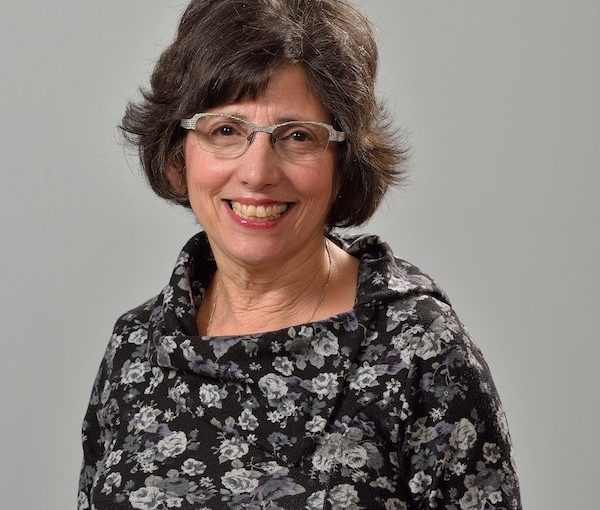
Dr. Cheryl Rockman-Greenberg (photo from Rockman-Greenberg)

In the 1970s, when Dr. Cheryl Rockman-Greenberg was eyeing the budding field of genetics as a career, she had to become a pediatric doctor first. Now, Rockman-Greenberg counts her clinical background as a blessing, one that, today, geneticists no longer require.

“Having a strong background in clinical medicine certainly always helped me in my career, because the kind of genetics I was always interested in was in rare metabolic diseases,” said Rockman-Greenberg. “These are diseases often caused by enzyme deficiencies that go by very elaborate names. Having a good foundation in clinical medicine through pediatrics certainly helped me.”

Rockman-Greenberg, who lives in Winnipeg, was invited to speak at the city’s Congregation Shaarey Zedek Sisterhood Interfaith Luncheon on April 30.

“I learned that the luncheon was spearheaded through the sisterhood in many ways to promote information sharing between the faiths,” she said, noting that a purpose of the event is education and “to look at how we can build bridges between people of different faiths and not build walls.”

“From a global perspective,” she said, “I think it fits the themes of the interfaith luncheon. And, from a Jewish perspective, I’ve certainly been involved over the years, particularly with the National Council of Jewish Women, of increasing awareness of the importance of genes for health, and bringing together some of the advocacy groups in rare genetic disorders.

“I helped the National Council put out a brochure on carrier testing on new genetic disorders in the Ashkenazi Jewish population that has been extremely well-received worldwide. This information is always evolving.”

At the luncheon, Rockman-Greenberg was planning to discuss, among other things, Bill S-201, also known as the Genetic Non-Discrimination Act, which passed into law in Canada in 2017, though it is still being challenged by insurance companies in Quebec.

“This is a remarkable act in the sense that it does protect Canadians from the use of genetic test results outside of medical care and medical research,” Rockman-Greenberg told the Independent. “In other words, genetic test results do not have to be disclosed to insurance companies or employers. We’re one of many countries who have such legislation in place, and many people here have worked for years and years lobbying for similar legislation for Canada.”

Methods of genetic testing continue to advance, said Rockman-Greenberg. Tests that were nonexistent or very complicated to administer as recently as two decades ago can now be done quickly and inexpensively.

“The evolution has dramatically changed over the past 10 years, particularly in the sense that the techniques we use to diagnose genetic disease have dramatically changed – from studying one gene at a time, to being able to sequence the entire genome of an individual,” she explained.

When Rockman-Greenberg refers to “new genetics,” she is referring to the ability to offer state-of-the-art, revolutionary genetic testing that was not possible just 10 years ago. It is this access that Rockman-Greenberg is lobbying for now.

“Everybody doesn’t have the same access to the testing in Canada,” she said. “It’s certainly not uniform from province to province or within provinces. So, many people are very committed to ensuring there are strategies in place to promote fairness.

“Notwithstanding that, the legislation is going to protect people against disclosing information that is already in place. I think we are ahead of the game because we have this in place. But, we are not ahead of the game in making sure people are going to have access to new diagnostic testing and new therapeutics in a way that’s going to be equal across the board.”

Rockman-Greenberg’s focus on rare metabolic diseases means that she has witnessed firsthand the struggles to get specialty drugs approved through a system focused on the big diseases, such as diabetes and cancer.

“You may get a new drug for diabetes that will be approved and available for patients very quickly, whereas some of the new drugs for other diseases I treat can take years and years before they go through the approval process,” she said.

Rockman-Greenberg thought that the topic was an appropriate one for an interfaith gathering, “as everybody having the same chance to be successful is very important to me. I work with families and patient support groups to help remove barriers and help people feel empowered.”

She said, “There are many challenges in dealing with rare diseases and I try to work both sides: the patient side, as well as advocate for changes at the government level, to make sure there is fairness in access to new therapies.”

Rebeca Kuropatwa is a Winnipeg freelance writer.

In spirit of Jewish law

The other night, I sat on the couch with my husband in an attempt at togetherness. We watched an episode of Madam Secretary. It was our second attempt. On the first try, worn out, I was about to fall asleep when my spouse suggested that we save it for another time so I could go to bed. It was, he pointed out, supposed to be fun. Sticking to the initial “date time” wasn’t working. Thank goodness for the PVR.

The show we watched was full of allusions to knitting and design, which are parts of my freelance work. I cringed inwardly, preparing for derogatory comments about “women’s work.” To my surprise, the textile theme was respectful. A man with PTSD takes up knitting as part of his therapy – it helps him focus his mind. A first-year university student struggles with a design assignment – she comes away with a couture dress, but not before we hear the sounds of her sewing machine at work in the background. Best yet, when her sister begins to panic at modeling the dress, the student gives her a pep talk, saying, “Pull yourself together, be strong. Do this, I need you.” What started as a frivolous thing – “help me out at this fashion show” – became more. It became a chance to succeed academically, and to use inner strength to prevail over a trying situation. The episode showed strong women and struggling men seeking to be their best selves.

All this came to mind later, in the context of a Talmud class. I signed up for a Jewish Theological Seminary online course. With the wonders of technology, I can hear lectures by Rabbi Dr. Judith Hauptman, who is a gifted teacher and intellect. Her course has an interesting premise – looking at situations when “law meets life.”

She began with basic information, and got started studying talmudic text. Whenever I study Talmud (or any older text), I have to remember the inherent inequalities. Women were seen as subservient, with less agency than we think is appropriate today. Through careful reading, we saw lists of tasks wives are obligated to perform for their husbands (Bavli Ketubot 61a) and a discussion about how one might “wash” – sprinkle water on – a floor on Shabbat (Bavli Shabbat 95a). (This last reference was not cleaning so much as providing a form of air conditioning and reducing dust on an extremely hot Shabbat in Babylonia.)

Hauptman showed us how women’s interpretations allowed them both to obey the spirit of Jewish law, and to accomplish what needed to be done. In more than one place in these readings, the rabbis (all male) allude to the fact that women were smart and had power or agency. Even if the language of the Talmud relegates women to being “property of a man’s house,” the women in these stories shine through as being shrewd and savvy.

We think sometimes that our lives are infinitely more complicated, sophisticated and detailed than those in the nostalgic past. Yet, these talmudic texts reminded me that, more than 1,500 years ago, smart people focused on the details that make our households and lives function. We may have a way to record entertainment now (and a TV!) or access to machine-produced clothing, but our fundamental concerns are similar. How are we to balance the spirit of our commitments with the laws’ requirements? What is the intention of our roles? How do men and women balance and subvert traditional roles in order to cope? How do our household tasks make life comfortable and/or meaningful?

The first text we studied refers to tasks that wives perform for their husbands: grinding grain, baking bread, doing the laundry, cooking, nursing his babies, making his bed, and working with wool. When she has wealth and servants, she can avoid some of these household obligations. As we studied this text together, I was knitting a wool sweater I’d promised to finish for one of my kids. I thought the webcam was trained up, only on my face. No, as it turned out – a friend, also taking the class, in New York, said she could see my knitting.

That’s OK. In the end, the more things change, the more they stay the same. Regardless of your level of observance, we still wrestle with these issues. Women often interpret Jewish law and tradition when it comes to household details. If one doesn’t have enough servants or financial resources, or even enjoys knitting and finds it focuses the mind, one might still be working with wool.

A recent study indicated that, in Reform Jewish congregations, rabbis who are women are paid less than their male counterparts. Women have fewer positions “at the top” as senior or sole congregational rabbis. We continue, even in the most progressive Jewish movements, to struggle with pay equity and gender roles.

The Talmud is an essential part of Jewish oral law, but it’s also literature, with narratives that shed light on daily life. A current TV show portrays a woman as U.S. Secretary of State, and shows that interaction with fibre arts is still an important, useful and viable thing to devote time to creating, no matter your gender.

In both the show’s legal negotiations and this talmudic text, we’re taught that, sometimes, the spirit of the law, the intention, is more important than the letter of the law. Through all the big decisions, it’s sometimes the small household details that make people’s lives rich. I’ll keep knitting handmade sweaters for my kids – and studying Talmud. Even in these times, there’s a place for both.

Joanne Seiff writes regularly for CBC Manitoba and various Jewish publications. She is the author of three books, including From the Outside In: Jewish Post Columns 2015-2016, a collection of essays available for digital download or as a paperback from Amazon. See more about her at joanneseiff.blogspot.com.

Increasing awareness

Eldad Goldfarb, executive director of the Jewish Community Centre of Greater Vancouver, and Jewish community member Shirley Barnett show off their “Labels are for Clothes” T-shirts. (photo by Leamore Cohen)

February is Jewish Disability Awareness and Inclusion Month and the shirts are available for purchase ($18) at the JCC. The message on the back of the shirts reads, in smaller print: “100% human / Treat with care and love / Learn before you assume / Do not separate / Do not label / #jccincludesme.”


Immersed in Hebrew

Friends at Camp Shomria show off the fresh vegetables they picked in the camp’s garden. The produce was used to make a salad for one of the meals. (photo from Camp Shomria)

It is said that there is no better way to learn something than by immersing yourself in it. And for kids who want to learn Hebrew in Canada, camp is one of the best and most accessible ways of doing that. But, while there are many Jewish camps in Canada that promote Hebrew language, Camp Massad in Manitoba is the only camp where all the activities and programming are carried out in Hebrew.

“They are not allowed to speak English outside the cabin,” said Danial Sprintz, the camp’s executive director. “Inside the cabin, they speak in whatever languages they want to. But, if they are outside, they are not allowed to speak in English to each other. The kids are all trying to speak Hebrew. So, when everybody’s doing it, you fall in line. Our camp is run completely in Hebrew and there isn’t any other camp that is doing that.

“Not all the kids that come to the camp can speak Hebrew when they arrive. About 50% of the kids don’t go to Hebrew day school, so they are learning Hebrew at camp. We don’t sit them down in a classroom, but we teach them the essentials they need to ask the basic questions. We teach Hebrew through song.”

With repetition, and everyone being together for three meals a day and programming, the kids start picking up the ability to communicate with each other as they go.

Most of the staff has grown up going to the camp and, each year, there are also a number of staff who come in from Israel.

The camp also prides itself on being 100% inclusive. No matter what a child’s situation – if they are autistic, use a wheelchair or are developmentally delayed, or if they are completely secular or ultra-Orthodox in Jewish observance – Sprintz said the camp is dedicated to finding a way to make the experience work for all campers.

Sprintz was executive director of Congregation Emanu-El in Victoria for a number of years, when he and his wife were going to school in British Columbia, before returning to Winnipeg and taking on his role at Camp Massad.

“When I arrived in Victoria, the rabbi was on sabbatical in Israel,” said Sprintz. “I approached the board about helping them with the programming while he was away, and then just stayed on after.”

This experience helped Sprintz develop ways of introducing the children at Camp Massad to Judaism. “We make it fun,” he said. “And we make it something the kids look forward to, as we make the tunes and the process of it all fun. We have tefillin club in the morning for kids who want to try something out, and for kids who need to. But, when it comes down to it, we provide all the religious and traditional cultural components that kids would need to come to camp, to a certain point – we don’t want to separate boys and girls, as we want everybody to be together.”

Camp Massad encourages the children to write their own songs and to put on plays for others in the camp – all in Hebrew.

Winnipeg’s Aviva Tabac has been sending her two daughters, Chaya, 15, and Sara, 13, to Camp Massad for the last three years.

“I didn’t go to camp growing up,” said Tabac. “My parents took us on a summer vacation each year, and the rest of the time was spent at the beach with family and friends. Since I didn’t grow up going to summer camp, I felt it would be a good idea for the girls to try it. Just from my immediate circle of friends who all went to Massad, there’s a special bond they have with one another that carries over into adulthood. All my friends still talk about their fond Massad days and I wanted to give the girls the chance to experience that for themselves.”

Both Chaya and Sara attend public school, so they do not get a lot of other opportunities to speak Hebrew. Tabac said, “When my girls return from camp, they continue to speak in Hebrew, sing Hebrew songs and reminisce. They hang onto their Massad memories and feelings for as long as they can.

“The Hebrew is a big component,” she continued, “but, more so, the celebration of Shabbat, day-to-day celebration of Jewish culture and being proud of being Jewish. The lov[ing], understanding and caring staff and councilors [are] amazing. My girls feel at home when they’re at Massad. They come back rejuvenated, independent and confident. I know that, when they’re there, I have nothing to worry about because they’re in good hands.”

Meanwhile, Lilach Golan moved with her family to Vancouver last fall. She has been sending her four daughters to Camp Shomria in Ontario for years, and plans to continue doing so. She does it with the hope of them picking up some of the values that she grew up with on kibbutz in Israel, including Hebrew.

“For us, the Hebrew language and culture were extremely important and it was very difficult to speak in Hebrew at home all the time … because, when children live in English, they want to speak English and want to be part of the culture around them,” said Golan.

While Camp Shomria operates in English, Hebrew is everywhere at the camp, and the different areas in the camp have Hebrew names, like the chof (beach), cheder ochel (dining room) and moadon tarbut (culture club). Hebrew is also spoken during many of the activities, which include singing and dancing, and at different presentations.

“They do have a lot of Israelis and people who speak Hebrew,” said Golan. “And that’s a big push for the Hebrew – kids love to talk Hebrew with them and the Israelis come every summer. And the songs they sing, there is a lot of language happening there.”

Sharon, 14, is Golan’s youngest daughter. For her, the best part of camp is getting to spend time with her kvutza (group).

“We use Hebrew terminology in contexts where they make sense to me and I can use them meaningfully,” said Sharon. “I also remember better what they mean when I’m not at camp anymore because I can remember the context in which we used them. Hebrew constructs a lot of what and how we do things at Camp Shomria and it’s that culture, atmosphere and values that make me want to come back.

“Even if the Hebrew we use at camp is not new to me,” she said, “it adds so much value to the camp environment and my experience of it. It helps me develop the connection to the three pillars of Hashomer Hatzair [The Young Guard, the Zionist-socialist youth movement] and the core values we share.”

Rebeca Kuropatwa is a Winnipeg freelance writer.