Express your opinion

The good news is we’re again debating “who is a Jew.” This is good news, of course, only because it’s a topic that divides Jews mostly when external threats abate enough to allow the luxury of pilpul around denominational rights and definitions.

We can only assume that the state of the world – the Iranian threat, the unhinged American administration, Syria in collapse – looks fine enough from the Israeli prime minister’s office that we have the freedom to indulge in family squabbles.

A year-and-a-half ago, the Israeli government finally agreed to create an egalitarian prayer space at the Western Wall. The Charedim who legally control Israel’s Jewish religious character, including practices at the Wall, have imposed a strict gender division on prayer and ritual at the holy site. This has sent the message to Conservative, Reform and other non-Orthodox Jews that the holy site is not wholly theirs and, by extension, that their forms of Judaism are not authentic or proper. The creation of an egalitarian section was hailed as putting an end to a painful and divisive aspect of Israeli-Diaspora relations.

An egalitarian space would permit families to visit the Kotel together, allow girls to read from the Torah during their bat mitzvahs and give women the right to pray out loud, rather than following the existing rules by which women must pray quietly so that their voices may not be heard by men on the other side of the divided plaza. The agreement for a new egalitarian space would not alter the existing men’s and women’s areas, but rather add a new, third space, south of the traditional prayer areas.

At the time the agreement was reached, Anat Hoffman, chair of the board of Women of the Wall, a group that has been at the fore in advancing the goal of an egalitarian space and whose members are routinely arrested for praying at the Kotel with prayer shawls, said the decision by Israel’s cabinet was an acknowledgment “that there is more than one way to be Jewish.”

Last week, the Netanyahu government changed its mind and decided there is not.

Bending to pressure from the ultra-Orthodox members of his coalition, the proverbial tail that so often wags the dog in Israel’s political system, Netanyahu called a snap vote on whether the decision taken in January 2016 to create the egalitarian space should indeed proceed. Ministers who last year voted in favour last week voted against.

In for a penny, in for a pound, the government at the same time advanced a bill that would reinstate the Orthodox monopoly on conversions and lifecycle events, including marriage and burials. Among the implications is that Jews not converted under the auspices of the Chief Rabbinate – in other words, by Conservative, Reform or other non-Orthodox rabbis – would not be recognized as Jews.

On most issues, Israel should take Diaspora concerns into consideration only secondarily to what is right for Israel. We have said in this space before, for instance, that Israeli defence policies should be determined with the security of Israelis as the priority, not the comfort of Diaspora Jews who have to live with the political consequences, but not the life-and-death consequences facing Israelis.

This is different. Rules regarding prayer at the Western Wall – who, where and how – should be made with the interests of the Jewish people – not just Israelis – foremost in mind. Of course, if the rules were made with the majority of Israelis in mind, they would reflect the diversity of religious observance both in Israel and in the Diaspora. Instead, what we have is a narrow reflection of ultra-Orthodox priorities that is more a result of political realities in the Knesset than religious reality anywhere outside that chamber.

Ultimately, these decisions are a result of political, not religious, considerations. The political needs of the Netanyahu government’s coalition appear to be superseding the Jewish state’s respect for diversity and pluralism within the global Jewish peoplehood.

“We believe in Jewish unity, not uniformity,” states a letter to Netanyahu signed by scores of Canadian rabbis. “The spectrum of Jewish practice is diverse, but it need not lead to divisiveness. Our differences are eclipsed by all that unites us: millennia of shared history and a shared future. What happens to Jews today – no matter where they live or where they attend synagogue – invariably affects us all.… We are an indivisible people, which is why we are deeply concerned by these and any other actions that unnecessarily foment division within amcha.”

Most of us do not have a vote in Israel, but each of us has a voice. The Centre for Israel and Jewish Affairs is urging each of us to contact the Israeli embassy to express our views on this vital matter. Please do.

Resolution on full inclusion

The Reconstructionist Rabbinical Association, during its annual meeting, on March 28, overwhelmingly approved an expansive resolution affirming the full inclusion, equality and welcoming of all transgender, non-binary and gender non-conforming individuals.

The resolution commits the RRA to work for “full inclusion, acceptance, appreciation, celebration and welcome of people of all gender identities in Jewish life and in society at large.” The document also “strongly advocates for the full equality of transgender, non-binary and gender non-confirming people and for equal protections for people of all gender identities under the law, at all levels of government, in North America and Israel.”

In keeping with the ethos of Reconstructionist Judaism, the resolution’s passage followed a democratic and deliberative process. Over the past year, representatives from Reconstructionist congregations, as well as the board of governors of the Reconstructionist Rabbinical College, approved similar resolutions. All of the central organizational bodies representing Reconstructionists have now raised their collective moral voice.

The RRA vote comes about a year and a half after the Union for Reform Judaism passed its Resolution on the Rights of Transgender and Gender Non-Conforming People. The RRA is pleased to join the ranks of a growing number of Jewish religious and cultural institutions formally affirming transgender inclusion and establishing new policy guidelines.

The resolution aims to be a blueprint for action. Already, the Reconstructionist Rabbinical College has graduated rabbis who identify as transgender, non-binary or gender non-conforming. Individually, congregations have been taking steps toward the full inclusion of people of all gender identities. Congregation Bet Haverim in Atlanta, for example, is in the process of creating a fully inclusive chevra kadisha (burial society) that will ensure that Jews of all genders will have access to respectful and traditional rites throughout their entire lifecycle. Other congregations have been experimenting with methods of calling people up to Torah using non-binary and gender-neutral language.

Under the March resolution, efforts will be made to aggregate and share these innovations among the approximately 100 congregations and 350 rabbis of the Reconstructionist movement. In addition, the movement’s website for ritual resources, ritualwell.org, will be expanding its existing resources giving expression to all-gender-inclusive values.

The full resolution can be found at jewishrecon.org.

Feminism needs mentioning

While a recent panel called Israel, Canada and Me in the Age of Trump covered many topics well, there was a noticeable omission – feminism.

Three of the four panelists at the Peretz Centre on April 9 were women – Dr. Shayna Plaut, Ofira Roll and Rabbi Susan Shamash, with Eviatar Bach. But most participating audience members were male, with moderator Stephen Aberle having to solicit a question from a woman near the end to provide a semblance of balance. Perhaps the aggressive tone coming from the floor, not to mention the police protection, was stifling for some women.

The event sponsor, Independent Jewish Voices, Vancouver, requested the police presence because of a threat by another Jewish political group to disrupt the event. Thankfully, while some of the other group’s members were in the audience and were quite outspoken, a stimulating, heartfelt and combative exchange between the panel and an audience of about 40 people took place without incident. Unfortunately, the emotionally charged atmosphere shut down exploration of two pressing questions regarding the rights of Palestinians in Israel: the two-state solution and the ongoing Jewish settlements in East Jerusalem and the occupied territories.

It was noted that, at the core of the tensions for Jews is a fundamental contradiction: the injustices experienced by the Palestinians in Israel go against Jewish values and teachings. As well, while Prime Minister Binyamin Netanyahu’s support of President Donald Trump may be politically expedient, it is morally questionable. Separate from the panel discussion, an American news commentator caught my attention with the suggestion that German Chancellor Angela Merkel now stands as the most seasoned and capable leader among Western democratic nations. I would add a third adjective to describe her – compassionate.

Perhaps just as practising Christians who voted for Trump in the American election last November were able to close their eyes to the “unChristian” aspects of his words and actions, so too has a segment of Jewish people who support “part” of what Trump stands for. All these diverse outlooks and allegiances fit with Plaut’s assertion: despite our conflicted and incongruent ideas, it is important to wade in and “engage in the messy.”

As hard as this is to do within ourselves, the difficulty is magnified when we try to maintain or reach a respectful dialogue. Tolerance is all good and well, but what happens when some voices become intolerable – that is, in denial of the truth and in support of racism, bigotry, misogyny? What happens when power – even democratically elected power – is used to exploit and oppress?

The panel fully addressed the fears many of us are feeling, including the danger of making decisions based on this emotion and the fact that fear can lead to a “them versus us” mentality. Surprisingly fascism, rooted in this negative feeling, was only mentioned once during the afternoon talk, when Bach used it to describe his view of Israel’s body politic as the left becomes more “lethargic.”

On the whole, we can’t afford to become lethargic and we can’t exclude women’s voices in favour of a “muscular” political agenda. The Women’s March on Washington on Jan. 21, held in conjunction with hundreds of solidarity marches elsewhere, gave us a taste of our collective power, as I personally witnessed by participating with about 15,000 women and men in Vancouver. We garnered praise for a day that was peaceful, inclusive, positive – and global.

That historic action has since faded into a grim reality, as women (along with LGBTQ people and visible minorities) witness Trump, who has a lengthy record of misogyny, working alongside his almost exclusively white male cabinet, take backward steps on human rights. Government actions have included an executive order to block funding to organizations that support abortion services, a travel ban targeting some Muslim countries and the appointment of a Supreme Court justice that could lead to legal changes regarding women’s reproductive rights.

In contrast, Canadian feminists and their allies’ success in decriminalizing abortion remains uncontested. To his credit, Prime Minister Justin Trudeau pledged $650 million in March for women’s sexual and reproductive health around the world, stating “a lack of choices in reproductive health mean that they [women] either are at risk of death, or simply cannot contribute and cannot achieve their potential.”

But, when Trump applauded Trudeau’s initiative to organize a joint women’s entrepreneur project in February, many questioned how sincere this “pro-women” gesture was. A diversity of board members not only benefits women, but expands business approaches and ideas. And women are underrepresented at this level, only holding 18.8% of Fortune 1000 company board seats in 2015 and 20.6% of the seats on Fortune 500 boards. The Trump-Trudeau roundtable with North American businesswomen may have raised awareness on women’s value in the workplace, but did the session result in a significant step toward equality or simply provide an image-boost for the male leaders involved?

Certainly in stark contrast to Trump’s male-dominated inner circle is Trudeau’s cabinet, with half of its members female, appointed from a caucus where women comprise 27% of Liberal members of Parliament. However, Canada only ranks 50th out of 190 countries on proportion of national-level female politicians. As well, five of the 15 women in Trudeau’s cabinet are in junior positions.

In Israel, women have also been elected in greater numbers over time but men are still at the helm. Economic equality also eludes Israeli women at every level. This appears to be the narrative for women in most democracies, Scandinavian nations providing some important exceptions.

Systemic, rather than cosmetic, changes need to be made within institutions – including provisions for harassment-free parliamentary debate so female politicians can thrive without being subject to intimidation and emotional abuse. Indeed, all forms of violence faced by women from all walks of life must be addressed, most urgently among indigenous women in Canada, a long-ignored and tragic reality.

When policies impacting the vast majority of women are implemented, the ramifications are significant. Consider that women continue to be the primary childcare provider: according to Statistics Canada, women comprise 80% of single parents with a child and three quarters of part-time workers are women.

So why, again using Statistics Canada figures, do women make 87 cents for every man’s dollar – a gap even wider for visible minorities and immigrant women? Pay equity legislation is a move in the right direction and provinces that do not have this, such as Alberta, are shown to have a wider gap.

The spread of part-time, precarious jobs affects all workers, but especially women, and has led to a groundswell of campaigns across North America to raise the minimum wage. In British Columbia, 63% of minimum wage earners are women, according to the B.C. Federation of Labour, and these are not only teenagers – 80% of all minimum wage earners are over 20 years old.

Malala Yousafzai was recently bestowed with an honorary Canadian citizenship by the Trudeau government, her bravery and powerful messages to girls and women inspiring global admiration. She would undoubtedly agree that, in these politically uncertain times, we must strive for a climate of respect and tolerance and ensure women are an integral part of dialogues and policies.

Janet Nicol is a teacher at Killarney Secondary School in Vancouver, freelance writer and local historian. She has written previously about an early-20th-century Jewish-Canadian human rights lawyer, Israel Rubinowitz, for the Jewish Independent.


Being a woman in the IDF

From left to right, Staff Sgt. Maya, Sgt. Noam and Brigadier General (Res.) Gila Klifi-Amir at a Friends of the Israel Defence Forces program April 3 in New York City. (photo by Shiryn Ghermezian)

Israel’s female soldiers seem to break barriers on a consistent basis. In January, new figures revealed that the number of women serving in combat roles in the Israel Defence Forces’ Homefront Command is up 38% this year. Last month, the IDF launched a pilot program in which women will be trained as tank operators for the first time.

Indeed, the Jewish state takes pride in being an oasis for gender equality in a Mideast region largely bereft of women’s rights, and this attitude extends to Israel’s military. At the same time, for a nation facing ever-present security threats both internally and on its borders, gender equality has its limits.

“The mission of the army is to protect and win. We need to understand that the mission of the army is not equal opportunity,” Brigadier General (Res.) Gila Klifi-Amir, who has had a 30-year career with the IDF and served as an adviser on women’s issues to the military’s chief of staff, said April 3 in New York City.

Klifi-Amir moderated a discussion with three female Israeli soldiers – Sgt. Noam, Staff Sgt. Maya and Staff Sgt. Y, whose full names were withheld for security reasons – in a program hosted by the Young Leadership Division of Friends of the Israel Defence Forces, a nonprofit whose mission is “to provide for education and well-being” of IDF soldiers.

The soldiers on the panel all told JNS.org they have never felt discrimination for being a woman in the military, and that their male counterparts treat them with respect. Y described the interactions as “very, very professional,” and Maya – who commands an infirmary at her battalion’s headquarters – explained, “We train with the guys, we do everything like them. Inside the unit, everything is the same.”

Israel is the world’s only country where military service is obligatory for women. From ages 18-26, women must serve two years in the military – with some exceptions, such as if they are pregnant. Today, 95% of the IDF’s positions are available to women, according to Klifi-Amir.

Yet “equal opportunity” does not exist in the purest sense, the soldiers said. Klifi-Amir told the crowd she does not believe all military positions should be open for women, depending on the mission. The physical training required for some military roles may be too grueling for a woman’s body, and the IDF is responsible for the life of each soldier, she said.


Read more at jns.org.

New LGBTQ+ council

Earlier this month, the Centre for Israel and Jewish Affairs (CIJA) announced the establishment of an LGBTQ Advisory Council. “Our LGBTQ+ family and friends are an integral part of the Jewish people and Canadian society as a whole,” said CIJA chair David J. Cape in a statement. “We are excited to launch this vital initiative, which brings together a talented and diverse group of leaders and young professionals for the goal of strengthening our ties with the LGBTQ+ community. We look forward to working with the LGBTQ+ Advisory Council, which will play a crucial role in providing CIJA with guidance on policies and issues, while expanding our capacity to connect with the broader LGBTQ+ community on matters of common cause.”

Tom Chervinsky, chair of CIJA’s LGBTQ+ Advisory Council, said, “As someone who is Jewish and gay, I am heartened to see both the support and importance that the organized Jewish community is placing on building strong bridges of friendship and cooperation with the LGBTQ+ community. Our Jewish and sexual/gender identities are fundamental to who we are. Being able to integrate our whole selves into the fabric of both these communities makes each community, and all of Canada, stronger. It is an honour to get to work with so many dedicated Canadian volunteers to help make that possible.”

The council consists of 14 members from seven provinces. It includes both Jewish and non-Jewish members with a diverse range of professional and political backgrounds, including experience in law, academia, business, politics, advocacy and Jewish community work. A full list of members, including biographies, may be found at cija.ca/lgbtq.

CIJA has been involved in various LGBTQ+ advocacy activities, even before the creation of the council. This involvement includes sponsoring outreach events at various Pride festivals across Canada and serving as one of several organizations on the executive of Trans Equality Canada, a coalition urging Parliament to pass Bill C-16 to strengthen human rights and hate crimes protections for the transgender community.

Reut fills social gaps

Gidi Grinstein (photo from Jewish Federation of Greater Vancouver)

When Gidi Grinstein finished his army service in Israel in 1995, he wanted to “make a contribution to the most dramatic issues of our time.” And it wasn’t long before he began making tracks in that quest, about which he will talk at Jewish Federation of Greater Vancouver’s annual campaign launch on Sept. 22.

Grinstein, now 44, coordinated Israel’s negotiations with the Palestinians, serving as secretary for the Israeli delegation at the Camp David Summit at the tender age of 29, while serving in the office of prime minister Ehud Barak from 1999 to2001. “They called me on Friday afternoon,” Grinstein recalled. “And they said, ‘The first meeting is tomorrow night. If you come, you have the job.’ It took me about three seconds to think about it.”

Grinstein had a close-up view of the strengths and weaknesses of the inner workings of the government. After the conclusion of the negotiations, he received a Wexner fellowship and spent a year at Harvard University’s Kennedy School of Government, thinking about how to move Israel forward through the many challenges that it faces. As he told Israel21c, “There is a systemic problem deriving from the gap between the complexity of the emerging challenges facing the country and the weakness of the tools of governance to meet those challenges.”

Grinstein concluded that tackling this problem “would have to come from the outside” and, after his year at Harvard, he set out to create a nongovernmental body to address Israel’s most pressing problems.

“Governments in general are weak when it comes to innovation,” Grinstein told the Independent, “so NGOs experiment and explore, try new methods; when there is rightness, the government takes them on.”

Grinstein said Reut (meaning “clear vision”), the organization he founded with two others, aims “to help communities drive their own long-term development and create a vision for the next 10 years.”

Reut does this by mobilizing economic potential, key institutions, the municipal and central government and entrepreneurs. “Reut is a platform for social innovation that aims at what I call ‘inclusive prosperity,’” said Grinstein, “prosperity that includes Jews and Arabs, the wealthy and the poor, everyone. Only inclusive prosperity will bring Israel forward into its future as what it is meant to be.”

Grinstein said Reut exists “to create integrative models to tackle big problems, problems with no market or government solutions, problems where solutions don’t exist or cannot be afforded.”

He pointed out that “the state of Israel does not have a specific unit of people dedicated to long-term well-being of its people, as if that will just take care of itself!”

Grinstein said, in Israel’s early years, it led the world in societal innovation but, in recent decades, it has focused on technological innovation without a corresponding degree of societal innovation, leading to an imbalance. He told Haaretz last year that technological innovation benefits far fewer people than societal innovation. “It creates social gaps,” he said, adding that “Israel has gone from being one of the most egalitarian countries in the world to one of the least.”

Grinstein laid out his vision for Israel in his 2015 book Flexigidity: The Secret of Jewish Adaptability and the Challenge and Opportunity Facing Israel. He views Israel’s role as both a light unto the nations and a key agent of the historical vision and special role of the Jewish people, with concerns that need to transcend a narrow focus on economic and security concerns, as important as those issues are.

Reut’s projects include Firewall Israel, a web platform designed to support every Jewish and pro-Israel community in the world in their local fight against boycott, divestment and sanction challenges; TOM (Tikkun Olam Makers), which addresses neglected societal problems faced by people with disabilities, the elderly and underprivileged, by creating affordable options for them; and the Leapfrog Centre, which offers consulting and training to municipalities, based on knowledge developed through Reut’s efforts in the city of Tzfat (since 2011) and in the Western Galilee (since 2010).

Grinstein will be joined at the Sept. 22 campaign launch, FEDtalks, by Randi Zuckerberg, author, radio host and founder of Zuckerberg Media; Alison Lebovitz, One Clip at a Time co-founder; and journalist Terry Glavin. For tickets and more information, visit jewishvancouver.com/fedtalks2016.

Matthew Gindin is a Vancouver freelance writer and journalist. He blogs on spirituality and social justice at seeking her voice (hashkata.com) and has been published in the Forward, Tikkun, Elephant Journal and elsewhere.

Reacting to others’ suffering

Gun violence in America is an intractable, apparently unsolvable crisis. This month, it has intersected catastrophically with other tenacious American ailments: race and police violence. These issues have been inextricable in many ways for decades, of course, but the pervasiveness of video-recording and social media have helped turn what was once a matter of competing testimonies into irrefutable proof of police overreach, including murder.

The police killings of black civilians in Louisiana and Minnesota last week, followed by the revenge killing of five police officers in Texas, created a climate of crisis in the United States. Such times are, sometimes, opportunities for progress. The Civil Rights movement of the 1950s and ’60s was advanced by the widespread awareness among Americans of all races of injustices being perpetrated against black Americans. However, anything involving guns in America seems somehow impervious to reason.

Race is a unique flashpoint in American life and approaches to it have very often split directly along color lines. This may be changing, with more white Americans recognizing the injustices experienced by their fellow citizens of color. Like sexual orientation equality, issues of racial justice seem to be advancing because of a wider appreciation that transcends personal identity and relies on human empathy for those who are different from ourselves.

Still, Americans – and Canadians in somewhat different contexts, and all peoples – struggle to find balance and moral approaches to confounding issues. In response to the Black Lives Matter movement, a counter-campaign declares “All Lives Matter.” After the police killings in Dallas, “Blue Lives Matter” became a slogan. While the veracity of these statements cannot be refuted, they are nonetheless unhelpful and dismissive. Responding to Black Lives Matter with an appropriated variation is disrespectful. It is akin to the complaints by members of the majority when gay pride events occur and the question arises, “When do we celebrate straight pride day?” The answer, as empathetic people know, is that straight people (or white people) don’t need special days to celebrate their situation in society.

The insensitivity of such approaches has been slyly critiqued in social media recently, with one cartoon showing a house on fire while firefighters douse the house next door in water, declaring “All houses matter.” Similarly, a man in the doctor’s office with a broken arm is told, “All bones matter.”

The message should be clear: the perennial problems America has around race are particularly enflamed right now and attempting to dilute these through banal attempts to universalize what is a very particular problem effectively exacerbates the issue. Just last week in this space we noted that the specious way some people respond to any mention of the Holocaust is to note that Jews aren’t the only people to have suffered. Replying to the suffering of one group by an erroneous universalizing of race-particular situations is not a healthy response.

Another development seen recently is the attempt by “pro-Palestinian” activists in the United States to co-opt the Black Lives Matter movement and the recent catastrophes to their own narrow ends. Students for Justice in Palestine at New York University declared that those responsible for the “genocide” of Palestinians are likewise responsible for the “genocide” of African-Americans, a circle they attempt to square with the fact that a small number of U.S. police have received anti-terrorism training from the Israel Defence Forces.

There are plenty of issues competing for the attention of people of goodwill. There are injustices everywhere, God knows. There is racism, homophobia, antisemitism, Islamophobia and every range and permutation of human misery that deserve attention. Yet, when something as systemic and pernicious as the murder of African-Americans by those entrusted to protect American citizens becomes epidemic, this is not the time to elbow one group out of the way or try to co-opt their tragedies.

Affirming transgender rights

Citing both changing social practice and traditional Jewish values, the international association of Conservative rabbis passed a resolution on May 22 calling on Jewish institutions and government agencies to embrace the full equality of transgendered people.

The Rabbinical Assembly’s Resolution Affirming the Rights of Transgender and Gender Non-Conforming People begins, “Whereas our Torah asserts that all humanity is created b’tzelem Elohim, in God’s divine image….” It discusses historical evidence of “non-binary gender expression” in Jewish texts dating back to the third-century Mishnah. It calls on synagogues, camps, schools and other institutions affiliated with the Conservative movement to meet the needs of transgender people and to use the names and pronouns that people prefer. It also encourages Conservative institutions to advocate for national and local policies on behalf of transgender people. In light of its passing, the Jewish Independent spoke with several local rabbis from across denominations about the resolution and about transgender inclusivity in their communities.

“The statement feels comprehensive and as positive and embracing as it should be,” said Rabbi Hannah Dresner of Or Shalom, which is part of the Jewish Renewal movement. “We need always to try to get to the heart of what the halachah (Jewish law) and the mitzvot are trying to do for us. The way they were concretized in another century does not limit them for all time. Halachah is a process. I think it is beautiful when any part of the community pulls up a chair at table and says we are participating in the ongoing evolution of halachah. This is at the heart of what it means to continually create Torah, to turn Torah over and over, to continually participate in the exchange between the Holy One and human beings, which is God giving the written Torah and our response by taking it in and answering in the voice of our humanness. This is at the heart of what the halachic process is and should be in any sphere.”

LGBTQ people are fully welcomed at Or Shalom, and people are called to the Torah by their preferred gender identification. Or Shalom is currently working on infrastructural and ritual changes to be more explicitly and fully inclusive of LGBTQ people in all spheres. “There are alternatives that are easy and sweet,” said Dresner. “We just have to do our work.”

When asked what he thought of the Conservative resolution, Rabbi Dan Moscovitz of Temple Sholom, a Reform congregation, replied with typical humor: “Great, welcome to the party.” He said he views the resolution as a return to the deep values of the tradition, not a departure. “This is at the core of who we are commanded to be as human beings – to find the tzelem Elohim (image of God) inside of each individual and to not be confused or distracted by outside appearances, generalizations or labels,” he said.

The resolution is largely the same as that passed by the Reform movement in November 2015. As early as 1965, the Women of Reform Judaism called for the decriminalization of homosexuality. In 1977, Reform’s Central Conference of American Rabbis adopted a resolution calling for legislation decriminalizing homosexual acts between consenting adults, and an end to discrimination against gays and lesbians. In the late 1980s, the primary seminary of the Reform movement, Hebrew Union College-Jewish Institute of Religion, changed its admission requirements to allow openly gay and lesbian people to join the student body. In 1990, gay and lesbian rabbis were officially affirmed and, in 1996, so were same-sex civil unions. In 2000, a resolution followed fully affirming sanctified Jewish unions for same-sex couples and, in 2003, there was a resolution affirming the full acceptance of trans- and bisexual people, a stance confirmed and elaborated in the 2015 resolution.

“We have trans members, both adults and children, who we embrace and welcome fully,” said Moscovitz. “We call up to the Torah by preferred gender and gender-neutral pronouns which are present on our gabai [person who calls people to the Torah] sheet…. All bathrooms are multi-gendered or non-gendered.”

Moskovitz cited the case of a bar mitzvah boy who now identifies as a female and was offered a mikvah ritual as a transitional symbol, as well as a new Hebrew name and the reissue of the bar mitzvah certificate as a bat mitzvah.

The Conservative movement has been slower to change its position on LGBTQ sexuality than the Reform. In 1990, the Rabbinical Assembly’s Committee on Jewish Law and Standards (CJLS), which sets halachic policy for the movement, stated their desire to “work for full and equal civil rights for gays and lesbians in our national life.” Nevertheless, the CJLS maintained a ban on homosexual conduct, the ordination of homosexuals as rabbis and same-sex marriage unions until 2006, when LGBTQ people were first admitted for rabbinical ordination; in 2012, the Israeli Masorti (Conservative) movement followed suit. In 2012, the CJLS allowed same-sex marriages, with the U.K. Masorti movement following in 2014. The 2016 resolution is a milestone for the Conservative movement.

Rabbi Jonathan Infeld of Congregation Beth Israel, which is part of the Conservative movement, applauds the new document. “Kevod ha’ briyot [the dignity of all created beings, cited in the CJLS resolution] is very important…. For me, the over-arching concept of respecting all human beings and making them feel welcome, bringing them into the Jewish community is vitally important and is the keystone of the resolution.”

Infeld said the resolution is an expression of foundational Jewish values. “It is critically important to recognize the humanity and holiness of every person and that’s the essence of the resolution,” he said.

Beth Israel has private, non-gender-specific washrooms available, and calls to the Torah for an aliyah are done on the basis of the gender with which the person identifies, he noted. “We don’t loudly announce our stance so much as we are very happy to have trans and gay people in our synagogue as a natural part of the social fabric of our shul, by being warm and welcoming to everyone who walks in the door,” he said.

Speaking to the JI only days after the mass shooting at the Pulse nightclub, Infeld said, “The Orlando massacre is another reminder of the need to fight discrimination on every level and recognize the humanity of every person.”

Unlike non-Orthodox denominations, Orthodox Jews maintain traditional rabbinic stances against homosexual conduct, and behaviors such as cross-dressing or identifying with a gender aside from one’s birth gender. Nevertheless, there are a number of Orthodox rabbis and Jewish groups that are openly LGBTQ and/or call for greater inclusivity in Orthodox communities. And, in recent years, a number of Orthodox statements have been issued – mostly from within the Modern Orthodox world but also from others – calling for the expression of love, support and inclusion of LGBTQ people without condoning LGBTQ behaviors.

“We do not judge anyone here,” said Chabad Rabbi Shmulik Yeshayahu of Ohel Ya’akov Community Kollel. “We love and welcome everyone. We follow the Orthodox halachah that the Torah only allows union between a man and a woman, but gay, lesbian and transgender people are welcomed in our community and no one will judge them or condemn them. We do not ask questions about people’s behavior or police them. We love people, and we do not make everything they do or don’t do our business. We have had and do have gay and lesbian couples here and, in the past, even one Orthodox gay couple, and they were not judged, no one is saying anything to them. Everyone is welcome here.”

Matthew Gindin is a Vancouver freelance writer and journalist. He blogs on spirituality and social justice at seeking her voice (hashkata.com) and has been published in the Forward, Tikkun, Elephant Journal and elsewhere. He has written more on the Rabbinical Assembly resolution on forward.com (“Jewish values tell us to back equality for transgender people – it’s in the Torah”), medium.com (“Repentance in the wake of Orlando”) and hashkata.com (“All a horrible mistake: The Bible’s supposed condemnation of homosexuality”).

Synagogue more inclusive

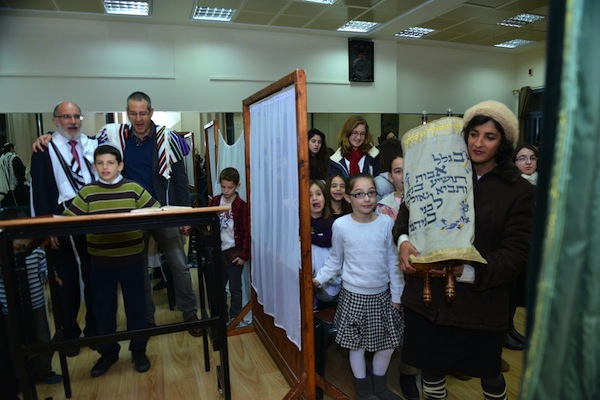
At Zemer Hazayit, a Modern Orthodox congregation in Efrat, when the Torah reading is finished, the scroll is passed from the men’s side to a woman who takes it through the women’s side. (photo from David Bollag)

Ten years ago, a group of people in a Modern Orthodox congregation in Efrat, a Gush Etzion settlement, decided they wanted women to be more involved in their synagogue services. The majority of the congregation was reluctant, however, so they set out to form a community of their own.

They consulted with Efrat’s chief rabbi, Shlomo Riskin, about the idea and, he said, “Listen, I don’t think it should be the only reason why you would start a new community – the position of women. Why don’t you also make it special in terms of prayer and make it kind of a song?” So, they named the community Zemer Hazayit (Song of the Olive). “There was strong contact with the head rabbi from the very beginning,” said Rabbi David Bollag, spiritual leader of Zemer Hazayit.

Bollag, originally from Switzerland, made aliyah 25 years ago. He has been with the community for the past eight years. He still flies home eight times a year to teach at two Swiss universities, the University of Zurich and the University of Lucerne.

“My field is Jewish philosophy, but I also teach some Jewish history, Bible, whatever they need in the institutes,” he said.

“Our congregation is Modern Orthodox. In Modern Orthodoxy, in almost every aspect of life, women are fully integrated and emancipated, and have almost the same role as men – socially, professionally, in politics and at home. They have the same rights, almost the same education possibilities.”

Ever since Zemer Hazayit opened its doors, the community has been growing. It has some 200 community members today. While this community is new to Efrat, there are many like it elsewhere.

“The process that is taking place is a slow development,” said Bollag. “More and more, laymen and rabbis realize the difference between normal life and religious life isn’t sitting well with most people.” While women are intellectually engaged at schools, workplaces and in politics, he said, “when it comes to religious life, they’re treated like second-class citizens, and they are just going to leave religion or consider it something primitive. For that reason, changes have to take place.”

While people see the need, they also understand that change takes time to be accepted. “That’s why the process is very slow, sometimes very painful – there’s a lot of opposition,” said Bollag.

The tensions and discussions are not only between their community and the rest of Efrat’s Modern Orthodox communities, but within Zemer Hazayit, as well.

“We definitely have people who are more progressive, who are interested in more changes, and others who are much less,” said Bollag. “Not only do we have to find the right balance between introducing new things and making sure we remain within the limits of Modern Orthodoxy, we also have to make sure we find the right balance that’s OK for everybody in our community.”

When Bollag was asked to be the community’s rabbi, one of the first things he wanted was to have an official meeting with members of other neighborhood synagogues. “I wanted to make sure to explain to them what we’re interested in doing, to make sure they would fully accept us,” he said. “They don’t have to agree with us, but I would like them to be accepting.”

photo - Women at Zemer Hazayit return the Torah scroll to the ark
Women at Zemer Hazayit return the Torah scroll to the ark. (photo from David Bollag)

Zemer Hazayit first gets Riskin’s blessing before implementing any proposed changes. So far, these changes have included splitting the prayer room in the middle from front to back, giving women equal access to the ark and, when the Torah reading is finished, the scroll is passed from the men’s side to a woman who takes it through the women’s side and then places it back in the ark.

“One of the main issues being discussed at the moment is whether or how women can read from the Torah,” said Bollag. “So, we have, about once in two months, a reading of the Torah by women, but just among women.”

At the moment, the opinion is that they cannot have women reading for men. “So, we separate for that reading – the women are in one place and the men in another,” said Bollag. “Women read for women. We usually also do that when there’s a bat mitzvah, as most of the girls are interested in reading Torah.

“Also, women say Kaddish – that goes without saying in our community – even if there is just a woman and no man.”

According to Bollag, the ordination of women in Reform synagogues has influenced Modern Orthodox congregations, as well, noting that these communities now will hire a woman as part of the discussion, including as a rabbi/spiritual leader.

“When they approached me about being the rabbi of this community, we made it very clear that it isn’t just me, but also my wife who will be very involved in leading our community,” said Bollag. “We also put a lot of emphasis on integrating children into the services as much as we can.”

Zemer Hazayit is currently raising funds to build a synagogue, as they have outgrown the room they have been using in a local school. For more information, visit buildzemerhazayit.org.

Rebeca Kuropatwa is a Winnipeg freelance writer.


LEAF works for equality

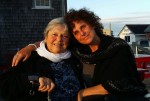
Michele Landsberg and her daughter, Ilana Landsberg-Lewis. (photo from West Coast LEAF)

Michele Landsberg and her daughter Ilana Landsberg-Lewis laughed and spoke over each other in an animated joint telephone interview with the Jewish Independent. The two women, who are among Canada’s most influential activists, agreed more than they disagreed, and their ideas and opinions flowed and meshed in a way made possible perhaps only through a lifetime of dialogue.

The mother-daughter duo will be keynote speakers at West Coast LEAF’s Equality Breakfast March 11. West Coast LEAF was founded in 1985, alongside its sister organization, the Women’s Legal and Education Action Fund (LEAF National), to ensure that the promises contained in the Canadian Charter of Rights and Freedoms would become a reality for women in British Columbia. West Coast LEAF’s founders recognized that there would be challenges and great potential in putting the abstract legal rights of Section 15 (the equality provision) into action through the courts. The annual Equality Breakfast generally falls around International Women’s Day, which is May 8.

Landsberg is a writer and social activist who wrote for the Globe and Mail and Chatelaine before a 25-year run as a columnist for the Toronto Star. An officer of the Order of Canada, Landsberg’s name is synonymous with feminist perspectives on Canadian and global events.

Landsberg-Lewis is a labor and human rights lawyer. She is the executive director of the Stephen Lewis Foundation, which she co-founded with her father, the former leader of Ontario’s New Democratic party, who also served as Canada’s ambassador to the United Nations. The foundation works with grassroots organizations in sub-Saharan Africa to turn the tide of the AIDS pandemic.

Landsberg-Lewis said she never felt any pressure to go into the family business. In addition to her mother’s writing and activism and her father’s political and diplomatic career, her grandfather David Lewis was leader of the federal NDP.

“There was always interesting and lively conversation,” she said. “Whatever column Mom was writing, whatever Dad was doing … all three of the kids, but I was the eldest, were encouraged to be part of that thinking and lively debate. Yes, I landed very firmly a millimetre away from the tree but, if you ask me, that was the right place to be.”

In her work with her father, Landsberg-Lewis sees the catastrophic advance of AIDS in Africa, but is also inspired by the responses of women who are, she said, “the most affected and infected” by the disease.

“They’re bearing the brunt of the apocalypse of AIDS, they are raising the children, they are pulling their communities together, they are the ones who are trying to effect change, they are the ones who are most adversely affected by discriminatory laws and, on that level, it’s pretty grim,” she said. On the other hand, she continued, despite global funding for fighting AIDS flatlining, affected women are stepping up.

“Take the grandmothers, for instance, who are raising 17 million orphaned children, who were living in isolation, stigma, absolute abject poverty, and were terribly grief stricken because of the loss of their adult children, and they get up the next morning and they look after all these kids. And more than that now – you see that they are beginning to run for local councils and land rights councils and they’re pushing for pensions and pushing for better health care for older women, and so there’s a groundswell of demands for their own rights to be recognized,” she said. “The world is being negligent. This is not surprising or unusual when it comes to women, but the women themselves, as usual, are not waiting for that support, they’re just making it happen.”

Back in North America, a whole different type of change is happening, both mother and daughter agree. Feminists who remember the fights of the 1950s and ’60s are coming up against a generation of young women with a very different idea of what equality and feminism mean. The recent comments by former U.S. secretary of state Madelaine Albright and feminist icon Gloria Steinem, who is a friend of Landsberg’s, nearly led to inter-generational warfare on social media.

Steinem apologized for her comment that young women are abandoning Hillary Clinton’s campaign for Bernie Sanders’ “because that’s where the boys are.” Landsberg blames a grueling book tour and Steinem’s emphatic support for Clinton for the comment, but added she thinks Steinem was getting at an important point when she misspoke.

“I think she meant that young women are still swayed by the power dynamics of our very gendered system, our gendered culture,” said Landsberg. “Boys have more clout and presence in the political world and young women tend to take their cues from them still, quite often, not always, obviously. I think that’s what she meant: that they are swayed by young men’s enthusiasm for Bernie.”

Landsberg-Lewis interjected, contending that the division between Clinton and Sanders supporters is based on ideology more than gender.

Landsberg, who admits she has never shared her friends’ enthusiasm for Clinton, leapt on Albright’s comment, “There is a special place in hell for women who don’t help other women.”

“If we really want to get it right, her quote is misguided,” Landsberg said. “It should be ‘there’s a special place in hell for women who don’t support feminist women.’ Not just any woman, because there was [British prime minister Margaret] Thatcher.”

Clinton, Landsberg said, is “not the kind of woman we can look to to undo the power that has oppressed many, many people.… She is part of the establishment, she is backed by Wall Street, she has endorsed many wars and would endorse more wars as president.”

The rise of Sanders, the democratic socialist whose campaign bills itself as a movement for change, is a good sign on several fronts, say the two. Feminism, among other movements, has struggled in the face of American individualism. This is something that differs in Canada, they agreed, but may signal a revival of movement feminism as more Americans hear Sanders’ message of shared responsibility.

“He’s talking about collective responsibility for changing the situation of women, collective power in collective action and vision,” said Landsberg-Lewis. “And I think that’s an extraordinarily powerful antidote to the individualism that has, I think, for young women – not all young women, not all the time – but has eclipsed the sense of feminism as really being about a movement as opposed to individual power.”

Moving to Canadian politics, mother and daughter both expressed optimism.

“I think the whole country woke up the day after the election and realized that that bad headache they’d had for 10 years was gone,” Landsberg said, laughing. “I think we had a nationwide depression under that grim regime and people felt a sense of relief that we had a new beginning.”

She’ll be watching the new government’s approach to a national child-care plan and worries that Trudeau may be too insulated in the world of “nannydom” to understand that affordable child care is key to women’s equality.

“It is very exciting to have a prime minister who runs around calling himself a feminist,” said Landsberg-Lewis. “I think that that is not a small thing. It’s a first time thing and it’s a big deal.”

“I am thrilled Michele and Ilana are coming together for our Equality Breakfast,” said West Coast LEAF interim executive director Alison Brewin. She said, “The fact that they are mother and daughter reflects the intergenerational nature of the fight to advance women’s equality. West Coast LEAF uses the law to make change, but the work comes in waves that catch and move mothers and daughters, fathers and sons – Michelle and Ilana represent our national struggle for justice.”

Tickets for the West Coast LEAF Equality Breakfast March 11, 7 a.m., at Fairmont Hotel Vancouver are $90 (tax receipt for eligible portion) from 2016equalitybreakfast.eventbrite.ca.