Skip to content
  • Home
  • Subscribe / donate
  • Events calendar
  • News
    • Local
    • National
    • Israel
    • World
    • עניין בחדשות
      A roundup of news in Canada and further afield, in Hebrew.
  • Opinion
    • From the JI
    • Op-Ed
  • Arts & Culture
    • Performing Arts
    • Music
    • Books
    • Visual Arts
    • TV & Film
  • Life
    • Celebrating the Holidays
    • Travel
    • The Daily Snooze
      Cartoons by Jacob Samuel
    • Mystery Photo
      Help the JI and JMABC fill in the gaps in our archives.
  • Community Links
    • Organizations, Etc.
    • Other News Sources & Blogs
    • Business Directory
  • FAQ
  • JI Chai Celebration
  • JI@88! video

Recent Posts

  • Sharing her testimony
  • Fall fight takes leap forward
  • The balancing of rights
  • Multiple Tony n’ Tina roles
  • Stories of trauma, resilience
  • Celebrate our culture
  • A responsibility to help
  • What wellness means at JCC
  • Together in mourning
  • Downhill after Trump?
  • Birth control even easier now
  • Eco-Sisters mentorship
  • Unexpected discoveries
  • Study’s results hopeful
  • Bad behaviour affects us all
  • Thankful for the police
  • UBC needs a wake-up call
  • Recalling a shining star
  • Sleep well …
  • BGU fosters startup culture
  • Photography and glass
  • Is it the end of an era?
  • Taking life a step at a time
  • Nakba exhibit biased
  • Film festival starts next week
  • Musical with heart and soul
  • Rabbi marks 13 years
  • Keeper of VTT’s history
  • Gala fêtes Infeld’s 20th
  • Building JWest together
  • Challah Mom comes to Vancouver
  • What to do about media bias
  • Education offers hope
  • Remembrance – a moral act
  • What makes us human
  • המלחמות של נתניהו וטראמפ

Archives

Follow @JewishIndie
image - The CJN - Visit Us Banner - 300x600 - 101625

Tag: democracy

קנדה נאבקת בענקיות התקשורת

קנדה נאבקת בענקיות התקשורת

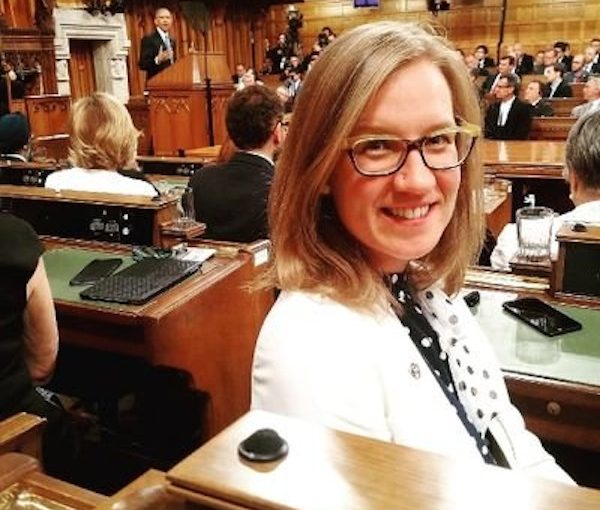
השרה קרינה גולד. (Twitter)

ממשלת קנדה מתכוננת במלוא המרץ לבחירות הכלליות שייערכו בחודש אוקטובר הקרוב. הממשלה מעוניינת למנוע מעורבות חיצונית כפי שקרתה במערכת הבחירות האחרונות בארה”ב. הממשלה בוחנת את האפשרויות שונות בהן: חקיקה חדשה שתחזק את הפיקוח על הרשתות החברתיות המובילות.

הממשלה הקנדית צופה שקרוב לוודאי יהיה ניסיון של התערבות חיצונית בבחירות הפדרליות שייערכו באוקטובר. ולכן היא שוקלת להגביר את הרגולציה כדי לפקח משמעותית על חברות הרשתות החברתיות. זאת כדי להבטיח חסימה עד כמה שאפשר של התערבות גורמים זרים שמחוץ למדינה, בהליך הצבעה. כך מסרה לאחרונה השרה אחראית על טוהר הבחירות של קנדה, קרינה גולד.

השרה גולד אמרה את הדברים לאחר פרסום דוח מיוחד של סוכנויות ביטחון הקנדיות השונות על פעילות של מדינות אחרות, ברשתות אינטרנט, כדי להתערב בהליך הבחירות במדינה. “להערכתנו יש סיכוי גבוה שהמצביע הקנדי ייתקל במעורבות של גורמים זרים שונים ברשתות האינטרנט, בהקשר של הבחירות הפדרליות באוקטובר השנה”, כך נכתב בדוח של סוכנויות הביטחון. “עם זאת המעורבות בבחירות כאן צפויה להיות בהיקף קטן יותר, לעומת המעורבות הרוסית בבחירות לנשיאות בארצות הברית לפני כשנתיים וחצי”. אגב הדוח לא ציין מי הן המדינות שעשויות לנסות ולהתערב בבחירות של קנדה.

השרה גולד ציינה במסיבת עיתונאים שקיימה באוטווה הבירה: “הבחירות בקנדה הן מטרה לאלו שמעוניינים לערער את יסודות הדמוקרטיה שלנו”. גולד יצאה בדברי ביקורת ישירים נגד ענקי התקשורת השולטים במדיה החברתית: גוגל, טוויטר ופייסבוק. וזאת על כך שהם לא מספקים מידע לממשלת קנדה, כפי שהם סיפקו לממשלות אירופה השונות בחודשים הארונים, על מאמציהם לעצור התערבות זרה בבחירות. “אין לנו שום התקדמות עם גוגל, טוויטר ופייסבוק בנושא זה. החברות מסרבות לעדכן באופן סדיר את הרגולטורים בקנדה, על הפעילות שלהן למניעת התערבות זרה בבחירות הקרובות. שיהיה ברור: החברות צריכות לקחת את הנושא ביותר רצינות”, הוסיפה עוד השרה גולד.

ראש מחלקת המדיניות הציבורית של פייסבוק בקנדה, קווין צ’אם, אמר לאמצעי תקשורת המקומית את הדברים הבאים: “פייסבוק מתכננת להציג חוקים חדשים עבור פרסומות פוליטיות בתשלום”. הוא הדגיש כי פייסבוק עושה כל מאמץ לחסום התערבות זרה בבחירות הקרובות בקנדה. ראש מחלקת המדיניות הממשלתית של גוגל בקנדה, קולין מקיי, אמר את הדברים הבאים: “נציגי גוגל מיוזמתם נפגשו כבר מספר פעמים עם מספר רשויות ממשלתיות כדי לדון בשקיפות, אבטחת מידע וכן אבטחת סייבר”.

השרה גולד מסרה עוד כי ממשלת קנדה בוחנת כיום את שלל החוקים שלה כדי לראות כיצד ניתן להשתמש בהם, כדי לנקוט בכל האמצעים נגד חברות הרשתות החברתיות, כדי למנוע התערבות זרה בבחירות כאן. הממשלה שוקלת אף להתקין חקיקה חדשה בנושא. בנוסף קנדה בוחנת את הצעדים שנוקטות מדינות אחרות בעולם כלפי הרשתות החברתיות. למשל בריטניה שהכריזה על הקמת גוף רגולטורי טשר מפקח על הרשתות החברתיות. ואילו אוסטרליה עומת זאת שינתה את החוקים במדינה כך שבין היתר, מנהלים של רשתות חברתיות עשויים להישלח לכלא, אם הם לא יסירו תוכן אלים מהרשתות החברתיות עליהם הם אחראים.

לסיכום הנושא אמרה השרה הקנדית גולד: “הרשתות החברתיות הצליחו עד כה להימנע מלשאת באחריות לגבי מה שמתרחש בפלטפורמות שלהם. זאת כידוע כבר זמן רב מדי. הממשלה הליברלית הקנדית החליטה כעת לשנות את הגישה כלפי חברות הרשתות החברתיות. בעבר חזרנו אחריהן ומשכנו אותן לכאן כדי לפתוח מרכזי הנדסה ומסחר, ובייחוד בתחום הבינה המלאכותית”.

Format ImagePosted on May 8, 2019May 1, 2019Author Roni RachmaniCategories עניין בחדשותTags Canada, democracy, elections, Facebook, Google, Karina Gould, Twitter, בחירות, גוגל, דמוקרטיה, טוויטר, פייסבוק, קנדה, קרינה גולד

Strongmen bromance

Binyamin Netanyahu appears comfortably ensconced in the Israeli prime minister’s office after last week’s elections. While his Likud bloc effectively tied for seats with the upstart Blue and White party, the smattering of smaller parties are mostly of the nationalist, religious and right-wing bent, meaning Netanyahu will have a fifth term as leader. If he hangs on until July, he will surpass David Ben-Gurion as Israel’s longest-serving prime minister.

The likelihood that he will reach that mark seems good. He faces probable criminal charges but that does not necessarily mean the end of his career. Rumours are rife that he is considering a legal escape hatch that would permit him to remain in office even if indicted or, more likely, make it illegal to indict a sitting prime minister. In most democracies, at most times in recent history, such a move would be seen as intolerably corrupt. Times change.

The leaders of democracies today are blazing new trails. The words and actions of the U.S. president confound our capacity for incredulity. Jaw-dropping statements of contempt, bigotry, juvenile pique and lies emanate from his mouth (and Twitter fingers) faster than the outrage can follow. Across Europe, far-right extremist parties are rising, as they did in elections in Finland on the weekend. In Britain, which is convulsing from self-induced Brexit trauma, the leftist Labour party is engulfed in an antisemitism crisis. Positions and statements that would have been unthinkable in the civil discourse of recent decades are suddenly at the centre of public discourse in democracies everywhere.

Israel is no exception. During the recent election campaign, candidates expressed erstwhile unspeakable ideas, including a scheme to ethnically cleanse the West Bank of Arabs and annex the land to Israel. The advocate of that idea was soundly defeated – the Knesset democratically cleansed of his ideology when the party failed to reach the 3.25% minimum vote to enter parliament.

But Netanyahu himself floated some astonishing trial balloons during the campaign. He mooted annexing West Bank settlement blocs into Israel – a concept that is not ludicrously beyond the pale since, if a negotiated settlement ever emerges, it will likely include such a move in exchange for traded land. But he also suggested annexing settlements that are not adjacent to or contiguous with Israel’s recognized boundaries. Such an idea would create a patchwork in the West Bank along the lines that would make an independent Palestine unworkable. The fact that the incumbent prime minister opened this political Pandora’s box is evidence of a new willingness to play with potential fire.

That foot play with extremists is not limited to domestic affairs. If an Israeli Rip Van Winkle fell asleep a couple of decades ago and woke up to Israel’s current diplomatic situation, he would be confused and possibly delighted. If that Van Winkle shared our worldview – an apparently old-fashioned belief in pluralistic, inclusive, universal humanitarian values – he would quickly conclude that the prima facie bonanza of goodwill has a rotting core.

As former Israeli ambassador to the United Nations Ron Prosor said Sunday night (see cover story), Israel has open lines of communication with countries that for decades steadfastly rejected its very existence. Likewise, Israel has excellent relations with some of the most populous and powerful countries in the world – India, China, Russia, Brazil and, in different but important ways, a refreshed, familial relationship with the current U.S. administration.

Israel has superb relations with these countries, and with the Philippines, as well as with Hungary and other eastern European states that have traditionally been problematic for the Jewish state. That seemingly good news is tempered by the fact that these good relations are not based on conventional diplomatic alliances. To a large extent – especially in the cases of Hungary, the Philippines, Brazil, Russia and the reinvigorated bonhomie between the leaders of Israel and the United States – these close relations are based on a shared strain of politics that fill us with more nervousness than naches.

These relationships are less between Israel and Brazil or the Philippines or Hungary or Russia than a bromance between Netanyahu and Jair Bolsonaro, Rodrigo Duterte, Viktor Orban and Vladimir Putin, to say nothing of the continuing lovefest between Bibi and Donald Trump. Each of these figures is a strongman who is, to varying degrees, pushing the limits of their democracies to see how far they can stretch rule of law and diminish respect for human rights. With this in mind, the diplomatic warmth seems less about traditional bilateral relations than about a fraternity of nationalist, populist and authoritarian men leading the world down a path unimagined a decade ago.

With that background, Israel’s unprecedentedly improved relations with so many countries seems less positive a development. Our proverbial sleeper might pull the covers back over his head and hope for better in the decades to come.

Posted on April 19, 2019April 17, 2019Author The Editorial BoardCategories From the JITags Binyamin Netanyahu, democracy, elections, human rights, Israel, politics
The dangers of drones

The dangers of drones

An image of drones filling the sky from Reva Stone’s Falling. (photo from Reva Stone)

Multi-awarding-winning Winnipeg artist Reva Stone researched drones for three years and then began creating art to share some of what she had learned about how the technology affects our lives. The exhibit erasure, which comes from that research, features three works – Falling, Atomic Bomb and Erase. It is on display at the University of Manitoba’s School of Art Gallery until April 26.

“I’m very much an observer of what’s going on with new technologies, so when I saw the impact that UAVs [unmanned aerial vehicles] were starting to have – especially with war and changing the nature of war – I applied for and got a Canada Council [for the Arts] grant to do a lot of research and reading about what actually is happening,” Stone told the Independent.

She went so far as to get two quadcopters, to understand what they really sounded like, and hoping to use them in her art, which she has.

“I was working on this, and then I started thinking about our skies filling up with these commercial and militarized drones and how they were basically machines … that could fall out of the sky … that could crash into each other, that could bring down an aircraft. We were filling up our skies,” she said. “And then, about two years ago, I was reading and realized that we were now targeting not other countries, but targeting humans.”

photo - Artist Reva Stone’s exhibit erasure warns about the use of drones in our society
Artist Reva Stone’s exhibit erasure warns about the use of drones in our society. (photo from Reva Stone)

Stone ended up making five or six individual pieces that deal with different aspects of the use of drones, but relate to one another. Depending on the exhibition venue, she decides which ones will work best together in a particular space.

Originally, drones were developed for spying purposes for the military. Later versions were outfitted with weapons for protection and assault. More recently, commercial drones have been developed. Now, anyone can buy a drone for as little as $20. This easy accessibility is challenging our society, contends Stone, causing hazards to planes in airports, affecting people at parks and disrupting the peace.

“Drones are becoming these things that fly in the air that have no human controllers … that are almost autonomous,” she said.

Stone often uses computers, movies, motors and speakers to help fully immerse visitors in her art pieces.

The work Falling, she said, “is an animated video that I made that has to do with what I see as a very new future, wherein UAVs are ubiquitous, because of civilian, military, commercial and private use.

“It’s almost slow motion or balletic on a massive screen,” she said. “There’s constant falling out of the skies, sometimes flipping as they fall. Sometimes, there’s a drone that has exploded in the sky … sometimes, small and far away and, sometimes, they’re so big when they fall through the sky that they look almost life-size and you’ll have to back away from the screen … that will be the feeling you get. Then, sometimes, there are these little windows that open up and you look through, into another world, and that world is more about what we’re fighting about – the fact that we are actually using these to make war. Other than that, some of them are commercial, some are cute, some are scary looking … and it’s like a continuous rain coming down.”

Atomic Bomb is also a film.

“I started with an early atomic bomb explosion,” said Stone. “It was a 30-second film and I made it into an almost 20-minute video. I really slowed it down and altered the time to give the impression that the person in the exhibition space is looking at a still image caught in time. I show this video together with texts that I found speak to the history of the use of radio-controlled airplanes and UAVs, and to longheld ideas about collateral damage – the relationship between … the use of atomic bombs and the use of drones and collateral damage, which, to me, is a huge issue with the use of drones as military.”

photo - A single frame from Reva Stone’s Atomic Bomb video piece
A single frame from Reva Stone’s Atomic Bomb video piece. (photo from Reva Stone)

The first text is from Harry Truman, the American president who made the decision in the Second World War to use the bomb, and it reads: “The world will note that the first atomic bomb was dropped on Hiroshima, a military base. That was because we wished, in this first attack, to avoid, insofar as possible, the killing of civilians.”

The next one is from John Brennan, Central Intelligence Agency director from 2013 to 2017: “There hasn’t been a single collateral death because of the exceptional proficiency, precision of the capabilities we’ve been able to develop.”

According to Stone, “This is just bullshit. But this is part of the cleaning up of the media presentation of all these ideas and all these things I’ve been researching, that I’ve been noticing going on over time. And, it has actually made me change the name of the work. I was going to call all three of them a totally different name. Recently, maybe a month ago, I changed it to erasure because of the erasure of people, the erasure of a lot of critical dialogue that’s been happening since I started researching in 2015 … how we are mediated, what we are presented with as a culture. The info is so mediated by how it’s reported, and if it’s reported.”

Stone wants “her audience to consider how the capabilities of such technology may be turned against citizens and how governments might, and do, get away with employing them in the name of patriotism in ways that ultimately test the ethical and moral values of its citizenry,” notes the exhibit description. “With news cycles moving so rapidly, the reports of deadly events quickly fall from memory, seemingly erased from public consciousness.”

The third piece, Erase, is interactive. Stone said it is based on what, in her view, the Obama administration practised – the targeting of individuals based on algorithms, mostly guilt by association.

“With this one, I’m actually replicating the procedure,” she said. “I have my two quadcopters that are doing the surveillance and capturing people in the exhibition space, unbeknownst to them. Then, they get captured and saved.

“Then, it’s a process that goes on, that they get played back. And you begin to realize that you’re under surveillance, the people in the space. And, every so often, a target comes up over one of them, one of the captured images. It’s really intense and an explosion occurs, and that person actually comes out of my captured list. That person will never show again. They’ve been erased.”

The exhibit erasure opened Feb. 7. For more information about Stone and her work, visit revastone.ca.

Rebeca Kuropatwa is a Winnipeg freelance writer.

Format ImagePosted on March 15, 2019March 14, 2019Author Rebeca KuropatwaCategories Visual ArtsTags art, atomic bomb, cultural commentary, democracy, drones, military, privacy, Reva Stone, technology, war
Reflections on elections

Reflections on elections

(photo by Cynthia Ramsay)

Advance voting is underway across British Columbia for municipal elections that culminate Oct. 20.

There are many dedicated, informed people with excellent ideas running for office in Vancouver and in communities across British Columbia. This is especially fortunate, since this year saw what may be the greatest number of incumbents in recent memory opt not to seek reelection. Of the 10 members of Vancouver city council, for example, only three are running for reelection. (One is running for mayor.) Mayor Gregor Robertson is also leaving the scene.

A similar change is evident across Metro Vancouver, where an inordinate number of incumbent mayors and councilors have chosen not to continue serving. Part of this may be coincidence and part may be that new funding rules put in place by the province have made the task of running more challenging, in some ways. Whatever the reasons, Vancouver and many other communities face a major realignment in our local politics.

Especially at a time like this, it is a little disappointing that there are not more individuals from the Jewish community who have chosen to offer themselves for office. It has been encouraging, on the other hand, to see the number of people from the community who are volunteering on campaigns and taking a very active role in engaging with candidates. The candidates forum for several mayoral hopefuls, sponsored by the Centre for Israel and Jewish Affairs (CIJA) and the social service agency SUCCESS, was well attended. Another event, organized by CIJA and the Canadian Jewish Political Affairs Committee, allowed people to speak one-on-one with those who would like to be mayor of Vancouver.

There are, of course, not a lot of “Jewish issues” in local elections, though candidates for mayor addressed a number of things that are of concern to the Jewish community at a recent candidates forum. (For story, click here.) Ensuring that our municipalities remain welcoming, safe places for members of every ethnocultural community is a top priority. Part of that comes from people in positions of leadership leading by example. We have seen, in the United States, Europe and elsewhere, the licence that can be given to people with ill will when leaders choose to engage in incendiary language. It has been reassuring that there have, to date, been no serious incidents in local campaigns of overtly divisive language or strategies.

While the atmosphere has not been terribly divisive, division is the key word for traditional political parties in Vancouver.

Vision Vancouver, which has dominated the city for the last decade, has collapsed, not even managing to put up a candidate for mayor. The Non-Partisan Association (NPA) is a house divided, with at least two new parties emerging from disaffected former members.

The likelihood of independent candidates being elected to Vancouver city council and boards – as well as to the mayor’s chair – has probably never been greater. It could be an interesting mix for the next four years, with a constructive amalgam of different ideas coming together to synthesize into good policy – or it could be four years of chaos.

On the topic of chaos … a word about Vancouver’s at-large voting system. It is difficult enough to make an informed choice for the one position of mayor with 21 people contesting the race. It is an entirely different ballgame to try to make sense of the 137 candidates running for the 26 positions on city council, school board and park board. There is simply no way to expect reasonable, ordinary people to inform themselves adequately about this number of candidates.

Vancouverites have been floating the possibility of a ward system for decades but still face this daunting and compendious ballot every election. A ward system would not be without it faults – it could have the effect, for example, of elected officials representing their narrow constituencies against the broader interests of the city at large – but it would certainly permit average voters to become more familiar with the candidates who would represent them.

For now, though, this is the system we are in. And finding our way through it and voting with the best information we can access is the least we can do as citizens of a democracy. Despite the fact that local government is the one that has the most direct impact on our everyday lives, it is also the one that tends to attract the lowest voter turnout.

The last election saw a turnout of about 43%, which is comparatively good for a local election. (The one before that saw less than 35% turnout.) Some observers have suggested that the circus-like circumstances this year could help voter turnout, with so many new groups and independent candidates trying to get their supporters to the polls. Still, with 21 candidates for mayor – at least a half-dozen of them serious contenders – the possibility of someone taking the position with, say, 25% of the vote, is a real possibility. If turnout were to rise to a comparatively healthy level of, say, 50%, that would still mean the mayor has a mandate from a mere 12.5% of voters.

But, consider this from your perspective as a voter: the power of your one ballot to influence the outcome may be higher than ever.

Format ImagePosted on October 12, 2018October 9, 2018Author The Editorial BoardCategories From the JITags democracy, elections, politics, Vancouver

Civil dissent: a Jewish value

Last week, I participated in a survey on Canadian Jews done by the Environics Institute for Survey Research, in partnership with Prof. Robert Brym of the University of Toronto and Prof. Rhonda Lenton of York University. It’s considered a “landmark national survey of Jews in Canada in 2018.”

The phone call came at 5 p.m. This time coincides with making dinner, school lunches for my kids, feeding our dogs, and keeping the twins and dogs from roughhousing too much in the meanwhile. (Did I mention my biologist husband was away, doing field work?)

However, I knew this was important. This was a situation where my opinions and experiences mattered. I needed to contribute despite being the only adult present to address the chaos at my house.

Often, we think of politics, religion and money as things to avoid. They’re too emotionally laden to make good dinner conversation. Still, we need to talk and think about this to figure out where we stand. If one looks only at the Torah portion of the week, you might see it as black and white pronouncements about how one should behave or observe the commandments. Yet Oral Law is also part of Judaism. We care what the rabbis thought and discussed. Over thousands of years, our ideas developed, changed and grew. Those talmudic discussions include majority and minority opinions, as well as stories and sayings.

In our tradition, subtle differences matter. Opinions matter. According to the joke, if you ask two Jews, you’ll get three opinions.

That’s why I was stunned by the reaction to actress Natalie Portman’s choice to decline the Genesis Prize. In her statement, she lovingly celebrated her Israeli identity, her friends and family and her citizenship. She also explained that she felt uncomfortable with the current government, specifically, Prime Minister Binyamin Netanyahu’s choices, and its “violence, corruption, inequality and abuse of power.”

A torrent of media and political reaction followed, some of it hysterical in tone. The president of the Zionist Organization of America, Mort Klein, was downright misogynistic. He called the Harvard-educated actor and director “beautiful, but not too bright.”

Portman carries two passports as a dual American-Israeli citizen. Some called for her to be stripped of her Israeli citizenship. Since when is it OK to tell someone they can no longer be a citizen of a democratic country because she spoke out on political issues that concern her?

I’m a dual American-Canadian citizen. If I speak out on a political issue, I am within my rights as a citizen of (either) democratic society. I hear comments on Prime Minister Justin Trudeau’s government or U.S. President Donald Trump’s latest tweets wherever I go. All that said, some of those survey questions made me realize – I no longer feel comfortable publicly writing about or speaking either in support of Israel or criticizing Israel’s policies. Why?

All subtlety has dropped out of the conversation.

Old guard, right-wing Zionists who say “I stand with Israel” bristle whenever anyone says something critical of the current Israeli government’s policies. Meanwhile, anyone with liberal or left-wing politics feels uncomfortable with the notion that Israel would deport asylum-seekers, never mind the current violence with Palestinians or the reactions to their using the word “occupied.”

Many have given up even trying to discuss the issues. They don’t want to be attacked. Getting vitriolic responses from friends, acquaintances and family members, or a stream of emails about those “antisemites,” or worse, seems par for the course now.

A New York magazine article online, “Natalie Portman and the crisis of liberal Zionism,” helps explain the dilemma. Many younger North American Jews embrace liberal North American politics about equality and human rights, and feel disconnected from Israel. The old notion of a liberal Zionist or progressive supporter is no longer courted by Israel, either. The support of Christian evangelicals and a growing block of Orthodox, conservative voters might mean that some in Israel believe they no longer need the support of those liberal Zionists of old.

You may wonder why my columns don’t discuss Israel much. I’d respond with what Israelis told me as a teenager, living on an Israeli kibbutz. “If you want to weigh in on Israeli politics? Move to Israel and vote. Otherwise? We’ve heard enough from you North Americans.”

I tend my garden, as Voltaire says – I write about Judaism, religion, family and about where we stand as Canadian Jews. Our religion teaches us to learn, analyze and form opinions, like the rabbis do. As a citizen of both the United States and Canada, I defend wholeheartedly Portman’s right to speak out on politics and human rights issues that matter to her. It’s an essential part of free speech and the democratic ideal. One has to wonder whether the virulent reaction to her statement says more about Portman, or about the people who have responded so negatively.

In a democracy, we should be able to express well-considered opinions and disagree about things in a civil way, without fear of threats. Why would anyone consider it acceptable (Jewish) behaviour to threaten, embarrass or demean someone else? Many rabbis taught us: threats, embarrassment or denigrating others are just not Jewish things to do.

Joanne Seiff writes regularly for CBC Manitoba and various Jewish publications. She is the author of three books, including From the Outside In: Jewish Post Columns 2015-2016, a collection of essays available for digital download or as a paperback from Amazon. See more about her at joanneseiff.blogspot.com.

Posted on May 4, 2018May 2, 2018Author Joanne SeiffCategories Op-EdTags Binyamin Netanyahu, civil discourse, democracy, Genesis Prize, Israel, Judaism, Natalie Portman

Challenges in Mideast

The Russia- and Iran-backed Assad regime in Syria employed chemical weapons against its own citizens again last week. It’s hard to imagine that the atrocities in Syria could be any worse. Indeed, it is chilling to imagine what Syrian forces would be doing right now had Israel not neutralized that country’s nuclear capabilities in 2007.

Despite the horrific images coming out of Syria, much of the world’s attention, including that of the United Nations, was focused on Israel’s response to rallies on the Gaza border. It was striking to hear the outrage about Israel’s reaction to the Gaza events while a few hundred kilometres away the most atrocious acts were being perpetrated on a people by their own government. That said, the loss of life in Gaza is startling and we hope that the Israel Defence Forces can find non-lethal ways to defend against the protesters.

At the same time, it has been difficult not to be frustrated about the placement of blame. Portrayed by apologists as a peaceful rally – the so-called March for Return – the Friday events, for the second consecutive week, were a violent assault on the Israeli border. The planned action featured Gazans burning hundreds of tires in order to obscure the visibility of IDF soldiers. While tallying up the number of dead – 26 have been killed, according to the Associated Press Monday – it’s clear that the associations of some of the dead have been lost on most audiences, as at least 10 have been reported to be known combatants in the al-Aqsa Martyrs’ Brigade, Islamic Jihad and Hamas’ terrorist wings.

On Friday, the leader of Hamas in the Gaza Strip, Yehya Al-Sinwar, was employing what outside observers will likely dismiss as flowery rhetoric for domestic audiences when he exclaimed on Al-Jazeera that “We will take down the border [with Israel] and tear out their hearts from their bodies.”

Whether the actions of the IDF are deemed justified, the Diaspora community must continue to press for a non-military solution where possible and demand that the IDF remain restrained when demonstrators are unarmed. With a video surfacing that allegedly shows an IDF sniper shooting an unarmed Palestinian man while other soldiers cheer, there are calls for an investigation within Israel from across the political spectrum. As one Israeli politician said in the Times of Israel, “The battle isn’t just between us and Hamas; it is also for ourselves, for our values and for the identity of Israel society.”

It was, however, a leading figure in the Fatah government of Mahmoud Abbas, which runs the West Bank, who pointed out what should be obvious to the world. Dr. Mahmoud Habbash, a supreme judge in the Palestinian Authority Islamic court and Abbas’s adviser on religious and Islamic affairs, accused Hamas of “trading in suffering and blood, trading in victims” to get sympathetic headlines worldwide.

It seems to be working. “Solidarity” marches around the world included chants of “From the river to the sea, Palestine will soon be free.”

Against this backdrop, it may seem odd to raise the issue of Israel’s treatment of African refugees. As a Jewish newspaper, we feel it is our obligation to defend Israel from unjust accusations and attacks, and it is our duty also to condemn actions by Israeli governments or others that betray what we believe to be the just course.

Last week’s flip-flop by Prime Minister Binyamin Netanyahu was a disgrace and an insult to the values on which Israel prides itself.

A week ago Monday, Netanyahu announced an agreement with a United Nations refugee agency to alleviate a conflict about what to do with 38,000 African asylum-seekers currently in legal limbo in Israel by relocating about half of them to Western countries, including Canada. The next day, after getting pushback from right-wing members of his coalition and some aggressive residents of south Tel Aviv (where most of the migrants live) who want few or no migrants to remain in Israel, the prime minister reneged on the deal, seeking again to eject all 38,000.

As we have said in this space previously, it is ludicrous to suggest that 38,000 Africans – or half that – threaten the Jewish nature of the state. Neither, contrary to Netanyahu’s allegations, would the acceptance of these refugees – who fled violence and war – create a precedent.

If Israel wants to create a situation where it can avoid unwanted refugees while ensuring that it meets the obligations of a democratic state, it must develop the systems to appropriately adjudicate refugee claims. At present, situations like this – affecting the lives of 38,000 individuals – are being addressed arbitrarily and inappropriately. Israel, like Canada, Germany and other democracies, needs to have a standard by which the world’s homeless, who happen to find temporary refuge within its borders, are assessed and treated fairly within clearly defined legal parameters that recognize both the rights of individual non-citizens and the necessities of Israel, from the perspective of both the security of its citizens and the Jewish nature of the state. These are not incompatible objectives.

There is no shortage of challenges facing the Middle East. The situations in Gaza and Syria seem intractable. The fate of 38,000 migrants should not be so difficult to resolve.

Posted on April 13, 2018April 11, 2018Author The Editorial BoardCategories From the JITags asylum seekers, conflict, democracy, Israel, Middle East, Netanyahu, Palestinians, refugees, Syria

Merkel’s election win

Angela Merkel was returned for a fourth term as Germany’s chancellor on Sunday, defeating her main Social Democrat opponent, as well as a seemingly global surge toward populism. However, while she succeeded, her vote share declined – and the footnote of the election turns out to be the bigger story.

The far-right Alternative for Germany (AfD) party came third, taking about 13% of the vote and entering parliament for the first time. The result was as good as any polls had predicted, meaning that some people who voted for them probably didn’t feel comfortable sharing their voting intentions with pollsters. The party was formed just four years ago, amid an anti-immigrant and anti-refugee backlash in response to Merkel’s liberal approach to the crisis caused by the Syrian civil war. In response, Merkel reined in her liberal approach somewhat, possibly saving her party from defeat. Just a few months ago, Merkel’s reelection appeared to be in doubt.

The success of Merkel’s conservative bloc is a sign that, when push comes to shove, German voters trust her steady hand at a time when the European Union and the world is in upheaval. While immigration remained a central issue in the election, its potentially negative impact on Merkel’s chances may have been blunted by the overarching desire for stable government.

In the face of Brexit and various economic crises in EU member states over recent years, Merkel emerged as the unequivocal leader of the vision of European unity. German voters endorsed her overall approach. But the emergence of AfD is worrying, though not surprising. Extremist parties have been burgeoning all over Europe – and extremism is flourishing in the United States. It would have been stunning if Germany completely avoided this trend.

For their part, the Social Democrats had been in a governing agreement with Merkel’s conservatives and, as is often the case in such scenarios, found themselves at a disadvantage in differentiating themselves from the incumbent government when putting their case to voters. They may choose to rebuild their party from the opposition side, rather than form another coalition with Merkel. However, if they choose to cooperate with the conservatives, that will put the third-party AfD in the enviable position of official opposition. This would give the radical right grouping even greater prominence than their 13% vote share would seem to justify.

“We will change this country,” declared Alexander Gauland, a co-leader of the AfD, on Sunday night. These are eerie words coming from the leadership of a group that promises a return to traditional German “volk” values, glorifies the Nazis and has been accused of racism and antisemitism.

The extremists will have an unprecedented platform (at least in the postwar era) in German politics and, even lacking legislative power, will be able to give voice to ideas that have largely been taboo in the German body politic for the past 70 years.

Yet, we should not allow the dark lining to obliterate the silver cloud. The election secured a stable, reliable and moderate direction for Germany that is good for Europe, the world and, not incidentally, Israel.

In its manifesto, Merkel’s party acknowledged a “special responsibility of Germany toward Israel” and earlier equated the BDS (boycott, divestment and sanction) movement with the Nazi campaign to boycott Jewish businesses. Under Merkel’s leadership, Germany has continued and strengthened its very close alliance with the Jewish state. The German government has been a bulwark, to the extent that a single government can be, against the anti-Israel movements at the EU and the United Nations.

In election after election in Europe over the past year, worst-case scenarios have been avoided. Extremist parties have made inroads, but generally less than anticipated. The AfD’s relative success may be seen as a protest vote, in which case we may be seeing its zenith. In any case, Germans will now get a clear view of what the party stands for – and will have the opportunity to stand up in opposition to the divisive and xenophobic policies the AfD promotes.

Posted on September 29, 2017September 28, 2017Author The Editorial BoardCategories From the JITags Angela Merkel, antisemitism, democracy, elections, Germany, politics, racism
News, democracy and trust

News, democracy and trust

The Shattered Mirror: News, Democracy and Trust in the Digital Age, released on Jan. 26 by the Public Policy Forum, shines a light on the news industry in Canada, revealing it is reaching a crisis point as the decline of traditional media, fragmentation of audiences and the rise of fake news pose a growing threat to the health of our democracy.

When the PPF began thinking about a study on the state of the news media in Canada, in early 2016, the headlines were all bad. Within a fortnight in January 2016 alone, Rogers Media and Postmedia announced new rounds of staff reductions, Torstar revealed plans to close its printing plant, and Confederation-era newspaper titles in Guelph, Ont., and Nanaimo, B.C., were shuttered, the first of six daily papers to close, merge or reduce their publishing schedules before year’s end. The situation wasn’t much better on the broadcast news side, where revenues, especially in local television, followed the downward track of the newspaper industry, inducing the Canadian Radio-television and Telecommunications Commission to step in.
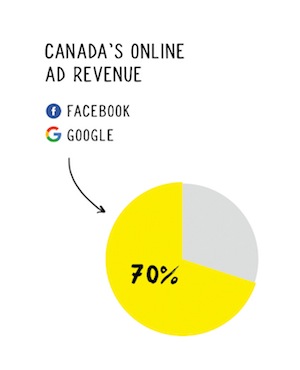
chart - Online ad revenue pie chart from Shattered Mirror ReportA parliamentary committee was formed. News companies and industry associations queued up with complaints of inequities in the marketplace. The Government of Canada contracted with the PPF, a non-partisan and independent think-tank, to assess the situation and make recommendations on what, if anything, should be done.

“The question for Canadian policy-makers is not whether given news outlets are in trouble, but whether democracy itself has been placed at risk in the process,” states The Shattered Mirror. “To the extent public policy has a role to play, it should be focused on maintaining the flow of information essential to a healthy society and ensuring the development of the digital arteries of the new information system – not preserving the press as we know it. The digital revolution is real, but with it have arisen challenges: fragmentation, distortion and adjusting to new business and storytelling models.”

After six months of study and discussions with close to 300 people, the report proposes recommendations aimed at ensuring that the news media and journalists continue in their role as the watchdogs over elected representatives and public institutions, and the connective tissue within communities.
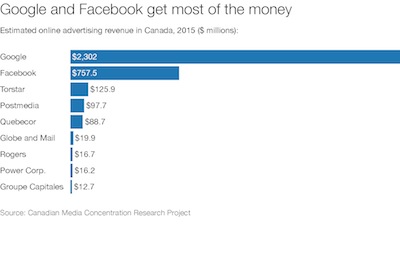
“This report is not about the journalists, with whom I feel great solidarity, but rather the role they play, and what we may be putting at risk if we are inattentive,” writes Edward Greenspon, president and chief executive author of the PPF and the report’s author. Greenspon spent more than 30 years as a journalist before joining the PPF.

“[Digital] platforms, with daily audiences 10 times larger than those of major newspapers or TV broadcasters, are not just the new intermediaries of the public square but control the commanding heights of the marketplace of ideas,” the report says. “Their models are based on truth neutrality. Moreover, they only give the appearance of being a common space. Rather, they calculate and reinforce the prejudices of the like-minded, who either assign themselves to echo chambers or find themselves invisibly assigned by algorithms into filter bubbles. Both run counter to the concept of the media as an agent of common understanding.”

The dominance of Google and Facebook delivers another blow to Canada’s main providers of news: the loss of revenue with which to fund quality journalism at scale. “They pocket two of every three digital ad dollars spent in Canada and, in recent months, have generated 82% of the ads served up with digital news.
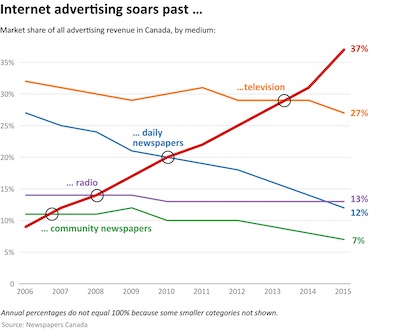
chart - Internet revenue, from Shattered Mirror Report“Google’s share of the Canadian digital market is almost 10 times that of the daily newspaper industry and 60 times that of community newspapers. A comparison of digital revenues for all newspapers and TV programs shows they bring in about one-seventh of the total of the two U.S. platform giants.”

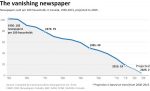
One result of this inequity? “Since 2010, there have been 225 weekly and 27 daily newspapers lost to closure or merger in more than 210 federal ridings,” notes the report. Small market TV stations have closed and many others, like surviving newspapers, have cut service and journalistic staff. Information supplied by Canada’s main media unions points to an estimated 30% reduction in journalism jobs since 2010.

Among the 12 recommendations are proposals for a new “local mandate” for Canada’s national wire service, The Canadian Press, ensuring there are more journalistic “boots on the ground” to supplement coverage of courts, legislatures and city halls; an indigenous journalism initiative to put more resources into communities and governments that are often overlooked; the launch of a service that provides much-needed legal advice to smaller outlets providing investigative and accountability journalism; and the creation of a research institute that would examine news and democracy issues more closely, including the distribution of fake news.

The report also calls for changes to Section 19 and 19.1 of the Income Tax Act to support civic-function journalism in Canada, whether by incentivizing Canada-centred news organizations to do more reporting or, for those that don’t, creating a revenue stream to support a Future of Journalism and Democracy Fund.

chart - Decline in newspaper ads, from Shattered Mirror ReportThree recommendations deal with CBC’s special role in Canadian news, including a call to relieve the CBC of the need to sell online advertising in order to promote production of civic-function journalism over chasing clicks.

Included in the PPF study is public opinion research by Earnscliffe Strategy Group, which conducted focus groups and surveyed more than 1,500 adult Canadians. Respondents “were very aware that ‘a lot of bogus and untrue news and information appears online’ (83%)…. Whereas seven out of 10 respondents completely or mostly trust their newspapers, radio and television, the figure drops to 15% for news acquired via social media.”

As chronicled by Craig Silverman, media editor of BuzzFeed, false news stories in the United States began to spike in August after the firing of Facebook editors, on top of the downgrading of material posted by established news organizations. Between August and election day in November, stories from hyper-partisan and hoax sources actually pulled ahead of real news, registering 8.7 million acts of engagement versus 7.4 million.

“While fake news takes just moments to make up, real news often requires days, weeks and even months of digging and verifying,” notes the PPF report, the title of which, The Shattered Mirror, pays homage to the 1970 groundbreaking Senate report on the mass media called The Uncertain Mirror. “Unfortunately, the state of the news media’s job in reflecting society back to itself is no longer uncertain,” Greenspon said.
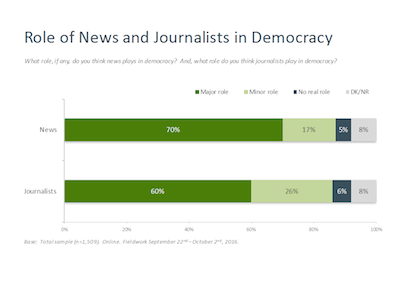
chart - Democracy poll, from Shattered Mirror Report“Never have Canadians had access to more information,” states the report. “But the capacity to produce original news, particularly of a civic nature, is severely constrained by the unsolved riddle of how to finance the cost of journalism in the digital age.”

The PPF media study was partially funded by Canadian Heritage and ISEDC (Innovation, Science and Economic Development Canada); the McConnell, Atkinson and Max Bell foundations; and four corporations, CN, TD Bank, Ivanhoe Properties and Clairvest Investments. However, the findings and recommendations are the PPF’s alone.

Greenspon concludes that Canada has already reached a “crunch point” in terms of the state of the news industry and its ability to fulfil its democratic responsibilities. “This report is meant to offer insight into the state of news two decades into its existential crisis, as well as ideas for how to respond,” he writes. “We hope it will stimulate a necessary debate and necessary action, while understanding no story is ever at its end.”

The full report can be downloaded at shatteredmirror.ca.

Format ImagePosted on February 10, 2017February 8, 2017Author Public Policy ForumCategories NationalTags democracy, journalism, media, Shattered Mirror

What now, America?

Many of our readers survived the predations of fascism or communism; some endured both. It is probably safe to say these people do not take democracy for granted, as some of us who have been fortunate to live our entire lives under democratic governments may.

For many of us, Remembrance Day is one of the few times in the year when we stop and take stock of our good fortune and the sacrifices that made it possible. This year, we should perhaps give even more consideration to the fact, which we have mentioned in this space before, that democracy is a remarkably new and fragile thing. What we recognize as modern democracy is an American invention just 240 years old.

There have been concerning noises in the birthplace of democracy leading up to the close Tuesday of this ugliest of presidential election campaigns. In addition to Donald Trump’s threats to not abide by the democratic decision of the people because of some imaginary “rigging,” much of his rhetoric has seemed deliberately calculated to undermine democracy and its parallel values of pluralism and respect for diversity. Trump’s behavior and language – and the vitriol and violence he inspired and encouraged among his followers – are antithetical to American democracy.

We should not fall into the trap of comparative blame. This was probably the nastiest campaign in American history, but that is not something we can ascribe equally to both leading candidates and their followers.

Hillary Clinton ran a negative campaign, yes, but only within the comparatively gentle parameters of what has become conventional in American politics of the television age. Trump’s campaign, on the other hand, was a blast furnace of hatred, ridicule, dehumanization, lies, racism, sexism and incitement.

One of the most important pillars of democracy is also one of the most ephemeral: the confidence of the populace in the institutions of governance. And polls indicate that Americans currently have extraordinarily low opinions of their officials.

The American people – and the new president (who was declared after the Independent went to press) – have an unenviable task ahead of them in restoring confidence in the system, in their institutions and in their ability to advance as the world’s beacon of democracy.

For the sake of their country – and for the sake of the magnitude of impact it will have on the rest of the world – we should all wish for a period of reflection, healing and reconciliation.

Posted on November 11, 2016November 11, 2016Author The Editorial BoardCategories From the JITags Clinton, democracy, presidential elections, Trump

The future of democracy

Israel’s President Reuven Rivlin spoke strong words at the opening of the Knesset’s winter session this week. The very survival of democracy, he suggested, is on the line.

“Against a background of political upheavals occurring in the West, the free world, it is no secret that democracy – or Western liberal democracy – is in a state of confusion,” said Rivlin. “Many citizens across the world feel that the existing democratic system is struggling to function and, moreover, is struggling to offer an answer to their needs in light of the current threat of terrorism, the current wave of migration and refugees, or the ongoing economic and employment crises.”

Rivlin was speaking broadly, apparently referencing the various movements springing up in recent years at the fringes of what was once the political mainstream. These include new nativist and often xenophobic movements in Europe. The vote by Britain to leave the European Union is a symptom of a strain of political ideology that rejects open borders – both for trade and for people. While the Brexit vote was supported by people across the political spectrum, its campaign was led by the United Kingdom Independence Party, a movement pushing its way into the mainstream from the far right.

While Europe struggles with the challenges of and reactions to economic meltdowns and waves of refugees and migrants, the presidential election in the United States has been rocked by events that also threaten foundational understandings of democracy.

Donald Trump, the Republican candidate for president, has suggested he may not abide by the results of the election, an outcome he is alleging to be “rigged.” There is no evidence, according to almost all commentators, of any rigging of the electoral system. Indeed, say most, the patchwork nature of the American electoral system makes comprehensive manipulation of a federal election essentially impossible. However, Trump’s assertions seem based less on the idea that the electoral infrastructure is rigged than on his perception that the media and the political establishment are nearly uniformly against him. As paranoid as this may seem, it is not altogether false. The political establishment, even in his own Republican party, is lukewarm at best toward their outsider nominee. And the media is merely reporting the attitudes of some of the public, many of whom are aghast and appalled at the successive emanations from Trump’s mouth.

However, if the establishment and commentators in the media are lined up against him, this should arguably be viewed as a statement about him, not them – which brings us back to the issue of Trump’s threatened refusal to admit defeat. Absolutely crucial to democracy is the legitimacy – and perception of legitimacy – of the electoral process. In the most contested election in modern history, in 2000, Al Gore accepted defeat even though he received more votes in the state of Florida than the declared victor George W. Bush and, therefore, should have been the winner. In the interest of national unity and the preservation of confidence in the system, Gore acceded to the determination of a Florida court.

Now, Trump suggests he may not accept the results even if he is conclusively defeated. Of course, anything is possible with this candidate, so it may be bluster. But the bigger picture in this scenario is the impact Trump’s words have on his followers. Some are already promising “revolution” if Trump is defeated.

Then, of course, there is the other possibility: Trump wins.

Where American democracy – and the country’s role as a model of responsible government – would go from there is an ominous mystery.

Posted on November 4, 2016November 3, 2016Author The Editorial BoardCategories From the JITags Clinton, democracy, Europe, presidential elections, racism, Trump, xenophobia

Posts pagination

Previous page Page 1 … Page 7 Page 8 Page 9 Next page
Proudly powered by WordPress