Feminism needs mentioning

While a recent panel called Israel, Canada and Me in the Age of Trump covered many topics well, there was a noticeable omission – feminism.

Three of the four panelists at the Peretz Centre on April 9 were women – Dr. Shayna Plaut, Ofira Roll and Rabbi Susan Shamash, with Eviatar Bach. But most participating audience members were male, with moderator Stephen Aberle having to solicit a question from a woman near the end to provide a semblance of balance. Perhaps the aggressive tone coming from the floor, not to mention the police protection, was stifling for some women.

The event sponsor, Independent Jewish Voices, Vancouver, requested the police presence because of a threat by another Jewish political group to disrupt the event. Thankfully, while some of the other group’s members were in the audience and were quite outspoken, a stimulating, heartfelt and combative exchange between the panel and an audience of about 40 people took place without incident. Unfortunately, the emotionally charged atmosphere shut down exploration of two pressing questions regarding the rights of Palestinians in Israel: the two-state solution and the ongoing Jewish settlements in East Jerusalem and the occupied territories.

It was noted that, at the core of the tensions for Jews is a fundamental contradiction: the injustices experienced by the Palestinians in Israel go against Jewish values and teachings. As well, while Prime Minister Binyamin Netanyahu’s support of President Donald Trump may be politically expedient, it is morally questionable. Separate from the panel discussion, an American news commentator caught my attention with the suggestion that German Chancellor Angela Merkel now stands as the most seasoned and capable leader among Western democratic nations. I would add a third adjective to describe her – compassionate.

Perhaps just as practising Christians who voted for Trump in the American election last November were able to close their eyes to the “unChristian” aspects of his words and actions, so too has a segment of Jewish people who support “part” of what Trump stands for. All these diverse outlooks and allegiances fit with Plaut’s assertion: despite our conflicted and incongruent ideas, it is important to wade in and “engage in the messy.”

As hard as this is to do within ourselves, the difficulty is magnified when we try to maintain or reach a respectful dialogue. Tolerance is all good and well, but what happens when some voices become intolerable – that is, in denial of the truth and in support of racism, bigotry, misogyny? What happens when power – even democratically elected power – is used to exploit and oppress?

The panel fully addressed the fears many of us are feeling, including the danger of making decisions based on this emotion and the fact that fear can lead to a “them versus us” mentality. Surprisingly fascism, rooted in this negative feeling, was only mentioned once during the afternoon talk, when Bach used it to describe his view of Israel’s body politic as the left becomes more “lethargic.”

On the whole, we can’t afford to become lethargic and we can’t exclude women’s voices in favour of a “muscular” political agenda. The Women’s March on Washington on Jan. 21, held in conjunction with hundreds of solidarity marches elsewhere, gave us a taste of our collective power, as I personally witnessed by participating with about 15,000 women and men in Vancouver. We garnered praise for a day that was peaceful, inclusive, positive – and global.

That historic action has since faded into a grim reality, as women (along with LGBTQ people and visible minorities) witness Trump, who has a lengthy record of misogyny, working alongside his almost exclusively white male cabinet, take backward steps on human rights. Government actions have included an executive order to block funding to organizations that support abortion services, a travel ban targeting some Muslim countries and the appointment of a Supreme Court justice that could lead to legal changes regarding women’s reproductive rights.

In contrast, Canadian feminists and their allies’ success in decriminalizing abortion remains uncontested. To his credit, Prime Minister Justin Trudeau pledged $650 million in March for women’s sexual and reproductive health around the world, stating “a lack of choices in reproductive health mean that they [women] either are at risk of death, or simply cannot contribute and cannot achieve their potential.”

But, when Trump applauded Trudeau’s initiative to organize a joint women’s entrepreneur project in February, many questioned how sincere this “pro-women” gesture was. A diversity of board members not only benefits women, but expands business approaches and ideas. And women are underrepresented at this level, only holding 18.8% of Fortune 1000 company board seats in 2015 and 20.6% of the seats on Fortune 500 boards. The Trump-Trudeau roundtable with North American businesswomen may have raised awareness on women’s value in the workplace, but did the session result in a significant step toward equality or simply provide an image-boost for the male leaders involved?

Certainly in stark contrast to Trump’s male-dominated inner circle is Trudeau’s cabinet, with half of its members female, appointed from a caucus where women comprise 27% of Liberal members of Parliament. However, Canada only ranks 50th out of 190 countries on proportion of national-level female politicians. As well, five of the 15 women in Trudeau’s cabinet are in junior positions.

In Israel, women have also been elected in greater numbers over time but men are still at the helm. Economic equality also eludes Israeli women at every level. This appears to be the narrative for women in most democracies, Scandinavian nations providing some important exceptions.

Systemic, rather than cosmetic, changes need to be made within institutions – including provisions for harassment-free parliamentary debate so female politicians can thrive without being subject to intimidation and emotional abuse. Indeed, all forms of violence faced by women from all walks of life must be addressed, most urgently among indigenous women in Canada, a long-ignored and tragic reality.

When policies impacting the vast majority of women are implemented, the ramifications are significant. Consider that women continue to be the primary childcare provider: according to Statistics Canada, women comprise 80% of single parents with a child and three quarters of part-time workers are women.

So why, again using Statistics Canada figures, do women make 87 cents for every man’s dollar – a gap even wider for visible minorities and immigrant women? Pay equity legislation is a move in the right direction and provinces that do not have this, such as Alberta, are shown to have a wider gap.

The spread of part-time, precarious jobs affects all workers, but especially women, and has led to a groundswell of campaigns across North America to raise the minimum wage. In British Columbia, 63% of minimum wage earners are women, according to the B.C. Federation of Labour, and these are not only teenagers – 80% of all minimum wage earners are over 20 years old.

Malala Yousafzai was recently bestowed with an honorary Canadian citizenship by the Trudeau government, her bravery and powerful messages to girls and women inspiring global admiration. She would undoubtedly agree that, in these politically uncertain times, we must strive for a climate of respect and tolerance and ensure women are an integral part of dialogues and policies.

Janet Nicol is a teacher at Killarney Secondary School in Vancouver, freelance writer and local historian. She has written previously about an early-20th-century Jewish-Canadian human rights lawyer, Israel Rubinowitz, for the Jewish Independent.

 

Being a woman in the IDF

From left to right, Staff Sgt. Maya, Sgt. Noam and Brigadier General (Res.) Gila Klifi-Amir at a Friends of the Israel Defence Forces program April 3 in New York City. (photo by Shiryn Ghermezian)

Israel’s female soldiers seem to break barriers on a consistent basis. In January, new figures revealed that the number of women serving in combat roles in the Israel Defence Forces’ Homefront Command is up 38% this year. Last month, the IDF launched a pilot program in which women will be trained as tank operators for the first time.

Indeed, the Jewish state takes pride in being an oasis for gender equality in a Mideast region largely bereft of women’s rights, and this attitude extends to Israel’s military. At the same time, for a nation facing ever-present security threats both internally and on its borders, gender equality has its limits.

“The mission of the army is to protect and win. We need to understand that the mission of the army is not equal opportunity,” Brigadier General (Res.) Gila Klifi-Amir, who has had a 30-year career with the IDF and served as an adviser on women’s issues to the military’s chief of staff, said April 3 in New York City.

Klifi-Amir moderated a discussion with three female Israeli soldiers – Sgt. Noam, Staff Sgt. Maya and Staff Sgt. Y, whose full names were withheld for security reasons – in a program hosted by the Young Leadership Division of Friends of the Israel Defence Forces, a nonprofit whose mission is “to provide for education and well-being” of IDF soldiers.

The soldiers on the panel all told JNS.org they have never felt discrimination for being a woman in the military, and that their male counterparts treat them with respect. Y described the interactions as “very, very professional,” and Maya – who commands an infirmary at her battalion’s headquarters – explained, “We train with the guys, we do everything like them. Inside the unit, everything is the same.”

Israel is the world’s only country where military service is obligatory for women. From ages 18-26, women must serve two years in the military – with some exceptions, such as if they are pregnant. Today, 95% of the IDF’s positions are available to women, according to Klifi-Amir.

Yet “equal opportunity” does not exist in the purest sense, the soldiers said. Klifi-Amir told the crowd she does not believe all military positions should be open for women, depending on the mission. The physical training required for some military roles may be too grueling for a woman’s body, and the IDF is responsible for the life of each soldier, she said.


Read more at jns.org.

Queen Esther in Vancouver

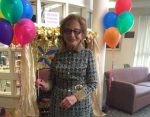
Goldie Kassen at Louis Brier Home and Hospital’s Purim party last year. (photo from Barbara Taranto)

There are not many news stories in print or online that laud the everyday work of women. Occasionally, studies are published regarding the status of women’s salaries relative to men’s, the position of women’s roles relative to men’s, the division of labour in the household, etc., but very little is published about the everyday life and sacrifices of women. When stories are published, they are most often about how women have contributed, as a female actor in a traditional male role, to the social and economic welfare of the greater community.

I do not have many “heroes.” I never quite got the appeal of adoring a public figure or wanting to model myself after a stranger regardless of his or her qualities. One person I do admire, however, is Justice Ruth Bader Ginsberg – obviously for her remarkable contribution to the U.S. Supreme Court, her leadership and her example to American women – but more for the non-public and under-appreciated value she has added as a mother and a grandmother.

Bader Ginsberg is very much like Queen Esther of Purim – a woman with a private life who serves the greater good in the public sphere. There were not, and are not, many opportunities to have a life like hers. But, ordinary women, women not in the spotlight, have been serving the greater good throughout human history – volunteering in the community, giving time, food, sustenance and support to help their communities not only survive, but thrive.

When I grew up, I often came home from school and stopped at the Jewish community centre to see my mother – Goldie Kassen – who was working in the kitchen with the other women of Hadassah, an organization’s whose name is Queen Esther’s Hebrew name. The women of Hadassah were very active in Saskatoon. There wasn’t a week that went by that they weren’t involved in some sort of social action or charity event. And, on the days they were not busy with Hadassah, they were involved in the sisterhood at Congregation Agudas Israel, performing vital ritual tasks for the mikvah, the chevra kadisha or distributing mishloach manot (loosely translated as gift baskets) on Purim.

This culture of volunteerism that was widespread and common in my youth seems to have disappeared. Many smaller Jewish communities do not have the congregation or the means to support these activities and many services have been taken over by professionals. Frankly, many women understandably do not want to volunteer for no pay.

When my father, z”l, died, my mother left Saskatoon and moved to Vancouver. She immediately volunteered for a seniors group, Hadassah and the sisterhood at Temple Sholom. She became an active member of her new community by giving first and receiving warmth and welcome in return.

For the past 28 years, my mother has volunteered at the Louis Brier Home and Hospital. She started out as a salesperson, one day a week, in the gift shop. Over the years, she took on more and more responsibility. Today, she manages the staff and the staff schedule. She does the buying for the shop, she does the books for the shop and she does special requests for those who have no family or aid. She works four days a week, every week.

The proceeds from the shop have been used to purchase diagnostic medical equipment, hospital beds, a barbeque for the residents and much, much more. She greets all the customers in a quiet and gentle way, and I know she is loved for her patience and her concern.

On the Louis Brier’s website, there is a very brief paragraph about the shop. No mention is made of the women who work there, not that they expect it, but it would be nice. I know that the shop is an integral part of the life of the residents and the staff at the home. I know that there are not many women left like my mother.

So, when my mom called and told me she was going to the Purim party last year as Queen Esther, I was especially proud. She was worrying over what dress to wear. In the end, she chose the evening gown my father bought her in Jerusalem in 1962. It was a beautiful dress then and it is a beautiful dress now. More importantly, the woman wearing the dress is beautiful – as beautiful as Queen Esther and as important as all those women who have kept the traditions alive and without whom we would be impoverished.

Barbara Taranto lives in Tel Aviv. A version of this article was published last year on her blog, btarantoaretz.com.

Korts fund education

Sol and Shirley Kort (photo from Alisa Kort)

Catherine Stoller, president of the Vancouver section of the National Council of Jewish Women of Canada, announces the Shirley and Sol Kort Family Award to HIPPY, which will enable HIPPY home visitors to pursue higher education in an accredited program. The award, $5,000 annually for five years, will be divided between two qualified applicants, to be adjudicated by the HIPPY board of directors.

The HIPPY program, originating in Israel and now operating in many countries around the world, is dedicated to ensuring that immigrant and refugee women can achieve the training and education they need to support their families and create a better future. The Kort family thus continues the dedicated and creative work of Shirley Kort, who was a longtime member of NCJW, and one of the key supporters of establishing HIPPY here in Canada.

Both Shirley and Sol Kort were community activists, focusing largely on the immigrant community. They were equally committed to the role of education as the key to better lives for everyone.

NCJW of Canada will be celebrating its 120th birthday this year – the Vancouver section has a history of 96 years! NCJW’s commitment to education, service and social action is demonstrated locally, nationally and internationally. Its members have worked with immigrant and refugee agencies for decades and NCJW is proud to celebrate the Kort family’s dedication to these issues.

Curiosity, activism, Judaism

Rebecca Baron gave a TEDx talk last year, calling for more encouragement and more opportunities for women in the STEM fields. Her nine-minute talk can be viewed at tedxkidsbc.com/rebecca-baron. (screenshot)

Rebecca Baron, a teenager who does research on air quality and speaks out about the gender gap in the sciences, has won the inaugural Temple Sholom Teen Tikkun Olam Award.

Baron will be given the award on March 5 at Temple Sholom’s Dreamers and Builders Gala, honouring world-renowned landscape architect Cornelia Hahn Oberlander.

“We are incredibly proud to be able to offer this Temple Sholom Teen Tikkun Olam Award to Rebecca,” said Temple Sholom Rabbi Dan Moskovitz. “Even at a relatively young age, Rebecca had demonstrated a passionate commitment to using her intellect and Jewish values to repair brokenness in our world.”

Baron, 16, is currently a Grade 11 student at Prince of Wales Mini School but has already been recognized nationally for her experiments on air quality. She won top medals at the Canada-Wide Science Fair in 2015 for research on whether bacteria found in household plant roots filter formaldehyde from paint fumes. Last summer, she won an award for the best business plan at a national student program focused on STEM (science, technology, engineering and math).

Baron said in an interview that she became aware of a gender gap in the sciences as early as Grade 3. As an example, boys and girls were interested in dissecting a fish when she was in kindergarten – she was so excited about the project that she decided at that moment to become a scientist. But when her class did a similar experiment in Grade 3, many girls were no longer interested. In subsequent years, she noticed how stereotypes, social pressure and cultural biases pushed many young girls away from the sciences.

She felt the curriculum that she experienced was not geared to encouraging girls to pursue studies in STEM. For instance, women were seldom portrayed as scientists in textbooks.

On their own, the incidents may not seem like much, but small things add up and contribute to an overall negative effect, she said. Statistics Canada in 2014 reported that women account for only 22% of the STEM-related workforce. Baron gave a TEDx talk last year calling for more encouragement and more opportunities for women in the STEM fields.

Baron attributed her unflagging interest in math and science to encouragement from family and friends. “It may be harder for others who do not have as much support as I have,” she said. “I just pushed through it.”

As her fascination with science developed, Baron began to conduct experiments at home, working on the kitchen counter. After winning awards, she “cold-called” academic researchers to ask if she could use their labs. Eventually, she found someone who said yes.

She now conducts her experiments after school in a lab at the University of British Columbia’s Life Sciences Institute. She also takes part in Science World’s Future Science Leaders program.

She linked her intellectual curiosity and social activism to values instilled by her parents and inspired by Judaism. She sees Judaism as valuing the strength and wisdom of women.

“The Torah emphasizes the emotional and physical differences between men and women,” she said in her submission for the Tikkun Olam Award. “However, these defining characteristic are not seen as inferior or superior to one another, but instead are considered to have cause for equal celebration.”

Baron went to Vancouver Talmud Torah for kindergarten, and from grades 3 to 7. Her bat mitzvah was at Masada, the Israeli mountaintop that symbolizes the determination of the Jewish people to control their own fate. As she stood amid the archeological ruins and looked toward Jerusalem, she felt a strong connection with the Jewish people. “It was a really neat experience,” she said. “I definitely did not expect that.”

She intends to use the Tikkun Olam Award money to help develop a nonprofit organization to encourage young women to pursue STEM and familiarize them with job-related opportunities.

Moskovitz said the annual Temple Sholom award is for a Jewish teen who is “doing the sacred and important work of tikkun olam,” regardless of affiliation or religious congregation.

The award was made possible by Temple Sholom members Michelle and Neil Pollack, who initiated efforts to create a prize recognizing teens who make a difference. Their generosity enabled Temple Sholom to make the Dreamers and Builders Teen Tikkun Olam Award an annual celebration and recognition of one of many inspiring Jewish teens in Vancouver.

Robert Matas, a Vancouver-based writer, is a former journalist with the Globe and Mail.

Inspiring Jewish connection

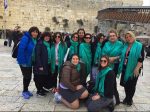
The recent Toronto Jewish Women’s Renaissance Project group in front of the Western Wall in Jerusalem. (photo from Nicole Pollak)

In its flagship program, Momentum, the Jewish Women’s Renaissance Project (JWRP) provides Jewish women and men, typically mothers and fathers, with a free journey throughout Israel (airfare is not included).

The trips – the women’s and men’s trips are separate – are designed for people who are not shomer Shabbat (Shabbat observant). As well, 90% of participants must have children at home under the age of 18, and participants must be physically and emotionally healthy.

Rebbetzin Lori Palatnik founded JWRP in 2008. Since then, it has become an international initiative bringing thousands of women and hundreds of men to Israel each year from 19 different countries.

“The goal is that the women have 10 incredible, uplifting, inspirational days together … and then go home and bring that back to their families and communities,” said Toby Bernstein of the Chabad Romano Centre in Richmond Hill, Ont.

Bernstein led a group of women on the program in December 2016, noting, “We decided to do this trip to encourage some of the women in our community to be more connected to Judaism.”

Bernstein took with her 10 women, “women who come to synagogue services, a couple Hebrew school moms [and] a couple preschool moms.”

These women joined 250 others from the United States, Canada, Russia, Greece and England.

“It was an inspirational trip, because there were classes every day [about] what it means to be a Jewish mom, a Jewish wife, to be a Jew altogether … what’s the purpose of life,” said Bernstein. “It got a lot of people thinking, so it was inspirational. Even me, who grew up with all of this, grew from [the trip] and gained new insight, new inspiration…. It was beautiful to see the women growing and taking it all in.”

One of the participants was Nicole Pollak, a business owner in Toronto along with her husband, Aaron; the couple has a 3-year-old, Sydney.

Pollak went on the trip with both of her sisters after her younger sister, Melissa Jacks, who sends her children to the Chabad Romano Centre, was invited to join by Bernstein.

“My sister came to me and said that Chabad Romano is going to be running a JWRP trip and asked if me and our older sister, Allyson Theodorou, were interested in going,” said Pollak. “We applied, and all three of us went on this trip together.

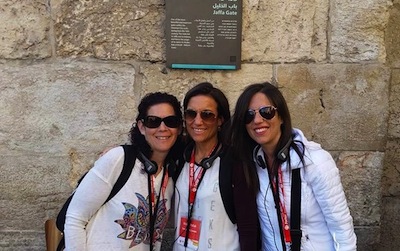
photo - Left to right, sisters Allyson Theodorou, Nicole Pollak and Melissa Jacks during a tour of the Old City, outside Jaffa Gate
Left to right, sisters Allyson Theodorou, Nicole Pollak and Melissa Jacks during a tour of the Old City, outside Jaffa Gate. (photo by Megan Epstein)

“We thought it would be an amazing experience to do this together, and to learn more about Judaism and Israel,” she said. “And I, personally, have been studying with a rabbi for about eight years. So, I really liked the idea that it was an educational trip to teach us more and give us more insight into Judaism and the religion, and thought it was a good opportunity to get some Jewish inspiration.”

Before leaving, Pollak had to do what she could to ready her daughter for her absence. “From an emotional standpoint, preparing my daughter that I was going to be away for that amount of time was very difficult for a 3-year-old,” said Pollak. “I don’t think she has a concept of time – 10 days, for her, could be 10 hours, 10 minutes or 10 weeks … [so it was hard to tell] her that I’m going away and what that means and that I’ll be calling her every day. Preparing for the trip on my end, it was not really that difficult. It was just a matter of packing and organizing.”

Pollak’s husband was very supportive of her going on the trip. When Pollak became anxious about leaving, it was her husband who helped push her through it.

“There were a couple of times where I contemplated whether I was even going to go. I thought it was going to be too stressful for the family for me to be gone,” said Pollak. “My husband was the one who said, ‘I support you whether you want to go or if you don’t want to go, but I’d be very disappointed if you didn’t go. I think that would teach our daughter we don’t do things because we’re afraid, instead of showing her to do what we want – to learn, to have an adventure or explore life. He was pushing me to go because he thought it would be an incredible opportunity to go to Israel, learn and spend that time with my sisters.”

From the moment Pollak arrived at the airport, she could feel the camaraderie of the women traveling, all with similar feelings about leaving home, and she began focusing on the trip and getting as much out of it as she could.

Each day of the program in Israel involved one or two discussions, lectures, lessons and classes, sightseeing and tours, and the opportunity to see something cultural or religious in the region. For Pollak, the learning was the best part of the experience.

“One of the things we learned was that there are three major mitzvot for a Jewish woman: lighting Shabbat candles, making challah and going to the mikvah,” she explained. “We had the opportunity to light Shabbat candles and to participate in a challah-making class. And, on our visit to Tzfat, we visited a mikvah and had a tour.

“One of the things they talked about is, if you’re a secular Jewish woman and you don’t have a lot of religion in your life, you should start with lighting Shabbat candles. My older sister, Allyson, had never lit Shabbat candles in her house in her whole life and she’s been married 18 years. In Israel, she bought Shabbat candles and, last Friday night was the first time ever she lit them in her house. That’s pretty amazing.”

As for challah-making, the sisters have committed to getting together sometimes on Friday nights and making challah for Shabbat. As for the mikvah mitzvah, Pollak plans to investigate it more before deciding whether she wants to make it a part of her life.

With respect to the sightseeing, visiting the Kotel was a major highlight for Pollak, especially after having had a class about prayer before going in a spot overlooking the wall.

“I heard a lot of people saying … they don’t know how to pray, they don’t know what that means,” said Pollak. “People will often go to the wall and pray for world peace or for their entire family to be happy or healthy. They pray for these big things because they think that, when you talk to G-d, that’s what you ask for – big things.

“Something they emphasized in that class was that praying is not about just big things, it’s about little things, too; it’s that we should pray about everything. You can pray that you want your little son Johnny to do well on his math test. You can pray that you hope that your daughter wins that award, or that next week your haircut is going to be great. The message was, pray for what’s important to you.”

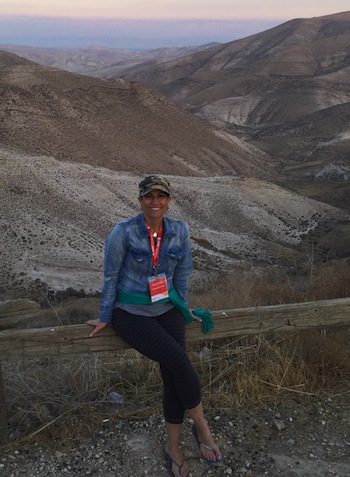
photo - Nicole Pollak at Eretz Bereshit, overlooking the Judean Desert
Nicole Pollak at Eretz Bereshit, overlooking the Judean Desert. (photo by Allyson Theodorou)

Another class that hit home for Pollak was one about judgment and perspective. In it, a story was shared that she has been telling people ever since. It was about a little girl who is standing in the kitchen with her mom, holding two bright red apples, one in each hand.

“She says to her mother, ‘Mommy, do you want one of my apples?’” said Pollak. “The mother says, ‘Yes, I do.’ So, the little girl proceeds to take a bite of one apple and then takes another bite from the other apple. The mother stops and thinks to herself, ‘Oh, you little brat.’ Then, the little girl puts her hand out to her mother and says, ‘Here, Mom. This one is sweeter.’

“That story really hit home and depicted that we judge based on what we see and not on what really is. I realized that it’s easy for us to judge based on what we think is happening. That story took me through the trip and really made me stop in my tracks every time I looked at someone or if I heard a story and judged what was going on with that person.”

Once back in Toronto, Pollak thanked G-d for the life that she has. She also discovered that her husband, mother-in-law and friends really stepped up and looked after her life while she was away. Her husband, she said, “appreciated me more, just like I appreciated him more when I came back.”

As a result of the trip, Pollak has decided to find ways to live her life with more intention and more appreciation for her marriage, focusing on the positive things in her life, as well as understanding the responsibilities of being a Jewish woman in one’s home.

“I think coming back made me realize that I have a responsibility bigger than I thought from a spiritual standpoint and that I’m going to live and work to do more of that,” she said.

A Vancouver JWRP group is being formed under the auspices of Vancouver Torah Learning Centre for a July 17-24 trip to Israel. For more information, contact Devorah Brody via e-mail at devorahbrody@gmail.com or visit jwrp.org.

Rebeca Kuropatwa is a Winnipeg freelance writer.

Mystery photo … Jan. 27/17

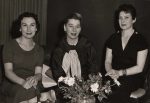
National Council of Jewish Women, 1955. (photo from JWB fonds, JMABC L.13956)

If you know someone in this photo, please help the JI fill the gaps of its predecessor’s (the Jewish Western Bulletin’s) collection at the Jewish Museum and Archives of B.C. by contacting archives@jewishmuseum.ca or 604-257-5199. To find out who has been identified in the photos, visit jewishmuseum.ca/blog.

Exploring power of women

Expectations – our own and others’ – can motivate us or constrain us. Two recently published novels feature strong (Jewish) women who must fight for their independence, battling not only parental, societal and other judgments, but their own self-conceptions. One book takes readers to the wilds of Arizona more than a century ago, the other takes us to a contemporary world of privilege in Boston. Both are internal, as much as they are external, journeys, and both are journeys worth taking.

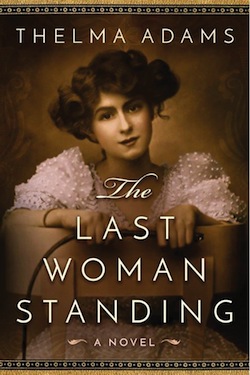
The Last Woman Standing: A Novel by Thelma Adams (Lake Union Publishing, 2016) is a fictional account of how Josephine Marcus met and fell in love with Wyatt Earp (and he with her). While the real-life Josephine apparently tried very hard to keep her and Wyatt’s private life private, Adams has mined what information exists and creatively filled in the blanks for the beginning, in 1880-1881, of their infamous romance.

Josephine defied all expectations when she ran away from home as a young teen in the 1870s and, though she returned, she didn’t do so for long. She left home again in 1880, at age 19, with a promise of marriage from Johnny Behan, a man she met on her first foray into the Wild West from the relative safety and security of San Francisco.

book cover - The Last Woman StandingThe daughter of Prussian Jewish immigrants who eked out a living on her father’s income as a baker, Josephine cannot bear to be contained by the strictures of society, her religion and her mother, whose story of coming to America is truly tragic. “I loved my mother but wouldn’t follow her down her path of righteousness and sorrow,” says Josephine in The Last Woman Standing. “We lived in a new world. She dwelled among old dybbuks.”


While the spirits of the dead might have haunted her mother, Josephine learned how brutal the living world could be when she arrived in Tombstone, Ariz. A shonda (shame) to her family – though her father and three siblings are portrayed as more understanding than her mother – Josephine becomes a shame to herself.

Johnny doesn’t follow through on his promises; in fact, he’s a cad who cheats and lies to get his way, including betraying Wyatt in order to become sheriff of the county. The position came with power, and money, but Johnny also knew of Josephine and Wyatt’s attraction to each other, so revenge was also a motivation. As well, Wyatt was a marshal – a position that deals with federal issues – and there was still unrest stemming from the Civil War. Johnny was friendly with the cowboy crowd, which generally voted Democrat and were sympathetic to the Confederates, if not Confederate veterans themselves, while Wyatt and his brothers were Republicans. These political differences no doubt played a part in the men’s animosity for each other.

Josephine eventually leaves Johnny, after one particularly harrowing experience in which he places her as a bet in cards and loses, and another in which she catches him mid-dalliance. On her own, she finally starts to understand a woman’s terrifyingly narrow set of survival choices – not that men were much more secure at that time and in that place. Wyatt must also fend for his life, and not just at the shoot-out at OK Corral.

All told, The Last Woman Standing is a fascinating tale, a western from a woman’s perspective, though it does drag a bit in places. It takes a long time in the narrative for Josephine and Wyatt to finally get together and they aren’t together for that long before Wyatt is a wanted man and must fight for his life. There’s a little too much of Josephine’s pining in the sections in which the lovers are separated, but, otherwise, this is a great read.

* * *

Good Girls by Shalta Dicaire Fardin and Sarah Sahagian (Inanna Publications and Education, 2016) is a young adult novel that not-so-young adults – women mainly – will also enjoy very much.

When we meet Octavia Irving, 15, she’s in the middle of hosting the party of her life at her family’s summer home. And she’s loving it, until her 19-year-old boyfriend leaves early with a bunch of his friends. Fortunately for her, as it turns out, one of those friends vandalizes a neighboring home.

book cover - Good Girls
Good Girls book cover

Octavia’s father gets the news during the bar mitzvah of his wife’s nephew. We find out that this is his second marriage and that he had walked out on Octavia’s mother during her pregnancy, “because his parents found her bohemian nature objectionable.” We also find out that he has issues with “her lax parenting style.”

So, while Octavia may come from a family with money to spare, the family dynamic is complex. As well, the expectations her parents have of her, and that she has of herself, are low. However, when Octavia tells her father the name of the culprit, and he calls her mother, she knows things are about to seriously change – “No matter how badly she misbehaved, her parents had never teamed up against her before.”

Allie Denning, on the other hand, is one of the “good girls.” She loves being a student at Anne Bradstreet College, an all-girls prep school in Boston. She follows the rules to the letter and is totally focused on doing the best she can. But, no matter what she does, because it comes from a place of privilege, it doesn’t seem good enough for her mother, the daughter of immigrants, who grew up in poverty but managed to get a scholarship to Columbia then go on to graduate with a PhD from Harvard. Allie’s father also went to Harvard and her great-grandfather was a president of the university, so expectations all round are that Allie will continue the legacy.

Again, a complex family dynamic. But one with which Allie more or less knows how to deal. As long as school is good, life is good. And that’s how Octavia throws a wrench into Allie’s world; she’s the bad girl who has been banished to the all-girls school, and she has the attitude to prove it.

One of Allie’s main sources of pride is being “the first 10th grader in ABC history to make captain of the debate team.” When Octavia tries out for the team at the behest of the school’s new guidance counselor, and makes it – showing a natural talent for debating – both Allie and Octavia must adjust. And, as the team gears up for a big competition, the girls must decide the person they want to be, whether or not that person meets their, or anyone else’s, expectations. The tension leading up to the debate is palpable and the reading compelling.

The cast of characters in Good Girls is diverse, and Allie and Octavia are not the only ones facing challenges and trying to figure out who they are. We meet fellow students and get to know the guidance counselor and other teachers, as well. The storyline doesn’t always go in the direction one expects, which is a great attribute for a novel. And, since it is a novel that is intended to be part of a series that will follow Allie, Octavia et al through their time at ABC, not everything gets resolved in this first instalment.

One of Inanna Publications’ priorities is “to publish literary books, in particular by fresh, new Canadian voices, that are intellectually rigorous, speak to women’s hearts, and tell truths about the lives of the broad diversity of women – smart books for people who want to read and think about real women’s lives.” With Good Girls, they have done just that.

Unique book group

The next novel up for discussion at the Jewish-Muslim women’s book group is The Red Tent.

One Sunday in July led to several new experiences for yours truly, a 23-year-old Jew living on Vancouver’s North Shore. For starters, it was my first time in a mosque, it was my first time in Delta and it was without a doubt my first Jewish-Muslim book gathering. Thankfully, it wasn’t my first time reading a book in less than 24 hours, as my decision to attend the gathering after seeing it mentioned in this very newspaper, was pretty spur of the moment.

The book group’s second-ever session was held at Baitur Rahman Mosque, a building that, upon first impressions, was slightly imposing – British Columbia’s largest mosque, dwarfing any synagogue I’ve come across – but which proved home to an incredible amount of warmth. The warmth began with smiles when I entered the room late – it was a longer journey than I expected – and continued through the entire two-hour session about the book (I Am Malala by Malala Yousafzai with Christina Lamb), and well into the snacks and chats afterwards.

Having been greeted by 30 or so women from both Jewish and Muslim backgrounds, there was the classic ice-breaker – going round in a circle, saying one’s name, a little bit about yourself and an interesting fact. I may not have been able to beat one woman’s fact (she used to be a stilt walker) but my relatively young age meant I stood out.

This lengthy introduction introduced me well to the thoughtful, kind group. In true Canadian spirit, they were from so many different places and cultures. The Muslim women in particular had a heartening appreciation for their country. One said she “liked Canada very much”; another one-upped her, exclaiming, “I am one of the luckiest people alive” for having been welcomed here. There’s no doubt that the women from both religions were of a progressive stance – the bulk of Jews was from egalitarian Or Shalom synagogue, while the Muslim women were part of the Ahmadiyya community, which has been persecuted relentlessly by more orthodox Muslim groups.

As conversation began about the book, it became clear that everyone was so lovely – was I the only person who hadn’t helped Syrian refugees settle in Canada? – that I began to wonder if the group was a case of “preaching to the converted.” Surely the people most ignorant, and most in need of education about other religions, weren’t the type who would turn up to this group? A cynic by nature, this worry stayed with me during the (fairly fleeting) discussions about the book and the (much longer) follow-up conversation about the link between religion and education, how and whether you can teach critical thinking, and other thought-provoking questions.

So, I reached out to the organizers from both sides. The email chains that followed gave me insight into two great communities and their prior interfaith ties, as well as into two pioneering women: Tiferet Welch from the Jewish community and Aisha Naveed from the Ahmadiyya Muslim Jama’at. They provided some strikingly similar answers to my questions, illustrating how much common ground can be found between the two religions (religions that, evidently, don’t always see eye to eye).

About why the book group came about, it seemed that the books were simply a way of facilitating discussion about religion itself. Welch said she decided to make the group happen after meeting some of the Muslim women, who “stated their knowledge of Judaism and, hence, Jews, was extremely limited,” but they were “fueled with a strong desire to know more.” Naveed said “the book club was initiated to remove common misconceptions between the Jewish and Islamic faith,” explaining to me how her community believes in interfaith dialogue to “encourage learning” and “prevent ignorance.”

The women were also on the same wavelength about the group’s future – Naveed called it “an organic venture” and Welch said “we want to see it progress organically.” They were both proud of what it had accomplished in such a short time: Naveed proclaimed it “a huge success,” while Welch described the discussions as “open” and “honest.”

And what did they have to say to my “preaching to the converted” angst? Naveed said that, because interfaith gatherings “are a form of open and safe space,” they mean you learn a great deal about one another. Welch said “there needs to be a distinction made between being open and being knowledgeable.” In layman’s terms: those who attend the group are open, but that doesn’t mean they’re knowledgeable, and the group aims to educate.

Welch also pointed out that, because the event is promoted, for instance, via Or Shalom’s electronic bulletin, geography is a non-issue. Theoretically, people all around the globe can subscribe to the group and see how progressive it is. And, she reminded me that, once this article is published, other Jews will know about it, and thus the group’s potential for change is increased.

With that in mind – how to sell the group to someone reading this? I’ll break it down, simply and honestly, into three points.

First off, the reading material is quality. The first session the group discussed the book Faithfully Feminist: Jewish, Christian and Muslim Feminists on Why We Stay, edited by Amy Levin, Gina Messina-Dysert and Jennifer Zobair. It led to a worthwhile discussion on how both religions are traditionally patriarchal, and what this has meant for female faith in male-dominated arenas. For me, having started off dubious about I Am Malala, the second session’s read proved a powerful one. The youngest-ever Nobel Peace Prize winner’s account is both humble and knowledgeable, a memoir that explains well the Taliban’s rise, Pakistan’s history and politics, and the monumental importance of educating girls.

Second, the discussions that stem from the books are as intelligent as they are interesting. The two-hour discussion flew by at the mosque – the only thing I can compare it to is a dream university seminar or tutorial; i.e. one not ruined by hung-over students unable even to blag the required reading. Participants were incredibly educated and respectful. We covered moral values and where they should be learned, we discussed the media’s portrayal of religion and our internal prejudices, and I gained a ton of insight into a religion that many of us could, and should, know more about. Their actual definition of jihad – as education; a clear rejection of terrorism – which hung proudly in the room, struck me as particularly vital in this day and age.

Third, the post-discussion food is fantastic. The informal portion of the event, where we stood eating (delicious snacks) and chatting, was where we all connected more personally and more deeply. I found out what it’s like to be judged immediately and constantly for wearing a hijab, and how it feels to be asked where you’re from, to reply saying “Canada,” and then receive a demanding “No, but where are you really from?” On a more light-hearted note, I found out how pleasing it is to interact with people outside my usual social circle, to do something new and to spend a Sunday afternoon with a group of thoughtful, inspiring women from all over. Oh, and did I mention how good the food is?

The group’s next meeting – about The Red Tent by Anita Diamant – is scheduled for Dec. 18, 2-4 p.m., at Or Shalom. Women interested in attending are advised to follow Or Shalom’s web page or subscribe to its email list, and to RSVP Welch at twilla.welch.1@gmail.com.

Rebecca Shapiro is the associate editor of vivalifestyleandtravel.com and a travel blogger at thethoughtfultraveller.com. She’s been published in the Guardian, Elle Canada and the Huffington Post, as well as various other Jewish newspapers in the United Kingdom and Canada. She currently resides in Vancouver, having previously lived in London, Shanghai and Toronto.

Strength in numbers

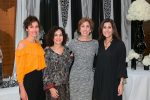
Left to right, Yael Rubanenko Horwitz, Wendi Klein, Debbie Jeroff and Lisa Pullan at Choices on Oct. 30. (photo from Jewish Federation of Greater Vancouver)

For the 12th year in a row, hundreds of women of all ages gathered to celebrate the choice they made to strengthen our community through tzedakah at this year’s Choices event. Co-chairs Debbie Jeroff, Wendi Klein and Yael Rubanenko Horwitz and their committee worked for months to make the event a success, and brought the room to life with their chic black-and-white theme.

“Each of us [came] with our own story, history, talents and tragedies,” said Lisa Pullan, chair of women’s philanthropy for the Jewish Federation of Greater Vancouver annual campaign, as she addressed the packed ballroom at Congregation Beth Israel on Oct. 30. “But what unites us is the choice that we have made to stand together in support of our Jewish community.”

With more than 400 women in the room, including 36 first-time attendees, Pullan declared that “there is definitely strength in numbers.” Case in point is the more than $2,064,000 that was raised through women’s philanthropy last year, accounting for 25% of the 2015 Federation annual campaign’s record $8.3 million total. “Together,” Pullan remarked, “we are making a lasting impact on the community that we love.”

A highlight of the event every year is the inspirational speaker, and this year’s keynote speaker, Talia Levanon, was no exception. As director of the Israel Trauma Coalition (ITC), she and her team provide trauma care and emergency preparedness and response to affected communities in Israel and around the world. ITC is a global leader in providing aid and support to local professionals working in the field in crisis zones.

“Seeing how the ITC social workers in crisis zones have to work through their own traumas to help others was particularly powerful,“ said Pullan. “Talia showed a video in which one of the ITC workers was talking to a client on the phone and had to talk her through a rocket firing, while simultaneously getting out of her own car, lying on the ground and dealing with it herself. It helped us understand in a visceral way the trauma that Israelis experience.”

Community member Stephanie Mrakovich also spoke at the event, sharing the moving story of how her family discovered their Jewish roots and how she came to find her place as a leader in our community. She shared her personal and touching account of her dying grandmother’s revelation of the family’s Jewish heritage. Her remarks can be found at jewishvancouver.com/stephanie-mrackovich-choices-speech.

Choices is the signature campaign event for women’s philanthropy. While the speakers and the theme change each year, what stays the same is the focus on the great work in the community that is made possible by women’s commitment to the mitzvah of tzedakah. To donate or for more information on the annual campaign and the services and organizations it helps fund, visit jewishvancouver.com.

– From e-Yachad, published by Jewish Federation of Greater Vancouver