Skip to content
  • Home
  • Subscribe / donate
  • Events calendar
  • Business Directory
  • FAQ
  • News
    • Local
    • National
    • Israel
    • World
    • עניין בחדשות
      A roundup of news in Canada and further afield, in Hebrew.
  • Opinion
    • From the JI
    • Op-Ed
  • Arts & Culture
    • Performing Arts
    • Music
    • Books
    • Visual Arts
    • TV & Film
  • Life
    • Celebrating the Holidays
    • Travel
    • The Daily Snooze
      Cartoons by Jacob Samuel
    • Mystery Photo
      Help the JI and JMABC fill in the gaps in our archives.
  • Community Links
    • Organizations, Etc.
    • Other News Sources & Blogs
  • JI Chai Celebration
  • JI@88! video

Recent Posts

  • SFU honours Gloria Gutman
  • Lifting people’s spirits
  • Wedding a ray of light
  • Indigeneity and Zionism
  • Rule of law broken: councilor
  • Football and its roles
  • The burden of defence
  • Fish Café returns after fire
  • All right in what goes wrong
  • Nuns & mermaids at TUTS
  • Camp offers holiday retreat
  • Students and mentors inspire
  • Once-in-a-lifetime trip
  • 100 dancers, one heart
  • Money for the sciences
  • What “Jewish food” means
  • Have a cookie, schnitzel too
  • Federation now across BC
  • Israel fighting for its existence
  • Deal strengthens Iran
  • Patriotic belonging diminishes
  • A campaign to engage
  • Upstanders’ first live event
  • Responding to Carney
  • Having your own home
  • Music a family tradition
  • Musical to warm heart
  • Community milestones … June 2026
  • Sharing her passion for Israel
  • Or Shalom reopens its doors
  • JFS from past to future
  • Need holistic approach
  • Sharing stories, advice
  • Journalist shares fears
  • Skills to live together
  • Road to independence

Archives

Follow @JewishIndie
image - CJN box ad Rockowers 2026

Tag: women

NCJW Canada is honoured

NCJW Canada is honoured

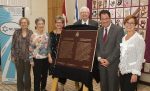
At the Oct. 23 ceremony for the unveiling of a plaque honouring National Council of Jewish Women of Canada’s 120 years of service are, from the left, Sharon Allentuck, Gloria Roden, Debbie Wasserman, Dr. Richard Alway, Councilor James Pasternak and Eva Karpati. (photo from NCJWC)

On Oct. 23, National Council of Jewish Women national president Debbie Wasserman accepted a plaque honouring the work of NCJW. It was from Parks Canada and the Historic Sites and Monuments Board of Canada and it was unveiled at the Toronto offices of NCJW Canada. The recognition came on the council’s 120th anniversary.

“NCJWC in Vancouver has an enviable track record of working with disadvantaged elementary schools, funding programs of nutrition, hygiene, cooking, farm visits and street safety,” NCJWC Vancouver’s Debby Altow told the Independent. “We have received heart-stopping letters of thanks from the kids and their teachers; they inspire us to do even more in our fight to alleviate poverty…. Our Operation Dressup delivers thousands of items of good clothing, plus shopping certificates for teens every year, and our Books for Kids program reaches into daycares, preschools, doctors’ offices and other sites…. We hope to expand these programs into other nearby communities.”

Altow said, “Vancouver section president Catherine Stoller is following in the footsteps of her mom, Sheilah, serving as president of the section for the past three years. Our section has been an integral part of the community for over 90 years, and the Heritage designation, while it rests in Toronto, really applies to every province where council has been active.”

Of the Oct. 23 event, Wasserman said, “The ceremony was very moving. We began by proceeding into the auditorium…. The Canadian flag was dominantly displayed and the plaque was draped. We all sang O Canada. The master of ceremonies then introduced all the dignitaries and all spoke about the importance of NCJWC over its 120-year history. The ceremony’s highlight was when we all came off the stage to unveil the plaque displayed on an easel.”

Wasserman and NCJWC Toronto president Eva Karpati unveiled the plaque. Ena Cord, immediate past president of the Toronto section, read the inscription in English and Dahlia Rusinek, a past Toronto section president, read it in French. There were many photos taken, and a reception followed.

“Parks Canada contacted us earlier this year to tell us that NCJWC was to be recognized as an organization of national significance to Canada, seeing that we were the first Jewish women’s organization in Canada,” explained Wasserman. “The plaque will be permanently installed at 44 St. George St. in Toronto, the former head office of NCJWC.”

Dignitaries at the ceremony included Eric Nielsen of Parks Canada (master of ceremonies), Dr. Richard Alway of the Historic Sites and Monuments Board of Canada, Toronto City Councilor James Pasternak (York Centre), NCJWC Toronto member and historian Gloria Roden, and Sharon Allentuck, NCJWC immediate past president and Winnipeg section member.

“As a passionate advocate for social justice and equality since 1897, the National Council of Jewish Women of Canada has forged an enduring legacy of community service across Canada,” Nielsen noted in his remarks. “It’s incredible to think that the council was founded right here in Toronto and has been growing steadily for over a century.

“The birth of the council came at a truly interesting time in Canadian history,” he continued. “During the late 19th century, urbanization, industrialization and immigration were causing social disruption in many cities across Canada. It was at this time that a pioneering group of Jewish women united to effect social change. Led by Meldola de Sola, wife of a distinguished Montreal rabbi, women of the Holy Blossom Synagogue in Toronto began meeting in private homes to study Genesis and the teachings of Judaism in preparation for beginning philanthropic activities in their communities.

“At the time of its founding in Toronto, the National Council of Jewish Women of Canada focused on supporting young girls and new immigrants. They provided shelter, training, and other forms of assistance, all while strengthening the Jewish community.”

Nielsen said that, through NCJW, Jewish women across the country “gained a voice in Canadian society and the women’s movement.”

The oldest Jewish women’s organization in Canada, NCJWC has evolved, said Nielsen, “to meet the changing needs of the most vulnerable in society.” And it “continues to work tirelessly to promote social justice, freedom, equality and tolerance at home. Equally concerned with the well-being of people outside of Canada, the council’s members have also collaborated with aid organizations, such as the Red Cross, to contribute to humanitarian efforts abroad.

“Thanks to their efforts, we are creating a rich mosaic portraying the greatest moments of our nation’s history. Future generations will better understand their history through this mosaic and, hopefully, better understand themselves and the values of our country.”

Nielsen congratulated NCJWC. “The council’s invaluable legacy,” he said, “is a source of inspiration for all who work to promote meaningful social change, at home and abroad.”

Noting that NCJWC “began in 1897 with 20 women studying and learning Bible,” Roden said the council “realized there was an urgent need to help immigrants arriving daily in Toronto. And so, by 1909, a place was needed for the growing group to expand their activities. Two rooms on Walton Street in the Ward were rented, but, by 1913, there was a move to new larger headquarters on McCaul Street.

“With the outbreak of the First World War,” she said, “young council members took an active part and McCaul Street was transformed into a Red Cross centre, providing hospital supplies and other necessities for wartime aid. In 1918, with the Spanish flu epidemic, council volunteers carried meals to 800 flu victims from our kosher kitchen and provided home nursing care.

“In 1919, council women became big sisters to children and working girls, and bought Fairview Cottage at Whitby Beach to provide these girls with an oasis for much-needed fresh air and sunshine. By 1937, council continued their involvement with the Jewish Camp Council to included Camp Camperdown near Orillia.”

The offices on St. George were “purchased with a modest down payment,” said Roden. “It was called Community House, with the Jewish community using the much-needed premises for a variety of activities. It operated classes, including cooking, sewing, journalism, language, dance and art. Sports teams were formed … [to help newcomers to Canada], a daycare centre, English classes, and even a legal storefront service was established. A club for handicapped girls was formed to teach sewing and social skills, and there were interpreters to translate for the newly arrived.

“The NCJW has continued with our motto of ‘Faith and Humanity,’ and the voluntary participation as our civic responsibility as citizens of our great country. We continue to study, educate ourselves and participate with pride.”

Rebeca Kuropatwa is a Winnipeg freelance writer.
Format ImagePosted on November 17, 2017November 15, 2017Author Rebeca KuropatwaCategories NationalTags National Council of Jewish Women of Canada, NCJW, tikkun olam, women
A fine line we all walk

A fine line we all walk

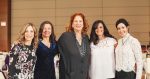
Left to right: Choices co-chair Debra Miller, Choices co-chair Sarah Marel-Schaffer, keynote speaker Lisa Friedman Clark, Choices co-chair Judith Blumenkrans and Jewish Federation of Greater Vancouver women’s philanthropy chair Megan Laskin. (photo from JFGV)

This year marked 13 years since the inception of Choices and some 450 women gathered in the Beth Israel reception hall to mingle over dinner and support Jewish women’s philanthropy. The keynote speaker was Lisa Friedman Clark, a New York native who commanded the floor as soon as she described herself as the “luckiest unlucky woman alive.”

Clark’s story is compelling. Diagnosed in 1995 at age 23 with a rare form of ovarian cancer, she endured chemotherapy and survived the illness against incredible odds. Andy Friedman, her boyfriend at the time, stood by her side throughout and, two years later, the couple married and began what she described as a “storybook life.” The arrival of twin boys completed their new family and both were pursuing successful careers up until Sept. 11, 2001. That morning, Andy went to work on the 92nd floor of One World Trade Centre and never came home.

There were audible gasps from the audience as Friedman Clark described the details of the morning her life changed forever. “He called me after the second plane had hit and said he was in a room with all his colleagues and they had plenty of air,” she recalled. “Later, we found out that the plane had hit one floor above him and the damage to the stairwells was so bad that he and his 68 colleagues could not get down. His floor was the line of demarcation between life and death. Those on floor 92 and above died.”

“I was 39 years old with two 11-year-old boys whose hero had just been killed in one of the most horrific manners one could think of,” she continued. “One minute you’re rushing to get the kids off to school and, in a split second, your husband has been murdered and life as you knew it has ceased to exist.”

Friedman Clark’s message was devoid of self-pity. “We all walk a fine line between being a donor to Federation and being a recipient of its generosity,” she told the crowd. “We never know when our lives will change.”

Federation counselors, social workers and support groups in New York were trained to deal with families affected by terrorism and came directly to the aid of her family and others in the same situation, she said. “They were uniquely able to understand our needs, and they were also there with financial aid for anyone who needed it. This help was invaluable and, had it not been for the many people that helped me at Federation, I’m not sure where I’d be today.”

Another story that touched a chord with Choices attendees was that of Ronit Yona, an Ethiopian Jew who, as a child, was rescued during Operation Moses. She lived in Israel for several years and more recently moved to Vancouver with her husband and two sons. Yona recalled her early years as a child in Ethiopia, growing up in a village that was home to 1,000 Jews and a life that revolved around home, school and synagogue. At the age of 9, everything changed. “The Ethiopian government wouldn’t allow us to practise our customs,” she explained. “I found myself following my father through the jungle at night as he led our donkey and horses, all loaded with our entire life. My father told me that, if the soldiers found us, they would kill us.”

Yona and her family became refugees in Sudan, in a tent camp where there was no sanitation and dysentery was rife. She recalled walking four hours a day to fill heavy jugs with water for the family. Then, at 10 years old, she found herself on an airplane with other Ethiopian families en route to Jerusalem. “What I didn’t know then, as a child, was that we weren’t walking alone on that journey,” she said. “ORT helped my father train as a nurse in Ethiopia and, later, the global Jewish community gave its money, time and energy to the Jewish Agency to rescue the Jews of Ethiopia who were stranded in Sudan.”

“We are all here this evening because we care about the future of the Jewish community, here at home, in Israel and around the world,” Megan Laskin, chair of women’s philanthropy at the Jewish Federation of Greater Vancouver, told attendees. “We’re celebrating making good choices for ourselves as strong women and setting a lasting example of l’dor v’dor. Women’s philanthropy is truly a force and your contributions are changing and saving lives.”

Last year, Choices generated more than $2.1 million. For information on this year’s campaign, visit jewishvancouver.com.

Lauren Kramer, an award-winning writer and editor, lives in Richmond. To read her work online, visit laurenkramer.net.

Format ImagePosted on November 3, 2017November 1, 2017Author Lauren KramerCategories LocalTags 9/11, annual campaign, cancer, Choices, Jewish Federation, Lisa Friedman Clark, philanthropy, terrorism, women
Women in politics night

Women in politics night

A sold-out crowd attended CJPAC’s Women in Politics Pecha Kucha event on Oct. 24, which featured four speakers, including CJPAC’s Sherry Barad Firestone (standing on the left). (photo from CJPAC)

On Oct. 24, CJPAC (the Canadian Jewish Political Affairs Committee) hosted its first Women in Politics Pecha Kucha event in Vancouver. It was a sold-out crowd with women and men of all ages and political backgrounds in attendance. Hodie Kahn hosted the event at her home.

The Pecha Kucha style of 20 slides at 20 seconds per slide created a dynamic evening that allowed CJPAC to showcase four guest speakers, all Jewish, each highlighting different facets of political engagement, as well as its importance and its accessibility during and between elections.

CJPAC advisory board chair Sherry Barad Firestone, originally from Vancouver but now living in Toronto, was one of the presenters. “It was such a thrill to participate,” said Firestone. “It was nice to be able to share my experience as someone who does not come from a political background. We often think politics should be left to the experts but there’s a role for all of us, regardless of experience, in our democracy.”

Other presenters included Temple Sholom Rabbi Carey Brown, an American transfer to Canada, who is passionate about adult and youth education, social justice and teen engagement; Dr. Moira Stilwell, who served as the member of the Legislative Assembly for Vancouver-Langara from 2009 until 2017, and was a minister of several portfolios; and, Rakeea Gordis, a high school student who has attended political rallies, volunteered on campaigns and recently became an EF Canadian Youth Ambassador.

Perhaps one of the best and inspiring quotes of the night came from Gordis, who stated, “I’m too young to vote. The only way I can use my womanly voice is to volunteer on campaigns.”

Kara Mintzberg, B.C. regional director for CJPAC, noted that CJPAC hopes to have more events focused on women’s experience in politics. “We know that it’s not always easy to be a woman in politics but we think events such as these, in particular hearing from their peers, will encourage more women to get involved and, ultimately, it will become easier for those who follow.”

CJPAC is hosting another event soon – the Ultimate Kiddush Club, featuring “Scotch master” Barry Dunner, on Nov. 23, 7:30 p.m. For more information about the evening or any other CJPAC events and opportunities, contact Mintzberg at [email protected] or 604-343-4126.

Format ImagePosted on November 3, 2017November 1, 2017Author Canadian Jewish Political Affairs CommitteeCategories LocalTags Carey Brown, CJPAC, Moira Stilwell, politics, Rakeea Gordis, Sherry Barad Firestone, women

CHW marks 100 years

Canadian Hadassah-WIZO (CHW) has been a driving force in the Jewish community for 100 years. Known to many simply as Hadassah, CHW has rebranded in the last decade to be recognized for its full range of activities, using its acronym to also exemplify the work it does for children, healthcare and women in Israel.

Jewish Canadians can take great pride in the many initiatives that have come from the fundraising and determination of CHW women who have helped build the state of Israel.

One of the keystone projects CHW supports is the Hadassim Children and Youth Village, located east of Netanya. Founded in 1947 for European Jewish refugee children, it is one of the largest residential schools in Israel. The school has evolved over the years to house children as young as age 6 who could not safely remain in their homes. These children live in family units, cared for by foster parents who maintain contact with biological parents when appropriate.

With the world refugee crisis, there has been somewhat of a return for Hadassim to its original purpose. As an example, because of antisemitism, more than 60 teens from France have sought refuge at Hadassim through the Na’aleh program, according to CHW national executive director Alina Ianson.

The program, she said, “is an opportunity for Francophone youth to continue their education in their native language. The Na’aleh program has become increasingly important due to the rise of antisemitism, causing many European teenagers to seek out safety and security. CHW Hadassim gives teenagers freedom: freedom to learn, freedom to live, freedom to be Jewish. CHW Hadassim gives teenagers a home again.”

Over the past 100 years, Israel has grown from the dream of a homeland to a high-tech powerhouse. Nonetheless, pressing social issues, particularly for women and children, still exist. Healthcare has changed dramatically but the need for support is arguably more critical because, while there are more life-saving technologies, they can also be quite expensive. For this reason, CHW continues to be as relevant as ever, national president Debbie Eisenberg told the Independent.

Eisenberg highlighted the CHW Vancouver connection. “Four of CHW’s past national presidents have called Vancouver home,” she said. “These visionary past national leaders include Naomi Frankenberg, z”l, Judy Mandelman, Rochelle Levinson and Claudia Goldman. Throughout our 100 year history, CHW has certainly changed the very fabric of Israeli society by supporting essential programs and services for children, healthcare and women in Israel,” she added.

Current Vancouver centre president Stephanie Rusen is proud to head an organization that has made and continues to make such an impact on the lives of people in Israel. Rusen believes that the focus for Vancouver in CHW’s centennial year is the Hadassim Youth Village partly because it exemplifies everything that CHW does right. Those most vulnerable in Israeli society find a home at Hadassim and grow up to meet their potential as active, contributing members of Israeli society.

“CHW Hadassim has been improving the lives of children and families for the last 70 years,” said Rusen. “Many of the children who come to CHW Hadassim are escaping prejudice, persecution, and even violence. Thanks to our generous supporters, as well as the funds raised at last year’s tribute gala, the Claudia Goldman Dormitory Hey at CHW Hadassim was renovated and is now home to 60 students. These children now have a safe place to call home. CHW Vancouver proudly supports CHW Hadassim.”

Rusen has presided over many local changes in how CHW operates. The previous chapter-based format has given way to an organization that plans citywide programs for all ages and interests, while continuing its efforts to fund its projects in Israel. The local annual kick-off event was held on Sunday at the Shaughnessey Golf and Country Club. Entitled “Heroes Among Us,” the event honoured three local women, ranging in age from the mid-20s to mid-80s, who have made a difference in various aspects of the Metro Vancouver community: Courtney Cohen, Lori Yelizarov and Helen Coleman.

For more information on how to become involved with the activities of CHW, visit their website at chw.ca (look for Vancouver centre) or call the office at 604-257-5160.

Michelle Dodek is a freelance writer living in Vancouver.

Posted on September 22, 2017September 21, 2017Author Michelle DodekCategories WorldTags CHW, Hadassah, Hadassim, healthcare, women, youth
Helping out new immigrants

Helping out new immigrants

Sol and Shirley Kort (photo from Alisa Kort)

The Kort family – in an initiative led by sisters Beverley and Alisa – has established a scholarship in their parents’ names with the National Council of Jewish Women. The award will provide education funding to two newcomer women each year.

Beverley and Alisa’s parents, Shirley and Sol Kort, have both passed away. They met, said the sisters, in Shirley’s hometown of Edmonton at a Shabbat dinner event organized by the local Jewish community for the American Jewish soldiers stationed there – this included Detroit-native Sol, who was then in the U.S. army.

The couple moved to Vancouver in the 1940s and Sol started up the business Kent Chemicals with a fellow American who relocated to Vancouver.

Of Kent Chemicals, Beverley said, “He did that for many years, until the 1960s. Then, he sold his business and went into continuing education at UBC. On the side, he was leading and developing a lecture series called Search for Meaning, and more. He decided that, instead of being a chemist, he’d become an adult educator in the humanities.”

Sol was in his 40s when he changed career paths. In his new endeavour, he enjoyed connecting with people who were pushing the boundaries of understanding philosophy, science and psychology – people questioning the world.

Beverley recalled going to her father’s lectures, along with other kids, starting in her early teens. “I’d sometimes leave school and go to those lectures,” she said. “People came and stayed at our house. I was exposed to all sorts of interesting perspectives, like Buddhism and different types of spirituality, levels of consciousness, and ideas. I was already curious about human nature and this catapulted me onto the level of, ‘Oh, my God! Wow. What’s going on?’”

Meanwhile, Beverley’s mom, Shirley, was busy doing her own work, serving on the board of the Jewish Community Centre of Greater Vancouver for many years and being involved in National Council of Jewish Women (NCJW), among other pursuits. Later, Shirley helped form Shalom Vancouver, a welcoming service for newcomers to Vancouver.

“This was very important to her,” recalled Beverley. “People would describe her as one of the most welcoming, supportive people. When we did a special kind of presentation about my mom for the NCJW after she passed away, people got up and spoke about their relationship with her, especially young women who moved to Vancouver when she was quite involved in the council. They just found there wasn’t anything she wouldn’t do to help them get settled – connecting with people, coming to our house for dinner. Our whole family has this culture of, come for dinner, how can I help you connect, that kind of thing.”

Alisa added, “My mother was also on the board of the Volunteer Bureau of Canada and had been a president of the Vancouver chapter of the NCJW a number of times, [as well as being] involved in their mobile hearing testing project, HIPPY and Shalom Vancouver. My father was involved with the Vanier Institute of Canada and was director of humanities and science in continuing education at UBC.”

Alisa noted that one of her father’s good friends, author Ted Roszak, wrote of Sol that “he was ‘a bright, inquiring and caring educator who wanted to bring every leaping mind he could find to his school.’”

When Sol passed away, the Kort family established a fund in his name at the Isaac Waldman Jewish Public Library, as he was an avid reader. They also sponsored the Sol and Shirley Kort Author Series, the opening night of the Cherie Smith JCC Jewish Book Festival, for many years.

photo - Shirley and Sol Kort
Shirley and Sol Kort (photo from Alisa Kort)

“My mom, during her life with my dad, was always hosting events and having people come and speak, and dealt with the behind-the-scenes things, organizing and being social,” said Beverley. “For her, hosting the author series in her and my dad’s name was a nice continuation of that. We did that for many years. They would come to our house the night before. And, the author would come, and my mom would meet him and talk. We named it after both of them because we always wanted to do something for both of them together.”

When Shirley passed away, the family wanted to find a way to further commemorate both of their parents’ lives, and looked to the NCJW, even though Sol wasn’t a member of the council.

“He was like a feminist more than his own daughters were, and he was an educator and a mentor,” said Beverley. “He was always finding people who needed mentoring. We were hosts for a Bosnian family who we’re still good friends with. After retiring, they set up weekly sessions with him to talk about books. He led speaking series for seniors and was always looking for ways to teach.”

Among the NCJW initiatives that were important to Shirley was HIPPY (Home Instruction for Parents of Preschool Youngsters), said Beverley, and she talked about it “a lot during the last three years of her life, as she struggled with dementia. HIPPY is about mentoring women and furthering their education. We wanted to do something that would further education and make a difference in someone’s life – that’s why we chose the scholarship.”

The Shirley and Sol Kort scholarship provides $2,500 per year to two newcomer women toward their education.

“HIPPY is a way of keeping my parent’s memory alive and supporting something that represents the essence of what they found important in the world, which is welcoming people, furthering education, being supportive and being larger than the Jewish community,” said Beverley.

According to Alisa, her parents were interested in people, above all – they were passionate about education and in helping newcomers to the Jewish community and beyond. Beverley and Alisa also are inspired in what they do by their late grandmother, who informally adopted one of the young children who made their way to safety via the Kindertransport.

Regarding the HIPPY scholarship, Alisa said, “It seemed to embody all that our parents held dear and it also seemed very important to support women, particularly women with children struggling to find a new life in a new country after having to let go of so much of what made them who they are.”

The initial recipients of the award, said Alisa, “were both very highly motivated and articulate about their experiences as immigrant women and mothers in Canada, and how … being involved in HIPPY has factored into their journey and continues enriching their lives. They’re multicultural in background. One of the women intends to complete her bachelor of social work and the other wants to get her social work diploma.”

Past president of NCJW’s Vancouver chapter, Debbie Altow, said, “Shirley Kort inspired us all in council. Besides working to bring HIPPY to Canada, she led the way – she was the first in our membership to use a computer; she worked tirelessly to pilot a hearing testing program for preschoolers (a project taken over by Vancouver’s health department); she hosted so many meetings that daughter, Beverley, printed up a neat collection of her recipes; and she had family and friends all over Western Canada, especially in Edmonton and Winnipeg.

For more information about NCJW in Vancouver, visit ncjwvancouver.org.

Rebeca Kuropatwa is a Winnipeg freelance writer.
Format ImagePosted on September 1, 2017August 30, 2017Author Rebeca KuropatwaCategories LocalTags education, Kort, NCJW, tikkun olam, women
Bridging STEM gender gap

Bridging STEM gender gap

LeadWith’s leadership team at one of the organization’s events, left to right: co-founders Shira Weinberg and Dalit Heldenberg and managing director Aviv Ziv. (photo by Hadas Eldar Photography)

STEM-related women’s groups are popping up all over the world – and Israel is no exception. In fact, the country is a leader in this area.

Shira Weinberg and Dalit Heldenberg co-started LeadWith, a group for women like them – women interested in STEM (science, technology, engineering and math) and seeking camaraderie.

Weinberg, a senior product manager at Microsoft, started out as a software developer while in the Israel Defence Forces’ marine core, and then worked and studied as a software engineer for five years. She’s been with Microsoft for nine years, first as an engineer and then as a product manager.

“As a woman in the industry, I always felt like there aren’t many women,” said Weinberg. “At the beginning, I got used to it and I figured that’s how it is in this area and that’s OK. But, after a few years in the industry, I realized it doesn’t have to be like that.

“That’s one of the reasons I started LeadWith, and I’m also doing some other stuff related to promoting girls and women in the tech industry.”

Raised by a father who worked in the industry in Herzliya, Weinberg was much more familiar with computers than were most of her friends. She went into computer science in high school, which paved the way to her position in the IDF.

Like Weinberg, Heldenberg also started her career as a software engineer. “As a kid, I was always attracted to computers more than the others,” said Heldenberg. “I knew that this is what I wanted to learn, computer science.”

Both young women feel strongly that there is no reason the gender gap should be as big as it is today.

“As you look higher and higher in management positions, there are fewer women,” said Weinberg. “This is something we want to change. And this is one of the main reasons I wanted to lead this change.”

Heldenberg added, “Even when I studied computer science, I’d always see too few women in this field. When I was learning high school physics and when I studied computer science, I was always missing women. We want to see more women wanting to be in management roles.”

Weinberg and Heldenberg understand that, in order to create this change, they need to provide mentorship to other women. They now have bi-monthly get-togethers that include networking and education sessions.

“We found a lot of demand from women for these kinds of events,” said Heldenberg. “At the first event, we weren’t sure how many women would come. We planned for about 50, but ended up with 200 attendees.

“We are currently doing three types of activities. One, the meet-ups, where we usually have 100 to 200 women come.

“We also have the mentoring program, where we hold events also every two months. The mentoring events are smaller in terms of size, but we have our team of mentors all volunteering and joining in for the events. We hold sessions of one-on-one mentoring conversations for around 30 minutes…. For each mentoring event, we have about 25 mentees.”

The third activity is an accelerator program for women entrepreneurs who are at the end stages of launching their start-up. In the first program, they had 13 entrepreneurs. It involved nine full days of sessions over nine weeks, with each day focused on different tools relevant to entrepreneurs.

“At the end, we had a big demo day with important people in the industry,” said Heldenberg.

With more than 1,600 people now involved with LeadWith, it is clear that they are filling a previous void and that their approach is working.

“At the events, we put a lot of focus on networking,” said Weinberg. “We usually have a short networking session before the main session begins. We make sure every woman will talk with one or two women she hasn’t met before … that really helps them know more women in the industry and creates more conversations.

“Always after these kinds of events, you hear good stories about things that happen because of the networking and the new connections. Of course, you get to know other women in the industry.

“Also, at the time when a woman wants to change roles, she can draw upon the extensive connections she has gained at our events. You can never know what will come out of this kind of connection. We always hear great stories.”

LeadWith’s focus is both on connecting women who are already in the industry, as well as those who studied computer science or technology but, for one reason or another, did not go on to work in the field. The organization hopes to draw these latter women back into the field.

“A month ago, we did a hackathon in collaboration with another organization, called Cyber Girls,” which brings computer science to those around 16 and 17-years old, said Weinberg. “They brought the girls and we brought the women, and we divided into teams that included both women from the industry and the girls. It was a few hours. There were multiple teams. Each team had a big mission and a lot of tasks along the way – quizzes and such – to figure out solutions that involve writing code.

“What was amazing was that each team in this hackathon was … 10 teenaged girls and a woman from our community, and the quizzes they had to do were really tough. The young girls were very ambitious, they couldn’t get the answers from us. It was really good to see that. They are very smart.”

LeadWith is a nonprofit organization and volunteers are an integral part in whatever they do, said Heldenberg. “We get some help in posting events in certain offices, [donations of] snacks and drinks for events, those kinds of things, from Microsoft, Google and Wix.”

Both Heldenberg and Weinberg think there are multiple reasons for the lack of women in STEM fields, from how children are raised, the educational system and society as a whole. They also are concerned that, if they spread themselves too thin, they will achieve less. As such, they have opted to focus, for now, on industry women in their 20s to 40s. For more information, visit leadwith.org.

Rebeca Kuropatwa is a Winnipeg freelance writer.

Format ImagePosted on August 18, 2017August 16, 2017Author Rebeca KuropatwaCategories IsraelTags Dalit Heldenberg, Israel, LeadWith, mentorship, Shira Weinberg, technology, women

Express your opinion

The good news is we’re again debating “who is a Jew.” This is good news, of course, only because it’s a topic that divides Jews mostly when external threats abate enough to allow the luxury of pilpul around denominational rights and definitions.

We can only assume that the state of the world – the Iranian threat, the unhinged American administration, Syria in collapse – looks fine enough from the Israeli prime minister’s office that we have the freedom to indulge in family squabbles.

A year-and-a-half ago, the Israeli government finally agreed to create an egalitarian prayer space at the Western Wall. The Charedim who legally control Israel’s Jewish religious character, including practices at the Wall, have imposed a strict gender division on prayer and ritual at the holy site. This has sent the message to Conservative, Reform and other non-Orthodox Jews that the holy site is not wholly theirs and, by extension, that their forms of Judaism are not authentic or proper. The creation of an egalitarian section was hailed as putting an end to a painful and divisive aspect of Israeli-Diaspora relations.

An egalitarian space would permit families to visit the Kotel together, allow girls to read from the Torah during their bat mitzvahs and give women the right to pray out loud, rather than following the existing rules by which women must pray quietly so that their voices may not be heard by men on the other side of the divided plaza. The agreement for a new egalitarian space would not alter the existing men’s and women’s areas, but rather add a new, third space, south of the traditional prayer areas.

At the time the agreement was reached, Anat Hoffman, chair of the board of Women of the Wall, a group that has been at the fore in advancing the goal of an egalitarian space and whose members are routinely arrested for praying at the Kotel with prayer shawls, said the decision by Israel’s cabinet was an acknowledgment “that there is more than one way to be Jewish.”

Last week, the Netanyahu government changed its mind and decided there is not.

Bending to pressure from the ultra-Orthodox members of his coalition, the proverbial tail that so often wags the dog in Israel’s political system, Netanyahu called a snap vote on whether the decision taken in January 2016 to create the egalitarian space should indeed proceed. Ministers who last year voted in favour last week voted against.

In for a penny, in for a pound, the government at the same time advanced a bill that would reinstate the Orthodox monopoly on conversions and lifecycle events, including marriage and burials. Among the implications is that Jews not converted under the auspices of the Chief Rabbinate – in other words, by Conservative, Reform or other non-Orthodox rabbis – would not be recognized as Jews.

On most issues, Israel should take Diaspora concerns into consideration only secondarily to what is right for Israel. We have said in this space before, for instance, that Israeli defence policies should be determined with the security of Israelis as the priority, not the comfort of Diaspora Jews who have to live with the political consequences, but not the life-and-death consequences facing Israelis.

This is different. Rules regarding prayer at the Western Wall – who, where and how – should be made with the interests of the Jewish people – not just Israelis – foremost in mind. Of course, if the rules were made with the majority of Israelis in mind, they would reflect the diversity of religious observance both in Israel and in the Diaspora. Instead, what we have is a narrow reflection of ultra-Orthodox priorities that is more a result of political realities in the Knesset than religious reality anywhere outside that chamber.

Ultimately, these decisions are a result of political, not religious, considerations. The political needs of the Netanyahu government’s coalition appear to be superseding the Jewish state’s respect for diversity and pluralism within the global Jewish peoplehood.

“We believe in Jewish unity, not uniformity,” states a letter to Netanyahu signed by scores of Canadian rabbis. “The spectrum of Jewish practice is diverse, but it need not lead to divisiveness. Our differences are eclipsed by all that unites us: millennia of shared history and a shared future. What happens to Jews today – no matter where they live or where they attend synagogue – invariably affects us all.… We are an indivisible people, which is why we are deeply concerned by these and any other actions that unnecessarily foment division within amcha.”

Most of us do not have a vote in Israel, but each of us has a voice. The Centre for Israel and Jewish Affairs is urging each of us to contact the Israeli embassy to express our views on this vital matter. Please do.

Posted on July 7, 2017July 5, 2017Author The Editorial BoardCategories From the JITags Centre for Israel and Jewish Affairs, CIJA, Conservative, Diaspora, discrimination, equality, identity, Israel, Kotel, Netanyahu, non-Orthodox, Reform, religion, ultra-Orthodox, women
Community birthdays, awards

Community birthdays, awards

Team BC Junior Olympic level 10 (16+) were bronze medalists in the 2017 Canadian Championships in Artistic Gymnastics that took place in Montreal May 25-28. Congratulations to the whole Gymnastics BC team, which included 18-year-old Rachel Rubin-Sarganis (third from the left). (photo from Gymnastics BC)

***

photo - Sylvia Hill
Sylvia Hill (photo from Jewish Seniors Alliance)

In the Pirkei Avot (Ethics of Our Fathers), we learn the saying, “Teach us to number our days so that the experiences of life should provide us with wisdom that only years can bring.” How fortunate we are that we have this exceptional woman, Sylvia Hill, admired by all who know her.

Sylvia has been part of the Jewish Seniors Alliance of Greater Vancouver since its inception and is an honourary life member. On June 6, Sylvia turned 103 years old. We honour her as she continues to inspire us with her staunch resolve to advocate for better lives for seniors – be it in the home where she was once president of the residents or within the community at large.

In the newsletter put out by the Snider Campus, Sylvia was called “the Face of Louis Brier” and was honoured during morning services on June 10, with a special kiddush following. On the day, we of JSA proudly wished you, dear Sylvia, a yom huledet sameach, a happy birthday, and we wish you continued good health for many years to come … beez (until) 120, and thriving, as has been the theme of JSA’s Empowerment Series this season. Continue being a beacon of light for us to follow!

With love and deep respect.

* * *

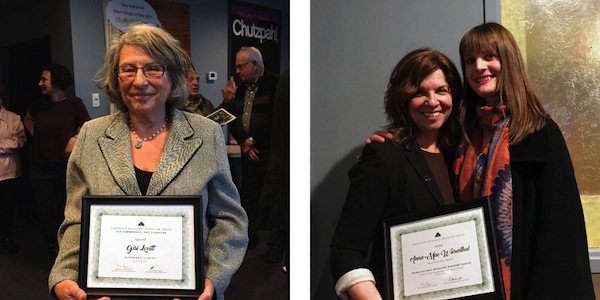
At the annual general meeting of the Vancouver Holocaust Centre Society for Education and Remembrance on June 14, Gisi Levitt received a Life Fellow Award for her 12 years of service as VHEC’s director of survivor services.

The Meyer and Gita Kron and Ruth Kron Sigal Award for Excellence in Holocaust Education was awarded to Anna-Mae Wiesenthal, who teaches Jewish history and English at King David High School. She recently worked together with VHEC on the Student Docent Training Initiative, a successful pilot project in which volunteer students from KDHS were trained to become docents. Two of the student docents, Milena Markovich and Jacqueline Belzberg, did an outstanding job of sharing with the audience their experiences of guiding their fellow students through the VHEC exhibition In Defiance: Jewish Resistance During the Holocaust.

photos - Gisi Levitt, and Anna-Mae Wiesenthal, left, and VHEC education director Ilona Shulman Spaar
Gisi Levitt, and Anna-Mae Wiesenthal, left, and VHEC education director Ilona Shulman Spaar. (photos from VHEC)

* * *

On June 20, Women in Film & Television Vancouver celebrated leaders for their outstanding work and contribution to advancing opportunities for women with their annual Spotlight Awards. This year’s recipients included Mark Leiren-Young, who received the Iris Award.

The Iris Award is given to a person who has demonstrated a commitment to the promotion of female creators and their screen-based works, either through curating or programming or through print and online media sources. Named after the Greek mythological figure Iris, associated with communication, messages and new endeavours.

Leiren-Young was also one of the finalists for the 2017 BC Book Prizes’ Hubert Evans Non-Fiction Prize for The Killer Whale Who Changed the World (Greystone Books).

Killer whales had always been seen as bloodthirsty sea monsters. That all changed when a young killer whale was captured off the west coast of North America and displayed to the public in 1964. Moby Doll – as the whale became known – was an instant celebrity, drawing 20,000 visitors on the one and only day he was exhibited. He died within a few months, but his famous gentleness sparked a worldwide crusade that transformed how people understood and appreciated orcas. Because of Moby Doll, we stopped fearing “killers” and grew to love and respect “orcas.”

Leiren-Young is a journalist, filmmaker and author. His Walrus article about Moby Doll was a finalist for the National Magazine Award and he won the Jack Webster Award for his CBC Ideas radio documentary Moby Doll: The Whale that Changed the World.

* * *

It was a banner year for the Leo Awards, which received a record 1,295 entries, from 301 unique programs in 14 different categories. Among the finalists was David Kaye – for best lead performance by a male in a motion picture for his work in Cadence and as part of the cast of Grocery Store Action Movie, which was nominated in the category of best music, comedy or variety program or series.

Format ImagePosted on June 30, 2017June 29, 2017Author Community members/organizationsCategories LocalTags Anna-Mae Wiesenthal, David Kaye, Gisi Levitt, gymnastics, Holocaust Centre, Jewish Seniors Alliance, KDHS, Leo Awards, Mark Leiren-Young, Rachel Rubin-Sarganis, Sylvia Hill, VHEC, women
Prairie study results in

Prairie study results in

Andrea Silverstone, coordinator of Shalom Bayit at Jewish Family Service Calgary. (photo from Andrea Silverstone)

A study of domestic violence in Jewish communities in the Prairie provinces was recently completed.

“The study has been a desire of mine probably since the day we started,” said Andrea Silverstone, Shalom Bayit coordinator at Jewish Family Service Calgary, “because a lot of what we know about domestic violence in the Jewish community is based on anecdotal information, suppositions, copying what is in the non-Jewish community or research from other jurisdictions outside our own.

“We were doing a good job of addressing the needs of the clients who walked in the door, some of the prevention programs we had in the schools and the community … [but] it wasn’t research-based in the sense of understanding the scope of the issue across the Jewish communities in the Prairie provinces.”

Silverstone would have loved to do a Canada-wide study, but her supporter, Resolve, which is a tri-party research body conducting community-based action, has a set research mandate of focusing exclusively on the Prairie provinces: Saskatchewan, Manitoba and Alberta.

Over the years, Silverstone has done a lot of work with Resolve and has an extensive background in dealing with domestic violence in her capacity at Shalom Bayit, which addresses everything from bullying and harassment to child abuse, elder abuse and spousal abuse.

“There was a research study done in 2004 by Jewish Women International that was fairly comprehensive,” said Silverstone. “So, we reached out to them, asking to borrow the methodology of their study, which they allowed. We also thought it would be a good comparison.”

Silverstone and the Resolve team, led by Dr. Nicole Letourneau of the University of Calgary, then approached Jewish Child and Family Service in Winnipeg, Jewish Family Services in Edmonton and various Jewish community organizations in Saskatchewan, asking them to be involved.

Silverstone found that getting people to work on this topic was easy – both the academics and community groups – as domestic violence has touched most people in one form or other.

“Everyone wanted to better understand the scope and needs around domestic violence in the Jewish community,” said Silverstone. “I don’t think anyone needed to be convinced [that there was an issue worth studying]…. It was just a matter of figuring how to best do this, so we that we weren’t taxing already taxed resources.”

The study involved two parts in terms of gathering data. The first part had participants take 20 to 25 minutes to fill out a survey based on the JWI survey. About 280 people filled this out.

Once the surveys were collected, the researchers asked two questions: Was there anything surprising? And, what did they understand from it?

“Those were the two data question points that helped us build the results of the study,” explained Silverstone. “We knew we’d have data to compare to mainstream populations. In terms of rates of people reporting that they are survivors of domestic violence, it is about the same as the general population. Twenty percent of the people who answered our study said they were victims of domestic violence. And, in the general population, those numbers are anywhere from 25 to 40%.”

The other aspect, she added, is “of those who experience domestic violence, their experience of it, in terms of physical and financial toll, is about the same, except for in our reported rates in the study of domestic violence in the form of emotional abuse – that is higher than the general population. They report about half to 60% of the domestic violence they experience is verbal [in the general population] and, in our survey, it was 82%.”

Silverstone said this divergence may be because Jews are very verbal people. Another possibility is that people tend to perceive verbal abuse as a more acceptable kind of domestic violence – they refrain from physically hitting their partner, but they won’t stop themselves from yelling or name-calling. “This is probably an area we should be researching further,” said Silverstone.

For Silverstone, there were some surprises when it came to the survey results, such as the low number of people who would consult with their rabbi about their situation – only three percent of those surveyed.

“Something that struck me,” she added, “which was also a finding of the JWI study, is that the top three sources victims utilize in domestic violence situations are friends, family and private therapists. Friends and family are, by far, the highest. It made me realize that we need to be focused on teaching friends and family in the Jewish community how to recognize domestic violence, to respond appropriately and then to refer people.”

Currently, Silverstone is in the process of determining which kinds of programs should be implemented and what kind of awareness-raising campaigns the community should be taking on, based on the survey results.

The first step is to educate friends and family about how to be good supports, she said. “There is all sorts of other research out there about what are called ‘informal supports.’… If the informal supporter has a healthy response, the person is going to go get help. If they don’t, that person is going to shut down and not seek help again for a long time. I think it’s important that we get that straight.”

Silverstone feels strongly that there is a need to dig deeper and find out why people are not using rabbis. “Is this because we’re not doing a good enough job of helping rabbis be effective supporters? Are they not talking about the issue enough? Do people not feel safe? Because they are a great resource if we can tap into them.”

Another big issue that came to light through the survey is that of safe housing for victims and that victims are not finding shelters to be helpful. Silverstone wants to examine this further.

If you or someone you know is experiencing domestic violence, contact the Jewish Family Service Agency at 604-257-5151, the bc211 help line at 211 if you live in Metro Vancouver, the Fraser Valley, Squamish-Lillooet or Sunshine Coast, or VictimLinkBC at 1-800-563-0808.

Rebeca Kuropatwa is a Winnipeg freelance writer.

Format ImagePosted on May 5, 2017May 3, 2017Author Rebeca KuropatwaCategories NationalTags Andrea Silverstone, domestic violence, JWI, Prairies, women

Feminism needs mentioning

While a recent panel called Israel, Canada and Me in the Age of Trump covered many topics well, there was a noticeable omission – feminism.

Three of the four panelists at the Peretz Centre on April 9 were women – Dr. Shayna Plaut, Ofira Roll and Rabbi Susan Shamash, with Eviatar Bach. But most participating audience members were male, with moderator Stephen Aberle having to solicit a question from a woman near the end to provide a semblance of balance. Perhaps the aggressive tone coming from the floor, not to mention the police protection, was stifling for some women.

The event sponsor, Independent Jewish Voices, Vancouver, requested the police presence because of a threat by another Jewish political group to disrupt the event. Thankfully, while some of the other group’s members were in the audience and were quite outspoken, a stimulating, heartfelt and combative exchange between the panel and an audience of about 40 people took place without incident. Unfortunately, the emotionally charged atmosphere shut down exploration of two pressing questions regarding the rights of Palestinians in Israel: the two-state solution and the ongoing Jewish settlements in East Jerusalem and the occupied territories.

It was noted that, at the core of the tensions for Jews is a fundamental contradiction: the injustices experienced by the Palestinians in Israel go against Jewish values and teachings. As well, while Prime Minister Binyamin Netanyahu’s support of President Donald Trump may be politically expedient, it is morally questionable. Separate from the panel discussion, an American news commentator caught my attention with the suggestion that German Chancellor Angela Merkel now stands as the most seasoned and capable leader among Western democratic nations. I would add a third adjective to describe her – compassionate.

Perhaps just as practising Christians who voted for Trump in the American election last November were able to close their eyes to the “unChristian” aspects of his words and actions, so too has a segment of Jewish people who support “part” of what Trump stands for. All these diverse outlooks and allegiances fit with Plaut’s assertion: despite our conflicted and incongruent ideas, it is important to wade in and “engage in the messy.”

As hard as this is to do within ourselves, the difficulty is magnified when we try to maintain or reach a respectful dialogue. Tolerance is all good and well, but what happens when some voices become intolerable – that is, in denial of the truth and in support of racism, bigotry, misogyny? What happens when power – even democratically elected power – is used to exploit and oppress?

The panel fully addressed the fears many of us are feeling, including the danger of making decisions based on this emotion and the fact that fear can lead to a “them versus us” mentality. Surprisingly fascism, rooted in this negative feeling, was only mentioned once during the afternoon talk, when Bach used it to describe his view of Israel’s body politic as the left becomes more “lethargic.”

On the whole, we can’t afford to become lethargic and we can’t exclude women’s voices in favour of a “muscular” political agenda. The Women’s March on Washington on Jan. 21, held in conjunction with hundreds of solidarity marches elsewhere, gave us a taste of our collective power, as I personally witnessed by participating with about 15,000 women and men in Vancouver. We garnered praise for a day that was peaceful, inclusive, positive – and global.

That historic action has since faded into a grim reality, as women (along with LGBTQ people and visible minorities) witness Trump, who has a lengthy record of misogyny, working alongside his almost exclusively white male cabinet, take backward steps on human rights. Government actions have included an executive order to block funding to organizations that support abortion services, a travel ban targeting some Muslim countries and the appointment of a Supreme Court justice that could lead to legal changes regarding women’s reproductive rights.

In contrast, Canadian feminists and their allies’ success in decriminalizing abortion remains uncontested. To his credit, Prime Minister Justin Trudeau pledged $650 million in March for women’s sexual and reproductive health around the world, stating “a lack of choices in reproductive health mean that they [women] either are at risk of death, or simply cannot contribute and cannot achieve their potential.”

But, when Trump applauded Trudeau’s initiative to organize a joint women’s entrepreneur project in February, many questioned how sincere this “pro-women” gesture was. A diversity of board members not only benefits women, but expands business approaches and ideas. And women are underrepresented at this level, only holding 18.8% of Fortune 1000 company board seats in 2015 and 20.6% of the seats on Fortune 500 boards. The Trump-Trudeau roundtable with North American businesswomen may have raised awareness on women’s value in the workplace, but did the session result in a significant step toward equality or simply provide an image-boost for the male leaders involved?

Certainly in stark contrast to Trump’s male-dominated inner circle is Trudeau’s cabinet, with half of its members female, appointed from a caucus where women comprise 27% of Liberal members of Parliament. However, Canada only ranks 50th out of 190 countries on proportion of national-level female politicians. As well, five of the 15 women in Trudeau’s cabinet are in junior positions.

In Israel, women have also been elected in greater numbers over time but men are still at the helm. Economic equality also eludes Israeli women at every level. This appears to be the narrative for women in most democracies, Scandinavian nations providing some important exceptions.

Systemic, rather than cosmetic, changes need to be made within institutions – including provisions for harassment-free parliamentary debate so female politicians can thrive without being subject to intimidation and emotional abuse. Indeed, all forms of violence faced by women from all walks of life must be addressed, most urgently among indigenous women in Canada, a long-ignored and tragic reality.

When policies impacting the vast majority of women are implemented, the ramifications are significant. Consider that women continue to be the primary childcare provider: according to Statistics Canada, women comprise 80% of single parents with a child and three quarters of part-time workers are women.

So why, again using Statistics Canada figures, do women make 87 cents for every man’s dollar – a gap even wider for visible minorities and immigrant women? Pay equity legislation is a move in the right direction and provinces that do not have this, such as Alberta, are shown to have a wider gap.

The spread of part-time, precarious jobs affects all workers, but especially women, and has led to a groundswell of campaigns across North America to raise the minimum wage. In British Columbia, 63% of minimum wage earners are women, according to the B.C. Federation of Labour, and these are not only teenagers – 80% of all minimum wage earners are over 20 years old.

Malala Yousafzai was recently bestowed with an honorary Canadian citizenship by the Trudeau government, her bravery and powerful messages to girls and women inspiring global admiration. She would undoubtedly agree that, in these politically uncertain times, we must strive for a climate of respect and tolerance and ensure women are an integral part of dialogues and policies.

Janet Nicol is a teacher at Killarney Secondary School in Vancouver, freelance writer and local historian. She has written previously about an early-20th-century Jewish-Canadian human rights lawyer, Israel Rubinowitz, for the Jewish Independent.


Posted on April 28, 2017April 26, 2017Author Janet NicolCategories Op-EdTags equality, feminism, Trudeau, Trump, women

Posts pagination

Previous page Page 1 … Page 12 Page 13 Page 14 Page 15 Next page
Proudly powered by WordPress