Skip to content
  • Home
  • Subscribe / donate
  • Events calendar
  • Business Directory
  • FAQ
  • News
    • Local
    • National
    • Israel
    • World
    • עניין בחדשות
      A roundup of news in Canada and further afield, in Hebrew.
  • Opinion
    • From the JI
    • Op-Ed
  • Arts & Culture
    • Performing Arts
    • Music
    • Books
    • Visual Arts
    • TV & Film
  • Life
    • Celebrating the Holidays
    • Travel
    • The Daily Snooze
      Cartoons by Jacob Samuel
    • Mystery Photo
      Help the JI and JMABC fill in the gaps in our archives.
  • Community Links
    • Organizations, Etc.
    • Other News Sources & Blogs
  • JI Chai Celebration
  • JI@88! video

Recent Posts

  • SFU honours Gloria Gutman
  • Lifting people’s spirits
  • Wedding a ray of light
  • Indigeneity and Zionism
  • Rule of law broken: councilor
  • Football and its roles
  • The burden of defence
  • Fish Café returns after fire
  • All right in what goes wrong
  • Nuns & mermaids at TUTS
  • Camp offers holiday retreat
  • Students and mentors inspire
  • Once-in-a-lifetime trip
  • 100 dancers, one heart
  • Money for the sciences
  • What “Jewish food” means
  • Have a cookie, schnitzel too
  • Federation now across BC
  • Israel fighting for its existence
  • Deal strengthens Iran
  • Patriotic belonging diminishes
  • A campaign to engage
  • Upstanders’ first live event
  • Responding to Carney
  • Having your own home
  • Music a family tradition
  • Musical to warm heart
  • Community milestones … June 2026
  • Sharing her passion for Israel
  • Or Shalom reopens its doors
  • JFS from past to future
  • Need holistic approach
  • Sharing stories, advice
  • Journalist shares fears
  • Skills to live together
  • Road to independence

Archives

Follow @JewishIndie
image - CJN box ad Rockowers 2026

Tag: women

The wrap dress began it all

The wrap dress began it all

Diane von Furstenberg was born Diane Simone Michelle Halfin in Brussels, Belgium. (PR photo)

Character. Intelligence. Strength. Style. That makes beauty.” These timeless words of wisdom were expressed by the iconic Diane von Furstenberg.

Born Diane Simone Michelle Halfin in Brussels, Belgium, 18 months after the liberation of Auschwitz – where her mother, Lily Nahmias, was among those interned – von Furstenberg was taught from a young age, “Fear is not an option.” Following this motto has helped her become a legendary designer, with a business that was worth some $300 million in mid-2017, according to Forbes.

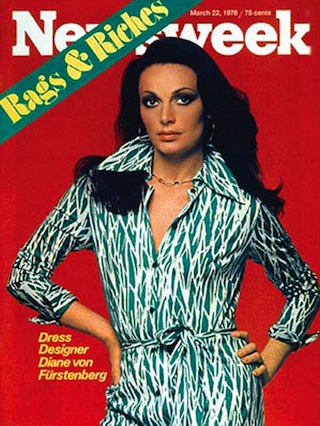
image - Diane von Furstenberg made the cover of Newsweek, among other publications, in 1976
Diane von Furstenberg made the cover of Newsweek, among other publications, in 1976.

Von Furstenberg married Austro-Italian Prince Egon von Furstenberg in 1969. Soon thereafter, in 1972, she introduced her blueprint classic wrap dress. She made the cover of Newsweek, among other publications, in 1976, after selling five million dresses worldwide. Today, the quintessential wrap dress is on display at the Costume Institute at the Metropolitan Museum of Art, as von Furstenberg has been a major contributor to women’s fashion.

It was crucial, on a personal level, for von Furstenberg to be financially independent. She never wanted to rely on a husband or anyone else to pay her bills. Divorcing in 1972, she was determined, as a single mother of two, to make her dreams come true. A degree in economics helped her land a job as an apprentice in a textile house, which was where she learned the art of fabrics.

Von Furstenberg’s passion for prints began when she received the gift of a Pucci-designed outfit from a lover. And the idea of the silk, jersey wrap dress came to her when she saw Julie Nixon Eisenhower on television donning a wrap top with a skirt.

The wrap dress was considered both ageless and timeless: worn by women of varying cultures and sizes, from working women to the more wealthy. The wrap dress became a symbol of independence and power for a generation of women.

During this time, while ascending in her career, von Furstenberg lived a vibrant life. She had relationships with both men and women, she dressed the famous and traveled the world. She found love again with her present husband, Barry Diller. Though she had to relinquish the title of princess, she was still deemed royalty in the fashion business.

And her empire extended through the years to other domains. She wrote several books, including the memoir The Woman I Wanted to Be. She started a collaboration with the Gap, designed rooms and suites for Claridge’s hotel in London and starred in her own reality show, House of DVF.

Life was not without its challenges. She has battled cancer and, at one point, almost lost her business, but von Furstenberg prevailed.

The importance of her Jewish heritage became publicly apparent in the 1980s. It was then that she began her longtime commitment to preserving the memory of the Holocaust, and she became a prominent fundraiser for the United States Holocaust Memorial Museum in Washington, D.C.

Von Furstenberg is a philanthropist, giving back through various initiatives. For her, the empowerment of women has always been at the forefront – “Every woman can be the woman she wants to be!”

Ariella Stein is a mother, wife and fashion maven. A Vancouverite, she has lived in both Turkey and Israel for the past 25 years.

Format ImagePosted on March 9, 2018March 7, 2018Author Ariella SteinCategories Arts & CultureTags business, Diane von Furstenberg, DVF, fashion, women

2018 CHW campaign begins

Canadian Hadassah-WIZO’s 2018 annual campaign, Come Together, Right Now, began on March 1 in support of various CHW projects. This pillar of CHW’s fundraising efforts provides $1.5 million in support of children, healthcare and women in Israel and Canada.

CHW is a non-political, nonpartisan national network of dedicated volunteers and professionals who believe that the advancement of childcare, education, healthcare and women’s issues transcends politics, religion and national boundaries.

Over the last century, CHW has been involved in all aspects of Israeli life, supporting women, children and families around the world. CHW’s support has strengthened, and continues to strengthen, the very fabric of Israeli society.

“I can give you 161,453 reasons to be proud of being a donor to Canadian Hadassah-WIZO (CHW),” said Debbie Eisenberg, CHW national president. “It’s really quite simple: this is the number of lives CHW positively impacted in Israel just this past year. This is the difference you made through your generous support of CHW.”

“For me, the theme for this year’s annual campaign encompasses everything that our supporters do for CHW,” said Alina Ianson, CHW national executive director. “Each person has their own reason for supporting the work of CHW, but when we come together, we make a statement about our belief in endorsing the mission of CHW.”

For information on the projects CHW supports, and to contribute to the Come Together, Right Now campaign, visit chw.ca.

Posted on March 2, 2018March 1, 2018Author Canadian Hadassah-WIZOCategories NationalTags Alina Ianson, CHW, Debbie Eisenberg, fundraising, healthcare, Israel, women
Mothers embrace Mamatefet

Mothers embrace Mamatefet

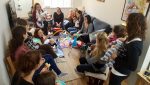
Mamatefet’s first Mom and Babe Circle. (photo from Mamatefet)

Meirav Galili and her husband Itai moved to Vancouver with their two children from Israel five years ago. When their third child was born here, the family received lots of support from friends, something that helped make up for the fact that they have no extended family here.

When she heard about a plan to create a network of Israeli moms and moms-to-be, she was one of the first to sign up with Mamatefet.

Mamatefet, which has grown exponentially almost exclusively through word of mouth, is a mash-up of “mama” with the Hebrew word “maatefet,” which is a wraparound or embrace. The group welcomes those who want to be an otefet, an embracer, or a ne’etefet, an embracee. Except, the terms are not mutually exclusive.

“Sometimes it’s our turn to give and sometimes it’s our turn to get some help,” said Galili, adding that the success of the group surprised all involved.

“It was amazing because many, many people said, ‘me, me, me, me, me,’ and quickly we established something,” she said. Understanding the added burden of having and raising children without parents, aunts, sisters-in-law or other family around inspired many women to step forward.

Thanks to Mamatefet, one phone call or a WhatsApp message can put a team into action.

“The woman doesn’t need to ask even,” Galili said. “Everything is being done for her. She just needs to tell a friend, ‘My child is sick with me’ or ‘I have to stay at the hospital for tonight,’ and we’ll take it from there, and when they get home they have everything. It’s a very strong, warm feeling that we are not alone and we have this supportiveness.”

That is exactly what Rotem Regev had in mind when she and four friends conceived of Mamatefet in late 2016.

“It was one of those nights,” Regev recalled, “a few friends got together sitting around the coffee table chatting, recounting their individual – which we then realized were quite collective – stories of transition, to Vancouver, to motherhood, and how that intersected. What became really crystal clear to all of us is that we were feeling quite a bit of loneliness at that time, whenever that transition was, coming to Vancouver either pregnant or with a very little one, when there is not a school yet or any sort of structure to fit into…. To top that off, you would also be facing an extra challenge being away from your family and friends in a country that doesn’t yet quite feel like home and a language that doesn’t quite feel like home and a healthcare system that feels very, very different.

“We didn’t want any woman to feel the loneliness that we felt,” she said.

photo - Mamatefet offers moms like Osher Cohen support, including the occasional homemade meal, and friendship
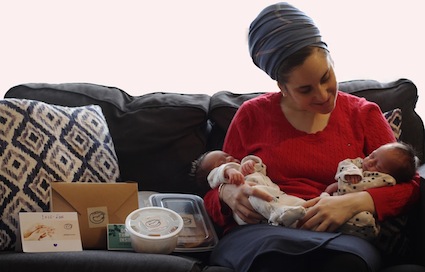
Mamatefet offers moms like Osher Cohen support, including the occasional homemade meal, and friendship. (photo by Lior Noyman)

When they decided to share their idea, they thought maybe five more women would join, perhaps seven. A few months later, they had 70 embracers and more than 40 embracees.

“The word spread out like wildfire really, because I think the need was so great,” said Regev, who is a clinical psychologist. There are a couple of similar groups in Israel and something sort of like Mamatefet in San Francisco and another in New Jersey, but, considering the evident need, it is a surprisingly rare initiative.

Regev and her Mamatefet co-founders Tamara Halamish, Yael Pilo Raz, Yael Mayer and Matti Feigelstock, have now seen their project expand from Vancouver to teams in Richmond, Ladner, Surrey, North Vancouver and East Vancouver-Burnaby, with a new team gearing up in Langley and the Tri-Cities.

In general, Mamatefet volunteers will deliver food, often including a Shabbat meal. There are regular meet-up groups for pregnant women and another for new moms. They are also on call in case of a crisis, like a miscarriage or a stillbirth.

But it’s the informal friendships that organically develop that are as important, said Marina Ingel. Being able to arrange play dates, exchange kids’ clothes, have a coffee with other new moms – this is an important outcome too, she said.

One of the reassuring things is talking to other moms about how the medical system in Canada differs from that in Israel.

“Here it’s totally different. Everything,” said Ingel. “In Israel, every time you’re going to the doctor, you’re doing an ultrasound. Here, you have maybe two the whole pregnancy. A bunch of things that they’re checking in Israel, they’re not doing this at all. But then you realize it’s fine and, if you have any problem, they will check it. Everything is OK, but the thing is that you’re worried about it, because it’s new to you.”

For Galili, cooking is both a hobby and a way to support other new moms.

“They send a message saying there is a woman who is about to come home with a baby and [asking] who is willing to participate,” she said. “I thought, OK, I need to prepare something anyway so I’ll just prepare something extra.”

Baking, homemade granola and yogurt, soups and a main dish, comfort food like chicken and rice, are the sorts of things she preps for new moms.

“If her mother were here, this is what she would probably make for her,” said Galili.

Mamatefet can be reached via facebook.com/mamatefet.

Format ImagePosted on February 23, 2018February 21, 2018Author Pat JohnsonCategories LocalTags childcare, children, Mamatefet, Rotem Regev, Vancouver, women

My homemade Purim poncho

I might have been a Jewish Martha Stewart if fate had been kinder to me. I used to watch with envy as she placed her rose-scented candles on the needlepoint tablecloth in the centre of which were the exquisite paper flowers she crafted. In my fantasy, I imagine my own dinner table now ready for the chopped liver, with braised lamb shanks, kasha pilaf and apple kugel, which would be served on my designer Star of David ceramic plates. Blossoms of fresh orchids from my greenhouse would fill the room. And it would be a good thing.

It is to my chagrin, however, that domestic tasks have never been my forte. Instead, I learned to deflect sizzling hockey pucks from four older brothers as they practised their shots on goal on the frozen North End streets of Winnipeg. I couldn’t whip up a chocolate brownie, but I could power a strike ball for the boys baseball team. I would likely have made a slam-dunk career in basketball if not for my growth spurt maxing out at five feet at an early age.

But, as I became an adult, stopping a puck, throwing a baseball or shooting baskets were no longer in demand. Domestic tasks became the necessity of life and I had few skills. I did manage to accumulate some basic cooking skills, however, and, to date, none of my family has succumbed to starvation.

Now, the task of sewing is a different ball of yarn. What little I learned, I picked up in school. I still remember the pained look on the face of my Grade 7 teacher as I zigzagged the hemline on the proverbial apron running it through the sewing machine. Nonetheless, my lack of proficiency with domestic skills had not interfered greatly in my life – that is, until I became a mother. Then it all came to a flashpoint!

My then-5-year-old daughter, who was attending Peretz School at the time, needed a costume for their annual Purim carnival. She, the little princess, wanted to be a queen – Queen Esther, no less. Oh sure, I’ll just whip up a queen’s costume as soon as I finish the cheese soufflé, the salmon mousse, chocolate-coated orange peels and homemade halvah. What to do? Well, creativity helps where skills fail. I pondered that maybe I could pick up a large piece of fancy material, cut a hole in the middle, and then throw the whole thing over her head, like a poncho.

So, for the first time in my life I found myself in a fabric store like a rookie at a textiles Superbowl. I looked and felt and touched, feigning expertise. Eventually, I settled on a rich red satin. I cut out a round hole in the centre using a “dummy” circle for an approximate size of her head. If I was looking for a “dummy,” I could well have used my own head. The hole had to be adjusted several times to make it big enough to actually get her head through it. The biggest problem, however, was the edges. They were frayed all around and still needed something more to dress it up.

After another search, I discovered long strands of sequins sold by the yard. Exactly what I needed! I chose gold. Very royal, I thought. Much to my surprise, I still remembered the basic back and hemstitch from my sewing class – not a total loss. With needle and thread, I painstakingly stitched on the sequins around the neck and all the edges (I knew enough not to have her head in it at the time). After numerous hours, with bleary, red, irritated eyes, stitch by stitch, it was done.

“What will I wear for a crown?” whined my unappreciative daughter. Once again, I called on some inner resources for inspiration. I found an expandable holder used for tying hair back in a knot or bun. It was gold-coloured metal dotted with decorative “pearls.” When it was fully extended, it sat on the top of her little head like a crown. She loved it! Perfect!

We were ready. Her long, blonde hair flowed softly over her simple red satin poncho gilded with gold sequins, and her greenish-blue eyes sparkled like the “crown” on her head. She was a queen! A blonde Queen Esther!

The party was already in full swing when we arrived, with blue-and-white streamers and balloons lining the walls and ceiling. Chattering children were milling about in all kinds of wonderful outfits. Although her costume was not as elaborate as many, she blended with the others and joined in the games, sang Purim songs and ate hamantashen. At the end of the afternoon, everyone was told to gather around because the judges were ready to announce the winners of the contest.

What contest?

But before I could answer my own question, I heard them announce, “The winner for the best girls costume is Queen Esther.”

“Who?” I whispered under my breath in disbelief.

“Queen Esther!” they called again, as if responding to me personally.

With astonishment, I watched, tears welling in my eyes, as my daughter scrambled onto the stage of the school auditorium for her special moment. I was delighted for her, but bursting with pride for me. It had not been my goal but turned out to be my slam-dunk. This small victory was my personal triumph. I was a Martha Stewart after all. Well, a Jewish Martha Stewart, or maybe substitute Miriam Silver? Regardless, it was a good thing.

Libby Simon, MSW, worked in child welfare services prior to joining the Child Guidance Clinic in Winnipeg as a school social worker and parent educator for 20 years. Also a freelance writer, her writing has appeared in Canada, the United States, and internationally, in such outlets as Canadian Living, CBC, Winnipeg Free Press, PsychCentral and Cardus, a Canadian research and educational public policy think tank.

Posted on February 23, 2018February 21, 2018Author Libby SimonCategories Celebrating the HolidaysTags Purim, Queen Esther, sewing, textiles, women
Salomé’s rightful place

Salomé’s rightful place

Salomé: Woman of Valor will have its world première at the Chutzpah! Festival March 8-10. (image by Anya Ross, graphics by John Greenaway)

There have been many interpretations of Salomé – thought to be the woman whose alluring dance persuaded King Herod to honour her request that he have John the Baptist beheaded – but none quite like that of Salomé: Woman of Valor, which has its world première at Chutzpah! March 8-10.

The creation of this complex, multilayered work that combines poetry, music, dance and film was led by composer and trumpeter Frank London and poet and performer Adeena Karasick. It features live music by London, percussionist Deep Singh and keyboard player Shai Bachar. The poetry is written and performed by Karasick, the dance choreographed and performed by Rebecca Margolick and Jessie Zaritt, and the video analyzing Charles Bryant’s 1923 silent film Salomé was made by Elizabeth Mak. The whole production is directed by Alex Aron.

“Frank was intrigued by the Salomé story due to the visual cornucopia of the Bryant film, and because it is a story where dance was at the centre, motivating the complex chain of events, and thus ripe for reinvention as a contemporary dance-theatre piece incorporating Bryant’s imagery,” Karasick told the Independent about why the work focuses on Salomé and not another Jewish historical or literary woman. “However, he was only aware of the [Oscar] Wilde retelling of the Salomé story and thus not really interested in her narrative. He came to me to see if I could reenvision her story in a more compelling way.”

It has always bothered her, said Karasick, how, within Christian mythology and entrenched in history by writers like Wilde, Gustave Flaubert and Stéphane Mallarmé and artists such as Gustav Klimt, Gustave Moreau and Aubrey Beardsley, “Salomé was seen as yet another Jewish temptress/Christian killer – but, in fact, there isn’t any evidence to substantiate this claim. According to apocrypha and Josephus’s Antiquities, she came from Jewish royalty and there is no evidence she murdered John the Baptist or even danced for Herod,” said Karasick.

“The only historical reference that [Herod’s wife] Herodias’s daughter’s name was Salomé is from Flavius Josephus, who makes no other claims about her – not that she danced for Herod, not that she demanded John’s head, but only that she went on to marry twice and live peacefully. The other apocryphal reference is that a daughter danced for Herod, which caused him to lose his mind and kill John the Baptist. Thus, the conflagrated Salomé that appears in the Wilde play, [Richard] Strauss opera and all subsequent productions, is an amalgamated construct, so we felt it was our duty to set the record straight.”

In fact, added Karasick, there are three women named Salomé in Jewish history: Salomé, daughter of Herodias and Herod II (circa 14-71 CE); Queen Salomé, her great-aunt (65 BCE-10 CE); and Salomé Alexandra (139-67 BCE).

“Her great-aunt, Salomé I, was the powerful sister and force behind Herod the Great, king of Judea and Second Temple rebuilder,” said Karasick, while Salomé Alexandra (also known as Shelomtzion) was one of only two women who reigned over Judea.

“I wanted my Salomé, Salomé of Valor, to carry the weight of both her genetic lineage and the cultural heredity of her name, embodying the legacy and power of the women that came before her,” said Karasick.

Karasick, who was born in Winnipeg, grew up in Vancouver, earning her bachelor’s from the University of British Columbia. She did her master’s at York University and her PhD at Concordia University. Among other things, she teaches literature and critical theory at Pratt Institute in New York, is co-founding artistic director of KlezKanada and performs her work around the world. The author of nine books – with a 10th, Checking In, published by Talonbooks, on the way – she has been awarded for her contributions to feminist thinking and, last year, the Adeena Karasick Archive was established at Special Collections, Simon Fraser University.

London – a member of the Klezmatics and the group Hasidic New Wave, who has performed with countless musicians and made numerous recordings of his own – saw Karasick perform in New York in 2011. He then hired her, she said, “along with Jake Marmer to design and lead the poetry retreat at KlezKanada…. We hadn’t yet collaborated before this, but I was always compelled by his music and the breadth of all he created as a masterful revolutionary himself, not only as a spectacularly fierce trumpet player but virtuosic composer, reinvigorating klezmer music, transcendentally intermixing it with aspects of world music, jazz, Chassidic new wave, punk – and always felt it would be a thrilling and highly symbiotic artistic match.”

When Frank approached her about the Salomé project, said Karasick, they both “fell in love with the Bryant film but were so perplexed” about Salomé’s “reputation in cultural history.”

So, Karasick started researching, “poring through the multiple and conflict[ing] narratives – through Josephus and the apocrypha, locating the many discrepancies between Christian and Jewish mythologies, speaking with specialists in the field, and became fascinated with how there are so many ‘truths,’ stories, misreadings, and how imperative it is to question these grand narratives, problematize traditional cultural, moral and religious perspectives.

“For millennia,” she said, “Jews have been portrayed as the murderers of gods and prophets in other people’s mythologies, so Salomé: Woman of Valor deconstructs this mythology, exposing how she was not a demonic murderess, and opens up the possibilities for infinite retelling and how truth itself is always a construct of veiling and unveiling.”

About the magnitude of the project, Karasick said, “As the author of nine books invested in issues of ethnicity, gender and ways to construct meaning, as professor of poetry and critical theory, gender images in the media, and poetics and performance, Salomé: Woman of Valor is a logical progression in my 30-year career, and has allowed me to integrate my experiences in one work – something that I have never done before.

“Due to the scope of this show,” she said, “I’m able to weave together the multiple styles of writing that I’ve experimented with over the years – sound poetry, homophonic translations, post-language conceptualism, kabbalistic and feminist revisionist practices, all syntactically playful, polyphonic, ironic and rhythmically complex – a fusion of my esthetic passions and expertise; opening a space of female empowerment.”

While London has been involved in many projects, Karasick said Salomé might be the first for him with performance poetry at the centre.

“We created Salomé: Woman of Valor as an integration of performance poetry, dance, music and video exploring the dialectic between narrative and abstraction – it is a quantum leap forward in collaborative artistic development, challenging my conceptual processes of making an artwork,” she said. “I couldn’t be more excited.”

Salomé: Woman of Valor is already being presented in an array of venues and contexts, said Karasick. “Its form and content make it appropriate to be presented at jazz, dance, poetry, new theatre, literary and electronic literature festivals; in performing arts centres, universities, avant garde text-based multimedia events, as well as events focusing on new media and cross arts,” she said.

“With its feminist and mystical kabbalistic take on Jewish historical subject matter and a live score which draws from East European Jewish music (klezmer) with jazz, Arabic and Indian musics, our Salomé is especially attractive to Jewish culture festivals and to presenters of Jewish music, language, dance and art.”

The libretto has been published in Italian and in English, and selections of it have been published in Bengali, Arabic, Yiddish and German. It is “being taught in universities worldwide in departments of global literature, Jewish studies and humanities and media studies,” she said.

The artists bringing Salomé: Woman of Valor to Vancouver are all “at the forefront of their respective fields,” said Karasick, “and so I feel so fortunate to be working with such powerful creators, all revolutionaries in their own ways. Frank works with Shai Bachar and Deep Singh on a number of musical projects – Deep and Frank started the internationally acclaimed bhangra-klezmer fusion band Sharabi; and [Frank] co-developed Night in the Old Marketplace with Alex Aron, so bringing her on board as a director seemed a natural fit.

“Over the five years of envisioning the piece, we tried on a number of dance styles, ranging from tribal belly dance to sword dance/swallowers, and, with the advice of (Merce Cunningham protégé) Gus Solomons, Jr., settled on the avant garde modern dance of Israeli superstar Jesse Zarrit and the stunningly poetic Rebecca Margolick, with a shout-out to the Dadaist Loïe Fuller stylings by Jodi Sperling.”

Mak’s video on Bryant’s silent film, notes the project’s promotional material, is “punctuated with Jim Andrews’ stunning vispo [visual poetry], with special video appearances by … Tony Torn as Herod, lit by Nicole Lang.”

“Together,” said Karasick, “we’re expanding our work in ways only dreamed possible; have created an intellectually provocative, audio-visual sensorium, informed by our (Frank’s and my) ongoing obsession with excess, desire and pushing boundaries.”

And it’s an interest, if not obsession, with many others, as well. The Kickstarter campaign for Salomé surpassed its goal of $20,000, about half of the project’s budget.

“The show has been garnering a lot of love and support from colleagues and patrons,” said Karasick, “perhaps due to ways that it addresses the social and political necessity to speak the unspoken, resist stereotypes, misrepresentation and outdated myths, and fosters a thinking that leads to a hybridized syncretic culture, one that honours the intermixing of blood, belief, rhythm, texture and being. Content-wise, it addresses outdated notions of identity and ethnicity, and carves out a space where difference and otherness can be celebrated. We feel incredibly grateful, and hope that we can keep growing it. Broadway, here we come!”

But, first, the Chutzpah! Festival. They have also been invited to Toronto’s Ashkenaz Festival and the Boston Jewish Music Festival, said Karasick, who will continue to tour with the Salomé books. “Frank,” she said, “will record and release the music as a CD. We hope to see it at major festivals and venues worldwide.”

The presentations of Salomé at Chutzpah! are presented in association with the Dance Centre, where the performances will take place. For tickets and the full festival lineup, visit chutzpahfestival.com.

Format ImagePosted on February 16, 2018February 14, 2018Author Cynthia RamsayCategories Performing ArtsTags Adeena Karasick, Charles Bryant, Chutzpah! Festival, dance, film, Frank London, music, Oscar Wilde, poetry, Salomé, spoken word, vispo, women

In spirit of Jewish law

The other night, I sat on the couch with my husband in an attempt at togetherness. We watched an episode of Madam Secretary. It was our second attempt. On the first try, worn out, I was about to fall asleep when my spouse suggested that we save it for another time so I could go to bed. It was, he pointed out, supposed to be fun. Sticking to the initial “date time” wasn’t working. Thank goodness for the PVR.

The show we watched was full of allusions to knitting and design, which are parts of my freelance work. I cringed inwardly, preparing for derogatory comments about “women’s work.” To my surprise, the textile theme was respectful. A man with PTSD takes up knitting as part of his therapy – it helps him focus his mind. A first-year university student struggles with a design assignment – she comes away with a couture dress, but not before we hear the sounds of her sewing machine at work in the background. Best yet, when her sister begins to panic at modeling the dress, the student gives her a pep talk, saying, “Pull yourself together, be strong. Do this, I need you.” What started as a frivolous thing – “help me out at this fashion show” – became more. It became a chance to succeed academically, and to use inner strength to prevail over a trying situation. The episode showed strong women and struggling men seeking to be their best selves.

All this came to mind later, in the context of a Talmud class. I signed up for a Jewish Theological Seminary online course. With the wonders of technology, I can hear lectures by Rabbi Dr. Judith Hauptman, who is a gifted teacher and intellect. Her course has an interesting premise – looking at situations when “law meets life.”

She began with basic information, and got started studying talmudic text. Whenever I study Talmud (or any older text), I have to remember the inherent inequalities. Women were seen as subservient, with less agency than we think is appropriate today. Through careful reading, we saw lists of tasks wives are obligated to perform for their husbands (Bavli Ketubot 61a) and a discussion about how one might “wash” – sprinkle water on – a floor on Shabbat (Bavli Shabbat 95a). (This last reference was not cleaning so much as providing a form of air conditioning and reducing dust on an extremely hot Shabbat in Babylonia.)

Hauptman showed us how women’s interpretations allowed them both to obey the spirit of Jewish law, and to accomplish what needed to be done. In more than one place in these readings, the rabbis (all male) allude to the fact that women were smart and had power or agency. Even if the language of the Talmud relegates women to being “property of a man’s house,” the women in these stories shine through as being shrewd and savvy.

We think sometimes that our lives are infinitely more complicated, sophisticated and detailed than those in the nostalgic past. Yet, these talmudic texts reminded me that, more than 1,500 years ago, smart people focused on the details that make our households and lives function. We may have a way to record entertainment now (and a TV!) or access to machine-produced clothing, but our fundamental concerns are similar. How are we to balance the spirit of our commitments with the laws’ requirements? What is the intention of our roles? How do men and women balance and subvert traditional roles in order to cope? How do our household tasks make life comfortable and/or meaningful?

The first text we studied refers to tasks that wives perform for their husbands: grinding grain, baking bread, doing the laundry, cooking, nursing his babies, making his bed, and working with wool. When she has wealth and servants, she can avoid some of these household obligations. As we studied this text together, I was knitting a wool sweater I’d promised to finish for one of my kids. I thought the webcam was trained up, only on my face. No, as it turned out – a friend, also taking the class, in New York, said she could see my knitting.

That’s OK. In the end, the more things change, the more they stay the same. Regardless of your level of observance, we still wrestle with these issues. Women often interpret Jewish law and tradition when it comes to household details. If one doesn’t have enough servants or financial resources, or even enjoys knitting and finds it focuses the mind, one might still be working with wool.

A recent study indicated that, in Reform Jewish congregations, rabbis who are women are paid less than their male counterparts. Women have fewer positions “at the top” as senior or sole congregational rabbis. We continue, even in the most progressive Jewish movements, to struggle with pay equity and gender roles.

The Talmud is an essential part of Jewish oral law, but it’s also literature, with narratives that shed light on daily life. A current TV show portrays a woman as U.S. Secretary of State, and shows that interaction with fibre arts is still an important, useful and viable thing to devote time to creating, no matter your gender.

In both the show’s legal negotiations and this talmudic text, we’re taught that, sometimes, the spirit of the law, the intention, is more important than the letter of the law. Through all the big decisions, it’s sometimes the small household details that make people’s lives rich. I’ll keep knitting handmade sweaters for my kids – and studying Talmud. Even in these times, there’s a place for both.

Joanne Seiff writes regularly for CBC Manitoba and various Jewish publications. She is the author of three books, including From the Outside In: Jewish Post Columns 2015-2016, a collection of essays available for digital download or as a paperback from Amazon. See more about her at joanneseiff.blogspot.com.

Posted on February 9, 2018February 7, 2018Author Joanne SeiffCategories Op-EdTags equality, Jewish life, Judaism, Madam Secretary, Talmud, TV, women

A no-go zone for Jews?

Women and their allies across North America marched last Saturday in a massive show of feminist and progressive activism. It was the second annual such event, the first one coming the day after U.S. President Donald Trump’s inauguration last year.

At the Los Angeles Women’s March, actor Scarlett Johansson, who is Jewish, told the audience that she became part of the movement because she felt a rage in her on behalf of women who have been abused and because of things that have happened to her in the past.

“Suddenly, I was 19 again and I began to remember all the men who had taken advantage of the fact that I was a young woman who didn’t yet have the tools to say no, or understand the value of my own self-worth,” Johansson said.

Johansson’s experience is one of millions that have been shared in recent months since the advent of the #MeToo movement. But it was a message that was not heard by all.

Because Johansson was scheduled to speak at the event, Palestinian women’s groups boycotted it. One group accused Johansson of “unapologetic support of illegal settlements in the West Bank.”

The Palestinian groups’ complaint, ostensibly, is that Johansson was a spokesperson for SodaStream, which produces an at-home beverage carbonation system. The fact that SodaStream was based in Maale Adumim, a West Bank Jewish settlement, made it a target for BDS, the movement to boycott, divest from and sanction Israel.

The Palestinian American Women’s Association declared: “While her position may not be reflective of all organizers at the Women’s March Los Angeles Foundation, PAWA cannot in good conscience partner itself with an organization that fails to genuinely and thoughtfully recognize when their speaker selection contradicts their message.”

In a free country like the United States, anyone is free to boycott anything. The Palestinian women’s groups were fully within their rights to stay home. But the idea that Johansson was not a legitimate voice to be heard at the rally because she does not condemn Jewish settlements in the West Bank is a bit of a stretch.

If Johansson’s association with SodaStream was the real reason the Palestinian groups stayed home, as they say it is, it presents an opportunity to reflect on a bit of recent history. In one of their few successful campaigns, BDS managed to force SodaStream to close its West Bank plant, causing unemployment for 500 Palestinians who had worked there. Some achievement.

However, something potentially more significant may be afoot, which has nothing to do with SodaStream or settlements at all.

The Palestinian movement is trying to co-opt the progressive and feminist movements in the name of a nationalist movement that gives no indication that it would, if successful, reflect anything like what North Americans would consider a progressive or woman-friendly independent country.

One of the things that progressive people have come to accept, with much thanks to #MeToo, is that intent sometimes matters less than impact. We have come to accept, for instance, that what a man might call “persistent flirtation” can be experienced by women as coercion, intimidation or worse.

Palestinian groups – and the progressive and feminist groups they infiltrate – should be conscious that what is intended as criticism of Israel, whether they like it or not, impacts on Jews. Of course, not all Jews are Zionists. Nonetheless, when you attack Israel, Jews feel it.

Consider from where we’ve come. A few short years ago, most “pro-Palestinian groups” insisted they didn’t oppose Israel’s existence, they were merely criticizing certain policies of the Israeli government. Now, it is extremely common for people to express outright antipathy to Zionism. Indeed, Zionism is a dirty word among many of the people who organized and participated in the marches last weekend. This is a far step from criticizing certain policies. To oppose Zionism is to oppose the existence of a Jewish state.

The Palestinian movement is trying to kick the Zionists (and that includes most North American Jews) out of the progressive and feminist movements. Is that OK with progressives? Is that OK with Jews?

If both sides don’t do something about it, Zionists and Jews are going to have a sworn enemy on the left and the left is going to be known as a no-go zone for Jews and Zionists. Who thinks that’s OK?

Posted on January 26, 2018January 24, 2018Author The Editorial BoardCategories From the JITags #MeToo, Israeli-Palestinian conflict, progressive, Scarlett Johansson, women, Zionism
NCJW pays tribute to Poliakoff

NCJW pays tribute to Poliakoff

Left to right: former National Council of Jewish Women Vancouver section president Shirley Hyman; Gloria Hendin, tribute committee chair; Barbara Heller, longtime supporter of council; Marion Poliakoff, the guest of honour; Bonnie Gertsman, former Vancouver section president; Anne Melul, former Vancouver section membership chair; and Debby Altow, past president, Vancouver section. (photo by Joanne Emerman)

National Council of Jewish Women hosted a tea at Temple Sholom on Jan. 9 to celebrate Marion Poliakoff, a true Renaissance woman. At 94 years young, she continues to be an inspiration to council members past and present.

Poliakoff’s career and her personal life demonstrate the principles of NCJW: fostering multiculturalism, alleviating poverty among women and children, supporting family counseling in Israel through ALUMA, and cherishing music and family. Her commitment to clear and convincing communication has been a boon to many newsletter writers – and she continues to edit us closely.

Gloria Hendin, who chaired the event committee, welcomed everyone. Shelagh Stoller bought the gift for Poliakoff, which Shirley Hyman presented. Barbara Heller managed all the banner decorations, Bonnie Gertsman and Anne Melul organized the food, and Judy Stern greeted guests as they arrived. The entertainment came courtesy of Poliakoff’s daughter, Amy Poliakoff, who brought her flute from Boston. I delivered the tribute speech, which I share below.

Vancouver section president Catherine Stoller set the tone for the annual general meeting that followed the celebration. “Looking backward, we recall our ancestry. Looking forward, we confront our destiny,” she said. The board of directors was installed by Shanie Levin with those words ringing in their ears!

In preparing my remarks, I read Melul’s biographical notes on Poliakoff, Carol Weinstock’s article on NCJW in the Jewish Museum and Archives of British Columbia’s journal, The Scribe, and the book More Than Just Mrs.: Jewish Women’s Organizations in B.C., as well as the council’s cookbook. Of course, I also spoke with many council members who worked with Poliakoff, and reflected on my own personal experiences with her. With some minor editing, to reflect their publication after the event, my remarks follow.

Marion was born in the United States. Holding a bachelor’s from Simmons College in Massachusetts and a master’s in journalism from New York’s Columbia University, she married Mel Poliakoff in 1949, adopting Mel’s son Merrill at the same time. Although at first they were unable to live in Tenafly, N.J., because, as Jews, they could not buy a house there, nevertheless they did move there a few years later. She became the first Jew elected to public office, serving on the board of education.

In 1972, she moved to West Vancouver with her husband and their daughters Amy and Nan. They loved tennis, skiing and sailing. Sadly, Merrill and Nan are gone, but many of Marion’s family were able to join the council’s tribute.

When Marion met Bess Narod – Bess is from Ottawa; I knew her family back home – they went to an NCJW meeting, and that was the start of Marion’s connection with council. The first big item she worked on, the hearing screening project in schools, demonstrated council’s mission: identify a need, pilot a response, make it a success and turn it over to government. The Vancouver health department now runs it.

Marion also met Rita Weintraub, who became a lifelong friend. Together, they have worked to support the Isaac Waldman Jewish Public Library at the Jewish Community Centre of Greater Vancouver.

Meanwhile, Marion got another master’s degree – from the University of British Columbia’s School of Social Work – and, through a field placement at Britannia Community Centre, became interested in multicultural issues. Always the consummate writer, she contributed the Multicultural Corner column to the monthly newsletter of the B.C. Association of Social Workers; another column went into the Britannia newsletter, which was translated into Italian and Chinese.

The City of Vancouver grabbed Marion and she ran parenting groups for mothers in three community centres – using translators for Farsi, Chinese and Italian participants. In 1981, she received the Social Worker of the Year Award from the B.C. Association of Social Workers for her multicultural work.

I met her when I was the director of communications for the Canadian Cancer Society and she was a social worker at the B.C. Cancer Agency. I was working on breast cancer issues, with multicultural projects for Chinese and South Asian women. We found we had much in common.

Marion was also the one who called me every year to pay my NCJW dues, even though I was not an active volunteer in those years. She recruited me after I retired to join the board and, 13 years later, I’m still on it in one capacity or another.

In 1991, HIPPY (Home Instruction for Parents of Preschool Youngsters) was brought to Canada from Israel as a council initiative by Carol Slater. Ever alert to new connections, Marion linked Britannia, along with Simon Fraser University, to council as our community partners to launch the HIPPY project. She was intimately involved in establishing its work with immigrant mothers and their families. While its name has changed to the Mothers Matter Centre, HIPPY remains one of council’s programs, and Wazi Kapenda, its Western director, was in attendance at the tribute.

Marion’s volunteering extended to driving people to services at Congregation Har El, eventually donating her beloved baby grand piano to the shul, fundraising for the synagogue, and cooking and serving food weekly to needy and homeless people at Harvest House.

Later, she joined the North Shore Osteoporosis Society, organizing monthly speakers. I spoke at one gathering and there were more than 100 people attending – a not uncommon number!

Her commitment to ALUMA (formerly the Israel Family Counseling Agency) was, and continues to be, an inspiration. She fought for support for ALUMA in council, because the organization was dedicated to supporting people in Israel who could not afford professional counseling but who desperately needed it. And Judy Stern could always count on Marion to canvass for Friends and Angels, council’s only annual fundraiser.

Marion’s was a home where music was loved and valued, even after the piano was gone. She supported the Vancouver Symphony, the Vancouver Chamber Music Society and Music in the Morning. Music continues to be a tree of life for many of her family members. Her close friend Shirley Lecker is part of that tradition.

Do you see a thread unspooling here – with HIPPY, with anti-poverty issues, with a commitment to Jewish values, with a passion for family, with a professional eye for communication, with an abiding love of music? When I said Renaissance woman, the label is legitimate.

It is such an honour to acknowledge Marion for her work with council – and with many of us personally. It is beyond words. To simply say thank you is really inadequate. But, from the bottom of my heart, and from all of us, thank you, Marion.

Format ImagePosted on January 19, 2018January 17, 2018Author Debby AltowCategories LocalTags health, HIPPY, Marion Poliakoff, NCJW, tikkun olam, volunteering, women

Light against darkness

There is a reason that we wake up every morning to new reports of accusations against men in positions of power. It is not that the sad phenomenon of sexual harassment or violence is new – in fact, many of these accusations relate to incidents decades ago. It is also not because the women who are sharing their experiences of abuse are more courageous now than they were last week or last year.

The reason is that we have reached one of a series of tipping points. As recently as 2014, when a number of allegations of inappropriate and illegal actions by legendary comedian Bill Cosby became public, his accusers were treated as such accusers have routinely been treated: variously as complicit in their victimizations, as liars, as exaggerators, as willing partners who alleged assault only when the “relationship” went sour.

What has changed in this short time is a critical mass of people – women and men, as well as media, employers and the consumers and voters upon whose beneficence the alleged perpetrators have depended – have adopted a new willingness to believe women’s narratives of harassment and assault. This change has happened, in the context of social change, with startling suddenness.

This has created a tipping point of its own. Knowing that they are more likely to be believed than further victimized, a vast number of women have found strength in their numbers and, sensing the social change at hand, have stepped up to share their experiences.

The unprecedented acknowledgements by millions of women that they have been subjected to sexual harassment, assault or worse are taking place not only in Hollywood and Washington. As the #MeToo campaign is demonstrating, many, if not most, women have experienced something on the spectrum of gender-rooted harassment or violence. The incidents have caused unique effects in each instance, on each woman, effects that range from stunted career development and self-image issues to debilitating, lasting psychological trauma. So, put mildly, these are not good news stories.

Yet something good could come from this – indeed, it can’t help but. Our society is finally having an open and frank discussion about these issues. Yet another tipping point is surely upon us. The public perception of appropriate behaviour toward women (and, to extrapolate, respectful behaviour between all people, especially those in positions of vulnerability or subordination) has changed and will continue to change as we navigate this public discourse.

Again, this is not a good news story. In an ideal world, there would have been no such incidents that led us to this point. Yet, like the reconciliation process taking place between indigenous and non-indigenous Canadians, the fact that these things did happen, and that they cannot be undone, demands that a frank public reckoning take place and that we identify ways to hasten a better future. That we are doing so is a good thing.

These are not the sorts of topics we like to reflect on at the holidays, and yet it is something appropriate that this issue is top of the newscast as we approach Chanukah.

This holiday has, among other meanings, the idea of kindling light in the deepest part of winter. Each of the women who has come forward about her experiences has lit a single flame. Together, these lights have become a force against individual and collective darkness.

Posted on December 1, 2017November 29, 2017Author The Editorial BoardCategories From the JITags abuse, Chanukah, harassment, women
Women lead way to peace

Women lead way to peace

Yael Deckelbaum is using her musical talents and connections to help Israelis and Palestinians press for peace. (photo from Yael Deckelbaum)

Yael Deckelbaum is using her musical talents and connections to help lead thousands of Israeli and Palestinian women to peacefully press for the end of the fighting between their two peoples via March for Hope.

Deckelbaum’s celebrity status in Israel and around the world – through performances with known local artists and bands such as Shlomo Artzi and Machinah, as well as her career with Habanot Nechama and solo albums – helps draw a crowd. Her involvement in the cause began when she joined forces with Daphni Leef, an Israeli activist for social justice.

“I’d sit with her and tell her she’s a better person than I am,” said Deckelbaum. “She was always talking about how we have to change things in Israel – going around in many places in Israel, meeting people, listening to them and trying to learn … what’s wrong and trying to fix things. I decided to take a caravan, go through Israel, sell CDs, maybe bring a sound system, perform … see people from a different angle. Daphni decided to join me. From this idea, it became 20 people, two caravans … a journey we did for 45 days in 40 different places across Israel.”

They met many Israelis from various cities and villages, and Deckelbaum gained a new perspective. Everywhere they went, she would sing and Leef would speak to the people after every show.

“That’s when I decided I would dedicate myself, using music as an instrument, toward change … not just be an instrument for supporting my existence … but to spread a message and how I believe this world should be. [It] was a big turning point in my path,” Deckelbaum told the Independent.

A year later, one of Deckelbaum’s friends shared an email about Women Wage Peace.

“A lot of times, us musicians, we get invited, we go, sing and leave,” said Deckelbaum. “We feel good about it. But, this time, I felt like I had to meet them. A few days later, I was sitting at a table with women from Women Wage Peace. They told me about this march they were planning – a group of mothers who, in the period of military operation, were experiencing terror at home, fear … mothers sitting at home, knowing their sons are somewhere and not knowing if they’d come home from war.

“One of the founders told me she said to herself that she would never forget this feeling of terror, that she can’t sit anymore and do nothing about it. She urged us to do something radical, extreme, because something had to change. She couldn’t live with the feeling of helplessness anymore.”

At one point, Women Wage Peace fasted for 50 days outside the prime minister’s house, demanding a mutual agreement between Israel and Palestine be made.

“They told me they were already connected with Palestinian women who feel the same,” said Deckelbaum. “And then, on Oct. 19, 2016, 1,000 Palestinian women marched with us together in the Dead Sea [area] – the lowest place of the earth. I started to cry, as it touched me in a deep place.

“Many years ago, I had this vision of women marching together … not something I can explain…. Then, I met these women [who] told me about this, and it was coming true. And, it has an energetic meaning that it happened in the lowest place on the earth – women marching to the belly of the earth. So, I cried and offered to give my music to the cause.”

Deckelbaum invited more artists to join and sing, and became the march’s artistic director. She began with songs like “Give Peace a Chance” and “Hallelujah,” and then wrote originals herself. “The melody and the lyrics just came,” she said. “And the ‘Prayer of the Mothers’ was born, directed by Astar Elkayam.”

Deckelbaum was inspired by a message that had been sent to march organizers by Leymah Gbowee. Gbowee is a Liberian woman who led a women’s peace movement, which helped bring an end to the Second Liberian Civil War in 2003, after 13 years of fighting.

“I felt something very real is happening, that I have a chance to do this,” said Deckelbaum. “I put it into the song clip, so you can hear her speaking. And she sang, ‘As the world we live in, peace is possible / Only when women of integrity and faith stand up for the future of their children.’”

This year, Women Wage Peace planned a second march, dubbed, “The Journey to Peace,” which started in the south of Israel near the Gaza border on Sept. 24 and ended in Jerusalem. Other events have followed, and will continue, throughout Israel. The peak of it was on Oct. 6 in Jaffa/Tel Aviv, with a march that Deckelbaum helped organize, “colourful with dancers, musicians, and drummers – happy and hopeful,” she said.

On Oct. 8, there was an event in the desert with Palestinian women. The previous year, 1,000 Palestinian women came. This year, there was twice that number, and the hope is that, each year, it will grow.

“These are the miracles we’re all waiting for – peace between Israel and Palestine, and between and within ourselves and amongst us as people,” said Deckelbaum. “Women Wage Peace isn’t only about making peace with Palestinian women. It’s about making peace between all kinds of women in our society and different places.”

Deckelbaum learned there is a global women’s revolution. She heard of a march in Washington, D.C., in which she participated, and another in Zurich, at which she was invited to sing.

After the video of “Prayer of the Mothers” was released, more marchers all over the world were set into motion. Deckelbaum is now working on a project called Women of the World Unite.

“I believe that women from all over the world are sharing this message, a hope for peace – a message that’s inclusive of all human beings,” she said. “We need women to be more involved in managing the ways of the world – not only by raising children, but also by engaging in the system and how things will work.”

The Jewish Independent spoke over the phone with Deckelbaum when she was in Switzerland doing concerts with an ensemble of religious and secular Jewish, Muslim and Christian women called Prayer of the Mothers Ensemble. It involves 14 women, carrying the message of female empowerment, revolution, evolution and peace.

Rebeca Kuropatwa is a Winnipeg freelance writer.

Format ImagePosted on November 24, 2017November 23, 2017Author Rebeca KuropatwaCategories WorldTags Israel, Israeli-Palestinian conflict, peace, women, Yael Deckelbaum

Posts pagination

Previous page Page 1 … Page 11 Page 12 Page 13 … Page 15 Next page
Proudly powered by WordPress