Skip to content
  • Home
  • Subscribe / donate
  • Events calendar
  • News
    • Local
    • National
    • Israel
    • World
    • עניין בחדשות
      A roundup of news in Canada and further afield, in Hebrew.
  • Opinion
    • From the JI
    • Op-Ed
  • Arts & Culture
    • Performing Arts
    • Music
    • Books
    • Visual Arts
    • TV & Film
  • Life
    • Celebrating the Holidays
    • Travel
    • The Daily Snooze
      Cartoons by Jacob Samuel
    • Mystery Photo
      Help the JI and JMABC fill in the gaps in our archives.
  • Community Links
    • Organizations, Etc.
    • Other News Sources & Blogs
    • Business Directory
  • FAQ
  • JI Chai Celebration
  • JI@88! video

Recent Posts

  • המלחמות של נתניהו וטראמפ
  • Zionism wins big in Vegas
  • Different but connected
  • Survival not passive
  • Musical celebration of Israel
  • Shoppe celebrates 25 years
  • Human “book” event
  • Reclaiming Jewish stories
  • Bema presents Perseverance
  • CSS honours Bellas z”l
  • Sheba Promise here May 7
  • Reflections from Be’eri
  • New law a desecration
  • Resilient joy in tough times
  • Rescue dog brings joy
  • Art chosen for new museum
  • Reminder of hope, resilience
  • The national food of Israel?
  • Story of Israel’s north
  • Sheltering in train stations
  • Teach critical thinking
  • Learning to bridge divides
  • Supporting Iranian community
  • Art dismantles systems
  • Beth Tikvah celebrates 50th
  • What is Jewish music?
  • Celebrate joy of music
  • Women share experiences 
  • Raising funds for Survivors
  • Call for digital literacy
  • The hidden hand of hate
  • Tarot as spiritual ritual
  • Students create fancy meal
  • Encouraging young voices
  • Rose’s Angels delivers
  • Living life to its fullest

Archives

Follow @JewishIndie
image - The CJN - Visit Us Banner - 300x600 - 101625

Tag: women

JNF hosts Israel’s Rasnic

JNF hosts Israel’s Rasnic

At the Jewish National Fund, Pacific Region, Negev Dinner on April 10, left to right, are Ruth Rasnic, dinner honoree Shirley Barnett and B.C. Premier Christy Clark. (photo from JNF Pacific Region)

When many people think of feminism, it’s likely they connect it with the second half of the last century – names like Germaine Greer and Betty Friedan, who garnered followers in the 1970s for their discussion of equality and freedom.

Some will think of the suffrage movement at the beginning of the past century, which struggled to get women the vote.

But feminism for Ruth Rasnic means safety from harm, respect at home.

Rasnic is a much-decorated social activist recognized in her home of Israel for the work she started in the 1970s creating the organization No to Violence Against Women. She was also a founding member of Ratz, a political party that focused on human and civil rights, and, in 2008, she was appointed by former prime minister Ehud Olmert to his advisory council for women’s stature. She was awarded the Israel Prize for lifetime achievement in 2009, joining the ranks of Golda Meir, Abba Eban and Amos Oz.

Established by Rasnic in 1978, No to Violence Against Women provides emergency housing for victims of physical or psychological abuse. It also runs a 24-hour hotline and advocates for women’s rights.

Rasnic was in Vancouver recently to promote the collaboration between No to Violence Against Women and the Jewish National Fund, Pacific Region (JNF) to raise funds to rebuild a shelter in Rishon Le Zion. The goal is $1.5 million Cdn.

“By building shelters like the Rishon Le Zion shelter, giving women and children a safe haven, support, empowerment, legal aid, we enable them to carve a different future for themselves and their children,” Rasnic said.

The shelters provide victims of domestic violence with a safe environment in which to get a fresh start. They are provided with clothing, access to therapy, employment and assistance in finding new housing. A 24-hour housemother ensures that someone is with the women all the time. To ensure security for the women and their children, they are housed in a shelter that is not within their own city.

“Most women are in shock when they come to the shelter,” said Rasnic. “They have nothing. They may be haggard, malnourished, suffering from PTSD. Within a week, they are physically changed.”

Israel particularly faces challenges servicing victims of domestic violence because many women are new immigrants from Ethiopia, Eritrea and Sudan, and don’t speak common languages. Many have no national status and are not medically insured.

“These are some of the harrowing things we have in the shelters,” she said. “Seven to eight percent of our residents are women, with children often, who are stateless and have no status in Israel. We are now working with the government to ensure that while these women are at the shelter, they can get medical aid.”

Rasnic said that legislation around this problem should be passed after Passover.

Rasnic was a guest of honor at the JNF Negev Dinner on April 10, and the next day visited King David High School to speak to the students. She is adamant that education has to be a key factor in making any difference in abuse toward women.

“No male baby is born a violent man. No female baby is born a victim,” she told the audience at the Negev Dinner. “These are societal norms learned in the home, school and army.”

She has even produced a book, The Shelter is My Home, which is written looking at life in a shelter through a child’s eyes.

“Nobody can take out an insurance policy for their daughters,” Rasnic said. “This is our joint responsibility.”

Beyond the issues for which she’s best known, Rasnic also feels strongly about other social issues in her hometown of Herzliya. She has worked on no-smoking campaigns, which included a free course for those wanting to quit; she has worked to get better access for people with disabilities to public areas in city; and she helped transform a kindergarten space into a drop-in health centre for teens.

At a national level, Rasnic is troubled by laws still on the books that require a woman to get her husband’s signed agreement in the case of abortion or a get (Jewish divorce document).

“Oh, talk about the get,” Rasnic said, her whole body seeming to stiffen at the thought. “Rabbis have to find a solution to the get. They must do it. My own daughter’s husband wouldn’t give her a get for three years.”

While in Vancouver, Rasnic remarked on the federal government’s new cabinet, which comprises 50% women, and Christy Clark being British Columbia’s premier.

“I think it’s wonderful,” she said. “I think it will make a better society. I don’t think women are cleverer than men – I think we’re sensitized to different issues that men have simply ignored.”

No to Violence Against Women has three shelters in Israel, in Hadera, Herzliya and Rishon Le Zion. The fundraising efforts spearheaded by Rasnic are to rebuild the shelter in Rishon Le Zion, to be renamed the Vancouver Shelter. The cause was chosen as the beneficiary of the Negev Dinner by this year’s honoree, Shirley Barnett. To donate to the campaign, visit jnf.ca/index.php/vancouver/campaigns/negev-campaign.

Baila Lazarus is a freelance writer and media trainer in Vancouver. Her consulting work can be seen at phase2coaching.com.

Format ImagePosted on April 22, 2016April 20, 2016Author Baila LazarusCategories Israel, LocalTags abuse, Israel, JNF, Rasnic, shelter, women

Love, family, tradition

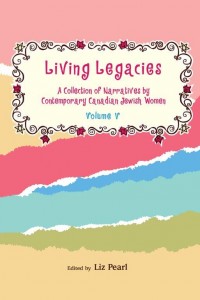
The 23 authors in editor Liz Pearl’s latest collection of essays – Living Legacies: A Collection of Narratives by Contemporary Canadian Jewish Women, Vol. 5 (PK Press, 2015) – come from a range of backgrounds. They work in fields as varied as medicine, education, the arts, philanthropy, event planning and graphic design. They have served in the army, immigrated from Africa and led all manner of enterprises in business, education and community service. Their essays are brimful of passion, wisdom and intellect.

Among the writers are Victoria’s Vicki Davidoff and Vancouver’s Ada Glustein.

In her essay, Davidoff describes her journey from good friend and wife to skilled caregiver and, finally, “death doula” for terminal cancer patients. Losing her own husband, Ken, to cancer in 2008, Davidoff learned what it means to create a “conscious death.” Together, she and her husband crafted a space for reflection, writing letters to family members as well as his obituary. She describes this space as “sacred,” and she has established a respectful, spiritual program for patients and their families, one that gives structure and meaning to an otherwise terrifying ordeal.

Glustein, the daughter of Russian immigrants, was raised in a kosher home where Yiddish was spoken and the festivals of Canadian society ignored. Defining herself through her religion and culture, she was presented with a challenge growing up. Every young adult longs to blend in with her peers, but this felt impossible. She once made an Easter card at school. Knowing that it could not go home with her, the teacher tore it up, “her best artwork ever tossed in the wastebasket.” It was like an act of violence; combined with the hurtful comments from well-meaning but ignorant peers, Glustein felt like an impostor.

book cover- Living LegaciesTimes have changed, she notes. Nowadays, we understand that a person’s culture is less like a cold, unchanging monolith than a soft, woven, multi-textured fabric. Coming to understand and respect her parents’ reasons for raising her as they did, Glustein’s values as a teacher and a mother are grounded in the principle of inclusion.
The desire to connect with family is a thread that runs throughout Living Legacies, but the narratives also capture the essence of an organic form of Judaism, in which we all play a role in nurturing bonds both within and beyond our nuclear families. Rituals and traditions are opportunities to slow down long enough to celebrate each other, such as Ruth Ladovsky’s mother exclaiming over the Shabbat dinner table, “Did I ever tell you how lucky I am?”

When Marlene Levenson’s mother was afflicted with early onset Alzheimer’s, which created a sense of “chaos and confusion” in her childhood home, Levenson transformed her anger and grief with chesed, deciding to serve the Alzheimer’s community as a volunteer. Writes Levenson, “I have fallen in love with each and every client…. Being able to give back love and caring to these people is a dream.”

The collection also celebrates the making and eating of food shared with friends and family – blintzes, egg noodles, latkes, the knishes and shtrudel made by Dorothy Rusoff’s mother. Rusoff’s prose is positively delicious, jam-packed with references to cookies, soups, meringues and pastries. The vivid description of her mother and aunt cooking together is served with humor and affection, as well as reverence.

Living Legacies reveals the constant search for growth and inspiration, as modeled by Jewish women who, like Lori Palatnik, observe that “tikkun olam is in our DNA.” These vibrant, dynamic and driven individuals have clear goals for their and their families’ spiritual development. There emanates from this collection the sense of an assembly of leaders.

The stories are entertaining, like the story of the apple pie contest reported by Linda Rosenbaum, as well as challenging and uplifting, like L. Deborah Sword’s account of her unplanned pregnancy. It’s a book best served in small dishes, with lots of room between courses to allow for contemplation.

As is evident from the biographies of these well-traveled writers, many of us are separated from our extended families. Many of us keep a close watch on the clock at certain times of the day, only reaching for the phone when our loved ones in other countries have woken up. Living Legacies is a lovely way to bring the voices of mothers, grandmothers, aunts and sisters into our minds as we sip our coffee and wait for the golden moment when we can call home and hear our own mothers’ voices.

Brenda Morgenstern’s reflection on her mother’s legacy sums up the collection perfectly: “My mother left me with pride. My mother left me with love for Friday nights, Shabbos. Long tables at Rosh Hashanah and Passover. Tables filled with her legacy, her many children and grandchildren, sharing what was most important to her. Each other.”

Like the communal ring described by Rhonda Spivak, the collection is a symbol of the “core values of which Judaism is based – strength of community, love, family and tradition.”

Living Legacies is available from PK Press.

Shula Klinger is an author, illustrator and journalist living in North Vancouver.

Posted on April 15, 2016April 13, 2016Author Shula KlingerCategories BooksTags Living Legacies, Liz Pearl, women
Synagogue more inclusive

Synagogue more inclusive

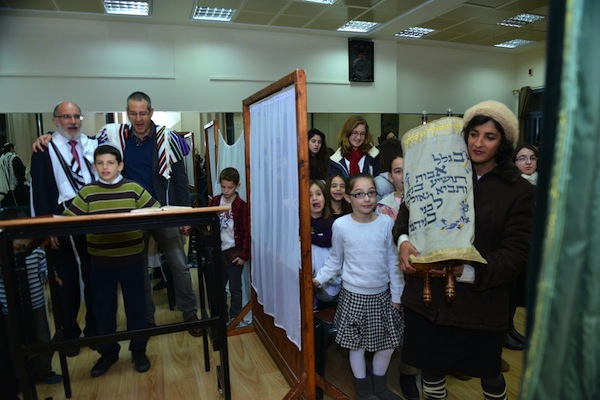
At Zemer Hazayit, a Modern Orthodox congregation in Efrat, when the Torah reading is finished, the scroll is passed from the men’s side to a woman who takes it through the women’s side. (photo from David Bollag)

Ten years ago, a group of people in a Modern Orthodox congregation in Efrat, a Gush Etzion settlement, decided they wanted women to be more involved in their synagogue services. The majority of the congregation was reluctant, however, so they set out to form a community of their own.

They consulted with Efrat’s chief rabbi, Shlomo Riskin, about the idea and, he said, “Listen, I don’t think it should be the only reason why you would start a new community – the position of women. Why don’t you also make it special in terms of prayer and make it kind of a song?” So, they named the community Zemer Hazayit (Song of the Olive). “There was strong contact with the head rabbi from the very beginning,” said Rabbi David Bollag, spiritual leader of Zemer Hazayit.

Bollag, originally from Switzerland, made aliyah 25 years ago. He has been with the community for the past eight years. He still flies home eight times a year to teach at two Swiss universities, the University of Zurich and the University of Lucerne.

“My field is Jewish philosophy, but I also teach some Jewish history, Bible, whatever they need in the institutes,” he said.

“Our congregation is Modern Orthodox. In Modern Orthodoxy, in almost every aspect of life, women are fully integrated and emancipated, and have almost the same role as men – socially, professionally, in politics and at home. They have the same rights, almost the same education possibilities.”

Ever since Zemer Hazayit opened its doors, the community has been growing. It has some 200 community members today. While this community is new to Efrat, there are many like it elsewhere.

“The process that is taking place is a slow development,” said Bollag. “More and more, laymen and rabbis realize the difference between normal life and religious life isn’t sitting well with most people.” While women are intellectually engaged at schools, workplaces and in politics, he said, “when it comes to religious life, they’re treated like second-class citizens, and they are just going to leave religion or consider it something primitive. For that reason, changes have to take place.”

While people see the need, they also understand that change takes time to be accepted. “That’s why the process is very slow, sometimes very painful – there’s a lot of opposition,” said Bollag.

The tensions and discussions are not only between their community and the rest of Efrat’s Modern Orthodox communities, but within Zemer Hazayit, as well.

“We definitely have people who are more progressive, who are interested in more changes, and others who are much less,” said Bollag. “Not only do we have to find the right balance between introducing new things and making sure we remain within the limits of Modern Orthodoxy, we also have to make sure we find the right balance that’s OK for everybody in our community.”

When Bollag was asked to be the community’s rabbi, one of the first things he wanted was to have an official meeting with members of other neighborhood synagogues. “I wanted to make sure to explain to them what we’re interested in doing, to make sure they would fully accept us,” he said. “They don’t have to agree with us, but I would like them to be accepting.”

photo - Women at Zemer Hazayit return the Torah scroll to the ark
Women at Zemer Hazayit return the Torah scroll to the ark. (photo from David Bollag)

Zemer Hazayit first gets Riskin’s blessing before implementing any proposed changes. So far, these changes have included splitting the prayer room in the middle from front to back, giving women equal access to the ark and, when the Torah reading is finished, the scroll is passed from the men’s side to a woman who takes it through the women’s side and then places it back in the ark.

“One of the main issues being discussed at the moment is whether or how women can read from the Torah,” said Bollag. “So, we have, about once in two months, a reading of the Torah by women, but just among women.”

At the moment, the opinion is that they cannot have women reading for men. “So, we separate for that reading – the women are in one place and the men in another,” said Bollag. “Women read for women. We usually also do that when there’s a bat mitzvah, as most of the girls are interested in reading Torah.

“Also, women say Kaddish – that goes without saying in our community – even if there is just a woman and no man.”

According to Bollag, the ordination of women in Reform synagogues has influenced Modern Orthodox congregations, as well, noting that these communities now will hire a woman as part of the discussion, including as a rabbi/spiritual leader.

“When they approached me about being the rabbi of this community, we made it very clear that it isn’t just me, but also my wife who will be very involved in leading our community,” said Bollag. “We also put a lot of emphasis on integrating children into the services as much as we can.”

Zemer Hazayit is currently raising funds to build a synagogue, as they have outgrown the room they have been using in a local school. For more information, visit buildzemerhazayit.org.

Rebeca Kuropatwa is a Winnipeg freelance writer.


Format ImagePosted on March 4, 2016March 3, 2016Author Rebeca KuropatwaCategories IsraelTags Bollag, Efrat, equality, Modern Orthodox, Riskin, women, Zemer Hazayit

An extremist war on women

A small Israeli ultra-Orthodox newspaper in Israel became the target of international ridicule earlier this year after blotting out the faces of three women from a prominent photo of 40 world leaders.

Heads of state were marching through the streets of Paris to demonstrate solidarity with France, opposition to terrorism and support for freedom of expression after Islamic State sympathizers murdered journalists at the satirical magazine Charlie Hebdo and Jewish hostages at a kosher market in a Paris suburb.

HaMevaser, which serves an insular Israeli community indifferent to modernity, seems to have missed the point of the march. HaMevaser editor Binyamin Lipkin defended the altered photo, insisting a photo in the newspaper that included German Chancellor Angela Merkel, Paris Mayor Anne Hidalgo and European Union official Fedrica Mogherini would “desecrate” the memory of the 17 people who were killed.

The incident once again drew attention to the fanaticism of the ultra-religious community in Israel that demands the complete removal of all photos of women in public spaces, tight restrictions on the role of women in public life and severe limits on education for both boys and girls.

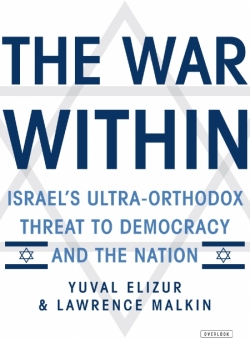
book cover - The War Within: Israel’s Ultra-Orthodox Threat to Democracy and the Nation by Yuval Elizur and Lawrence MalkinTwo books, written in a conversational style, came out recently that shine a glaring light on recent controversies sparked by the ultra-Orthodox in Israel. Reading them together provides a broad understanding of the issues.

The War Within: Israel’s Ultra-Orthodox Threat to Democracy and the Nation (Overlook Press, 2013) by journalists Yuval Elizur and Lawrence Malkin, looks at several flashpoints that, the authors say, will invariably turn into even more difficult social, economic and political problems as the ultra-Orthodox population grows.

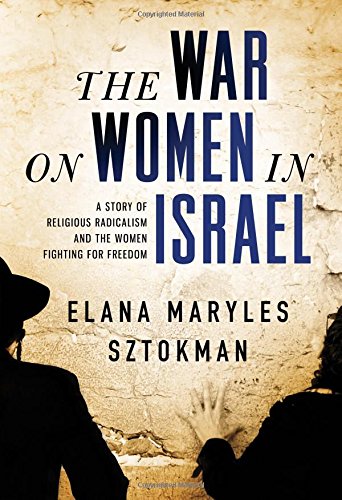
The War on Women in Israel: A Story of Religious Radicalism and the Women Fighting for Freedom (Sourcebooks Inc., 2014 ) by feminist activist Elana Maryles Sztokman, is an unrelenting assault on Israeli society for accepting blatant discrimination against women in almost every aspect of their lives. At times, the book reads like a social activist’s pamphlet demanding justice.

Israel ranks near the bottom among world democracies on the right to religious freedom. The books are reports from the frontlines in the fight for equality, and will be disturbing for those concerned about civil rights in Israel. The writers leave the impression that radical religious voices are shredding the fabric of the country.

Both books offer portraits of the ultra-Orthodox communities and a brief account of the historical context that led to the current problems. The perspective is clearly that of outsiders who have little patience for the ultra-Orthodox way of life. Nevertheless, it is difficult to ignore what they say.

Roughly 10 percent of the country and one-third of Jerusalem are ultra-Orthodox. Those numbers will likely explode within a generation, if current trends continue. The birthrate within the ultra-Orthodox community is twice the national average. As the children grow up, the impact of the ultra-Orthodox community will be felt in many different ways throughout Israeli society.

Students in ultra-Orthodox schools spend their day studying religious texts, paying scant attention to core subjects of English, math and science. Elizur and Malkin say that most students complete their formal schooling without the education or skills to work in a modern economy.

Several ultra-Orthodox schools go further, refusing to allow girls to write final exams in core subjects in order to ensure the girls do not leave school with a high school diploma.

Meanwhile, the economic life within the ultra-Orthodox community is grim and will likely degenerate even further as their numbers increase. The Taub Centre for Social Policy Research, in a report released in December, pegs the poverty rate in the ultra-Orthodox community at 66 percent in 2013, an increase from 60 percent in the previous year. The ultra-religious have the lowest participation rate in employment in the developed world.

And it’s not just a Jerusalem phenomenon. Ultra-Orthodox communities are scattered across the country. In the ultra-Orthodox community of B’nei Brak, half of all children live in families below the poverty line.

Both books provide an account of the historical roots for these circumstances. The ultra-Orthodox communities have relied almost entirely on national subsidies since the creation of the state in 1948. At that time, the rabbis argued that studying Torah and praying had ensured the survival of the Jewish people through centuries of wandering and persecution.

The founders of the state wanted to maintain the Jewish nature of the state. Religious authorities were given unqualified control over marriage and divorce. David Ben-Gurion agreed to exempt the ultra-Orthodox from military service and pay them to spend their days studying in a yeshiva. In exchange, he expected to receive their support in the Knesset.

The arrangement was a trade-off endorsed by most Israelis for more than 50 years. But demographics have shifted. In 1948, 4,000 students were studying in a yeshiva. Today, around 120,000 students study full-time and are dependent on allowances from the government. Many Israelis now are not so comfortable with the arrangement.

The trade-off has also meant that Israel does not have a constitution guaranteeing individual rights and freedoms. The ultra-Orthodox at that time refused to support a constitution, mostly to prevent shifts in the status of women, the journalists say.

The country’s founders forged practical arrangements without any long-term vision, say Elizur and Malkin. It was a colossal mistake. Successive governments have maintained the status quo, in effect placing huge barriers for those fighting for changes.

As women have asserted their right to be treated equally, religious zealots have escalated their tactics, moving from bullying and shouting to spitting, shoving and throwing rocks.

image - The War on Women in Israel: A Story of Religious Radicalism and the Women Fighting for Freedom by Elana Maryles Sztokman book coverThe ultra-Orthodox succeeded in pressuring Israeli public and private companies to ban female faces on transit ads and force women to sit at the back of the bus. Weak protection for secular values, coupled with liberal tolerance for diversity, enabled the ultra-Orthodox to push bus companies in Israel to segregate 150 bus lines across the country, Sztokman writes.

The arrests of women who sing, wear a tallit or pray at the Western Wall have been widely reported. These books provide numerous anecdotes about the confrontations on many fronts, including some outrageous instances of the struggles that some women face in obtaining a Jewish divorce from a vengeful husband. Around 10,000 women in Israel are in limbo, unable to obtain a get (a divorce decree) from the religious courts.

Elizur and Malkin also look at the government-funded rabbinic councils that operate under a minimum of oversight and with their jurisdiction only loosely defined. They assert control over everything from certifying pensions funds to ensuring that water is kosher.

Women disproportionately feel the impact of the institutions run exclusively by males. None of the judges in the religious courts are women. Until recently, even all the supervisors of the mikvehs were male.

The lack of accountability and vagueness over roles has cleared the way for the rabbinical authorities to attempt to expand their control over the lives of all Israelis. Imprecise boundaries have led to recent flare-ups over matters of division of property, child custody, alimony, child support and education. The army is struggling to find a compromise for ultra-Orthodox who are now enlisted. A battle over jurisdiction over circumcision was recently in an Israeli court.

The power of the religious authorities is on display in the most unexpected places. A produce market has separate shopping hours for men and women. Women’s voices disappear from the radio. A women’s health conference excludes accomplished women researchers and prominent women doctors from its program. Young girls cannot sing in public. Daughters are not allowed to stand by the grave of their fathers to say Kaddish.

Despite the dark portrait of the religious divide, both Sztokman and journalists Elizur and Malkin find reasons to be hopeful. Restrictions on seating on buses have been lifted on some lines; women’s faces are returning to some billboards on the street. Even the Women of the Wall can claim some victories.

Momentum is clearly on the side of the ultra-Orthodox. However, a backlash against the most extreme measures has begun to undo some excesses. The authors also find some members of the ultra-Orthodox community are working to change the system from within. Sztokman, for example, finds hope for religious pluralism in Israel from the work of an emerging alliance of Orthodox feminists and secular activists who are pushing for a more egalitarian country.

Robert Matas, a Vancouver-based writer, is a former journalist with the Globe and Mail. This review was originally published on the Isaac Waldman Jewish Public Library website and is reprinted here with permission. To reserve this book or any other, call 604-257-5181 or email [email protected]. To view the catalogue, visit jccgv.com and click on Isaac Waldman library.

Posted on March 27, 2015March 26, 2015Author Robert MatasCategories BooksTags discrimination, Elana Maryles Sztokman, Israel, Lawrence Malkin, ultra-Orthodox, women, Yuval Elizur
Safe options for pet lovers

Safe options for pet lovers

When it comes to cases of domestic violence, wanting to keep our pets has particularly dangerous implications; it can potentially put both children and adults at risk. (photo from commons.wikimedia.org)

Times are tough. Difficult financial circumstances and/or acts of violence force all kinds of people to seek shelter outside their homes. As if leaving one’s home in the wake of such challenges isn’t bad enough, sometimes this leave-taking involves the very painful question of what to do with the individual or family’s pet.

Many of us can well appreciate the desire to hold on to our animals. When it comes to cases of domestic violence, however, wanting to keep our pets has particularly dangerous implications; it can potentially put both children and adults at risk.

Dr. Frank Ascione provides this eye-opening statistic: “In 12 independent surveys, between 18 percent and 48 percent of battered women have delayed their decision to leave their batterer, or have returned to their batterer, out of fear for the welfare of their pets or livestock.” (Violence Against Women, 13(4), 2007)

Why are these pet owners willing to go to extremes to hold on to their animals? Genevieve Frederick of the U.S. organization Pets of the Homeless elaborates on her nonprofit’s website, “Their pets are nonjudgmental; provide comfort and an emotional bond of loyalty. In some cases, they provide the homeless with protection and keep them warm.”

In addition, Dr. Andrew Gardiner, who helps run free veterinary clinics at two homeless hostels in Edinburgh, Scotland, offers this interesting observation: “… many homeless people say that having a pet is what gives them hope….”

Critically, keeping the family dog or cat is vital to children’s continued emotional stability. In her groundbreaking paper for the National District Attorneys Association (NDAA), Allie Phillips states, “When a child has been abused or traumatized, it can be the nonjudgmental comfort from an animal that helps the child heal…. Children often love their pets like family members and, if a pet is threatened, harmed or killed, this can cause psychological trauma to the children.”

Moreover, Jewish law requires us to be pro-active in cases of domestic abuse as well in situations of cruelty to animals. In a 2007 article entitled “Few are guilty, but all are responsible: The obligations to help survivors of abuse,” Rabbi Mark Dratch (executive vice-president of the Rabbinical Council of America and founder of Jsafe) writes: “… the physical, emotional and spiritual dangers that result from perpetrators of abuse and violence … obligate each of us to protect potential victims from them.” Among the texts he uses to base his conclusions about Jewish responsibilities toward people in domestic violence situations are Leviticus 19:16 and Deuteronomy 22:2 and, in the case of cruelty to animals, Exodus 23:5 and Deuteronomy 22:4.

According to the Jewish Coalition Against Domestic Abuse: “Domestic abuse occurs in Jewish families at about the same rate as in the general community – about 15 percent – and the abuse takes place among all branches of Judaism and at all socioeconomic levels. Studies show that abuse occurs in every denomination of Judaism in equal percentages, and we see abuse in all communities including the unaffiliated.”

But the Jewish community in particular, and the community at large, have thus far established few shelters for pet-owning domestic violence victims. In 2014 (during two days of census taking), Vancouver had 1,820 individuals living in emergency or transitional facilities, 957 people living on the streets (homelesshub.ca/community-profiles/british-columbia/vancouver) and 88 children (under the age of 19) in the company of a parent. Of those people living in transition homes, 116 were women and children fleeing violence (vancouver.ca/files/cov/results-of-the-2014-metro-vancouver-homeless-count-july-31-2014.pdf).

Another complication once someone is able to transition back to a more stable living situation is access to affordable, pet-friendly rental accommodations. Vancouver has one of the lowest vacancy rates in Canada. Moreover, in British Columbia, there is no law permitting tenants to have a pet. In fact, the existing Residential Tenancy Act explicitly gives landlords the right to refuse pets, or to charge an extra deposit for accepting pets. Many renters have a hard time finding rental apartments and pet-owning residents have an even harder time locating suitable housing. People are often forced to choose between their pet and a roof over their head.

What then is available to these needy residents and their animals? The Salvation Army’s Centre for Hope in Abbottsford is currently working on becoming pet friendly. Shilo St. Cyr, program supervisor of Sheena’s Place, an Elizabeth Fry Society facility in Vancouver, reports: “We don’t accommodate women and children who have pets. We usually try to arrange for a dog sitter/shelter.”

Jodi Dunlop, Vancouver branch manager of British Columbia’s Society for the Prevention of Cruelty to Animals, reports: “Currently, our branches offer a two-week compassionate board for the animals. This gives the person leaving the violent situation a chance to find accommodation and not have to worry about the care and safety of their pet. In some cases, we have extended the care for the animal. It is dependent on each situation and also the animal’s welfare while in our care. There is no charge for this service. Our goal is to always reunite the animal with their owner.”

No doubt the animals are kept safe in foster care. But individuals and family members must temporarily deal with separation, both from their physical home and from the most cherished parts of that former home life.

Indeed, the flipside of this human attachment is such that dogs and cats of homeless people are also very attached to their owners. Gardiner points out: “The pet and the person spend so much time interacting with each other that the human/animal bond is incredibly strong. If these pets are taken from their owners, it is not uncommon for them to suffer separation anxiety or demonstrate other behavioral problems. In the worst case, a dog that is unable to adjust could end up being put down. That would be a terrible outcome.”

Nationwide, the number of Canadian domestic violence shelters offering pet facilities is still very small. While individual Vancouver cat and dog owners might find shelter for themselves and their pets at either 412 Women’s Emergency Shelter or St. Elizabeth’s-St. James Community Service Society, it appears the family member seeking temporary shelter in Vancouver would do best to contact either the BCSPCA branches in the Vancouver area or, as St. Cyr advises, contacting 211. Additionally, for more non-pet-related inquiries, the Women’s Safety and Outreach Program recently opened a weekday hotline between 5 p.m. and 1 a.m. – it can arrange transportation for women fleeing violence to housing (transition, shelter). As of this writing, the telephone number is 604-652-1010.

Deborah Rubin Fields is an Israel-based features writer. She is also the author of Take a Peek Inside: A Child’s Guide to Radiology Exams, published in English, Hebrew and Arabic.

Format ImagePosted on January 30, 2015January 29, 2015Author Deborah Rubin FieldsCategories LifeTags Andrew Gardiner, domestic violence, Frank Ascione, homeless, Jodi Dunlop, Mark Dratch, pets, Shilo St. Cyr, women

Contribute to Legacies

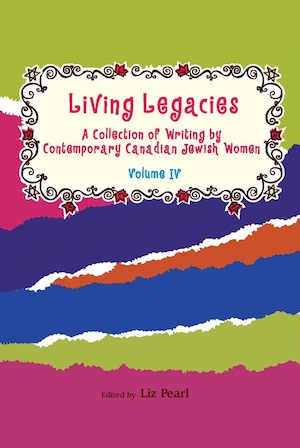
PK Press is now accepting submissions for the fifth volume of Living Legacies: A Collection of Writing by Contemporary Canadian Jewish Women. Edited by Liz Pearl – a Toronto-based educator and therapist specializing in psychogeriatrics and the expressive art therapies – the collection includes personal narratives, mini-memoirs and legacy writing from women across the country.

image - Living Legacies Vol. 4 cover
PK Press is now accepting submissions for the fifth volume of Living Legacies.

“What Living Legacies clearly indicates is that, in fact, we do not need to open our TV sets or buy glossy magazines to find inspiration. It is truly in our midst and we seem to have forgotten that our most profound life lessons can come from our mothers, sisters, girlfriends, children and, yes, ourselves. Liz has brought new meaning to the word legacy by making it so contemporary and alive. Her notion that we need to celebrate the legacies in our midst is unique; we all need to look around ourselves and rejoice in this wisdom,” writes Ina Fichman, president/producer of Intuitive Pictures Montreal, in the foreword to the fourth volume, which was published last year. One of the contributors to that collection is Lillian Boraks-Nemetz, with a story called “Sacrifice.”

Each volume of Living Legacies is available for purchase at a cost of $20 per copy plus shipping, and there is an order form online (at.yorku.ca/pk/ll-order.htm). PK Press updates are on Facebook, facebook.com/PKPress. For submission guidelines, email Pearl at [email protected].

Posted on January 30, 2015January 29, 2015Author PK PressCategories BooksTags Ina Fichman, Lillian Boraks-Nemetz, Living Legacies, Liz Pearl, women

Posts pagination

Previous page Page 1 … Page 14 Page 15
Proudly powered by WordPress