Skip to content
  • Home
  • Subscribe / donate
  • Events calendar
  • News
    • Local
    • National
    • Israel
    • World
    • עניין בחדשות
      A roundup of news in Canada and further afield, in Hebrew.
  • Opinion
    • From the JI
    • Op-Ed
  • Arts & Culture
    • Performing Arts
    • Music
    • Books
    • Visual Arts
    • TV & Film
  • Life
    • Celebrating the Holidays
    • Travel
    • The Daily Snooze
      Cartoons by Jacob Samuel
    • Mystery Photo
      Help the JI and JMABC fill in the gaps in our archives.
  • Community Links
    • Organizations, Etc.
    • Other News Sources & Blogs
    • Business Directory
  • FAQ
  • JI Chai Celebration
  • JI@88! video

Recent Posts

  • האלימות בישראל מורגשת בהרבה מגזרים
  • טראמפ עוזר דווקא לנושא הפלסטיני
  • New rabbi settles into post
  • A light for the nations
  • Killed for being Jewish 
  • The complexities of identity
  • Jews in time of trauma
  • What should governments do?
  • Annie will warm your heart
  • Best of the film fest online
  • Guitar Night at Massey
  • Partners in the telling of stories
  • Four Peretz pillars honoured
  • History as a foundation
  • Music can comfort us
  • New chapter for JFS
  • The value(s) of Jewish camp
  • Chance led to great decision
  • From the JI archives … camp
  • עשרים ואחת שנים להגעתי לונקובר
  • Eby touts government record
  • Keep lighting candles
  • Facing a complex situation
  • Unique interview show a hit
  • See Annie at Gateway
  • Explorations of light
  • Help with the legal aspects
  • Stories create impact
  • Different faiths gather
  • Advocating for girls’ rights
  • An oral song tradition
  • Genealogy tools and tips
  • Jew-hatred is centuries old
  • Aiding medical research
  • Connecting Jews to Judaism
  • Beacon of light in heart of city

Archives

Follow @JewishIndie
image - The CJN - Visit Us Banner - 300x600 - 101625

Byline: Shula Klinger

Stories create impact

Stories create impact

Choices keynote speaker Mandana Dayani, centre, with event  co-chairs, left to right, Gail James, Briana James, Lola Pawer and Lisa Boroditsky. (photo by Rhonda Dent)

On Nov. 16, Choices once again celebrated the work of Jewish women philanthropists. This year’s theme, “L’dor Vador” (“Generation to Generation”), reflected the more than 400 people who attended the 21st annual event, which took place at Congregation Beth Israel.

“We saw so many younger, first-time attendees,” said Ricki Thal, associate campaign director at Jewish Federation of Greater Vancouver. 

The event’s four co-chairs also represented the theme: Gail James and her granddaughter, Briana James; Lola Pawer and her daughter, Lisa Boroditsky.

Briana James introduced the keynote speaker, business leader and activist Mandana Dayani. In doing so, James said “our future shines bright,” with Dayani leading the way in philanthropy and activism, fighting antisemitism and advocating on behalf of women’s rights. 

Dayani took the stage with her husband, Peter Traugott, presenting her material in conversation with him.

A Hollywood film producer with credits including HBO, Apple TV and Netflix, among others, Traugott also holds a master’s in business administration from Harvard University. He set a light-hearted tone, quipping, “This is my first at this – [being] Mandana’s ‘plus one’!” Speaking about their Jewish life in Los Angeles, where several members of the Dayani family live close by, he described a cross between Everybody Loves Raymond and My Big Fat Greek Wedding.

Traugott asked Dayani about her experiences as a new immigrant in New York. She spoke of the culture shock, the lights and traffic in New York. She also spoke, with gratitude, about HIAS (Hebrew Immigrant Aid Society), which supported her family’s flight from Iran, found her father a job as a shoe salesman and found them a place to live, where they became part of the community.

Dayani said her earliest memories of Iran are of “the morality police, the fear in everyone’s eyes.” She recalled having a gun pointed at her when she was just 4 years old. She is now 43.

Her family, who had wanted to leave Iran since the revolution in 1979, finally got a visa to Italy in 1987. They fled there, “leaving everything behind.” The experience has left her, she said, with an enduring sense of “how quickly this escalates, seeing my country taken over by lunatics.” 

Despite having to live “with no safety net, starting over and over again, with no money,” Dayani said, “I’ve never missed a Shabbat in my life…. Shabbat is everything to us.”

Dayani’s grandfather was a rabbi and the family Orthodox. She understands the sacrifices that had to be made to maintain their traditions and feels “a responsibility” to do so as well, she said. As for integrating into American life, she described watching TV to learn how to dress, speak and behave as an American. She said, “I feel very Persian. Being a Persian Jew, that’s integral to who I am.” She also describes herself as “deeply patriotic – the US saved my life.”

Dayani takes her two daughters everywhere, she said. “If I meet my heroes, they meet my heroes. If I’m going to the UN General Assembly or the White House, they come with me.”

She and Traugott are trying to raise active, responsible citizens. “We have conversations about what’s happening in the world and they’re always rooted in kindness, through the lens of compassion,” she said.

Dayani advises caution when it comes to internalizing the messages we see online. “If we cave to the algorithms, we’ll believe that everyone hates Jews and it simply isn’t true,” she said, adding, “So many people stand with us and love us. The kids are good!”

In response to a question from Traugott about her process as a storyteller, Dayani spoke about “using storytelling to create impact,” to change society in significant ways.

Dayani acknowledged that anger spurs some of her work, such as her fight against the first Trump administration’s policy of attempting to deter migrants by separating children from their parents. She recalled her fears as a child, landing in New York, not wanting to let go of her mother’s hand. “I can’t think of a worse thing you could do to the most vulnerable population in the world,” she said. This sentiment led her to travel to Texas to see the policy in action, as the disconnect was just too powerful, she said. “The country that saved me is doing this?”

Her strategy in situations like this, she said, is to “call all the women I know who are smarter than me” to together “redirect the world’s attention to what we want them to look at. Real issues. It worked.”

She explained, “We received hundreds of millions of dollars of donated advertising…. I was so moved by how everyone showed up.”

The advertising aspect – the dissemination of information – was absolutely essential, she said, noting that “20% of the pro-Hamas information being spread on social media right after Oct. 7 was disseminated by bots, not real people…. It was planned. There was spin on the day it happened.” 

When Mandani posted a video about this online within days of Hamas’s attack, the post got some 50 million views within a couple of hours. Death threats started coming in.

“I am a progressive leader and none of those people were speaking up,” she said, referring to other human rights and anti-hate activists.

Even though, as Traugott noted, Dayani doesn’t just work for a single demographic, but rather does outreach on behalf of various groups who have experienced different kinds of trauma and marginalization, she lost friends after Oct. 7 – or, as she put it, “so-called ‘thought leaders’ remaining silent because they couldn’t stand 10 negative comments” on their social media accounts. Dayani said the people she thought were her peers lacked the courage to stand up for justice when it came to Jews. 

Among many other initiatives, Dayani founded, in 2024, the Calanet Foundation for young people, to harness “the power of Jewish stories in response to the branding work done by the Palestinian contingent.” After Oct. 7, she saw “so many black squares on people’s feeds,” as a mark of Jews’ grief. She also wanted people to focus on “the desert flower growing out of a crack,” the calanet (Hebrew for anemone), which symbolizes strength and resilience. She quoted the adage “They tried to bury us – they didn’t know we were seeds.”

One of Calanet’s projects is One Mitzvah a Day, which entails expressing thanks to those who stand up against antisemitism and/or in support of Israel – “one text a day, such as expressing gratitude to Trader Joe’s for selling Israeli feta,” said Dayani, noting that 5.5 million messages have been sent since the project’s January launch. Traugott pointed out that “most of the allies weren’t Jewish.”

Dayani asked the audience to consider “the power of this room, when everyone does the work.” She said, “Just do what you’re doing today – keep showing up.”  

Shula Klinger is an author and journalist living in North Vancouver.

Format ImagePosted on December 5, 2025December 4, 2025Author Shula KlingerCategories LocalTags annual campaign, antisemitism, Calanet, Choices, Jewish Federation, Mandana Dayani, Oct. 7, One Mitzvah a Day, Peter Traugott, philanthropy, Ricki Thal, tikkun olam
Anne Frank exhibit on now

Anne Frank exhibit on now

Created in 1995, the traveling exhibit Anne Frank: A History for Today is on display roughly 300 times a year. Mainly for school groups, people can visit the exhibit at Seaforth Armoury Nov. 11. (photo from Anne Frank House)

The traveling exhibit Anne Frank: A History for Today, hosted by the Consulate General of the Netherlands, is at Seaforth Armoury until Nov. 21. An opportunity for school groups to learn about Anne’s story and the legacy of her diary, the exhibit tours have already sold out, but the public is welcome to visit on Remembrance Day, Nov. 11.

While this is not the first time the exhibit has been in Vancouver, its presence at the armoury and museum is poignant. Started in 1920 by Scottish Canadians, infantry from the Seaforth Highlanders were on the ground in Amsterdam on May 8, 1945. They entered the city as part of the Allies’ liberating force.

Following months of battles and Germany’s surrender, the Seaforth Highlanders offered humanitarian aid to the city’s population. The close ties between the regiment and the people of the Netherlands are commemorated every year. 

The school tours at Seaforth Armoury are led by volunteers trained by Phyllis Lewis, a staff member of Anne Frank House, said the house’s director of Canadian activities, John Kastner.

Arriving on Nov. 5, the exhibit required about six people half a day to set up, then there was peer training. The response to the call for volunteers was excellent, said Kastner, as has been the level of interest from local schools.

“I think the premise is from Anne Frank House in Amsterdam – there’s real value for people to become ambassadors of the message. People that are close to the same age as Anne are particularly effective when it comes to relaying the message of the diary,” he said.

Not all the exhibit’s stops are in metropolitan areas. Kastner described its journey to Anne Frank Public School in Vaughan, part of the Greater Toronto Area, then it went to Marathon, a mining community on the shore of Lake Superior, then to All Saints High School in Toronto, before being displayed at Ottawa’s Beechwood Cemetery (Canada’s national military cemetery) and the Dutch consulate in Vancouver, which sponsored it. 

And the exhibition will keep moving, said Kastner. “It’s been very busy in 2025 – demand has been very steady and it has hardly been in storage at all.”

Created in 1995, the Canadian exhibitions are just some of the many around the world, in languages including Albanian, Arabic, Bengali, Bosnian, Korean, Macedonian and two forms of Portuguese. In total, the exhibit is on display roughly 300 times a year.

Paired with a 30-minute film, Who was Anne Frank?, the tour takes about 90 minutes. It comprises 11 panels of information that are the same worldwide and the 12th panel is curated specifically for the region. The version that arrived in Vancouver this week references the liberation of Amsterdam and all the panels are in both English and French, which is the case for all the Canadian showings, though the exhibit for northern Ontario is also in Inuktitut.

The docents bear a responsibility as ambassadors for Anne’s legacy and message, said Kastner. “You want people who are in classrooms, at dinner tables, in peer groups at schools, who are aware of the story, that become advocates of fairness, opponents of racism, opponents of prejudice, and we really see it in real life – that those docents become docents of the message of Anne Frank House.

“Every generation that comes through, you create a new generation that becomes familiar with the story and the messaging of Anne Frank – not only what she went through, but her optimism in a world surrounded by hate, prejudice and violence…. As people go through the exhibit, they become aware of what an important story it is,” said Kastner. “They come to realize that it is, by definition, a history for today – that it has relevance in today’s society.”

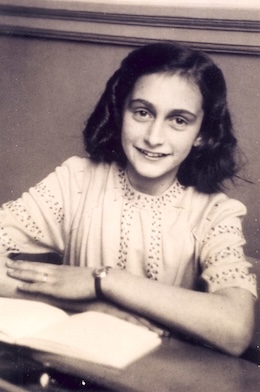
photo - Anne Frank, in 1941. The traveling exhibit Anne Frank: A History for Today is at Seaforth Armoury until Nov. 21
Anne Frank, in 1941. The traveling exhibit Anne Frank: A History for Today is at Seaforth Armoury until Nov. 21. (photo from Anne Frank House)

Kastner spoke about his personal connection to Anne’s remarkable outlook and values, referencing her often-quoted diary entry of July 15, 1944: “In spite of everything, I still believe that people are really good at heart.”

“I wish we could all be as optimistic as Anne was,” he said. “It was remarkable.

“There have been many periods since the Second World War when we’ve had many reasons to be pessimistic, and that’s why it’s a history for today. It’s a recurring message that continues. After 75 years, it still has relevance.”

Kastner praised the design of the exhibit, calling it “fantastic.”

“There’s a timeline ribbon that goes down the centre … the date and the year. Above the ribbon is what is happening in the world politically at the time. Below the ribbon is how it’s impacting people – Anne, her family and everybody else,” he explained. “The idea is that [some people think] what you see on the news doesn’t really matter…. This says, it should matter, it does make a difference. And that creates an awareness of current events, of being involved … of speaking out. Even in minor cases of prejudice, it’s problematic and [can lead] to a greater problem.”

When talking about this idea in Marathon, Kastner gave the example of name-calling. “Calling someone a name, a slur, we can see it as problematic but not the end of the world,” he said. Or, “graffiti on a kid’s locker, that’s not very nice, but it’s not the end of the world – but it leads to a huge problem when [such actions] become the norm.”

Kastner spoke highly of the 3D model of the house, which is “one of the great learning tools that goes with the exhibit.” There is power in asking teenagers, “Who can tell us where Anne slept?”

“When I went to Anne Frank House to work there, where my workspace was, I’d be looking at the courtyard and at the Annex, looking at the tree, and it’s absolutely surreal,” he said. “Being in the presence of that kind of history. There’s no replacement for that.”

It’s the same tree Anne would have seen. 

“I’d be in her father’s office at the warehouse and there are all sorts of people traipsing through the house,” he said, and he’d think about “how you [would have] had to be deathly quiet, completely stationary, because people were using that office.”

Certain questions come up time and again. Students want to know how the Holocaust started, for example.

“The Holocaust didn’t start with people getting loaded on trains,” Kastner explains to the kids. “The Holocaust started with all sorts of things that Anne talks about – her bike being taken away, not being allowed to swim in the public pool, not being allowed to take public transit, then extended to larger things. Her dad not being allowed to have a job or own property.… It starts by slow increments.”

At Anne Frank Public School in Vaughan, the kids asked Kastner how Anne’s diary got published. He described the return of Anne’s father, Otto Frank, to the Annex, which had not changed since the day their hiding place was discovered. He told the students that Miep Gies, who had helped hide Anne and her family, “had taken the diary after the Nazis had left and kept it, gave it to Otto and he read through it and then said, I should publish this.”

Kastner said the kids marvel at the serendipity, the turn of events that led to “one of the most important books written by somebody under the age of 16.” He added, “The kids say that it’s amazing that [Otto] survived, that he got the book, that somebody wanted to publish it and then the idea that it’s become standard reading for millions of kids 70 years later.”

During the exhibition’s stop at Beechwood Cemetery, Kastner recalled two students asking him, “What is it about Jewish people? Why do they pick on Jewish people?” And, “Why didn’t somebody do something?

Kastner explained the scapegoat theory to these students. “It’s in Shakespearian plays, it’s throughout history: the idea of a common enemy often solidifies a group,” he said.

Each exhibition site brings different opportunities for learning, said Kastner. Getting it to remote locations can be tough but it’s worthwhile. Shipping the panels to Marathon, for example, was challenging, but Kastner applauded the motivation of the school there as “very noble and progressive.”

“Every place it goes, it has a different impact and it’s going there for a different reason,” said Kastner of the exhibition. 

“The message,” he said, “is in Anne’s experience, Anne’s death – that has relevance in today’s society.” 

Shula Klinger is an author and journalist living in North Vancouver.
Format ImagePosted on November 7, 2025November 6, 2025Author Shula KlingerCategories LocalTags Amsterdam, Anne Frank, Anne Frank House, education, exhibits, history, Holocaust, John Kastner, Seaforth Armoury, Second World War
Deborah Wilde makes magic

Deborah Wilde makes magic

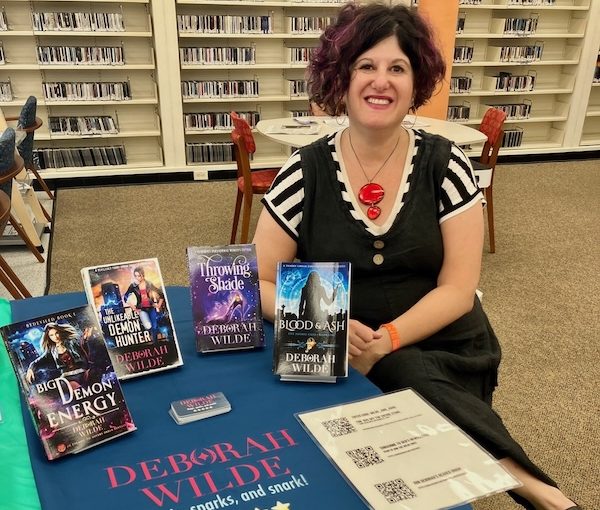
Writer Deborah Wilde is more public now about the Jewish elements in her novels, which have always had a Jewish sensibility. (photo from Deborah Wilde)

East Vancouver author Deborah Wilde has been a writer since childhood, when she filled countless notebooks with her stories. Born and raised in Greater Vancouver, she also spent some years in Kitimat; hers was the only Jewish family in town. She read Isaac Bashevis Singer and watched Neil Simon movies. It was an upbringing she describes as being “rich in tradition.” 

Wilde started her writing career in TV and film. “I loved it. I got to be in writers’ rooms, it was a real privilege,” she said. However, she added, screenwriters are “part of a machine: you’re hired to work on other people’s stories. I wanted to tell my stories.” These stories, as it turns out, are ones with strong Jewish representation and tough, sassy female protagonists.

With the movie industry being in what she describes as “a terrible state,” Wilde took the leap into young adult fiction. In writing the Nava Katz series, she was pleased to find that many of her screenwriting skills were transferable to this new genre. “Dialogue is my happy place,” she laughed. “I had a great time doing it.”

She knew that she had to have Jewish protagonists. “I was an avid reader as a kid but I only saw myself in Holocaust stories,” she explained. “Where was the Jewish girl falling down the rabbit hole or going through the cupboard into Narnia?”

In Wilde’s books, we meet a Jewish mom from Mumbai, and the love interest in her current series is a Mizrahi Jew. Diversity even within the Jewish community is vital, she said. “I want smart Jewish women who have adventures, who are the object of desire.”

Having embarked on her career in fiction, Wilde has reached her initial goal of publishing five books in three years. It took a lot of stamina and she learned that being an independent (or “indie”) young adult author was “not sustainable.” Setting her sights on an adult audience, she took inspiration from her “love of old Hollywood – it was the banter. And I’d always read romances,” she said, “so I wanted to include that as well.” 

Wilde settled on first-person, urban fantasy. A relatively new but extremely popular genre, urban fantasy tales are set in the world we live in but with magical and supernatural elements. Ordinary or “mundane” activities are constantly disrupted by these troublemaking nasties, sometimes with deadly consequences.

And that is where we meet Jewish heroine Ashira Cohen, private investigator. Walking down a Vancouver street, Cohen comes across a “grimy convenience store selling long-distance phone cards and bongs.” A Vancouver scene we probably recognize, but she might also run into a bodyguard who’s been possessed by a demon or a delinquent teen with a talent for vanishing into thin air. Cohen is fast-talking, feisty and funny, but she’s also “someone you’d want to run into at Café 41,” said Wilde. 

Meanwhile, Cohen’s finances are in a state, her love life is stagnant and she’s extraordinarily (and creatively) accident prone. The character is unsentimental, caustic and cynically bored. An interview with a young adult client gave her, she says, “all the details about their nauseatingly cute courtship and very little useful information.” 

Wilde’s novels bring a big helping of zany chaos, a nod to the screwball comedies of the 1940s, staple viewing in the author’s childhood home. But, while the books conform to established genres – such as the “chosen one” trope, the terribly attractive and just as infuriating nemesis – they’re also full of little winks at the reader: neurotic elders, Jewish idioms, references to Jewish traditions. 

Wilde’s talent lies in her ability to layer elements of regular life – like an eye-rolling teen whose statements sound like questions, or the intrusive badgering of Ash’s mother at a moment when tensions are already running high – over the frenzied dangers of the world inhabited by Cohen. The result is fiction that is absurd, surreal and peppered with rapid-fire dialogue reminiscent of the classic film His Girl Friday. 

There is also a serious undercurrent. The author seasons her prose with references to history. For example, one of the magical characters, Meryem, is a Turkish magic refugee who has fled the “purges.”

Jewish representation is very important to Wilde. “There is so little fiction and television with strong, tough Jewish characters,” she said. The Jezebel narrative isn’t a Jewish story but, explained Wilde, “it has a Jewish sensibility – because that’s my own. It’s authentic to my experience.” 

There has always been a Jewish flavour to Wilde’s writing, but it was more subtle; it could be found in the humour. “Readers would find the Jewish stuff eventually,” she said. “But now I’m talking about it in my ads, or even in certain interviews. I’m more public about it now.”

This is one of the aspects that makes Wilde’s work original. While Greek, Celtic, Roman and Norse tales have been all the rage for years, Jezebel’s Jewish folklore and mythology make it stand out. “I won’t write it if I don’t have something original to say,” said Wilde. And that’s where we find a magical organization called Nefesh, or, in Hebrew, “soul” or “life.”

Wilde is both a prolific writer and a businessperson. Talking about the switch to indie authorship, she describes it as “exhausting and a huge learning curve.” She is now both an author and her own publishing house. She has learned about search engine optimization, how to print and distribute books, the advantages of the different platforms and the wizardry required to publish ebooks online. But, despite all the technology that runs behind the scenes, Wilde finds that “word of mouth is still the best form of advertising – many people comment on my ads with things like, I just bought this book because of all the comments, so it had better be as funny as you all said!”

But she’s not alone in her work: her team now includes her husband (who designed the back end of her online store), an editor, cover designers and a slew of peers on whom she has depended for critical (but kind) feedback, moral support, professional insight and companionship. 

Wilde sells her books directly to readers. She explained that, when you buy from Amazon, “you’re actually leasing the book.” Instead, she said, “When you buy digitally from an author, you actually own the book – it’s yours, not just a link you have access to while you have that device.”

Past and present intersect with Wilde’s writing. Most of her grandfather’s family was killed in the Warsaw Ghetto. Of those who survived, she said, “They ended up in a displaced persons’ camp in Germany. My mom was born prematurely in that camp, delivered by a former Nazi doctor.” So, stories about how Jews once lived in Russia, which invaded Poland in 1939 and fully occupied it at the end of the Second World War, “that was my childhood.” 

Having been raised by her grandparents, Wilde said, “I know there is absolutely an aspect of me working through this generational trauma, baggage, but, at the same time, there’s also me working through the patriarchal aspect of Judaism.” 

Shula Klinger is an author and journalist living in North Vancouver.
Format ImagePosted on June 27, 2025June 26, 2025Author Shula KlingerCategories BooksTags Deborah Wilde, fiction, identity, Judaism, novels, urban fantasy, writing
Grandfather’s prayers

Grandfather’s prayers

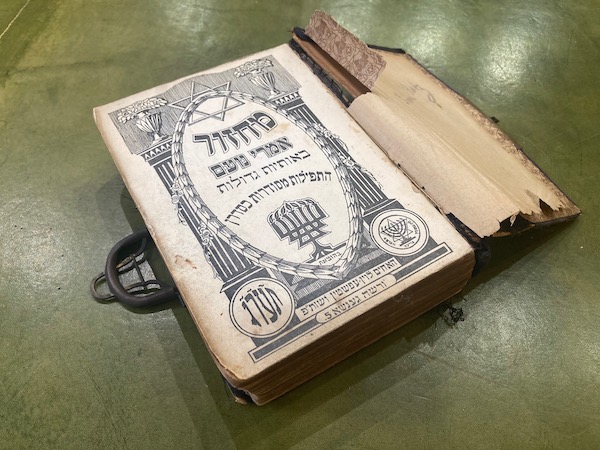
The author’s family Machzor, which was printed in Warsaw in 1913, was most likely owned by her grandfather. (photo by Shula Klinger)

Growing up, I was never taken to shul. I never saw my parents pray, read religious texts or attend any Jewish community events. I saw my maternal grandfather’s tallit case once or twice; I don’t know if he attended shul regularly. These ritual items were simply family artifacts, not elements of our daily lives.

At school, I went to Shabbat with a school friend and muddled through, not knowing the customs. I went to Jewish assembly twice a week and learned the Shema – sort of – from the other girls. With an Israeli father who spoke fluent Hebrew, I didn’t know where I fitted in. Religious Jews weren’t “our people.” My father’s religion was Zionism, not Judaism. I was English, but, at the same time, I wasn’t.

My mother passed away in 2020. As I went through her belongings, I was startled to find a Machzor (prayer book for the High Holidays) that had belonged to – I presume – her father, Dr. Bernard (Boris) Stein. It was coming apart and not just from age; it had clearly been well-used.

This was a deeply moving discovery for me. It told me that my family had once kept the High Holidays, that my ancestors did attend services and were indeed part of a spiritual community.

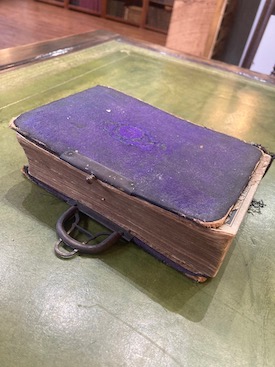
The prayer book’s worn, shabby velvet has been repaired more than once. Once bound in a rich purple velvet, glue marks are all that is left of the cover ornament. The buckle is mostly intact but the spine is roughly stitched together with cotton thread. This is not the work of a professional artisan; maybe it’s the handiwork of my grandfather himself. He was used to handling a needle and thread, though as a surgeon.

From the Cyrillic text in the front, I learned that the book was published by Levin-Epstein in Warsaw. Why would my grandfather, who was born in Lithuania and raised in South Africa, have owned a Polish Machzor?

According to Nathan Cohen in Warsaw: The Jewish Metropolis, Warsaw did not rise to prominence in Eastern European Jewish life until the second half of the 19th century. This was a result of the czar’s 1836 decree that closed down Jewish printing houses in the Russian empire. Only select printers in Vilna and Zhitomir were allowed to print in Hebrew characters. Warsaw, however, was outside the boundaries of this region, so the Jewish printing industry moved there instead. My family prayer book was published in 1913.

photo - Once bound in a rich purple velvet, glue marks are all that is left of the cover ornament
Once bound in a rich purple velvet, glue marks are all that is left of the cover ornament. (photo by Shula Klinger)

And what of our Machzor’s future? I don’t want to pack it up and hide it away. I want it to be a family heirloom for generations to come, and for my children to see it as they grow up. They are proud of their heritage and will also want to see that the book is well cared for.

I sought the advice of a professional. Having worked with local bookbinder Richard Smart on a Jewish Independent story about Anne Frank in late 2017, I returned with the book and a new set of questions.

Could the book be repaired? Smart said no, because “any new suede isn’t going to blend in nicely with the old … it’s very fragile.” However, he came up with another option for conserving it: building a custom box. This way, he said, “it’ll stay in one piece, but it also keeps its history of having been handled and used.” I like this approach because it prevents the book from coming to further harm, but it also preserves it as evidence of my ancestors’ religious lives.

While the book will not be in circulation, I am heartened by the knowledge that it will, at least, be safe. Even if it doesn’t form a part of my own religious practice, it won’t be discarded or tucked away like a souvenir. This Machzor will be treated in a manner that befits an ancient treasure: laid carefully in a box that is made by hand. I’m proud to be its guardian until it passes to the next generation of our family.

To see a video of Smart reaching his decision about the Machzor, visit @oldenglishbindery on Instagram.

Shula Klinger is an author and journalist living in North Vancouver.

Format ImagePosted on April 28, 2023April 26, 2023Author Shula KlingerCategories Op-EdTags family, history, Judaism, machzor, memoir, prayer book
Haas talks acting and BGU

Haas talks acting and BGU

Israeli actor Shira Haas was the featured guest at the Canadian Associates of Ben Gurion University of the Negev’s virtual gala July 7. (photo by Shula Klinger)

On July 7, the Canadian Associates of Ben Gurion University of the Negev held their second virtual fundraising gala. More than 1,200 participants logged on to the An “Unorthodox” National Virtual Gala event, which raised $850,000 for brain research at BGU’s Zlotowski Centre for Neuroscience.

The Zlotowski Centre is a group of researchers dedicated to finding cures and management tools for neurodegenerative diseases including Parkinson’s, Alzheimer’s, ALS and epilepsy.

photo - As part of the gala event, attendees received a special dinner package
As part of the gala event, attendees received a special dinner package. (photo by Shula Klinger)

Months in the making, the virtual gala was the work of a countrywide team of BGU staffers and numerous volunteers. Every participating household in Metro Vancouver received sweet and savoury kosher treats from Café 41. The accompanying gift box also brought olive oil from the Negev, a copy of Deborah Feldman’s memoir, Unorthodox: The Scandalous Rejection of My Hasidic Roots (Simon & Schuster, 2012), appetizer dishes and a commemorative cutting board.

Danny Chamovitz, BGU’s president, spoke about the work of BGU’s academics in general, in disciplines ranging from public health to brain research. Canadian Senator Linda Frum conducted the feature interview – with multiple-award-winning actor Shira Haas.

Describing herself as “very, very shy” as a young person, Haas said she had considered psychology or graphic design as professions, until a casting director approached her on Facebook. Sixteen years old at the time, she said, with respect to that first project, “I understood that this is what I want to do, it was like the door to Narnia.”

Haas does not take her success or popularity for granted. “It was always a dream to work internationally, in different languages, for different audiences, but I never imagined it,” she said. “It was always about the work. I am very, very lucky to be in this position.” She added, “My parents deserve to be talked about! They are the most supportive and amazing parents.”

Known for taking on demanding roles, Haas approaches acting in a scholarly fashion. She studied musculoskeletal diseases to play a terminally ill woman in the film Asia, and researched Russian, Yiddish and Charedi culture for the series Shtisel and Unorthodox. She said she finds beauty in hard work, explaining that Asia was “challenging in the most beautiful way. It was a lot of physical and emotional work, and very personal for me.”

When playing a part, Haas said she is motivated by two things. First, she must be passionate about the role because “that’s what brings everything alive.” About Shtisel, she said, “I fell in love with it immediately.”

Her second principle is to portray “subjects that matter to me.”

Haas’s idealism was evident in the way she spoke about Asia. “It’s not really about death,” she said. “It’s about relationships, about appreciating the time we have and what we do with it. The highest form of art is to bring light to the darkness.”

About Unorthodox, she said, “It didn’t occur to me that it is about the Orthodox world. It was just a story about people who want to be loved, their doubts, desires and failures.”

And Shtisel, she noted, had a huge impact on people all over the world. The show helped change people’s view of Orthodox communities, she said: “It’s universal.”

Of her forthcoming portrayal of Golda Meir in her early years, Haas described a woman with “a very interesting life. She was very passionate, with many dreams and desires.”

Since David Ben-Gurion and Golda Meir were friends, she laughed, “this event was meant to be!”

Haas spoke of her personal connection to BGU. Her sister studied at the university and a close friend is there now. Haas wanted to participate in the gala for several reasons, including, she said, “I am Jewish, I am an Israeli. I want to keep on doing events like this! I am even more proud to do it for Ben-Gurion.”

As for the brain research being conducted at BGU, which the gala funds will support, there has already been groundbreaking progress. Claude Broski’s group has identified a protein that can slow down the degeneration brought on by Parkinson’s. The social robots developed by Shelley Levy-Tzedek and her team will have an impact on stroke patient recovery – the robots offer motivation, feedback and performance-tracking during the rehabilitation phase. Epilepsy researchers are developing wearable hardware and software that could alert patients to an oncoming seizure, an hour before it happens. And Deborah Toiber’s Alzheimer’s team is exploring questions about brain aging, such as, Why does the disease affect so many of us, when only 5% of cases are genetic?

David Berson, executive director of CABGU, British Columbia and Alberta, said, “It has been very gratifying to see how the Metro Vancouver community has embraced BGU students and faculty in recent years. Many new supporters have stepped forward during the last year to engage with us. We are especially grateful to our community partners, who helped us promote this Unorthodox event.”

Among the many contributors to the gala were board members Jay Eidelman and Si Brown. Rachelle Delaney helped Berson with the goodie boxes at the crack of dawn on July 7, while volunteer drivers delivered the boxes. Adrian Cantwell and I were co-chairs for the Metro Vancouver team.

Shula Klinger is an author and journalist living in North Vancouver. She was Metro Vancouver co-chair of the CABGU gala with Adrian Cantwell.

Format ImagePosted on July 23, 2021July 21, 2021Author Shula KlingerCategories WorldTags acting, Ben-Gurion University, BGU, CABGU, Camp David Accords, fundraising, gala, healthcare, philanthropy, science, Shira Haas, Zlotowski Centre
Belong at Bayit and beyond

Belong at Bayit and beyond

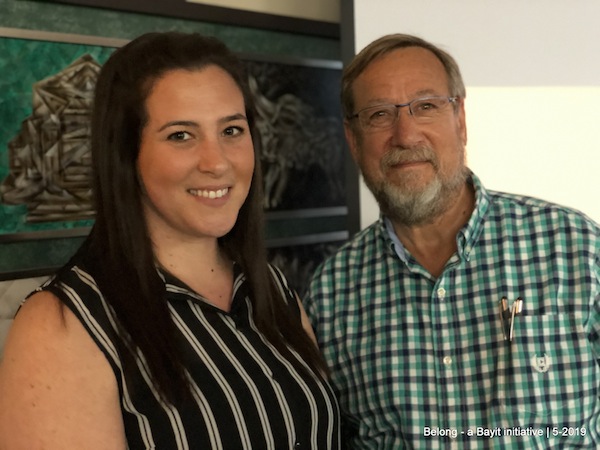
Shira Sachs and Dan Shmilovitch at the Bayit’s Belong launch May 12. (photo from facebook.com/thebayit)

Earlier this year, the Bayit in Richmond launched Belong. The goal of the program is “to create a community where belonging grows and isolation disappears.”

Belong was developed by a committee of six Bayit members: Mel Bauer, Matti Feigelstock, Shelley Goldberg, Shira Sachs, Dan Shmilovitch and Rabbi Levi Varnai.

“There are people that you know you should be connecting to, [or] they should be connecting to you as an organization, but, for whatever reason, they’re not. So, we started talking about how we could address that issue as the Bayit,” explained Shmilovitch, who has been active in the Jewish community for more than 30 years.

There is never just one reason why people feel isolated, he said. “People are isolated for a whole range of reasons – health issues, economic circumstances, mental health issues, maybe they are recently widowed or divorced.”

It is easy to assume that Jewish communities are inherently so strong as to make isolation impossible, but this is not the case. Shmilovitch spoke of the need for “deepening Jewish connections … because isolation is a huge problem in every community and it affects the Jewish community as well, for all age groups.”

There are challenges in combating isolation. “As a Jewish organization, as a synagogue, you’re always looking to invite people in,” he said. “But, when you have people who are isolated and really disconnected, your approach has to be different to get that connection because that’s not their mindset. At that moment in time, that’s not where they’re at.”

photo - Left to right: Mike Sachs, Dan Shmilovitch and Rabbi Levi Varnai at the Bayit’s Belong launch May 12
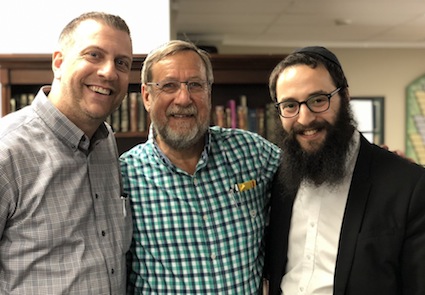
Left to right: Mike Sachs, Dan Shmilovitch and Rabbi Levi Varnai at the Bayit’s Belong launch May 12. (photo from facebook.com/thebayit)

The Belong committee started their planning by examining the obstacles that prevent people from making contact. There is more to being a community member than simply going to shul, explained Sachs, who is a teacher at Vancouver Talmud Torah.

She noted that people can still feel “uncomfortable or isolated” attending social gatherings outside regular services. She talked about how loneliness has a profound effect on a person’s health and can lead to depression. Using her own childhood story as an example, she described arriving in Canada when her mother, now deceased, was pregnant with twins; Sachs is the oldest of four.

“Community became so important to us,” she said. “We didn’t have the language and, within a couple of months, we went from a family of four to a family of six. My mom was a new mother in a new country, with twins.”

Going to shul helped the family make connections, learn about which schools the family wanted for the children. As a parent herself now, Sachs described how this ethos has shaped her own approach to family life. “When we came back from L.A., it was the number one thing to do – find a community and slowly grow with it. Now, how do we do that for others?”

The Belong committee determined multiple strategies for community development, the first of which was through Friday night dinners. The Belong team sought Bayit members who were willing to invite people to meals at home. They also reached out to Jewish Family Services for help locating people in Richmond who needed help.

“If you have a lady who is a single parent, you match them with another single parent,” said Sachs. “If you have a person who is passionate about literature, you sit them with someone who has the same passion. It was all assigned seating.” She added, “It’s comforting to know, ‘I don’t have to worry about that.’ Maybe that anxiety is why people haven’t come to a dinner.”

Belong is also working to offer food deliveries to families in need. “Food security is an issue in the Jewish community,” said Shmilovitch. The program has been running for awhile now but he hopes that deliveries will become more frequent in future.

“There are vulnerable people in the Jewish community – whether they don’t have enough food, feel isolated for a short time or in the longer term. Regardless, it’s hard to come out at the other end. That’s what drives us.”

In addition, Belong has created a support structure for new mothers. Inspired by and in partnership with Mamatefet, a support organization for Hebrew speakers in Vancouver, Mama Belong will work to diminish the feelings of isolation that often follow the birth of a baby. (See jewishindependent.ca/mothers-embrace-mamatefet.) Mama Belong started delivering baskets to Jewish mothers this summer.

The future of Belong came into focus at the May 12 launch. Current members of the Bayit were invited to learn about the new program. Guests were given a card with tear-off tabs that suggested a wide range of ways in which people could contribute, including hosting Friday night dinners, Russian language conversation groups and cash donations, among other ideas. Between 90 and 95% of the attendees folded over a tab.

From Mama Belong to food bank deliveries and Shabbat dinners, the program is striving to create a warm sense of community for those in need. “You never know what’s going to happen at what point in your life,” said Shmilovitch, but “something’s going to happen to connect you.”

Shula Klinger is an author and journalist living in North Vancouver. Find out more at shulaklinger.com.

Format ImagePosted on August 23, 2019August 22, 2019Author Shula KlingerCategories LocalTags Bayit, Dan Shmilovitch, Judaism, lifestyle, Shira Sachs, tikkun olam
Local woman inspires chesed

Local woman inspires chesed

Members of Vancouver Talmud Torah’s Grade 7 chesed club with Gia Tran, a local woman who raises money for cancer research by taking refundable containers to a bottle depot. (photo from VTT)

Since 2014, Vancouver Talmud Torah has offered a chesed (kindness) program to students in grades 3 and 6. Following requests from parents, the school introduced a mandatory chesed program for Grade 7s this year, which nurtures a commitment to volunteering and social justice.

And, this year, the initiative was pursued with a particular dedication, as students mourned the recent passing of Rose Dupaya, who worked as a custodian at VTT. She took ill last fall with cancer and died suddenly, which was a tremendous shock to the school community. In response, the students – who would often greet Rose with hugs – turned their grief into action.

When the Chesed Leadership Club heard about local woman Gia Tran, who takes refundable containers to a bottle depot every day to raise money for cancer research – more than $15,000 in 22 years – they were inspired. Following in Tran’s footsteps, the kids raised $2,000 from a bottle drive for cancer research.

VTT student Julia Andison expressed her gratitude to Tran for teaching her about personal agency. “Gia taught me that even a small act like collecting cans can make a big impact on others. And, as a chesed leader, I was able to communicate this to the younger students in our school, that every little bit counts.”

Students in the chesed club do not follow a curriculum. Unlike with subjects like math or language arts, the club was founded for students to explore their values and lead a program on their own initiative. As a consequence, the program’s success lies in the development of student ideas, teamwork and leadership.

“The minute you offer something optional and student-driven, it takes on a life of its own,” said Shoshana Burton, director of Hebrew (grades 5-7) and chesed programming at VTT.

Students are not admitted automatically to the chesed club. Instead, they submit applications and sign contracts. If they do not follow up on their commitment to leadership, they can be dropped from the program, which is both an opportunity and a challenge to the students’ organizational skills and a way to exercise their moral and management muscles.

All of the students volunteer as part of the program. Some do so once a week while others volunteer their help every day. Many organizations and communities have benefitted from the support of VTT students, including the Muslim Food Bank and residents of the Downtown Eastside.

According to their teacher, the success of the club is in its spontaneous, natural development. “You can’t know the end result when you start. You can’t plan in advance,” said Burton. “The students learn how to work as part of a team, learning to commit to a project.”

Student Celia Joffe spoke of the club’s impact on her. “Helping others gives us a sense of pride and responsibility,” she said. “The project with Gia was amazing because we ended up not only helping the cancer foundation and the environment, but we also made Gia feel special and acknowledged.”

Shula Klinger is an author and journalist living in North Vancouver. Find out more at shulaklinger.com.
Format ImagePosted on July 12, 2019July 10, 2019Author Shula KlingerCategories LocalTags cancer, chesed, Gia Tran, philanthropy, recycling, tikkun olam, tzedakah, Vancouver Talmud Torah, VTT
Try to make the world better

Try to make the world better

Jewish Family Services Innovators Lunch committee, left to right: Sherri Wise, Tamar Bakonyi, Candice Thal and Shannon Ezekiel. (photo from JFS)

On May 14, Jewish Family Services held its 15th annual Innovators Lunch at the Hyatt Regency downtown. The sold-out event was hosted by CBC broadcaster Gloria Macarenko and featured keynote speaker Lane Merrifield of CBC’s Dragons’ Den. Attended by 620 donors, partners, sponsors and volunteers, it raised an unprecedented $380,000 towards programs and services designed to improve quality of life for 2,000 Lower Mainland residents.

This year’s theme at JFS is “community.” At the luncheon, Richard Fruchter, the agency’s chief executive officer, spoke of JFS’s mission to provide life’s necessities: “food, shelter, accessibility and emotional stability.”

The audience was shown a video presentation created by Michael Millman, which revealed the wide-ranging benefits of JFS’s work. A single mother spoke candidly and with feeling about her struggles. “Before I reached out to JFS, I struggled with everything. We lived on almost nothing,” she said. JFS staff provided housing, food and food vouchers, as well as trauma counseling. JFS partner agency Tikva Housing provided the family with a townhouse in a new development. “It’s a beautiful place, right on the Fraser River … a lovely home for us to have for many years,” she said, adding, “JFS has given us a life. A way to be happy. It’s just been a huge blessing for us.”

A senior with disabilities spoke about how a spinal cord injury felled him at the age of 36. JFS has helped him remain independent with its Better at Home program. In the video, Cindy MacMillan, director of senior services at JFS, explained that a grant from the United Way made it possible for the senior to remain at home. Now he has a housekeeper come in to look after his home, and also enjoys companionship with weekly visits from a JFS volunteer. “It’s working out, I look forward to them!” he said.

photo - JFS board member Jody Dales spoke about her own family’s struggles
JFS board member Jody Dales spoke about her own family’s struggles. (photo from JFS)

“It’s helped him realize that people in his community care about him,” said MacMillan. “It’s really Jewish values in action, in the broader community. Those values of caring and healing happen every time we make a match with a volunteer.”

JFS board member Jody Dales gave a passionate speech about her own family’s struggles. Dales saw her grandmother turn away help when she was struggling with poverty. Having survived the Holocaust, her grandmother still felt that others needed the help more than she did, Dales explained. As a result, Dales said she applauds anyone who comes forward to seek support. Rather than being a sign of weakness, she said, “Only the courageous are able to say, ‘Help me.’” She acknowledged that people tend to experience “a sense of shame in asking for help. But nothing is certain. It could be any of us at any time.”

Dales also explained how big a difference can be made by even a small donation and told the audience, “Let your empathy guide your decisions.”

Merrifield, co-creator of Club Penguin, an online community for kids, spoke about building community in the business world. Designed to be a safe, collaborative environment for play and learning, Club Penguin is founded on an ethos of mutual reliance and philanthropy. Eventually sold to Disney for $350 million, Disney recruited Merrifield to lead the project, ensuring that Club Penguin maintained the integrity of its original goal, “inspiring change in the world.”

Merrifield urged people to work towards social entrepreneurship, where human concerns guide business decisions. Rather than focusing on capital investment, he advised the audience to “invest in people because that’s what keeps us healthy. Revenue is not what you chase for its own sake,” he said. “It is the by-product of creating a great product with a great team.”

photo - Keynote speaker Lane Merrifield, left, and JFS chief executive officer Richard Fruchter
Keynote speaker Lane Merrifield, left, and JFS chief executive officer Richard Fruchter. (photo from JFS)

Right from the beginning, the business plan for Club Penguin was based on philanthropy. A portion of subscriptions went to families that live on less than $51 per day, he said. But “there was no fanfare,” said Merrifield. “We didn’t want this to look like a gimmick.” In the first year, the company gave away hundreds of thousands of dollars.

Merrifield spoke of the need to galvanize the community of kids, teaching them to invest in their community with a “coins for change” program. This virtual fundraiser even allowed children to “ring bells” to attract the attention of other subscribers. Over one billion digital coins were donated annually, for a range of humanitarian causes. Self-organizing kids formed virtual marches, becoming activists in their own right; held candlelit vigils and themed parties.

Merrifield brings the same spirit of social responsibility to his work on Dragons’ Den. He and his fellow panelists (“dragons”) hear pitches by entrepreneurs who are looking for investment and choose which ones to support. Merrifield said he looks for companies that “use recycled materials, hire disabled applicants, plant trees, and make an effort to reduce waste in their packaging and lower their fuel costs.” So far, he has not been disappointed. “Most companies have pretty good answers and that gives me hope,” he said.

On the subject of giving back, Merrifield encouraged people to consider donations – such as those to JFS – not as losses to oneself, but as “investments in the future, to individuals who continue to pay it forward.”

He also asked the audience to engage everyone they could to further the cause of fearless generosity. “Use your collective strength and influence to create change for good,” he said.

He advised, “Pool your talents and leave this world far better than it was when we came into it.”

Shula Klinger is an author and journalist living in North Vancouver. Find out more at shulaklinger.com.
Format ImagePosted on June 21, 2019June 20, 2019Author Shula KlingerCategories LocalTags CBC, fundraising, Innovators Lunch, Jewish Family Services, JFS, Jody Dales, Lane Merrifield, philanthropy, Richard Fruchter, tikkun olam
Using AI in health care

Using AI in health care

Prof. Yuval Shahar, left, and David Berson with Dr. Rachael Ritchie of Vancouver Coastal Health. (photo by Shula Klinger)

The use of artificial intelligence is intended “to harness the power of computers with math and statistics theory to improve the diagnosis and care of patients,” according to Dr. Yuval Shahar, professor of Ben-Gurion University of the Negev’s software and information systems engineering department.

Between May 23 and 30, Canadian Associates of BGU, B.C. and Alberta Region, hosted a visit from Shahar, whose research explores how information technologies can be used to improve numerous aspects of healthcare.

Shahar has spent 30 years working in digital medicine, gained his bachelor and medical degrees from the Hebrew University, and a master’s in computer science from Yale University. He did his doctorate at Stanford University, where he also spent 10 years as a faculty member in the computer science and medicine department. He founded BGU’s Medical Informatics Research Centre in 2000 and, in 2017, was elected as a founding member of the International Academy of Health Sciences Informatics.

During his time in Vancouver, Shahar presented his work to full lecture halls across town, including at Simon Fraser University, University of British Columbia, various government offices, Vancouver General Hospital, Pacific Blue Cross and some start-ups.

The program with which Shahar works requires patients to wear an ECG (echocardiographic) belt around their chest to monitor their heart, as well as a blood pressure cuff. This allows a patient to receive care 24 hours a day. Using Bluetooth, the data collected from these devices are sent to the patient’s cellphone and then to the program’s server in Israel.

MobiGuide was developed with 13 partners in Europe, including Italy, Spain, the Netherlands and Austria. Even with 63 other projects competing for funding – including teams at Oxford and Cambridge universities – the MobiGuide team received seven million euros. “Ben-Gurion already had the necessary technology working,” said Shahar.

The program is led by an Israeli team in the main technology centre at BGU, with the partners from across Europe. Shahar explained how the system works, using the analogy of today’s mapping software. “It’s like a medical version of GPS,” he said. Right now, the program’s focus is on diabetes and hypertension.

One advantage of MobiGuide is the way the server handles massive amounts of clinical research, explained Shahar. For instance, when international guidelines for treating hypertension change, you can update that information in one place and it will be reflected throughout the entire system. That information is then immediately available to all patients and their physicians on the MobiGuide system.

“There are millions of patients on the system now,” said Shahar. “Each cellphone has a customized version of the guidelines in the program so the phone alerts the ‘mothership’ and the server examines the data for anomalies. The mothership knows the full patient history and clinical guidelines.”

The server in Israel also reminds patients to make adjustments, such as to their diet. A phone can contact the mothership to ask for advice, and recommendations are customized for each individual. Personal preferences can be adjusted depending on the patient – for example, when they prefer to be alerted to take their medications. If they are on vacation, they can ask the system not to alert them as frequently.

The system can also be notified to anticipate spikes in blood glucose. For instance, if a patient is attending a wedding and expects to eat rich food, she can tell the system first that it need not be concerned about this. Likewise, if a patient lives alone and has nobody to rely on for support with their health, the system can issue different instructions than for someone with a companion.

Humans are, however, still essential to the smooth running of the system. Shahar relies on “medical-knowledge engineers, graduate students,” who digitize clinical knowledge so that it can be applied on the system. But, he said, “It’s a sign of the future. Chronic patients won’t need to be in clinics all of the time. You want to be there only if there’s no other way.” It is cheaper to offer care in the community, especially in remote areas, even while offering round-the-clock observation.

To date, feedback from patients and the professional community has been consistently good. Compliance with clinical guidelines by physicians has improved, preventing a great deal of human error and possibly fatal mistakes, said Shahar. Likewise, he said, “Compliance was very high, we saw real patient empowerment.”

Patients “said that their quality of life had improved, they felt more secure and safe,” said Shahar. This is important, he explained, because AI in healthcare is not just about technology – human psychology has a huge impact on both patient treatment and outcomes.

As an example of the program’s success, Shahar said, in Barcelona, pregnant women with gestational diabetes were studied. The blood pressure of the research patients was significantly lower than in the control group, who attended in-person clinics. Shahar explained that these data were accompanied by a sense that a “benevolent big brother was monitoring them, and someone was sending alerts and recommendations every few days.”

After a four-year evaluation hosted by a veterans hospital in Palo Alto, Calif., there is evidence that the software developed by Shahar’s team has helped physicians manage oncology data better than before. With only seven to 10 minutes to give to each patient, physicians simply do not have the time to review all the material they need to, while considering its application and significance to individual patients.

In his talk at the Eye Care Centre at VGH, Shahar recalled asking a patient if she minded getting numerous texts from MobiGuide every day. “She laughed, I get 50 texts from my friends, what’s another 20?” he said. But, in reality, she clarified, “How could I mind? This is about the health of my baby.” Shahar added, “They feel that someone knows them deeply.”

According to David Berson, regional executive director of CABGU, Shahar’s visit was a success. He said BGU will examine how Shahar’s research in medical informatics can dovetail with local efforts to revolutionize healthcare, exploring the potential for “patient empowerment, remote monitoring, decision-making support and beyond.”

BGU board member and innovation expert Jonathan Miodowski said there was a need to balance between “blue-sky research and practical solutions” to real-world problems. “Multidisciplinary approach is a hot topic for universities these days – it is critical to bring different perspectives to the research,” he said.

Miodowski described Israel as a world leader in innovation. Last year, Canada raised $4.7 billion in start-up capital, he said, noting that Israeli start-ups, by contrast, raised $10 billion. “For a country that is two-thirds the size of Vancouver Island, that’s pretty significant,” he said. “In a sense, the size of the territory is very convenient. Cross-pollination of ideas is inevitable.”

Miodowski also spoke well of the Vancouver visit. “We planted some seeds on both sides,” he said. “It was very positive. There was real interest in Yuval’s research, real appreciation for what Israel has done in terms of its innovation ecosystem.”

Shula Klinger is an author and journalist living in North Vancouver. Find out more at shulaklinger.com.
Format ImagePosted on June 21, 2019June 20, 2019Author Shula KlingerCategories LocalTags Ben-Gurion University, BGU, CABGU, David Berson, health, Israel, Jonathan Miodowski, MobiGuide, technology, Yuval Shahar
Dali artwork on display

Dali artwork on display

Left to right: Oree Gianacopoulos, Chali-Rosso Gallery director; James Sanders from Dali Universe (Switzerland); and Susanna Strem, president of Chali-Rosso Gallery. (photo by Shula Klinger)

May 17 and 18 saw the unveiling of two sculptures by Spanish surrealist Salvador Dali, which will be on display until September. The sculptures were brought to Vancouver by the Chali-Rosso Gallery on Howe Street, the site of the annual Definitely Dali exhibition. More than 100 Dali originals are on display at the gallery, along with 20 smaller versions of Dali’s bronzes.

On May 17, “Dalinian Dancer” was revealed at the corner of Thurlow and Alberni. “Space Venus” was unveiled on the next day at Lot 19, on West Hastings at Hornby. The unveilings were accompanied by flamenco music, which Dali loved.

Oree Gianacopoulous, Chali-Rosso’s director, spoke before the unveiling of “Space Venus.” Describing it as one of Dali’s “iconic” pieces, she expressed her gratitude to Beniamino Levi, director of Dali Universe, the foundation that lends out the artwork. Levi worked with Dali himself to develop the collection of 29 sculptures.

This is the third year that Dali sculptures have traveled to Vancouver, under the leadership of Chali-Rosso president Susanna Strem, a member of the Jewish community. Working in close collaboration with Dali Universe in Europe, which loaned the sculptures to Chali-Rosso, Strem’s initiative has helped establish a new cultural tradition for the downtown core.

This year, the gallery also worked with Virtro Games to develop a smartphone application to enhance viewers’ experience of the sculpture. Definitely Dali is an augmented reality app – when a phone camera is focused on the image of Dali’s face, the dancer begins to move her arms and spin.

Alex Lazimir, who developed the app, talked about the privilege of spending many hours looking at Dali’s dancer. “I really like this piece because it was like going into Salvador Dali’s mind. The first thing I thought was that she has to be spinning.”

photo - Salvador Dali’s “Dalinian Dancer” can be found at the corner of Thurlow and Alberni
Salvador Dali’s “Dalinian Dancer” can be found at the corner of Thurlow and Alberni. (photo by Shula Klinger)

After the unveilings, Chali-Rosso hosted a champagne reception and a talk by James Sanders of Dali Universe (Switzerland). With reference to the sculptures at the gallery, Sanders spoke about Dali’s life and the tremendous influence of his surreal imagination on the world of art. Sanders is responsible for sourcing locations, sponsors and partners for exhibitions all over the world.

Originally from Europe, Strem came to Canada 25 years ago, via a spell in Israel. Formerly an information technology professional, Strem spoke about the challenge of bringing world-class art to public spaces in Vancouver.

“These sculptures are traveling all over the world. They’re exhibited in many major cities. Vancouver has to compete with cities like New York, London and Paris. These are major art hubs, so we are very happy that we managed to get two sculptures.”

Last year, Definitely Dali featured “Woman in Flame” and “Surrealist Piano.” More than three million visitors saw the sculptures.

Bringing monumental works of art here is a labour of love, however. “It takes almost a year to organize something like this,” said Strem. “Last year, when we had two other sculptures here, we were already talking about this year’s exhibition. It all depends on what is available and circumstances in other cities.”

The logistics of moving bronzes like “Space Venus” – which is 3.5 metres high – can be tough. “These sculptures were transported by ocean freight from Italy, then traveled through the Atlantic to the Panama Canal, up the Pacific Ocean past Mexico and California to Vancouver,” she said. “It’s a long journey. We experienced a delay. There was a traffic jam in the Panama Canal.”

photo - “Space Venus” by Salvador Dali has been placed in Lot 19, on West Hastings at Hornby
“Space Venus” by Salvador Dali has been placed in Lot 19, on West Hastings at Hornby. (photo by Shula Klinger)

These exhibits are both the impetus for, and a sign of, urban growth – “for a real city,” said Strem, “public art is a natural part of its evolution.” She spoke of the collaboration with the Downtown Business Improvement Association. “They were full-force behind it from day one, which helped motivate us. They were really enthusiastic,” she said.

Part of Chali-Rosso’s community involvement includes supporting Recovery Through Art, a charitable organization in Vancouver that gives individuals struggling with mental illness and addiction a chance to heal through the creation and appreciation of art.

Strem is already seeing the impact of the Dali pieces on public display. “If somebody is looking at their phone and they walk by 10 times but, this time, they look up and their face changes, even for a fleeting moment, that’s important. Or they might stop for 30 minutes. There are many ways to enjoy art,” she said.

Strem explained that, to truly become part of life, art should not just be locked away in special locations.

“It’s not about having a destination for art, where you allocate time and energy to it,” she said. “When we don’t engage with art like this, in public, people are missing out.”

Shula Klinger is an author and journalist living in North Vancouver. Find out more at shulaklinger.com.


Format ImagePosted on June 14, 2019June 12, 2019Author Shula KlingerCategories Visual ArtsTags Alex Lazimir, art, Chali-Rosso, James Sanders, Oree Gianacopoulous, Salvador Dali, sculpture, Susanna Strem

Posts pagination

Page 1 Page 2 … Page 6 Next page
Proudly powered by WordPress